REVIEW 3 major objections 6 minor 87 references
Stop the diffusion ODE early and decode the clean sample; affine paths already contain the endpoint.
Reviewed by Pith at T0; open to challenge. T0 means a machine referee read the full paper against a public rubric. the ladder, T0–T4 →
T0 review · grok-4.5
2026-07-14 16:06 UTC pith:U2AOOUPI
load-bearing objection Clean algebraic formalization of early-exit x0 decoding that actually delivers 20-70% NFE cuts on off-the-shelf checkpoints, with theory that holds up. the 3 major comments →
x-Prediction Is All You Need:Training-Free Accelerated Generation via Endpoint Decodability
The pith
A machine-rendered reading of the paper's core claim, the machinery that carries it, and where it could break.
Core claim
For any non-degenerate affine probability path the intermediate state and path velocity uniquely determine the clean sample through a closed-form decoder, and under the standard ℓ2 training objective that decoder is precisely the minimum-mean-square-error estimator of the clean sample. Consequently one may safely stop the ODE early and jump to the decoded endpoint without redesigning the trajectory.
What carries the argument
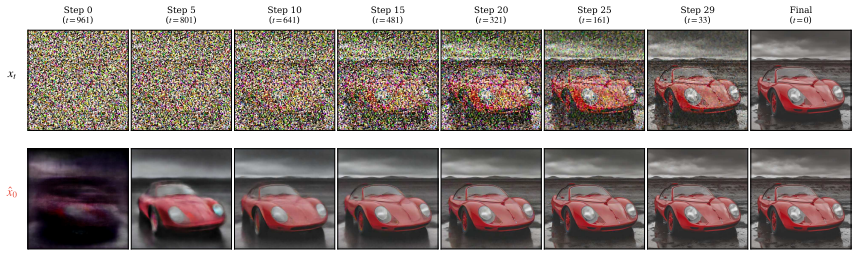
Endpoint decodability: the path determinant Δt = α̇t σt − αt σ̇t is nonzero, so the linear system relating (xt, ut) to (x0, ε) is invertible and the decoder x0 = (σt ut − σ̇t xt)/Δt recovers the clean sample; under optimal velocity prediction this equals E[x0|xt]. Truncated Jump Sampling is the resulting early-exit algorithm.
Load-bearing premise
The pretrained model must already be accurate enough that its estimation error is negligible once the intermediate state carries most of the endpoint information; if that residual model error stays large, early exit fails even though the algebra is exact.
What would settle it
On a well-trained checkpoint, measure whether quality metrics remain monotonic and near full-ODE levels when the ODE is stopped at the paper’s recommended early-exit fractions; a sharp quality collapse at those fractions, or a large residual error between the decoded endpoint and the true clean sample once the irreducible uncertainty has decayed, would falsify the claim.
Editorial analysis
A structured set of objections, weighed in public.
Referee Report
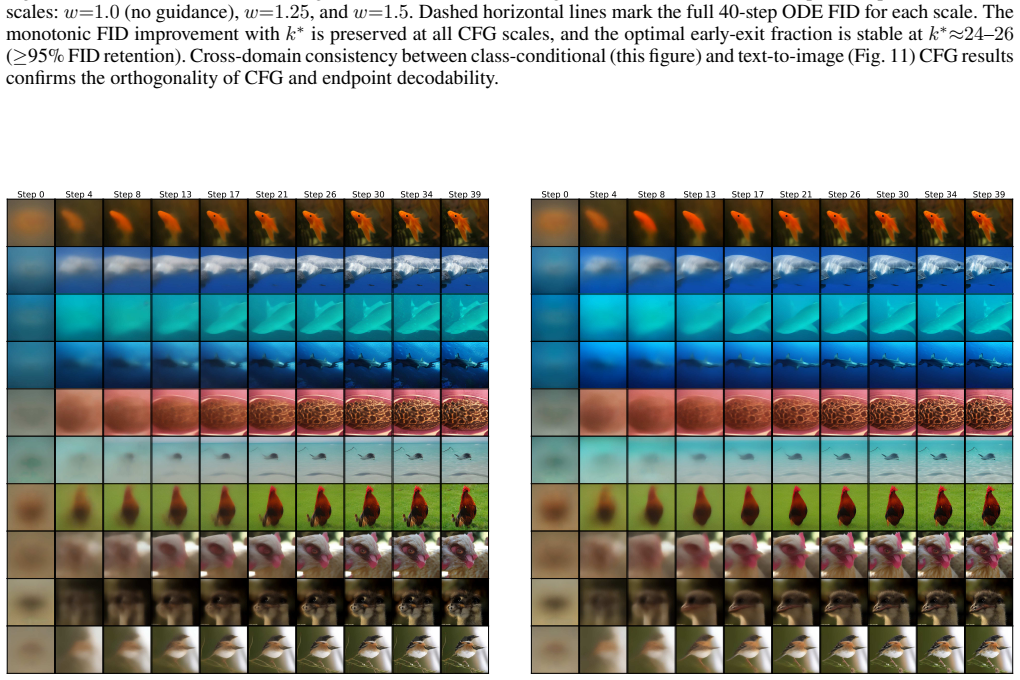
Summary. The paper formalizes endpoint decodability for affine probability paths: whenever the path determinant Δt ≠ 0, the pair (xt, ut) recovers x0 by the closed-form decoder of Theorem 5, and under the standard ℓ2 training objective this decoder is exactly the MMSE estimator E[x0|xt] (Theorem 6). From this they propose Truncated Jump Sampling (TJS): integrate the pretrained ODE only to an early-exit time t* and return the decoded x0. Error analysis (Theorem 9) decomposes TJS MSE into model error plus irreducible endpoint uncertainty U(t*), with no curvature term; Proposition 12 shows straight trajectories are sufficient but not necessary. Experiments on SDXL, SD3.5M, Z-Image-Turbo, ImageNet-256, CIFAR-10, and MNIST report 20–70% NFE reductions at near-matched quality, with sampler/schedule/CFG/step-count ablations and multi-metric T2I sweeps.
Significance. If the claims hold, the work supplies a genuinely training-free acceleration route that applies immediately to the large ecosystem of released checkpoints (including community fine-tunes) without distillation or trajectory redesign. The algebraic and optimality results (Theorems 5–6) are clean, the curvature-independent error decomposition (Theorem 9) and the straightness counter-example (Proposition 12) are useful conceptual contributions, and the empirical coverage across six model families with systematic ablations is unusually thorough for an inference-only method. The orthogonal composition with distillation (Z-Image-Turbo) is a practically valuable observation. These strengths make the paper a solid candidate for a methods-oriented ML venue.
major comments (3)
- Theorem 9 decomposes TJS error into E[∥et*∥²] + U(t*), yet the experiments never estimate either term separately. All reported curves are end-to-end quality metrics. Without a direct measurement (e.g., proxy residual of the velocity field, or Monte-Carlo estimates of conditional variance on synthetic Gaussian data), it remains unclear how much of the observed early-exit degradation is model error versus irreducible uncertainty. This is the load-bearing empirical precondition for Corollary 10 and for aggressive γ choices; a short diagnostic experiment would substantially strengthen the theory–experiment link.
- The main baselines are full-K ODE trajectories. Theorem 11 compares TJS to coarse Euler at matched NFE, but the practical competitor is a modern few-step solver (DPM-Solver++, UniPC, etc.) run for the same reduced NFE budget without an endpoint jump. Table 6 shows sampler-agnosticity at fixed k*=12, yet does not report quality of those solvers when stopped at the same NFE without decoding. A head-to-head at matched NFE (TJS-γ vs. solver with γK steps) is needed to isolate the gain attributable to the jump itself rather than simply using fewer steps.
- Practical selection of t* (or γ) is left as a user-chosen operating point. Tables 2 and 10 and the Pareto analysis show that different metrics saturate at different depths (CLIP early, ImageReward late), and complex prompts are noted as failure modes in §B.5. Without a cheap adaptive rule or a recommended default schedule (beyond the heuristic γ≈0.5), practitioners cannot reliably deploy TJS on new checkpoints or prompt distributions. A short adaptive procedure or a validated default table would make the method more actionable.
minor comments (6)
- Figure 1 caption and the surrounding text use both t and discrete step indices; a single consistent time convention (forward t:0 o1 or reverse) stated once in Preliminaries would reduce reader friction.
- In Algorithm 7 the notation mixes γ and t*; the main text later uses both γ and k*. Aligning on one primary symbol (with the other defined) would help.
- The claim that TJS can beat the full ODE (TJS-best overshoots in Table 1 and Z-Image-Turbo HPSv2/AES) is interesting; a one-sentence pointer in the main text to the discretization-error explanation already present in §B.5 would prevent misreading these as free quality gains.
- Related Work cites DPM-Solver with a broken reference marker (“?”). Please fix the bibliography entry.
- Supplementary §A.9 on DDIM is thorough; a one-paragraph condensation of the five numbered differences could usefully appear in the main Related Work or Discussion for readers who skip the supplement.
- Typos / spacing: “trainingcostthroughretraining”, “changestothetrajectory”, and similar missing spaces appear in the Introduction; a pass for word-boundary errors would improve polish.
Circularity Check
No significant circularity: decoder and MMSE optimality follow by linear algebra and standard ℓ2 Bayes properties from the affine-path definition; TJS is an inference policy, not a fitted prediction.
full rationale
The load-bearing chain is Definition 1 (affine path xt=αt x0+σt ε) → Lemma 2 (ut) → invertible linear system when Δt eq0 → closed-form decoder of Theorem 5. Theorem 6 then substitutes the Bayes-optimal velocity vigstar=E[ut|xt] and recovers E[x0|xt] by linearity of conditional expectation; the cross-term vanishing in Theorem 9 is the usual orthogonality of the MMSE residual. None of these steps introduce free parameters fitted to the reported NFE savings, nor do they rely on self-citation of a uniqueness theorem or an ansatz. γ (or t*) is an explicit user-chosen operating point, not a quantity whose value is forced by a prior fit. The comparison to DDIM is acknowledged as algebraic similarity with a different inference strategy; the paper does not rename a known empirical pattern as a new derivation. Experiments are external validation on off-the-shelf checkpoints. The derivation is therefore self-contained against its own inputs.
Axiom & Free-Parameter Ledger
free parameters (1)
- early-exit fraction γ (or t*)
axioms (3)
- domain assumption The generative process follows an affine probability path xt = αt x0 + σt ε with C1 schedules satisfying the usual boundary conditions.
- domain assumption Models are trained under the standard ℓ2 (flow-matching or noise-prediction) objective, so the Bayes-optimal predictor is the conditional expectation.
- standard math The path determinant Δt ≠ 0 for all t in (0,1] on the schedules of interest.
invented entities (2)
-
endpoint decodability
independent evidence
-
Truncated Jump Sampling (TJS)
independent evidence
read the original abstract
Diffusion and flow matching models generate high-quality samples, but their ODE samplers often need tens to hundreds of neural function evaluations (NFEs). This remains a practical challenge for released checkpoints, since many accelerators require additional design choices and training cost through retraining, distillation, or trajectory redesign. We investigate a different route based on $x$-prediction. During sampling, standard affine probability paths already expose $x_0$ information: an intermediate state and its path velocity determine a principled estimate of the clean sample. We formalize this property as \textbf{endpoint decodability} and show that the decoder is the minimum-MSE estimator $\mathbb{E}[x_0\mid x_t]$ under the usual $\ell_2$ objective. This yields \textbf{Truncated Jump Sampling} (TJS): stop the ODE at an early-exit time $t^*$ and return the decoded $x_0$. TJS requires no retraining, distillation, or architecture change. Across SDXL, SD3.5M, Z-Image-Turbo, and three class-conditional benchmarks, it reduces NFEs by 20--70\% with near-matched quality. The analysis also shows why endpoint prediction can work without straightening the trajectory, providing inference acceleration without trajectory redesign.
Figures




Reference graph
Works this paper leans on
-
[1]
Flow Matching for Generative Modeling , author=
-
[2]
Building Normalizing Flows with Stochastic Interpolants , author=
-
[3]
Flow Straight and Fast: Learning to Generate and Transfer Data with Rectified Flow , author=
-
[4]
Generative modeling by estimating gradients of the data distribution , author=
-
[5]
Score-Based Generative Modeling through Stochastic Differential Equations , author=
-
[6]
Denoising diffusion probabilistic models , author=
-
[7]
U-Net: Convolutional Networks for Biomedical Image Segmentation
Ronneberger, Olaf and Fischer, Philipp and Brox, Thomas. U-Net: Convolutional Networks for Biomedical Image Segmentation. Medical Image Computing and Computer-Assisted Intervention -- MICCAI 2015. 2015
2015
-
[8]
Denoising Diffusion Implicit Models , author=
-
[9]
2021 , organization=
Improved denoising diffusion probabilistic models , author=. 2021 , organization=
2021
-
[10]
arXiv preprint arXiv:2207.12598 , year=
Classifier-Free Diffusion Guidance , author=. arXiv preprint arXiv:2207.12598 , year=
-
[11]
Diffusion models beat gans on image synthesis , author=
-
[12]
Progressive Distillation for Fast Sampling of Diffusion Models , author=
-
[13]
Masked Generative Distillation , author=
-
[14]
Consistency Models , author=
-
[15]
2023 , eprint=
Latent Consistency Models: Synthesizing High-Resolution Images with Few-Step Inference , author=. 2023 , eprint=
2023
-
[16]
Zero-shot text-to-image generation , author=
-
[17]
arXiv preprint arXiv:2204.06125 , year=
Hierarchical text-conditional image generation with clip latents , author=. arXiv preprint arXiv:2204.06125 , year=
-
[18]
2022 , organization=
GLIDE: Towards Photorealistic Image Generation and Editing with Text-Guided Diffusion Models , author=. 2022 , organization=
2022
-
[19]
Photorealistic text-to-image diffusion models with deep language understanding , author=
-
[20]
Transactions on Machine Learning Research , issn=
Scaling Autoregressive Models for Content-Rich Text-to-Image Generation , author=. Transactions on Machine Learning Research , issn=. 2022 , url=
2022
-
[21]
High-resolution image synthesis with latent diffusion models , author=
-
[22]
arXiv preprint arXiv:2307.01952 , year=
Sdxl: Improving latent diffusion models for high-resolution image synthesis , author=. arXiv preprint arXiv:2307.01952 , year=
-
[23]
Scalable diffusion models with transformers , author=
-
[24]
Scaling rectified flow transformers for high-resolution image synthesis , author=
-
[25]
2026 , url=
Improving Classifier-Free Guidance in Masked Diffusion: Low-Dim Theoretical Insights with High-Dim Impact , author=. 2026 , url=
2026
-
[26]
Black-Forest-Labs. FLUX.1. 2024
2024
-
[27]
arXiv preprint arXiv:2405.12230 , year=
Qwen-Image Technical Report , author=. arXiv preprint arXiv:2405.12230 , year=
-
[28]
arXiv preprint arXiv:2502.17332 , year=
Wan: Open and Advanced Large-Scale Video Generative Models , author=. arXiv preprint arXiv:2502.17332 , year=
-
[29]
PriorGrad: Improving Conditional Denoising Diffusion Models with Data-Dependent Adaptive Prior , author=
-
[30]
2021 , url=
Diffusion Schr\"odinger Bridge with Applications to Score-Based Generative Modeling , author=. 2021 , url=
2021
-
[31]
2025 , eprint=
CFG-Zero*: Improved Classifier-Free Guidance for Flow Matching Models , author=. 2025 , eprint=
2025
-
[32]
2024 , eprint=
CFG++: Manifold-constrained Classifier Free Guidance for Diffusion Models , author=. 2024 , eprint=
2024
-
[33]
Rectified
Shreshth Saini and Shashank Gupta and Alan Bovik , booktitle=NeurIPS, year=. Rectified
-
[34]
2026 , eprint=
CFG-Ctrl: Control-Based Classifier-Free Diffusion Guidance , author=. 2026 , eprint=
2026
-
[35]
2026 , eprint=
C ^2 FG: Control Classifier-Free Guidance via Score Discrepancy Analysis , author=. 2026 , eprint=
2026
-
[36]
2025 , eprint=
Warm Starts Accelerate Conditional Diffusion , author=. 2025 , eprint=
2025
-
[37]
Flowing from Words to Pixels: A Noise-Free Framework for Cross-Modality Evolution , author=
-
[38]
Chen Chen and Pengsheng Guo and Liangchen Song and Jiasen Lu and Rui Qian and Tsu-Jui Fu and Xinze Wang and Wei Liu and Yinfei Yang and Alex Schwing , booktitle=NeurIPS, year=
-
[39]
Neural ordinary differential equations , author=
-
[40]
What uncertainties do we need in bayesian deep learning for computer vision? , author=
-
[41]
and Bottou, L
Lecun, Y. and Bottou, L. and Bengio, Y. and Haffner, P. , journal=. Gradient-based learning applied to document recognition , year=
-
[42]
Learning multiple layers of features from tiny images , year =
Krizhevsky, Alex and Hinton, Geoffrey , address =. Learning multiple layers of features from tiny images , year =
-
[43]
ImageNet: A large-scale hierarchical image database , year=
Deng, Jia and Dong, Wei and Socher, Richard and Li, Li-Jia and Kai Li and Li Fei-Fei , booktitle=. ImageNet: A large-scale hierarchical image database , year=
-
[44]
2017 , isbn =
Heusel, Martin and Ramsauer, Hubert and Unterthiner, Thomas and Nessler, Bernhard and Hochreiter, Sepp , title =. 2017 , isbn =
2017
-
[45]
2016 , isbn =
Salimans, Tim and Goodfellow, Ian and Zaremba, Wojciech and Cheung, Vicki and Radford, Alec and Chen, Xi , title =. 2016 , isbn =
2016
-
[46]
2025 , eprint=
SD3.5-Flash: Distribution-Guided Distillation of Generative Flows , author=. 2025 , eprint=
2025
-
[47]
2016 , volume=
Szegedy, Christian and Vanhoucke, Vincent and Ioffe, Sergey and Shlens, Jon and Wojna, Zbigniew , booktitle=CVPR, title=. 2016 , volume=
2016
-
[48]
arXiv , primaryClass=
Flow Matching in Latent Space , author=. arXiv , primaryClass=. 2023 , eprint=
2023
-
[49]
2020 , eprint=
An Ensemble of Simple Convolutional Neural Network Models for MNIST Digit Recognition , author=. 2020 , eprint=
2020
-
[50]
Deep Residual Learning for Image Recognition , author=
-
[51]
generation: Taming optimization dilemma in latent diffusion models , author=
Reconstruction vs. generation: Taming optimization dilemma in latent diffusion models , author=
-
[52]
2026 IEEE International Conference on Robotics and Automation (ICRA) , year=
Dense-Jump Flow Matching with Non-Uniform Time Scheduling for Robotic Policies: Mitigating Multi-Step Inference Degradation , author=. 2026 IEEE International Conference on Robotics and Automation (ICRA) , year=
2026
-
[53]
Elucidating the Design Space of Diffusion-Based Generative Models , author=
-
[54]
InstaFlow: One Step is Enough for High-Quality Diffusion-Based Text-to-Image Generation , author=
-
[55]
ICML 2023 Workshop on Structured Probabilistic Inference and Generative Modeling , year=
BOOT: Data-free Distillation of Denoising Diffusion Models with Bootstrapping , author=. ICML 2023 Workshop on Structured Probabilistic Inference and Generative Modeling , year=
2023
-
[56]
Pick-a-Pic: An Open Dataset of User Preferences for Text-to-Image Generation , author=
-
[57]
arXiv preprint arXiv:2306.09341 , year=
Human Preference Score v2: A Solid Benchmark for Evaluating Human Preferences of Text-to-Image Synthesis , author=. arXiv preprint arXiv:2306.09341 , year=
-
[58]
ImageReward: Learning and Evaluating Human Preferences for Text-to-Image Generation , author=
-
[59]
Journal of the American Statistical Association , volume =
Bradley Efron , title =. Journal of the American Statistical Association , volume =. 2011 , publisher =
2011
-
[60]
IEEE Transactions on Information Theory , volume=
Mutual information and minimum mean-square error in Gaussian channels , author=. IEEE Transactions on Information Theory , volume=. 2005 , publisher=
2005
-
[61]
Learning Transferable Visual Models From Natural Language Supervision , author=
-
[62]
DPM-Solver++: Fast Solver for Guided Sampling of Diffusion Probabilistic Models , journal =. 2025 , issn =. doi:10.1007/s11633-025-1562-4 , url =
-
[63]
SDEdit: Guided Image Synthesis and Editing with Stochastic Differential Equations , author=
-
[64]
Variational Diffusion Models , author=
-
[65]
Analytic-DPM: an Analytic Estimate of the Optimal Reverse Variance in Diffusion Probabilistic Models , author=
-
[66]
Fast Sampling of Diffusion Models via Operator Learning , author =
-
[67]
Pseudo Numerical Methods for Diffusion Models on Manifolds , author=
-
[68]
Trajectory Consistency Distillation: Improved Few-Step Image Generation , author=
-
[69]
Flow Matching for Conditional Generation with Optimal Transport , author=
-
[70]
Improved Techniques for Training GANs , author=
-
[71]
Flow Matching on Manifolds , author=
-
[72]
2024 , eprint=
Improving and generalizing flow-based generative models with minibatch optimal transport , author=. 2024 , eprint=
2024
-
[73]
PFDiff: Training-Free Acceleration of Diffusion Models Combining Past and Future Scores , author=
-
[74]
TADA: Improved Diffusion Sampling with Training-Free Augmented Dynamics , author=
-
[75]
arXiv preprint arXiv:2505.24210 , year=
STORK: Faster Diffusion and Flow Matching Sampling by Resolving Both Stiffness and Structure-Dependence , author=. arXiv preprint arXiv:2505.24210 , year=
-
[76]
SADA: Stability-Guided Adaptive Diffusion Acceleration , author=
-
[77]
arXiv preprint arXiv:2502.11420 , year=
TreeG: Tree Search-Based Path Steering Guidance for Diffusion and Flow Matching , author=. arXiv preprint arXiv:2502.11420 , year=
-
[78]
A Simple Early Exiting Framework for Accelerated Sampling in Diffusion Models , author=
-
[79]
DuoDiff: Accelerating Diffusion Models with a Dual-Backbone Approach , author=
-
[80]
The Diffusion Duality , author=
discussion (0)
Sign in with ORCID, Apple, or X to comment. Anyone can read and Pith papers without signing in.