REVIEW 3 major objections 6 minor 19 references
Reviewed by Pith at T0; open to challenge.
T0 means a machine referee read the full paper against a public rubric. The mark states how deep the mechanical check went, never who wrote it. the ladder, T0–T4 →
T0 review · glm-5.2
Swap any AI model, keep the same clinical routing
2026-07-08 02:42 UTC pith:V35P56CT
load-bearing objection A well-formalized orchestration spec with a sound but near-tautological impermeability proof; the practical question is whether real models can satisfy the interface contract. the 3 major comments →
The Large Cancer Assistant (LCA): A Model-Agnostic Orchestration Framework for Scalable Clinical Decision Support in Oncology
The pith
A machine-rendered reading of the paper's core claim, the machinery that carries it, and where it could break.
Core claim
The paper's central result is Proposition 2 (System Impermeability), which states that for any two AI model configurations satisfying the same interface contract, the orchestration-structural projection of the system—activation set, routing decisions, failure handling, and SIP schema—is mathematically identical. The proof works by showing that the preprocessing and routing modules carry no dependence on the AI model parameters, that the failure-precondition sets are part of the interface contract shared by all conforming implementations, and that the SIP schema is determined entirely by protocol-level declarations. This means clinical AI models can be retrained, updated, or replaced without触
What carries the argument
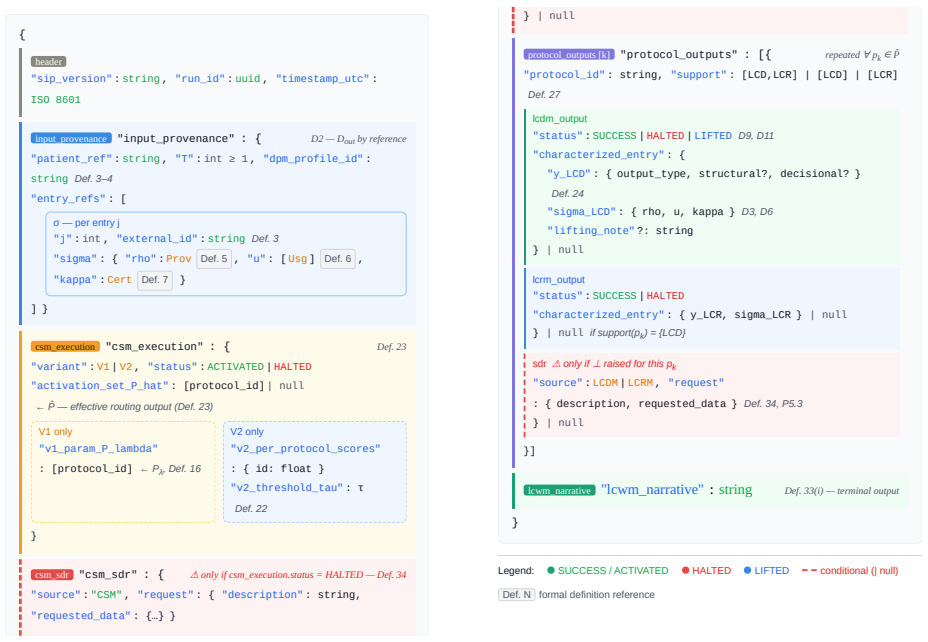
Algorithmic Impermeability (Proposition 2): the guarantee that the orchestration-structural projection is invariant under AI model substitution, provided both models satisfy the same interface contract (Definition 25). The interface contract specifies input types, output types (structural or decisional), and a failure precondition set. The Entry Theory provides the input formalization: a Characterized Entry combines a CS axis (domain, symmetry group, feature space) with a Medical Signature (provenance, usage, epistemic certainty), with these two axes proven mutually independent (Proposition 1). The Cancer Switching Module routes to activated protocols via either deterministic parameterized (
Load-bearing premise
The proof of impermeability assumes that all AI models can be wrapped to satisfy a predefined interface contract, including a declared set of failure preconditions that cleanly separates missing-data failures from internal model crashes. If real-world AI models cannot be reliably wrapped this way, the impermeability guarantee does not hold in practice.
What would settle it
Substitute two real diagnostic AI models (not stubs) that both nominally satisfy the same interface contract but differ in how they handle edge cases—e.g., one model degrades gracefully on partial inputs while the other crashes. If the orchestration-structural projection (routing, failure handling, SIP schema) differs between the two configurations on any input, Proposition 2 is violated. More directly: find a model that cannot be wrapped to cleanly distinguish precondition failures from internal inference failures, and the entire impermeability guarantee collapses.
If this is right
- Clinical AI models in oncology could be upgraded or replaced without revalidating the routing, failure-handling, or output-contract layers of the clinical decision support system, reducing the regulatory and engineering cost of model iteration.
- The SIP boundary could allow hospitals to change EMR systems, FHIR versions, or database schemas without modifying any upstream AI orchestration module, since the framework outputs a self-contained payload decoupled from downstream infrastructure.
- The failure-safety mechanism (targeted Supplementary Data Requests instead of silent failures) could enforce a human-in-the-loop pathway where missing or corrupted clinical evidence systematically halts the affected protocol rather than producing a speculative diagnosis.
- The cancer-agnostic routing design could allow a single orchestration layer to serve multiple cancer types simultaneously, with per-protocol independence preventing cross-contamination between parallel diagnostic pipelines.
Where Pith is reading between the lines
- The impermeability guarantee depends on real-world AI models being reliably wrappable to satisfy the interface contract, particularly the distinction between precondition failures (missing data) and internal inference failures (model crashes). If production models cannot be cleanly wrapped this way, the guarantee is theoretical rather than practical.
- The proof of concept uses synthetic stubs rather than real neural networks, so the 100% impermeability result validates the architectural design but not the behavior of the framework under the messier conditions of production clinical AI, where models may partially satisfy contracts or produce ambiguous failure modes.
- The V2 probabilistic router, which would auto-detect cancer type from clinical data, is fully specified but not empirically validated—meaning the framework's most clinically ambitious routing capability remains untested.
- The Entry Theory's use of geometric deep learning to unify spatial and non-spatial modalities under a common domain-signal representation is mathematically clean but may face practical challenges when clinical data has irregular sampling, missing dimensions, or non-standard acquisition protocols that resist canonical geometric formalization.
Editorial analysis
A structured set of objections, weighed in public.
Referee Report
Summary. The paper proposes the Large Cancer Assistant (LCA), a model-agnostic orchestration framework for clinical decision support in oncology. The LCA is formalized as a 7-tuple architecture that decouples multimodal data ingestion, clinical routing, and AI inference. The central theoretical contribution is the principle of Algorithmic Impermeability (Proposition 2), which guarantees that the orchestration-structural projection (routing, failure handling, SIP schema) remains invariant under AI model substitution, provided models satisfy a predefined interface contract. The framework includes an Entry Theory based on Geometric Deep Learning to standardize heterogeneous inputs, a Cancer Switching Module (CSM) for routing, and a Standardized Intermediate Payload (SIP) to isolate the system from EMR infrastructure. A Proof of Concept (PoC) with four scenarios validates orchestration properties (nominal flow, impermeability, failure safety, multi-protocol execution) using synthetic data and stub models.
Significance. The paper addresses a genuine systems-engineering gap in clinical AI deployment: the tight coupling of data orchestration and model inference in monolithic architectures. The formalization of Algorithmic Impermeability via Proposition 2 is a clean architectural contribution, and the authors are commendably transparent about the PoC's scope—explicitly stating that it evaluates orchestration behavior, not clinical accuracy, and using synthetic stubs by design. The public code repository and fully specified SIP/SDR JSON schema support reproducibility. The distinction between precondition failure (⊥) and internal inference failure (CODE_FAIL) is a thoughtful design choice for auditability. However, the practical significance is currently limited by the absence of any validation with real models or clinical data, which leaves the realizability of the interface contract untested.
major comments (3)
- §3.2.5, Definition 25 + Remark 3: The practical realizability of the ⊥/CODE_FAIL distinction is the load-bearing assumption for Proposition 2's utility. The proof (Appendix B, Step 2) correctly establishes that ⊥-status is identical across conforming implementations because E_⊥^(k) is a declared component of the contract. However, the PoC (S1–S4) uses stubs that trivially conform by construction and does not exercise Case 8 (the CODE_FAIL path) empirically. The paper would benefit from explicitly acknowledging that the contract's decidability assumption—particularly the requirement that wrappers reliably distinguish precondition violations from internal inference failures with real models—is untested, and ideally from sketching how a real model wrapper would implement this distinction (e.g., structural input checks for E_⊥ vs. try/catch for CODE_FAIL).
- §4.2, Scenario 2: The impermeability demonstration substitutes Stub A (U-Net-style schema) with Stub B (SegResNet-style schema), both satisfying the same interface contract. Since both stubs are constructed to conform to the contract, the 100% π-equality result is essentially a verification that the codebase correctly implements the projection π, not an empirical discovery. The paper should clarify that S2 is a consistency check of the implementation against Proposition 2, not independent evidence that the proposition holds beyond the contract assumption. This is a framing issue, not a correctness issue.
- §3.2.4, Variant V2: The probabilistic auto-detection router is fully specified theoretically (Definitions 18–22) but excluded from the PoC. Since V2 is the more clinically realistic variant (auto-detecting cancer type from data rather than requiring a priori declaration), its absence limits the empirical contribution. The paper should more prominently flag that the framework's practical utility is currently validated only for the deterministic V1 path, and clarify whether V2's calibration-dependent routing guarantee (Definition 21) introduces any additional impermeability risks not covered by Proposition 2.
minor comments (6)
- Table 1 lists eight canonical orchestration cases, but the PoC (§4) only covers four scenarios. A brief note mapping S1–S4 to the specific cases tested (e.g., S1→Case 1, S3→Case 4, etc.) would improve traceability.
- Figure 2: The shared routing context is denoted as P̂ in the caption but the text uses ̂P (hat over P). Consistent notation would help.
- §3.1.1: The claim that the Entry definition 'elegantly unifies spatial and non-spatial modalities' is strong; the trivial symmetry group for tabular data (Table 4) is a degenerate case rather than an elegant unification. Consider softening.
- Appendix I: The latency projection equations (Eqs. 3–4) are presented but T_par is not benchmarked. A note that the parallel execution lower bound is unmeasured would prevent misinterpretation.
- References: López et al. (2026) is cited as an arXiv preprint with a 2026 date; verify this is not a typo for 2025.
- §5.2: The limitations section is thorough but could explicitly mention that the NLG component (lcwm_narrative) is untested for clinical readability or correctness, which is relevant for the SIP's downstream utility.
Simulated Author's Rebuttal
We thank the referee for a careful and constructive reading of the manuscript. The referee correctly identifies the paper's core contribution (the formalization of Algorithmic Impermeability and the orchestration framework) and its principal limitation (validation with synthetic stubs only, no real models or clinical data). All three major comments are well-taken: they are framing and scoping clarifications rather than correctness objections. We address each below and confirm the revisions we will make.
read point-by-point responses
-
Referee: §3.2.5, Definition 25 + Remark 3: The practical realizability of the ⊥/CODE_FAIL distinction is the load-bearing assumption for Proposition 2's utility. The proof (Appendix B, Step 2) correctly establishes that ⊥-status is identical across conforming implementations because E_⊥^(k) is a declared component of the contract. However, the PoC (S1–S4) uses stubs that trivially conform by construction and does not exercise Case 8 (the CODE_FAIL path) empirically. The paper would benefit from explicitly acknowledging that the contract's decidability assumption—particularly the requirement that wrappers reliably distinguish precondition violations from internal inference failures with real models—is untested, and ideally from sketching how a real model wrapper would implement this distinction (e.g., structural input checks for E_⊥ vs. try/catch for CODE_FAIL).
Authors: The referee is correct on both points. First, the decidability of the ⊥/CODE_FAIL distinction with real models is indeed untested by the current PoC. The stubs conform by construction, and while Case 8 is formally specified in Appendix H (Table 8) and the SIP schema (D12) handles it, no PoC scenario exercises the CODE_FAIL path empirically. Second, the referee's suggested wrapper implementation pattern—structural input checks for E_⊥ versus try/catch for CODE_FAIL—is precisely the design we envision. We will add the following to the revised manuscript: (1) an explicit acknowledgment in §5.2 (Limitations) that the contract's decidability assumption is untested with real models, and (2) a concrete remark in §3.2.5 (after Remark 3) sketching the wrapper implementation pattern: E_⊥ checks are structural pre-conditions evaluated before model invocation (e.g., verifying required modality presence, shape conformance, quality thresholds), while CODE_FAIL is emitted when the model raises an exception or returns an invalid output during inference on a structurally valid input. This is a standard exception-handling pattern and does not require the model itself to be aware of the distinction—the wrapper enforces it. revision: yes
-
Referee: §4.2, Scenario 2: The impermeability demonstration substitutes Stub A (U-Net-style schema) with Stub B (SegResNet-style schema), both satisfying the same interface contract. Since both stubs are constructed to conform to the contract, the 100% π-equality result is essentially a verification that the codebase correctly implements the projection π, not an empirical discovery. The paper should clarify that S2 is a consistency check of the implementation against Proposition 2, not independent evidence that the proposition holds beyond the contract assumption. This is a framing issue, not a correctness issue.
Authors: The referee's characterization is accurate. S2 verifies that the implementation correctly realizes the projection π and that the two conforming stubs produce identical orchestration-structural projections. It is not independent evidence that Proposition 2 holds beyond the contract assumption—the proposition's validity is conditional on the contract being satisfied, and S2 confirms the codebase respects this. We will revise the framing of S2 in §4.2 and the corresponding Discussion paragraph (§5) to state explicitly that S2 is a consistency check of the implementation against Proposition 2 under the contract assumption, not an empirical discovery that the proposition holds independently of that assumption. The current language ('empirically demonstrated algorithmic impermeability') overstates the epistemic status of the result. revision: yes
-
Referee: §3.2.4, Variant V2: The probabilistic auto-detection router is fully specified theoretically (Definitions 18–22) but excluded from the PoC. Since V2 is the more clinically realistic variant (auto-detecting cancer type from data rather than requiring a priori declaration), its absence limits the empirical contribution. The paper should more prominently flag that the framework's practical utility is currently validated only for the deterministic V1 path, and clarify whether V2's calibration-dependent routing guarantee (Definition 21) introduces any additional impermeability risks not covered by Proposition 2.
Authors: We agree on both the scoping point and the need to address the impermeability question for V2. On the first point: the current PoC is V1-only, and this is stated in §4 and §5.2, but we agree it should be flagged more prominently—specifically in the abstract and the contributions list, so readers do not overestimate the empirical scope. On the second point: V2's calibration-dependent routing (Definition 21) does not introduce additional impermeability risks to Proposition 2, because Proposition 2 concerns the invariance of the orchestration-structural projection under AI model substitution (θ-swap in LCDM/LCRM), and the CSM is θ-free by construction (Step 1 of the proof). V2's routing function h is part of the CSM, not part of the interchangeable AI modules. However, V2 introduces a distinct concern not covered by Proposition 2: if h itself is replaced by a different routing hypothesis h', the activation set P̂ may change, which means the routing projection is NOT invariant under CSM-level substitutions. This is a different kind of substitution than the one Proposition 2 addresses. We will add a remark clarifying this distinction: Proposition 2 covers AI model substitution within the LCDM/LCRM interface contract; V2's routing function is a CSM component and its substitution is outside the scope of the impermeability guarantee. The calibration guarantee (Definition 21) concerns the quality of h's routing decisions, not their invariance under substitution. revision: yes
Circularity Check
No significant circularity found; the impermeability proof is straightforward-by-construction but not circular.
full rationale
The paper's central claim (Proposition 2, System Impermeability) is proven by showing that (i) orchestration modules DPM, CSM, LCWM are defined as θ-free, (ii) the ⊥-status of AI modules is determined by the declared precondition set E_⊥ from the interface contract (Definition 25), and (iii) the projection π explicitly discards inference content ỹ (the only θ-dependent component). The proof is near-tautological — 'if you define modules as θ-free and project away θ-dependent content, the projection is θ-invariant' — but it is not circular in the technical sense: the architectural design choices are the inputs and impermeability is the output; they are not the same object renamed. There are zero self-citations in the paper; all references are to external work. No parameters are fitted to data and then 'predicted.' The PoC uses synthetic stubs that trivially conform to the contract, which is a weak empirical test but not circular — it verifies implementation-to-specification conformance, not a fitted quantity. The paper is transparent about the proof being a design property ('by construction'). Score 1 reflects the minor concern that the result is almost definitional, but no circularity pattern from the enumerated list applies.
Axiom & Free-Parameter Ledger
free parameters (3)
- Protocol Catalog (P) =
N/A (declared a priori)
- V1 Activation Parameter (P_lambda) =
N/A (declared a priori)
- V2 Confidence Threshold (tau) =
N/A (operational parameter)
axioms (3)
- domain assumption Geometric Deep Learning principles can unify spatial and non-spatial clinical data under a common domain/signal representation.
- domain assumption AI models can be reliably wrapped to satisfy strict interface contracts, including the distinction between precondition failures and internal inference failures.
- ad hoc to paper The orchestration pipeline is a unidirectional DAG with no feedback loops.
invented entities (2)
-
Standardized Intermediate Payload (SIP)
independent evidence
-
Supplementary Data Request (SDR)
independent evidence
read the original abstract
- Objective: Multimodal deep learning models in oncology are currently limited by monolithic designs that rigidly couple data ingestion, clinical routing, and artificial intelligence (AI) inference. To address this inflexibility, we propose the Large Cancer Assistant (LCA), a model-agnostic, post-hoc orchestration framework designed for scalable clinical decision support. - Methods: The LCA is mathematically formalized as a 7-tuple architecture grounded in the principle of Algorithmic Impermeability, ensuring the orchestration logic remains strictly independent of underlying black-box AI models. We introduce the Entry Theory, leveraging Geometric Deep Learning (GDL) to standardize multimodal patient data along distinct structural and medical axes. The system dynamically orchestrates data via a Cancer Switching Module and intentionally isolates the core AI execution from volatile hospital IT infrastructures by outputting a Standardized Intermediate Payload (SIP). - Results: A Proof of Concept (PoC) validated the orchestration logic across four technical scenarios. The framework executed a nominal flow with negligible orchestration overhead. It empirically demonstrated algorithmic impermeability by maintaining an invariant routing projection during AI model swaps, and it validated strict failure-safety by achieving a 100\% recall rate in generating targeted Supplementary Data Requests (SDR) under injected data anomalies. Multi-protocol execution capability was also successfully verified. - Conclusion: By structurally decoupling multimodal ingestion from feature inference, the LCA provides a highly adaptable and modular orchestration foundation. The SIP establishes a clear architectural boundary, natively setting the stage for downstream Electronic Medical Record (EMR) interoperability as an independent future paradigm.
Figures




Reference graph
Works this paper leans on
-
[1]
Lin, J. and Deng, W. and Wei, J. and Zheng, J. and Chen, K. and Chai, H. and Zeng, T. and Tang, H. , title =. Journal of Cellular and Molecular Medicine , year =. doi:10.1111/jcmm.70221 , pmid =
-
[2]
Zhang, B. and Wan, Z. and Luo, Y. and Zhao, X. and Samayoa, J. and Zhao, W. and Wu, S. , title =. Frontiers in Pharmacology , year =. doi:10.3389/fphar.2025.1609079 , url =
-
[3]
Wang, Z. and Lin, R. and Li, Y. and Zeng, J. and Chen, Y. and Ouyang, W. and Li, H. and Jia, X. and Lai, Z. and Yu, Y. and Yao, H. and Su, W. , title =. Precision Clinical Medicine , year =. doi:10.1093/pcmedi/pbae012 , pmid =
-
[4]
Wang, N. and Lin, J. and Li, W. and Lyu, Y. and Jiang, Y. and Ni, Z. and Huang, Q. and Chen, H. and Yan, Q. and Huang, C. , title =. npj Digital Medicine , year =. doi:10.1038/s41746-025-02236-3 , url =
-
[5]
Waqas, A. and Tripathi, A. and Ramachandran, R. P. and Stewart, P. A. and Rasool, G. , title =. Frontiers in Artificial Intelligence , year =. doi:10.3389/frai.2024.1408843 , url =
-
[6]
Yang, H. and Yang, M. and Chen, J. and Yao, G. and Zou, Q. and Jia, L. , title =. Briefings in Bioinformatics , year =. doi:10.1093/bib/bbae699 , url =
-
[7]
Xiang, J. and Wang, X. and Zhang, X. and Xi, Y. and Eweje, F. and Chen, Y. and Li, Y. and Bergstrom, C. and Gopaulchan, M. and Kim, T. and Yu, K. and Willens, S. and Olguin, F. M. and Nirschl, J. J. and Neal, J. and Diehn, M. and Yang, S. and Li, R. , title =. Nature , year =. doi:10.1038/s41586-024-08378-w , url =
-
[8]
Niecikowski, A. and Gupta, S. and Suarez, G. and Kim, J. and Chen, H. and Guo, F. and Long, W. and Deng, J. , title =. International Journal of Radiation Oncology Biology Physics , year =. doi:10.1016/j.ijrobp.2022.07.894 , url =
-
[9]
Studies in Health Technology and Informatics , volume =
Lee, Jaehoon and Kim, JeongAh and Cho, Insook and Kim, Yoon , title =. Studies in Health Technology and Informatics , volume =. 2010 , issn =. doi:, url =
work page 2010
-
[10]
BMC Medical Research Methodology , volume =
Huser, Vojtech and Rasmussen, Luke V and Oberg, Ryan and Starren, Justin B , title =. BMC Medical Research Methodology , volume =. 2011 , month =. doi:10.1186/1471-2288-11-43 , pmid =
-
[11]
Cardoso, M. J. and Li, W. and Brown, R. and Ma, N. and Kerfoot, E. and Wang, Y. and Murrey, B. and Myronenko, A. and Zhao, C. and Yang, D. and Nath, V. and He, Y. and Xu, Z. and Hatamizadeh, A. and Zhu, W. and Liu, Y. and Zheng, M. and Tang, Y. and Yang, I. and Zephyr, M. and Hashemian, B. and Alle, S. and Darestani, M. Z. and Budd, C. and Modat, M. and V...
work page internal anchor Pith review Pith/arXiv arXiv
-
[12]
Beare, R. and Lowekamp, B. and Yaniv, Z. , title =. Journal of Statistical Software , year =. doi:10.18637/jss.v086.i08 , url =
-
[13]
ClinicalBERT: Modeling Clinical Notes and Predicting Hospital Readmission
Huang, K. and Altosaar, J. and Ranganath, R. , title =. arXiv preprint arXiv:1904.05342 , year =
work page internal anchor Pith review Pith/arXiv arXiv 1904
-
[14]
AMOS: A Large-Scale Abdominal Multi-Organ Benchmark for Versatile Medical Image Segmentation
Ji, Y. and Bai, H. and Yang, J. and Ge, C. and Zhu, Y. and Zhang, R. and Li, Z. and Zhang, L. and Ma, W. and Wan, X. and others , title =. arXiv preprint arXiv:2206.08023 , year =
work page internal anchor Pith review Pith/arXiv arXiv
-
[15]
Setio, A. A. A. and Traverso, A. and de Bel, T. and Berens, M. S. N. and Bogaard, C. V. D. and Cerello, P. and Chen, H. and Dou, Q. and Fantacci, M. E. and Geurts, B. and Gugten, R. V. and Heng, P. A. and Jansen, B. and de Kaste, M. M. J. and Kotov, V. and Lin, J. Y. and Manders, J. T. M. C. and Sóñora-Mengana, A. and García-Naranjo, J. C. and Papavasilei...
-
[16]
Computers in Biology and Medicine , volume=
From raw data to research-ready: A FHIR-based transformation pipeline in a real-world oncology setting , author=. Computers in Biology and Medicine , volume=. 2025 , publisher=
work page 2025
-
[17]
JMIR Medical Informatics , year =
Jung, S and Bae, S and Seong, D and Oh, O and Kim, Y and Yi, B , title =. JMIR Medical Informatics , year =. doi:10.2196/40338 , url =
-
[18]
Journal of Medical Internet Research , volume=
Designing clinical decision support systems (CDSS)—A user-centered lens of the design characteristics, challenges, and implications: Systematic review , author=. Journal of Medical Internet Research , volume=. 2025 , publisher=
work page 2025
-
[19]
An Empirical Analysis of Calibration and Selective Prediction in Multimodal Clinical Condition Classification , author=. arXiv preprint arXiv:2603.02719 , year=
work page internal anchor Pith review Pith/arXiv arXiv
discussion (0)
Sign in with ORCID, Apple, or X to comment. Anyone can read and Pith papers without signing in.