REVIEW 3 major objections 4 minor 22 references
Long-term forecasting fails when a single model averages over distinct operational regimes; NEST discovers those regimes and recomposes specialized experts for each one.
Reviewed by Pith at T0; open to challenge. T0 means a machine referee read the full paper against a public rubric. the ladder, T0–T4 →
T0 review · grok-4.5
2026-07-11 01:58 UTC pith:KTWPNIBT
load-bearing objection Solid empirical MoE pipeline for mixed-regime forecasting; the look-back proxy is a real but not fatal soft spot, and the CESNET + CKA evidence is worth the read. the 3 major comments →
NEST: Tackling Dataset-Level Distribution Shifts via Regime-Oriented Mixture-of-Experts
The pith
A machine-rendered reading of the paper's core claim, the machinery that carries it, and where it could break.
Core claim
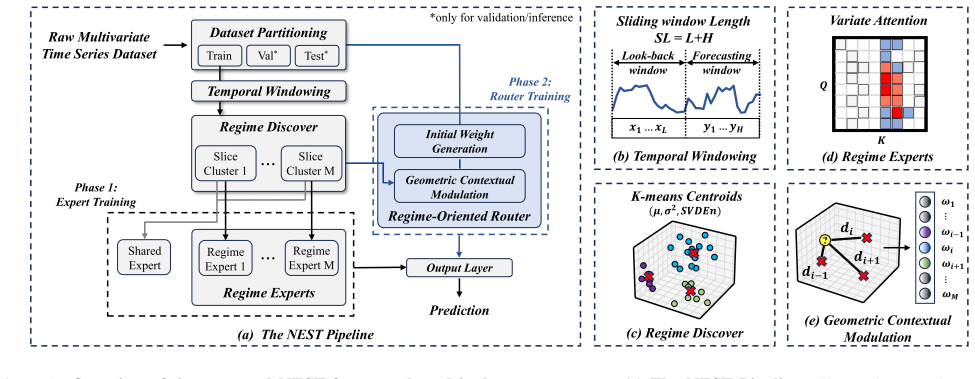
Dataset-level distribution shift is the structural problem of a time series being a composite of distinct operational regimes. By partitioning slices in moment-entropy space, training specialized variate-attention experts on each partition, and routing new windows with a content-plus-centroid gate, NEST turns that shift into an explicit process of regime identification and dependency recomposition, consistently outperforming models that only correct local non-stationarity.
What carries the argument
Regime-oriented Mixture-of-Experts: unsupervised K-means in the three-dimensional moment-entropy space produces regime centroids; each expert evolves a distinct variate-attention map; a two-step router multiplies a content-based initial weight by a soft inverse-distance geometric modulation to those centroids.
Load-bearing premise
The mean, variance and SVD entropy of the look-back window alone are a reliable proxy for the regime of the full look-back-plus-horizon slice, so that distances to the training centroids remain valid at inference without using any future values.
What would settle it
Construct or select a test series in which the look-back window and the subsequent forecast horizon systematically belong to different moment-entropy clusters; if NEST then loses its reported advantage over the same experts under simple averaging or under a pure distance router, the proxy assumption fails.
If this is right
- Forecasting pipelines for multi-year or multi-mode systems can replace a single model with a small set of regime-specialized kernels whose outputs are mixed on the fly.
- Attention maps of the specialized experts become direct, inspectable evidence of how variable couplings reorganize across operating modes.
- Once regimes are discovered offline, new data streams can be routed without retraining the expert pool, provided their statistics remain near the original centroids.
- The same moment-entropy clustering can be used as a diagnostic tool to quantify how many distinct behavioral modes a dataset actually contains.
Where Pith is reading between the lines
- If the moment-entropy features prove portable, the same unsupervised partition could be reused as a pre-processing step for any backbone, not only the MoE architecture proposed here.
- Systems whose regime transitions are abrupt rather than smooth may need a sharper gating function or an explicit change-point detector on top of the soft geometric modulation.
- The approach suggests a natural extension to online regime discovery: update centroids incrementally as new slices arrive, testing whether the expert pool remains specialized without full retraining.
Editorial analysis
A structured set of objections, weighed in public.
Referee Report
Summary. NEST addresses dataset-level distribution shifts in long-term multivariate forecasting by treating a series as a composite of operational regimes. It first discovers regimes via K-means on a three-dimensional moment-entropy feature space (mean, variance, SVD entropy) computed on L+H slices, then trains a heterogeneous pool of specialized variate-attention experts (one per regime plus a shared expert) in Phase 1. In Phase 2 a regime-oriented router produces content-based initial weights that are multiplicatively modulated by inverse-quadratic geometric proximity to the training centroids; the final forecast is a weighted sum of expert outputs. Empirically the method reports 32 of 36 first-place MSE/MAE settings (averaged over four horizons) against strong baselines on nine datasets that include heterogeneous network traffic (CESNET), ionospheric TEC, Weather and ETT, with supporting ablations, CKA dissimilarity maps and expert-permutation tests.
Significance. If the central claim holds, NEST supplies a concrete, reproducible architecture that moves beyond local non-stationarity correctors (RevIN, SAN, FAN) to explicit global regime recomposition. The public code release, the CKA/permutation interpretability suite, and the consistent gains on high-variability CESNET series are genuine strengths. The work is therefore of practical interest to the time-series community even if the absolute novelty of moment-entropy clustering or dense MoE routing is incremental.
major comments (3)
- §4.2 explicitly trains centroids on L+H slices yet at inference computes the same three features from the L-length look-back alone, asserting that the look-back is a “sufficient proxy” and that local normalizers keep look-back/horizon distributions consistent. This assumption is load-bearing for the geometric modulation term (Eqs. 8–10) that the SOTA claim relies upon. When a regime boundary falls inside the horizon—the precise setting advertised as the paper’s target—the proxy can map to the wrong centroid and the modulation becomes incorrect. No experiment isolates this failure mode (e.g., synthetic transitions, boundary-straddling subsets, or an oracle that uses future features only for diagnosis). The ablations in Table 2 remove the router or K-means wholesale but never measure proxy error; consequently the 32/36 first-place count may overstate robustness exactly where the method cla
- Table 1 (and the corresponding ablation Table 2) report only averages over the four horizons {96,192,336,720}. Per-horizon numbers, standard deviations across seeds, and statistical significance tests are absent. Without them it is impossible to verify that the claimed gains are stable rather than driven by a single easy horizon, nor to assess whether the geometric router remains beneficial at the longest horizons where regime transitions are most likely. The manuscript itself still contains unresolved “Table??” cross-references, indicating that the experimental presentation is incomplete.
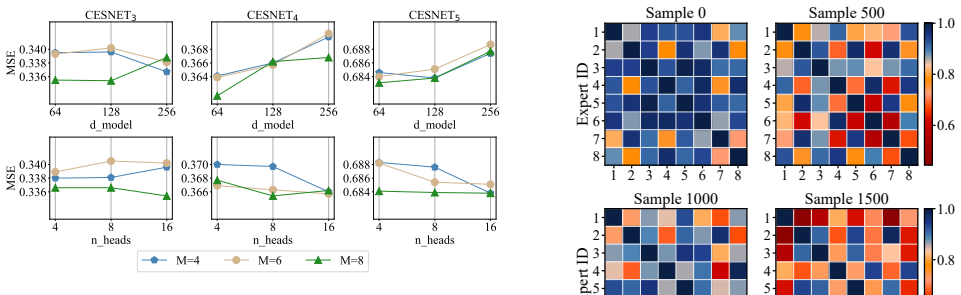
- The free parameters M (number of regimes) and α (softening of geometric weights) are acknowledged but only lightly explored (Figure 3 shows M mainly on CESNET subsets). Because both the expert pool size and the strength of the geometric prior directly control how the model reacts to the inference-time proxy, a more systematic sensitivity study—especially on datasets known to contain abrupt regime changes—is required before the architectural claims can be considered fully substantiated.
minor comments (4)
- Throughout the experimental section the main result table is still referenced as “Table??”; these placeholders must be resolved.
- Figure 3’s glyph encoding is hard to read in grayscale; a clearer legend or separate panels would help.
- Related-work discussion of recent MoE time-series models (e.g., Time-MoE, MoLE) is thin; a short paragraph situating NEST relative to those concurrent dense/sparse MoE designs would improve positioning.
- Notation for the shared-expert weight ws (sigmoid) versus the renormalized regime weights is slightly inconsistent between Eqs. (7) and (11); a single paragraph clarifying the two-stage normalization would remove ambiguity.
Circularity Check
No circularity: empirical MoE method with unsupervised train-time clustering, standard MSE training, and chronological held-out evaluation; no prediction reduces to its inputs by construction.
full rationale
NEST is a standard empirical deep-learning paper. Regime labels arise from K-means on moment-entropy features of training slices only (Eqs. 2-4, §4.2); experts and the router are then trained by ordinary MSE against ground-truth future windows under a chronological 70/10/20 split (Eq. 12). At inference the look-back proxy is an explicit modeling assumption, not a fitted quantity that is later re-labeled a prediction. No equation equates a claimed forecast to a parameter fitted on the same target; no uniqueness theorem or ansatz is imported via self-citation; the Informer citation is merely a baseline. Ablations and CKA analyses further test specialization rather than tautologically restate the clustering. The derivation chain is therefore self-contained against external benchmarks and contains none of the six circular patterns.
Axiom & Free-Parameter Ledger
free parameters (4)
- M (number of regimes / experts) =
typically 8
- α (softening factor on geometric weights) =
∈ (0,1], value not fixed in text
- d_model, n_heads, embedding dimension d for SVD trajectory =
d_model ∈ {64,128,256}; n_heads ∈ {4,8,16}
- K-means centroids C = {c_m} =
data-dependent
axioms (4)
- domain assumption Mean, variance, and SVD entropy of a slice are jointly sufficient to separate functionally distinct operational regimes for forecasting.
- domain assumption Statistics of the look-back window of length L are a sufficient proxy for the regime of the full L+H slice at inference, with local normalization methods keeping look-back and horizon distributions consistent.
- ad hoc to paper K-means in the three-dimensional moment-entropy space yields forecasting-oriented clusters when slices span L+H.
- standard math Standard attention, Softmax, Sigmoid, Euclidean distance, and MSE loss behave as usual.
invented entities (3)
-
moment-entropy space (μ, σ², SVDEn feature manifold for regimes)
no independent evidence
-
regime-oriented router with geometric contextual modulation
no independent evidence
-
specialized regime experts as variate-attention kernels
no independent evidence
read the original abstract
Accurate long-term forecasting in complex systems is frequently compromised by dataset-level distribution shifts, where diverse underlying behavioral modes and evolving system states drive the dynamic multivariate time-series. While existing methods predominantly focus on local temporal shifts, they fail to explicitly model the global structural challenge where datasets are composites of distinct operational regimes. In this paper, we propose NEST, a specialized framework designed to model and recompose these evolving structures through a two-phase dense MoE architecture. NEST first facilitates structural specialization by partitioning the dataset into distinct operational regimes through unsupervised clustering in a principled moment-entropy space. We introduce a regime-oriented router mechanism that generates initial expert weights based on temporal content, subsequently refined through geometric modulation to regime centroids. Crucially, rather than acting as monolithic predictors, individual experts function as specialized kernels that capture regime-specific dynamics by evolving unique variate-attention patterns. Extensive evaluations on diverse benchmarks, including heterogeneous network traffic and physical phenomena, demonstrate that NEST consistently achieves state-of-the-art performance. Our code and datasets are available at https://github.com/Aaralshin/NEST
Figures

Reference graph
Works this paper leans on
-
[1]
Time series models for internet traf- fic
[Basuet al., 1996 ] Sabyasachi Basu, Amarnath Mukherjee, and Steve Klivansky. Time series models for internet traf- fic. InProceedings of IEEE INFOCOM’96. Conference on Computer Communications, volume 2, pages 611–620. IEEE,
work page 1996
-
[2]
[Boehmeet al., 2007 ] Thomas Boehme, A Robin Wallace, and Gareth P Harrison. Applying time series to power flow analysis in networks with high wind penetration.IEEE transactions on power systems, 22(3):951–957,
work page 2007
-
[3]
Stl: A seasonal-trend decomposition.J
[Clevelandet al., 1990 ] Robert B Cleveland, William S Cleveland, Jean E McRae, and Irma Terpenning. Stl: A seasonal-trend decomposition.J. Off. Stat, 6(1):3–73,
work page 1990
-
[4]
Dish-ts: a general paradigm for alleviating distribution shift in time series forecasting
[Fanet al., 2023 ] Wei Fan, Pengyang Wang, Dongkun Wang, Dongjie Wang, Yuanchun Zhou, and Yanjie Fu. Dish-ts: a general paradigm for alleviating distribution shift in time series forecasting. InProceedings of the AAAI conference on artificial intelligence, volume 37, pages 7522–7529,
work page 2023
-
[5]
[Gaoet al., 2024 ] Shanghua Gao, Teddy Koker, Owen Queen, Tom Hartvigsen, Theodoros Tsiligkaridis, and Marinka Zitnik. Units: A unified multi-task time series model.Advances in Neural Information Processing Sys- tems, 37:140589–140631,
work page 2024
-
[6]
Re- versible instance normalization for accurate time-series forecasting against distribution shift
[Kimet al., 2021 ] Taesung Kim, Jinhee Kim, Yunwon Tae, Cheonbok Park, Jang-Ho Choi, and Jaegul Choo. Re- versible instance normalization for accurate time-series forecasting against distribution shift. InInternational con- ference on learning representations,
work page 2021
-
[7]
[Koumaret al., 2025 ] Josef Koumar, Karel Hynek, Tom ´aˇs ˇCejka, and Pavel ˇSiˇska. Cesnet-timeseries24: Time series dataset for network traffic anomaly detection and forecast- ing.Scientific Data, 12(1):338,
work page 2025
-
[8]
Pyraformer: Low-complexity pyramidal attention for long-range time series modeling and forecasting
[Liuet al., 2021 ] Shizhan Liu, Hang Yu, Cong Liao, Jian- guo Li, Weiyao Lin, Alex X Liu, and Schahram Dust- dar. Pyraformer: Low-complexity pyramidal attention for long-range time series modeling and forecasting. InInter- national conference on learning representations,
work page 2021
-
[9]
iTransformer: Inverted Transformers Are Effective for Time Series Forecasting
[Liuet al., 2023a ] Yong Liu, Tengge Hu, Haoran Zhang, Haixu Wu, Shiyu Wang, Lintao Ma, and Mingsheng Long. itransformer: Inverted transformers are effective for time series forecasting.arXiv preprint arXiv:2310.06625,
work page internal anchor Pith review Pith/arXiv arXiv
-
[10]
A Time Series is Worth 64 Words: Long-term Forecasting with Transformers
[Nieet al., 2022 ] Yuqi Nie, Nam H Nguyen, Phanwadee Sinthong, and Jayant Kalagnanam. A time series is worth 64 words: Long-term forecasting with transformers.arXiv preprint arXiv:2211.14730,
work page internal anchor Pith review Pith/arXiv arXiv 2022
-
[11]
Adaptive normalization: A novel data normalization approach for non-stationary time series
[Ogasawaraet al., 2010 ] Eduardo Ogasawara, Leonardo C Martinez, Daniel De Oliveira, Geraldo Zimbr ˜ao, Gisele L Pappa, and Marta Mattoso. Adaptive normalization: A novel data normalization approach for non-stationary time series. InThe 2010 International Joint Conference on Neu- ral Networks (IJCNN), pages 1–8. IEEE,
work page 2010
-
[12]
[Passaliset al., 2019 ] Nikolaos Passalis, Anastasios Tefas, Juho Kanniainen, Moncef Gabbouj, and Alexandros Iosi- fidis. Deep adaptive input normalization for time series forecasting.IEEE transactions on neural networks and learning systems, 31(9):3760–3765,
work page 2019
-
[13]
Space weather: Terres- trial perspective.Living Reviews in Solar Physics, 4(1):1,
[Pulkkinen, 2007] Tuija Pulkkinen. Space weather: Terres- trial perspective.Living Reviews in Solar Physics, 4(1):1,
work page 2007
-
[14]
A comparison of arima and lstm in forecasting time series
[Siami-Naminiet al., 2018 ] Sima Siami-Namini, Neda Tavakoli, and Akbar Siami Namin. A comparison of arima and lstm in forecasting time series. In2018 17th IEEE international conference on machine learning and applications (ICMLA), pages 1394–1401. Ieee,
work page 2018
-
[15]
[Torrence and Compo, 1998] Christopher Torrence and Gilbert P Compo. A practical guide to wavelet analy- sis.Bulletin of the American Meteorological society, 79(1):61–78,
work page 1998
-
[16]
[Weerakodyet al., 2021 ] Philip B Weerakody, Kok Wai Wong, Guanjin Wang, and Wendell Ela. A review of irreg- ular time series data handling with gated recurrent neural networks.Neurocomputing, 441:161–178,
work page 2021
-
[17]
Deep Transformer Models for Time Series Forecasting: The Influenza Prevalence Case
[Wuet al., 2020 ] Neo Wu, Bradley Green, Xue Ben, and Shawn O’Banion. Deep transformer models for time series forecasting: The influenza prevalence case.arXiv preprint arXiv:2001.08317,
work page internal anchor Pith review Pith/arXiv arXiv 2020
-
[18]
[Wuet al., 2021 ] Haixu Wu, Jiehui Xu, Jianmin Wang, and Mingsheng Long. Autoformer: Decomposition transform- ers with auto-correlation for long-term series forecast- ing.Advances in Neural Information Processing Systems, 34:22419–22430,
work page 2021
-
[19]
[Yeet al., 2024 ] Weiwei Ye, Songgaojun Deng, Qiaosha Zou, and Ning Gui. Frequency adaptive normalization for non-stationary time series forecasting.Advances in Neural Information Processing Systems, 37:31350–31379,
work page 2024
-
[20]
[Zenget al., 2023 ] Ailing Zeng, Muxi Chen, Lei Zhang, and Qiang Xu. Are transformers effective for time series fore- casting? InProceedings of the AAAI conference on artifi- cial intelligence, volume 37, pages 11121–11128,
work page 2023
-
[21]
Informer: Beyond efficient transformer for long sequence time-series forecasting
[Zhouet al., 2021 ] Haoyi Zhou, Shanghang Zhang, Jieqi Peng, Shuai Zhang, Jianxin Li, Hui Xiong, and Wan- cai Zhang. Informer: Beyond efficient transformer for long sequence time-series forecasting. InProceedings of the AAAI conference on artificial intelligence, volume 35, pages 11106–11115,
work page 2021
-
[22]
Fedformer: Fre- quency enhanced decomposed transformer for long-term series forecasting
[Zhouet al., 2022 ] Tian Zhou, Ziqing Ma, Qingsong Wen, Xue Wang, Liang Sun, and Rong Jin. Fedformer: Fre- quency enhanced decomposed transformer for long-term series forecasting. InInternational Conference on Ma- chine Learning, pages 27268–27286. PMLR, 2022
work page 2022
discussion (0)
Sign in with ORCID, Apple, or X to comment. Anyone can read and Pith papers without signing in.