REVIEW 3 major objections 4 minor 151 references
Perturbing a few late-layer units that fire more for reward cues makes vision-language models prefer low-effort, low-reward choices and score lower on clinical anhedonia scales, while leaving raw task skill intact.
Reviewed by Pith at T0; open to challenge. T0 means a machine referee read the full paper against a public rubric. the ladder, T0–T4 →
T0 review · grok-4.5
2026-07-11 01:09 UTC pith:AOBQXGQK
load-bearing objection Solid causal demo of sparse reward-sensitive units driving effort avoidance in VLMs, with good controls; the NAc label is an unvalidated analogy that does not sink the empirical result. the 3 major comments →
Reward Valuation in Vision Language Models: Causal Mechanisms Underlying Anhedonia
The pith
A machine-rendered reading of the paper's core claim, the machinery that carries it, and where it could break.
Core claim
A sparse set of late-layer MLP units whose activations rise under reward-framed prompts are causally necessary for reward-seeking behavior in vision-language models: silencing them by activation patching shifts the models toward low-effort, low-reward choices and lowers scores on DARS, MAP-SR and AES while leaving forced-choice accuracy unchanged.
What carries the argument
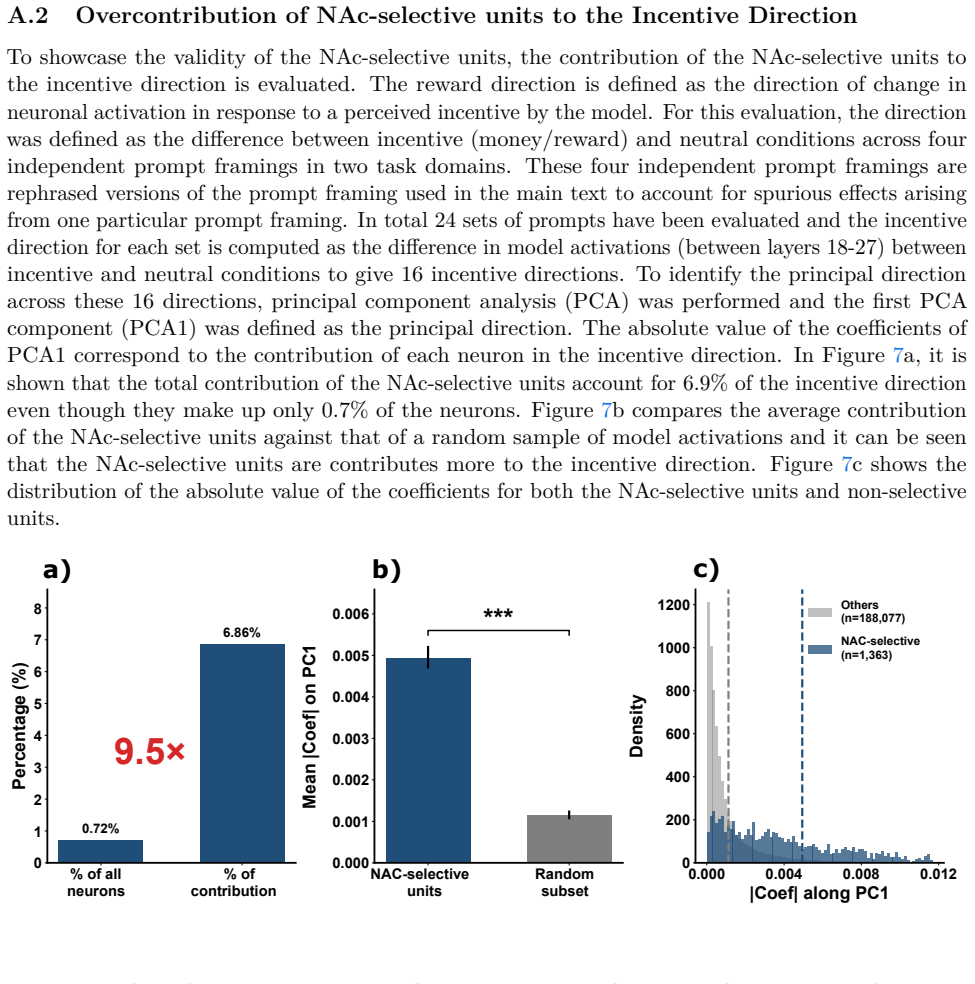
NAc-selective units: the top ~0.7 % of late-layer MLP neurons whose activation difference (reward prompt minus neutral prompt) exceeds three standard deviations; these units are then mean-patched to a neutral resting value to test causal necessity.
Load-bearing premise
That units singled out solely by a three-standard-deviation activation jump between reward-worded and neutral textual prompts are genuine functional analogues of the human nucleus accumbens, so that mean-activation patching cleanly isolates their causal contribution to motivation.
What would settle it
If an equal-sized set of randomly chosen late-layer units, or the mid-layer units that are suppressed rather than elevated by reward, produced the same drop in high-effort choices and clinical scores when patched, the claim that the 3σ reward-selective set is specifically NAc-like would be falsified.
Editorial analysis
A structured set of objections, weighed in public.
Referee Report
Summary. The paper claims that VLMs contain sparse late-layer units selectively activated by reward-predicting textual cues (identified via 3σ activation difference from neutral prompts at last-token MLP states), which function as analogues of the human nucleus accumbens. Targeted activation patching of these units (0.7% of targeted layers) induces a selective shift toward low-effort/low-reward options on ASDiv-EEfRT and Probability-EEfRT adaptations, plus lower scores on DARS, MAP-SR and AES, while forced-choice accuracy without reward choice remains intact. Parametric λ scaling, random-unit and mid-layer controls, EV calculation, third-person perspective shifting, and replication on InternVL2.5-8B are presented as evidence of a specific reward-valuation deficit rather than general capability loss, supporting the broader claim of parallel reward circuits in AI and humans usable for in-silico anhedonia modeling.
Significance. If the selective causal role of the identified units holds, the work supplies a concrete, controllable mechanistic handle on incentive motivation inside modern VLMs and a new route for testing psychiatric hypotheses that are difficult to probe causally in humans. Explicit strengths include the multi-control design (forced-choice accuracy preservation, random ablation, mid-layer negative control, EV knowledge check, perspective shift, dose-response λ, second-model replication), public code, and direct use of established clinical instruments (DARS, MAP-SR, AES, EEfRT). These make the behavioral phenotype itself robust and falsifiable even if the precise NAc mapping remains interpretive. The contribution is therefore valuable both for VLM interpretability of motivation and as a proof-of-concept digital-twin substrate for affective disorders.
major comments (3)
- [§4 Isolating the NAc-selective Units; Fig. 2] The localization criterion (absolute activation difference >3σ between reward/money-framed and neutral prompts at last-token MLP states of layers 18–27) is purely linguistic and is never validated against an independent measure of valuation, expected-value sensitivity, or any human NAc BOLD data. The units could therefore simply be the sparse neurons most sensitive to reward-related lexical features; clamping them to the neutral mean would then remove a decision-relevant cue without implying a dedicated reward-valuation circuit. Perspective-shift and EV-calculation controls show conceptual knowledge survives but do not rule out this cue-removal alternative. Because every subsequent causal and clinical-alignment claim rests on the functional identity of these units as NAc analogues, either additional validation (e.g., correlation with EV computation or non-reward motivational cues) or sub
- [§5 Clinical Psychometric Profile; Fig. 5] The reported model score reductions (DARS −16.7 %, MAP-SR −2.4 %, AES −8.6 %) are statistically significant, yet the human MDD comparisons drawn from Llerena et al., Rizvi et al. and Dong et al. are themselves non-significant owing to high variance; the paper claims only “directional alignment.” This undercuts the stronger assertion that the induced state “mirrors” clinical anhedonia. A quantitative comparison (effect-size matching or testing whether the model profile falls inside the patient distribution) or explicit limitation language is needed to support the clinical-alignment claim.
- [§4 MID Task Adaptation for VLMs] The human MID localizer is a visual, timed, motor-response paradigm that isolates anticipatory BOLD in NAc; the VLM adaptation uses static textual prompts of equal character length and records last-token MLP activations. While the textual format is justified to avoid visual confounds, the functional equivalence of this snapshot to the anticipatory phase remains an untested axiom. Without a control that dissociates anticipatory from purely lexical or consummatory processing, the mapping to NAc is under-constrained and load-bearing for the paper’s framing.
minor comments (4)
- [Fig. 1] The schematic is clear, but the example model responses in panel (c) are truncated; providing complete, unedited outputs in the appendix would improve reproducibility of the qualitative claims.
- [Appendix A.1] InternVL2.5-8B results are shown only for the ASDiv-EEfRT variant. Reporting the psychometric scales and Probability-EEfRT for the second model would strengthen the generalizability claim already advanced in the main text.
- [Throughout] Minor typographical issues appear throughout (e.g., missing spaces in “in silicoinvestigations”, inconsistent hyphenation of “reward-anticipatory”). A careful proof-read would remove them.
- [§4 / Fig. 2c] The free parameters (3σ threshold, late-layer range, λ range) are acknowledged via sensitivity plots, yet the main text could more explicitly state that the primary results are robust within the reported ranges rather than uniquely determined by the chosen values.
Circularity Check
No circularity: unit selection by reward-minus-neutral activation is independent of the EEfRT/psychometric evaluation tasks, and no prediction is forced by construction or self-citation.
full rationale
The derivation chain is: (i) localize late-layer MLP units whose activations differ by >3σ between reward/money-framed and length-matched neutral prompts (MID-inspired localizer, Fig. 2, §4), (ii) replace those units’ activations with their neutral-condition mean (activation patching), (iii) measure choice frequencies on ASDiv-EEfRT / Probability-EEfRT and scores on DARS/MAP-SR/AES. The localizer stimuli are simple factual questions; the evaluation stimuli are multi-option effort-reward trade-offs and Likert self-reports never used for selection. Random-unit and mid-layer (L13-14) controls produce null effects, forced-choice accuracy is preserved, and EV calculation / third-person choice remain intact. Threshold 3σ is chosen by collapse-rate sensitivity (Fig. 2c), not by fitting to behavioral outcomes. Self-citations (AlKhamissi 2025a, Honarmand 2026) supply only the general localization/patching toolkit; they do not supply a uniqueness theorem or ansatz that forces the anhedonia phenotype. Consequently no step reduces the reported behavioral shift to its own inputs by construction.
Axiom & Free-Parameter Ledger
free parameters (3)
- activation threshold (3σ) =
3σ (0.7 % of targeted layers)
- layer range for primary intervention =
layers 18–27
- scaling factor λ for dose-response =
range ≈ −2 to +1
axioms (4)
- domain assumption Nucleus Accumbens hypoactivation is a causal substrate of anticipatory anhedonia in MDD.
- ad hoc to paper Mean activation of selected units under neutral prompts constitutes a valid “resting-state” baseline for causal patching.
- domain assumption LLM self-report scores on DARS/MAP-SR/AES and forced-choice effort tasks are valid behavioural read-outs of anhedonia.
- ad hoc to paper Activation differences measured at the last-token MLP state after a reward cue are the functional equivalent of the anticipatory BOLD phase in the human MID task.
invented entities (1)
-
NAc-selective (reward-anticipatory) units
no independent evidence
read the original abstract
Recent Vision-Language Models capture increasingly complex aspects of human cognition. Here we ask whether this alignment extends to reward valuation, which we assess in a mechanistic framework built on clinical tests that were developed to evaluate anhedonia and motivational deficits in major depressive disorder. In the brain, anhedonia is frequently linked to dysregulation in the Nucleus Accumbens (NAc) and the broader dopaminergic reward system. While neuroimaging has localized these deficits, establishing a causal link between NAc activity and specific behavioral symptoms remains a challenge. We use these ideas from neuroscience to functionally identify reward-anticipatory units in vision language models, and test their causal role via targeted perturbations. Perturbing NAc-selective units induces behavioral effects that mirror human anhedonia: the model shifts toward low-effort, low-reward options in effort-based decision-making tasks. Crucially, our results reflect a specific deficit in reward valuation and anticipation rather than a loss of task capability: the perturbed model maintains baseline performance when reward-based choice is removed. This induced vulnerability further aligns with clinical anhedonia and motivation scales, including DARS and MAP-SR. Taken together, these results reveal reward valuation circuits in AI models that parallel those in humans.
Figures




Reference graph
Works this paper leans on
-
[1]
and Kanwisher, Nancy and Tenenbaum, Joshua B
Schrimpf, Martin and Blank, Idan Asher and Tuckute, Greta and Kauf, Carina and Hosseini, Eghbal A. and Kanwisher, Nancy and Tenenbaum, Joshua B. and Fedorenko, Evelina , year=. The neural architecture of language: Integrative modeling converges on predictive processing , volume=. Proceedings of the National Academy of Sciences , publisher=
-
[2]
and Hulme, Charles and Nation, Kate , year=
Snowling, Margaret J. and Hulme, Charles and Nation, Kate , year=. Defining and understanding dyslexia: past, present and future , volume=. Oxford Review of Education , publisher=
-
[3]
AN OVERVIEW OF DYSLEXIA: SOME KEY ISSUES AND ITS EFFECTS ON LEARNING MATHEMATICS , journal=
Kunwar, Rajendra and Sapkota, Hari , year =. AN OVERVIEW OF DYSLEXIA: SOME KEY ISSUES AND ITS EFFECTS ON LEARNING MATHEMATICS , journal=
-
[4]
and Cohen, Laurent and Dehaene, Stanislas , year=
McCandliss, Bruce D. and Cohen, Laurent and Dehaene, Stanislas , year=. The visual word form area: expertise for reading in the fusiform gyrus , volume=. Trends in Cognitive Sciences , publisher=
-
[5]
The unique role of the visual word form area in reading , volume=
Dehaene, Stanislas and Cohen, Laurent , year=. The unique role of the visual word form area in reading , volume=. Trends in Cognitive Sciences , publisher=
-
[6]
and Yablonski, Maya and Stone, Hannah L
Mitchell, Jamie L. and Yablonski, Maya and Stone, Hannah L. and Jimenez, Mia and Takada, Megumi E. and Tang, Kenny A. and Tran, Jasmine E. and Chou, Clementine and Yeatman, Jason D. , title =. bioRxiv , year =
-
[7]
Silani, G. and Frith, U. and Demonet, J.-F. and Fazio, F. and Perani, D. and Price, C. and Frith, C. D. and Paulesu, E. , year=. Brain abnormalities underlying altered activation in dyslexia: a voxel based morphometry study , volume=. Brain , publisher=
-
[8]
Paulesu, E. and Démonet, J.-F. and Fazio, F. and McCrory, E. and Chanoine, V. and Brunswick, N. and Cappa, S. F. and Cossu, G. and Habib, M. and Frith, C. D. and Frith, U. , year=. Dyslexia: Cultural Diversity and Biological Unity , volume=. Science , publisher=
-
[9]
Turkeltaub, Peter E. and Goldberg, Ethan M. and Postman-Caucheteux, Whitney A. and Palovcak, Merisa and Quinn, Colin and Cantor, Charles and Coslett, H. Branch , year=. Alexia due to ischemic stroke of the visual word form area , volume=. Neurocase , publisher=
-
[10]
Connectivity precedes function in the development of the visual word form area , volume=
Saygin, Zeynep M and Osher, David E and Norton, Elizabeth S and Youssoufian, Deanna A and Beach, Sara D and Feather, Jenelle and Gaab, Nadine and Gabrieli, John D E and Kanwisher, Nancy , year=. Connectivity precedes function in the development of the visual word form area , volume=. Nature Neuroscience , publisher=
-
[11]
The LLM Language Network: A Neuroscientific Approach for Identifying Causally Task-Relevant Units
AlKhamissi, Badr and Tuckute, Greta and Bosselut, Antoine and Schrimpf, Martin. The LLM Language Network: A Neuroscientific Approach for Identifying Causally Task-Relevant Units. Proceedings of the 2025 Conference of the Nations of the Americas Chapter of the Association for Computational Linguistics: Human Language Technologies (Volume 1: Long Papers). 2025
work page 2025
-
[12]
Qwen2 Technical Report , author =. arXiv preprint arXiv:2407.10671 , year =
work page internal anchor Pith review Pith/arXiv arXiv
-
[13]
Liu, Haotian and Li, Chunyuan and Li, Yuheng and Li, Bo and Zhang, Yuanhan and Shen, Sheng and Lee, Yong Jae , year =
- [14]
-
[15]
Lam, Joseph Hin Yan and Tong, Shelley Xiuli , year=. Drawing a New Picture: Children with Developmental Dyslexia Exhibit Superior Nonverbal Creativity , volume=. Research in Developmental Disabilities , publisher=
-
[16]
and Tang, Kenny An and Donnelly, Patrick M
Yeatman, Jason D. and Tang, Kenny An and Donnelly, Patrick M. and Yablonski, Maya and Ramamurthy, Mahalakshmi and Karipidis, Iliana I. and Caffarra, Sendy and Takada, Megumi E. and Kanopka, Klint and Ben-Shachar, Michal and Domingue, Benjamin W. , year=. Rapid online assessment of reading ability , volume=. Scientific Reports , publisher=
-
[17]
Burke, Henry R. , year=. Raven’s Progressive Matrices: A Review and Critical Evaluation , volume=. The Journal of Genetic Psychology , publisher=
-
[18]
RAVEN: A Dataset for Relational and Analogical Visual rEasoNing , publisher=
Zhang, Chi and Gao, Feng and Jia, Baoxiong and Zhu, Yixin and Zhu, Song-Chun , year=. RAVEN: A Dataset for Relational and Analogical Visual rEasoNing , publisher=
-
[19]
Peterson, Robin L. and Pennington, Bruce F. , year=. Developmental Dyslexia , volume=. Annual Review of Clinical Psychology , publisher=
-
[20]
Developmental dyslexia , author=. The Lancet , volume=. 2012 , publisher=
work page 2012
-
[21]
Kempler, Daniel and Almor, Amit and Tyler, Lorraine K. and Andersen, Elaine S. and MacDonald, Maryellen C. , year=. Sentence Comprehension Deficits in Alzheimer’s Disease: A Comparison of Off-Line vs. On-Line Sentence Processing , volume=. Brain and Language , publisher=
-
[22]
and Brown, Toni and Smith, Cole and Gutierrez, Adriana and Tolley, Celeste and Ford, Olivia , year=
Luke, Steven G. and Brown, Toni and Smith, Cole and Gutierrez, Adriana and Tolley, Celeste and Ford, Olivia , year=. Dyslexics exhibit an orthographic, not a phonological deficit in lexical decision , volume=. Language, Cognition and Neuroscience , publisher=
-
[23]
Dyslexia linked to talent: Global visual-spatial ability , volume=
von Károlyi, Catya and Winner, Ellen and Gray, Wendy and Sherman, Gordon F , year=. Dyslexia linked to talent: Global visual-spatial ability , volume=. Brain and Language , publisher=
-
[24]
Kanwisher, Nancy and McDermott, Josh and Chun, Marvin M. , year=. The Fusiform Face Area: A Module in Human Extrastriate Cortex Specialized for Face Perception , volume=. The Journal of Neuroscience , publisher=
-
[25]
Pennington, Bruce F. and McGrath, Lauren M. and Rosenberg, Jenni and Barnard, Holly and Smith, Shelley D. and Willcutt, Erik G. and Friend, Angela and DeFries, John C. and Olson, Richard K. , year=. Gene × environment interactions in reading disability and attention-deficit/hyperactivity disorder. , volume=. Developmental Psychology , publisher=
-
[26]
Lyon, G. Reid and Shaywitz, Sally E. and Shaywitz, Bennett A. , year=. A definition of dyslexia , volume=. Annals of Dyslexia , publisher=
-
[27]
Wagner, Richard K. and Zirps, Fotena A. and Edwards, Ashley A. and Wood, Sarah G. and Joyner, Rachel E. and Becker, Betsy J. and Liu, Guangyun and Beal, Bethany , year=. The Prevalence of Dyslexia: A New Approach to Its Estimation , volume=. Journal of Learning Disabilities , publisher=
-
[28]
Brem, S. and Maurer, U. and Kronbichler, M. and Schurz, M. and Richlan, F. and Blau, V. and Reithler, J. and van der Mark, S. and Schulz, E. and Bucher, K. and Moll, K. and Landerl, K. and Martin, E. and Goebel, R. and Schulte-Körne, G. and Blomert, L. and Wimmer, H. and Brandeis, D. , year=. Visual word form processing deficits driven by severity of read...
-
[29]
Dyslexia: Causes and Concomitant Impairments , volume=
Werth, Reinhard , year=. Dyslexia: Causes and Concomitant Impairments , volume=. Brain Sciences , publisher=
-
[30]
Using goal-driven deep learning models to understand sensory cortex , volume=
Yamins, Daniel L K and DiCarlo, James J , year=. Using goal-driven deep learning models to understand sensory cortex , volume=. Nature Neuroscience , publisher=
-
[31]
Schrimpf, Martin and Kubilius, Jonas and Lee, Michael J. and Ratan Murty, N. Apurva and Ajemian, Robert and DiCarlo, James J. , year=. Integrative Benchmarking to Advance Neurally Mechanistic Models of Human Intelligence , volume=. Neuron , publisher=
-
[32]
Monzalvo, Karla and Fluss, Joel and Billard, Catherine and Dehaene, Stanislas and Dehaene-Lambertz, Ghislaine , year=. Cortical networks for vision and language in dyslexic and normal children of variable socio-economic status , volume=. NeuroImage , publisher=
-
[33]
Biological Psychiatry , author=
Disruption of posterior brain systems for reading in children with developmental dyslexia , volume=. Biological Psychiatry , author=. 2002 , pages=
work page 2002
-
[34]
Maurer, Urs and Brem, Silvia and Bucher, Kerstin and Kranz, Felicitas and Benz, Rosmarie and Steinhausen, Hans-Christoph and Brandeis, Daniel , year=. Impaired tuning of a fast occipito-temporal response for print in dyslexic children learning to read , volume=. Brain , publisher=
-
[35]
Boros, Marianna and Anton, Jean-Luc and Pech-Georgel, Catherine and Grainger, Jonathan and Szwed, Marcin and Ziegler, Johannes C. , year=. Orthographic processing deficits in developmental dyslexia: Beyond the ventral visual stream , volume=. NeuroImage , publisher=
-
[36]
The Importance of the Left Occipitotemporal Cortex in Developmental Dyslexia , volume=
Kronbichler, Lisa and Kronbichler, Martin , year=. The Importance of the Left Occipitotemporal Cortex in Developmental Dyslexia , volume=. Current Developmental Disorders Reports , publisher=
-
[37]
and Hulme, Charles and Stanley, Leanne M
Tanaka, Hiroko and Black, Jessica M. and Hulme, Charles and Stanley, Leanne M. and Kesler, Shelli R. and Whitfield-Gabrieli, Susan and Reiss, Allan L. and Gabrieli, John D. E. and Hoeft, Fumiko , year=. The Brain Basis of the Phonological Deficit in Dyslexia Is Independent of IQ , volume=. Psychological Science , publisher=
-
[38]
Learning Disability Quarterly , volume=
The future of a mistake: Will discrepancy measurement continue to make the learning disabilities field a pseudoscience? , author=. Learning Disability Quarterly , volume=. 2005 , publisher=
work page 2005
-
[39]
Roitsch, Jane and Watson, Silvana , year=. An Overview of Dyslexia: Definition, Characteristics, Assessment, Identification, and Intervention , volume=. Science Journal of Education , publisher=
-
[40]
Yamins, Daniel L. K. and Hong, Ha and Cadieu, Charles F. and Solomon, Ethan A. and Seibert, Darren and DiCarlo, James J. , year=. Performance-optimized hierarchical models predict neural responses in higher visual cortex , volume=. Proceedings of the National Academy of Sciences , publisher=
-
[42]
and Rajalingham, Rishi and Issa, Elias B
Schrimpf, Martin and Kubilius, Jonas and Hong, Ha and Majaj, Najib J. and Rajalingham, Rishi and Issa, Elias B. and Kar, Kohitij and Bashivan, Pouya and Prescott-Roy, Jonathan and Geiger, Franziska and Schmidt, Kailyn and Yamins, Daniel L. K. and DiCarlo, James J. , year=. Brain-Score: Which Artificial Neural Network for Object Recognition is most Brain-L...
-
[43]
Cadena, Santiago A. and Denfield, George H. and Walker, Edgar Y. and Gatys, Leon A. and Tolias, Andreas S. and Bethge, Matthias and Ecker, Alexander S. , year=. Deep convolutional models improve predictions of macaque V1 responses to natural images , volume=. PLOS Computational Biology , publisher=
-
[44]
Spoerer, Courtney J. and Kietzmann, Tim C. and Mehrer, Johannes and Charest, Ian and Kriegeskorte, Nikolaus , editor=. Recurrent neural networks can explain flexible trading of speed and accuracy in biological vision , volume=. PLOS Computational Biology , publisher=. 2020 , pages=
work page 2020
-
[45]
Zhuang, Chengxu and Yan, Siming and Nayebi, Aran and Schrimpf, Martin and Frank, Michael C. and DiCarlo, James J. and Yamins, Daniel L. K. , year=. Unsupervised neural network models of the ventral visual stream , volume=. Proceedings of the National Academy of Sciences , publisher=
-
[46]
and Grill-Spector, Kalanit and Yamins, Daniel L.K
Margalit, Eshed and Lee, Hyodong and Finzi, Dawn and DiCarlo, James J. and Grill-Spector, Kalanit and Yamins, Daniel L.K. , year=. A unifying framework for functional organization in early and higher ventral visual cortex , volume=. Neuron , publisher=
-
[47]
Scaling Laws for Task-Optimized Models of the Primate Visual Ventral Stream , journal=
Gokce, Abdulkadir and Schrimpf, Martin , year=. Scaling Laws for Task-Optimized Models of the Primate Visual Ventral Stream , journal=
-
[49]
Tang, Yingtian and Gokce, Abdulkadir and Al-Karkari, Khaled Jedoui and Yamins, Daniel and Schrimpf, Martin , year=. Many-two-one: Diverse Perceptual Representations Across Visual Pathways Emerge from A Single Objective , journal=
-
[51]
Driving and suppressing the human language network using large language models , volume=
Tuckute, Greta and Sathe, Aalok and Srikant, Shashank and Taliaferro, Maya and Wang, Mingye and Schrimpf, Martin and Kay, Kendrick and Fedorenko, Evelina , year=. Driving and suppressing the human language network using large language models , volume=. Nature Human Behaviour , publisher=
-
[52]
Hosseini, Eghbal A. and Schrimpf, Martin and Zhang, Yian and Bowman, Samuel and Zaslavsky, Noga and Fedorenko, Evelina , year=. Artificial Neural Network Language Models Predict Human Brain Responses to Language Even After a Developmentally Realistic Amount of Training , volume=. Neurobiology of Language , publisher=
-
[53]
Toneva, Mariya and Sordoni, Alessandro and Combes, Remi Tachet des and Trischler, Adam and Bengio, Yoshua and Gordon, Geoffrey J. , year=. An Empirical Study of Example Forgetting during Deep Neural Network Learning , journal=
-
[55]
Deep language algorithms predict semantic comprehension from brain activity , volume=
Caucheteux, Charlotte and Gramfort, Alexandre and King, Jean-Rémi , year=. Deep language algorithms predict semantic comprehension from brain activity , volume=. Scientific Reports , publisher=
-
[56]
Can Deep Generative Models Explain Brain Function in People with Developmental Dyslexia? , volume=. MDPI AG , author=. 2023 , pages=
work page 2023
-
[57]
Handwriting Anomalies and Learning Disabilities through Recurrent Neural Networks and Geometric Pattern Analysis , author=. arXiv , archivePrefix=. 2024 , eprint=
work page 2024
-
[58]
Locating and Editing Factual Associations in GPT , journal=
Meng, Kevin and Bau, David and Andonian, Alex and Belinkov, Yonatan , year=. Locating and Editing Factual Associations in GPT , journal=
-
[59]
Müller, Veronika I. and Cieslik, Edna C. and Serbanescu, Ilinca and Laird, Angela R. and Fox, Peter T. and Eickhoff, Simon B. , year=. Altered Brain Activity in Unipolar Depression Revisited , volume=. JAMA Psychiatry , publisher=
-
[60]
and Virtala, Paula and Thiede, Anja and Laasonen, Marja and Kujala, Teija , year=
Sihvonen, Aleksi J. and Virtala, Paula and Thiede, Anja and Laasonen, Marja and Kujala, Teija , year=. Structural white matter connectometry of reading and dyslexia , volume=. NeuroImage , publisher=
-
[61]
M o E fication: Transformer Feed-forward Layers are Mixtures of Experts
Zhang, Zhengyan and Lin, Yankai and Liu, Zhiyuan and Li, Peng and Sun, Maosong and Zhou, Jie. M o E fication: Transformer Feed-forward Layers are Mixtures of Experts. Association for Computational Linguistics. 2022
work page 2022
-
[62]
and Kay, Kendrick and Naselaris, Thomas and Tarr, Michael J
Wang, Aria Y. and Kay, Kendrick and Naselaris, Thomas and Tarr, Michael J. and Wehbe, Leila , year=. Better models of human high-level visual cortex emerge from natural language supervision with a large and diverse dataset , volume=. Nature Machine Intelligence , publisher=
-
[63]
Instruction-tuning Aligns LLMs to the Human Brain , author=. 2024 , month =aug, eprint=
work page 2024
-
[64]
Valdois, S. , year=. Dyslexia (Developmental) , journal=
-
[65]
Olulade, Olumide A. and Napoliello, Eileen M. and Eden, Guinevere F. , year=. Abnormal Visual Motion Processing Is Not a Cause of Dyslexia , volume=. Neuron , publisher=
-
[66]
and Nishimoto, Shinji and Gallant, Jack L
Naselaris, Thomas and Kay, Kendrick N. and Nishimoto, Shinji and Gallant, Jack L. , year=. Encoding and decoding in fMRI , volume=. NeuroImage , publisher=
-
[67]
and Hutchinson, Sam and Fedorenko, Evelina and Saxe, Rebecca R
Marvi, Ammar I. and Hutchinson, Sam and Fedorenko, Evelina and Saxe, Rebecca R. and Kamps, Frederik S. and Regev, Tamar I. and Chen, Emily M. and Kanwisher, Nancy G. , year=. An efficient multifunction fMRI localizer for high-level visual, auditory, and cognitive regions in humans , volume=. Imaging Neuroscience , publisher=. doi:10.1162/IMAG.a.905 , url =
- [69]
-
[70]
and Hajishirzi, Hannaneh and Girshick, Ross and Farhadi, Ali and Kembhavi, Aniruddha , year=
Deitke, Matt and Clark, Christopher and Lee, Sangho and Tripathi, Rohun and Yang, Yue and Park, Jae Sung and Salehi, Mohammadreza and Muennighoff, Niklas and Lo, Kyle and Soldaini, Luca and Lu, Jiasen and Anderson, Taira and Bransom, Erin and Ehsani, Kiana and Ngo, Huong and Chen, YenSung and Patel, Ajay and Yatskar, Mark and Callison-Burch, Chris and Hea...
-
[71]
Chalikia, Aliki and Ralli, Asimina M. and Antoniou, Faye , year=. Developmental Language Disorder and Risk of Dyslexia—Can They Be Told Apart? , journal=
-
[72]
Nicolson, Roderick I. and Fawcett, Angela J. , year=. Dyslexia, dysgraphia, procedural learning and the cerebellum , volume=. Cortex , publisher=. doi:10.1016/j.cortex.2009.08.016 , url =
-
[73]
Cognitive, Affective, & Behavioral Neuroscience , volume=
Anhedonia relates to reduced striatal reward anticipation in depression but not in schizophrenia or bipolar disorder: A transdiagnostic study , author=. Cognitive, Affective, & Behavioral Neuroscience , volume=. 2025 , doi=
work page 2025
- [78]
- [82]
-
[102]
Boshoff, Marcelle and Thawer, Zainub , title =. 2014 , institution =
work page 2014
-
[103]
Psychological Medicine , author=
A computational approach to understanding effort-based decision-making in depression , url=. Psychological Medicine , author=. 2025 , doi=
work page 2025
-
[107]
The Assistant Axis: Situating and Stabilizing the Default Persona of Language Models , author=. 2026 , publisher =
work page 2026
-
[108]
Large Language Models Show Human-like Social Desirability Biases in Survey Responses , author=. 2024 , month = may, pages =. doi:https://doi.org/10.48550/arXiv.2601.10387 , url=. 2405.06058 , publisher=
-
[110]
and Hammer, Rubi and Booth, James R
Lytle, Marisa N. and Hammer, Rubi and Booth, James R. , year=. A neuroimaging dataset on working memory and reward processing in children with and without ADHD , volume=. doi:10.1016/j.dib.2020.105801 , journal=
-
[114]
Efficient LLaMA-3.2-Vision by Trimming Cross-attended Visual Features
Efficient LLaMA-3.2-Vision by Trimming Cross-attended Visual Features , author=. 2025 , publisher=. doi:10.48550/arXiv.2504.00557 , url=
work page internal anchor Pith review Pith/arXiv arXiv doi:10.48550/arxiv.2504.00557 2025
-
[131]
N. Abe and J. D. Greene. Response to anticipated reward in the nucleus accumbens predicts behavior in an independent test of honesty. Journal of Neuroscience, 34 0 (32): 0 10564–10572, 2014. doi:10.1523/jneurosci.0217-14.2014. URL http://dx.doi.org/10.1523/jneurosci.0217-14.2014
-
[132]
The LLM Language Network: A Neuroscientific Approach for Identifying Causally Task-Relevant Units
Badr AlKhamissi, Greta Tuckute, Antoine Bosselut, and Martin Schrimpf. The LLM language network: A neuroscientific approach for identifying causally task-relevant units. In Proceedings of the 2025 Conference of the Nations of the Americas Chapter of the Association for Computational Linguistics: Human Language Technologies (Volume 1: Long Papers). Associa...
work page internal anchor Pith review Pith/arXiv arXiv doi:10.48550/arxiv.2411.02280 2025
-
[133]
From language to cognition: How llms outgrow the human language network, 2025 b
Badr AlKhamissi, Greta Tuckute, Yingtian Tang, Taha Osama A Binhuraib, Antoine Bosselut, and Martin Schrimpf. From language to cognition: How llms outgrow the human language network, 2025 b . URL http://dx.doi.org/10.18653/v1/2025.emnlp-main.1237
-
[134]
Gonzalo Arrondo, Nuria Segarra, Antonio Metastasio, Hisham Ziauddeen, Jennifer Spencer, Niels R. Reinders, Robert B. Dudas, Trevor W. Robbins, Paul C. Fletcher, and Graham K. Murray. Reduction in ventral striatal activity when anticipating a reward in depression and schizophrenia: a replicated cross-diagnostic finding. Frontiers in Psychology, 6, 2015. do...
discussion (0)
Sign in with ORCID, Apple, or X to comment. Anyone can read and Pith papers without signing in.