REVIEW 2 major objections 5 minor 136 references
Extreme debris disks are mid-infrared fingerprints of violent Moon- to Mars-sized collisions that build rocky planets and later scramble their orbits.
Reviewed by Pith at T0; open to challenge. T0 means a machine referee read the full paper against a public rubric. the ladder, T0–T4 →
T0 review · grok-4.5
2026-07-10 23:25 UTC pith:G7F52BXH
load-bearing objection Solid JWST expansion of the EDD sample with clean mineralogy metrics; the Mars/Moon and instability mappings are useful hypotheses, not yet secured diagnostics. the 2 major comments →
Extreme Debris Disks: Insights into Violent Collisions in Planet Formation and Destruction
The pith
A machine-rendered reading of the paper's core claim, the machinery that carries it, and where it could break.
Core claim
EDDs contain significantly more optically thin, sub-micron, thermally altered grains—marked by elevated silica and crystalline silicates—than typical protoplanetary or debris disks. Together with stochastic infrared variability, these features define EDDs as a subclass whose dust is generated by large collisions between Moon- and Mars-sized bodies. Silica-rich systems preferentially trace energetic embryo impacts during terrestrial planet formation (mostly younger than ~300 Myr); silica-poor systems with very high 10 µm feature strength offer a potential marker of later orbital instability.
What carries the argument
Dust emissivity in the 10 µm region, quantified by feature strength W10, FWHM, and four dust indices (P10 and O10 for crystalline silicates; S10 and especially S10,s for silica), used to classify systems as silica-rich or silica-poor and to measure the mass of optically thin small grains.
Load-bearing premise
The mapping from silica-rich versus silica-poor mid-infrared indices to impact energy and body size (Mars-sized vaporizing collisions versus smaller or grazing events) assumes laboratory shock products and simple impact-debris statistics translate directly into the observed spectra without major rewriting by later grinding, radiation-pressure sorting, or grain porosity.
What would settle it
A clear detection of silica-rich EDDs around stars securely older than ~300 Myr, or a demonstration that ordinary debris disks share the same silica abundance and sub-micron grain populations as EDDs once measured the same way, would collapse the proposed energy–age–mineralogy link.
If this is right
- Silica-rich 10 µm signatures become a practical energy and age diagnostic for the final giant-impact phase of terrestrial planet formation.
- EDDs older than ~300 Myr should be silica-poor and highly variable if they truly trace dynamical instability rather than ongoing planet assembly.
- Mid-infrared monitoring of W10 and silica indices can flag planetary systems currently rearranging their architectures.
- Impact simulations and laboratory shock products can be tested against observed mineralogical dichotomies, not only against total dust mass.
- EDDs supply an observable counterpart to the architectural ‘breaking the chain’ process inferred from mature multi-planet systems.
Where Pith is reading between the lines
- A larger JWST sample of older EDDs could cleanly separate the terrestrial-formation and dynamical-instability channels and measure their relative rates.
- If high-W10 silica-poor EDDs mark ‘breaking the chain,’ they should preferentially host residual planetesimals or non-resonant multi-planet systems accessible to transit and radial-velocity surveys.
- Spectral decomposition of the 20 µm region can test the paper’s prediction that vapor-condensate silica lacks high-pressure polymorphs such as coesite and stishovite.
- Wide, eccentric stellar companions may systematically elevate collisional rates, offering a demographic test once companion orbits are better constrained.
Editorial analysis
A structured set of objections, weighed in public.
Referee Report
Summary. The paper analyzes JWST MIRI/MRS and Spitzer IRS mid-IR spectra of 21 extreme debris disks (EDDs). Using a uniform dust-emissivity approach in the 10 µm region (pseudocontinuum subtraction, W10, FWHM, and dust indices P10, O10, S10, S10,s calibrated against laboratory materials and prior silica-rich systems), the authors show that EDDs have elevated optically thin sub-micron grains and high crystallinity/silica relative to typical PPDs and DDs. They classify ~38% as silica-rich (S10,s > 2.98), document stochastic IR variability from WISE and multi-epoch 10/20 µm photometry, and interpret silica-rich systems as products of energetic Mars-sized embryo collisions during terrestrial planet formation (≲300 Myr) while high-W10 silica-poor systems as potential markers of later dynamical instability.
Significance. If the observational characterization holds, the work substantially enlarges the high-quality mid-IR sample of EDDs, provides a reproducible, laboratory-calibrated index framework for silica vs. crystalline silicate content, and supplies a concrete observational definition of EDDs (elevated W10, thermally altered grains, stochastic variability). The age and mineralogy trends offer a useful empirical bridge between impact simulations and exoplanetary systems. The mineralogy-to-impact-energy and high-W10-to-instability mappings remain interpretive, but the spectral reduction, index definitions, and multi-epoch variability analysis are carefully documented and falsifiable with larger samples.
major comments (2)
- Sections 3.2 and 4 (and Appendix B.3): The load-bearing interpretive step maps S10,s > 2.98 (silica-rich) to Mars-sized vaporizing collisions and high-W10 silica-poor systems to later dynamical instability. This rests on laboratory shock/annealing products and zero-order impact-simulation debris statistics translating directly into the observed mid-IR indices. Real grains are mixtures whose porosity, Fe/Mg, subsequent grinding, and radiation-pressure sorting can shift the same indices without a change in impact energy. The paper should either (i) present a quantitative forward model linking vapor-condensate vs. annealed debris to the measured indices and light-curve amplitudes, or (ii) clearly reframe these mappings as plausible but untested interpretations rather than demonstrated diagnostics, and state what observations would falsify them.
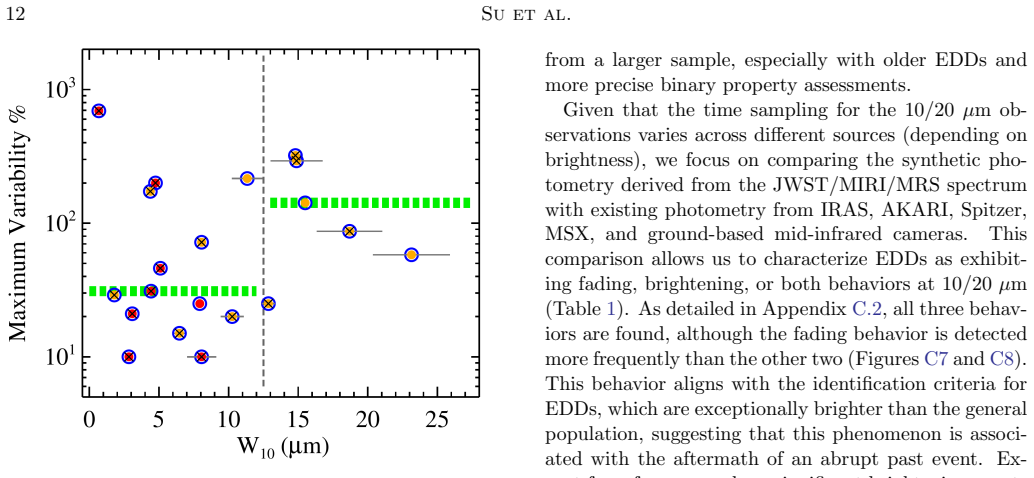
- Section 3.3 and Figure 4 vs. Figure C6 / Appendix C.1: The claimed factor-of-five higher variability for high-W10 (≳12.5 µm) systems appears only in relative flux (normalized to each system’s minimum disk flux), not in absolute dust cross-section ΔΣ. With only three systems older than ~300 Myr and a small high-W10 subsample, the age cut-off and the high-W10–instability link are under-constrained. The text should quantify the statistical significance of the W10 split (including sensitivity to the 12.5 µm cut), discuss selection/temperature biases that can decouple relative flux from ΔΣ, and soften the dynamical-instability claim accordingly.
minor comments (5)
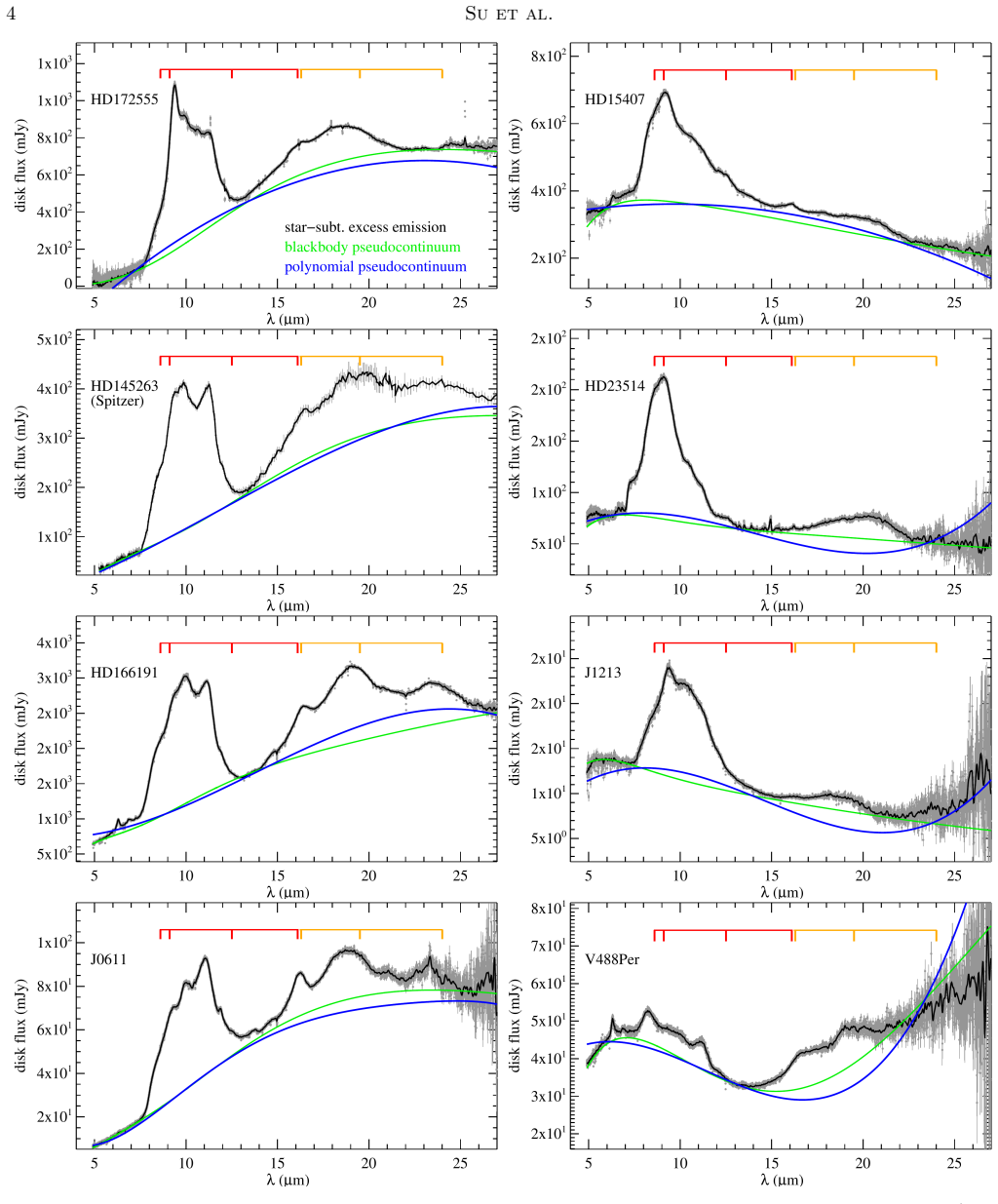
- Appendix B.2 / Table 1: State explicitly how the two pseudocontinuum forms (blackbody combination vs. polynomial) are combined into the reported uncertainties, and whether the silica-rich classification of any edge-case object (e.g., HD 172555 with S10,s = 2.95 ± 0.23) flips under either choice.
- Figure 1 and Table A2: Several systems (J0609, J2301, V488 Per) have poor long-wavelength background subtraction; note more clearly which 20 µm features and cooler-temperature anchors are unreliable so readers do not over-interpret those panels.
- Section 3.1 / right panel of Figure 2: The statement that FWHM implies sub-micron grains in most EDDs should briefly address the known degeneracy with crystallinity (already noted in the text) so the grain-size claim is not overstated.
- Table 1 and Appendix C: For saturated WISE targets the variability is taken from Spitzer I2; a short note on absolute calibration consistency between the two instruments would help when comparing max/typ percentages across the sample.
- Minor presentation: standardize the silica-rich fraction notation (38+11/-9% vs. ~38%) and fix a few typographical inconsistencies (e.g., “PDDs” in the Figure 3 caption, “What Are Extreme Debris Disks?” running headers).
Circularity Check
No load-bearing circularity: dust indices and thresholds are calibrated on external laboratory spectra plus prior independent classifications; age/variability come from catalogs and multi-epoch photometry; mineralogy-to-impact mappings are interpretive, not definitional reductions.
specific steps
-
self citation load bearing
[Section 2.2 / Appendix B.2–B.3]
"We used the JWST MIRI/MRS spectrum of LkCa 15 (K. Y. L. Su et al. 2025) as the pristine standard and computed the dust indices for three minerals: crystalline olivine (O10) and pyroxene (P10), and silica (S10)…"
The reference emissivity used to normalize all dust indices is taken from a contemporaneous paper by the same lead author. While the choice is subsequently validated against independent ISM optical-depth profiles and laboratory materials (so the indices remain externally anchored), the pristine baseline itself is not an external, pre-existing standard; this is a minor self-citation that is not load-bearing for the silica-rich threshold or the main scientific claims.
full rationale
The paper is an empirical mid-IR spectral analysis of 21 EDDs. Dust emissivity, FWHM, W10, and the four indices (P10, O10, S10, S10,s) are computed from observed spectra after pseudocontinuum subtraction (Appendix B); the S10,s > 2.98 silica-rich threshold is set from the lowest laboratory silica-like S10,s value (shocked shergottite) plus previously published silica-rich systems, not from a fit that is then re-predicted. W10 and variability indicators (max/typ % and ΔΣ) are direct measurements; correlations with age and mineralogy are reported, not forced by construction. Self-citations (LkCa 15 pristine reference from Su et al. 2025; earlier Spitzer EDD classifications) supply a convenient standard and historical context but are cross-checked against ISM opacities, laboratory shock series (Morlok et al.), and independent PPD samples; they do not close a uniqueness or prediction loop. The Mars- vs Moon-sized and high-W10-to-instability claims remain under-constrained interpretations (as the skeptic notes) but are not circular reductions of inputs to outputs. Score 1 reflects only the minor self-citation of the pristine reference; the central observational results stand independently.
Axiom & Free-Parameter Ledger
free parameters (4)
- S10,s silica-rich threshold =
2.98
- W10 high/low division =
~12.5 µm
- pseudocontinuum temperatures and anchor points =
system-dependent
- integration half-width Δλ for dust indices =
0.182 µm
axioms (5)
- domain assumption Dust emissivity Wλ = (Fλ − Fλ,c)/Fλ,c isolates composition of small grains once a pseudocontinuum is subtracted.
- domain assumption Silica-rich laboratory and previously classified systems provide a reliable absolute threshold for identifying silica-rich EDDs.
- domain assumption Impact energy (hence vapor fraction and silica production) scales primarily with impactor mass (Mars-sized vs Moon-sized) and velocity, as indicated by existing hydrodynamical simulations.
- ad hoc to paper High crystallinity observed in EDDs is generated by recent transient heating rather than inherited from the PPD phase.
- domain assumption Radiation-pressure blow-out and collisional grinding do not erase the initial mineralogical imprint on the timescales sampled.
read the original abstract
Debris disks are dusty structures around mature stars, primarily identified by infrared excesses in the stellar spectra. A subset, known as extreme debris disks (EDDs), exhibits stochastic infrared variability, believed to result from large-scale violent collisions that contribute to the formation or destruction of rocky planetary bodies. We analyze JWST and Spitzer mid-infrared spectra for 21 EDDs to investigate the connection between impact-produced dust mineralogy and the age and dynamical state of these systems during various stages of planet formation and evolution. Our findings indicate that EDDs contain significantly more optically thin, small dust grains compared to those typically seen in protoplanetary and debris disks. Predominantly submicron in size, these grains are thermally altered, as shown by their high levels of silica and crystalline silicate composition. Along with stochastic infrared variability, these features define EDDs as a subclass of debris systems where dust is generated from large collisions between Moon- and Mars-sized bodies. Our results not only provide diagnostic information about the physical conditions of violent events during terrestrial planet formation, aiding in differentiating the complex outcomes of these impacts, but also offer a potential marker for identifying planetary systems experiencing dynamical instability.
Figures



Reference graph
Works this paper leans on
-
[1]
Aannestad, P. A., & Purcell, E. M. 1973, ARA&A, 11, 309, doi: 10.1146/annurev.aa.11.090173.001521
-
[2]
2006, A&A, 455, L25, doi: 10.1051/0004-6361:20065697
Alibert, Y., Baraffe, I., Benz, W., et al. 2006, A&A, 455, L25, doi: 10.1051/0004-6361:20065697
-
[3]
Alonso-Floriano, F. J., Caballero, J. A., Cort´ es-Contreras, M., Solano, E., & Montes, D. 2015, A&A, 583, A85, doi: 10.1051/0004-6361/201526795 34Su et al. Figure C8.This figure shows the flux ratio between the previous 10/20µm photometry and the synthetic values derived from the JWST/MIRI/MRS spectra. The left panel displays the results for the VLT/VISI...
-
[4]
Armitage, P. J. 2024, arXiv e-prints, arXiv:2412.11064, doi: 10.48550/arXiv.2412.11064
work page internal anchor Pith review Pith/arXiv arXiv doi:10.48550/arxiv.2412.11064 2024
-
[5]
Asphaug, E. 2014, Annual Review of Earth and Planetary Sciences, 42, 551, doi: 10.1146/annurev-earth-050212-124057
-
[6]
2013, Icarus, 223, 544, doi: 10.1016/j.icarus.2012.12.009
Asphaug, E., & Reufer, A. 2013, Icarus, 223, 544, doi: 10.1016/j.icarus.2012.12.009
-
[7]
Ballering, N. P., Rieke, G. H., & G´ asp´ ar, A. 2014, ApJ, 793, 57, doi: 10.1088/0004-637X/793/1/57
-
[8]
Balog, Z., Kiss, L. L., Vink´ o, J., et al. 2009, ApJ, 698, 1989, doi: 10.1088/0004-637X/698/2/1989
-
[9]
Beichman, C. A., Lisse, C. M., Tanner, A. M., et al. 2011, ApJ, 743, 85, doi: 10.1088/0004-637X/743/1/85
-
[10]
Birnstiel, T., Dullemond, C. P., & Brauer, F. 2010, A&A, 513, A79, doi: 10.1051/0004-6361/200913731
-
[11]
Bottke, W. F., & Norman, M. D. 2017, Annual Review of Earth and Planetary Sciences, 45, 619, doi: 10.1146/annurev-earth-063016-020131
-
[12]
Bouwman, J., Henning, T., Hillenbrand, L. A., et al. 2008, ApJ, 683, 479, doi: 10.1086/587793 Brice˜ no, C., & Tokovinin, A. 2017, AJ, 154, 195, doi: 10.3847/1538-3881/aa8e9b What Are Extreme Debris Disks?35
-
[13]
2023,, 1.12.5 Zenodo, doi: 10.5281/zenodo.10022973
Bushouse, H., Eisenhamer, J., Dencheva, N., et al. 2023,, 1.12.5 Zenodo, doi: 10.5281/zenodo.10022973
-
[14]
2019, ApJ, 875, 40, doi: 10.3847/1538-4357/ab0e8a
Cambioni, S., Asphaug, E., Emsenhuber, A., et al. 2019, ApJ, 875, 40, doi: 10.3847/1538-4357/ab0e8a
-
[15]
Cambioni, S., Weiss, B. P., Asphaug, E., et al. 2025, A&A, 696, A174, doi: 10.1051/0004-6361/202450128
-
[16]
Stewart, S. T. 2015, ApJ, 813, 72, doi: 10.1088/0004-637X/813/1/72
work page internal anchor Pith review doi:10.1088/0004-637x/813/1/72 2015
-
[17]
Carter, P. J., & Stewart, S. T. 2020, PSJ, 1, 45, doi: 10.3847/PSJ/abaecc
-
[18]
Chambers, J. E. 2013, Icarus, 224, 43, doi: 10.1016/j.icarus.2013.02.015
-
[19]
2025, A&A, 696, A175, doi: 10.1051/0004-6361/202553710
Charalambous, C., Cuello, N., & Petrovich, C. 2025, A&A, 696, A175, doi: 10.1051/0004-6361/202553710
-
[20]
Chen, C. H., Mamajek, E. E., Bitner, M. A., et al. 2011, ApJ, 738, 122, doi: 10.1088/0004-637X/738/2/122
-
[21]
H., Mittal, T., Kuchner, M., et al
Chen, C. H., Mittal, T., Kuchner, M., et al. 2014, ApJS, 211, 25, doi: 10.1088/0067-0049/211/2/25
-
[22]
Chen, C. H., Su, K. Y. L., & Xu, S. 2020, Nature Astronomy, 4, 328, doi: 10.1038/s41550-020-1067-6
-
[23]
Chen, C. H., Sargent, B. A., Bohac, C., et al. 2006, ApJs, 166, 351, doi: 10.1086/505751
-
[24]
Chen, C. H., Li, A., Bohac, C., et al. 2007, ApJ, 666, 466, doi: 10.1086/519989
-
[25]
2002, A&A, 391, 267, doi: 10.1051/0004-6361:20020791
Sakamoto, D. 2002, A&A, 391, 267, doi: 10.1051/0004-6361:20020791
-
[26]
Contardo, G., & Hogg, D. W. 2024, AJ, 168, 157, doi: 10.3847/1538-3881/ad6b90 ´Cuk, M., Dones, L., & Nesvorn´ y, D. 2016, ApJ, 820, 97, doi: 10.3847/0004-637X/820/2/97
-
[27]
2024, AJ, 168, 239, doi: 10.3847/1538-3881/ad83a6
Dai, F., Goldberg, M., Batygin, K., et al. 2024, AJ, 168, 239, doi: 10.3847/1538-3881/ad83a6
-
[28]
Davies, E. J., Carter, P. J., Root, S., et al. 2020, Journal of Geophysical Research (Planets), 125, e06227, doi: 10.1029/2019JE006227
-
[29]
2006, A&A, 448, L1, doi: 10.1051/0004-6361:200600002 de Vries, B
Davoisne, C., Djouadi, Z., Leroux, H., et al. 2006, A&A, 448, L1, doi: 10.1051/0004-6361:200600002 de Vries, B. L., Skogby, H., Waters, L. B. F. M., & Min, M. 2018, Icarus, 307, 400, doi: 10.1016/j.icarus.2017.10.029
-
[30]
2024, PSJ, 5, 59, doi: 10.3847/PSJ/ad2178
Emsenhuber, A., Asphaug, E., Cambioni, S., et al. 2024, PSJ, 5, 59, doi: 10.3847/PSJ/ad2178
- [31]
-
[32]
2012, ApJL, 749, L29, doi: 10.1088/2041-8205/749/2/L29
Fujiwara, H., Onaka, T., Yamashita, T., et al. 2012, ApJL, 749, L29, doi: 10.1088/2041-8205/749/2/L29
-
[33]
2019, MNRAS, 488, 4465, doi: 10.1093/mnras/stz1942
Gaidos, E., Jacobs, T., LaCourse, D., et al. 2019, MNRAS, 488, 4465, doi: 10.1093/mnras/stz1942
-
[34]
2015, ApJ, 810, 136, doi: 10.1088/0004-637X/810/2/136 Gentile Fusillo, N
Genda, H., Kobayashi, H., & Kokubo, E. 2015, ApJ, 810, 136, doi: 10.1088/0004-637X/810/2/136 Gentile Fusillo, N. P., Tremblay, P.-E., G¨ ansicke, B. T., et al. 2019, MNRAS, 482, 4570, doi: 10.1093/mnras/sty3016
-
[35]
Ghosh, T., Chatterjee, S., & Lombardi, J. C. 2024, AJ, 168, 238, doi: 10.3847/1538-3881/ad7d8a
-
[36]
2022, AJ, 163, 201, doi: 10.3847/1538-3881/ac5961
Goldberg, M., & Batygin, K. 2022, AJ, 163, 201, doi: 10.3847/1538-3881/ac5961
-
[37]
Goldberg, M., & Petit, A. C. 2025, arXiv e-prints, arXiv:2511.11329, doi: 10.48550/arXiv.2511.11329
-
[38]
F., Tsiganis, K., & Morbidelli, A
Gomes, R., Levison, H. F., Tsiganis, K., & Morbidelli, A. 2005, Nature, 435, 466, doi: 10.1038/nature03676
-
[39]
Gorlova, N., Balog, Z., Rieke, G. H., et al. 2007, ApJ, 670, 516, doi: 10.1086/521671
-
[40]
Hamer, J. H., & Schlaufman, K. C. 2024, AJ, 167, 55, doi: 10.3847/1538-3881/ad110e
-
[41]
Hansen, B. M. S. 2023, MNRAS, 520, 761, doi: 10.1093/mnras/stac2847
-
[42]
Woodward, C. E. 2023, PSJ, 4, 242, doi: 10.3847/PSJ/ad0382
-
[43]
Hartman, Z. D., & L´ epine, S. 2020, ApJS, 247, 66, doi: 10.3847/1538-4365/ab79a6
-
[44]
Hazen, R. M., Morrison, S. M., Prabhu, A., Walter, M. J., & Williams, J. R. 2023, American Mineralogist, 108, 1620, doi: 10.2138/am-2022-8539
-
[45]
Hwang, H.-C., Ting, Y.-S., & Zakamska, N. L. 2022, MNRAS, 512, 3383, doi: 10.1093/mnras/stac675
-
[46]
Izidoro, A., Ogihara, M., Raymond, S. N., et al. 2017, MNRAS, 470, 1750, doi: 10.1093/mnras/stx1232
-
[47]
Jackson, A. P., & Wyatt, M. C. 2012, MNRAS, 425, 657, doi: 10.1111/j.1365-2966.2012.21546.x
-
[48]
Jang, H., Waters, R., Kamp, I., & Dullemond, C. P. 2024a, A&A, 687, A275, doi: 10.1051/0004-6361/202348630
-
[49]
2024b, A&A, 691, A148, doi: 10.1051/0004-6361/202451589
Jang, H., Waters, R., Kaeufer, T., et al. 2024b, A&A, 691, A148, doi: 10.1051/0004-6361/202451589
-
[50]
Stock, D. J. 2022, A&A, 665, A153, doi: 10.1051/0004-6361/202141511
-
[51]
Johnson, B. C., & Melosh, H. J. 2012, Icarus, 217, 416, doi: 10.1016/j.icarus.2011.11.020
-
[52]
Johnson, B. C., & Melosh, H. J. 2014, Icarus, 228, 347, doi: 10.1016/j.icarus.2013.10.022
-
[53]
Johnson, B. C., Minton, D. A., Melosh, H. J., & Zuber, M. T. 2015, Nature, 517, 339, doi: 10.1038/nature14105
-
[54]
Johnson, B. C., Lisse, C. M., Chen, C. H., et al. 2012, ApJ, 761, 45, doi: 10.1088/0004-637X/761/1/45 36Su et al. Juh´ asz, A., Henning, T., Bouwman, J., et al. 2009, ApJ, 695, 1024, doi: 10.1088/0004- 637X/695/2/102410.48550/arXiv.0902.0405 Juh´ asz, A., Bouwman, J., Henning, T., et al. 2010, ApJ, 721, 431, doi: 10.1088/0004-637X/721/1/431
-
[55]
Kaeufer, T., Min, M., Woitke, P., Kamp, I., & Arabhavi, A. M. 2024, A&A, 687, A209, doi: 10.1051/0004-6361/202449936
-
[56]
Kemper, F., Vriend, W. J., & Tielens, A. G. G. M. 2004, ApJ, 609, 826, doi: 10.1086/421339
-
[57]
Kennedy, G. M., Kenworthy, M. A., Pepper, J., et al. 2017, Royal Society Open Science, 4, 160652, doi: 10.1098/rsos.160652
-
[58]
Kennedy, G. M., & Wyatt, M. C. 2013, MNRAS, 433, 2334, doi: 10.1093/mnras/stt900
-
[59]
Kennedy, G. M., & Wyatt, M. C. 2014, MNRAS, 444, 3164, doi: 10.1093/mnras/stu1665
-
[60]
Kennedy, G. M., Murphy, S. J., Lisse, C. M., et al. 2014, MNRAS, 438, 3299, doi: 10.1093/mnras/stt2435
-
[61]
Kennedy, G. M., Ginski, C., Kenworthy, M. A., et al. 2020, MNRAS, 496, L75, doi: 10.1093/mnrasl/slaa092
-
[62]
2023, Nature, 622, 251, doi: 10.1038/s41586-023-06573-9
Kenworthy, M., Lock, S., Kennedy, G., et al. 2023, Nature, 622, 251, doi: 10.1038/s41586-023-06573-9
-
[63]
Kenyon, S. J., & Bromley, B. C. 2005, AJ, 130, 269, doi: 10.1086/430461
-
[64]
Kessler-Silacci, J., Augereau, J.-C., Dullemond, C. P., et al. 2006, ApJ, 639, 275, doi: 10.1086/499330
-
[65]
2003, A&A, 399, 1101, doi: 10.1051/0004-6361:20021831
Koike, C., Chihara, H., Tsuchiyama, A., et al. 2003, A&A, 399, 1101, doi: 10.1051/0004-6361:20021831
-
[66]
2013, ApJ, 778, 60, doi: 10.1088/0004-637X/778/1/60
Koike, C., Noguchi, R., Chihara, H., et al. 2013, ApJ, 778, 60, doi: 10.1088/0004-637X/778/1/60
-
[67]
Kraus, R. G., Stewart, S. T., Swift, D. C., et al. 2012, Journal of Geophysical Research (Planets), 117, E09009, doi: 10.1029/2012JE004082
-
[68]
2003, The physics of interstellar dust
Kruegel, E. 2003, The physics of interstellar dust
work page 2003
-
[69]
Law, D. R., Argyriou, I., Gordon, K. D., et al. 2025, AJ, 169, 67, doi: 10.3847/1538-3881/ad9685
-
[70]
Lebouteiller, V., Barry, D. J., Spoon, H. W. W., et al. 2011, ApJS, 196, 8, doi: 10.1088/0067-0049/196/1/8
-
[71]
Li, J., O’Connor, C. E., & Rasio, F. A. 2026, ApJL, 998, L5, doi: 10.3847/2041-8213/ae3a9a
-
[72]
Li, M. P., Zhao, G., & Li, A. 2007, MNRAS, 382, L26, doi: 10.1111/j.1745-3933.2007.00382.x
-
[73]
2025, AJ, 169, 323, doi: 10.3847/1538-3881/adce0c
Li, R., Chiang, E., Choksi, N., & Dai, F. 2025, AJ, 169, 323, doi: 10.3847/1538-3881/adce0c
-
[74]
Lieman-Sifry, J., Hughes, A. M., Carpenter, J. M., et al. 2016, ApJ, 828, 25, doi: 10.3847/0004-637X/828/1/25
-
[75]
Lisse, C. M., Chen, C. H., Wyatt, M. C., et al. 2009, ApJ, 701, 2019, doi: 10.1088/0004-637X/701/2/2019
work page internal anchor Pith review doi:10.1088/0004-637x/701/2/2019 2009
-
[76]
Lisse, C. M., Meng, H. Y. A., Sitko, M. L., et al. 2020, ApJ, 894, 116, doi: 10.3847/1538-4357/ab7b80
-
[77]
Liu, B., Raymond, S. N., & Jacobson, S. A. 2022, Nature, 604, 643, doi: 10.1038/s41586-022-04535-1
-
[78]
2006, Nature, 441, 305, doi: 10.1038/nature04828 Matr` a, L., Marino, S., Wilner, D
Lovis, C., Mayor, M., Pepe, F., et al. 2006, Nature, 441, 305, doi: 10.1038/nature04828 Matr` a, L., Marino, S., Wilner, D. J., et al. 2025, A&A, 693, A151, doi: 10.1051/0004-6361/202451397
work page internal anchor Pith review doi:10.1038/nature04828 2006
-
[79]
2021, ApJ, 923, 90, doi: 10.3847/1538-4357/ac2603
Melis, C., Olofsson, J., Song, I., et al. 2021, ApJ, 923, 90, doi: 10.3847/1538-4357/ac2603
-
[80]
Melis, C., Olofsson, J., Song, I., et al. 2026, arXiv e-prints, in. prep
work page 2026
discussion (0)
Sign in with ORCID, Apple, or X to comment. Anyone can read and Pith papers without signing in.