REVIEW 7 minor 113 references
Sampling whitened Fourier coefficients turns pulsar-timing gravitational-wave inference from a months-long cluster job into a 15-minute GPU run.
Reviewed by Pith at T0; open to challenge. T0 means a machine referee read the full paper against a public rubric. the ladder, T0–T4 →
T0 review · grok-4.5
2026-07-10 20:19 UTC pith:C3ETLIPO
load-bearing objection Practical, GPU-ready whitening of the Fourier-coefficient posterior that turns HMC into a real workhorse for PTA models; the speed claims hold up on real NG15 data.
A new framework for lightning-fast gravitational wave analysis of pulsar timing data
The pith
A machine-rendered reading of the paper's core claim, the machinery that carries it, and where it could break.
Core claim
A coordinate transformation that recenters and rescales the Fourier coefficients by their approximate conditional mean and Cholesky factor (computed under a common-uncorrelated-red-noise approximation) converts the hierarchical PTA posterior into a near-standard-normal density that Hamiltonian Monte Carlo can sample in minutes, yielding identical inference on spectral hyper-parameters and deterministic signals without ever inverting large dense covariance matrices.
What carries the argument
The standardizing (whitening) transform a = â_CURN + L_CURN z (and its deterministic-signal generalization), which maps the funnel-shaped Fourier-coefficient posterior onto approximately independent standard normals while leaving the full Hellings–Downs correlations inside the target density.
Load-bearing premise
The whitening matrix can safely ignore all inter-pulsar correlations and still leave the transformed variables close enough to standard normal for efficient sampling.
What would settle it
Run the same NANOGrav-15-year-scale model both with the CURN whitening and with an exact Hellings–Downs Cholesky factor; if the whitened chains fail to recover the known hyper-parameter posteriors or require orders-of-magnitude more steps, the approximation is inadequate.
If this is right
- Joint stochastic-plus-deterministic models that previously required months of CPU time become routine single-GPU analyses.
- Free spectral models for every pulsar and the background can be run without neglecting inter-frequency or inter-pulsar correlations.
- Non-Gaussian priors on the Fourier coefficients become feasible because no analytic marginalization is required.
- Dataset size can grow (more pulsars, longer spans) without the quadratic-to-cubic scaling of the classic dense-matrix approach.
Where Pith is reading between the lines
- The same whitening idea should transfer to other hierarchical time-domain problems whose latent processes are approximately stationary (e.g., continuous-wave searches with red-noise confusion).
- Once the coefficients are cheap to sample, evidence calculations via thermodynamic integration become practical for model selection between Gaussian and non-Gaussian backgrounds.
- GPU-native PTA pipelines can now treat the full multi-pulsar free-spectrum model as a default rather than an expensive special case.
Editorial analysis
A structured set of objections, weighed in public.
Referee Report
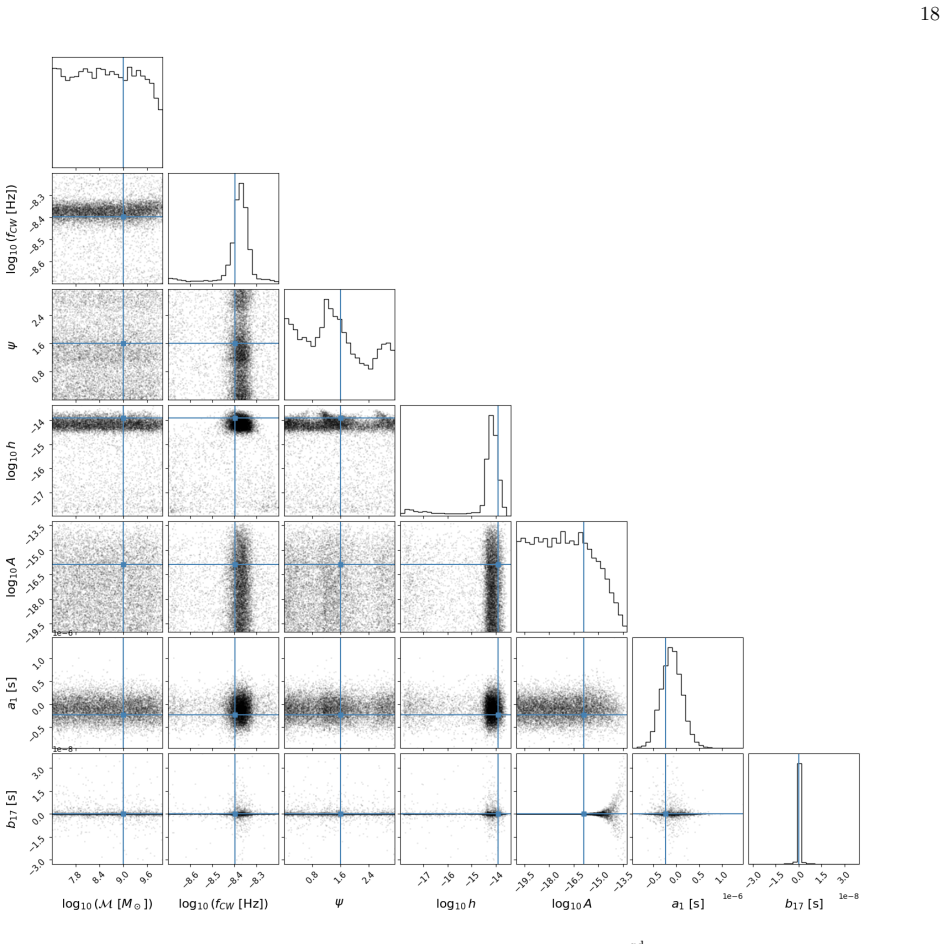
Summary. The paper presents a reparameterization of the hierarchical PTA posterior that samples Fourier coefficients numerically rather than analytically marginalizing them. By applying a standardizing (whitening) transform based on the Laplace mean and a CURN Cholesky factor of the coefficient covariance, the latent coefficients become approximately standard normal and can be sampled efficiently with HMC/NUTS on a GPU. The authors derive the transform for pure stochastic models, then generalize it to deterministic signals (e.g. continuous waves), inter-frequency correlations, tempered likelihoods, split GWB/RN coefficients, and non-Gaussian priors. On NANOGrav 15-year-scale data they report converged posteriors for HD-correlated GWB + pulsar RN (and joint CW) models in ~15 minutes on a single RTX 3090, more than an order of magnitude faster than an equivalent JAX analytically-marginalized baseline and far faster than ENTERPRISE on a CPU cluster. Validation includes direct posterior comparison with ENTERPRISE on the real 15-year data set and recovery of injected parameters on a 100-pulsar simulation.
Significance. If the reported speedups and posterior fidelity hold, this is a substantial practical advance for PTA gravitational-wave analysis. It removes a long-standing computational bottleneck that has restricted joint stochastic–deterministic modeling and free-spectral analyses of full arrays. The derivation is standard hierarchical reparameterization applied carefully to the Lentati-style Fourier-domain posterior; the empirical validation against ENTERPRISE on real data and against known injections is strong; and the authors ship a public implementation (PROMETHEUS) with reproducible figure code. Enabling HD+RN+CW analyses in tens of minutes on a single GPU, rather than hours to months, would materially expand the model space accessible to the PTA community.
minor comments (7)
- Fig. 1 caption: typo “hiearchical” → “hierarchical”.
- Sec. VI A: the quoted effective-sample rates (~1.53 vs ~0.12 ESS/s) should state explicitly which parameters they refer to (hyper-parameters η only, or including the high-dimensional z). A short table of ESS for AGWB, γGWB, and a few RN amplitudes would make the speed claim fully transparent.
- Sec. IV B (after Eq. 29): a brief forward-looking sentence on when the CURN whitening approximation might degrade (e.g. if off-diagonal HD power becomes comparable to the diagonal, or for strongly anisotropic backgrounds) would help readers judge applicability to future data sets, even though the present NANOGrav-scale results support the approximation.
- Sec. VI B / Appendix B: multi-modality of continuous-wave posteriors is acknowledged as future work; a short note on whether the tempered standardizing transform of Appendix B was used (or not) in the Fig. 6 run would clarify the current practical status of joint CW sampling.
- Eq. (31) and Eq. (38): the placement of det(LCURN) relative to the prior normalization is correct but dense; a one-line reminder that this is the absolute value of the Jacobian determinant of the map z → a would aid readers less familiar with non-centered parameterizations.
- Fig. 3: the polynomial scaling fits are quoted for Np > 60; stating the exact fit range and whether timing includes only the log-density evaluation or a full NUTS leapfrog step would improve reproducibility of the scaling claim.
- References: a few arXiv-only citations (e.g. recent non-Gaussian GWB papers) may have journal versions by publication time; a final pass would be useful.
Circularity Check
No significant circularity: standardizing transform is a standard Laplace/non-centered reparameterization of the same posterior that is sampled; validation is against ENTERPRISE and injections.
full rationale
The paper's central claim is a computational reparameterization (standardizing / whitening transform of Fourier coefficients under a CURN Laplace approximation of mean and covariance, Eqs. 29–31 and generalizations) that removes Neal's funnel so HMC/NUTS can sample the hyper-efficient Lentati-style posterior numerically rather than analytically marginalizing. The transform is constructed from the target density itself (MAP and Hessian of Eq. 28, then CURN approx for cost), samples are mapped back by the inverse, and the Metropolis step evaluates the full (HD-correlated) density; inference is therefore identical by construction to the untransformed model, not a prediction forced by a fitted input. Empirical speed and correctness are demonstrated by reproducing NANOGrav 15-year power-law and free-spectrum posteriors against ENTERPRISE (Figs. 4–5) and recovering injected CW+HD+RN parameters (Fig. 6). Self-citations supply prior posterior formulations and sampling attempts; none is a load-bearing uniqueness theorem or ansatz that forces the 15-minute claim. The CURN whitening approximation is explicitly approximate and is justified by published Bayes factors on the same data, not by circular definition. No step reduces a claimed first-principles result to its own inputs.
Axiom & Free-Parameter Ledger
free parameters (2)
- Nf (number of Fourier frequency bins) =
14 / 30 / 60 (analysis-dependent)
- hyper-prior bounds on log10 A and gamma
axioms (4)
- domain assumption The Laplace approximation supplies a sufficiently accurate local mean and covariance for the Fourier coefficients that the subsequent linear whitening yields near-standard-normal variables.
- ad hoc to paper A CURN (diagonal) approximation to the prior covariance is adequate for the whitening transform even though the target posterior retains full Hellings–Downs correlations.
- domain assumption White-noise parameters (EFAC/EQUAD/ECORR) may be fixed from single-pulsar analyses without biasing the multi-pulsar inference.
- standard math HMC/NUTS with a Euclidean-Gaussian kinetic energy efficiently samples high-dimensional near-standard-normal targets.
read the original abstract
Pulsar timing array data analysis is computationally expensive, limiting the complexity of models which can be studied. As pulsar timing datasets and their respective models grow in size and sophistication, faster and scalable inference methods are essential. In this paper, we accelerate pulsar timing analyses by sampling in the space of Fourier coefficients instead of analytically marginalizing over them. Previous studies have shown the Fourier space induces a complex, high-dimensional posterior geometry, from which it is generally difficult to sample. We show that under an appropriate coordinate transformation the Fourier coefficients approximately follow a standard normal distribution, and may be efficiently sampled using a Hamiltonian Monte Carlo scheme. Under this coordinate transformation, for datasets of size and complexity comparable to the NANOGrav 15-year release, the new method produces converged posterior distributions for a range of models which include inter-pulsar correlations, stochastic, and deterministic signals in approximately 15 minutes on an NVIDIA GeForce RTX 3090 GPU. By comparison, the legacy pulsar timing analysis software \texttt{ENTERPRISE} would require months of computation on a CPU cluster to analyze comparable datasets under the same joint stochastic and deterministic models.
Figures



Reference graph
Works this paper leans on
-
[1]
for rapid PTA parameter estimation. These meth- ods are currently being added to theDISCOVERY[95] andATLAS(in preparation) packages as well for next- generation PTA analyses. WithinPROMETHEUS, the pos- terior density and standardizing transform are imple- mented inJAX[17]. The sampling is performed with NUMPYRO[83, 84]. Figures are created withMATPLOTLIB
-
[2]
andCORNER[97]. The simulated datasets and code to reproduce figures presented in this work are publicly available at [98]. Data. Simulated data is generated with theNUMPY package [99]. The North American Nanohertz Observa- tory for Gravitational Waves (NANOGrav) 15-year Data Set [100] is analyzed using the methods presented in this paper to reproduce exis...
-
[3]
M. V. Sazhin, Sov. Astron.22, 36 (1978)
work page 1978
- [4]
-
[5]
Agazieet al.(NANOGrav Collaboration), The As- trophysical Journal Letters951, L8 (2023)
G. Agazieet al.(NANOGrav Collaboration), The As- trophysical Journal Letters951, L8 (2023)
work page 2023
-
[6]
D. J. Reardonet al.(Parkes Pulsar Timing Array), The Astrophysical Journal Letters951, L6 (2023)
work page 2023
-
[7]
EPTA Collaboration, InPTA Collaboration,et al., As- tron. Astrophys.678, A50 (2023), arXiv:2306.16214 [astro-ph.HE]
work page internal anchor Pith review Pith/arXiv arXiv 2023
-
[8]
H. Xuet al.(Chinese Pulsar Timing Array), Research in Astronomy and Astrophysics23, 075024 (2023), arXiv:2306.16216 [astro-ph.HE]
work page internal anchor Pith review Pith/arXiv arXiv 2023
-
[9]
M. T. Mileset al.(MeerKAT Pulsar Timing Array), Monthly Notices of the Royal Astronomical Society536, 1489 (2025), https://academic.oup.com/mnras/article- pdf/536/2/1489/61215196/stae2571.pdf
work page 2025
-
[10]
Ultra-Low Frequency Gravitational Radiation from Massive Black Hole Binaries
M. Rajagopal and R. W. Romani, Astrophys. J.446, 543 (1995), arXiv:astro-ph/9412038 [astro-ph]
work page internal anchor Pith review Pith/arXiv arXiv 1995
-
[11]
A. H. Jaffe and D. C. Backer, The Astrophysical Journal 583, 616 (2003)
work page 2003
-
[12]
J. S. B. Wyithe and A. Loeb, The Astrophysical Journal 590, 691 (2003)
work page 2003
-
[13]
A. Sesana, F. Haardt, P. Madau, and M. Volonteri, Astrophys. J.611, 623 (2004), arXiv:astro-ph/0401543 [astro-ph]
work page internal anchor Pith review Pith/arXiv arXiv 2004
-
[14]
S. T. McWilliams, J. P. Ostriker, and F. Pretorius, Astrophys. J.789, 156 (2014), arXiv:1211.5377 [astro- ph.CO]
work page internal anchor Pith review Pith/arXiv arXiv 2014
-
[15]
S. Burke-Spolaor, S. R. Taylor, M. Charisi, T. Dolch, J. S. Hazboun, A. M. Holgado, L. Z. Kelley, T. J. W. Lazio, D. R. Madison, N. McMann, C. M. F. Mingarelli, A. Rasskazov, X. Siemens, J. J. Simon, and T. L. Smith, The Astronomy and Astrophysics Review27, 5 (2019)
work page 2019
-
[16]
Afzalet al.(NANOGrav Collaboration), The Astro- physical Journal Letters951, L11 (2023)
A. Afzalet al.(NANOGrav Collaboration), The Astro- physical Journal Letters951, L11 (2023)
work page 2023
-
[17]
M. Vallisneri, M. Crisostomi, A. D. Johnson, and P. M. Meyers, Phys. Rev. Lett.135, 071401 (2025)
work page 2025
-
[18]
D. Shih, M. Freytsis, S. R. Taylor, J. A. Dror, and N. Smyth, Phys. Rev. Lett.133, 011402 (2024)
work page 2024
-
[19]
J. Bradbury, R. Frostig, P. Hawkins, M. J. Johnson, C. Leary, D. Maclaurin, G. Necula, A. Paszke, J. Van- derPlas, S. Wanderman-Milne, and Q. Zhang, JAX: composable transformations of Python+NumPy pro- grams,http://github.com/jax-ml/jax(2018). 24
work page 2018
-
[20]
J. A. Ellis, M. Vallisneri, S. R. Taylor, and P. T. Baker, ENTERPRISE: Enhanced Numerical Toolbox Enabling a Robust PulsaR Inference SuitE, Astrophysics Source Code Library, record ascl:1912.015 (2019)
work page 1912
-
[21]
L. Lentati, P. Alexander, M. P. Hobson, S. Taylor, J. Gair, S. T. Balan, and R. van Haasteren, Phys. Rev. D87, 104021 (2013)
work page 2013
-
[22]
R. van Haasteren and M. Vallisneri, Phys. Rev. D90, 104012 (2014)
work page 2014
-
[23]
N. Laal, W. G. Lamb, J. D. Romano, X. Siemens, S. R. Taylor, and R. van Haasteren, Phys. Rev. D108, 063008 (2023)
work page 2023
-
[24]
N. Laal, S. R. Taylor, R. van Haasteren, W. G. Lamb, and X. Siemens, Phys. Rev. D111, 063067 (2025)
work page 2025
- [25]
-
[26]
A. Gundersen and N. J. Cornish, arXiv e-prints (2025), arXiv:2510.12917 [stat.ME]
-
[27]
S. R. Taylor, J. Simon, and L. Sampson, Phys. Rev. Lett.118, 181102 (2017)
work page 2017
-
[28]
M. Vallisneri and R. van Haasteren, Monthly Notices of the Royal Astronomical Society466, 4954 (2017)
work page 2017
-
[29]
A Conceptual Introduction to Hamiltonian Monte Carlo
M. Betancourt, arXiv e-prints (2017), arXiv:1701.02434 [stat.ME]
work page internal anchor Pith review Pith/arXiv arXiv 2017
- [30]
- [31]
-
[32]
G. E. Freedman, A. D. Johnson, R. van Haasteren, and S. J. Vigeland, Phys. Rev. D107, 043013 (2023)
work page 2023
-
[33]
G. E. Freedman and S. J. Vigeland, Phys. Rev. D110, 063038 (2024)
work page 2024
-
[34]
Buikemaet al.(LIGO Scientific Collaboration), Phys
A. Buikemaet al.(LIGO Scientific Collaboration), Phys. Rev. D102, 062003 (2020)
work page 2020
-
[35]
Acerneseet al.(Virgo Collaboration), Phys
F. Acerneseet al.(Virgo Collaboration), Phys. Rev. Lett.123, 231108 (2019)
work page 2019
-
[36]
A. G. Abacet al.(LIGO Scientific, Virgo, and KAGRA Collaborations), Gwtc-5.0: An introduction to version 5.0 of the gravitational-wave transient catalog (2026), arXiv:2605.27223 [gr-qc]
work page internal anchor Pith review Pith/arXiv arXiv 2026
-
[37]
M. R. Adams, N. J. Cornish, and T. B. Littenberg, Phys. Rev. D86, 124032 (2012), arXiv:1209.6286 [gr- qc]
work page internal anchor Pith review Pith/arXiv arXiv 2012
- [38]
-
[39]
S. Vitale, D. Gerosa, W. M. Farr, and S. R. Taylor, Inferring the properties of a population of compact bi- naries in presence of selection effects, inHandbook of Gravitational Wave Astronomy, edited by C. Bambi, S. Katsanevas, and K. D. Kokkotas (Springer Singapore, Singapore, 2020) pp. 1–60
work page 2020
- [40]
-
[41]
S. R. Taylor and D. Gerosa, Phys. Rev. D98, 083017 (2018)
work page 2018
-
[42]
van Haasteren, The Astrophysical Journal Supple- ment Series273, 23 (2024)
R. van Haasteren, The Astrophysical Journal Supple- ment Series273, 23 (2024)
work page 2024
-
[43]
B. Goncharov, E. Thrane, R. M. Shannon, J. Harms, N. D. R. Bhat, G. Hobbs, M. Kerr, R. N. Manchester, D. J. Reardon, C. J. Russell, X.-J. Zhu, and A. Zic, The Astrophysical Journal Letters932, L22 (2022)
work page 2022
-
[44]
B. Goncharov and S. Sardana, Monthly Notices of the Royal Astronomical Society537, 3470 (2025), https://academic.oup.com/mnras/article- pdf/537/4/3470/61743825/staf190.pdf
work page 2025
- [45]
-
[46]
R. M. Neal, The Annals of Statistics31, 705 (2003)
work page 2003
-
[47]
N. Metropolis, A. W. Rosenbluth, M. N. Rosenbluth, A. H. Teller, and E. Teller, J. Chem. Phys.21, 1087 (1953)
work page 1953
-
[48]
M. Girolami and B. Calderhead, Journal of the Royal Statistical Society: Series B (Statistical Methodology)73, 123 (2011), https://rss.onlinelibrary.wiley.com/doi/pdf/10.1111/j.1467- 9868.2010.00765.x
-
[49]
Betancourt, inGeometric Science of Information, edited by F
M. Betancourt, inGeometric Science of Information, edited by F. Nielsen and F. Barbaresco (Springer Berlin Heidelberg, Berlin, Heidelberg, 2013) pp. 327–334
work page 2013
-
[50]
O. Papaspiliopoulos, G. O. Roberts, and M. Sk¨ old, Sta- tistical Science22, 59 (2007)
work page 2007
-
[52]
Agazieet al.(NANOGrav Collaboration), The As- trophysical Journal Letters951, L10 (2023)
G. Agazieet al.(NANOGrav Collaboration), The As- trophysical Journal Letters951, L10 (2023)
work page 2023
-
[53]
R. M. Shannon and J. M. Cordes, The Astrophysical Journal725, 1607 (2010)
work page 2010
- [54]
-
[55]
M. J. Keith, W. Coles, R. M. Shannon, G. B. Hobbs, R. N. Manchester, M. Bailes, N. D. R. Bhat, S. Burke- Spolaor, D. J. Champion, A. Chaudhary, A. W. Hotan, J. Khoo, J. Kocz, S. Os lowski, V. Ravi, J. E. Reynolds, J. Sarkissian, W. van Straten, and D. R. B. Yard- ley, Mon. Not. R. Astron. Soc.429, 2161 (2013), arXiv:1211.5887 [astro-ph.GA]
work page internal anchor Pith review Pith/arXiv arXiv 2013
-
[56]
K. J. Lee, C. G. Bassa, G. H. Janssen, R. Karuppusamy, M. Kramer, K. Liu, D. Perrodin, R. Smits, B. W. Stap- pers, R. van Haasteren, and L. Lentati, Monthly No- tices of the Royal Astronomical Society441, 2831–2844 (2014)
work page 2014
-
[57]
Pulsar Timing Array Observations of Massive Black Hole Binaries
V. Corbin and N. J. Cornish, arXiv e-prints (2010), arXiv:1008.1782 [astro-ph.HE]
work page internal anchor Pith review Pith/arXiv arXiv 2010
-
[58]
K. J. Lee, N. Wex, M. Kramer, B. W. Stappers, C. G. Bassa, G. H. Janssen, R. Karuppusamy, and R. Smits, Monthly Notices of the Royal Astronomical Society414, 3251–3264 (2011)
work page 2011
-
[59]
Nonlinear gravitational-wave memory from binary black hole mergers
M. Favata, Astrophys. J. Lett.696, L159 (2009), arXiv:0902.3660 [astro-ph.SR]
work page internal anchor Pith review Pith/arXiv arXiv 2009
- [60]
-
[61]
D. J. Champion, G. B. Hobbs, R. N. Manchester, R. T. Edwards, D. C. Backer, M. Bailes, N. D. R. Bhat, S. Burke-Spolaor, W. Coles, P. B. Demorest, R. D. Fer- dman, W. M. Folkner, A. W. Hotan, M. Kramer, A. N. Lommen, D. J. Nice, M. B. Purver, J. M. Sarkissian, I. H. Stairs, W. van Straten, J. P. W. Verbiest, and D. R. B. Yardley, The Astrophysical Journal ...
work page 2010
-
[62]
M. Vallisneri, S. R. Taylor, J. Simon, W. M. Folkner, R. S. Park, C. Cutler, J. A. Ellis, T. J. W. Lazio, S. J. Vigeland, K. Aggarwal, Z. Arzoumanian, P. T. Baker, A. Brazier, P. R. Brook, S. Burke-Spolaor, S. Chatter- jee, J. M. Cordes, N. J. Cornish, F. Crawford, H. T. Cromartie, K. Crowter, M. DeCesar, P. B. Demorest, T. Dolch, R. D. Ferdman, E. C. Fer...
work page 2020
-
[63]
J. A. Ellis, X. Siemens, and J. D. E. Creighton, The Astrophysical Journal756, 175 (2012)
work page 2012
-
[64]
J. A. Ellis, Classical and Quantum Gravity30, 224004 (2013)
work page 2013
- [65]
-
[66]
R. W. Hellings and G. S. Downs, Astrophys. J. Lett. 265, L39 (1983)
work page 1983
-
[67]
L. Sampson, N. J. Cornish, and S. T. McWilliams, Phys. Rev. D91, 084055 (2015)
work page 2015
- [68]
-
[69]
G. Agazie, et al, and Nanograv Collaboration, Astro- phys. J. Lett.952, L37 (2023), arXiv:2306.16220 [astro- ph.HE]
work page internal anchor Pith review Pith/arXiv arXiv 2023
-
[70]
S. R. Taylor, J. R. Gair, and L. Lentati, Phys. Rev. D 87, 044035 (2013)
work page 2013
-
[71]
S. R. Taylor, J. Simon, L. Schult, N. Pol, and W. G. Lamb, Phys. Rev. D105, 084049 (2022), arXiv:2202.08293 [gr-qc]
work page internal anchor Pith review Pith/arXiv arXiv 2022
-
[72]
W. G. Lamb, S. R. Taylor, and R. van Haasteren, Phys. Rev. D108, 103019 (2023)
work page 2023
-
[73]
W. G. Lamb and S. R. Taylor, The Astrophysical Jour- nal Letters971, L10 (2024)
work page 2024
-
[74]
W. G. Lamb, J. M. Wachter, A. Mitridate, S. C. Sarde- sai, B. B´ ecsy, E. L. Hagen, S. R. Taylor, and L. Z. Kelley, Phys. Rev. D113, 123065 (2026)
work page 2026
- [75]
-
[76]
The distribution of the gravitational-wave background from supermassive black holes
G. Sato-Polito and M. Zaldarriaga, The distribution of the gravitational-wave background from supermassive black holes (2024), arXiv:2406.17010 [astro-ph.CO]
work page internal anchor Pith review Pith/arXiv arXiv 2024
-
[77]
X. Xue, Z. Pan, and L. Dai, Non-gaussian statis- tics of nanohertz stochastic gravitational waves (2025), arXiv:2409.19516 [astro-ph.CO]
work page internal anchor Pith review Pith/arXiv arXiv 2025
-
[78]
The Heavy Tailed Non-Gaussianity of the Supermassive Black Hole Gravitational Wave Background
J. Raidal, J. Urrutia, V. Vaskonen, and H. Veerm¨ ae, The heavy tailed non-gaussianity of the supermas- sive black hole gravitational wave background (2026), arXiv:2604.08506 [astro-ph.CO]
work page internal anchor Pith review Pith/arXiv arXiv 2026
-
[79]
On measuring the gravitational-wave background using Pulsar Timing Arrays
R. van Haasteren, Y. Levin, P. McDonald, and T. Lu, Mon. Not. R. Astron. Soc.395, 1005 (2009), arXiv:0809.0791 [astro-ph]
work page internal anchor Pith review Pith/arXiv arXiv 2009
-
[80]
van Haasteren, Monthly Notices of the Royal Astro- nomical Society429, 55–62 (2012)
R. van Haasteren, Monthly Notices of the Royal Astro- nomical Society429, 55–62 (2012)
work page 2012
-
[81]
Understanding and analysing time-correlated stochastic signals in pulsar timing
R. van Haasteren and Y. Levin, Mon. Not. Roy. Astron. Soc.428, 1147 (2013), arXiv:1202.5932 [astro-ph.IM]
work page internal anchor Pith review Pith/arXiv arXiv 2013
discussion (0)
Sign in with ORCID, Apple, or X to comment. Anyone can read and Pith papers without signing in.