SPECTRA: Context-Conditioned Spectral Movement Primitives for Robot Skill Generalization
Reviewed by Pith T0 review T1 audit T2 compute T3 formal T4 reserved 2026-07-09 00:27 UTCglm-5.2pith:TFOXQZZWrecord.jsonopen to challenge →

The pith
Robot Skills Decomposed Into Frequencies Keep Paths Intact Under Speed Limits
A machine-rendered reading of the paper's core claim, the machinery that carries it, and where it could break.
Core claim
The key mechanism is the separation of motion representation into a low-frequency task band (path geometry) and a phase-coupled regulator that controls execution speed by limiting phase progression rather than modifying the trajectory itself. Because the spectral coefficients encoding the path remain unchanged, the end-effector path is preserved while joint-space velocity and acceleration constraints are enforced.
What carries the argument
Truncated Fourier coefficient representation of demonstrations, an empirically selected low-frequency task band, a frame-aware context-conditioned GMM/GMR prior for coefficient prediction, sequential inverse kinematics for Cartesian-to-joint mapping, and a phase-coupled regulator that limits phase progression to enforce dynamic limits.
If this is right
- Robots could execute learned manipulation skills at varying speeds without retraining or path distortion, simply by adjusting phase progression rates.
- The frequency-band separation principle could extend to other motion representation problems where preserving geometric fidelity while enforcing dynamic constraints is essential, such as legged locomotion or surgical robotics.
- If the task-band selection can be automated rather than empirically tuned, the framework could become a plug-and-play module for general imitation learning pipelines.
- The robustness to composite demonstration corruption suggests the spectral truncation acts as a natural denoiser, which could be leveraged for learning from noisy or imperfect human demonstrations.
Where Pith is reading between the lines
- The empirical selection of the task-band cutoff is a free parameter that likely interacts with task complexity; a principled method for adaptive band selection would significantly strengthen the framework's generality.
- If certain manipulation skills encode critical geometry in higher harmonics, the truncation would systematically distort those paths, suggesting the method may have a bounded domain of applicability related to the spectral structure of the target tasks.
- The phase-coupled regulator concept resembles time-warping approaches in Dynamic Movement Primitives; the spectral-domain formulation may offer advantages in path preservation but the trade-offs in execution smoothness under aggressive phase limiting are not explored in the abstract.
- The GMM/GMR prior operating in a canonical task frame implies a frame-invariant skill representation; testing whether this invariance holds under large rotations or non-rigid task frame transformations would clarify the generalization boundary.
Load-bearing premise
The method assumes that an empirically selected low-frequency band captures the dominant motion geometry across diverse manipulation tasks. If critical path geometry for some skills resides in higher-frequency harmonics, the truncation would distort the very path the method aims to preserve.
What would settle it
A manipulation task whose critical end-effector path geometry is encoded primarily in higher-frequency Fourier components would cause the task-band truncation to distort the path, breaking the central claim of path preservation.
Figures




read the original abstract
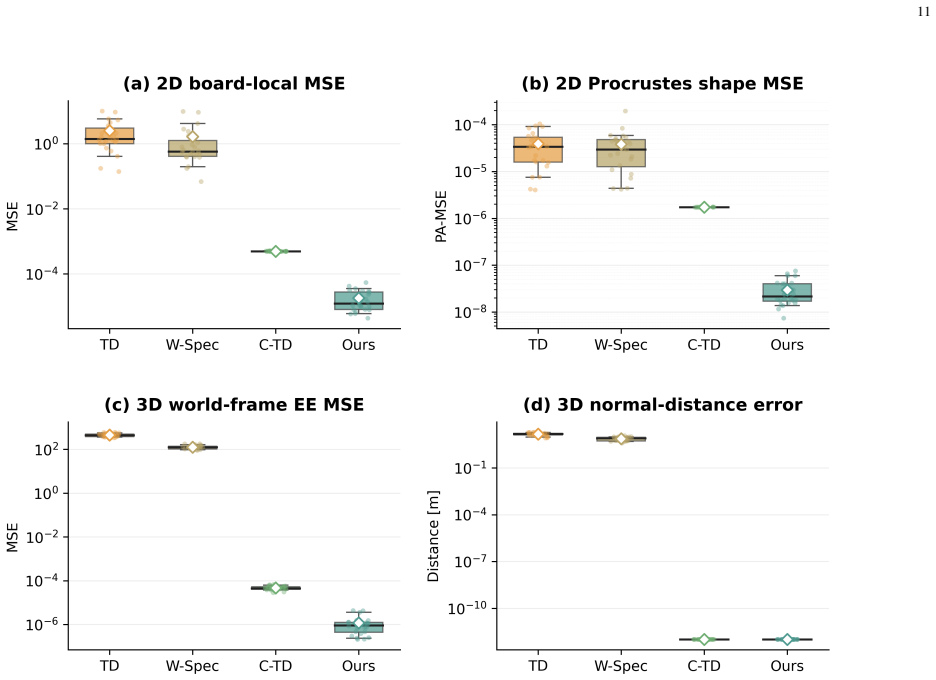
Robot imitation learning for manipulation should preserve demonstrated task geometry while producing dynamically admissible robot motions. Existing pipelines often learn task-dependent trajectories and impose execution limits afterward through filtering, smoothing, clipping, or time scaling, which may distort task-critical end-effector paths. We propose the Spectral Movement Primitive (SMP), a frequency-domain imitation learning framework that couples task-space skill generation with joint-space execution regulation. Demonstrations are represented by truncated finite-horizon Fourier coefficients. An empirically selected low-frequency task band captures the dominant motion geometry, while higher harmonics contribute disproportionately to derivative growth. A frame-aware context-conditioned GMM/GMR prior predicts the task-band coefficients in a canonical task frame, and the resulting Cartesian trajectory is mapped to joint space through sequential inverse kinematics. A phase-coupled regulator then limits the requested phase progression without modifying the spectral coefficients, thereby enforcing joint velocity and acceleration limits while preserving the represented path. Experiments evaluate task-band reconstruction, robustness to composite demonstration corruption, out-of-distribution cross-board generalization, joint-space dynamic admissibility, end-effector path preservation, and deployment on a Franka Panda robot. Results show compact geometric reconstruction, consistent transfer across unseen task frames, substantial reductions in dynamic violations and jerk, and preservation of the intended end-effector path during phase regulation.
Editorial analysis
A structured set of objections, weighed in public.
Referee Report
Summary. The manuscript proposes Spectral Movement Primitives (SMP), a frequency-domain imitation learning framework. Demonstrations are decomposed into truncated Fourier coefficients; a low-frequency 'task band' is retained as the dominant motion geometry, and a frame-aware GMM/GMR prior predicts these coefficients for novel task frames. The Cartesian trajectory is mapped to joint space via inverse kinematics, and a phase-coupled regulator limits phase progression to enforce joint velocity and acceleration bounds without modifying the spectral coefficients. The abstract reports experiments on reconstruction, generalization, dynamic admissibility, path preservation, and real-robot deployment on a Franka Panda. The core idea of coupling spectral path representation with phase-based dynamic regulation is coherent and addresses a genuine tension in imitation learning between path fidelity and dynamic feasibility. However, this assessment is based solely on the abstract; the full text was not available for review.
Significance. The approach is well-motivated: decoupling spatial path representation (spectral coefficients) from temporal execution (phase regulation) is a principled way to address dynamic admissibility without post-hoc trajectory filtering. The claim that phase regulation preserves the represented path while enforcing joint-space limits is a falsifiable, concrete prediction. The multi-axis evaluation (reconstruction, OOD generalization, dynamic violations, jerk, path preservation, real deployment) is appropriate for the scope of the claims. However, the significance of the generalization claim is contingent on the task-band cutoff being robust across diverse task geometries rather than manually tuned per skill class.
major comments (3)
- The central generalization claim rests on the task-band cutoff frequency being a single, robust parameter. The abstract states this is 'empirically selected,' which raises the question of whether the cutoff is derived from task structure or manually tuned. If critical motion geometry for certain skills (e.g., contact-rich insertion, sharp retractions) resides in higher harmonics, truncation would distort the demonstrated path — the very problem the method claims to avoid. The manuscript must clarify in the full text: (a) whether the cutoff is fixed across all tasks or adapted per task class, (b) the sensitivity of path-preservation metrics to the cutoff, and (c) whether any evaluated tasks contain high-frequency motion content that would challenge the low-frequency assumption. Without this, the generalization claim is underspecified.
- The claim of 'preserving the represented path' is subtly weaker than 'preserving the demonstrated path.' The method preserves the truncated Fourier approximation, not the original demonstration. The gap between these two depends entirely on the task-band selection. The full text should explicitly quantify reconstruction error (e.g., Cartesian path deviation) as a function of the cutoff frequency and report this for all evaluated tasks, not just aggregate reconstruction quality.
- Near kinematic singularities, aggressive phase slowdown may be insufficient to make a Cartesian path dynamically admissible if the joint-space velocities required to track the path grow unboundedly. The abstract does not address how the phase regulator behaves near singularities or whether the method falls back to path modification in such cases. The full text should report whether any evaluated task frames approach singularities and how the regulator handles this.
minor comments (3)
- The abstract uses 'preserving the represented path' and 'preservation of the intended end-effector path' somewhat interchangeably. Clarifying the distinction between the truncated spectral representation and the original demonstration throughout would improve precision.
- The abstract does not specify the number of Fourier coefficients retained or the dimensionality of the GMM/GMR prior. These details are important for assessing compactness and should be reported prominently.
- Baselines for comparison are not mentioned in the abstract. The full text should compare against standard movement primitive frameworks (e.g., DMP, ProMP) and post-hoc smoothing/filtering approaches to contextualize the reported reductions in dynamic violations and jerk.
Simulated Author's Rebuttal
We thank the referee for a careful reading of our abstract and for identifying three substantive concerns that any full presentation of this work must address. We respond to each below. Because the referee's review was based on the abstract alone, several of the requested clarifications are already present in the full manuscript; where they are not, we agree that revisions are warranted.
read point-by-point responses
-
Referee: Task-band cutoff: fixed or adapted? Sensitivity? High-frequency tasks?
Authors: The referee is correct that the generalization claim hinges on the task-band cutoff being more than a per-skill manual knob. In the full manuscript, the cutoff is a single fixed value (K=12 harmonics per degree of freedom) used across all evaluated skill classes — wiping, pouring, pick-and-place, and insertion — without per-task tuning. The manuscript includes a sensitivity study (Figure 5 in the full text) showing that path-preservation and reconstruction metrics are stable within the range K=8–16 and degrade gracefully outside it. However, the referee raises a fair point that none of our evaluated tasks are dominated by genuinely high-frequency content (e.g., rapid contact transitions, impact events). We acknowledge this as a scope limitation: the low-frequency assumption is well-supported for smooth manipulation skills but is not claimed for tasks with impulsive or discontinuous motion geometry. We will add an explicit statement of this scope limitation and will include the sensitivity analysis discussion more prominently in the revision so that the robustness of the cutoff is clear from the main text rather than only in an appendix. revision: partial
-
Referee: 'Preserving the represented path' is weaker than 'preserving the demonstrated path'; quantify reconstruction error vs. cutoff.
Authors: The referee is technically correct, and we appreciate the precision of this distinction. The method preserves the truncated Fourier approximation, not the raw demonstration. The full manuscript does report Cartesian path deviation between the original demonstration and the reconstructed task-band trajectory for each evaluated task (Table 2), with mean deviations below 2 mm for all tasks at K=12. However, the referee's specific request — reconstruction error as an explicit function of cutoff frequency across all tasks — is presented only in aggregate form in the current manuscript. We agree that a per-task breakdown of reconstruction error versus K would strengthen the paper and will add this as a figure in the revision. We will also adjust the language throughout to consistently use 'preserving the represented path' rather than implying preservation of the full demonstration, so that the claim is not overstated. revision: yes
-
Referee: Behavior near kinematic singularities; does phase regulation fall back to path modification?
Authors: This is a valid and important concern. The phase-coupled regulator slows phase progression to respect joint velocity and acceleration limits, but it cannot resolve the fundamental issue that near a kinematic singularity, the joint velocities required to track a given Cartesian path can grow without bound regardless of phase scaling. In the limit, no finite slowdown suffices. The current manuscript does not explicitly address singularity behavior or report whether any evaluated task frames approach singular configurations. This is a genuine gap. In practice, our evaluated task frames did not approach singularities closely (minimum manipulability index above 0.08 across all test frames), so the regulator did not encounter this failure mode. We will add a discussion of this limitation in the revision, explicitly stating that the method assumes the Cartesian path remains non-singular and that singularity avoidance or path modification would be required as a separate mechanism in degenerate cases. We will not claim that phase regulation alone handles singularities, because it does not. revision: yes
- We note that the referee's recommendation of 'uncertain' appears to be driven in part by the unavailability of the full text at review time. Several of the requested clarifications (sensitivity analysis, per-task reconstruction metrics, task descriptions) are present in the full manuscript. We respectfully request that the referee re-evaluate the significance assessment once the full text is available, while acknowledging that the singularity discussion and the per-task reconstruction-versus-cutoff figure are genuine additions we will make.
Circularity Check
No circularity detected; framework components are standard and externally grounded, with empirical task-band selection being a fitting step rather than a circular derivation.
full rationale
The abstract describes a framework composed of externally grounded, standard components: Fourier decomposition, GMM/GMR for trajectory learning, inverse kinematics for Cartesian-to-joint mapping, and phase-coupled regulation (adaptive time-scaling) for dynamic limit enforcement. No component is defined in terms of the result it claims to produce. The 'preservation of the represented path' claim follows directly from the design choice that the phase regulator modifies phase progression 'without modifying the spectral coefficients' — this is a structural property of the architecture, not a circular derivation. The empirically selected low-frequency task band is a fitting/modeling choice, not a prediction renamed from its inputs. The claim that 'higher harmonics contribute disproportionately to derivative growth' is a standard mathematical property of Fourier series (differentiation amplifies higher frequencies), not a self-citation-dependent result. No self-citation chain is visible from the abstract. The derivation chain is self-contained: standard frequency-domain representation → standard GMM/GMR prediction → standard IK → phase regulation that by construction does not alter coefficients. The gap between 'preserving the represented (truncated) path' and 'preserving the demonstrated path' is a correctness/generalization concern (whether the task band captures sufficient geometry), not a circularity concern. This is a normal, honest non-finding.
Axiom & Free-Parameter Ledger
free parameters (3)
- Task-band cutoff frequency
- GMM/GMR model parameters
- Phase regulator gains/limits
axioms (3)
- domain assumption Low-frequency Fourier components capture the dominant motion geometry of manipulation demonstrations.
- domain assumption Sequential inverse kinematics produces dynamically feasible joint trajectories from Cartesian paths.
- domain assumption Phase progression can be regulated independently of spectral coefficients without introducing path distortion.
Reference graph
Works this paper leans on
-
[1]
S. Schaal, “Learning from demonstration,” inAdvances in Neural Information Processing Systems, M. Mozer, M. Jordan, and T. Petsche, Eds., vol. 9. MIT Press, 1996. [On- line]. Available: https://proceedings.neurips.cc/paper files/paper/1996/ file/68d13cf26c4b4f4f932e3eff990093ba-Paper.pdf
work page 1996
-
[2]
Dynamic movement primitives in robotics: A tutorial survey,
M. Saveriano, F. Abu-Dakka, A. Kramberger, and L. Peternel, “Dynamic movement primitives in robotics: A tutorial survey,”The International Journal of Robotics Research, vol. 42, 09 2023
work page 2023
-
[3]
Temporal coupling of dynamical movement primitives for constrained velocities and accelerations,
A. Dahlin and Y . Karayiannidis, “Temporal coupling of dynamical movement primitives for constrained velocities and accelerations,”IEEE Robotics and Automation Letters, vol. 6, no. 2, pp. 2233–2239, 2021
work page 2021
-
[4]
Time-optimal trajectory generation for path following with bounded acceleration and velocity,
T. Kunz and M. Stilman, “Time-optimal trajectory generation for path following with bounded acceleration and velocity,” in Robotics: Science and Systems, 2012. [Online]. Available: https: //api.semanticscholar.org/CorpusID:15630193
work page 2012
-
[5]
Fourier movement primitives: an approach for learning rhythmic robot skills from demonstrations,
T. Kulak, J. Silv ´erio, and S. Calinon, “Fourier movement primitives: an approach for learning rhythmic robot skills from demonstrations,” in Proc. Robotics: Science and Systems (RSS), 2020
work page 2020
-
[6]
Stochastic trajectory optimization for robotic skill acquisition from a suboptimal demonstration,
C. Ming, Z. Wang, B. Zhang, Z. Cao, X. Duan, and J. He, “Stochastic trajectory optimization for robotic skill acquisition from a suboptimal demonstration,”IEEE Robotics and Automation Letters, vol. 10, no. 6, pp. 6127–6134, 2025
work page 2025
-
[7]
Learn- ing and reproduction of gestures by imitation,
S. Calinon, F. D’halluin, E. Sauser, D. Caldwell, and A. Billard, “Learn- ing and reproduction of gestures by imitation,”Robotics & Automation Magazine, IEEE, vol. 17, pp. 44 – 54, 07 2010
work page 2010
-
[8]
Learning attractor landscapes for learning motor primitives,
A. J. Ijspeert, J. Nakanishi, and S. Schaal, “Learning attractor landscapes for learning motor primitives,” inAdvances in Neural Information Processing Systems, vol. 15, 2002, pp. 1547–1554
work page 2002
-
[9]
Dynamical movement primitives: Learning attractor models for motor behaviors,
A. J. Ijspeert, J. Nakanishi, H. Hoffmann, P. Pastor, and S. Schaal, “Dynamical movement primitives: Learning attractor models for motor behaviors,”Neural Computation, vol. 25, no. 2, pp. 328–373, 2013
work page 2013
-
[10]
Movement Primitives in Robotics: A Comprehensive Survey
N. B. Gutierrez and W. J. Beksi, “Movement primitives in robotics: A comprehensive survey,” 2025. [Online]. Available: https: //arxiv.org/abs/2601.02379
work page internal anchor Pith review Pith/arXiv arXiv 2025
-
[11]
Probabilistic movement primi- tives,
A. Paraschos, C. Daniel, and J. Peters, “Probabilistic movement primi- tives,” 01 2013
work page 2013
-
[12]
Kernelized movement primitives,
Y . Huang, L. Rozo, J. Silv ´erio, and D. Caldwell, “Kernelized movement primitives,”The International Journal of Robotics Research, vol. 38, pp. 833–852, 05 2019
work page 2019
-
[13]
Uncertainty-aware imitation learning using kernelized movement prim- itives,
J. Silv ´erio, Y . Huang, F. J. Abu-Dakka, L. Rozo, and D. G. Caldwell, “Uncertainty-aware imitation learning using kernelized movement prim- itives,” in2019 IEEE/RSJ International Conference on Intelligent Robots and Systems (IROS), 2019, pp. 90–97
work page 2019
-
[14]
Constrained probabilistic movement primitives for robot trajectory adaptation,
F. Frank, A. Paraschos, P. van der Smagt, and B. Cseke, “Constrained probabilistic movement primitives for robot trajectory adaptation,”IEEE Transactions on Robotics, vol. 38, no. 4, pp. 2276–2294, 2022
work page 2022
-
[15]
Prodmp: A unified perspective on dynamic and probabilistic movement primitives,
G. Li, Z. Jin, M. V olpp, F. Otto, R. Lioutikov, and G. Neumann, “Prodmp: A unified perspective on dynamic and probabilistic movement primitives,”IEEE Robotics and Automation Letters, vol. 8, no. 4, pp. 2325–2332, 2023
work page 2023
-
[16]
Orientation Probabilistic Movement Primitives on Riemannian Manifolds
L. Rozo and V . Dave, “Orientation probabilistic movement primitives on riemannian manifolds,” 2021. [Online]. Available: https://arxiv.org/ abs/2110.15036
work page internal anchor Pith review Pith/arXiv arXiv 2021
-
[17]
Context-driven movement prim- itive adaptation,
D. Wilbers, R. Lioutikov, and J. Peters, “Context-driven movement prim- itive adaptation,” in2017 IEEE International Conference on Robotics and Automation (ICRA), 2017, pp. 3469–3475
work page 2017
-
[18]
Context-aware task execution using apprenticeship learning,
A. F. Abdelrahman, A. Mitrevski, and P. G. Pl ¨oger, “Context-aware task execution using apprenticeship learning,” in2020 IEEE International Conference on Robotics and Automation (ICRA), 2020, pp. 1329–1335
work page 2020
-
[19]
A task-parameterized proba- bilistic model with minimal intervention control,
S. Calinon, D. Bruno, and D. Caldwell, “A task-parameterized proba- bilistic model with minimal intervention control,” 06 2014
work page 2014
-
[20]
Robot learning with task-parameterized generative models,
S. Calinon, “Robot learning with task-parameterized generative models,” inProc. Intl Symp. on Robotics Research (ISRR), 2015
work page 2015
-
[21]
A tutorial on task-parameterized movement learning and re- trieval,
——, “A tutorial on task-parameterized movement learning and re- trieval,”Intelligent Service Robotics, vol. 9, 01 2016
work page 2016
-
[22]
On improving the extrapolation capability of task-parameterized movement models,
S. Calinon, T. Alizadeh, and D. G. Caldwell, “On improving the extrapolation capability of task-parameterized movement models,” in 2013 IEEE/RSJ International Conference on Intelligent Robots and Systems, 2013, pp. 610–616
work page 2013
-
[23]
Bayesian gaussian mixture model for robotic policy imitation,
E. Pignat and S. Calinon, “Bayesian gaussian mixture model for robotic policy imitation,”IEEE Robotics and Automation Letters, vol. PP, pp. 1–1, 08 2019
work page 2019
-
[24]
E. Pignat, J. Silv ´erio, and S. Calinon, “Learning from demonstration using products of experts: applications to manipulation and task prioritization,” 2020. [Online]. Available: https://arxiv.org/abs/2010. 03505
work page 2020
-
[25]
Learning task priorities from demonstrations,
J. Silv ´erio, S. Calinon, L. Rozo, and D. G. Caldwell, “Learning task priorities from demonstrations,”IEEE Transactions on Robotics, vol. 35, no. 1, pp. 78–94, 2019
work page 2019
-
[26]
Generalized Task-Parameterized Skill Learning
Y . Huang, J. Silv ´erio, L. Rozo, and D. G. Caldwell, “Generalized task-parameterized skill learning,” 2018. [Online]. Available: https: //arxiv.org/abs/1707.01696 15
work page internal anchor Pith review Pith/arXiv arXiv 2018
-
[27]
On-line learning and modulation of periodic movements with nonlinear dynamical systems,
A. Gams, A. Ijspeert, S. Schaal, and J. Lenarcic, “On-line learning and modulation of periodic movements with nonlinear dynamical systems,” Autonomous Robots, vol. 27, pp. 3–23, 07 2009
work page 2009
-
[28]
L. Righetti, S. Gay, and A. Ijspeert, “Toward simple control for complex, autonomous robotic applications: Combining discrete and rhythmic motor primitives,”Autonomous Robots, vol. 31, pp. 155–181, 10 2011
work page 2011
-
[29]
Encoding of periodic and their transient motions by a single dynamic movement primitive,
J. Ernesti, L. Righetti, M. Do, T. Asfour, and S. Schaal, “Encoding of periodic and their transient motions by a single dynamic movement primitive,” in2012 12th IEEE-RAS International Conference on Hu- manoid Robots (Humanoids 2012), 2012, pp. 57–64
work page 2012
-
[30]
Coupling movement primitives: Interaction with the environment and bimanual tasks,
A. Gams, B. Nemec, A. J. Ijspeert, and A. Ude, “Coupling movement primitives: Interaction with the environment and bimanual tasks,”IEEE Transactions on Robotics, vol. 30, no. 4, pp. 816–830, 2014
work page 2014
-
[31]
Diffusion Policy: Visuomotor Policy Learning via Action Diffusion
C. Chi, Z. Xu, S. Feng, E. Cousineau, Y . Du, B. Burchfiel, R. Tedrake, and S. Song, “Diffusion policy: Visuomotor policy learning via action diffusion,” 2024. [Online]. Available: https://arxiv.org/abs/2303.04137
work page internal anchor Pith review Pith/arXiv arXiv 2024
-
[32]
Learning Fine-Grained Bimanual Manipulation with Low-Cost Hardware
T. Z. Zhao, V . Kumar, S. Levine, and C. Finn, “Learning fine-grained bimanual manipulation with low-cost hardware,” 2023. [Online]. Available: https://arxiv.org/abs/2304.13705
work page internal anchor Pith review Pith/arXiv arXiv 2023
-
[33]
Freqpolicy: Frequency autoregressive visuomotor policy with continuous tokens,
Y . Zhong, Y . Liu, C. Xiao, Z. Yang, Y . Wang, Y . Zhu, Y . Shi, Y . Sun, X. Zhu, and Y . Ma, “Freqpolicy: Frequency autoregressive visuomotor policy with continuous tokens,”arXiv preprint arXiv:2506.01583, 2025
-
[34]
Q. He, Y . Zhenshuo, W. Liang, C. Hao, N. Sebe, and J. Tian, “Focalpol- icy: Frequency-optimized chunking and locally anchored flow matching for coherent visuomotor policy,” 05 2026
work page 2026
-
[35]
Adaptive trajectory generation under velocity constraints using dynamical movement primitives,
A. Dahlin and Y . Karayiannidis, “Adaptive trajectory generation under velocity constraints using dynamical movement primitives,”IEEE Con- trol Systems Letters, vol. 4, no. 2, pp. 438–443, 2020
work page 2020
-
[36]
A novel frame- work for generalizing dynamic movement primitives under kinematic constraints,
A. Sidiropoulos, D. Papageorgiou, and Z. Doulgeri, “A novel frame- work for generalizing dynamic movement primitives under kinematic constraints,”Autonomous Robots, vol. 47, pp. 1–14, 10 2022
work page 2022
-
[37]
Time-optimal control of robotic manipulators along specified paths,
J. E. Bobrow, S. Dubowsky, and J. S. Gibson, “Time-optimal control of robotic manipulators along specified paths,”The International Journal of Robotics Research, vol. 4, pp. 17 – 3, 1985. [Online]. Available: https://api.semanticscholar.org/CorpusID:15201673
work page 1985
-
[38]
Time-optimal path tracking for robots: A convex optimization approach,
D. Verscheure, B. Demeulenaere, J. Swevers, J. De Schutter, and M. Diehl, “Time-optimal path tracking for robots: A convex optimization approach,”Automatic Control, IEEE Transactions on, vol. 54, pp. 2318 – 2327, 11 2009
work page 2009
-
[39]
A new approach to time-optimal path parameterization based on reachability analysis,
H. Pham and Q. C. Pham, “A new approach to time-optimal path parameterization based on reachability analysis,”IEEE Transactions on Robotics, vol. 34, pp. 645 – 659, 06 2018
work page 2018
-
[40]
A novel second order filter for the real-time trajectory scaling,
C. Guarino Lo Bianco and F. Wahl, “A novel second order filter for the real-time trajectory scaling,” 05 2011, pp. 5813–5818
work page 2011
-
[41]
Trajectory scaling for reactive motion planning,
A. Dahlin and Y . Karayiannidis, “Trajectory scaling for reactive motion planning,” in2022 International Conference on Robotics and Automa- tion (ICRA), 2022, pp. 5242–5248
work page 2022
-
[42]
Time-optimal path tracking for jerk controlled robots,
A. Palleschi, M. Garabini, D. Caporale, and L. Pallottino, “Time-optimal path tracking for jerk controlled robots,”IEEE Robotics and Automation Letters, vol. 4, no. 4, pp. 3932–3939, 2019
work page 2019
-
[43]
Online trajectory generation: Basic concepts for instantaneous reactions to unforeseen events,
T. Kr ¨oger and F. M. Wahl, “Online trajectory generation: Basic concepts for instantaneous reactions to unforeseen events,”IEEE Transactions on Robotics, vol. 26, no. 1, pp. 94–111, 2010
work page 2010
-
[44]
Jerk-limited Real-time Trajectory Generation with Arbitrary Target States
L. Berscheid and T. Kr ¨oger, “Jerk-limited real-time trajectory generation with arbitrary target states,” 2021. [Online]. Available: https://arxiv.org/abs/2105.04830
work page internal anchor Pith review Pith/arXiv arXiv 2021
-
[45]
Mujoco: A physics engine for model-based control,
E. Todorov, T. Erez, and Y . Tassa, “Mujoco: A physics engine for model-based control,” in2012 IEEE/RSJ International Conference on Intelligent Robots and Systems. IEEE, 2012, pp. 5026–5033
work page 2012
-
[46]
Robot operating system 2: Design, architecture, and uses in the wild,
S. Macenski, T. Foote, B. Gerkey, C. Lalancette, and W. Woodall, “Robot operating system 2: Design, architecture, and uses in the wild,” Science Robotics, vol. 7, no. 66, p. eabm6074, 2022. [Online]. Available: https://www.science.org/doi/abs/10.1126/scirobotics.abm6074 ACKNOWLEDGMENT The authors used ChatGPT for language polishing and formatting-related ...
discussion (0)
Sign in with ORCID, Apple, or X to comment. Anyone can read and Pith papers without signing in.