REVIEW 4 major objections 8 minor 57 references
Reviewed by Pith at T0; open to challenge.
T0 means a machine referee read the full paper against a public rubric. The mark states how deep the mechanical check went, never who wrote it. the ladder, T0–T4 →
T0 review · glm-5.2
Federated learning system matches oracle performance without oracle knowledge
2026-07-09 22:17 UTC pith:2FQBBCUW
load-bearing objection FeLiX is a solid FL systems paper with a practical three-part design (tiered availability tracking, dual eval/train selection, staleness-utility fusion aggregation) that shows consistent improvements over baselines including oracle-assisted variants. The main weakness is missing statistical rigor: no error bars, no multiple seeds, and key parameters not reported. the 4 major comments →
Robust Federated Learning Under Real-World Client Churn
The pith
A machine-rendered reading of the paper's core claim, the machinery that carries it, and where it could break.
Core claim
The paper's central contribution is the demonstration that the gap between idealized federated learning (where an oracle knows which clients will be available and what their data utility is) and real-world federated learning (where availability is bursty, utility estimates go stale, and updates arrive late) can be substantially closed without oracle knowledge by treating availability and freshness as first-class, low-latency control inputs rather than passive observations. The specific mechanism that carries this claim is the coupling of three primitives into a single orchestration loop: TierTrack maintains a real-time, low-overhead view of which clients can train, which can only evaluate, и
What carries the argument
The paper identifies three coupled failure modes in streaming federated learning—transient availability, stale utility estimates, and delayed updates—and addresses each with a named primitive. TierTrack replaces periodic heartbeats with a client-driven state-change protocol that sorts devices into three tiers (can-train, can-evaluate-only, unavailable) and uses a 90-second timeout to detect silent drops. TierSelect runs two concurrent selectors: a TrainSelector that picks top-utility clients from the can-train pool, and an EvalSelector that dispatches lightweight forward passes to the can-evaluate pool to refresh stale utility estimates, with the constraint that eval tasks are rate-limited.
Load-bearing premise
The aggregation weighting formula assumes that a client's local loss is a reliable proxy for how informative its update is, even under strongly non-IID data distributions. This is validated empirically on two datasets but lacks theoretical convergence guarantees; if local loss poorly correlates with actual gradient utility under extreme heterogeneity, the system could incorporate noise rather than signal.
What would settle it
If one could construct a federated learning scenario where client local loss is systematically decoupled from actual update informativeness—say, a distribution where high local loss corresponds to clients whose gradients point away from the global optimum due to extreme non-IID partitioning—then TierFuse would up-weight precisely the wrong updates, and the system's convergence advantage over staleness-only aggregation would vanish or reverse.
If this is right
- If the coupling of live availability tracking, fresh-utility scouting, and informativeness-aware aggregation generalizes beyond the two datasets tested, production federated learning systems could shift from multi-day batch refreshes to hourly streaming updates, directly improving click-through rates and recommendation relevance in volatile environments.
- The TierSelect dual-path approach—using cheap evaluations to scout for high-value clients while training proceeds on known-good ones—suggests a broader design pattern for any distributed system where the value of a participant's contribution changes faster than the system can measure it through full participation.
- The TierFuse weighting formula, which rescues delayed-but-informative updates from staleness-based discarding, implies that the common practice of dropping stale updates in asynchronous FL systematically discards the most valuable training signal from the long tail of slow or intermittently available devices.
- The finding that real-time, client-driven tiering outperforms oracle-assisted baselines by 5–7% suggests that reactive resampling when a client drops mid-computation is more valuable than predictive avoidance, which changes how FL systems should handle the straggler problem.
Where Pith is reading between the lines
- The paper evaluates on two datasets (CIFAR-10, Google Speech) with a single non-IID partition setting (Dirichlet alpha=0.1). Whether the TierFuse weighting formula's balance parameter sigma and the functional forms for staleness decay and utility gain transfer across tasks with different loss landscapes or different non-IID structures remains untested.
- The eval-task communication overhead scales with model size (583 GB for the 7.2M-parameter speech model vs 20.3 GB for the 0.5M-parameter image model), which suggests that for very large models, the scouting mechanism's bandwidth cost could erode the communication savings unless proxy models or compressed eval uploads are used.
- The system's near-oracle performance under the MobiPerf trace (10–22% availability) raises the question of whether there exists an availability floor below which no amount of real-time tiering and fresh-utility selection can compensate, which the paper does not explore.
Editorial analysis
A structured set of objections, weighed in public.
Referee Report
Summary. The paper presents FeLiX, a federated learning (FL) orchestration framework designed to minimize wall-clock time-to-target accuracy in streaming, real-world deployment settings characterized by transient client availability, data heterogeneity, and delayed feedback. FeLiX introduces three mechanisms: (1) TierTrack, a lightweight, client-driven protocol that categorizes clients into availability tiers (AVL_TRAIN, AVL_EVAL, UN_AVL) based on runtime conditions; (2) TierSelect, a dual-tier selection mechanism that uses a high-frequency evaluation selector to refresh stale utility estimates and a train selector to prioritize high-utility, fast clients; and (3) TierFuse, an aggregation scheme that weights updates based on a combination of staleness decay and statistical utility (local loss). The system is evaluated via emulation on a multi-GPU node using CIFAR-10 and Google Speech Commands V2 under both synthetic availability scenarios and a real-world MobiPerf trace. The authors report up to 2.37x reduction in time-to-target accuracy and 1.30x communication savings compared to baselines including OORT, REFL, and FedBuff.
Significance. The problem addressed is well-motivated and practically important: bridging the gap between batch-oriented FL deployments and streaming, hourly-refresh applications under realistic client churn is a genuine systems challenge. The design of treating availability and utility as low-latency control inputs, rather than relying on oracular trace knowledge or coarse heartbeats, is a reasonable and potentially impactful architectural shift. The decomposition into tiered tracking, dual-tier selection, and utility-aware aggregation is clean and well-motivated. The system is implemented as extensions to an existing framework (Cisco's Flame), and the evaluation against strong baselines (OORT, REFL) under a real-world MobiPerf trace lends credibility to the empirical claims. The individual component analyses (Section 6.3) usefully decompose the end-to-end gains.
major comments (4)
- §5 and §6: The central performance claims (2.37x speedup, 1.30x bandwidth savings) are reported from what appear to be single-run experiments with no error bars, confidence intervals, or multiple-seed variance reporting. This is a significant concern because the most emphasized results occur in the highest-variance regime: Dir(α=0.1) with 50% client availability. FL training under strong non-IID conditions is well-known to exhibit substantial run-to-run variance across random seeds, data partitions, and availability timing. A single favorable run could disproportionately affect the headline numbers. The 2.37x figure specifically comes from the 90% availability synthetic trace (§6.2, Fig. 11), while at 100% availability the speedup is only 1.26x, making the headline claim sensitive to the specific operating point and potentially to run-to-run variation. The authors should either provide多次
- §3.4: The TierFuse weighting formula (w_i = σ·α(T_i) + (1−σ)·β(L_i)) introduces parameters σ, a, b (controlling decay and saturation), T_max (staleness cutoff), and the eval rate e per round, but the specific values used in the experiments are not reported anywhere in the paper. This is a transparency gap that makes the results difficult to reproduce and assess. If these parameters must be carefully tuned per dataset and model size (CIFAR-10 vs. Speech have very different model sizes and eval costs—20.3 GB vs. 583 GB as noted in §6.1), then the system implicitly requires deployment-specific calibration. This would partially undercut the framing that FeLiX achieves 'near-oracular performance without oracular knowledge,' since parameter tuning itself encodes prior knowledge about the deployment. The authors should disclose all parameter values and discuss the sensitivity of the results to
- §3.4 and §6.3: The TierFuse aggregation scheme relies on the assumption that local loss (L_i) is a reliable proxy for update informativeness across heterogeneous, non-IID data distributions. The paper provides no theoretical convergence guarantees for this weighting scheme; it is validated only empirically. Under strong non-IID conditions (α=0.1), a client with high local loss may simply have a divergent data distribution rather than an informative gradient, and incorporating such updates with high weight could introduce noise rather than signal. The paper should either provide a convergence analysis (even under simplified assumptions) or include an ablation that specifically isolates the effect of using local loss as the utility signal versus alternative informativeness metrics, to demonstrate that the claimed gains are not artifacts of the specific heuristic chosen.
- §5 (Experiment Setup): The evaluation is entirely emulation-based on a single multi-GPU node with up to 300 emulated clients. While this follows prior work (FedScale, OORT, REFL), it raises questions about whether the reported gains would hold in a true production-scale deployment with thousands of clients, real network variability, and actual device-level resource contention. The paper claims to target 'production-scale streaming workloads' (§7) and 'massive client populations' (§1), but the evaluation does not test at that scale. The authors should either temper their claims to match the evaluated scale or provide evidence that the mechanisms (particularly TierTrack's MQTT-based state updates and TierSelect's sorting) scale gracefully beyond 300 clients. The scalability discussion in §6.4 only covers up to 300 clients and reports 'no significant increase in selection latency,' but this
minor comments (8)
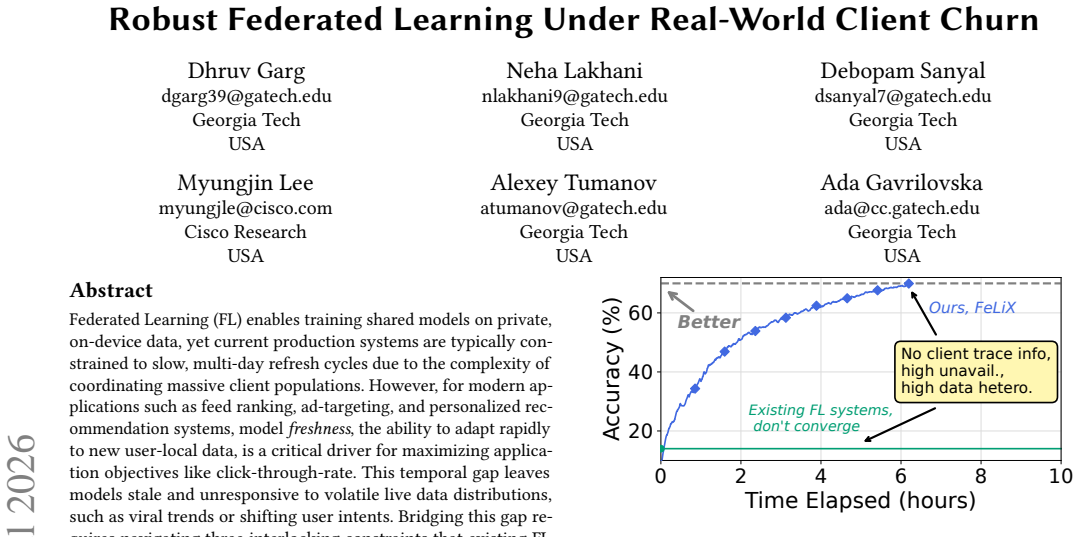
- §1, Fig. 1: The figure caption 'Existing FL systems, don't converge' is informal and could be stated more precisely (e.g., 'fail to converge within the depicted time window').
- §2.1: The phrase 'unavailability is the norm rather than the exception' is stated twice in close succession (once in the paragraph beginning 'Evolving runtime availability' and again shortly after). Consider condensing.
- §3.3, Algorithm 2: The algorithm description uses variables k_train, K_train, k_eval, K_eval but the relationship between concurrency level and evaluation goal is not clearly explained in the surrounding text. A brief clarifying sentence would help.
- §6.1: The communication cost discussion for the Speech task notes that eval traffic is 'more consequential' (583 GB) due to the larger model, and suggests that 'eval-task bandwidth must be tuned or compressed.' This is an important practical limitation that should be discussed more prominently, perhaps in the design considerations or limitations section, as it directly affects the applicability of the EvalSelector to large-model settings.
- §6.2: The claim that 'FeLiX actually outperforms these oracles' (referring to OORT+Async*) is stated without qualification. Given the absence of error bars, this claim should be softened to acknowledge potential variance.
- Figures 9-11: The y-axis labels and legends are small and difficult to read. Consider enlarging font sizes for readability.
- §3.4: The functional forms for α(T) and β(L) are given, but the rationale for choosing these specific forms (e.g., why 1.5 in the β(L) expression) is not explained. A brief justification would strengthen the design discussion.
- §7 (Related Work): The paper could cite and discuss more recent work on asynchronous FL convergence under non-IID data, particularly any work that provides theoretical bounds on staleness-weighted aggregation, to better position the TierFuse contribution.
Circularity Check
No circularity found: empirical systems paper validated against external baselines
full rationale
FeLiX is a systems paper whose central claims (2.37x time-to-accuracy, 1.30x communication savings) are empirical measurements against external baselines (OORT, REFL, FedBuff) from other author groups. The three core mechanisms—TierTrack, TierSelect, TierFuse—are design contributions, not mathematical derivations that could reduce to their inputs. TierSelect measures client utility via lightweight forward passes (an independent signal), then uses those measurements for selection—no self-definitional loop. TierFuse's weighting formula w_i = σ·α(T_i) + (1-σ)·β(L_i) is presented as a heuristic design choice with interpretable parameters, not as a derived result from first principles. The self-citation [10] (Garg et al., 'Client availability in federated learning: It matters!') is used purely to motivate the problem statement (that availability churn degrades FL performance), not to prove the solution's correctness; the solution is validated independently through experiments. No step in the paper's chain—problem motivation → mechanism design → empirical evaluation—reduces by construction to its own inputs.
Axiom & Free-Parameter Ledger
free parameters (7)
- sigma =
unreported
- a =
unreported
- b =
unreported
- T_max =
unreported
- e (eval task rate) =
unreported
- 90-second timeout =
90s
- battery threshold for AVL_EVAL =
unreported
axioms (4)
- domain assumption Local loss is a reliable proxy for update informativeness across non-IID data distributions
- domain assumption Forward-pass evaluation loss approximates training utility
- domain assumption Client push-based state updates are timely and accurate
- domain assumption Emulation on a single multi-GPU node with 300 clients approximates production behavior
invented entities (2)
-
Availability tiers (AVL_TRAIN, AVL_EVAL, UN_AVL)
independent evidence
-
TierFuse weighting formula
independent evidence
read the original abstract
Federated Learning (FL) enables training shared models on private, on-device data, but production deployments remain constrained to slow, multi-day refresh cycles due to the complexity of coordinating massive client populations. For applications such as feed ranking, ad targeting, and personalized recommendation, model freshness: the ability to rapidly adapt to new user-local data is critical for maximizing objectives like click-through rate. This lag leaves models stale and unresponsive to volatile data distributions driven by viral trends and shifting user intent. Bridging this gap requires addressing three challenges overlooked by existing FL systems: transient client availability, dynamic data heterogeneity, and delays between model predictions and observable outcomes. We present FeLiX, an FL orchestration framework that minimizes wall-clock time-to-target accuracy on live interaction streams. FeLiX introduces three primitives: (i) streaming-aware availability tiers that leverage lightweight telemetry to identify ready clients at scale; (ii) fresh-utility selection, a dual-tier mechanism that prioritizes statistically valuable updates from devices able to meet tight refresh deadlines; and (iii) informativeness-aware, delay-robust aggregation that incorporates late, high-value updates containing ground-truth outcomes without biasing the global model toward stale distributions. Unlike prior systems that rely on unrealistic oracular knowledge of client availability, FeLiX achieves near-oracular performance in real-world settings. Across CIFAR-10, Google Speech, and realistic low-availability traces, FeLiX reduces wall-clock time-to-target accuracy by up to 2.37X while reducing communication bandwidth by 1.30X compared to state-of-the-art synchronous and asynchronous FL baselines.
Figures


Reference graph
Works this paper leans on
-
[1]
Abdelmoniem, A. M., Sahu, A. N., Canini, M., and Fahmy, S. A.Refl: Resource- efficient federated learning. InProceedings of the Eighteenth European Conference on Computer Systems(2023), pp. 215–232
work page 2023
-
[2]
Flower: A Friendly Federated Learning Research Framework
Beutel, D. J., Topal, T., Mathur, A., Qiu, X., Fernandez-Marqes, J., Gao, Y., Sani, L., Kwing, H. L., Parcollet, T., Gusmão, P. P. d., and Lane, N. D.Flower: A friendly federated learning research framework.arXiv preprint arXiv:2007.14390 (2020)
work page internal anchor Pith review Pith/arXiv arXiv 2007
-
[3]
Bonawitz, K., Eichner, H., Grieskamp, W., Huba, D., Ingerman, A., Ivanov, V., Kiddon, C., Konečn`y, J., Mazzocchi, S., McMahan, B., et al.Towards federated learning at scale: System design.Proceedings of machine learning and systems 1(2019), 374–388
work page 2019
-
[4]
S., Chen, R., Mela, T., Olshevsky, A., Paschalidis, I
Brisimi, T. S., Chen, R., Mela, T., Olshevsky, A., Paschalidis, I. C., and Shi, W. Federated learning of predictive models from federated electronic health records. International journal of medical informatics 112(2018), 59–67
work page 2018
-
[5]
Charles, Z., Garrett, Z., Huo, Z., Shmulyian, S., and Smith, V.On large- cohort training for federated learning.Advances in neural information processing systems 34(2021), 20461–20475
work page 2021
-
[6]
Federated Learning of N-gram Language Models
Chen, M., Suresh, A. T., Mathews, R., Wong, A., Allauzen, C., Beaufays, F., and Riley, M.Federated learning of n-gram language models.arXiv preprint arXiv:1910.03432(2019)
work page internal anchor Pith review Pith/arXiv arXiv 1910
-
[7]
In2020 IEEE International Conference on Big Data (Big Data)(2020), IEEE, pp
Chen, Y., Ning, Y., Slawski, M., and Rangwala, H.Asynchronous online federated learning for edge devices with non-iid data. In2020 IEEE International Conference on Big Data (Big Data)(2020), IEEE, pp. 15–24
work page 2020
-
[8]
Daga, H., Shin, J., Garg, D., Gavrilovska, A., Lee, M., and Kompella, R. R. Flame: Simplifying topology extension in federated learning. InProceedings of the 2023 ACM Symposium on Cloud Computing(2023), SoCC ’23
work page 2023
-
[9]
K., Ingram, S., Mudigere, D., Krishnamoorthi, R., Nair, K., Smelyanskiy, M., and Annavaram, M
Eisenman, A., Matam, K. K., Ingram, S., Mudigere, D., Krishnamoorthi, R., Nair, K., Smelyanskiy, M., and Annavaram, M. {Check-N-Run}: A check- pointing system for training deep learning recommendation models. In19th USENIX Symposium on Networked Systems Design and Implementation (NSDI 22) (2022), pp. 929–943
work page 2022
-
[10]
Garg, D., Sanyal, D., Lee, M., Tumanov, A., and Gavrilovska, A.Client availability in federated learning: It matters! InProceedings of the 5th Workshop on Machine Learning and Systems(2025), pp. 114–121
work page 2025
-
[11]
Differentially Private Federated Learning: A Client Level Perspective
Geyer, R. C., Klein, T., and Nabi, M.Differentially private federated learning: A client level perspective.arXiv preprint arXiv:1712.07557(2017)
work page internal anchor Pith review Pith/arXiv arXiv 2017
-
[12]
InProceedings of the Nineteenth European Conference on Computer Systems(2024), pp
Gupta, T., Krishnan, S., Kumar, R., Vijeev, A., Gulavani, B., Kwatra, N., Ramjee, R., and Sivathanu, M.Just-in-time checkpointing: Low cost error recovery from deep learning training failures. InProceedings of the Nineteenth European Conference on Computer Systems(2024), pp. 1110–1125
work page 2024
-
[13]
Hard, A., Rao, K., Mathews, R., Ramaswamy, S., Beaufays, F., Augenstein, S., Eichner, H., Kiddon, C., and Ramage, D.Federated learning for mobile keyboard prediction.arXiv preprint arXiv:1811.03604(2018)
work page internal anchor Pith review Pith/arXiv arXiv 2018
-
[14]
He, C., Li, S., So, J., Zeng, X., Zhang, M., W ang, H., W ang, X., Vepakomma, P., Singh, A., Qiu, H., et al.Fedml: A research library and benchmark for federated machine learning.arXiv preprint arXiv:2007.13518(2020)
work page internal anchor Pith review Pith/arXiv arXiv 2007
-
[15]
Huba, D., Nguyen, J., Malik, K., Zhu, R., Rabbat, M., Yousefpour, A., Wu, C.-J., Zhan, H., Ustinov, P., Srinivas, H., et al.Papaya: Practical, private, and scalable federated learning.Proceedings of Machine Learning and Systems 4 (2022), 814–832
work page 2022
-
[16]
In Uncertainty in Artificial Intelligence(2022), PMLR, pp
Jhunjhunwala, D., Sharma, P., Nagarkatti, A., and Joshi, G.Fedvarp: Tack- ling the variance due to partial client participation in federated learning. In Uncertainty in Artificial Intelligence(2022), PMLR, pp. 906–916
work page 2022
-
[17]
B., Avent, B., Bellet, A., Bennis, M., Bhagoji, A
Kairouz, P., McMahan, H. B., Avent, B., Bellet, A., Bennis, M., Bhagoji, A. N., Bonawitz, K., Charles, Z., Cormode, G., Cummings, R., et al.Advances and open problems in federated learning.Foundations and trends®in machine learning 14, 1–2 (2021), 1–210
work page 2021
-
[18]
Federated Optimization: Distributed Machine Learning for On-Device Intelligence
Konečn`y, J., McMahan, H. B., Ramage, D., and Richtárik, P.Federated opti- mization: Distributed machine learning for on-device intelligence.arXiv preprint arXiv:1610.02527(2016)
work page internal anchor Pith review Pith/arXiv arXiv 2016
-
[19]
Krizhevsky, A.Learning multiple layers of features from tiny images. Tech. rep., 2009
work page 2009
-
[20]
InInternational conference on machine learning(2022), PMLR, pp
Lai, F., Dai, Y., Singapuram, S., Liu, J., Zhu, X., Madhyastha, H., and Chowd- hury, M.Fedscale: Benchmarking model and system performance of federated learning at scale. InInternational conference on machine learning(2022), PMLR, pp. 11814–11827
work page 2022
-
[21]
V., and Chowdhury, M.Oort: Efficient federated learning via guided participant selection
Lai, F., Zhu, X., Madhyastha, H. V., and Chowdhury, M.Oort: Efficient federated learning via guided participant selection. In15th {USENIX} Symposium on Operating Systems Design and Implementation ( {OSDI} 21)(2021), pp. 19–35
work page 2021
-
[22]
Li, Q., He, B., and Song, D.Practical one-shot federated learning for cross-silo setting.arXiv preprint arXiv:2010.01017(2020)
work page internal anchor Pith review Pith/arXiv arXiv 2010
-
[23]
Li, T., Sahu, A. K., Talwalkar, A., and Smith, V.Federated learning: Challenges, methods, and future directions.IEEE signal processing magazine 37, 3 (2020), 50–60
work page 2020
-
[24]
J., et al.Privacy-preserving federated brain tumour segmentation
Li, W., Milletarì, F., Xu, D., Rieke, N., Hancox, J., Zhu, W., Baust, M., Cheng, Y., Ourselin, S., Cardoso, M. J., et al.Privacy-preserving federated brain tumour segmentation. InMachine Learning in Medical Imaging: 10th International Workshop, MLMI 2019, Held in Conjunction with MICCAI 2019, Shenzhen, China, October 13, 2019, Proceedings 10(2019), Spring...
work page 2019
-
[25]
Li, X., Huang, K., Yang, W., Wang, S., and Zhang, Z.On the convergence of fedavg on non-iid data.arXiv preprint arXiv:1907.02189(2019)
work page internal anchor Pith review Pith/arXiv arXiv 1907
-
[26]
InInternational Conference on Machine Learning (2018), PMLR, pp
Lian, X., Zhang, W., Zhang, C., and Liu, J.Asynchronous decentralized parallel stochastic gradient descent. InInternational Conference on Machine Learning (2018), PMLR, pp. 3043–3052
work page 2018
-
[27]
A.Mosquitto: server and client implementation of the mqtt protocol
Light, R. A.Mosquitto: server and client implementation of the mqtt protocol. Journal of Open Source Software 2, 13 (2017), 265
work page 2017
-
[28]
Lin, T., Kong, L., Stich, S. U., and Jaggi, M.Ensemble distillation for robust model fusion in federated learning.Advances in neural information processing systems 33(2020), 2351–2363. [29]M-Lab. Mobiperf data set. https://www.measurementlab.net/tests/mobiperf/
work page 2020
-
[29]
Matam, K. K., Ramezani, H., Wang, F., Chen, Z., Dong, Y., Ding, M., Zhao, Z., Zhang, Z., Wen, E., and Eisenman, A. {QuickUpdate}: a {Real-Time} personalization system for {Large-Scale} recommendation models. In21st USENIX Symposium on Networked Systems Design and Implementation (NSDI 24) (2024), pp. 731–744
work page 2024
-
[30]
McMahan, B., Moore, E., Ramage, D., Hampson, S., and y Arcas, B. A. Communication-efficient learning of deep networks from decentralized data. In Artificial intelligence and statistics(2017), PMLR, pp. 1273–1282
work page 2017
-
[31]
Mitliagkas, I., Zhang, C., Hadjis, S., and Ré, C.Asynchrony begets momentum, with an application to deep learning. In2016 54th Annual Allerton Conference on Communication, Control, and Computing (Allerton)(2016), IEEE, pp. 997–1004
work page 2016
-
[32]
{CheckFreq}: Frequent,{Fine-Grained} {DNN} checkpointing
Mohan, J., Phanishayee, A., and Chidambaram, V. {CheckFreq}: Frequent,{Fine-Grained} {DNN} checkpointing. In19th USENIX Conference on File and Storage Technologies (FAST 21)(2021), pp. 203–216
work page 2021
-
[33]
Nguyen, D. C., Pham, Q.-V., Pathirana, P. N., Ding, M., Seneviratne, A., Lin, Z., Dobre, O., and Hwang, W.-J.Federated learning for smart healthcare: A survey.ACM Computing Surveys (Csur) 55, 3 (2022), 1–37
work page 2022
-
[34]
In International Conference on Artificial Intelligence and Statistics(2022), PMLR, pp
Nguyen, J., Malik, K., Zhan, H., Yousefpour, A., Rabbat, M., Malek, M., and Huba, D.Federated learning with buffered asynchronous aggregation. In International Conference on Artificial Intelligence and Statistics(2022), PMLR, pp. 3581–3607
work page 2022
-
[35]
InICC 2019-2019 IEEE international conference on communications (ICC)(2019), IEEE, pp
Nishio, T., and Yonetani, R.Client selection for federated learning with hetero- geneous resources in mobile edge. InICC 2019-2019 IEEE international conference on communications (ICC)(2019), IEEE, pp. 1–7
work page 2019
-
[36]
Peng, X., Huang, Z., Zhu, Y., and Saenko, K.Federated adversarial domain adaptation.arXiv preprint arXiv:1911.02054(2019)
work page internal anchor Pith review Pith/arXiv arXiv 1911
-
[37]
Adaptive Federated Optimization
Reddi, S., Charles, Z., Zaheer, M., Garrett, Z., Rush, K., Konečn`y, J., Kumar, S., and McMahan, H. B.Adaptive federated optimization.arXiv preprint arXiv:2003.00295(2020)
work page internal anchor Pith review Pith/arXiv arXiv 2003
-
[38]
Rodio, A., and Neglia, G.Fedstale: leveraging stale client updates in federated learning.arXiv preprint arXiv:2405.04171(2024)
work page internal anchor Pith review Pith/arXiv arXiv 2024
-
[39]
InProceedings of the IEEE/CVF Conference on Computer Vision and Pattern Recognition(2023), pp
Shenaj, D., Toldo, M., Rigon, A., and Zanuttigh, P.Asynchronous federated continual learning. InProceedings of the IEEE/CVF Conference on Computer Vision and Pattern Recognition(2023), pp. 5055–5063
work page 2023
-
[40]
In2017 IEEE symposium on security and privacy (SP)(2017), IEEE, pp
Shokri, R., Stronati, M., Song, C., and Shmatikov, V.Membership inference attacks against machine learning models. In2017 IEEE symposium on security and privacy (SP)(2017), IEEE, pp. 3–18
work page 2017
-
[41]
In22nd USENIX Symposium on Networked Systems Design and Implementation (NSDI 25)(2025), pp
Srinivas, H., Cormode, G., Honarkhah, M., Lurye, S., Hehir, J., He, L., Hong, G., Magdy, A., Huba, D., W ang, K., et al.{PAPAYA} federated analytics stack: Engineering privacy, scalability and practicality. In22nd USENIX Symposium on Networked Systems Design and Implementation (NSDI 25)(2025), pp. 883–898
work page 2025
-
[42]
Suresh, A. T., Felix, X. Y., Kumar, S., and McMahan, H. B.Distributed mean estimation with limited communication. InInternational conference on machine learning(2017), PMLR, pp. 3329–3337
work page 2017
-
[43]
Wang, E., Chen, B., Chowdhury, M., Kannan, A., and Liang, F.Flint: A platform for federated learning integration.Proceedings of Machine Learning and Systems 5(2023)
work page 2023
-
[44]
W ang, H., Yurochkin, M., Sun, Y., Papailiopoulos, D., and Khazaeni, Y.Fed- erated learning with matched averaging.arXiv preprint arXiv:2002.06440(2020)
work page internal anchor Pith review Pith/arXiv arXiv 2002
-
[45]
W ang, J., and Joshi, G.Adaptive communication strategies to achieve the best error-runtime trade-off in local-update sgd.Proceedings of Machine Learning and Systems 1(2019), 212–229
work page 2019
-
[46]
Wang, J., Liu, Q., Liang, H., Joshi, G., and Poor, H. V.Tackling the objective inconsistency problem in heterogeneous federated optimization.Advances in neural information processing systems 33(2020), 7611–7623
work page 2020
-
[47]
E., and W ang, Y.Gemini: Fast failure recovery in distributed training with in-memory checkpoints
W ang, Z., Jia, Z., Zheng, S., Zhang, Z., Fu, X., Ng, T. E., and W ang, Y.Gemini: Fast failure recovery in distributed training with in-memory checkpoints. In Proceedings of the 29th Symposium on Operating Systems Principles(2023), pp. 364– 381
work page 2023
-
[48]
Warden, P.Speech Commands: A Dataset for Limited-Vocabulary Speech Recognition.ArXiv e-prints(Apr. 2018)
work page 2018
-
[49]
Xie, C., Koyejo, S., and Gupta, I.Asynchronous federated optimization.arXiv preprint arXiv:1903.03934(2019)
work page internal anchor Pith review Pith/arXiv arXiv 1903
-
[50]
Xu, J., Glicksberg, B. S., Su, C., W alker, P., Bian, J., and W ang, F.Federated 14 Robust Federated Learning Under Real-World Client Churn learning for healthcare informatics.Journal of healthcare informatics research 5 (2021), 1–19
work page 2021
-
[51]
{FwdLLM}: Efficient federated finetuning of large language models with perturbed inferences
Xu, M., Cai, D., Wu, Y., Li, X., and Wang, S. {FwdLLM}: Efficient federated finetuning of large language models with perturbed inferences. In2024 USENIX Annual Technical Conference (USENIX ATC 24)(2024), pp. 579–596
work page 2024
-
[52]
Federated Learning of Gboard Language Models with Differential Privacy
Xu, Z., Zhang, Y., Andrew, G., Choqette-Choo, C. A., Kairouz, P., McMahan, H. B., Rosenstock, J., and Zhang, Y.Federated learning of gboard language models with differential privacy.arXiv preprint arXiv:2305.18465(2023)
work page internal anchor Pith review Pith/arXiv arXiv 2023
-
[53]
Y ang, Q., Liu, Y., Chen, T., and Tong, Y.Federated machine learning: Concept and applications.ACM Transactions on Intelligent Systems and Technology (TIST) 10, 2 (2019), 1–19
work page 2019
-
[54]
Ye, M., Fang, X., Du, B., Yuen, P. C., and Tao, D.Heterogeneous federated learning: State-of-the-art and research challenges.ACM Computing Surveys 56, 3 (2023), 1–44
work page 2023
-
[55]
In International conference on machine learning(2019), PMLR, pp
Yurochkin, M., Agarwal, M., Ghosh, S., Greenewald, K., Hoang, N., and Khazaeni, Y.Bayesian nonparametric federated learning of neural networks. In International conference on machine learning(2019), PMLR, pp. 7252–7261
work page 2019
-
[56]
InProceedings of the IEEE/CVF Conference on Computer Vision and Pattern Recognition(2023), pp
Zhang, T., Gao, L., Lee, S., Zhang, M., and Avestimehr, S.Timelyfl: Heterogeneity-aware asynchronous federated learning with adaptive partial training. InProceedings of the IEEE/CVF Conference on Computer Vision and Pattern Recognition(2023), pp. 5063–5072
work page 2023
-
[57]
IEEE Transactions on Parallel and Distributed Systems 33, 12 (2022), 3291–3305
Zhou, Z., Li, Y., Ren, X., and Yang, S.Towards efficient and stable k- asynchronous federated learning with unbounded stale gradients on non-iid data. IEEE Transactions on Parallel and Distributed Systems 33, 12 (2022), 3291–3305. 15
work page 2022
discussion (0)
Sign in with ORCID, Apple, or X to comment. Anyone can read and Pith papers without signing in.