REVIEW 4 major objections 6 minor 78 references
Reviewed by Pith at T0; open to challenge.
T0 means a machine referee read the full paper against a public rubric. The mark states how deep the mechanical check went, never who wrote it. the ladder, T0–T4 →
T0 review · glm-5.2
Closed-loop LLM agents recover from robot failures in real time
2026-07-09 22:03 UTC pith:OVUUG2EN
load-bearing objection Closed-loop multi-agent LLM framework for multi-robot manipulation; the architecture is sound but the multi-robot robustness claim rests on thin evidence. the 4 major comments →
A Closed-Loop Multi-Agent Framework for Robust Multi-Robot Manipulation
The pith
A machine-rendered reading of the paper's core claim, the machinery that carries it, and where it could break.
Core claim
The load-bearing discovery is that closing the loop with a VLM-based Verification Agent that performs discrete visual outcome validation after every sub-operation, combined with a two-tier recovery mechanism (local correction for execution failures, global re-planning for feasibility failures), is sufficient to prevent cascading errors in multi-robot manipulation. The paper demonstrates this with a 90-100% failure identification rate across tasks, and shows that removing the Verification Agent causes disproportionate drops in long-horizon tasks where minor per-step failures accumulate. The second key finding is that object-specific keypoint selection via grid-based visual prompting is the ir
What carries the argument
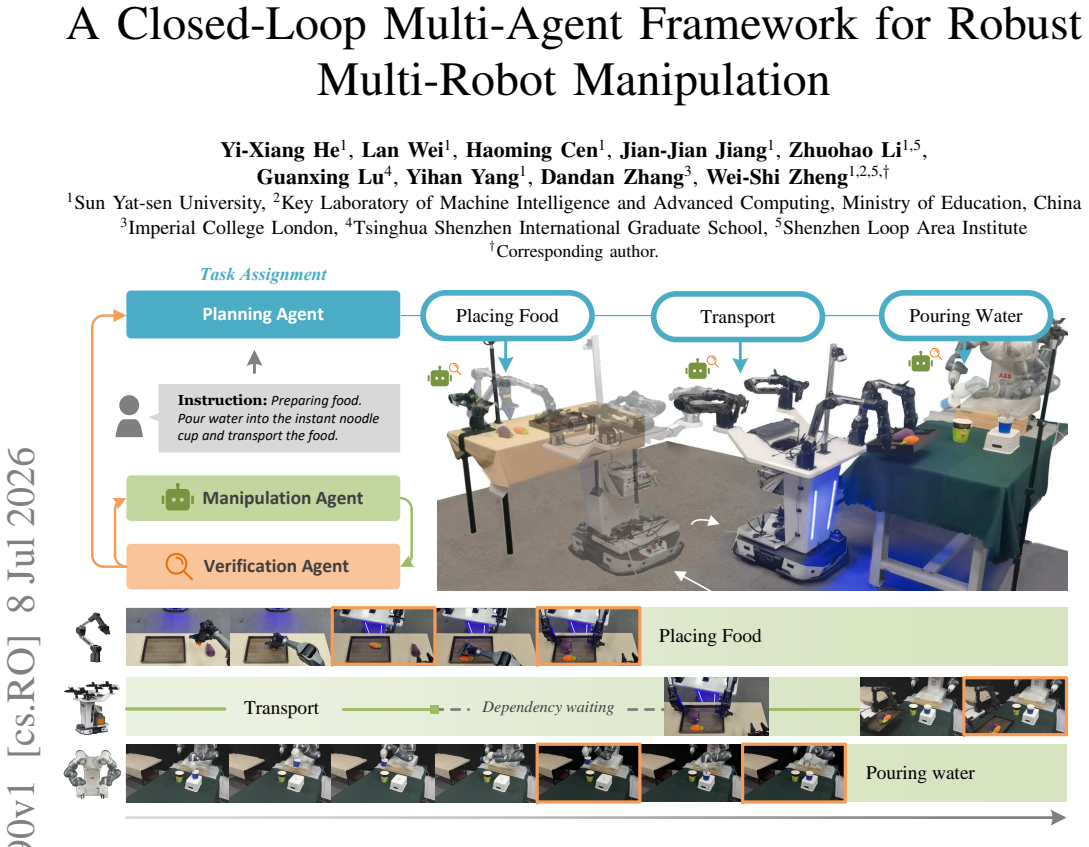
Three-agent closed-loop architecture: Planning Agent (DAG-based task decomposition with parallel flags, capability-based allocation, interactive refinement via further_perception queries), Manipulation Agent (role-based operation resolution, tool-augmented visual perception using VLM detection + SAM segmentation + grid-based keypoint selection + AnyGrasp 6-DoF grasp generation + rotation inference, dual-layer memory with short-term interaction history and long-term experience pool), Verification Agent (binary visual success prediction from pre/post-action images, hierarchical error recovery with local re-planning loop and global re-planning escalation). Action primitive library with 14 skill
Load-bearing premise
The entire recovery mechanism depends on the Verification Agent's VLM correctly classifying whether each sub-operation succeeded or failed from pre- and post-action images. If the VLM reports a false success, the closed loop never engages and errors propagate silently.
What would settle it
A task scenario where the Verification Agent systematically misclassifies failures as successes—e.g., subtle state changes invisible in RGB images such as partial fills, loose placements, or objects that shifted but remain within the original bounding box—would break the closed loop and reduce the system to open-loop behavior with no recovery.
If this is right
- Multi-robot teams could handle long-horizon domestic or industrial tasks (food preparation, warehouse shelving) without human intervention, provided the verification loop reliably catches failures.
- The hierarchical recovery pattern—local correction for execution errors, global re-planning for capability errors—could generalize beyond manipulation to other multi-agent robotic domains like navigation or construction.
- If VLM-based verification becomes reliable enough, the need for tactile or force-based failure detection in manipulation may diminish, reducing sensor complexity.
- The experience pool mechanism suggests that LLM-driven robot systems can accumulate task-specific efficiency gains without retraining, simply by caching validated action sequences.
- The gap between failure detection (90-100%) and final task success (40-80%) under disturbances reveals that physical recovery, not perception, is the remaining bottleneck for closed-loop manipulation.
Editorial analysis
A structured set of objections, weighed in public.
Referee Report
Summary. This paper proposes a hierarchical closed-loop multi-agent LLM-based framework for robust multi-robot manipulation. The system comprises three specialized agents: a Planning Agent for dependency-aware task decomposition and capability-based allocation, a Manipulation Agent for physical action grounding via adaptive tool use (keypoint selection, grasp generation, rotation inference), and a Verification Agent for outcome monitoring and hierarchical error recovery (local self-correction vs. global re-planning). The framework is evaluated on six real-world tasks spanning single-robot tabletop manipulation and multi-robot cross-workspace collaboration, with comparisons against learning-based (OpenVLA-OFT, π₀) and LLM-based (ReKep) baselines, plus ablation studies and disturbance experiments.
Significance. The paper addresses a genuine gap between single-robot LLM manipulation methods (which achieve physical grounding but lack coordination) and multi-robot LLM planners (which handle high-level allocation but treat manipulation as idealized primitives). The closed-loop verification with hierarchical recovery is a reasonable architectural contribution. The real-world experiments across heterogeneous robots (mobile dual-arm, single-arm, fixed dual-arm) demonstrate practical applicability. The ablation study (Table V, Fig. 4) provides useful component-level analysis, and the error breakdown (Fig. 5) honestly identifies keypoint selection as the dominant failure mode (60.4%). The system prompts in the appendix aid reproducibility.
major comments (4)
- The paper's central claim is 'robust multi-robot manipulation,' and the most distinctive architectural contribution for multi-robot scenarios is the hierarchical recovery mechanism—specifically, global re-planning that dispatches alternative robots when capability constraints are violated. However, this mechanism is evaluated in exactly one multi-robot task under disturbances: Basket Shelving (Table IV, n=10, Final SR=40%). The broader disturbance experiments in Table III cover only single-robot tabletop tasks. The other two multi-robot tasks (Collaborative Pouring, Food Preparation) are tested only under normal conditions (Table V: 55% and 50% SR respectively). This means the paper's most distinctive claim—robust multi-robot collaboration through hierarchical recovery—is supported by a single 10-trial experiment with a 40% success rate. The tabletop results are more thoroughly evaluated
- The sample sizes (20 trials for Table II, 10 trials for Tables III–IV) are modest, and no confidence intervals or statistical tests are reported. For Table II, the difference between Ours (14/20) and π₀ (9/20) on Block Stacking is 5 trials; with n=20, this is within the range where binomial noise could account for the gap. The authors should either increase trial counts or report binomial confidence intervals to demonstrate that the reported differences are not attributable to sampling variance.
- The Verification Agent's binary success prediction (§III.D) gates the entire recovery mechanism. Table IV reports 90–100% identification rates, but the methodology for computing this rate is not specified: Were failures injected deterministically? Were they naturally occurring? How many distinct failure types were tested? Without this detail, it is difficult to assess whether the 90–100% figure generalizes beyond the specific disturbances tested. The paper should clarify the identification-rate evaluation protocol.
- The comparison in Table II provides ReKep with manually annotated ground-truth keypoints 'to isolate perception errors and strictly evaluate manipulation capabilities' (§IV.B). However, the ablation in Table V shows that removing the keypoint perception tool causes catastrophic failure (0/10 on most tasks). This means the paper's own keypoint perception pipeline is load-bearing for success, yet the main comparison handicaps the baseline by giving it a different (manual) perception input. The experimental design conflates the contribution of the perception tool with the contribution of the agentic framework. A fairer comparison would use the same perception pipeline for ReKep, or at minimum discuss this confound explicitly.
minor comments (6)
- Table V reports Collaborative Pouring success as 11/20 (55%) in the 'Full Model' row, but the text in §IV.C refers to 'Collaborative Pouring' and 'Food Preparation' with different numbers (55% and 50%). These should be cross-checked for consistency.
- §III.C mentions 'a VLM then performs spatial reasoning to analyze the object's current state' for the rotation tool, but the specific VLM prompting strategy for rotation is only detailed in Appendix D. A forward reference would help readers.
- The experience pool (long-term memory) is described as reducing VLM API calls and accelerating execution (§III.C), but no timing data is reported. Quantifying the speedup would strengthen this claim.
- Fig. 2 is dense and the text labels are small. The distinction between Scenario 1 (recoverable feasibility error) and Scenario 2 (recoverable execution error) in panel (c) could be made clearer with larger annotations or a separate legend.
- The paper uses 'further_perception' and 'further_allocation' flags (§III.B and system prompts), but the relationship between these two flags is not clearly explained. Are they the same mechanism viewed from different agents, or distinct?
- Reference [32] (ReViP) is cited for execution uncertainties in multi-robot contexts, but ReViP appears to address VLA models, not multi-robot systems. The citation context should be verified.
Circularity Check
No circularity: the framework's claims are evaluated against external baselines and benchmarks; self-citations are tool usage, not load-bearing derivation steps.
full rationale
This paper proposes an engineering framework (a multi-agent LLM-based robotic manipulation system) rather than a theoretical derivation, so the circularity patterns targeted by this analysis (self-definitional derivations, fitted inputs called predictions, uniqueness theorems invoked from self-citations, ansatz smuggling, etc.) are largely inapplicable. The paper's central claim—that a closed-loop multi-agent architecture improves robustness in multi-robot manipulation—is evaluated empirically against external baselines (OpenVLA-OFT, π0, ReKep) across six real-world tasks. The authors do cite their own prior work (e.g., iGrasp [21], ReViP [32], visual prompting tool [45]), but these citations refer to specific tools or modules used within the system pipeline, not to theorems or derivations that would make the central claim true by construction. The Verification Agent's failure identification rate (Table IV) is measured empirically, not derived from a self-referential definition. The ablation study (Table V, Fig. 4) systematically removes components and measures performance impact, which is standard experimental methodology, not circular reasoning. No equation or claim in the paper reduces to its own inputs by construction. The paper is self-contained against external benchmarks, and the self-citations are incidental tool references rather than load-bearing logical dependencies.
Axiom & Free-Parameter Ledger
free parameters (4)
- Grid resolution for keypoint selection =
10x10
- Neighborhood sampling size for 3D coordinate extraction =
7x7
- Grasp search radius parameters (r_init, delta_r, r_max) =
Not specified
- Rotation angle options =
[60, 75, 90, 100]
axioms (3)
- domain assumption VLMs can reliably perform binary success prediction for manipulation tasks.
- domain assumption A predefined library of action primitives is sufficient for diverse manipulation tasks.
- domain assumption Semantic keypoints selected by VLMs correspond to physically graspable and stable locations.
invented entities (2)
-
Experience Pool (Long-Term Memory)
no independent evidence
-
Hierarchical Recovery Mechanism
no independent evidence
read the original abstract
Multi-robot systems provide the parallelism and redundancy necessary for long-horizon tasks, while Large Language Models (LLMs) offer the reasoning capabilities to decompose these objectives into actionable plans. However, effectively grounding this high-level reasoning in physical multi-robot execution remains an open challenge. Existing LLM-based approaches fall mainly into two categories: Single-robot methods achieve robust contact-rich manipulation but lack the coordination mechanisms required for tasks spanning multiple workspaces. Current multi-robot frameworks focus on high-level planning, often treating manipulation as an idealized primitive that fails to account for real-world execution uncertainties. To address this, we propose a hierarchical closed-loop agentic LLM-based framework to ensure robust multi-robot manipulation. Our system consists of three specialized agents: the Planning Agent decomposes instructions into allocated sub-tasks, the Manipulation Agent for each robot executes actions via adaptive tool use, and the Verification Agent closes the loop by monitoring physical outcomes and feeding back semantic corrections. Extensive real-world experiments demonstrate that our framework achieves superior success rates, ensures robust adaptability ranging from single to cross workspace manipulation, and offers a generalizable approach for diverse manipulation tasks.
Figures


Reference graph
Works this paper leans on
-
[1]
Josh Achiam, Steven Adler, Sandhini Agarwal, Lama Ahmad, Ilge Akkaya, Florencia Leoni Aleman, Diogo Almeida, Janko Altenschmidt, Sam Altman, Shyamal Anadkat, et al. Gpt-4 technical report.arXiv preprint arXiv:2303.08774, 2023. URL https://doi.org/10.48550/ arXiv.2303.08774
work page internal anchor Pith review Pith/arXiv arXiv 2023
-
[2]
Patrick Benavidez, Mohan Kumar, Sos S. Agaian, and Mo M. Jamshidi. Design of a home multi-robot system for the elderly and disabled. InSystem of Systems Engineering Conference, 2015. URL https://doi.org/10. 1109/SYSOSE.2015.7151907
-
[3]
$\pi_0$: A Vision-Language-Action Flow Model for General Robot Control
Kevin Black, Noah Brown, Danny Driess, Adnan Es- mail, Michael Equi, Chelsea Finn, Niccolo Fusai, Lachy Groom, Karol Hausman, Brian Ichter, Szymon Jakubczak, Tim Jones, Liyiming Ke, Sergey Levine, Adrian Li-Bell, Mohith Mothukuri, Suraj Nair, Karl Pertsch, Lucy Xiaoyang Shi, James Tanner, Quan Vuong, Anna Walling, Haohuan Wang, and Ury Zhilinsky.π 0: A Vi...
work page internal anchor Pith review Pith/arXiv arXiv doi:10.48550/arxiv.2410.24164 2025
-
[4]
Tom B. Brown, Benjamin Mann, Nick Ryder, Melanie Subbiah, Jared Kaplan, Prafulla Dhariwal, Arvind Neelakantan, Pranav Shyam, Girish Sastry, Amanda Askell, Sandhini Agarwal, Ariel Herbert- V oss, Gretchen Krueger, Tom Henighan, Rewon Child, Aditya Ramesh, Daniel M. Ziegler, Jeffrey Wu, Clemens Winter, Christopher Hesse, Mark Chen, Eric Sigler, Mateusz Litw...
work page 2020
-
[5]
A framework for task planning in heterogeneous multi robot systems based on robot capabilities
Jennifer Buehler and Maurice Pagnucco. A framework for task planning in heterogeneous multi robot systems based on robot capabilities. InProceedings of the AAAI Conference on Artificial Intelligence, 2014. URL https://www.researchgate.net/publication/286126681 A framework for task planning in heterogeneous multi robot systems based on robot capabilities
-
[6]
Scalable Multi-Robot Collaboration with Large Language Models: Centralized or Decentralized Systems?
Yongchao Chen, Jacob Arkin, Yang Zhang, Nicholas Roy, and Chuchu Fan. Scalable multi-robot collaboration with large language models: Centralized or decentralized systems? InIEEE International Conference on Robotics and Automation, 2024. URL https://doi.org/10.48550/ arXiv.2309.15943
work page internal anchor Pith review Pith/arXiv arXiv 2024
-
[7]
Integrated Task Assignment and Path Planning for Capacitated Multi-Agent Pickup and Delivery
Zhe Chen, Javier Alonso-Mora, Xiaoshan Bai, Daniel D Harabor, and Peter J Stuckey. Integrated task assignment and path planning for capacitated multi-agent pickup and delivery.IEEE Robotics and Automation Letters, 2021. URL https://doi.org/10.48550/arXiv.2110.14891
work page internal anchor Pith review Pith/arXiv arXiv doi:10.48550/arxiv.2110.14891 2021
-
[8]
Cheng Chi, Zhenjia Xu, Siyuan Feng, Eric Cousineau, Yilun Du, Benjamin Burchfiel, Russ Tedrake, and Shuran Song. Diffusion policy: Visuomotor policy learning via action diffusion.The International Journal of Robotics Research, 2025. URL https://journals.sagepub.com/doi/ full/10.1177/02783649241273668
-
[9]
Gheorghe Comanici, Eric Bieber, Mike Schaekermann, Ice Pasupat, Noveen Sachdeva, Inderjit Dhillon, Marcel Blistein, Ori Ram, Dan Zhang, Evan Rosen, et al. Gem- ini 2.5: Pushing the frontier with advanced reasoning, multimodality, long context, and next generation agentic capabilities.arXiv preprint arXiv:2507.06261, 2025. URL https://doi.org/10.48550/arXi...
work page internal anchor Pith review Pith/arXiv arXiv doi:10.48550/arxiv.2507.06261 2025
-
[10]
Neil T. Dantam, Zachary K. Kingston, Swarat Chaud- huri, and Lydia E. Kavraki. Incremental Task and Motion Planning: A Constraint-Based Approach. In Robotics: Science and Systems, 2016. URL http://www. roboticsproceedings.org/rss12/p02.html
work page 2016
-
[11]
A Survey on Code Generation with LLM-based Agents
Yihong Dong, Xue Jiang, Jiaru Qian, Tian Wang, Kechi Zhang, Zhi Jin, and Ge Li. A survey on code generation with llm-based agents.arXiv preprint arXiv:2508.00083,
work page internal anchor Pith review Pith/arXiv arXiv
-
[12]
URL https://doi.org/10.48550/arXiv.2508.00083
work page internal anchor Pith review Pith/arXiv arXiv doi:10.48550/arxiv.2508.00083
-
[13]
Haoshu Fang, Chenxi Wang, Hongjie Fang, Minghao Gou, Jirong Liu, Hengxu Yan, Wenhai Liu, Yichen Xie, and Cewu Lu. AnyGrasp: Robust and Efficient Grasp Perception in Spatial and Temporal Domains.IEEE Transactions on Robotics, 2023. URL https://doi.org/10. 1109/TRO.2023.3281153
-
[14]
PDDLStream: Integrating Symbolic Planners and Blackbox Samplers via Optimistic Adaptive Planning
Caelan Reed Garrett, Tom ´as Lozano-P ´erez, and Leslie Pack Kaelbling. PDDLStream: Integrating Symbolic Planners and Blackbox Samplers via Optimistic Adaptive Planning. In Proceedings of the International Conference on Automated Planning and Scheduling, 2020. URL https://ojs.aaai.org/index.php/ICAPS/article/view/6739
work page 2020
-
[15]
Rea- soning with Language Model is Planning with World Model
Shibo Hao, Yi Gu, Haodi Ma, Joshua Jiahua Hong, Zhen Wang, Daisy Zhe Wang, and Zhiting Hu. Rea- soning with Language Model is Planning with World Model. InProceedings of the Conference on Empirical Methods in Natural Language Processing, 2023. URL https://doi.org/10.18653/v1/2023.emnlp-main.507
-
[17]
Inner Monologue: Embodied Reasoning through Planning with Language Models
Wenlong Huang, Fei Xia, Ted Xiao, Harris Chan, Jacky Liang, Pete Florence, Andy Zeng, Jonathan Tomp- son, Igor Mordatch, Yevgen Chebotar, Pierre Sermanet, Tomas Jackson, Noah Brown, Linda Luu, Sergey Levine, Karol Hausman, and Brian Ichter. Inner Monologue: Embodied Reasoning through Planning with Language Models. InConference on Robot Learning, 2022. URL...
work page 2022
-
[18]
V oxPoser: Composable 3D Value Maps for Robotic Manipulation with Language Models
Wenlong Huang, Chen Wang, Ruohan Zhang, Yunzhu Li, Jiajun Wu, and Li Fei-Fei. V oxPoser: Composable 3D Value Maps for Robotic Manipulation with Language Models. InConference on Robot Learning, 2023. URL https://proceedings.mlr.press/v229/huang23b.html
work page 2023
-
[19]
ReKep: Spatio-Temporal Reasoning of Relational Keypoint Constraints for Robotic Manipula- tion
Wenlong Huang, Chen Wang, Yunzhu Li, Ruohan Zhang, and Li Fei-Fei. ReKep: Spatio-Temporal Reasoning of Relational Keypoint Constraints for Robotic Manipula- tion. InConference on Robot Learning, 2024. URL https://proceedings.mlr.press/v270/huang25g.html
work page 2024
-
[20]
A Survey of Language-Based Communication in Robotics
William Hunt, Sarvapali D Ramchurn, and Mohammad D Soorati. A survey of language-based communication in robotics.arXiv preprint arXiv:2406.04086, 2024. URL https://doi.org/10.48550/arXiv.2406.04086
work page internal anchor Pith review Pith/arXiv arXiv doi:10.48550/arxiv.2406.04086 2024
-
[21]
Brian Ichter, Anthony Brohan, Yevgen Chebotar, Chelsea Finn, Karol Hausman, Alexander Herzog, Daniel Ho, Julian Ibarz, Alex Irpan, Eric Jang, Ryan Julian, Dmitry Kalashnikov, Sergey Levine, Yao Lu, Carolina Parada, Kanishka Rao, Pierre Sermanet, Alexander Toshev, Vin- cent Vanhoucke, Fei Xia, Ted Xiao, Peng Xu, Mengyuan Yan, Noah Brown, Michael Ahn, Omar ...
work page 2022
-
[22]
igrasp: An interactive 2d-3d frame- work for 6-dof grasp detection
Jian-Jian Jiang, Xiao-Ming Wu, Zibo Chen, Yi-Lin Wei, and Wei-Shi Zheng. igrasp: An interactive 2d-3d frame- work for 6-dof grasp detection. InInternational Con- ference on Pattern Recognition, 2024. URL https://link. springer.com/chapter/10.1007/978-3-031-78113-1 22
-
[23]
Rethinking bimanual robotic manipulation: Learning with decoupled interaction framework
Jian-Jian Jiang, Xiao-Ming Wu, Yi-Xiang He, Ling- An Zeng, Yi-Lin Wei, Dandan Zhang, and Wei-Shi Zheng. Rethinking bimanual robotic manipulation: Learning with decoupled interaction framework. InInternational Conference on Computer Vision,
-
[24]
URL https://openaccess.thecvf.com/content/ ICCV2025/html/Jiang Rethinking Bimanual Robotic Manipulation Learning with Decoupled Interaction Framework ICCV 2025 paper.html
work page 2025
-
[25]
Self- planning code generation with large language models
Xue Jiang, Yihong Dong, Lecheng Wang, Zheng Fang, Qiwei Shang, Ge Li, Zhi Jin, and Wenpin Jiao. Self- planning code generation with large language models. ACM Transactions on Software Engineering and Method- ology, 2024. URL https://doi.org/10.48550/arXiv.2303. 06689
- [26]
-
[27]
PyRoki: A Modular Toolkit for Robot Kinematic Optimization
Chung Min Kim, Brent Yi, Hongsuk Choi, Yi Ma, Ken Goldberg, and Angjoo Kanazawa. PyRoki: A Modu- lar Toolkit for Robot Kinematic Optimization.arXiv preprint arXiv:2505.03728, 2025. URL https://arxiv.org/ abs/2505.03728
work page internal anchor Pith review Pith/arXiv arXiv 2025
-
[28]
Fine-Tuning Vision-Language-Action Models: Optimizing Speed and Success
Moo Jin Kim, Chelsea Finn, and Percy Liang. Fine- Tuning Vision-Language-Action Models: Optimizing Speed and Success.Robotics: Science and Systems, 2025. URL https://doi.org/10.48550/arXiv.2502.19645
work page internal anchor Pith review Pith/arXiv arXiv doi:10.48550/arxiv.2502.19645 2025
-
[29]
A Survey on Integration of Large Language Models with Intelligent Robots
Yeseung Kim, Dohyun Kim, Jieun Choi, Jisang Park, Nayoung Oh, and Daehyung Park. A survey on inte- gration of large language models with intelligent robots. Intelligent Service Robotics, 2024. URL https://doi.org/ 10.48550/arXiv.2404.09228
work page internal anchor Pith review Pith/arXiv arXiv doi:10.48550/arxiv.2404.09228 2024
-
[30]
Berg, Wan-Yen Lo, Piotr Doll ´ar, and Ross B
Alexander Kirillov, Eric Mintun, Nikhila Ravi, Hanzi Mao, Chlo ´e Rolland, Laura Gustafson, Tete Xiao, Spencer Whitehead, Alexander C. Berg, Wan-Yen Lo, Piotr Doll ´ar, and Ross B. Girshick. Segment Anything. InInternational Conference on Computer Vision, 2023. URL https://doi.org/10.1109/ICCV51070.2023.00371
-
[31]
Large Language Models are Zero-Shot Reasoners
Takeshi Kojima, Shixiang Shane Gu, Machel Reid, Yutaka Matsuo, and Yusuke Iwasawa. Large Language Models are Zero-Shot Reasoners. InAdvances in Neural Information Processing Systems, 2022. URL http://papers.nips.cc/paper files/paper/2022/hash/ 8bb0d291acd4acf06ef112099c16f326-Abstract-Conference. html
work page 2022
-
[32]
Large Language Models for Multi-Robot Systems: A Survey
Peihan Li, Zijian An, Shams Abrar, and Lifeng Zhou. Large language models for multi-robot systems: A sur- vey.arXiv preprint arXiv:2502.03814, 2025. URL https://doi.org/10.48550/arXiv.2502.03814
work page internal anchor Pith review Pith/arXiv arXiv doi:10.48550/arxiv.2502.03814 2025
-
[33]
Zhi Li, Ali Vatankhah Barenji, Jiazhi Jiang, Ray Y . Zhong, and Gangyan Xu. A mechanism for schedul- ing multi robot intelligent warehouse system face with dynamic demand.Journal of Intelligent Manufacturing,
-
[34]
URL https://doi.org/10.1007/s10845-018-1459-y
-
[35]
Zhuohao Li, Yinghao Li, Jian-Jian Jiang, Lang Zhou, Tianyu Zhang, and Wei-Shi Zheng. ReViP: Reducing False Completion in Vision-Language-Action Models with Vision-Proprioception Rebalance.arXiv, 2026. URL https://arxiv.org/abs/2601.16667
-
[37]
TypeTele: Releasing Dexterity in Teleoperation by Dexterous Manipulation Types
Yuhao Lin, Yi-Lin Wei, Haoran Liao, Mu Lin, Chengyi Xing, Hao Li, Dandan Zhang, Mark R. Cutkosky, and Wei-Shi Zheng. TypeTele: Releasing Dexterity in Teleop- eration by Dexterous Manipulation Types. InConference on Robot Learning, 2025. URL https://arxiv.org/abs/ 2507.01857
work page internal anchor Pith review Pith/arXiv arXiv 2025
-
[38]
EgoTraj-Bench: Towards Robust Trajectory Prediction Under Ego-view Noisy Ob- servations.arXiv, 2025
Jiayi Liu, Jiaming Zhou, Ke Ye, Kun-Yu Lin, Allan Wang, and Junwei Liang. EgoTraj-Bench: Towards Robust Trajectory Prediction Under Ego-view Noisy Ob- servations.arXiv, 2025. URL https://arxiv.org/abs/2510. 00405
work page 2025
-
[39]
Coherent: Collaboration of heterogeneous multi-robot system with large language models
Kehui Liu, Zixin Tang, Dong Wang, Zhigang Wang, Xuelong Li, and Bin Zhao. Coherent: Collaboration of heterogeneous multi-robot system with large language models. InIEEE International Conference on Robotics and Automation, 2025. URL https://arxiv.org/abs/2409. 15146
work page 2025
-
[40]
Leveraging Large Language Model for Heterogeneous Ad Hoc Teamwork Collaboration
Xinzhu Liu, Peiyan Li, Wenju Yang, Di Guo, and Huaping Liu. Leveraging large language model for heterogeneous ad hoc teamwork collaboration.arXiv preprint arXiv:2406.12224, 2024. URL https://doi.org/ 10.48550/arXiv.2406.12224
work page internal anchor Pith review Pith/arXiv arXiv doi:10.48550/arxiv.2406.12224 2024
-
[41]
Language Models of Code are Few-Shot Commonsense Learners
Aman Madaan, Shuyan Zhou, Uri Alon, Yiming Yang, and Graham Neubig. Language Models of Code are Few-Shot Commonsense Learners. InProceedings of the Conference on Empirical Methods in Natural Lan- guage Processing, 2022. URL https://doi.org/10.18653/ v1/2022.emnlp-main.90
work page 2022
-
[42]
RoCo: Di- alectic Multi-Robot Collaboration with Large Language Models
Zhao Mandi, Shreeya Jain, and Shuran Song. RoCo: Di- alectic Multi-Robot Collaboration with Large Language Models. InIEEE International Conference on Robotics and Automation, 2024. URL https://doi.org/10.1109/ ICRA57147.2024.10610855
-
[43]
Kazuma Obata, Tatsuya Aoki, Takato Horii, Tadahiro Taniguchi, and Takayuki Nagai. LiP-LLM: Integrating Linear Programming and Dependency Graph With Large Language Models for Multi-Robot Task Planning.IEEE Robotics and Automation Letters, 2025. URL https: //doi.org/10.1109/LRA.2024.3518105
-
[44]
Mingjie Pan, Jiyao Zhang, Tianshu Wu, Yinghao Zhao, Wenlong Gao, and Hao Dong. Omnimanip: Towards gen- eral robotic manipulation via object-centric interaction primitives as spatial constraints. InProceedings of the Computer Vision and Pattern Recognition Conference,
-
[45]
URL https://doi.org/10.48550/arXiv.2501.03841
work page internal anchor Pith review Pith/arXiv arXiv doi:10.48550/arxiv.2501.03841
-
[46]
Guangyao Shi, Yuwei Wu, Vijay Kumar, and Gaurav S Sukhatme. PIP-LLM: Integrating PDDL-Integer Pro- gramming with LLMs for Coordinating Multi-Robot Teams Using Natural Language.arXiv preprint arXiv:2510.22784, 2025. URL https://doi.org/10.48550/ arXiv.2510.22784
-
[47]
ProgPrompt: Generat- ing Situated Robot Task Plans using Large Language Models
Ishika Singh, Valts Blukis, Arsalan Mousavian, Ankit Goyal, Danfei Xu, Jonathan Tremblay, Dieter Fox, Jesse Thomason, and Animesh Garg. ProgPrompt: Generat- ing Situated Robot Task Plans using Large Language Models. InIEEE International Conference on Robotics and Automation, 2023. URL https://doi.org/10.1109/ ICRA48891.2023.10161317
-
[48]
CollaBot: Vision-Language Guided Simultaneous Collaborative Manipulation
Kun Song, Shentao Ma, Gaoming Chen, Ninglong Jin, Guangbao Zhao, Mingyu Ding, Zhenhua Xiong, and Jia Pan. CollaBot: Vision-language guided si- multaneous collaborative manipulation.arXiv preprint arXiv:2508.03526, 2025. URL https://doi.org/10.48550/ arXiv.2508.03526
work page internal anchor Pith review Pith/arXiv arXiv 2025
-
[49]
Chenyu Su, Weiwei Shang, Chen Qian, Fei Zhang, and Shuang Cong. ReSemAct: Advancing Fine-Grained Robotic Manipulation via Semantic Structuring and Af- fordance Refinement.arXiv preprint arXiv:2507.18262,
-
[50]
URL https://doi.org/10.48550/arXiv.2507.18262
-
[51]
Task-oriented 6-dof grasp pose detection in clutters
An-Lan Wang, Nuo Chen, Kun-Yu Lin, Yuan-Ming Li, and Wei-Shi Zheng. Task-oriented 6-dof grasp pose detection in clutters. InIEEE International Confer- ence on Robotics and Automation, 2025. URL https: //ieeexplore.ieee.org/abstract/document/11128749
-
[52]
Yi-Lin Wei, Jian-Jian Jiang, Chengyi Xing, Xiantuo Tan, Xiao-Ming Wu, Hao Li, Mark R. Cutkosky, and Wei-Shi Zheng. Grasp as You Say: Language-guided Dexterous Grasp Generation. InAdvances in Neural Information Processing Systems, 2024. URL https: //proceedings.neurips.cc/paper files/paper/2024/hash/ 5367f6d58cc98dc929e1b27fcaf2b0a6-Abstract-Conference. html
work page 2024
-
[53]
Yi-Lin Wei, Haoran Liao, Yuhao Lin, Pengyue Wang, Zhizhao Liang, Guiliang Liu, and Wei-Shi Zheng. Cycle- Manip: Enabling Cyclic Task Manipulation via Effective Historical Perception and Understanding.arXiv preprint arXiv:2512.01022, 2025. URL https://arxiv.org/abs/2512. 01022
-
[54]
AffordDexGrasp: Open-set Language- guided Dexterous Grasp with Generalizable- Instructive Affordance
Yi-Lin Wei, Mu Lin, Yuhao Lin, Jian-Jian Jiang, Xiao-Ming Wu, Ling-An Zeng, and Wei-Shi Zheng. AffordDexGrasp: Open-set Language- guided Dexterous Grasp with Generalizable- Instructive Affordance. InInternational Conference on Computer Vision, 2025. URL https://openaccess.thecvf.com/content/ICCV2025/html/ Wei AffordDexGrasp Open-set Language-guided Dexter...
work page 2025
-
[55]
Yi-Lin Wei, Zhexi Luo, Yuhao Lin, Mu Lin, Zhizhao Liang, Shuoyu Chen, and Wei-Shi Zheng. OmniDex- Grasp: Generalizable Dexterous Grasping via Founda- tion Model and Force Feedback.arXiv, 2025. URL https://arxiv.org/abs/2510.23119
-
[56]
Central- ized LLM-Driven Multi-Robot Coordination for Coop- erative Object Transportation
Jianan Xie, Wei Zhang, Hongming Chen, Jiayu Zeng, Yuyang Gao, Zhen Xu, and Kenji Hashimoto. Central- ized LLM-Driven Multi-Robot Coordination for Coop- erative Object Transportation. InIEEE International Conference on Advanced Robotics and its Social Im- pacts, 2025. URL https://ieeexplore.ieee.org/document/ 11124964
work page 2025
-
[57]
Wei Xu and Fu Zhang. Fast-lio: A fast, robust lidar- inertial odometry package by tightly-coupled iterated kalman filter.IEEE Robotics and Automation Letters,
-
[58]
URL https://ieeexplore.ieee.org/abstract/document/ 9372856
-
[59]
Zhi Yan, Nicolas Jouandeau, and Arab Ali Cherif. A survey and analysis of multi-robot coordination.Interna- tional Journal of Advanced Robotic Systems, 2013. URL https://journals.sagepub.com/doi/10.5772/57313
-
[60]
An Yang, Anfeng Li, Baosong Yang, Beichen Zhang, Binyuan Hui, Bo Zheng, Bowen Yu, Chang Gao, Chen- gen Huang, Chenxu Lv, et al. Qwen3 technical re- port.arXiv preprint arXiv:2505.09388, 2025. URL https://doi.org/10.48550/arXiv.2505.09388
work page internal anchor Pith review Pith/arXiv arXiv doi:10.48550/arxiv.2505.09388 2025
-
[61]
Co-NavGPT: Multi-Robot Cooperative Visual Semantic Navigation Using Vision Language Models
Bangguo Yu, Hamidreza Kasaei, and Ming Cao. Co- navgpt: Multi-robot cooperative visual semantic navi- gation using large language models.arXiv preprint arXiv:2310.07937, 2023. URL https://doi.org/10.48550/ arXiv.2310.07937
work page internal anchor Pith review Pith/arXiv arXiv 2023
-
[62]
3D Diffusion Policy: Generalizable Visuomotor Policy Learning via Simple 3D Representations
Yanjie Ze, Gu Zhang, Kangning Zhang, Chenyuan Hu, Muhan Wang, and Huazhe Xu. 3D Diffusion Policy: Generalizable Visuomotor Policy Learning via Simple 3D Representations. InRobotics: Science and Systems,
-
[63]
URL https://arxiv.org/abs/2403.03954
work page internal anchor Pith review Pith/arXiv arXiv
-
[64]
Building Cooperative Embodied Agents Modularly with Large Language Models
Hongxin Zhang, Weihua Du, Jiaming Shan, Qinhong Zhou, Yilun Du, Joshua B Tenenbaum, Tianmin Shu, and Chuang Gan. Building cooperative embodied agents modularly with large language models, journal=arXiv preprint arXiv:2307.02485. 2023. URL https://doi.org/ 10.48550/arXiv.2307.02485
work page internal anchor Pith review Pith/arXiv arXiv doi:10.48550/arxiv.2307.02485 2023
-
[65]
Tenenbaum, Tianmin Shu, and Chuang Gan
Hongxin Zhang, Weihua Du, Jiaming Shan, Qinhong Zhou, Yilun Du, Joshua B. Tenenbaum, Tianmin Shu, and Chuang Gan. Building Cooperative Embod- ied Agents Modularly with Large Language Models. InInternational Conference on Learning Represen- tations, 2024. URL https://openreview.net/forum?id= EnXJfQqy0K
work page 2024
-
[66]
Xiaopan Zhang, Hao Qin, Fuquan Wang, Yue Dong, and Jiachen Li. Lamma-p: Generalizable multi-agent long- horizon task allocation and planning with lm-driven pddl planner. InIEEE International Conference on Robotics and Automation, 2025. URL https://doi.org/10.48550/ arXiv.2409.20560
work page internal anchor Pith review Pith/arXiv arXiv 2025
-
[67]
Mitigating the Human-Robot Domain Discrepancy in Visual Pre- training for Robotic Manipulation
Jiaming Zhou, Teli Ma, Kun-Yu Lin, Zifan Wang, Ronghe Qiu, and Junwei Liang. Mitigating the Human-Robot Domain Discrepancy in Visual Pre- training for Robotic Manipulation. InProceedings of the Computer Vision and Pattern Recognition, 2025. URL https://openaccess.thecvf.com/content/CVPR2025/ html/Zhou Mitigating the Human-Robot Domain Discrepancy in Visua...
work page 2025
-
[68]
Exploring the Limits of Vision-Language-Action Manipulation in Cross- task Generalization
Jiaming Zhou, Ke Ye, Jiayi Liu, Teli Ma, Zifan Wang, Ronghe Qiu, Kun-Yu Lin, Zhilin Zhao, and Junwei Liang. Exploring the Limits of Vision-Language-Action Manipulation in Cross- task Generalization. InAdvances in Neural Information Processing Systems, 2025. URL https: //proceedings.neurips.cc/paper files/paper/2025/file/ cc92809cd8dfbd035801966ab4896741-P...
work page 2025
-
[69]
that enables the VLM to perform pixel-level semantic local- ization without requiring pixel-coordinate output capabilities. To bridge the gap between semantic instructions (e.g., “grasp the handle”) and spatial coordinates, we generate a visual prompt for each detected object. This process involves three steps: a)ROI Normalization and Enhancement:To empha...
work page 2026
-
[70]
Multi-Robot Task Planning Task:Generate a collaborative JSON plan for a multi-robot system (ArmRobot, SingleArmRobot, MobileRobot) based on #OBSERVATIONS#, #ROBOT_POSITIONS#, and #TASK_GOAL#. Reasoning Constraints: Collaboration: Prioritize placing objects on tables for transfers (especially for liquids) rather than direct handovers.Dual-Arm Strategy: For...
-
[71]
Analyze the #OBSERVATIONS#, #ROBOT_POSITIONS#, and the interrupted #INITIAL_PLAN#
Global Failure Recovery Task:Generate a new recovery plan to complete the #INSTRUCTION# following a runtime error (#ERROR_MESSAGE#). Analyze the #OBSERVATIONS#, #ROBOT_POSITIONS#, and the interrupted #INITIAL_PLAN#. Recovery Strategy: Analyze Error:If the error implies physical inability (e.g., reachability),re-allocatethe subtask to a different capable r...
-
[72]
Reasoning Constraints:Operate only on visible objects
Sub-task Planning Task:Analyze the #INSTRUCTION# and #IMAGE# to decompose the task into executable stages Skill Library (Primitives): •grasp_object / grasp_object_with_two_arms •place_object / place_object_with_two_arms •... Reasoning Constraints:Operate only on visible objects. Ensure each stage maps to a single atomic skill. Distinguish between Scenario...
-
[73]
Reasoning Logic:Identify targets with specific attributes and median points (point_2d)
Scene Perception (forfurther_perception) Task:Analyze the #IMAGE# and #INSTRUCTION# to categorize relevant items into ‘‘Target Objects’’ (manipulation targets) and ‘‘Static Objects’’ (destinations/containers). Reasoning Logic:Identify targets with specific attributes and median points (point_2d). For static objects,priorityis given to specific containers ...
-
[74]
Constraints:Account for potential partial occlusions (e.g., by the robotic gripper)
Object Detection Task:Identify the #OBJECTS_STR# in the #IMAGE# and output their bounding box coordinates and labels. Constraints:Account for potential partial occlusions (e.g., by the robotic gripper). Ensure the output contains separate items matching theexact countof requested objects, no more, no less. Output Format:JSON list where each item contains ...
-
[75]
Selection Rules:Determine if the task is bimanual
Keypoint Selection Task:Identify optimal grid labels (red numbers) for ‘‘Active’’ and ‘‘Passive’’ objects using the provided grid-overlaid #IMAGES#(active object(optional), passive objects), #SCENE_IMAGE# and #DESCRIPTIONS#. Selection Rules:Determine if the task is bimanual. Fortangiblesurfaces, select a single optimal label (select 2 only if bimanual). F...
-
[76]
Action Primitive Generation Task:Decompose a sub_task into executable Python code using the provided #PLAN_SO_FAR#, #INSTRUCTION#, #KEYPOINTS# and #SCENE_IMAGE_WITH_KEYPOINTS#. Primitive Library:AccessBasic Manipulations(macros: grasp, place, lift up, put down, reset home) andSpatial Adjustment(move xy, move pose, rotate, align) andConstraint interaction(...
-
[77]
Geometric Rotation Solver Task:Determine the optimal rotation parameters (Axis, Direction, Angle) for the robot end-effector to execute the #INSTRUCTION#, using the provided #IMAGE# and #OBJECT_FRAME_VECTORS#. Reasoning Logic:Select the primary functional axis based on object affordance (e.g., perpendicular to spout). Determine direction by analyzing the ...
-
[78]
Sub-task Signature Extractor (for Long-Term Mem- ory) Task:Parse the #SUB_TASK_DESCRIPTION# into a structured semantic signature to facilitate experience recording and retrieval in the experience pool. Parsing Logic:Identify the active object (initiator) and passive objects (recipients).Special Rules:Omit the active object for robot-centric actions (grasp...
-
[79]
Task Verification Task:Analyze the #INSTRUCTION# and pre/post-action images (#Image_PRE#, #Image_POST#) to assess if the robot successfully executed the command. Evaluation Rules:Verify action completion and object states. Identifygripper positions. Forrotational tasks, strict precision is not required. For dual-arm systems, success is valid if either gri...
-
[80]
If failed, generate a recovery sequence based on the execution #HISTORY#
Local Failure Recovery Task:Analyze pre/post-action images (#Image_PRE#, #Image_POST#) to verify the #CURRENT_OPERATION#. If failed, generate a recovery sequence based on the execution #HISTORY#. Recovery Logic:Compare states to determine outcome. IfCondition Lossoccurs (e.g., object dropped), retrieve the preparatory step from history and append the curr...
discussion (0)
Sign in with ORCID, Apple, or X to comment. Anyone can read and Pith papers without signing in.