REVIEW 1 major objections 6 minor 70 references
Sketches outperform words at revealing cultural differences in thought
Reviewed by Pith at T0; open to challenge. T0 means a machine referee read the full paper against a public rubric. the ladder, T0–T4 →
T0 review · glm-5.2
2026-07-09 15:34 UTC pith:H6I2WMPQ
load-bearing objection Large-scale sketch analysis shows image-based concept representations capture cultural variation that translated word embeddings miss, but the language baseline may be too weak to support the compression claim the 1 major comments →
Billions of Sketches Reveal Hidden Cultural Variation in Human Concepts
The pith
A machine-rendered reading of the paper's core claim, the machinery that carries it, and where it could break.
Core claim
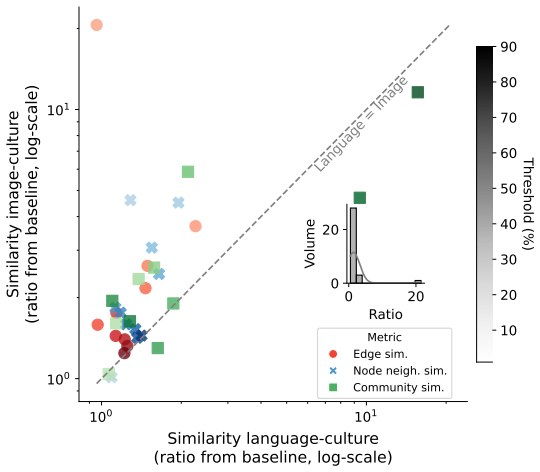
When people across 236 countries sketch everyday concepts, their drawings organize into stable visual exemplar clusters whose cross-cultural similarity patterns track established cultural distance measures 45% more closely than word-based similarity does. The geometry of these visual embedding spaces diverges systematically from word embedding spaces, showing that language and imagery encode different information about the same concepts. Concepts involving hands-on physical manipulation produce the most coherent visual clusters, linking conceptual structure to embodied experience rather than to dictionary definitions.
What carries the argument
The analysis pipeline embeds each sketch in a 384-dimensional latent space using a self-supervised vision transformer, reduces dimensions via PCA and UMAP, then clusters within each concept using DBSCAN with density-based validity optimization. Country-level visual similarity is computed via odds ratios measuring how strongly each country concentrates in specific visual clusters. This is compared against a word-embedding similarity network built from multilingual BERT embeddings of translated concept names, and against a cultural distance network derived from World Values Survey data. Network similarity is measured through edge Jaccard overlap, neighborhood Jaccard overlap, and NormalizedMut
Load-bearing premise
The entire argument depends on the image embedding model capturing genuine conceptual variation in what people draw, rather than low-level artifacts like stroke thickness, drawing speed, device type, or digital skill, all of which could correlate with country and produce spurious cultural clustering.
What would settle it
If the 45% cultural alignment advantage disappeared after controlling for drawing device type, interface differences, or socioeconomic factors that correlate with country, the central claim that visual representations preserve culturally meaningful structure would be substantially weakened.
If this is right
- If visual representations preserve cultural information that language compresses, then AI systems trained only on text will systematically miss culturally variable conceptual structure that matters for cross-cultural communication and design.
- The finding that haptic concepts cluster most coherently suggests that embodied interaction shapes visual conceptualization, providing a testable bridge between sensorimotor experience and abstract concept structure.
- Debates about conceptual universality that rely solely on linguistic data may be asking a modality-specific question and arriving at modality-specific answers, limiting the generality of both universalist and relativist claims.
- Large-scale behavioral datasets from gamified platforms can serve as high-resolution probes of cognitive and cultural structure at population scale, complementing controlled laboratory studies.
Where Pith is reading between the lines
- If the 45% alignment advantage of sketches over words holds after controlling for drawing device, internet access patterns, and English-language bias in the dataset, it would suggest that visual imagination is a more culturally sensitive channel than language for measuring conceptual diversity.
- The divergence between visual and linguistic geometry raises the possibility that multilingual large language models, which learn from text alone, encode a systematically impoverished model of human conceptual structure, missing the exemplar-level variation that sketches preserve.
- The clustering of haptic concepts into more coherent visual forms could imply that concepts grounded in shared physical manipulation are less culturally variable than concepts grounded in visual or social experience, though the paper claims the opposite direction, that haptic concepts cluster more, not less.
- If sketch-based cultural networks align better with survey-based cultural distances than word-based networks do, then sketching behavior might serve as an unobtrusive, scalable proxy for cultural distance measurement that does not require self-report instruments.
Editorial analysis
A structured set of objections, weighed in public.
Referee Report
Summary. This manuscript analyzes 2.6 billion sketches from the QuickDraw dataset across 236 countries to examine cultural variation in human conceptual structure. The authors find that concepts unfold into multiple visual exemplar clusters, that clusterability correlates with haptic sensorimotor properties, that image-based and word-based embedding geometries diverge, and that cross-cultural similarities derived from sketches align 45% more closely with World Values Survey cultural distances than do text-based measures. The central claim is that visual representations preserve rich semantic and cultural structure that language compresses, and that the modality of measurement critically affects conclusions about conceptual universality. The dataset is unprecedented in scale and the network comparison methodology is generally sound, with the cultural benchmark (WVS CFs index) being external to both sketch and word data. However, the headline 45% figure rests on a language baseline that may be structurally disadvantaged, and no statistical uncertainty is reported for this load-bearing comparison.
Significance. The paper's primary contribution is methodological and conceptual: it demonstrates that large-scale sketch data can serve as a high-resolution probe of cultural variation in conceptual structure, complementing word-based analyses. The scale of the dataset (2.6 billion sketches, 236 countries) is genuinely unprecedented for image-based cognitive research, and the pipeline (DINOv2 → PCA → UMAP → DBSCAN with DBCV optimization) is technically reasonable. The finding that haptic interaction correlates with clusterability is a novel, falsifiable empirical result linking embodied cognition to visual representation. The network comparison framework—comparing image- and language-based country similarity networks against an independent cultural benchmark—is well-constructed. Code availability and a 50M sketch sample for reproducibility are commendable. The paper also makes a timely contribution to debates about whether LLMs can capture human conceptual structure by showing that word-level representations mask latent visual variation.
major comments (1)
- The headline 45% cultural alignment figure (Abstract; Results, Fig. 4) is reported as an average across three network similarity metrics (edge similarity, neighborhood similarity, community overlap) and multiple edge-filtering thresholds (1%–90%), with no single confidence interval, standard error, or statistical test reported for the aggregate figure. The embedded histogram in Fig. 4 shows the distribution of ratios, but the reader cannot assess whether the 45% average is statistically distinguishable from a null hypothesis of no difference between image and language alignment. Given that this is the most prominent quantitative claim in the paper, a formal test (e.g., bootstrap CI on the ratio, or a permutation test comparing image-culture vs. language-culture similarity across thresholds) is needed. The robustness checks in Extended Data Fig. 13 (25-node and 50-node networks) are noted
minor comments (6)
- Figure 3: The word-based network is described as showing 'weaker and less coherent clustering,' but the figure caption does not specify the edge retention threshold or filtering method used for this visualization. Adding this information would make the visual comparison in Fig. 3 more rigorous.
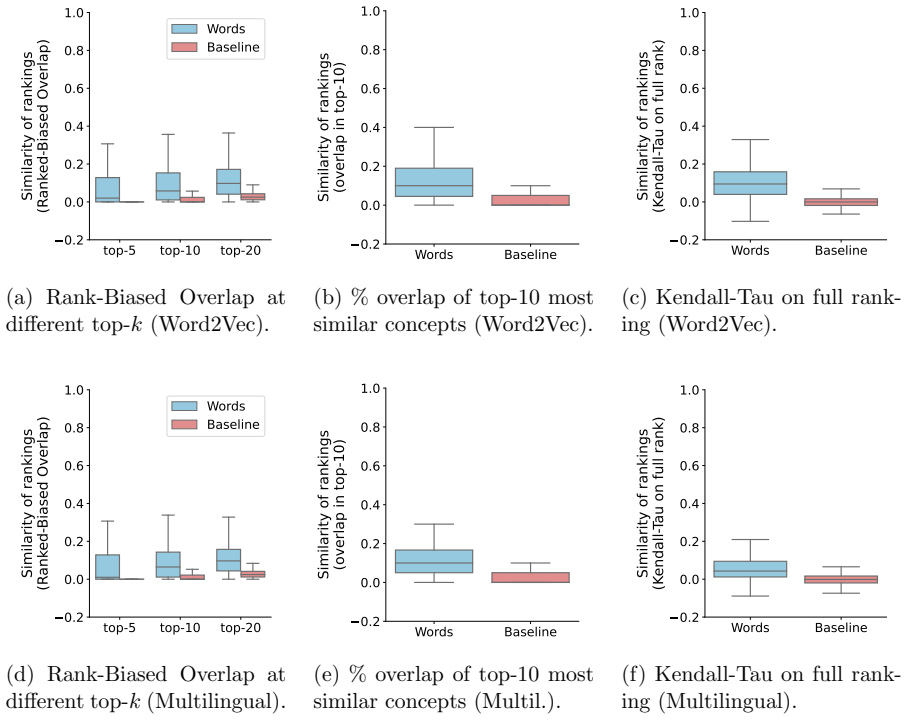
- Methods, 'Word vs. Image Semantics': The macro average rank correlation of 0.098 is described as 'consistently low' across 'multiple correlation metrics and embedding models,' but the SI details referenced are not visible in the main text. A brief summary table or inline statistics would help readers evaluate this claim without consulting SI.
- The 21-cluster outlier for 'crow' is mentioned without explanation. A brief note on why this concept produces so many clusters would help contextualize the clustering distribution.
- Extended Data Table 1: The country distribution shows 41.3% US sketches. While the paper acknowledges this in the Discussion, the main text could note the degree of US overrepresentation earlier (e.g., in the dataset description in the Results) to set reader expectations.
- The paper uses LLaMA 3.3-70B to supplement concreteness and sensorimotor ratings for 38–40 concepts lacking crowd-sourced annotations. The agreement between LLM-generated and human ratings for the overlapping concepts is not reported. A brief validation (e.g., correlation between LLM and human scores for concepts with both) would strengthen confidence in the haptic-interaction finding.
- The phrase 'language models compress' (Abstract, Discussion) is used loosely. The paper compares word embeddings (Word2Vec, multilingual BERT) with image embeddings, not language models in the generative sense. Clarifying that 'language models' refers to embedding models would improve precision.
Circularity Check
No circularity found; derivation chain is self-contained against external benchmarks
full rationale
The paper's three main claims are each derived from independently constructed inputs compared against external benchmarks. (1) The clustering result (concepts unfold into multiple visual exemplars) is an empirical output of DBSCAN on DINOv2-embedded sketches — no step defines clusters in terms of the claimed outcome. (2) The visual-linguistic divergence (0.098 rank correlation) compares two independently generated embedding spaces (DINOv2 image embeddings vs. Word2Vec/multilingual BERT word embeddings) — neither is constructed from the other. (3) The 45% cultural alignment figure compares three independently constructed networks: an image-based country similarity network (odds ratios of country-cluster associations), a language-based network (cosine similarity of translated word embeddings), and a cultural benchmark (WVS CFs index from Muthukrishna et al. 2020, an external dataset). The comparison uses a configuration-model null preserving degree sequence. No network is defined in terms of another. The self-citation at ref 14 (Guilbeault, Baronchelli, Centola 2021) provides conceptual framing about word compression but is not load-bearing for any mathematical derivation. The skeptic's concern that the language baseline may be near-ceiling for concrete nouns is a construct-validity issue, not circularity — the language network is not defined in terms of the cultural distance, nor is the image network defined in terms of either. The derivation is self-contained.
Axiom & Free-Parameter Ledger
free parameters (6)
- DBSCAN epsilon =
optimized via DBCV
- Noise threshold for clusterability =
local minimum of bimodal noise distribution
- Grid density percentile (non-clusterable concepts) =
60th percentile
- Network edge retention threshold =
top 10%
- Odds ratio similarity band =
0.9-1.1
- PCA dimensions =
40
axioms (5)
- domain assumption DINOv2 image embeddings capture semantically meaningful structural variation in human sketches
- domain assumption QuickDraw sketches reflect genuine conceptual representation rather than task-specific drawing strategies
- domain assumption Country-level IP address is a valid proxy for cultural context
- domain assumption Translated concept names in multilingual word embeddings provide a fair baseline for linguistic conceptual structure
- standard math World Values Survey cultural distance is an independent ground truth for cultural similarity
read the original abstract
Claims about the universality of human concepts have been predominantly assessed through linguistic similarity across languages and cultures. However, words are effective as communication devices because they compress rich experiential variation into shared conventions, potentially obscuring hidden individual and cultural differences in how concepts are mentally represented. Here, we analyse 2.6 billion human-made sketches of common concepts from 236 countries and territories to examine conceptual structure through people's visual imagination. Consistent with recent work on image-based cognition, we find that single concepts unfold into multiple distinct visual exemplars, revealing latent information about similarities and differences in conceptual structure across cultures. This variation is strongest for concepts involving haptic interaction, suggesting that visual imagery reflects variation in embodied experience as much as conventional definitions. Comparing embedding models of sketches with word embedding models across languages, we find that their geometries diverge, with visual representations preserving rich semantic and cultural structure that language models compress. Cross-cultural similarities derived from sketches align 45% more closely with established cultural distances than do text-based measures. Together, these results suggest that patterns of human conceptual universality may depend critically on the modality through which concepts are measured, with large-scale sketching providing a direct, high-resolution probe of conceptual diversity across embodied and cultural dimensions of thought.
Figures






Reference graph
Works this paper leans on
- [1]
-
[2]
Kemp, C., Xu, Y. & Regier, T. Semantic typology and efficient communication. Annual Review of Linguistics 4, 109–128 (2018)
work page 2018
-
[3]
Lewis, M., Cahill, A., Madnani, N. & Evans, J. Local similarity and global variabil- ity characterize the semantic space of human languages. Proceedings of the National Academy of Sciences 120, e2300986120 (2023)
work page 2023
-
[4]
Xu, Y., Duong, K., Malt, B. C., Jiang, S. & Srinivasan, M. Conceptual relations predict colexification across languages. Cognition 201, 104280 (2020)
work page 2020
- [5]
-
[6]
Zaslavsky, N., Kemp, C., Regier, T. & Tishby, N. Efficient compression in color naming and its evolution. Proceedings of the National Academy of Sciences 115, 7937–7942 (2018)
work page 2018
-
[7]
San Roque, L., Kendrick, K. H., Norcliffe, E. & Majid, A. Universal meaning exten- sions of perception verbs are grounded in interaction. Cognitive Linguistics 29, 371–406 (2018)
work page 2018
-
[8]
Kemp, C. & Regier, T. Kinship categories across languages reflect general communica- tive principles. Science 336, 1049–1054 (2012)
work page 2012
-
[9]
Thompson, B., Roberts, S. G. & Lupyan, G. Cultural influences on word meanings revealed through large-scale semantic alignment. Nature Human Behaviour 4, 1029– 1038 (2020). 14
work page 2020
-
[10]
Jackson, J. C. et al. Emotion semantics show both cultural variation and universal structure. Science 366, 1517–1522 (2019)
work page 2019
-
[11]
Tjuka, A., Forkel, R. & List, J.-M. Universal and cultural factors shape body part vocabularies. Scientific Reports 14, 10486 (2024)
work page 2024
-
[12]
Thompson, B., Roberts, S. G. & Lupyan, G. Quantifying semantic similarity across languages in Annual Meeting of the Cognitive Science Society (2018), 2554–2559
work page 2018
-
[13]
Fedorenko, E., Piantadosi, S. T. & Gibson, E. A. Language is primarily a tool for communication rather than thought. Nature 630, 575–586 (2024)
work page 2024
-
[14]
Guilbeault, D., Baronchelli, A. & Centola, D. Experimental evidence for scale-induced category convergence across populations. Nature communications 12, 327 (2021)
work page 2021
-
[15]
Wang, X. & Bi, Y. Idiosyncratic tower of Babel: Individual differences in word-meaning representation increase as word abstractness increases. Psychological science 32, 1617– 1635 (2021)
work page 2021
-
[16]
Duan, Y. & Lupyan, G. Divergence in word meanings and its consequence for com- munication in Proceedings of the Annual Meeting of the Cognitive Science Society 45 (2023)
work page 2023
-
[18]
Barsalou, L. W. Grounded cognition: Past, present, and future. Topics in cognitive science 2, 716–724 (2010)
work page 2010
-
[19]
Explaining embodied cognition results
Lakoff, G. Explaining embodied cognition results. Topics in cognitive science 4, 773–785 (2012)
work page 2012
-
[20]
Bergen, B. K. Louder than words: The new science of how the mind makes meaning (Basic Books, New York, 2012). 15
work page 2012
-
[21]
Lewis, M., Balamurugan, A., Zheng, B. & Lupyan, G. Characterizing variability in shared meaning through millions of sketches in Proceedings of the Annual Meeting of the Cognitive Science Society 43 (2021)
work page 2021
-
[22]
Malt, B. C. Representing the world in language and thought. Topics in Cognitive Science 16, 6–24 (2024)
work page 2024
-
[23]
Guilbeault, D. et al. Color associations in abstract semantic domains. Cognition 201, 104306 (2020)
work page 2020
-
[24]
Nadler, E. O. et al. Statistical or embodied? Comparing colorseeing, colorblind, painters, and Large Language Models in their processing of color metaphors. Cognitive Science 49, e70083 (2025)
work page 2025
-
[25]
Hand and Mind: What Gestures Reveal about Thought(University of Chicago Press, Chicago, 1992)
McNeill, D. Hand and Mind: What Gestures Reveal about Thought(University of Chicago Press, Chicago, 1992)
work page 1992
-
[26]
Xu, J., Gannon, P. J., Emmorey, K., Smith, J. F. & Braun, A. R. Symbolic gestures and spoken language are processed by a common neural system. Proceedings of the National Academy of Sciences 106, 20664–20669 (2009)
work page 2009
-
[27]
Willems, R. M., ¨Ozy¨ urek, A. & Hagoort, P. When language meets action: The neural integration of gesture and speech. Cerebral Cortex 17, 2322–2333 (2007)
work page 2007
-
[28]
¨Ozy¨ urek, A., Willems, R. M., Kita, S. & Hagoort, P. On-line integration of semantic in- formation from speech and gesture: Insights from event-related brain potentials.Journal of Cognitive Neuroscience 19, 605–616 (2007)
work page 2007
-
[29]
Fernandino, L., Tong, J.-Q., Conant, L. L., Humphries, C. J. & Binder, J. R. Decoding the information structure underlying the neural representation of concepts. Proceedings of the National Academy of Sciences 119, e2108091119 (2022)
work page 2022
-
[30]
Bechtold, L. et al. Brain signatures of embodied semantics and language: A consensus paper. Journal of cognition 6, 61 (2023). 16
work page 2023
-
[31]
Mukherjee, K. et al. Drawings of THINGS: A large-scale drawing dataset of 1,854 object concepts. Behavior Research Methods 58, 57 (2025)
work page 2025
-
[32]
Zhu, R., Kilonzo, T. N., Zhu, L. Z., Fan, J. E. & Frank, M. C. Cross-Contextual Vari- ability in Children’s Early Understanding of Visual Media. Topics in Cognitive Science (2025)
work page 2025
-
[33]
Long, B., Wang, Y., Christie, S., Frank, M. C. & Fan, J. E. Developmental changes in drawing production under different memory demands in a US and Chinese sample. Developmental Psychology 59, 1784 (2023)
work page 2023
-
[34]
Long, B., Fan, J. E., Huey, H., Chai, Z. & Frank, M. C. Parallel developmental changes in children’s production and recognition of line drawings of visual concepts. Nature Communications 15, 1191 (2024)
work page 2024
-
[35]
Yu, Q. et al. Sketch me that shoe in Proceedings of the IEEE Conference on Computer Vision and Pattern Recognition (2016), 799–807
work page 2016
-
[36]
Xu, P. et al. Deep learning for free-hand sketch: A survey.IEEE Transactions on Pattern Analysis and Machine Intelligence 45, 285–312 (2022)
work page 2022
-
[37]
Quick, Stat!: A Statistical Analysis of the Quick, Draw! Dataset
Fernandez-Fernandez, R., Victores, J. G., Estevez, D. & Balaguer, C. Quick, stat!: A statistical analysis of the quick, draw! dataset. arXiv preprint arXiv:1907.06417 (2019)
work page internal anchor Pith review Pith/arXiv arXiv 1907
-
[38]
A Neural Representation of Sketch Drawings
Ha, D. & Eck, D. A neural representation of sketch drawings. arXiv preprint arXiv:1704.03477 (2017)
work page internal anchor Pith review Pith/arXiv arXiv 2017
-
[39]
Xu, P. et al. Sketchmate: Deep hashing for million-scale human sketch retrieval in Pro- ceedings of the IEEE conference on computer vision and pattern recognition (2018), 8090–8098
work page 2018
-
[40]
Xu, P., Joshi, C. K. & Bresson, X. Multigraph transformer for free-hand sketch recog- nition. IEEE Transactions on Neural Networks and Learning Systems 33, 5150–5161 (2021). 17
work page 2021
-
[41]
Lamb, A., Ozair, S., Verma, V. & Ha, D. Sketchtransfer: A new dataset for exploring detail-invariance and the abstractions learned by deep networks in Proceedings of the IEEE/CVF Winter Conference on Applications of Computer Vision (2020), 963–972
work page 2020
-
[42]
Murphy, G. L. Is there an exemplar theory of concepts? Psychonomic bulletin & review 23, 1035–1042 (2016)
work page 2016
-
[43]
Goldstein, E. B. Cognitive psychology: Connecting mind, research, and everyday expe- rience (Cengage learning Stamford, CT, 2015)
work page 2015
-
[44]
Rosch, E. & Mervis, C. B. Family resemblances: Studies in the internal structure of categories. Cognitive psychology 7, 573–605 (1975)
work page 1975
-
[45]
Rogers, T. T. et al. Structure and deterioration of semantic memory: a neuropsycholog- ical and computational investigation. Psychological review 111, 205 (2004)
work page 2004
-
[46]
Medin, D. L. & Schaffer, M. M. Context theory of classification learning. Psychological review 85, 207 (1978)
work page 1978
-
[47]
Smith, E. E. & Medin, D. L. Categories and concepts (Harvard University Press, 1981)
work page 1981
-
[48]
Six views of embodied cognition
Wilson, M. Six views of embodied cognition. Psychonomic bulletin & review 9, 625–636 (2002)
work page 2002
-
[50]
D., Guillaume, J.-L., Lambiotte, R
Blondel, V. D., Guillaume, J.-L., Lambiotte, R. & Lefebvre, E. Fast unfolding of commu- nities in large networks. Journal of statistical mechanics: theory and experiment 2008, P10008 (2008)
work page 2008
-
[52]
Atari, M., Xue, M. J., Park, P. S., Blasi, D. E. & Henrich, J. Which Humans? 2023. 18
work page 2023
-
[53]
Michel, J.-B. et al. Quantitative analysis of culture using millions of digitized books. science 331, 176–182 (2011)
work page 2011
-
[54]
St¨ ockl, A. Watching a language model learning chess in Proceedings of the International Conference on Recent Advances in Natural Language Processing (RANLP 2021)(2021), 1369–1379
work page 2021
-
[55]
Loyola, P., Marrese-Taylor, E. & Hoyos-Idrobo, A. Perceptual structure in the absence of grounding: the impact of abstractedness and subjectivity in color language for LLMs in Findings of the Association for Computational Linguistics: EMNLP 2023 (2023), 1536–1542
work page 2023
-
[56]
Piantadosi, S. T. et al. Why concepts are (probably) vectors. Trends in Cognitive Sci- ences 28, 844–856 (2024)
work page 2024
-
[57]
Frank, M. C. & Goodman, N. D. Cognitive modeling using artificial intelligence. Annual Review of Psychology 777:543-566 (2026)
work page 2026
-
[58]
Marjieh, R., Sucholutsky, I., van Rijn, P., Jacoby, N. & Griffiths, T. L. Large language models predict human sensory judgments across six modalities. Scientific Reports 14, 21445 (2024). Methods Data Processing To build the dataset, we keep only sketches that have been recognized by the neural network in the QuickDraw game. To prevent imbalance from over...
work page 2024
-
[59]
Edge similarity : the Jaccard index of edge sets, i.e., the proportion of shared edges relative to the union of edges in both networks
-
[60]
This captures local structural similarity even when the exact edges differ
Neighborhood similarity: for each node, we compute the Jaccard index between its sets of neighbors in the two networks, and then average across all nodes. This captures local structural similarity even when the exact edges differ
-
[61]
This measure captures whether networks produce similar higher-level groupings of countries
Community similarity: we compare Louvain communities detected in the two networks using the Normalized Mutual Information (NMI) score. This measure captures whether networks produce similar higher-level groupings of countries. We repeat the procedure by considering the two methods for network filtering (i.e., threshold on strongest edges and disparity fil...
-
[62]
Oquab, M. et al. Dinov2: Learning robust visual features without supervision. arXiv preprint arXiv:2304.07193 (2023)
work page internal anchor Pith review Pith/arXiv arXiv 2023
-
[63]
UMAP: Uniform Manifold Approximation and Projection for Dimension Reduction
McInnes, L., Healy, J. & Melville, J. Umap: Uniform manifold approximation and pro- jection for dimension reduction. arXiv preprint arXiv:1802.03426 (2018)
work page internal anchor Pith review Pith/arXiv arXiv 2018
-
[64]
Ester, M., Kriegel, H.-P., Sander, J., Xu, X., et al. A density-based algorithm for dis- covering clusters in large spatial databases with noise in kdd 96 (1996), 226–231. 29
work page 1996
-
[65]
Moulavi, D., Jaskowiak, P. A., Campello, R. J., Zimek, A. & Sander, J. Density-based clustering validation in Proceedings of the 2014 SIAM international conference on data mining (2014), 839–847
work page 2014
-
[66]
Brysbaert, M., Warriner, A. B. & Kuperman, V. Concreteness ratings for 40 thousand generally known English word lemmas. Behavior research methods 46, 904–911 (2014)
work page 2014
-
[67]
Lynott, D., Connell, L., Brysbaert, M., Brand, J. & Carney, J. The Lancaster Sensori- motor Norms: multidimensional measures of perceptual and action strength for 40,000 English words. Behavior research methods 52, 1271–1291 (2020)
work page 2020
-
[68]
Llama-3.3-70B-Instruct https://huggingface.co/meta- llama/Llama- 3.3- 70B-Instruct
Meta. Llama-3.3-70B-Instruct https://huggingface.co/meta- llama/Llama- 3.3- 70B-Instruct. 2024
work page 2024
- [69]
-
[70]
GTE Multilingual Base Pre-trained BERT-based model, accessed 2025- 03-01
Alibaba-NLP. GTE Multilingual Base Pre-trained BERT-based model, accessed 2025- 03-01. https://huggingface.co/Alibaba-NLP/gte-multilingual-base
work page 2025
-
[71]
Muthukrishna, M. et al. Beyond Western, Educated, Industrial, Rich, and Democratic (WEIRD) psychology: Measuring and mapping scales of cultural and psychological dis- tance. Psychological science 31, 678–701 (2020)
work page 2020
-
[72]
Serrano, M. ´A., Bogun´ a, M. & Vespignani, A. Extracting the multiscale backbone of complex weighted networks. Proceedings of the national academy of sciences 106, 6483– 6488 (2009)
work page 2009
-
[73]
Newman, M. E., Strogatz, S. H. & Watts, D. J. Random graphs with arbitrary degree distributions and their applications. Physical review E 64, 026118 (2001). 30 Acknowledgements A.P and L.M.A. acknowledge funding from Carlsberg Foundation Project COCOONS (Grant ID: CF21-0432). Author Contributions A.P., M.M., D.G., L.M.A, and A.B. designed the project. A.P...
work page 2001
discussion (0)
Sign in with ORCID, Apple, or X to comment. Anyone can read and Pith papers without signing in.