REVIEW 3 major objections 8 minor 39 references
Wavelets cut graph-query layers by 75%, scale to 2.5M-node graphs
Reviewed by Pith at T0; open to challenge. T0 means a machine referee read the full paper against a public rubric. the ladder, T0–T4 →
T0 review · glm-5.2
2026-07-09 11:21 UTC pith:JTALAJQ7
load-bearing objection Wavelet-augmented NBF-Net for inductive query answering; scales to 2.5M-node Wiki-KG, but the central claim that wavelets drive the gains is untested by the ablation. the 3 major comments →
InductWave: Inductive Multi-Hop Logical Query Answering on Knowledge Graphs
The pith
A machine-rendered reading of the paper's core claim, the machinery that carries it, and where it could break.
Core claim
The paper's central claim is that graph-wavelet embeddings, derived from a novel relation-aware KG Laplacian, provide enough structural context to a message-passing link predictor that the same or better query-answering accuracy is achievable with half to a quarter as many message-passing layers. This layer reduction is what unlocks inductive logical query answering on million-node graphs that were previously intractable for message-passing approaches. The effect is most pronounced when the training graph is much smaller than the test graph (high train-to-test ratios), where the wavelet-derived structural information compensates for the scarcity of direct training signal.
What carries the argument
WAVBFNet: a message-passing link predictor that fuses NBF-Net's learned node-relation embeddings with precomputed graph-wavelet embeddings. The wavelets are built from a KG Laplacian (Eq. 9) that extends the magnetic Laplacian to multi-relational directed graphs, capturing both edge direction and relation identity. The wavelet embedding for each node is computed via Chebyshev-approximated spectral filtering and sampling from the characteristic function (Eqs. 11–13), then combined with the message function through a learned linear combination (Eq. 15).
Load-bearing premise
The paper attributes the performance gain to wavelet embeddings providing 'extra structural information,' but the ablation study only tests variations of the wavelet combination (linear vs. direct multiplication, DistMult vs. ComplEx). It never runs WAVBFNet without wavelet embeddings at all—that is, plain NBF-Net with 2–3 layers and the same memory optimizations. Without that baseline, the observed gains could stem from the different aggregation scheme, hyperparameter tuning
What would settle it
If plain NBF-Net with 2–3 layers and the same GE-SpMM memory optimization (but no wavelet embeddings) achieves comparable HITS scores and memory usage, then the wavelet component is not the load-bearing mechanism.
If this is right
- If wavelet pre-injection reliably substitutes for deep message passing, other GNN-based reasoning pipelines (e.g., path-finding, subgraph matching) could adopt the same pattern: precompute spectral structure, then run shallow message passing.
- The scalability gain means organizations with billion-edge knowledge graphs could run logical queries without sharding the graph or using massive GPU clusters, as long as the one-time wavelet preprocessing is feasible.
- The finding that wavelet embeddings help most at high train-to-test ratios suggests a general principle: structural pre-injection is most valuable precisely when training data is sparsest relative to the inference graph.
Where Pith is reading between the lines
- The paper does not isolate whether the wavelet embeddings themselves or the different aggregation scheme (splitting real/imaginary parts into smaller matrix multiplications) drives the memory savings. A clean test would run plain NBF-Net with 2 layers and the same GE-SpMM extension but without wavelets, to see how much of the gain is structural vs. architectural.
- The KG Laplacian normalizes by total graph degree D_z rather than per-relation degree, which means the wavelet for a rare relation is influenced by the density of all other relations. Whether this cross-relational normalization helps or hurts for long-tail relations is untested.
- The wavelet scaling factor s and Chebyshev approximation order are tuned per dataset (e.g., Chebyshev order drops from 37 on FB15k to 5 on Wiki-KG). This suggests the spectral structure captured by the wavelets may be dataset-specific, raising the question of whether the method transfers to graphs with very different degree distributions or relational patterns without re-tuning.
Editorial analysis
A structured set of objections, weighed in public.
Referee Report
Summary. The paper proposes InductWave, a method for inductive multi-hop logical query answering over knowledge graphs. The core technical contribution is WAVBFNet, which integrates graph wavelet embeddings (adapted from GraphWave to directed multi-relational KGs via a magnetic Laplacian) into the NBF-Net message-passing framework used by GNN-QE. The authors also extend GE-SpMM for efficient GPU computation. Experiments span seven train-test ratios on FB15k-(237) and a large-scale Wiki-KG (2.5M nodes), comparing against GNN-QE and NodePiece-QE. The central claim is that wavelet embeddings provide structural information enabling comparable or better HITS scores with 50–75% fewer message-passing layers, and that the reduced memory footprint allows scaling to graphs where GNN-QE cannot run.
Significance. The paper addresses a practical problem: the memory cost of NBF-Net-based inductive query answering (GNN-QE) limits applicability to large KGs. The combination of graph wavelet embeddings with NBF-Net is technically novel, and the extension of GE-SpMM to handle wavelet embeddings is a useful engineering contribution. The Wiki-KG experiment (Table VI) demonstrates scalability to a 2.5M-node graph, which is a meaningful result for the community. Code and datasets are publicly available (https://github.com/kracr/inductwave/), supporting reproducibility. The complexity analysis (Section V-C) is reasonable and the space/time measurements (Section V-E) concretely quantify the memory savings.
major comments (3)
- §V-D, Table VII: The ablation study does not include the critical baseline of WAVBFNet with wavelet embeddings disabled entirely (i.e., setting w2=0 in Eq. 15, reducing to plain NBF-Net with 2–3 layers and the same context-graph training protocol). The two ablation variants tested (removing linear combination vs. direct multiplication; swapping DistMult for ComplEx) do not isolate whether the wavelet embeddings themselves drive the performance gains. Without this baseline, the central claim that wavelets provide 'extra structural information enabling faster convergence' (§IV-A.3, §V-B) is confounded by differences in layer count, the context-graph training protocol (§V-A), and hyperparameter choices (e.g., traversal dropout 0.35–0.45). The gains over GNN-QE are modest (e.g., 43.5 vs. 41.4 avg HITS@10 at 175% in Table III), well within the range these confounds could explain. Adding this基
- §V-A, Training Graphs: InductWave trains on V_train0 plus k context graphs rotated across epochs, while baselines train only on V_train0. This is a training-protocol difference that could independently explain performance differences. The paper should either (a) run baselines with the same context-graph protocol, or (b) explicitly acknowledge this confound and temper the claims accordingly.
- §V-B, Table VI: The claim that InductWave achieves 'on-par with GNN-QE' on Wiki-KG cannot be verified because GNN-QE did not run due to memory constraints. The paper should reframe this as a scalability demonstration rather than a performance comparison with GNN-QE on this dataset. The text in §V-B ('InductWave outperforms all baseline models across all query types') is accurate for the baselines that did run, but the abstract's phrasing ('performs on par with the baseline models') should reflect this distinction.
minor comments (8)
- Abstract: 'with an implicit completeness assumption' is grammatically incomplete; consider rephrasing.
- §IV-A.1, Eq. (7): The notation i_r (imaginary dimension for relation r) is introduced without clarifying whether it is a scalar, a per-relation index, or a vector. This should be specified.
- §IV-A.3, Eq. (15): The split of embeddings into real and imaginary parts uses i/2 as the split point, but i is not defined (it appears to be the embedding dimension d). Use d/2 for clarity.
- Table I (hyperparameters): The 'GNN' column header is ambiguous — it appears to refer to GNN-QE's configuration but is not labeled as such.
- §V-B: The phrase 'Our model performs better as the ratio V_inf/V_train increases' could use statistical support; the differences at some ratios (e.g., 121% in Table IV) are within typical variance.
- §V-E: The one-time preprocessing time (10 min 50 s) for wavelet embeddings is mentioned only for FB15k-(237). For Wiki-KG, this cost is not reported; including it would strengthen the practical scalability argument.
- Figure 1: The toy example is helpful but the FOL notation in the caption ('Q=v.∃u:win(F ieldM edal, u)') has a typo ('v' should be '∃v' or similar).
- References: The citation for NodePiece-QE [4,5] appears to conflate two papers; ensure citations are precise.
Simulated Author's Rebuttal
We thank the referee for a careful and constructive review. The three major comments all identify legitimate concerns about confounds in our experimental design and imprecisions in our claims. We address each below and commit to revisions in all three cases.
read point-by-point responses
-
Referee: §V-D, Table VII: The ablation study does not include the critical baseline of WAVBFNet with wavelet embeddings disabled entirely (i.e., setting w2=0 in Eq. 15, reducing to plain NBF-Net with 2–3 layers and the same context-graph training protocol). The two ablation variants tested do not isolate whether the wavelet embeddings themselves drive the performance gains. Without this baseline, the central claim that wavelets provide extra structural information enabling faster convergence is confounded by differences in layer count, the context-graph training protocol, and hyperparameter choices. The gains over GNN-QE are modest and well within the range these confounds could explain.
Authors: The referee is correct that the ablation study as presented does not isolate the contribution of the wavelet embeddings themselves. The two variants we tested (removing the linear combination; swapping DistMult for ComplEx) ablate design choices within WAVBFNet but do not test the most important baseline: plain NBF-Net with the same number of layers (2–3), the same context-graph training protocol, and the same hyperparameters, but with w2=0 (wavelet embeddings disabled). We agree this is a critical gap. We will run this experiment and add it to Table VII. Specifically, we will train NBF-Net with 2 and 3 message-passing layers using the V_train0 + context-graph protocol, matching all other hyperparameters (traversal dropout, batch size, learning rate, etc.) to those used by InductWave. This will directly test whether the wavelet embeddings themselves drive the performance gains, or whether the context-graph protocol and reduced layer count are sufficient. If the gains are attributable to the training protocol rather than the wavelets, we will revise our claims accordingly. We acknowledge that the current gains over GNN-QE (e.g., 43.5 vs. 41.4 avg HITS@10 at 175% in Table III) are modest, and this ablation is necessary to attribute them correctly. revision: yes
-
Referee: §V-A, Training Graphs: InductWave trains on V_train0 plus k context graphs rotated across epochs, while baselines train only on V_train0. This is a training-protocol difference that could independently explain performance differences. The paper should either (a) run baselines with the same context-graph protocol, or (b) explicitly acknowledge this confound and temper the claims accordingly.
Authors: The referee correctly identifies a confound in our experimental setup. In the second set of datasets (Tables III–VI), InductWave trains on V_train0 plus k context graphs rotated across epochs, while the baselines (GNN-QE, NodePiece-QE) train only on V_train0. This means the baselines see fewer nodes during training than InductWave, which could independently explain some of the performance differences. We note that Table II (the first dataset, where both InductWave and baselines train on V_train without context graphs) does not have this confound, and InductWave (3 layers) still outperforms GNN-QE there (45.5 vs. 44.8 avg HITS@10). However, for Tables III–VI, the confound is real. We will address this in two ways: (1) We will run GNN-QE with the same context-graph training protocol (V_train0 + k context graphs) on at least the 175% ratio to quantify the effect. (2) Regardless of the outcome, we will explicitly acknowledge this training-protocol difference in §V-A and temper our claims in the abstract and §V-B to note that part of the improvement may stem from the context-graph protocol rather than solely from the wavelet embeddings. We agree this is important for honest reporting. revision: yes
-
Referee: §V-B, Table VI: The claim that InductWave achieves 'on-par with GNN-QE' on Wiki-KG cannot be verified because GNN-QE did not run due to memory constraints. The paper should reframe this as a scalability demonstration rather than a performance comparison with GNN-QE on this dataset. The text in §V-B is accurate for the baselines that did run, but the abstract's phrasing ('performs on par with the baseline models') should reflect this distinction.
Authors: The referee is correct. GNN-QE could not be run on Wiki-KG due to memory constraints, so the claim that InductWave performs 'on par with GNN-QE' on this dataset is not supported by the experiments. The Wiki-KG results (Table VI) demonstrate that InductWave scales to a 2.5M-node graph where GNN-QE cannot run, and that it outperforms NodePiece-QE and the heuristic baseline on this graph. This is a scalability demonstration, not a head-to-head performance comparison with GNN-QE. We will revise the abstract and §V-B to make this distinction clear. Specifically, we will reframe the Wiki-KG experiment as a scalability result showing that InductWave enables message-passing-based query answering on graphs where GNN-QE is infeasible, rather than claiming parity with GNN-QE on this dataset. The abstract phrasing 'performs on par with the baseline models' will be qualified to note that on Wiki-KG, GNN-QE could not be evaluated, and the comparison is limited to NodePiece-QE. revision: yes
Circularity Check
No significant circularity found; derivation chain is self-contained
full rationale
The paper's derivation chain proceeds from graph structure to KG Laplacian (Eqs. 4-10, extending MagNet [33] to multi-relational graphs), to graph wavelet embeddings (Eqs. 11-13, via spectral decomposition and Chebyshev approximation), to WAVBFNet message passing (Eqs. 14-19, combining wavelet embeddings with NBF-Net), to a standard BCE loss (Eq. 23). At no point does a 'prediction' or 'first-principles result' reduce to its own inputs by construction. The KG Laplacian is computed from adjacency matrices and degree matrices derived from the graph itself, not fitted to query answers. The wavelet embeddings are computed from the Laplacian without reference to the target task. The message-passing function (Eq. 15) linearly combines wavelet embeddings with relation embeddings via learnable parameters w1, w2, which is a design choice, not a definitional identity. Hyperparameters (scaling factor s, g, t1, t2) are tuned via grid search on validation data, which is standard practice rather than circular fitting. The one self-citation ([25], RConE, by three of the four authors) appears only in the related work survey of geometric embedding methods and is not load-bearing for any derivation step. The KG Laplacian positive-semidefiniteness proofs (Theorems 1-2 in the Appendix) are extensions of MagNet [33], an external citation, and the proofs are provided in full. The missing ablation (plain NBF-Net with 2-3 layers and same training protocol) is a legitimate experimental design concern, but it falls under correctness risk, not circularity. The central empirical claims are tested against external baselines (GNN-QE, NodePiece-QE) on standard datasets (FB15k-237, Wiki-KG), and the results are not forced by construction. Score of 1 reflects the minor non-load-bearing self-citation only.
Axiom & Free-Parameter Ledger
free parameters (7)
- g (KG Laplacian phase parameter) =
0.25
- s (wavelet scaling factor) =
10
- t1, t2 (characteristic function sample step sizes) =
t1=4, t2=3
- Chebyshev polynomial approximation order =
37 (FB15k), 5 (Wiki-KG)
- p (traversal dropout probability) =
0.35-0.45
- w1, w2 (linear combination weights)
- W_r, b_r (relation embedding parameters)
axioms (4)
- domain assumption The magnetic Laplacian (MagNet) framework extends validly to multi-relational directed graphs by computing per-relation hermitian matrices and normalizing with the global degree matrix.
- domain assumption Graph wavelet embeddings computed from the KG Laplacian capture useful structural neighborhood information that complements NBF-Net's learned representations.
- standard math Fuzzy set operations (product t-norm for conjunction, probabilistic sum for disjunction, complement for negation) are adequate for implementing FOL operators on continuous embeddings.
- domain assumption Training on a subgraph and evaluating on a supergraph is a valid inductive setting for query answering, provided all relations are present in training.
Cite this review
Pith. "Pith review of InductWave: Inductive Multi-Hop Logical Query Answering on Knowledge Graphs." pith.science (2026). https://pith.science/paper/JTALAJQ7
@misc{pith2026260707422,
  author       = {Pith},
  title        = {Pith review of: InductWave: Inductive Multi-Hop Logical Query Answering on Knowledge Graphs},
  year         = {2026},
  howpublished = {\url{https://pith.science/paper/JTALAJQ7}},
  note         = {Machine review of arXiv:2607.07422}
}
read the original abstract
Logical Multi-Hop Query Answering over Knowledge Graphs (KGs) can be formulated as querying, with an implicit completeness assumption. Current works mainly focus on Existential First Order Logic (EFO) queries. These EFO queries contain conjunction, disjunction, and negation operators. Most existing works employ transductive reasoning, meaning they are not capable of reasoning over entities unseen during training. In the real world, there is a resource scarcity, and we cannot train a model with all the nodes of a large KG. Hence, we propose InductWave, a wavelet-based inductive embedding method for logical query answering on large KGs. Here, the training graph consists of fewer nodes than the test graph. Our model performs on par with the baseline models while having half the number of message-passing layers. It outperforms all of them in most cases, with 75% of the layers. These fewer resource requirements enable us to evaluate InductWave on massive graphs, such as Wiki-KG. We test our model using extensive experiments across varying train-test graph proportions of the FB15k-(237) dataset, comparing it with the state-of-the-art models. The code and datasets for the model are available at https://github.com/kracr/inductwave/.
Figures
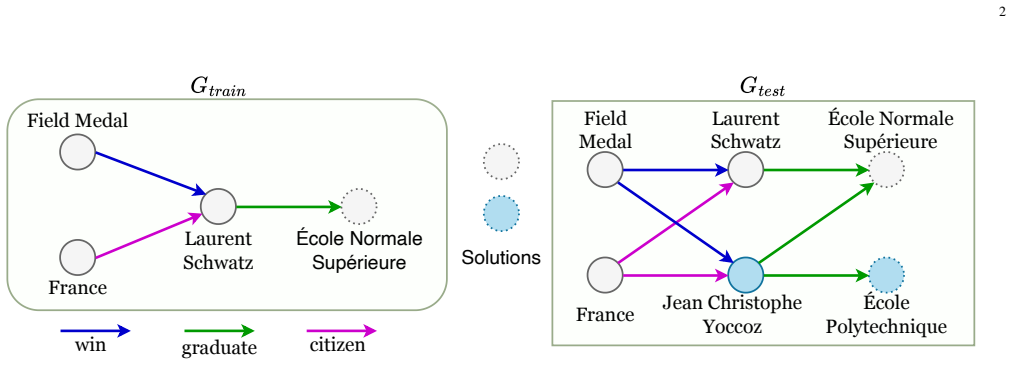


Reference graph
Works this paper leans on
-
[1]
A. Hogan, E. Blomqvist, M. Cochez, C. d’Amato, G. D. Melo, C. Gutierrez, S. Kirrane, J. E. L. Gayo, R. Navigli, S. Neumaieret al., “Knowledge graphs,”ACM Computing Surveys (Csur), vol. 54, no. 4, pp. 1–37, 2021
work page 2021
-
[2]
A survey on knowledge graphs: Representation, acquisition, and applications,
S. Ji, S. Pan, E. Cambria, P. Marttinen, and S. Y . Philip, “A survey on knowledge graphs: Representation, acquisition, and applications,”IEEE transactions on neural networks and learning systems, vol. 33, no. 2, pp. 494–514, 2021
work page 2021
-
[3]
Neural-symbolic models for logical queries on knowledge graphs,
Z. Zhu, M. Galkin, Z. Zhang, and J. Tang, “Neural-symbolic models for logical queries on knowledge graphs,” inInternational conference on machine learning. PMLR, 2022, pp. 27 454–27 478
work page 2022
-
[4]
Inductive logical query answer- ing in knowledge graphs,
M. Galkin, Z. Zhu, H. Ren, and J. Tang, “Inductive logical query answer- ing in knowledge graphs,”Advances in neural information processing systems, vol. 35, pp. 15 230–15 243, 2022
work page 2022
-
[5]
NodePiece: Compositional and Parameter-Efficient Representations of Large Knowledge Graphs
M. Galkin, E. Denis, J. Wu, and W. L. Hamilton, “Nodepiece: Com- positional and parameter-efficient representations of large knowledge graphs,”arXiv preprint arXiv:2106.12144, 2021
work page internal anchor Pith review Pith/arXiv arXiv 2021
-
[6]
Neural bellman-ford networks: A general graph neural network framework for link predic- tion,
Z. Zhu, Z. Zhang, L.-P. Xhonneux, and J. Tang, “Neural bellman-ford networks: A general graph neural network framework for link predic- tion,”Advances in Neural Information Processing Systems, vol. 34, pp. 29 476–29 490, 2021
work page 2021
-
[7]
Learning structural node embeddings via diffusion wavelets,
C. Donnat, M. Zitnik, D. Hallac, and J. Leskovec, “Learning structural node embeddings via diffusion wavelets,” inProceedings of the 24th ACM SIGKDD international conference on knowledge discovery & data mining, 2018, pp. 1320–1329
work page 2018
-
[8]
Ge-spmm: General-purpose sparse matrix-matrix multiplication on gpus for graph neural networks,
G. Huang, G. Dai, Y . Wang, and H. Yang, “Ge-spmm: General-purpose sparse matrix-matrix multiplication on gpus for graph neural networks,” inSC20: International Conference for High Performance Computing, Networking, Storage and Analysis. IEEE, 2020, pp. 1–12
work page 2020
-
[9]
Observed versus latent features for knowl- edge base and text inference,
K. Toutanova and D. Chen, “Observed versus latent features for knowl- edge base and text inference,” inProceedings of the 3rd workshop on continuous vector space models and their compositionality, 2015, pp. 57–66
work page 2015
-
[10]
Open graph benchmark: Datasets for machine learning on graphs,
W. Hu, M. Fey, M. Zitnik, Y . Dong, H. Ren, B. Liu, M. Catasta, and J. Leskovec, “Open graph benchmark: Datasets for machine learning on graphs,”Advances in neural information processing systems, vol. 33, pp. 22 118–22 133, 2020. 12
work page 2020
-
[11]
DeepPath: A Reinforcement Learning Method for Knowledge Graph Reasoning
W. Xiong, T. Hoang, and W. Y . Wang, “Deeppath: A reinforce- ment learning method for knowledge graph reasoning,”arXiv preprint arXiv:1707.06690, 2017
work page internal anchor Pith review Pith/arXiv arXiv 2017
-
[12]
Multi-hop knowledge graph reasoning with reward shaping,
X. V . Lin, C. Xiong, and R. Socher, “Multi-hop knowledge graph reasoning with reward shaping,” Apr. 18 2023, uS Patent 11,631,009
work page 2023
-
[13]
Embedding uncertain knowledge graphs,
X. Chen, M. Chen, W. Shi, Y . Sun, and C. Zaniolo, “Embedding uncertain knowledge graphs,” inProceedings of the AAAI conference on artificial intelligence, vol. 33, no. 01, 2019, pp. 3363–3370
work page 2019
-
[14]
Knowledge graph embedding with iterative guidance from soft rules,
S. Guo, Q. Wang, L. Wang, B. Wang, and L. Guo, “Knowledge graph embedding with iterative guidance from soft rules,” inProceedings of the AAAI Conference on Artificial Intelligence, vol. 32, no. 1, 2018
work page 2018
-
[15]
Jointly embedding knowledge graphs and logical rules,
——, “Jointly embedding knowledge graphs and logical rules,” in Proceedings of the 2016 conference on empirical methods in natural language processing, 2016, pp. 192–202
work page 2016
-
[16]
Relational Message Passing for Knowledge Graph Completion
H. Wang, H. Ren, and J. Leskovec, “Entity context and relational paths for knowledge graph completion,”arXiv preprint arXiv:2002.06757, p. 47, 2020
work page internal anchor Pith review Pith/arXiv arXiv 2002
-
[17]
Em- bedding logical queries on knowledge graphs,
W. Hamilton, P. Bajaj, M. Zitnik, D. Jurafsky, and J. Leskovec, “Em- bedding logical queries on knowledge graphs,”Advances in neural information processing systems, vol. 31, 2018
work page 2018
-
[18]
Query2box: Reasoning over Knowledge Graphs in Vector Space using Box Embeddings
H. Ren, W. Hu, and J. Leskovec, “Query2box: Reasoning over knowl- edge graphs in vector space using box embeddings,”arXiv preprint arXiv:2002.05969, 2020
work page internal anchor Pith review Pith/arXiv arXiv 2002
-
[19]
Beta embeddings for multi-hop logical reason- ing in knowledge graphs,
H. Ren and J. Leskovec, “Beta embeddings for multi-hop logical reason- ing in knowledge graphs,”Advances in Neural Information Processing Systems, vol. 33, pp. 19 716–19 726, 2020
work page 2020
-
[20]
Cone: Cone embeddings for multi-hop reasoning over knowledge graphs,
Z. Zhang, J. Wang, J. Chen, S. Ji, and F. Wu, “Cone: Cone embeddings for multi-hop reasoning over knowledge graphs,”Advances in Neural Information Processing Systems, vol. 34, pp. 19 172–19 183, 2021
work page 2021
-
[21]
Analysis of attention mechanisms in box-embedding systems,
J. Sardina, C. Sardina, J. D. Kelleher, and D. O’Sullivan, “Analysis of attention mechanisms in box-embedding systems,” inIrish Conference on Artificial Intelligence and Cognitive Science. Springer, 2022, pp. 68–80
work page 2022
-
[22]
Fuzzy logic based logical query answering on knowledge graphs,
X. Chen, Z. Hu, and Y . Sun, “Fuzzy logic based logical query answering on knowledge graphs,” inProceedings of the AAAI Conference on Artificial Intelligence, vol. 36, no. 4, 2022, pp. 3939–3948
work page 2022
-
[23]
Complex Query Answering with Neural Link Predictors
E. Arakelyan, D. Daza, P. Minervini, and M. Cochez, “Complex query answering with neural link predictors,”arXiv preprint arXiv:2011.03459, 2020
work page internal anchor Pith review Pith/arXiv arXiv 2011
-
[24]
Com- plex embeddings for simple link prediction,
T. Trouillon, J. Welbl, S. Riedel, ´E. Gaussier, and G. Bouchard, “Com- plex embeddings for simple link prediction,” inInternational conference on machine learning. PMLR, 2016, pp. 2071–2080
work page 2016
-
[25]
M. Kharbanda, R. R. Shah, and R. Mutharaju, “Rcone: Rough cone em- bedding for multi-hop logical query answering on multi-modal knowl- edge graphs,”IEEE Transactions on Knowledge and Data Engineering, 2025
work page 2025
-
[26]
Query Embedding on Hyper-relational Knowledge Graphs
D. Alivanistos, M. Berrendorf, M. Cochez, and M. Galkin, “Query embedding on hyper-relational knowledge graphs,”arXiv preprint arXiv:2106.08166, 2021
work page internal anchor Pith review Pith/arXiv arXiv 2021
-
[27]
A survey of knowledge graph reasoning on graph types: Static, dynamic, and multimodal,
K. Liang, L. Meng, M. Liu, Y . Liu, W. Tu, S. Wang, S. Zhou, X. Liu, and F. Sun, “A survey of knowledge graph reasoning on graph types: Static, dynamic, and multimodal,” 2022
work page 2022
-
[28]
Neural Graph Reasoning: Complex Logical Query Answering Meets Graph Databases
H. Ren, M. Galkin, M. Cochez, Z. Zhu, and J. Leskovec, “Neural graph reasoning: Complex logical query answering meets graph databases,” arXiv preprint arXiv:2303.14617, 2023
work page internal anchor Pith review Pith/arXiv arXiv 2023
-
[29]
Towards Foundation Models for Knowledge Graph Reasoning
M. Galkin, X. Yuan, H. Mostafa, J. Tang, and Z. Zhu, “Towards foundation models for knowledge graph reasoning,”arXiv preprint arXiv:2310.04562, 2023
work page internal anchor Pith review Pith/arXiv arXiv 2023
-
[30]
A Foundation Model for Zero-shot Logical Query Reasoning
M. Galkin, J. Zhou, B. Ribeiro, J. Tang, and Z. Zhu, “Zero-shot logical query reasoning on any knowledge graph,”arXiv preprint arXiv:2404.07198, 2024
work page internal anchor Pith review Pith/arXiv arXiv 2024
-
[31]
B. Xu, H. Shen, Q. Cao, Y . Qiu, and X. Cheng, “Graph wavelet neural network,”arXiv preprint arXiv:1904.07785, 2019
work page internal anchor Pith review Pith/arXiv arXiv 1904
-
[32]
Aswt-sgnn: Adaptive spectral wavelet transform-based self-supervised graph neural network,
R. Liu, R. Yin, Y . Liu, and W. Wang, “Aswt-sgnn: Adaptive spectral wavelet transform-based self-supervised graph neural network,” inPro- ceedings of the AAAI conference on artificial intelligence, vol. 38, no. 12, 2024, pp. 13 990–13 998
work page 2024
-
[33]
Magnet: A neural network for directed graphs,
X. Zhang, Y . He, N. Brugnone, M. Perlmutter, and M. Hirn, “Magnet: A neural network for directed graphs,”Advances in neural information processing systems, vol. 34, pp. 27 003–27 015, 2021
work page 2021
-
[34]
Chebyshev polyno- mial approximation for distributed signal processing,
D. I. Shuman, P. Vandergheynst, and P. Frossard, “Chebyshev polyno- mial approximation for distributed signal processing,” in2011 Inter- national Conference on Distributed Computing in Sensor Systems and Workshops (DCOSS). IEEE, 2011, pp. 1–8
work page 2011
-
[35]
Embedding Entities and Relations for Learning and Inference in Knowledge Bases
B. Yang, W.-t. Yih, X. He, J. Gao, and L. Deng, “Embedding entities and relations for learning and inference in knowledge bases,”arXiv preprint arXiv:1412.6575, 2014
work page internal anchor Pith review Pith/arXiv arXiv 2014
-
[36]
Translating embeddings for modeling multi-relational data,
A. Bordes, N. Usunier, A. Garcia-Duran, J. Weston, and O. Yakhnenko, “Translating embeddings for modeling multi-relational data,”Advances in neural information processing systems, vol. 26, 2013
work page 2013
-
[37]
Principal neighbourhood aggregation for graph nets,
G. Corso, L. Cavalleri, D. Beaini, P. Li `o, and P. Veli ˇckovi´c, “Principal neighbourhood aggregation for graph nets,”Advances in neural infor- mation processing systems, vol. 33, pp. 13 260–13 271, 2020
work page 2020
-
[38]
Free- base: a collaboratively created graph database for structuring human knowledge,
K. Bollacker, C. Evans, P. Paritosh, T. Sturge, and J. Taylor, “Free- base: a collaboratively created graph database for structuring human knowledge,” inProceedings of the 2008 ACM SIGMOD international conference on Management of data, 2008, pp. 1247–1250
work page 2008
-
[39]
Msgnn: A spectral graph neural network based on a novel magnetic signed laplacian,
Y . He, M. Perlmutter, G. Reinert, and M. Cucuringu, “Msgnn: A spectral graph neural network based on a novel magnetic signed laplacian,” in Learning on Graphs Conference. PMLR, 2022, pp. 40–1. Mayank Kharbandareceived his bachelor’s and master’s degrees in computer science from the Uni- versity of Delhi, India, in 2018 and 2020, respec- tively. He is cur...
work page 2022
discussion (0)
Sign in with ORCID, Apple, or X to comment. Anyone can read and Pith papers without signing in.