REVIEW 2 major objections 7 minor 78 references
Engine-swap move decorrelates rare-event paths roughly 5x faster
Reviewed by Pith at T0; open to challenge. T0 means a machine referee read the full paper against a public rubric. the ladder, T0–T4 →
T0 review · glm-5.2
2026-07-09 10:20 UTC pith:3PO6C4TI
load-bearing objection HRETIS adds Hamiltonian replica exchange to RETIS path sampling; the method is sound but the headline 5x speedup is in accepted paths, not wall-clock cost. the 2 major comments →
Collaborate to decorrelate in path space: Hamiltonian replica exchange transition interface sampling (HRETIS)
The pith
A machine-rendered reading of the paper's core claim, the machinery that carries it, and where it could break.
Core claim
The central object is the engine-swap move and its acceptance criterion built around ΔΔU, the double potential-energy difference obtained when two phase points are swapped between two Hamiltonians. The paper shows that this move, inserted into the RETIS/infinite-swap framework, decorrelates path-space sampling by enabling transitions between distinct reaction channels in any ensemble — a capability that standard RETIS lacks because its channel switches occur only near the reactant basin. The practical payoff is faster convergence of crossing probabilities: in the coarse-grained DPPC system, HRETIS achieves under 3% relative SEM roughly 5x faster than RETIS in terms of accepted paths, and the
What carries the argument
Engine-swap move; ΔΔU double energy difference (Eq. 2); factored acceptance criterion P'_acc (Eq. 3) with early rejection via P^ΔΔU_acc (Eq. 4); joint superstate z = (X_m, X_h); detailed balance proof (Appendix A).
Load-bearing premise
HRETIS requires a helper Hamiltonian that simultaneously explores phase space more freely than the main one and has enough Boltzmann-distribution overlap to yield acceptable engine-swap rates. These two desiderata can conflict: a very different helper explores broadly but gets rejected often. Whether a good helper exists for a given target system is not guaranteed in advance and is system-dependent.
What would settle it
Apply HRETIS to a system where no helper Hamiltonian with adequate overlap-and-diversity balance can be found, and show that the engine-swap acceptance rate collapses to a level where HRETIS offers no convergence advantage over RETIS.
If this is right
- For systems with multiple reaction channels separated by orthogonal barriers — drug unbinding, protein conformational switching, membrane transport through heterogeneous bilayers — HRETIS could reduce the wall-clock time to converged kinetics by a factor of several, provided a suitable helper Hamiltonian exists.
- The helper Hamiltonian need not be physically meaningful for the target system; a coarse-grained or lower-level-theory model can serve purely as an exploration accelerator, making the method applicable to all-atom or polarizable force fields paired with cheaper representations.
- When kinetics for two related molecules are both of interest (e.g., a drug and its methylated derivative), HRETIS yields converged statistics for both simultaneously, effectively splitting the computational cost.
- The early-rejection factorization via ΔΔU means most rejected engine-swap attempts cost only two potential-energy evaluations, not full trajectory generation, which keeps the overhead of high swap frequencies manageable.
Where Pith is reading between the lines
- The method's success hinges on finding a helper Hamiltonian in the sweet spot between sufficient Boltzmann-distribution overlap (for acceptable swap rates) and sufficient dynamical diversity (for meaningful decorrelation). This is analogous to the overlap problem in alchemical free-energy calculations, and systematic strategies for constructing or optimizing helper Hamiltonians — perhaps using aut
- Temperature-based replica exchange can be viewed as a special case of the HRETIS framework (absorbing temperature into the Hamiltonian), which suggests that the engine-swap move and its acceptance criterion could unify several existing enhanced-sampling strategies under a single path-space exchange formalism.
- The observation that longer helper-Hamiltonian paths (due to metastable states) correlate with better phase-space exploration hints that helper Hamiltonians could be deliberately designed to introduce controlled metastability or barrier reduction, rather than chosen from existing physical models.
- The current asymmetric treatment — infinite-swap for the main Hamiltonian but simple MC weighting for the helper — suggests a natural extension: applying infinite-swap to both Hamiltonians could further improve the helper's statistics and, by feedback, the main Hamiltonian's decorrelation.
Editorial analysis
A structured set of objections, weighed in public.
Referee Report
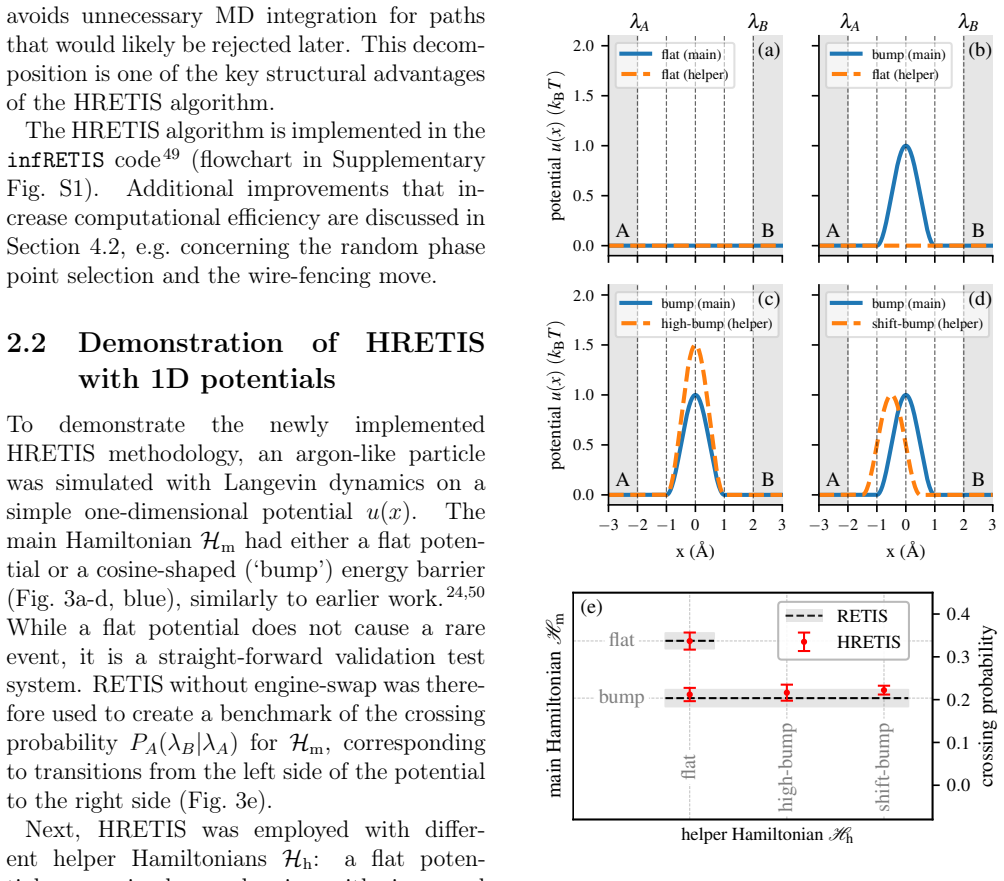
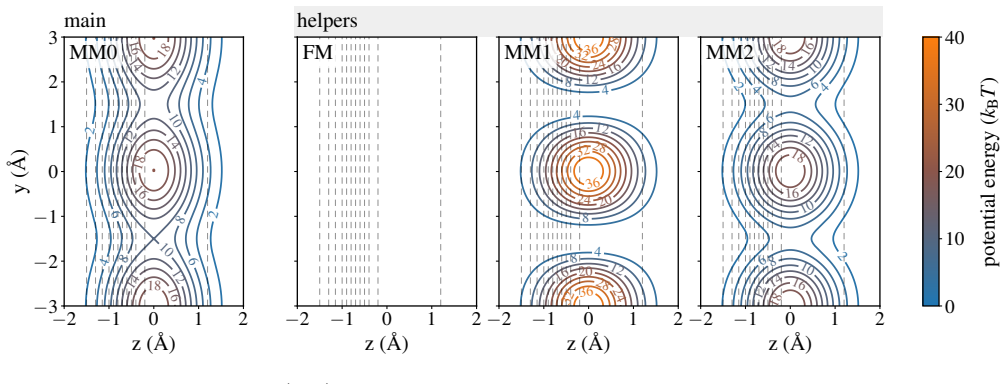
Summary. This manuscript introduces Hamiltonian Replica Exchange Transition Interface Sampling (HRETIS), which extends RETIS by adding an engine-swap move that exchanges phase points between a main and a helper Hamiltonian within path ensembles. The acceptance criterion (Eq. 1) is derived from detailed balance in Appendix A and can be decomposed into sequential checks for early rejection (Eq. 3). The method is validated on 1D Langevin potentials, demonstrated on 2D model membrane potentials with two permeation channels, and applied to coarse-grained (CG) Martini simulations of amino acid permeation through a DPPC bilayer. The central claims are that HRETIS enhances path decorrelation across all ensembles and improves convergence of crossing probabilities relative to RETIS.
Significance. The paper makes a genuine methodological contribution to path sampling. The detailed balance derivation in Appendix A is clean and follows standard path sampling formalism; the decomposition into sequential acceptance checks (Eq. 3) with the cheap early-rejection step via the ΔΔU criterion (Eq. 4) is a practical algorithmic improvement. The 1D validation (Fig. 3e) shows agreement with independent RETIS benchmarks. The 2D channel-switching analysis (Fig. 5) is particularly convincing: it demonstrates that engine-swap moves enable channel switching in all ensembles, not just the lower ones, and includes a cost-aware metric (force evaluations per channel switch, Fig. 5f). The CG results (Figs. 6-7) show clear decorrelation benefits in the xy-plane. The code and data are publicly available (GitHub and Zenodo), which is commendable.
major comments (2)
- Section 2.4.3, Fig. 8c: The headline claim that HRETIS reaches <3% relative SEM on P_A(λ_B|λ_A) approximately 5x faster than RETIS is measured in number of accepted paths (N_acc), not in computational cost. The paper itself acknowledges in Section 2.4.4 that 'the cost of HRETIS is higher than that of the RETIS simulation' (Supplementary Fig. S14) and that this cost 'gradually increases with increasing engine-swap probability.' The 5x claim is specifically at s75, the most expensive setting. In the CG system, the helper Hamiltonian (P2-C6) has path lengths approximately 3.7x longer than the main (P2-P5) (Section 2.4.1), and both Hamiltonians use the same Martini force field (same cost per force evaluation). The paper never combines the convergence data (Fig. 8c) with the cost data (Supplementary Fig. S14) to show the net speedup in force evaluations or wall-clock time. If the per-accepted
- path cost ratio at s75 is comparable to or exceeds the 5x convergence speedup in N_acc, the computational advantage vanishes. This is load-bearing for the paper's central practical claim. The authors should either (a) replot Fig. 8c with relative SEM vs. total force evaluations (or wall-clock time) instead of N_acc, or (b) explicitly state the per-accepted-path cost ratio at s75 and compute the net computational speedup. The 2D results already include such a cost-aware analysis (Fig. 5f), so the infrastructure exists; it should be applied to the CG system as well.
minor comments (7)
- Section 2.1, step 2: The notation x†_m and x†_h is introduced without explicitly stating that † denotes a selected (dagger) phase point rather than a time-reversed phase point. This could be confused with the ¯x notation used in Appendix A (Eq. 14). A brief clarifying remark would help.
- Section 2.3.1: The sentence 'The MC chain in RETIS (and HRETIS) is somewhat complex' is informal; consider rephrasing.
- Section 2.4.1: 'methionine' has a typo ('me-thionine' with a hyphenation artifact).
- Fig. 5e-f: The y-axis label 'SR = # switch / # acc. paths' could be formatted more cleanly. Similarly, the axis label 'force evaluation / # switch' in Fig. 5f should read 'force evaluations per channel switch' for clarity.
- Section 2.4.3: The reference to Supplementary Fig. S12 for the helper Hamiltonian convergence is mentioned in passing; a brief statement of the quantitative speedup factor (stated as 'approximately two times') would be useful in the main text.
- Appendix A, Eq. (23): The term e^{-βΔΔH} uses H (Hamiltonian) while the main text and Eq. (2) use U (potential energy). The transition from ΔΔH to ΔΔU is explained at the end of the appendix, but a forward reference to Eq. (2) earlier in the derivation would improve readability.
- Section 3 (Discussion): The paragraph beginning 'There is a subtle technical point...' discusses the case where both Hamiltonians have comparable cost, which is exactly the CG system studied. This important caveat would be better placed in Section 2.4.4 where the cost issue is first raised, rather than deferred to the Discussion.
Simulated Author's Rebuttal
We thank the referee for a careful and constructive report. The referee correctly identifies that the headline 5x convergence speedup for the CG system (Fig. 8c) is measured in number of accepted paths (N_acc), not in computational cost, and that this is a load-bearing gap given that HRETIS at s75 is acknowledged to be more expensive per accepted path. We agree this must be addressed directly in the revised manuscript.
read point-by-point responses
-
Referee: Section 2.4.3, Fig. 8c: The headline claim that HRETIS reaches <3% relative SEM on P_A(λ_B|λ_A) approximately 5x faster than RETIS is measured in number of accepted paths (N_acc), not in computational cost. The paper itself acknowledges in Section 2.4.4 that 'the cost of HRETIS is higher than that of the RETIS simulation' (Supplementary Fig. S14) and that this cost 'gradually increases with increasing engine-swap probability.' The 5x claim is specifically at s75, the most expensive setting. In the CG system, the helper Hamiltonian (P2-C6) has path lengths approximately 3.7x longer than the main (P2-P5) (Section 2.4.1), and both Hamiltonians use the same Martini force field (same cost per force evaluation). The paper never combines the convergence data (Fig. 8c) with the cost data (Supplementary Fig. S14) to show the net speedup in force evaluations or wall-clock time. If the per-accepted
Authors: The referee is correct on all factual points. The 5x convergence speedup in Fig. 8c is indeed measured in N_acc, not in force evaluations or wall-clock time, and we acknowledge in Section 2.4.4 that the per-accepted-path cost of HRETIS increases with engine-swap probability. We agree that for the CG system — where both Hamiltonians use the same Martini force field and the helper (P2-C6) has ~3.7x longer paths — the net computational speedup could be substantially smaller than 5x, and the manuscript does not currently make this explicit. This is a genuine gap in the presentation of our central practical claim. We will address it in the revision by: (1) adding a new figure or panel that replots the relative SEM of P_A(λ_B|λ_A) as a function of total force evaluations (combining the convergence data from Fig. 8c with the cost data from Supplementary Fig. S14), following the same cost-aware approach already used for the 2D system in Fig. 5f; (2) explicitly stating the per-accepted-path cost ratio at s75 and computing the net computational speedup in force evaluations; and (3) revising the wording in Section 2.4.3 and the abstract to clearly distinguish between convergence speedup measured in N_acc and net speedup in computational cost, and to qualify the claim accordingly. We note that the manuscript already discusses (Section 2.4.4 and Discussion) that the additional cost of HRETIS diminishes when the helper Hamiltonian is significantly cheaper than the main (e.g., CG helper for an all-atom main, or a classical force field helper for a polarizable main), which is the intended use case. However, the referee is right that for the specific CG demonstration presented — where both Hamiltonians have comparable per-force-evaluation cost — the net computational advantage must be量化 revision: yes
Circularity Check
No significant circularity: the acceptance criterion is derived from detailed balance in Appendix A, crossing probabilities are computed from sampled paths, and RETIS benchmarks are independent simulations.
specific steps
-
self citation load bearing
[Section 2.1, Eq. 2 and surrounding text]
"This term is identical to the expression obtained for a zero-swap move between two levels of theory (e.g. quantum mechanical versus classical), as implemented in QuanTIS."
The ∆∆U energy term (Eq. 2) is noted as identical to the QuanTIS expression (Ref. 48, by overlapping authors). However, this is a minor observation rather than a load-bearing derivation step. The acceptance criterion (Eq. 1) is independently derived from detailed balance in Appendix A (Eqs. 11-25) without requiring QuanTIS. The self-citation is contextual, not circular.
full rationale
The paper's central derivation—the HRETIS acceptance criterion (Eq. 1)—is derived from first principles via detailed balance in Appendix A. The derivation starts from the joint path probability (Eq. 17), the generation probability (Eq. 22), and arrives at the acceptance ratio (Eq. 23) and final criterion (Eq. 25) through standard Metropolis-Hastings logic. No step reduces to its own inputs by construction. The crossing probabilities (Fig. 3e, Fig. 8) are computed from sampled path statistics, not imposed or fitted. RETIS benchmarks are independent simulations. Self-citations (Refs. 23, 24, 50, 54, 57) are to prior RETIS methodology and applications by the same group, but these serve as baselines, software references, or context—not as load-bearing premises that would make the present derivation circular. The QuanTIS reference (Ref. 48) notes a mathematical similarity in the ∆∆U expression but does not constitute a circular dependency. The skeptic's concern about cost-per-accepted-path metrics is a correctness/communication issue, not a circularity issue.
Axiom & Free-Parameter Ledger
free parameters (4)
- engine-swap probability =
0%, 25%, 50%, 75%, 100% (varied across simulations)
- helper exploration probability =
0%, 50%, 100% (varied)
- 2D potential parameters (V1, V2, Vmax) =
See Table 1 (e.g., MM0: V1=10, V2=11, Vmax=20 kBT)
- Martini bead types (P2-P5, P2-C6) =
P2-P5 (main), P2-C6 (helper)
axioms (4)
- standard math Microscopic time-reversibility of the MD dynamics
- standard math Boltzmann equilibrium distribution for phase points
- domain assumption Sufficient overlap between Boltzmann distributions of main and helper Hamiltonians for acceptable engine-swap rates
- domain assumption The order parameter λ adequately describes the transition
read the original abstract
We present Hamiltonian Replica Exchange Transition Interface Sampling (HRETIS), a path sampling framework designed to efficiently sample rare events in systems with complex potential energy landscapes. HRETIS introduces a helper potential within a Hamiltonian replica exchange scheme, which enhances exploration of path space when the underlying potential is not well suited for conventional path sampling approaches. This is particularly advantageous for systems exhibiting multiple pathways separated by orthogonal barriers such as in drug (un)binding, where standard algorithms often show slow convergence since they become trapped within specific pathways. By exchanging Hamiltonians between the path ensembles, HRETIS overcomes these limitations and increases the decorrelation between subsequent paths in the Monte Carlo chain. We demonstrate that HRETIS provides robust and accurate kinetics in several systems, including coarse-grained simulations of amino acid permeation through a dipalmitoylphosphatidylcholine (DPPC) membrane. Moreover, HRETIS is found to improve sampling efficiency and convergence, illustrating its potential as a powerful tool for rare event sampling in complex molecular systems.
Figures




Reference graph
Works this paper leans on
-
[1]
Physical Review Letters , volume=
Enhanced sampling of configuration and path space in a generalized ensemble by shooting point exchange , author=. Physical Review Letters , volume=. 2024 , publisher=
work page 2024
-
[2]
The Journal of Chemical Physics , volume=
Enhanced path sampling using subtrajectory Monte Carlo moves , author=. The Journal of Chemical Physics , volume=. 2023 , publisher=
work page 2023
-
[3]
Physical Review Research , volume=
Exact non-Markovian permeability from rare event simulations , author=. Physical Review Research , volume=. 2021 , publisher=
work page 2021
-
[4]
Martini 3: a general purpose force field for coarse-grained molecular dynamics , author=. Nature Methods , volume=. 2021 , publisher=
work page 2021
-
[5]
The Journal of Physical Chemistry B , volume=
Exact Kinetics of Drug Permeation Using Transition Interface Sampling , author=. The Journal of Physical Chemistry B , volume=. 2025 , publisher=
work page 2025
-
[6]
Journal of Computational Chemistry , volume=
CHARMM-GUI: a web-based graphical user interface for CHARMM , author=. Journal of Computational Chemistry , volume=. 2008 , publisher=
work page 2008
-
[7]
The Journal of Chemical Physics , volume=
Canonical sampling through velocity rescaling , author=. The Journal of Chemical Physics , volume=. 2007 , publisher=
work page 2007
-
[8]
The Journal of Chemical Physics , volume=
Pressure control using stochastic cell rescaling , author=. The Journal of Chemical Physics , volume=. 2020 , publisher=
work page 2020
-
[9]
The Journal of Physical Chemistry B , volume=
Experimental and molecular dynamics simulation study of the effects of lignin dimers on the gel-to-fluid phase transition in DPPC bilayers , author=. The Journal of Physical Chemistry B , volume=. 2019 , publisher=
work page 2019
-
[10]
The Journal of Physical Chemistry A , volume=
Exchanging replicas with unequal cost, infinitely and permanently , author=. The Journal of Physical Chemistry A , volume=. 2022 , publisher=
work page 2022
-
[11]
The Journal of Chemical Physics , volume=
Generalized Path Reweighting and History-Dependent Free Energies , author=. The Journal of Chemical Physics , volume=. 2026 , publisher=
work page 2026
-
[12]
Annual Review of Physical Chemistry , volume=
Transition path sampling: Throwing ropes over rough mountain passes, in the dark , author=. Annual Review of Physical Chemistry , volume=. 2002 , publisher=
work page 2002
-
[13]
Advanced Computer Simulation Approaches for Soft Matter Sciences III , volume=
Transition path sampling and other advanced simulation techniques for rare events , author=. Advanced Computer Simulation Approaches for Soft Matter Sciences III , volume=. 2008 , publisher=
work page 2008
-
[14]
The Journal of Chemical Physics , volume=
Efficient transition path sampling: Application to Lennard-Jones cluster rearrangements , author=. The Journal of Chemical Physics , volume=. 1998 , publisher=
work page 1998
-
[15]
The Journal of Chemical Physics , volume=
Transition path sampling and the calculation of rate constants , author=. The Journal of Chemical Physics , volume=. 1998 , publisher=
work page 1998
-
[16]
The Journal of Chemical Physics , volume=
A novel path sampling method for the calculation of rate constants , author=. The Journal of Chemical Physics , volume=. 2003 , publisher=
work page 2003
-
[17]
Physical Review Letters , volume=
Reaction rate calculation by parallel path swapping , author=. Physical Review Letters , volume=. 2007 , publisher=
work page 2007
-
[18]
Proceedings of the National Academy of Sciences , volume=
Highly parallelizable path sampling with minimal rejections using asynchronous replica exchange and infinite swaps , author=. Proceedings of the National Academy of Sciences , volume=. 2024 , publisher=
work page 2024
-
[19]
Journal of Chemical Theory and Computation , volume=
Estimating full path lengths and kinetics from partial path transition interface sampling simulations , author=. Journal of Chemical Theory and Computation , volume=. 2026 , publisher=
work page 2026
-
[20]
Path sampling challenges in large biomolecular systems: RETIS and REPPTIS for ABL-imatinib kinetics , author=. Biophysical Journal , volume=. 2025 , publisher=
work page 2025
-
[21]
The Journal of Chemical Physics , volume=
The reweighted path ensemble , author=. The Journal of Chemical Physics , volume=. 2010 , publisher=
work page 2010
-
[22]
Journal of Chemical Theory and Computation , volume=
Analyzing complex reaction mechanisms using path sampling , author=. Journal of Chemical Theory and Computation , volume=. 2016 , publisher=
work page 2016
-
[23]
The Journal of Physical Chemistry Letters , volume=
Fast decorrelating Monte Carlo moves for efficient path sampling , author=. The Journal of Physical Chemistry Letters , volume=. 2017 , publisher=
work page 2017
-
[24]
The Journal of Chemical Physics , volume=
Rare events via multiple reaction channels sampled by path replica exchange , author=. The Journal of Chemical Physics , volume=. 2008 , publisher=
work page 2008
-
[25]
Machine Learning: Science and Technology , volume=
Conditioning Boltzmann generators for rare event sampling , author=. Machine Learning: Science and Technology , volume=. 2023 , publisher=
work page 2023
-
[26]
Boltzmann generators: Sampling equilibrium states of many-body systems with deep learning , author=. Science , volume=. 2019 , publisher=
work page 2019
-
[27]
The Journal of Chemical Physics , volume=
Practical guide to replica exchange transition interface sampling and forward flux sampling , author=. The Journal of Chemical Physics , volume=. 2022 , publisher=
work page 2022
-
[28]
The European Physical Journal Special Topics , volume=
Avoiding traps in trajectory space: Metadynamics enhanced transition path sampling , author=. The European Physical Journal Special Topics , volume=. 2016 , publisher=
work page 2016
-
[29]
Advanced Theory and Simulations , volume=
Transition path sampling as Markov chain Monte Carlo of trajectories: Recent algorithms, software, applications, and future outlook , author=. Advanced Theory and Simulations , volume=. 2021 , publisher=
work page 2021
-
[30]
Journal of Computational Physics , volume=
Elaborating transition interface sampling methods , author=. Journal of Computational Physics , volume=. 2005 , publisher=
work page 2005
-
[31]
Journal of Chemical Theory and Computation , volume=
Gluing potential energy surfaces with rare event simulations , author=. Journal of Chemical Theory and Computation , volume=. 2015 , publisher=
work page 2015
-
[32]
Journal of Physics: Condensed Matter , volume=
The atomic simulation environment—a Python library for working with atoms , author=. Journal of Physics: Condensed Matter , volume=. 2017 , publisher=
work page 2017
-
[33]
Journal of Computational Chemistry , volume=
PyRETIS 3: Conquering rare and slow events without boundaries , author=. Journal of Computational Chemistry , volume=. 2024 , publisher=
work page 2024
-
[34]
The European Physical Journal Special Topics , volume=
Practical and conceptual path sampling issues , author=. The European Physical Journal Special Topics , volume=. 2015 , publisher=
work page 2015
-
[35]
Current Opinion in Structural Biology , volume=
Path-sampling strategies for simulating rare events in biomolecular systems , author=. Current Opinion in Structural Biology , volume=. 2017 , publisher=
work page 2017
-
[36]
How far can we stretch the timescale with RETIS? , author=. Europhysics Letters , volume=. 2023 , publisher=
work page 2023
-
[37]
Physical Review Letters , volume=
Optimized monte carlo data analysis , author=. Physical Review Letters , volume=. 1989 , publisher=
work page 1989
-
[38]
The weighted histogram analysis method for free-energy calculations on biomolecules. I. The method , author=. Journal of Computational Chemistry , volume=. 1992 , publisher=
work page 1992
-
[39]
Computer Physics Communications , volume=
The calculation of the potential of mean force using computer simulations , author=. Computer Physics Communications , volume=. 1995 , publisher=
work page 1995
-
[40]
Journal of Chemical Theory and Computation , volume=
Combining transition path sampling with data-driven collective variables through a reactivity-biased shooting algorithm , author=. Journal of Chemical Theory and Computation , volume=. 2024 , publisher=
work page 2024
-
[41]
Recent progress towards chemically-specific coarse-grained simulation models with consistent dynamical properties , author=. Computation , volume=. 2019 , publisher=
work page 2019
-
[42]
Physical Chemistry Chemical Physics , volume=
Multiscale modeling of soft matter: scaling of dynamics , author=. Physical Chemistry Chemical Physics , volume=. 2011 , publisher=
work page 2011
-
[43]
Nature Communications , volume=
Large-scale simulation of biomembranes incorporating realistic kinetics into coarse-grained models , author=. Nature Communications , volume=. 2020 , publisher=
work page 2020
-
[44]
Journal of Chemical Information and Modeling , volume=
MartiniGlass: a tool for enabling visualization of coarse-grained martini topologies , author=. Journal of Chemical Information and Modeling , volume=. 2025 , publisher=
work page 2025
-
[45]
The Journal of Chemical Physics , volume=
Multidimensional replica-exchange method for free-energy calculations , author=. The Journal of Chemical Physics , volume=. 2000 , publisher=
work page 2000
-
[46]
Journal of Chemical Theory and Computation , volume=
Replica exchange nested sampling , author=. Journal of Chemical Theory and Computation , volume=. 2025 , publisher=
work page 2025
-
[47]
The Journal of Chemical Physics , volume=
Onsager--Machlup action-based path sampling and its combination with replica exchange for diffusive and multiple pathways , author=. The Journal of Chemical Physics , volume=. 2010 , publisher=
work page 2010
-
[48]
Chemical Physics Letters , volume=
Replica-exchange molecular dynamics method for protein folding , author=. Chemical Physics Letters , volume=. 1999 , publisher=
work page 1999
-
[49]
Journal of the Physical Society of Japan , volume=
Exchange Monte Carlo method and application to spin glass simulations , author=. Journal of the Physical Society of Japan , volume=. 1996 , publisher=
work page 1996
-
[50]
Hamiltonian replica exchange in GROMACS: a flexible implementation , author=. Molecular Physics , volume=. 2014 , publisher=
work page 2014
-
[51]
Chemical Physics Letters , volume=
Replica-exchange Monte Carlo method for the isobaric--isothermal ensemble , author=. Chemical Physics Letters , volume=. 2001 , publisher=
work page 2001
-
[52]
The Journal of Physical Chemistry B , volume=
Update of the CHARMM all-atom additive force field for lipids: validation on six lipid types , author=. The Journal of Physical Chemistry B , volume=. 2010 , publisher=
work page 2010
-
[53]
Journal of Chemical Theory and Computation , volume=
Multiple time-step dual-Hamiltonian hybrid molecular dynamics--Monte Carlo canonical propagation algorithm , author=. Journal of Chemical Theory and Computation , volume=. 2016 , publisher=
work page 2016
-
[54]
The Journal of Chemical Physics , volume=
Revisiting shooting point Monte Carlo methods for transition path sampling , author=. The Journal of Chemical Physics , volume=. 2025 , publisher=
work page 2025
-
[55]
The Journal of Chemical Physics , volume=
Obtaining reaction coordinates by likelihood maximization , author=. The Journal of Chemical Physics , volume=. 2006 , publisher=
work page 2006
-
[56]
Enhanced sampling in molecular dynamics using metadynamics, replica-exchange, and temperature-acceleration , author=. Entropy , volume=. 2013 , publisher=
work page 2013
-
[57]
Journal of Chemical Theory and Computation , volume=
Easy transition path sampling methods: Flexible-length aimless shooting and permutation shooting , author=. Journal of Chemical Theory and Computation , volume=. 2015 , publisher=
work page 2015
-
[58]
Convergence is not correctness: context-dependent performance of enhanced-sampling methods across biological complexity , author=. Nature Communications , year=
-
[59]
Nature Machine Intelligence , volume=
Efficient rare event sampling with unsupervised normalizing flows , author=. Nature Machine Intelligence , volume=. 2024 , publisher=
work page 2024
-
[60]
Nature Computational Science , volume=
Efficient sampling of high-dimensional free energy landscapes using adaptive reinforced dynamics , author=. Nature Computational Science , volume=. 2022 , publisher=
work page 2022
-
[61]
Nature Communications , volume=
Fast free energy estimates from -dynamics with bias-updated Gibbs sampling , author=. Nature Communications , volume=. 2023 , publisher=
work page 2023
-
[62]
Nature Communications , volume=
Enhanced sampling of protein conformational changes via true reaction coordinates from energy relaxation , author=. Nature Communications , volume=. 2025 , publisher=
work page 2025
-
[63]
Nature Communications , pages=
AI-guided transition path sampling of lipid flip-flop and membrane nanoporation , author=. Nature Communications , pages=. 2025 , publisher=
work page 2025
-
[64]
Nature Computational Science , volume=
Everything everywhere all at once: a probability-based enhanced sampling approach to rare events , author=. Nature Computational Science , volume=. 2025 , publisher=
work page 2025
-
[65]
Complete protein--protein association kinetics in atomic detail revealed by molecular dynamics simulations and Markov modelling , author=. Nature Chemistry , volume=. 2017 , publisher=
work page 2017
-
[66]
Nature Communications , volume=
Protein conformational plasticity and complex ligand-binding kinetics explored by atomistic simulations and Markov models , author=. Nature Communications , volume=. 2015 , publisher=
work page 2015
-
[67]
Determining small-molecule permeation through lipid membranes , author=. Nature Protocols , volume=. 2022 , publisher=
work page 2022
-
[68]
Adaptive sampling--based structural prediction reveals opening of a GABAA receptor through the interface , author=. Science Advances , volume=. 2025 , publisher=
work page 2025
-
[69]
Nature Computational Science , volume=
Computing the committor with the committor to study the transition state ensemble , author=. Nature Computational Science , volume=. 2024 , publisher=
work page 2024
-
[70]
Nature Communications , volume=
Learning stochastic dynamics and predicting emergent behavior using transformers , author=. Nature Communications , volume=. 2024 , publisher=
work page 2024
-
[71]
Annual Review of Biophysics , volume=
Milestoning: An efficient approach for atomically detailed simulations of kinetics in biophysics , author=. Annual Review of Biophysics , volume=. 2020 , publisher=
work page 2020
-
[72]
Nature Communications , volume=
Path sampling of recurrent neural networks by incorporating known physics , author=. Nature Communications , volume=. 2022 , publisher=
work page 2022
-
[73]
Journal of Chemical Theory and Computation , volume=
Predicting biomolecular binding kinetics: A review , author=. Journal of Chemical Theory and Computation , volume=. 2023 , publisher=
work page 2023
-
[74]
Proceedings of the National Academy of Sciences , volume=
STIM1 transmembrane helix dimerization captured by AI-guided transition path sampling , author=. Proceedings of the National Academy of Sciences , volume=. 2025 , publisher=
work page 2025
-
[75]
Molecular dynamics simulation of small molecules interacting with biological membranes , author=. ChemPhysChem , volume=. 2020 , publisher=
work page 2020
-
[76]
Living Journal of Computational Molecular Science , volume=
Enhanced Sampling Methods for Molecular Dynamics Simulations , author=. Living Journal of Computational Molecular Science , volume=
-
[77]
Journal of Chemical Theory and Computation , volume=
Alchemical enhanced sampling with optimized phase space overlap , author=. Journal of Chemical Theory and Computation , volume=. 2024 , publisher=
work page 2024
-
[78]
doi:10.5281/zenodo.14016590 , url =
2024 , howpublished =. doi:10.5281/zenodo.14016590 , url =
discussion (0)
Sign in with ORCID, Apple, or X to comment. Anyone can read and Pith papers without signing in.