REVIEW 3 major objections 5 minor 64 references
Activation dispersion at the prompt point reveals entity familiarity near ceiling from 1.5B, while factual reliability on known entities scales separately and models almost never refuse.
Reviewed by Pith at T0; open to challenge. T0 means a machine referee read the full paper against a public rubric. the ladder, T0–T4 →
T0 review · grok-4.5
2026-07-10 18:21 UTC pith:I7LCRBJF
load-bearing objection Solid one-pass familiarity detector on Bielik with real controls; the familiarity-vs-reliability dissociation is the interesting claim and is only half-settled because the reliability curve is athletes-only and Claude-judged. the 3 major comments →
Does Bielik Know What It Doesn't Know? Activation Dispersion Separates Entity Familiarity from Factual Reliability Across Model Scale
The pith
A machine-rendered reading of the paper's core claim, the machinery that carries it, and where it could break.
Core claim
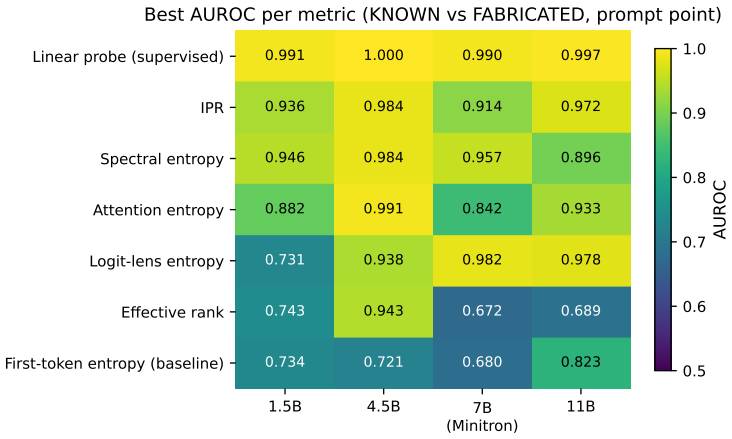
Entity familiarity and factual reliability are distinct phenomena on different scaling curves. Unsupervised inverse participation ratio and spectral entropy of post-SwiGLU MLP activations at the prompt point separate known from fabricated entities at AUROC 0.95–1.00 across athletes, cities, writers, and musicians and across Bielik scales 1.5B–11B, already at ceiling at 1.5B; the signal survives real-name controls and cross-domain transfer. Fully correct answers on the same known athletes rise from 0/42 to 19/42 under a strict judge. Dispersion does not reliably read correctness within known entities, and models almost never abstain despite a near-perfectly decodable familiarity signal.
What carries the argument
Inverse participation ratio and spectral entropy of winsorized post-SwiGLU MLP activations at the last prompt token: closed-form, unsupervised, single-forward-pass concentration statistics that measure how localized versus smeared the activation pattern is.
Load-bearing premise
The rising correctness curve and near-zero refusal claim rest on one family of LLM judges correctly scoring Polish sports-biography answers and refusals.
What would settle it
Have independent human annotators or a non-Claude judge re-label the 42 known athletes’ answers under the same strict and soft rubrics; if the 0→2→10→19 fully-correct counts flatten or reverse, or if refusals are no longer near zero, the dissociation and abstention-gap claims fail.
If this is right
- A free prefill-time dispersion gate can route high-dispersion (unfamiliar) queries to retrieval, escalation, or abstention without extra samples or labels.
- Familiarity detectors must not be marketed as hallucination detectors for answers about entities the model already knows.
- Representational ‘I don’t know this entity’ can be present at every scale while calibrated refusal remains almost absent—an alignment gap, not a capability gap.
- Entity recognition can saturate early while long-tail factual reliability continues to improve with scale, matching frequency-based accounts of recall.
- Global volumetric statistics remain useful even when the underlying circuitry is diffuse across heads rather than localized.
Where Pith is reading between the lines
- A cheap two-stage stack is natural: dispersion for prompt-side unfamiliarity, then multi-sample semantic entropy for generation-side consistency on familiar entities.
- The forced one-sentence prompt may suppress abstention; a prompt that invites ‘say if unsure’ could close the refusal gap more cheaply than steering or fine-tuning.
- Because the signal is diffuse across heads, global dispersion may stay a practical monitor across model families even when specific circuits differ.
- English and other-language replications would test whether the early ceiling is specific to Polish tokenization and Bielik pretraining frequency.
Editorial analysis
A structured set of objections, weighed in public.
Referee Report
Summary. The paper tests whether post-SwiGLU MLP activation dispersion (IPR and spectral entropy) at the prompt point, before any answer token, encodes entity familiarity in four Bielik models (1.5B–11B) across athletes, cities, writers, and musicians (known / obscure-real / fabricated; 504 prompts per model). Unsupervised dispersion separates known from fabricated at AUROC 0.95–1.00 (probe 0.99–1.00), clears selection-aware permutation floors (~0.70–0.74), survives held-out layer selection, persists on known vs. obscure-real names, and transfers across domains after a matched-template control for the cities stem. The familiarity signal is already near ceiling at 1.5B, while strict fully-correct answers on known athletes rise 0→2→10→19 of 42; within-known correctness is not cleanly read by dispersion; semantic entropy is weaker on familiarity but stronger on correctness; and an audit of 2,520 answers finds almost no refusals. The central claim is that entity familiarity and factual reliability are distinct phenomena on different scaling curves.
Significance. If the dissociation holds, the work cleanly separates a cheap, label-free, single-pass familiarity gate from answer-level factual reliability, with unusually careful selection controls, a fabricated-string-free real-name control, cross-domain transfer with a template counterfactual, a Gemma-4 qualitative control, and an honest mostly-negative result on within-known correctness. The public pipeline and frozen artifacts make the activation side reproducible. For Polish LLM deployment and for the broader internal-state hallucination literature, a prompt-point volumetric detector that is already strong at 1.5B is practically and scientifically useful even if it does not track correctness. The near-zero-refusal audit, if robust, is a concrete alignment gap rather than a capability gap.
major comments (3)
- [§3.2, §4.3, Fig. 1(b), §6] §3.2, §4.3, Fig. 1(b), and §6: the reliability half of the dissociation (strict 0→2→10→19 and soft 6→16→24→33 of 42 known athletes) rests entirely on Claude Opus 4.8, with parse failures defaulting to incorrect under the bare strict prompt. The paper itself notes that no non-Claude judge was run and that a family-level blind spot would contaminate behavioral counts and the SE correctness column together. Manual review of 615 soft verdicts (~0.3% anomalies) does not validate the absolute scale of the curve. Because the title/abstract claim is that familiarity and reliability move on different scaling curves, this is load-bearing: please add an independent judge family and/or human labels on a stratified subset of known-athlete answers, and report agreement with Opus so the scaling dissociation is not a single-judge artifact.
- [Abstract, §3.1–3.2, §5–6] Abstract, §1 contributions, and §5 state a general dissociation, but §3.1–3.2 and §6 restrict behavioral labels, semantic entropy, and the refusal audit to athletes only; cities/writers/musicians carry condition-based detection labels only. The familiarity detector generalizes well (Table 7, Fig. 5), yet the claim that reliability scales while familiarity does not is demonstrated on one domain. Either extend soft/strict judging (or a lighter human audit) to at least one additional domain, or narrow the abstract and discussion so the dissociation is explicitly athletes-only while cross-domain claims are limited to familiarity detection.
- [§3.5, Table 1] §3.5: winsorization quantile q=0.99 is acknowledged as a researcher degree of freedom and is the most favorable of {0.95, 0.99, 0.999, 1.0} on the 1.5B sweep; best layer moves with q and per-layer AUROCs degrade substantially at other settings (e.g., entropy at layer 22). The existence of a signal at every q is reassuring, but headline numbers and layer choices are tied to the most favorable setting on one model. Please either (i) fix q by a pre-registered rule independent of the known-vs-fabricated AUROC, (ii) report best-of-pair under a held-out q selection, or (iii) show that the multi-model, multi-domain ceiling claim is stable under a less favorable fixed q.
minor comments (5)
- [Table 5, §4.6] Table 5 uses a single-permutation floor that the text itself says understates the selection-aware null (§3.6); either recompute selection-aware floors for the behavioral grid or mark those floors more clearly as optimistic lower bounds so readers do not over-read the 11B probe cell.
- [Figure 2] Figure 2 note on MLP-hook vs residual-stream index offset is easy to miss; a one-line axis caption that residual and MLP depths are not identically indexed would help.
- [§3.1] §3.1: the 42-per-condition Adams nod is fine in a footnote, but the main text should state the sample-size rationale in statistical terms (power / CI width) given n=84 per contrast.
- [§5, Appendix A] Appendix A Gemma-4 refusal counts are marker-based entity-level all-five-sample refusals, unlike the Bielik LLM answer-level audit; state this contrast more prominently when comparing abstention regimes in §5.
- [§3.5, front matter] Typos / wording: “Inverse Participation Ration” (§3.5); “labelled spectral entropy in the figures” vs. Shannon entropy of activations (clarify naming once); arXiv date line “July 2026” looks like a placeholder.
Circularity Check
Empirical measurement paper with external condition labels and closed-form dispersion metrics; no derivation reduces to its inputs by construction.
full rationale
The paper’s load-bearing claims are empirical contrasts, not forced derivations. IPR and spectral entropy are closed-form functions of post-SwiGLU activations (Eqs. 1–2); known/unknown-real/fabricated labels are assigned from external entity lists, not from the metrics. AUROC is evaluated against those labels, against selection-aware permutation nulls that re-select layers, and against held-out layer selection—so the headline separability is not a fit renamed as a prediction. Cross-domain transfer, the matched-template counterfactual, and the known-vs-unknown-real control further test the signal against independent structure rather than restate the training contrast. Behavioral reliability is scored by an external LLM judge on sampled answers; that is a validity risk (single judge family, athletes-only), not circularity: correctness labels are not defined from dispersion, and dispersion is not fitted to correctness. There is no self-citation uniqueness theorem, no ansatz smuggled from the author’s prior work, and no renaming of a known result as a first-principles derivation. Solo author; Bielik citations are third-party model reports. Score 0 is the honest finding.
Axiom & Free-Parameter Ledger
free parameters (4)
- winsorization quantile q =
0.99
- entities per condition =
42
- best-layer / best-metric selection =
argmax over layers and metric pair
- sampling temperature and sample count for behavioral/SE =
T=0.7, n=5
axioms (5)
- domain assumption Famous entities in the known tier are substantially more present in pretraining than obscure-real and fabricated names for Bielik (and, with caveats, Gemma).
- domain assumption Fabricated names do not collide with real entities the models know, so fabricated labels remain valid negatives.
- ad hoc to paper Post-SwiGLU MLP activation vectors at the last prompt token carry a volumetric familiarity signal measurable by IPR and Shannon entropy of normalized squared activations.
- domain assumption Claude Opus/Sonnet/Haiku judgments are accurate enough proxies for factual correctness, meaning clusters, and refusal/hedge labels on Polish one-sentence answers.
- standard math Standard AUROC, logistic probes, and permutation tests correctly quantify separability under the stated selection procedures.
invented entities (1)
-
Prompt-point volumetric familiarity signal (IPR / spectral entropy of post-SwiGLU activations)
independent evidence
read the original abstract
Large language models hallucinate most about entities they have never seen. We ask whether a model's activations betray entity familiarity before a single answer token is generated, and whether that signal predicts the factual reliability of the answers. On four Polish Bielik models (1.5B-11B parameters), we probe four entity domains (athletes, cities, writers, musicians), each with 42 well-known, 42 obscure-but-real, and 42 fabricated entities addressed by a one-sentence question (504 prompts per model). Two unsupervised, single-forward-pass dispersion measures over post-SwiGLU MLP activations, inverse participation ratio and spectral entropy, separate known from fabricated entities at AUROC 0.95-1.00 across all domains and scales; a supervised linear probe reaches 0.99-1.00. Both clear selection-aware permutation floors of about 0.70-0.74 (empirical p<=1e-3), survive held-out layer selection (0.93-0.99), and persist on real names (known vs. obscure-but-real: 0.96-1.00). The signal transfers across entity types (mean off-diagonal AUROC 0.92-0.99); a matched-template counterfactual shows the only large drops are template-caused, not entity-type effects, and the signal is diffuse across heads. This representational signal is already at ceiling at 1.5B, whereas behavioral factual reliability scales sharply: 0, 2, 10, and 19 of 42 known athletes are answered fully correctly by the 1.5B, 4.5B, 7B, and 11B models under a strict judge. Within known entities, separating correct from hallucinated answers is much harder (probe 0.93; dispersion no better than a first-token-entropy baseline). A five-sample semantic-entropy baseline reaches only 0.71-0.83 at 5x the inference cost. Despite this internal awareness, the models almost never abstain: an audit of 2,520 answers finds 2 refusals and 1 hedge. Entity familiarity and factual reliability are distinct phenomena on different scaling curves.
Figures




Reference graph
Works this paper leans on
-
[1]
Ferrando, Javier and Obeso, Oscar and Rajamanoharan, Senthooran and Nanda, Neel , booktitle =. Do. 2025 , eprint =
work page 2025
-
[3]
Chen, Chao and Liu, Kai and Chen, Ze and Gu, Yi and Wu, Yue and Tao, Mingyuan and Fu, Zhihang and Ye, Jieping , booktitle =. 2024 , eprint =
work page 2024
-
[4]
Du, Xuefeng and Xiao, Chaowei and Li, Yixuan , booktitle =. 2024 , eprint =
work page 2024
-
[6]
Sriramanan, Gaurang and Bharti, Siddhant and Sadasivan, Vinu Sankar and Saha, Shoumik and Kattakinda, Priyatham and Feizi, Soheil , booktitle =. 2024 , url =
work page 2024
-
[7]
Lookback Lens: Detecting and Mitigating Contextual Hallucinations in Large Language Models Using Only Attention Maps , author =. Proceedings of the 2024 Conference on Empirical Methods in Natural Language Processing (EMNLP) , pages =. 2024 , publisher =. 2407.07071 , archivePrefix =
work page internal anchor Pith review Pith/arXiv arXiv 2024
-
[9]
Binkowski, Jakub and Janiak, Denis and Sawczyn, Albert and Gabrys, Bogdan and Kajdanowicz, Tomasz , booktitle =. Hallucination Detection in. 2025 , eprint =
work page 2025
-
[11]
Detecting Hallucinations in Large Language Models Using Semantic Entropy , author =. Nature , volume =. 2024 , publisher =
work page 2024
-
[13]
Language Models (Mostly) Know What They Know , author =. 2022 , eprint =
work page 2022
-
[14]
On the Biology of a Large Language Model , author =. 2025 , howpublished =
work page 2025
-
[15]
Deja Vu: Contextual Sparsity for Efficient
Liu, Zichang and Wang, Jue and Dao, Tri and Zhou, Tianyi and Yuan, Binhang and Song, Zhao and Shrivastava, Anshumali and Zhang, Ce and Tian, Yuandong and R. Deja Vu: Contextual Sparsity for Efficient. Proceedings of the 40th International Conference on Machine Learning (ICML) , series =. 2023 , eprint =
work page 2023
-
[16]
The Lazy Neuron Phenomenon: On Emergence of Activation Sparsity in Transformers
The Lazy Neuron Phenomenon: On Emergence of Activation Sparsity in Transformers , author =. International Conference on Learning Representations (ICLR) , year =. 2210.06313 , archivePrefix =
work page internal anchor Pith review Pith/arXiv arXiv
-
[18]
Absence of Diffusion in Certain Random Lattices , author =. Physical Review , volume =. 1958 , publisher =
work page 1958
-
[19]
Roy, Olivier and Vetterli, Martin , booktitle =. The Effective Rank:. 2007 , address =
work page 2007
- [20]
- [21]
-
[23]
Proceedings of the 40th International Conference on Machine Learning (ICML) , series =
Large Language Models Struggle to Learn Long-Tail Knowledge , author =. Proceedings of the 40th International Conference on Machine Learning (ICML) , series =. 2023 , eprint =
work page 2023
- [25]
-
[26]
Advances in Neural Information Processing Systems (NeurIPS) , volume =
Compact Language Models via Pruning and Knowledge Distillation , author =. Advances in Neural Information Processing Systems (NeurIPS) , volume =. 2024 , eprint =
work page 2024
- [27]
-
[30]
Unsupervised Real-Time Hallucination Detection based on the Internal States of Large Language Models
Su, Weihang and Wang, Changyue and Ai, Qingyao and Hu, Yiran and Wu, Zhijing and Zhou, Yujia and Liu, Yiqun , booktitle =. 2024 , publisher =. 2403.06448 , archivePrefix =
work page internal anchor Pith review Pith/arXiv arXiv 2024
-
[31]
Real-Time Detection of Hallucinated Entities in Long-Form Generation , author =. 2025 , eprint =
work page 2025
-
[32]
Moreno Cencerrado, Iv. No Answer Needed: Predicting. 2025 , eprint =
work page 2025
-
[33]
Orgad, Hadas and Toker, Michael and Gekhman, Zorik and Reichart, Roi and Szpektor, Idan and Kotek, Hadas and Belinkov, Yonatan , booktitle =. 2025 , eprint =
work page 2025
-
[35]
Alvi, Riasad and Sayeedi, Nurul Labib and Sayeedi, Md. Faiyaz Abdullah , booktitle =. 2026 , publisher =
work page 2026
-
[37]
Retrieval Head Mechanistically Explains Long-Context Factuality
Retrieval Head Mechanistically Explains Long-Context Factuality , author =. International Conference on Learning Representations (ICLR) , year =. 2404.15574 , archivePrefix =
work page internal anchor Pith review Pith/arXiv arXiv
-
[38]
Bielik-Minitron-7B: Compressing Large Language Models via Structured Pruning and Knowledge Distillation for the Polish Language , author =. 2026 , eprint =
work page 2026
-
[39]
HalluVerse25: Fine-grained Multilingual Benchmark Dataset for LLM Hallucinations
Samir Abdaljalil, Hasan Kurban, and Erchin Serpedin. HalluVerse25 : Fine-grained multilingual benchmark dataset for LLM hallucinations, 2025. URL https://arxiv.org/abs/2503.07833
work page internal anchor Pith review Pith/arXiv arXiv 2025
-
[40]
The Hitchhiker's Guide to the Galaxy
Douglas Adams. The Hitchhiker's Guide to the Galaxy. Pan Books, London, 1979
work page 1979
-
[41]
Riasad Alvi, Nurul Labib Sayeedi, and Md. Faiyaz Abdullah Sayeedi. MultiHaluDet : Multilingual hallucination detection via LLM hidden state probing. In Proceedings of the 1st Workshop on Multilinguality in the Era of Large Language Models (MeLLM 2026). Association for Computational Linguistics, 2026. URL https://aclanthology.org/2026.mellm-1.6/
work page 2026
-
[42]
P. W. Anderson. Absence of diffusion in certain random lattices. Physical Review, 109 0 (5): 0 1492--1505, 1958. doi:10.1103/PhysRev.109.1492
-
[43]
The internal state of an LLM knows when it's lying
Amos Azaria and Tom Mitchell. The internal state of an LLM knows when it's lying. In Findings of the Association for Computational Linguistics: EMNLP 2023, pages 967--976. Association for Computational Linguistics, 2023. doi:10.18653/v1/2023.findings-emnlp.68. URL https://aclanthology.org/2023.findings-emnlp.68/
-
[44]
Hallucination detection in LLM s using spectral features of attention maps
Jakub Binkowski, Denis Janiak, Albert Sawczyn, Bogdan Gabrys, and Tomasz Kajdanowicz. Hallucination detection in LLM s using spectral features of attention maps. In Proceedings of the 2025 Conference on Empirical Methods in Natural Language Processing (EMNLP), 2025. URL https://arxiv.org/abs/2502.17598
-
[45]
INSIDE : LLM 's internal states retain the power of hallucination detection
Chao Chen, Kai Liu, Ze Chen, Yi Gu, Yue Wu, Mingyuan Tao, Zhihang Fu, and Jieping Ye. INSIDE : LLM 's internal states retain the power of hallucination detection. In International Conference on Learning Representations (ICLR), 2024. URL https://openreview.net/forum?id=Zj12nzlQbz
work page 2024
-
[46]
Yung-Sung Chuang, Linlu Qiu, Cheng-Yu Hsieh, Ranjay Krishna, Yoon Kim, and James R. Glass. Lookback lens: Detecting and mitigating contextual hallucinations in large language models using only attention maps. In Proceedings of the 2024 Conference on Empirical Methods in Natural Language Processing (EMNLP), pages 1419--1436. Association for Computational L...
work page 2024
-
[47]
Yue Ding, Xiaofang Zhu, Tianze Xia, Junfei Wu, Xinlong Chen, Qiang Liu, and Liang Wang. D 2 HScore : Reasoning-aware hallucination detection via semantic breadth and depth analysis in LLM s, 2025. URL https://arxiv.org/abs/2509.11569. Under review
-
[48]
HaloScope : Harnessing unlabeled LLM generations for hallucination detection
Xuefeng Du, Chaowei Xiao, and Yixuan Li. HaloScope : Harnessing unlabeled LLM generations for hallucination detection. In Advances in Neural Information Processing Systems (NeurIPS), 2024. URL https://openreview.net/forum?id=nfK0ZXFFSn
work page 2024
-
[49]
Davide Ettori, Nastaran Darabi, Sina Tayebati, Ranganath Krishnan, Mahesh Subedar, Omesh Tickoo, and Amit Ranjan Trivedi. EigenTrack : Spectral activation feature tracking for hallucination and out-of-distribution detection in LLM s and VLM s, 2025. URL https://arxiv.org/abs/2509.15735. Submitted to ICASSP 2026
-
[50]
Detecting hallucinations in large language models using semantic entropy
Sebastian Farquhar, Jannik Kossen, Lorenz Kuhn, and Yarin Gal. Detecting hallucinations in large language models using semantic entropy. Nature, 630 0 (8017): 0 625--630, 2024. doi:10.1038/s41586-024-07421-0
-
[51]
Do I Know This Entity? Knowledge Awareness and Hallucinations in Language Models
Javier Ferrando, Oscar Obeso, Senthooran Rajamanoharan, and Neel Nanda. Do I know this entity? K nowledge awareness and hallucinations in language models. In International Conference on Learning Representations (ICLR), 2025. URL https://arxiv.org/abs/2411.14257
work page internal anchor Pith review Pith/arXiv arXiv 2025
-
[52]
Language Models (Mostly) Know What They Know
Saurav Kadavath, Tom Conerly, Amanda Askell, Tom Henighan, Dawn Drain, Ethan Perez, Nicholas Schiefer, Zac Hatfield-Dodds, Nova DasSarma, Eli Tran-Johnson, Scott Johnston, Sheer El-Showk, Andy Jones, Nelson Elhage, Tristan Hume, Anna Chen, Yuntao Bai, Sam Bowman, Stanislav Fort, Deep Ganguli, Danny Hernandez, Josh Jacobson, Jackson Kernion, Shauna Kravec,...
work page internal anchor Pith review Pith/arXiv arXiv 2022
-
[53]
Large language models struggle to learn long-tail knowledge
Nikhil Kandpal, Haikang Deng, Adam Roberts, Eric Wallace, and Colin Raffel. Large language models struggle to learn long-tail knowledge. In Proceedings of the 40th International Conference on Machine Learning (ICML), volume 202 of PMLR, pages 15696--15707, 2023. URL https://proceedings.mlr.press/v202/kandpal23a.html
work page 2023
-
[54]
Perez, Krzysztof Ociepa, ukasz Flis, Krzysztof Wr \'o bel, and Adrian Gwo \'z dziej
Remigiusz Kinas, Pawe Kiszczak, Sergio P. Perez, Krzysztof Ociepa, ukasz Flis, Krzysztof Wr \'o bel, and Adrian Gwo \'z dziej. Bielik-minitron-7b: Compressing large language models via structured pruning and knowledge distillation for the polish language, 2026. arXiv:2603.11881
-
[55]
Semantic Entropy Probes: Robust and Cheap Hallucination Detection in LLMs
Jannik Kossen, Jiatong Han, Muhammed Razzak, Lisa Schut, Shreshth Malik, and Yarin Gal. Semantic entropy probes: Robust and cheap hallucination detection in LLM s, 2024. URL https://arxiv.org/abs/2406.15927. ICML 2024 Workshop on Foundation Models in the Wild
work page internal anchor Pith review Pith/arXiv arXiv 2024
-
[56]
Lorenz Kuhn, Yarin Gal, and Sebastian Farquhar. Semantic uncertainty: Linguistic invariances for uncertainty estimation in natural language generation. In International Conference on Learning Representations (ICLR), 2023. URL https://arxiv.org/abs/2302.09664
work page internal anchor Pith review Pith/arXiv arXiv 2023
-
[57]
Reddi, Ke Ye, Felix Chern, Felix Yu, Ruiqi Guo, and Sanjiv Kumar
Zonglin Li, Chong You, Srinadh Bhojanapalli, Daliang Li, Ankit Singh Rawat, Sashank J. Reddi, Ke Ye, Felix Chern, Felix Yu, Ruiqi Guo, and Sanjiv Kumar. The lazy neuron phenomenon: On emergence of activation sparsity in transformers. In International Conference on Learning Representations (ICLR), 2023. URL https://openreview.net/forum?id=TJ2nxciYCk-
work page 2023
-
[58]
Jack Lindsey, Wes Gurnee, Emmanuel Ameisen, Brian Chen, Adam Pearce, Nicholas L. Turner, Craig Citro, David Abrahams, Shan Carter, Basil Hosmer, Jonathan Marcus, Michael Sklar, Adly Templeton, Trenton Bricken, Callum McDougall, Hoagy Cunningham, Thomas Henighan, Adam Jermyn, Andy Jones, Andrew Persic, Zhenyi Qi, T. Ben Thompson, Sam Zimmerman, Kelley Rivo...
work page 2025
-
[59]
Deja Vu: Contextual Sparsity for Efficient LLMs at Inference Time
Zichang Liu, Jue Wang, Tri Dao, Tianyi Zhou, Binhang Yuan, Zhao Song, Anshumali Shrivastava, Ce Zhang, Yuandong Tian, Christopher R \'e , and Beidi Chen. Deja vu: Contextual sparsity for efficient LLM s at inference time. In Proceedings of the 40th International Conference on Machine Learning (ICML), volume 202 of PMLR, pages 22137--22176, 2023. URL https...
work page internal anchor Pith review Pith/arXiv arXiv 2023
-
[60]
Alex Mallen, Akari Asai, Victor Zhong, Rajarshi Das, Daniel Khashabi, and Hannaneh Hajishirzi. When not to trust language models: Investigating effectiveness of parametric and non-parametric memories. In Proceedings of the 61st Annual Meeting of the Association for Computational Linguistics (Volume 1: Long Papers), pages 9802--9822. Association for Comput...
-
[61]
Potsawee Manakul, Adian Liusie, and Mark J. F. Gales. SelfCheckGPT : Zero-resource black-box hallucination detection for generative large language models. In Proceedings of the 2023 Conference on Empirical Methods in Natural Language Processing (EMNLP). Association for Computational Linguistics, 2023. URL https://arxiv.org/abs/2303.08896
work page internal anchor Pith review Pith/arXiv arXiv 2023
-
[62]
No answer needed: Predicting LLM answer accuracy from question-only linear probes, 2025
Iv \'a n Vicente Moreno Cencerrado, Arnau Padr \'e s Masdemont, Anton Gonzalvez Hawthorne, David Demitri Africa, and Lorenzo Pacchiardi. No answer needed: Predicting LLM answer accuracy from question-only linear probes, 2025. URL https://arxiv.org/abs/2509.10625. Accepted (poster), Principled Design for Trustworthy AI Workshop, ICLR 2026
-
[63]
Compact language models via pruning and knowledge distillation
Saurav Muralidharan, Sharath Turuvekere Sreenivas, Raviraj Joshi, Marcin Chochowski, Mostofa Patwary, Mohammad Shoeybi, Bryan Catanzaro, Jan Kautz, and Pavlo Molchanov. Compact language models via pruning and knowledge distillation. In Advances in Neural Information Processing Systems (NeurIPS), volume 37, 2024. URL https://openreview.net/forum?id=9U0nLnNMJ7
work page 2024
-
[64]
interpreting GPT : the logit lens
nostalgebraist. interpreting GPT : the logit lens. LessWrong, 2020. URL https://www.lesswrong.com/posts/AcKRB8wDpdaN6v6ru/interpreting-gpt-the-logit-lens. Published August 31, 2020
work page 2020
-
[65]
Real-time detection of hallucinated entities in long-form generation, 2025
Oscar Obeso, Andy Arditi, Javier Ferrando, Joshua Freeman, Cameron Holmes, and Neel Nanda. Real-time detection of hallucinated entities in long-form generation, 2025. URL https://arxiv.org/abs/2509.03531
-
[66]
Bielik v3 Small: Technical Report
Krzysztof Ociepa, ukasz Flis, Remigiusz Kinas, Krzysztof Wr \'o bel, and Adrian Gwo \'z dziej. Bielik v3 small: Technical report, 2025 a . URL https://arxiv.org/abs/2505.02550
work page internal anchor Pith review Pith/arXiv arXiv 2025
-
[67]
Bielik 11B v2 Technical Report
Krzysztof Ociepa, ukasz Flis, Krzysztof Wr \'o bel, Adrian Gwo \'z dziej, and Remigiusz Kinas. Bielik 11b v2 technical report, 2025 b . URL https://arxiv.org/abs/2505.02410
work page internal anchor Pith review Pith/arXiv arXiv 2025
-
[68]
LLM s know more than they show: On the intrinsic representation of LLM hallucinations
Hadas Orgad, Michael Toker, Zorik Gekhman, Roi Reichart, Idan Szpektor, Hadas Kotek, and Yonatan Belinkov. LLM s know more than they show: On the intrinsic representation of LLM hallucinations. In International Conference on Learning Representations (ICLR), 2025. URL https://openreview.net/forum?id=KRnsX5Em3W
work page 2025
-
[69]
Steer LLM Latents for Hallucination Detection
Seongheon Park, Xuefeng Du, Min-Hsuan Yeh, Haobo Wang, and Yixuan Li. Steer LLM latents for hallucination detection, 2025. URL https://arxiv.org/abs/2503.01917. International Conference on Machine Learning (ICML) 2025
work page internal anchor Pith review Pith/arXiv arXiv 2025
-
[70]
The effective rank: A measure of effective dimensionality
Olivier Roy and Martin Vetterli. The effective rank: A measure of effective dimensionality. In 15th European Signal Processing Conference (EUSIPCO), pages 606--610, Pozna \'n , Poland, 2007. URL https://www.eurasip.org/Proceedings/Eusipco/Eusipco2007/Papers/a5p-h05.pdf
work page 2007
-
[71]
LLM -check: Investigating detection of hallucinations in large language models
Gaurang Sriramanan, Siddhant Bharti, Vinu Sankar Sadasivan, Shoumik Saha, Priyatham Kattakinda, and Soheil Feizi. LLM -check: Investigating detection of hallucinations in large language models. In Advances in Neural Information Processing Systems (NeurIPS), volume 37, pages 34188--34216, 2024. URL https://proceedings.neurips.cc/paper_files/paper/2024/hash...
work page 2024
-
[72]
Weihang Su, Changyue Wang, Qingyao Ai, Yiran Hu, Zhijing Wu, Yujia Zhou, and Yiqun Liu. MIND : Unsupervised real-time hallucination detection based on the internal states of large language models. In Findings of the Association for Computational Linguistics: ACL 2024, pages 14379--14391. Association for Computational Linguistics, 2024. URL https://aclanth...
work page 2024
-
[73]
Massive Activations in Large Language Models
Mingjie Sun, Xinlei Chen, J. Zico Kolter, and Zhuang Liu. Massive activations in large language models. Conference on Language Modeling (COLM), 2024. URL https://arxiv.org/abs/2402.17762
work page internal anchor Pith review Pith/arXiv arXiv 2024
-
[74]
Ra \'u l V \'a zquez, Timothee Mickus, Elaine Zosa, Teemu Vahtola, J \"o rg Tiedemann, Aman Sinha, Vincent Segonne, Fernando S \'a nchez-Vega, Alessandro Raganato, Jind r ich Libovick \'y , Jussi Karlgren, Shaoxiong Ji, Jind r ich Helcl, Liane Guillou, Ona de Gibert, Jaione Bengoetxea, Joseph Attieh, and Marianna Apidianaki. SemEval -2025 task 3: M u- SHR...
work page internal anchor Pith review Pith/arXiv arXiv 2025
-
[75]
Retrieval head mechanistically explains long-context factuality
Wenhao Wu, Yizhong Wang, Guangxuan Xiao, Hao Peng, and Yao Fu. Retrieval head mechanistically explains long-context factuality. In International Conference on Learning Representations (ICLR), 2025. URL https://openreview.net/forum?id=EytBpUGB1Z. Oral presentation
work page 2025
-
[76]
Zhangyue Yin, Qiushi Sun, Qipeng Guo, Jiawen Wu, Xipeng Qiu, and Xuanjing Huang. Do large language models know what they don't know? In Findings of the Association for Computational Linguistics: ACL 2023, pages 8653--8665. Association for Computational Linguistics, 2023. doi:10.18653/v1/2023.findings-acl.551. URL https://aclanthology.org/2023.findings-acl.551/
discussion (0)
Sign in with ORCID, Apple, or X to comment. Anyone can read and Pith papers without signing in.