REVIEW 2 major objections 6 minor 106 references
Edge states can vanish into the bulk as a non-Hermitian chain grows
Reviewed by Pith at T0; open to challenge. T0 means a machine referee read the full paper against a public rubric. the ladder, T0–T4 →
T0 review · glm-5.2
2026-07-09 01:30 UTC pith:QV4VYGRE
load-bearing objection New mathematical mechanism for finite-size edge state destruction in non-Hermitian chains; genericity claim needs more support the 2 major comments →
Non-Hermitian Edge State Endocytosis
The pith
A machine-rendered reading of the paper's core claim, the machinery that carries it, and where it could break.
Core claim
The central object is the subset-resolved projected Green's function determinant G_S(E), which factorizes out of each term in the Widom expansion of the finite-chain determinant D_L(E). The paper's key claim is that endocytosed edge states arise from hidden zeros of G_S in subleading subsets S_1, S_2, etc., not from the leading subset S_0 that controls the thermodynamic limit. When the leading subset's boundary prefactor G_{S_0} is small but nonzero at a candidate energy E*, a subleading subset carrying a zero can dominate the determinant over a finite window of system sizes L, producing a spectrally isolated edge eigenvalue. As L increases past a critical scale L_c set by the balance of the
What carries the argument
Widom subset expansion (Theorem I) decomposing D_L into subset terms A_S^{L+P} * G_S; projected Green's function edge-state criterion (Theorem II) identifying zeros of G_S as boundary-compatible mode solutions; subset winding numbers nu_S distinguishing leading zeros from hidden subleading zeros; weak-coupling auxiliary-band construction inserting a root between parent-band roots to demote the parent edge zero to a subleading subset; flux-threading spectral flow as an experimental diagnostic
Load-bearing premise
The endocytosis mechanism requires a specific hierarchy of boundary prefactors: the leading subset must have a small-but-nonzero G_{S_0} while a subleading subset carries a hidden zero G_{S_1}=0. This hierarchy is demonstrated on specifically constructed model Hamiltonians, and the genericity claim rests on a perturbative weak-coupling argument without exhaustive verification across diverse model classes.
What would settle it
If the specific boundary-prefactor hierarchy (small nonzero G_{S_0} combined with a hidden zero in G_{S_1}) cannot be realized generically and instead requires fine-tuned Hamiltonian parameters, the claim that endocytosis occurs without fine-tuning would not hold. A systematic search across broader classes of non-Hermitian multi-band models showing that the required prefactor hierarchy is non-generic would falsify the genericity claim.
If this is right
- Finite non-Hermitian systems exhibiting isolated edge modes at accessible sizes may lose those modes upon scaling up, complicating the interpretation of experimental observations as evidence for topological protection.
- The endocytosis scale L_c can be tuned via the weak-coupling parameter kappa and the auxiliary-band root position, offering a design knob for platforms where finite-size spectral features are functionally relevant.
- The subset-winding diagnostic provides a local, computable test to distinguish genuine thermodynamic edge states from endocytosed states without extrapolating to infinite size.
- The phenomenon is platform-independent and is predicted to arise in photonic, topolectrical, acoustic, and active-mechanical non-Hermitian systems whenever an isolated edge mode coexists with auxiliary bands providing emergent non-locality.
- The ephemeral bound-state-in-the-continuum at critical contact has a flux-winding response distinct from surrounding continuum states, providing an experimental smoking gun for the crossover.
Editorial analysis
A structured set of objections, weighed in public.
Referee Report
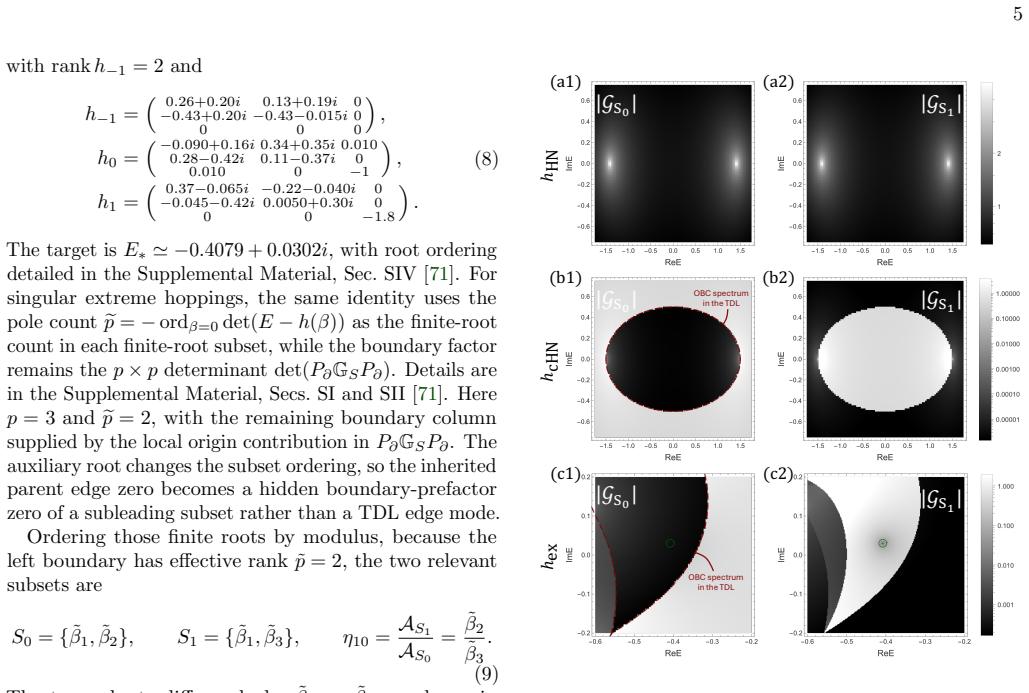
Summary. This manuscript introduces 'edge state endocytosis,' a phenomenon in which a finite-size edge-localized eigenstate in a non-Hermitian open chain is absorbed by the bulk spectrum at a critical system size $L_c$, rather than surviving to the thermodynamic limit (TDL). The mechanism is traced to the Widom expansion of the open-chain characteristic determinant into subset contributions, each factorizing into a boundary-projected Green's function (proj-GF) determinant and a bulk propagation factor. The authors show that while TDL edge states correspond to zeros of the leading-subset proj-GF, endocytosed states arise from 'hidden' zeros in subleading subsets that control the spectrum at finite sizes before being exponentially suppressed. The framework yields a quantitative prediction for $L_c$ (Eq. 6), verified numerically in Figs. 2-3, and is supplemented by Green's function diagnostics (Theorem II, Fig. 4) and flux-threading signatures (Fig. 5). A generic perturbative construction via weak auxiliary-band coupling (Eq. 13) is provided.
Significance. The paper identifies a genuinely novel scale-dependent phenomenon in non-Hermitian systems with a clear mathematical origin. The connection between the Widom subset expansion—a classical result from block Toeplitz matrix theory—and finite-size spectral absorption is non-trivial and physically interesting. The quantitative $L_c$ formula (Eq. 6) and its numerical confirmation at $L_c approx 40$ in Fig. 2(d3) constitute a falsifiable prediction. The Green's function and flux-threading diagnostics are concrete experimental proposals. The framework is platform-independent and builds on externally sourced mathematical results (Widom 1974, Böttcher-Grudsky 2005) and Green's function topology (Slager et al. 2015, Peng et al. 2017), giving it a solid foundation.
major comments (2)
- §'Generic construction' (Eq. 13): The claim that endocytosis occurs 'generically without fine-tuning' (Abstract, Introduction) rests on the weak-coupling construction $|kappa| ll 1$. In this limit, the leading-subset boundary prefactor scales as $G_{S_0}^{(kappa)} = O(kappa^ell)$, which is small but nonzero—the key condition for the endocytosis window. However, the manuscript does not verify whether this hierarchy persists at moderate or strong coupling. At finite $kappa$, the perturbative inheritance of the parent proj-GF zero can break down, root ordering can change, and the $O(kappa^ell)$ scaling no longer applies. Since the genericity claim is a central, load-bearing assertion of the paper, at least one numerical or analytical demonstration away from the weak-coupling regime is needed to substantiate it. As it stands, the claim is supported only in the perturbative limit.
- Eq. (6) and surrounding text: The $L_c$ formula involves $langle log|G_{S_1}/G_{S_0}| rangle_Gamma / langle log|A_{S_0}/A_{S_1}| rangle_Gamma$. If $G_{S_0} = O(kappa^ell)$, then $L_c$ diverges as $kappa to 0$, pushing endocytosis to inaccessible system sizes. Conversely, at large $kappa$ the perturbative argument fails. The manuscript should discuss the practical range of $kappa$ (or model parameters) for which $L_c$ falls within experimentally accessible sizes, clarifying the tension between the weak-coupling requirement and the $L_c$ scaling.
minor comments (6)
- Abstract and Fig. 1 caption: 'entocytosed' is a typo for 'endocytosed' (appears in both the abstract and the main text near Fig. 1).
- Introduction, paragraph 3: 'entocytosed' again; also 'entocytosis' should be 'endocytosis' in the phrase 'we name Edge State Endocytosis'. Consistent spelling should be maintained throughout.
- Fig. 2 caption: The panel labels (b1)-(d3) are dense and the description of the cyan/lighter shading in (c3) and (d3) could be clearer. Consider adding explicit axis labels or a more detailed caption for the competition panels (b3)-(d3).
- Eq. (8): The model parameters are given as explicit complex numbers without physical motivation. A brief comment on how these values were chosen (e.g., random sampling vs. targeted design) would help readers reproduce or generalize the result.
- Table I: The notation $Delta nu_{a0}$ is introduced but the table uses $Delta nu_{a0}$ while the text uses $Delta nu_{10}$. Consistency between the table and the main text would improve readability.
- §'Diagnosing state endocytosis from flux threading': The flux convention $e^{2iPhi}$ per plaquette and the range $0 le Phi le pi$ are explained but could benefit from a schematic figure or a clearer statement of why this specific flux threading is the natural diagnostic for the weak parent-auxiliary coupling.
Simulated Author's Rebuttal
We thank the referee for a careful and constructive report. The referee raises two major comments, both concerning the genericity claim: (1) whether endocytosis persists beyond the weak-coupling regime |κ|≪1, and (2) the practical tension between the weak-coupling requirement and the L_c scaling. We agree that both points deserve explicit treatment and will revise the manuscript accordingly. We provide a numerical demonstration at moderate coupling showing that the endocytosis mechanism persists, and we add a discussion of the accessible parameter window. No standing objections remain.
read point-by-point responses
-
Referee: §'Generic construction' (Eq. 13): The claim that endocytosis occurs 'generically without fine-tuning' (Abstract, Introduction) rests on the weak-coupling construction |κ|≪1. The manuscript does not verify whether this hierarchy persists at moderate or strong coupling. At finite κ, perturbative inheritance of the parent proj-GF zero can break down, root ordering can change, and the O(κ^ℓ) scaling no longer applies. At least one numerical or analytical demonstration away from the weak-coupling regime is needed.
Authors: We agree that the genericity claim should not rest solely on the perturbative limit. In the revised manuscript, we will add a numerical demonstration at moderate coupling (|κ| ~ 0.3–0.5 in the model of Eq. 7, where the weak-coupling expansion is no longer quantitatively accurate) showing that the endocytosis mechanism persists: the hidden proj-GF zero of the subleading subset remains, the subset crossover still occurs, and L_c is well predicted by Eq. (6) evaluated with the exact (non-perturbative) G_S and A_S. The key point is that the endocytosis mechanism requires only the structural condition—a hidden proj-GF zero in a subleading subset with a small-but-nonzero leading prefactor—not the perturbative scaling per se. At moderate coupling, the leading prefactor G_{S_0} is no longer O(κ^ℓ) but remains nonzero (the parent zero is lifted but not destroyed), and the ratio |G_{S_1}/G_{S_0}| entering Eq. (6) is modified but finite, yielding a shifted but still accessible L_c. We will also clarify that at sufficiently strong coupling, root reordering can occur and the subset hierarchy may change; in that regime the construction of Eq. (13) no longer applies as stated, and one must re-examine which subset carries the hidden zero. This is a genuine limitation of the perturbative construction, not of the endocytosis mechanism itself. We will add a remark to this effect. revision: yes
-
Referee: Eq. (6) and surrounding text: If G_{S_0} = O(κ^ℓ), then L_c diverges as κ→0, pushing endocytosis to inaccessible system sizes. Conversely, at large κ the perturbative argument fails. The manuscript should discuss the practical range of κ for which L_c falls within experimentally accessible sizes.
Authors: This is a correct and important observation. The tension is real: as κ→0, L_c ~ ℓ·|log κ| / |log η_{10}| diverges, while at large κ the perturbative construction breaks down. We will add a discussion of the accessible parameter window. Concretely, for the model in Eq. (7), the relevant coupling is set by the off-diagonal entries of h_0 (the (1,3) and (3,1) entries, of magnitude ~0.01), and the resulting L_c ≈ 40 is well within the range of current photonic and topolectrical experiments (which routinely reach L ~ 50–100). More generally, the accessible window is determined by the condition that ℓ·|log κ| is comparable to |log η_{10}|^{-1}·L_{max}, where L_{max} is the experimental system size. For ℓ = 1–2 (the typical case for boundary rank deficiency) and |η_{10}| ~ 0.9–0.95 (moderate bulk-factor ratio), couplings in the range |κ| ~ 0.01–0.1 give L_c ~ 20–80, which is experimentally accessible. We will include this estimate explicitly in the revised text, along with a note that the model parameters in Eq. (8) were chosen to fall within this window. revision: yes
Circularity Check
No significant circularity; the central derivation rests on externally sourced mathematics (Widom 1974, Böttcher-Grudsky 2005) and the proj-GF criterion (Slager et al. 2015, Peng et al. 2017), with one minor self-citation for proof details that is not load-bearing for the main result.
specific steps
-
self citation load bearing
[Theorem I and Theorem II proofs (referenced after Eq. 4 and after Eq. 11)]
"The proof is given in the Supplemental Material, Secs. SI and SII [71]."
Theorems I and II are the mathematical backbone of the endocytosis mechanism. Their proofs are deferred to Supplemental Material [71], which is authored by the present paper's authors. However, Theorem I is explicitly attributed to the Widom expansion (Widom 1974 [57,58]; Böttcher-Grudsky 2005 [65]), which are external, standard results in block Toeplitz matrix theory. Theorem II builds on projected Green's function topology (Slager et al. 2015 [60]; Peng et al. 2017 [59]), also external. The self-citation [71] provides the physicist-oriented derivation connecting these external results, but the load-bearing mathematical content is externally sourced and independently verifiable. This is a minor self-citation that does not make the result circular.
full rationale
The paper's central claim—edge state endocytosis via hidden proj-GF zeros in subleading Widom subsets—is derived from Theorem I (an externally known Widom-type determinant expansion, Widom 1974) and Theorem II (proj-GF edge-state criterion, building on Slager 2015 and Peng 2017). The endocytosis prediction (Eq. 5-6) follows from the subset competition in the exact finite-L decomposition without fitting parameters to the predicted quantity. The L_c formula (Eq. 6) is derived from balancing two subset contributions C0 and C1, each computed from the model Hamiltonian's Green's functions, not fitted to the spectral data. Numerical confirmation in Figs. 2-3 and 5 uses independently specified model Hamiltonians (Eqs. 7-8). The genericity construction (Eq. 13) is a perturbative weak-coupling argument, not a fit renamed as prediction. The only self-citation is to the Supplemental Material for proof details of theorems whose mathematical content traces to external sources. The derivation is self-contained against external benchmarks. Score 2 reflects the minor self-citation for proofs, which is not load-bearing for circularity.
Axiom & Free-Parameter Ledger
free parameters (4)
- Model parameters in hex (Eq. 8) =
Various complex numbers, e.g. h_{-1}[0,0]=0.26+0.20i, etc.
- Weak coupling κ in generic construction (Eq. 13) =
0 < |κ| ≪ 1
- Auxiliary band parameters a, b (Eq. 14) =
Not specified numerically
- Flux regulator ξ in ν_Φ (Eq. 12) =
ξ = 0.006
axioms (4)
- domain assumption Collision-free local root domain for the Widom expansion
- domain assumption Nonsingular extreme hopping matrices (det h_{-P} det h_Q ≠ 0)
- domain assumption Root ordering |β1| ≤ |β2| ≤ ... ≤ |β_{p+q}| remains stable over the energy loop Γ
- ad hoc to paper O(η_{20}^{L+P}) terms are negligible in the two-subset approximation
invented entities (2)
-
Edge state endocytosis (the phenomenon itself)
independent evidence
-
Ephemeral BIC (bound state in the continuum at critical contact)
independent evidence
read the original abstract
An isolated edge state observed in a finite open chain is usually expected to survive the thermodynamic limit (TDL), with a localization mechanism distinct from non-Hermitian skin accumulation, which localizes the \emph{entire} bulk continuum. We show that scale-sensitive non-Hermitian systems can generically admit a different fate: as we scale up the system size, a detached edge-localized eigenstate can remain sharply visible over a broad window until a critical scale is reached, where it forms an ephemeral bound state in the continuum (BIC) of the open-boundary bulk before being absorbed (entocytosed) at even larger system sizes. We call this phenomenon edge state endocytosis. Its mechanism is fundamentally traced to the Widom expansion of the open-chain characteristic determinant (energy dispersion equation) into contributions corresponding to admissible non-Bloch mode subsets. Each subset contribution factorizes into a boundary-projected Green's function (proj-GF) determinant, which encodes lattice truncation, and a subset-resolved bulk propagation factor, which encodes the system size dependence. We uncover the fundamental distinction: TDL edge states are zeros of the leading-subset proj-GF determinant, whereas endocytosed states are a hitherto-ignored class of hidden proj-GF zeros from subleading subsets that control the spectrum at finite sizes. Due to its fundamental mathematical origin, the endocytosis mechanism is completely platform-independent, occurring generically without fine-tuning when isolated edge states, topological or otherwise, are subject to non-Hermitian couplings that generate the requisite non-locality. Our new framework quantitatively predicts the endocytosis scale and sheds light on how its intricate competitive mechanism can be revealed through experimentally relevant Green's functions.
Figures



Reference graph
Works this paper leans on
-
[1]
Hatsugai, Chern number and edge states in the integer quantum hall effect, Phys
Y. Hatsugai, Chern number and edge states in the integer quantum hall effect, Phys. Rev. Lett.71, 3697 (1993)
work page 1993
-
[2]
A. Y. Kitaev, Unpaired majorana fermions in quantum wires, Physics-Uspekhi44, 131 (2001)
work page 2001
-
[4]
C. L. Kane and E. J. Mele, Quantum spin hall effect in graphene, Phys. Rev. Lett.95, 226801 (2005)
work page 2005
-
[5]
M. Z. Hasan and C. L. Kane, Colloquium: Topological insulators, Rev. Mod. Phys.82, 3045 (2010)
work page 2010
-
[6]
X.-L. Qi and S.-C. Zhang, Topological insulators and superconductors, Rev. Mod. Phys.83, 1057 (2011)
work page 2011
-
[7]
N. Hatano and D. R. Nelson, Localization transitions in non-hermitian quantum mechanics, Phys. Rev. Lett.77, 570 (1996)
work page 1996
-
[8]
N. Hatano and D. R. Nelson, Vortex pinning and non- hermitian quantum mechanics, Phys. Rev. B56, 8651 (1997)
work page 1997
-
[9]
T. E. Lee, Anomalous edge state in a non-hermitian lattice, Phys. Rev. Lett.116, 133903 (2016)
work page 2016
-
[10]
F. Song, S. Yao, and Z. Wang, Non-hermitian skin effect and chiral damping in open quantum systems, Phys. Rev. Lett.123, 170401 (2019)
work page 2019
- [11]
-
[12]
K. Yokomizo and S. Murakami, Non-bloch band theory of non-hermitian systems, Phys. Rev. Lett.123, 066404 (2019)
work page 2019
- [13]
-
[14]
Y. Ashida, Z. Gong, and M. Ueda, Non-hermitian physics, Adv. Phys.69, 249 (2020), arXiv:2006.01837 [cond-mat.mes-hall]. 8
work page internal anchor Pith review Pith/arXiv arXiv 2020
-
[15]
E. J. Bergholtz, J. C. Budich, and F. K. Kunst, Exceptional topology of non-hermitian systems, Rev. Mod. Phys.93, 015005 (2021), arXiv:1912.10048 [cond- mat.mes-hall]
work page internal anchor Pith review Pith/arXiv arXiv 2021
-
[16]
N. Okuma and M. Sato, Non-hermitian topological phe- nomena: A review, Annu. Rev. Condens. Matter Phys. 14, 83 (2023)
work page 2023
-
[17]
C. H. Lee, L. Li, and J. Gong, Hybrid higher-order skin- topological modes in nonreciprocal systems, Phys. Rev. Lett.123, 016805 (2019)
work page 2019
-
[18]
K. Kawabata, M. Sato, and K. Shiozaki, Higher-order non-hermitian skin effect, Phys. Rev. B102, 205118 (2020)
work page 2020
-
[19]
F. K. Kunst, E. Edvardsson, J. C. Budich, and E. J. Bergholtz, Biorthogonal bulk-boundary correspondence in non-hermitian systems, Phys. Rev. Lett.121, 026808 (2018)
work page 2018
-
[20]
M. Yang and C. H. Lee, Reversing non-hermitian skin accumulation with a non-local transverse switch, Com- munications Physics9, 210 (2026)
work page 2026
-
[21]
R. Shen, W. J. Chan, and C. H. Lee, Non-hermitian skin effect along hyperbolic geodesics, Phys. Rev. B111, 045420 (2025)
work page 2025
-
[22]
K. Kawabata, K. Shiozaki, and M. Ueda, Anomalous helical edge states in a non-hermitian chern insulator, Phys. Rev. B98, 165148 (2018)
work page 2018
-
[23]
S. Yao, F. Song, and Z. Wang, Non-hermitian chern bands, Phys. Rev. Lett.121, 136802 (2018)
work page 2018
- [24]
-
[25]
V. M. Martinez Alvarez, J. E. Barrios Vargas, and L. E. F. Foa Torres, Non-hermitian robust edge states in one dimension: Anomalous localization and eigenspace con- densation at exceptional points, Phys. Rev. B97, 121401 (2018)
work page 2018
-
[26]
Lieu, Topological phases in the non-hermitian Su- Schrieffer-Heeger model, Phys
S. Lieu, Topological phases in the non-hermitian Su- Schrieffer-Heeger model, Phys. Rev. B97, 045106 (2018)
work page 2018
-
[27]
C. Yin, H. Jiang, L. Li, R. L¨ u, and S. Chen, Geomet- rical meaning of winding number and its characteri- zation of topological phases in one-dimensional chiral non-hermitian systems, Phys. Rev. A97, 052115 (2018)
work page 2018
-
[28]
K.-I. Imura and Y. Takane, Generalized bulk-edge corre- spondence for non-hermitian topological systems, Phys. Rev. B100, 165430 (2019)
work page 2019
-
[29]
L. Herviou, J. H. Bardarson, and N. Regnault, Defining a bulk-edge correspondence for non-hermitian hamiltoni- ans via singular-value decomposition, Phys. Rev. A99, 052118 (2019)
work page 2019
-
[30]
K. Yokomizo and S. Murakami, Non-bloch band theory and bulk-edge correspondence in non-hermitian systems, Prog. Theor. Exp. Phys.2020, 12A102 (2020)
work page 2020
-
[31]
W. Zhu, W. X. Teo, L. Li, and J. Gong, Delocalization of topological edge states, Phys. Rev. B103, 195414 (2021)
work page 2021
-
[32]
D. S. Borgnia, A. J. Kruchkov, and R.-J. Slager, Non- hermitian boundary modes and topology, Phys. Rev. Lett.124, 056802 (2020)
work page 2020
- [33]
-
[34]
W. Xu and Q. Zhou, Excitonic skin effect, arXiv preprint arXiv:2508.20027 (2025)
work page internal anchor Pith review Pith/arXiv arXiv 2025
-
[35]
F. Alsallom, L. Herviou, O. V. Yazyev, and M. Brzezi´ nska, Fate of the non-hermitian skin effect in many-body fermionic systems, Phys. Rev. Res.4, 033122 (2022)
work page 2022
-
[36]
R. Shen and C. H. Lee, Non-hermitian skin clusters from strong interactions, Communications Physics5, 238 (2022)
work page 2022
-
[37]
L. Li, C. H. Lee, S. Mu, and J. Gong, Critical non- hermitian skin effect, Nat. Commun.11, 5491 (2020)
work page 2020
-
[38]
K. Yokomizo and S. Murakami, Scaling rule for the critical non-hermitian skin effect, Phys. Rev. B104, 165117 (2021)
work page 2021
-
[39]
S. M. Rafi-Ul-Islam, Z. B. Siu, H. Sahin, C. H. Lee, and M. B. A. Jalil, Critical hybridization of skin modes in coupled non-hermitian chains, Phys. Rev. Res.4, 013243 (2022)
work page 2022
-
[40]
F. Qin, Y. Ma, R. Shen, and C. H. Lee, Universal com- petitive spectral scaling from the critical non-hermitian skin effect, Phys. Rev. B107, 155430 (2023)
work page 2023
-
[41]
Y. Qin, Y. S. Ang, C. H. Lee, and L. Li, Many-body crit- ical non-hermitian skin effect, Communications Physics 9, 16 (2025)
work page 2025
-
[42]
C.-H. Liu, K. Zhang, Z. Yang, and S. Chen, Helical damp- ing and dynamical critical skin effect in open quantum systems, Phys. Rev. Res.2, 043167 (2020)
work page 2020
- [43]
-
[44]
S. Long and L. Li, Concurrent skin-scale-free localization and criticality under m¨ obius boundary conditions in a non-hermitian ladder, Phys. Rev. B112, 075107 (2025)
work page 2025
-
[45]
J. Claes and T. L. Hughes, Skin effect and winding number in disordered non-hermitian systems, Phys. Rev. B103, L140201 (2021)
work page 2021
- [46]
-
[47]
Longhi, Erratic non-hermitian skin localization, Phys
S. Longhi, Erratic non-hermitian skin localization, Phys. Rev. Lett.134, 196302 (2025)
work page 2025
-
[48]
H. Jiang, L.-J. Lang, C. Yang, S.-L. Zhu, and S. Chen, Interplay of non-hermitian skin effects and anderson localization in nonreciprocal quasiperiodic lattices, Phys. Rev. B100, 054301 (2019)
work page 2019
-
[49]
L. Li, C. H. Lee, and J. Gong, Impurity induced scale-free localization, Communications Physics4, 42 (2021)
work page 2021
-
[50]
Y. Liu, Y. Zeng, L. Li, and S. Chen, Exact solution of the single impurity problem in nonreciprocal lattices: Impurity-induced size-dependent non-hermitian skin ef- fect, Phys. Rev. B104, 085401 (2021)
work page 2021
-
[51]
P. Molignini, O. Arandes, and E. J. Bergholtz, Anoma- lous skin effects in disordered systems with a single non- hermitian impurity, Phys. Rev. Res.5, 033058 (2023)
work page 2023
- [52]
-
[53]
C. H. Lee, Exceptional bound states and negative entan- glement entropy, Physical Review Letters128, 010402 (2022)
work page 2022
-
[54]
D. Zou, T. Chen, H. Meng, Y. S. Ang, X. Zhang, and C. H. Lee, Experimental observation of exceptional bound states in a classical circuit network, Science Bul- letin69, 2194 (2024). 9
work page 2024
-
[55]
S. Liu, H. Jiang, W.-T. Xue, Q. Li, J. Gong, X. Liu, and C. H. Lee, Non-hermitian entanglement dip from scaling-induced exceptional criticality, Science Bulletin 70, 2929 (2025)
work page 2025
-
[56]
M. Yang and C. H. Lee, Beyond the non-hermitian skin effect: Scaling-controlled topology from exceptional- bound bands, Advanced Science , e23989 (2025)
work page 2025
-
[57]
Widom, Asymptotic behavior of block toeplitz matri- ces and determinants, Adv
H. Widom, Asymptotic behavior of block toeplitz matri- ces and determinants, Adv. Math.13, 284 (1974)
work page 1974
-
[58]
Widom, Asymptotic behavior of block toeplitz matri- ces and determinants
H. Widom, Asymptotic behavior of block toeplitz matri- ces and determinants. II, Adv. Math.21, 1 (1976)
work page 1976
-
[59]
Y. Peng, Y. Bao, and F. von Oppen, Boundary green functions of topological insulators and superconductors, Phys. Rev. B95, 235143 (2017)
work page 2017
- [60]
-
[61]
C. W. Hsu, B. Zhen, A. D. Stone, J. D. Joannopoulos, and M. Soljaˇ ci´ c, Bound states in the continuum, Nature Reviews Materials1, 16048 (2016)
work page 2016
-
[62]
C. W. Hsu, B. Zhen, J. Lee, S.-L. Chua, S. G. Johnson, J. D. Joannopoulos, and M. Soljaˇ ci´ c, Observation of trapped light within the radiation continuum, Nature 499, 188 (2013)
work page 2013
-
[63]
Z. Sakotic, P. Stankovic, V. Bengin, A. Krasnok, A. Al´ u, and N. Jankovic, Non-hermitian control of topological scattering singularities emerging from bound states in the continuum, Laser & Photonics Reviews17, 2200308 (2023)
work page 2023
-
[64]
P. Schmidt and F. Spitzer, The toeplitz matrices of an arbitrary laurent polynomial, Math. Scand.8, 15 (1960)
work page 1960
-
[65]
A. B¨ ottcher and S. M. Grudsky,Spectral Properties of Banded Toeplitz Matrices(SIAM, Philadelphia, PA, 2005)
work page 2005
-
[66]
A. B¨ ottcher and S. M. Grudsky,Toeplitz Matrices, Asymptotic Linear Algebra, and Functional Analysis (Birkh¨ auser, Basel, 2000)
work page 2000
-
[67]
P. Tilli, Singular values and eigenvalues of non-hermitian block toeplitz matrices, Linear Algebra and its Applica- tions272, 59 (1998)
work page 1998
-
[68]
A. B¨ ottcher and B. Silbermann,Analysis of Toeplitz Operators, 2nd ed. (Springer, Berlin, 2006)
work page 2006
-
[69]
C. A. Tracy and H. Widom, On the limit of some toeplitz- like determinants, SIAM J. Matrix Anal. Appl.23, 1194 (2002)
work page 2002
-
[70]
D. Bump and P. Diaconis, Toeplitz minors, J. Combin. Theory Ser. A97, 252 (2002)
work page 2002
-
[71]
Supplemental material (2026), see Supplemental Ma- terial for the physicist-oriented proof of the finite-size subset expansion (Theorem I), the pGF edge-state cri- terion (Theorem II), the singular-boundary extension, finite-size dominance estimates, eigenenergy displace- ment formulas, rank-two model details, winding and flux conventions, the auxiliary-b...
work page 2026
-
[72]
Z. Yang, K. Zhang, C. Fang, and J. Hu, Non-hermitian bulk-boundary correspondence and auxiliary general- ized brillouin zone theory, Phys. Rev. Lett.125, 226402 (2020)
work page 2020
- [73]
- [74]
-
[75]
A. M. Essin and V. Gurarie, Bulk-boundary correspon- dence of topological insulators from their green’s func- tions, Phys. Rev. B84, 125132 (2011)
work page 2011
- [76]
-
[77]
H.-G. Zirnstein, G. Refael, and B. Rosenow, Bulk- boundary correspondence for non-hermitian hamiltoni- ans via green functions, Phys. Rev. Lett.126, 216407 (2021)
work page 2021
-
[78]
D. S. Borgnia, A. Vishwanath, and R.-J. Slager, Rational approximations of quasiperiodicity via projected green’s functions, Phys. Rev. B106, 054204 (2022)
work page 2022
- [79]
-
[80]
H. Shen, B. Zhen, and L. Fu, Topological band theory for non-hermitian hamiltonians, Phys. Rev. Lett.120, 146402 (2018)
work page 2018
-
[81]
Z. Gong, Y. Ashida, K. Kawabata, K. Takasan, S. Hi- gashikawa, and M. Ueda, Topological phases of non- hermitian systems, Phys. Rev. X8, 031079 (2018)
work page 2018
discussion (0)
Sign in with ORCID, Apple, or X to comment. Anyone can read and Pith papers without signing in.