REVIEW 2 major objections 6 minor 61 references
Earth-observation foundation models need physics-aware design and evaluation, not just bigger vision pretraining.
Reviewed by Pith at T0; open to challenge. T0 means a machine referee read the full paper against a public rubric. the ladder, T0–T4 →
T0 review · grok-4.5
2026-07-10 18:57 UTC pith:BVULSGBD
load-bearing objection Solid design-oriented survey of EO foundation models; the normative claim is backed by external benchmarks, while the two self-cited case studies are useful illustrations with limited scope. the 2 major comments →
Scalable and Trustworthy Earth Observation Foundation Models
The pith
A machine-rendered reading of the paper's core claim, the machinery that carries it, and where it could break.
Core claim
Remote sensing foundation models cannot be transferred reliably or optimally without domain-specific adaptation, because Earth-observation data are governed by measurement physics and operational decision constraints. Therefore next-generation models should be evaluated not only by benchmark accuracy but also by modality-aware transfer and physically plausible representations that support trustworthy Earth-observation decisions.
What carries the argument
Domain-guided RSFM design: match architecture, pretraining data and objectives (including physics-informed spectral targeted masking and decision-aware adaptation), and evaluation splits to EO properties—sensor modality, spectral structure, resolution, revisit, geolocation, and deployment uncertainty—rather than treating EO as generic vision scale-up.
Load-bearing premise
That the two Lake Erie-style environmental case studies are enough to establish general design principles for foundation models across sensors, regions, seasons, and real operational budgets.
What would settle it
A controlled multi-sensor, multi-region, multi-season evaluation in which physics- and decision-aware models fail to beat strong supervised, physics-based, or simpler baselines on modality transfer, calibration, and decision utility under matched labels and compute, while generic vision-style pretraining does as well or better.
Editorial analysis
A structured set of objections, weighed in public.
Referee Report
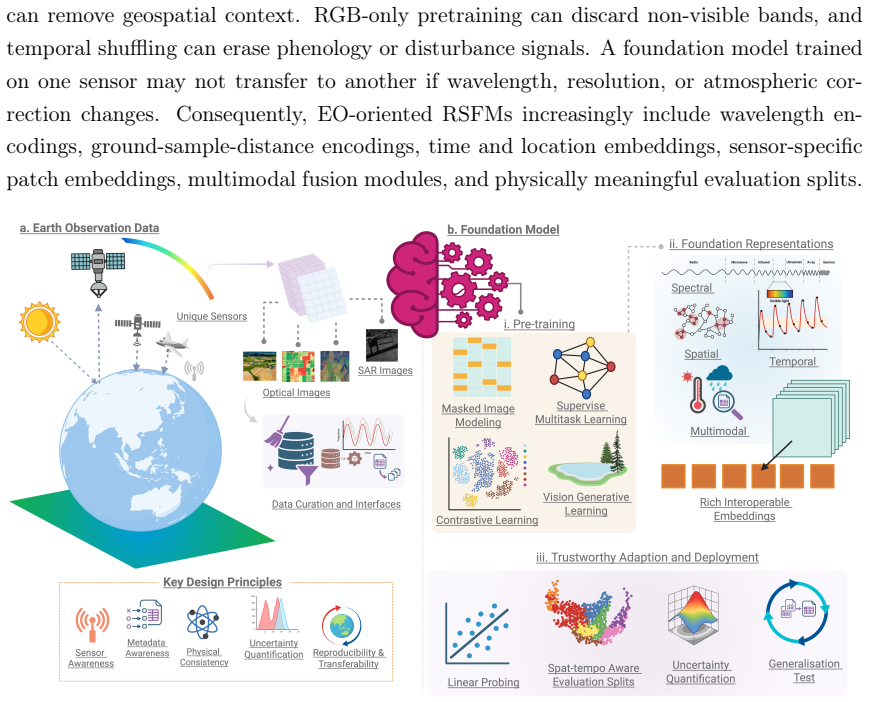
Summary. This chapter reviews remote-sensing foundation models (RSFMs) as a domain-specific adaptation of the foundation-model paradigm. It argues that EO data are governed by measurement physics and operational constraints, so RSFMs cannot transfer reliably without sensor-, spectral-, temporal-, and metadata-aware design. The manuscript synthesizes the model landscape (masked/spectral SSL, multimodal fusion, sensor-conditioned backbones, VLMs, generative models), pretraining objectives, architectures, adaptation methods, and trustworthiness requirements; it incorporates external benchmark evidence (PANGAEA, GEO-Bench-2, MMEarth-Bench, Corley et al.) that no single GFM is universally best and that evaluation protocols remain inconsistent. Two brief environmental-monitoring case studies (SpecTM physics-informed spectral targeted masking for HAB/microcystin prediction; PiCSRL RL for budgeted station selection) illustrate domain-guided principles. The central normative claim is that next-generation RSFMs should be judged not only by benchmark accuracy but also by modality-aware transfer and physically plausible representations for trustworthy EO decisions.
Significance. If accepted as a design and evaluation agenda, the chapter would help reorient RSFM research away from treating satellite data as scaled natural-image vision and toward sensor physics, product provenance, geographic/temporal holdouts, uncertainty calibration, and decision utility. Its main strengths are an extensively cited landscape synthesis, coherent model-family and evaluation-check tables (Tables 1–2), and explicit alignment with recent independent benchmarks showing no universal best model. The case studies usefully connect abstract principles to sparse-label biophysical retrieval and adaptive sensing, even though they are illustrative rather than definitive. For a methods/review chapter in EO/ML, this is a timely and practically useful contribution.
major comments (2)
- §§9.1–9.2: The chapter’s practical “evidence that domain-guided principles work” rests primarily on SpecTM and PiCSRL, both same-team 2026 arXiv works. The text itself marks external validation (other lakes, product versions, seasons, optical water types) and stronger active-sensing baselines as still necessary. For a review chapter this is acceptable only if the case studies are framed strictly as illustrations, not as general proof of transferable design principles. Please (i) state that limitation more prominently at the start of §9, (ii) avoid language that generalizes Lake Erie / N=8,K=3 results to next-generation RSFMs broadly, and (iii) add at least one independent external example (or a clearer “open validation” box) so the design thesis does not appear to rest mainly on self-cited results.
- §§7–8 and Table 2: The evaluation and trustworthiness agenda is load-bearing for the central claim, but the manuscript does not yet specify a minimal, reusable reporting checklist that readers could apply to new RSFMs. Table 2 lists many desirable items (deployment splits, product version, ECE/NLL/CRPS, decision metrics, energy, artifacts) without prioritization or a short “must-report” core. Please add a concise recommended minimum protocol (e.g., required split type, product provenance fields, one calibration metric, one decision/threshold metric when applicable, and artifact release) so the “modality-aware transfer + physical plausibility” recommendation is operational rather than only aspirational.
minor comments (6)
- Abstract and §1: phrasing such as “cannot be transferred reliably/optimally” is absolute; soften to “often cannot” or “cannot be assumed to transfer,” consistent with the benchmark literature cited later.
- Table 1: several model names and abbreviations are slightly inconsistent in the text (e.g., DOF A vs DOFA; Multi./gen./Eval. column headers). Standardize names and expand the reading guide so non-specialists can parse the “x” marks quickly.
- Eqs. (1)–(4): notation is standard, but Eq. (2) (mb = 1[b∈D]) is introduced without stating how D is chosen in practice or how sensitivity to D is assessed; a short sentence in §4.3 would help.
- Figures 1–3: captions are informative, but Figure 1’s panel labels (a/b) and the long multi-principle list would benefit from tighter visual hierarchy; ensure all three figures remain readable in grayscale print.
- §10: the bridge to climate FMs (ClimaX, Prithvi WxC, NeuralGCM) is valuable but abrupt; one sentence clarifying what is shared vs. distinct between EO RSFMs and weather/climate FMs would improve flow.
- Minor copy-edits: “FMs” is used both singular and plural; “vision-languagemodels” and similar spacing/hyphenation glitches appear in §4.4; “GFMs” vs “RSFMs” usage should be defined once and applied consistently.
Circularity Check
Survey/position chapter: central design thesis rests on external benchmarks and domain physics; only mild non-load-bearing self-citation of two companion case studies used as illustrations.
specific steps
-
self citation load bearing
[Abstract; §9.1 SpecTM (Imtiaz et al., 2026); §9.2 PiCSRL (Nasr Azadani et al., 2026)]
"In addition, two brief environmental monitoring case studies; physics-informed spectral targeted masking for harmful algal bloom prediction and reinforcement learning for adaptive environmental monitoring station selection to illustrate the FMs domain-guided principles in practice. ... SpecTM ... (Imtiaz et al., 2026). ... PiCSRL ... (Nasr Azadani et al., 2026)."
The only empirical “in practice” demonstrations of the chapter’s domain-guided principles are two companion arXiv papers by the same author team. That is self-citation. It is not load-bearing for the central normative claim, which is independently backed by external benchmarks and domain physics, and the chapter itself marks external validation as still necessary—so this is minor, not a forced circular derivation.
full rationale
This is a synthesis and position chapter, not a first-principles derivation paper. Its central claim—that RSFMs require domain-specific adaptation and should be judged by modality-aware transfer and physical plausibility, not only aggregate accuracy—is independently supported by external benchmarks (PANGAEA, GEO-Bench-2, MMEarth-Bench, Corley et al. 2026) and by standard EO measurement-physics arguments. There is no self-definitional loop, no fitted parameter renamed as a prediction, no uniqueness theorem imported from the authors, and no ansatz smuggled in as a theorem. The only circularity-adjacent element is the use of two same-team 2026 arXiv companions (SpecTM, PiCSRL) as the practical case studies in §9. Those are explicitly framed as illustrations of design principles, and the text itself flags external validation and stronger baselines as still necessary. That is ordinary self-citation of companion work, not a load-bearing reduction of the chapter’s thesis to its own unverified inputs. Score 2 matches “one minor self-citation that is not load-bearing.”
Axiom & Free-Parameter Ledger
free parameters (2)
- SpecTM diagnostic band set D / targeted mask =
mb = 1[b ∈ D]; +0.037 R² vs random masking (reported)
- PiCSRL station budget and candidate size (K, N) =
K=3 from N=8 (main reported setting)
axioms (4)
- domain assumption EO observations are a distinct ML modality governed by sensor physics, geolocation, product processing, and operational constraints, so generic natural-image FM transfer is incomplete.
- domain assumption No single geospatial foundation model is universally best; capability-specific evaluation is required.
- ad hoc to paper Physics-informed spectral masking and decision-aware RL station selection illustrate general RSFM design principles transferable beyond the reported settings.
- domain assumption Trustworthy EO deployment requires calibrated uncertainty, physically plausible features, representative data, documented failure modes, and reproducibility.
invented entities (2)
-
SpecTM (spectral targeted masking)
no independent evidence
-
PiCSRL (physics-informed contextual spectral RL)
no independent evidence
read the original abstract
Foundation models (FMs) have transformed machine learning from isolated task-specific model development toward general-purpose models pretrained on broad data and adapted to multiple downstream tasks. Earth observation (EO) is an important domain for this paradigm because satellite and airborne archives are large, high-revisit, and increasingly multimodal, while reliable field labels are often sparse. Remote sensing foundation models (RSFMs) cannot be transferred reliably/optimally without domain-specific adaptation. This is because EO data are governed by measurement physics and operational decision constraints. This chapter reviews the design principles arising from these domain-specific constraints. It first defines the FMs paradigm in remote sensing (RS), then synthesizes the current model landscape, pretraining objectives, architecture designs, downstream adaptation and trustworthiness requirements. The chapter also incorporates recent benchmark evidence showing that no single geospatial foundation model is universally best and that inconsistent evaluation remains a major issue to fair comparison and reliable deployment. In addition, two brief environmental monitoring case studies; physics-informed spectral targeted masking for harmful algal bloom prediction and reinforcement learning for adaptive environmental monitoring station selection to illustrate the FMs domain-guided principles in practice. This chapter posits that next-generation RSFMs should be evaluated not only by benchmark accuracy, but also by modality-aware transfer and physically plausible representations for trustworthy EO decisions.
Figures


Reference graph
Works this paper leans on
-
[1]
On the Opportunities and Risks of Foundation Models , author =. 2021 , eprint =
work page 2021
-
[2]
Mission Critical: Satellite Data is a Distinct Modality in Machine Learning , author =. 2024 , eprint =
work page 2024
-
[3]
IEEE Geoscience and Remote Sensing Magazine , year =
Foundation Models for Remote Sensing and Earth Observation: A Survey , author =. IEEE Geoscience and Remote Sensing Magazine , year =
-
[4]
IEEE Geoscience and Remote Sensing Magazine , volume =
Self-Supervised Learning in Remote Sensing: A Review , author =. IEEE Geoscience and Remote Sensing Magazine , volume =. 2022 , doi =
work page 2022
-
[5]
Proceedings of the IEEE/CVF Conference on Computer Vision and Pattern Recognition , pages =
Masked Autoencoders Are Scalable Vision Learners , author =. Proceedings of the IEEE/CVF Conference on Computer Vision and Pattern Recognition , pages =. 2022 , doi =
work page 2022
-
[6]
SatMAE: Pre-training Transformers for Temporal and Multi-Spectral Satellite Imagery
Cong, Yezhen and Khanna, Samar and Meng, Chenlin and Liu, Patrick and Rozi, Erik and He, Yutong and Burke, Marshall and Lobell, David and Ermon, Stefano , year =. 2207.08051 , archivePrefix=
work page internal anchor Pith review Pith/arXiv arXiv
-
[7]
Reed, Colorado J. and Gupta, Ritwik and Li, Shufan and Brockman, Sarah and Funk, Christopher and Clipp, Brian and Keutzer, Kurt and Candido, Salvatore and Uyttendaele, Matt and Darrell, Trevor , year =. 2212.14532 , archivePrefix=
work page internal anchor Pith review Pith/arXiv arXiv
-
[8]
CROMA: Remote Sensing Representations with Contrastive Radar-Optical Masked Autoencoders
Fuller, Anthony and Millard, Koreen and Green, James R. , year =. 2311.00566 , archivePrefix=
work page internal anchor Pith review Pith/arXiv arXiv
-
[9]
Hong, Danfeng and Zhang, Bing and Li, Xiuping and Li, Yuxuan and Li, Chenyu and Yao, Jiang and Yokoya, Naoto and Li, Hao and Ghamisi, Pedram and Jia, Xiuping and Plaza, Antonio and Gamba, Paolo and Benediktsson, Jon Atli and Chanussot, Jocelyn , journal =. 2024 , doi =
work page 2024
-
[10]
Liu, Fan and Chen, Delong and Guan, Zhangqingyun and Zhou, Xiaocong and Zhu, Jiale and Ye, Qiaolin and Fu, Liyong and Zhou, Jun , journal =. 2024 , doi =
work page 2024
-
[11]
Neural Plasticity-Inspired Multimodal Foundation Model for Earth Observation , author =. 2024 , eprint =
work page 2024
-
[12]
AnySat: One Earth Observation Model for Many Resolutions, Scales, and Modalities
Astruc, Guillaume and Gonthier, Nicolas and Mallet, Clement and Landrieu, Loic , year =. 2412.14123 , archivePrefix=
work page internal anchor Pith review Pith/arXiv arXiv
-
[13]
Towards a Unified Copernicus Foundation Model for Earth Vision
Wang, Yi and Xiong, Zhitong and Liu, Chenying and Stewart, Adam J. and others , year =. Towards a Unified. 2503.11849 , archivePrefix=
work page internal anchor Pith review Pith/arXiv arXiv
-
[14]
Szwarcman, Daniela and Roy, Sujit and Fraccaro, Paolo and others , year =. 2412.02732 , archivePrefix=
-
[15]
Galileo: Learning Global & Local Features of Many Remote Sensing Modalities
Tseng, Gabriel and Fuller, Anthony and Reil, Marlena and Herzog, Henry and Beukema, Patrick and Bastani, Favyen and Green, James R. and Shelhamer, Evan and Kerner, Hannah and Rolnick, David , year =. 2502.09356 , archivePrefix=
work page internal anchor Pith review Pith/arXiv arXiv
-
[16]
TerraMind: Large-Scale Generative Multimodality for Earth Observation
Jakubik, Johannes and Yang, Felix and Blumenstiel, Benedikt and others , year =. 2504.11171 , archivePrefix=
work page internal anchor Pith review Pith/arXiv arXiv
-
[17]
SkySense V2: A Unified Foundation Model for Multi-modal Remote Sensing
Zhang, Yingying and Ru, Lixiang and Wu, Kang and Yu, Lei and Liang, Lei and Li, Yansheng and Chen, Jingdong , year =. 2507.13812 , archivePrefix=
work page internal anchor Pith review Pith/arXiv arXiv
-
[18]
Brown, Christopher F. and Kazmierski, Michal R. and Pasquarella, Valerie J. and Rucklidge, William J. and others , year =. 2507.22291 , archivePrefix=
work page internal anchor Pith review Pith/arXiv arXiv
-
[19]
VRSBench: A Versatile Vision-Language Benchmark Dataset for Remote Sensing Image Understanding
Li, Xiang and Ding, Jian and Elhoseiny, Mohamed , year =. 2406.12384 , archivePrefix=
work page internal anchor Pith review Pith/arXiv arXiv
-
[20]
Zhang, Zilun and Zhao, Tiancheng and Guo, Yulong and Yin, Jianwei , year =. 2306.11300 , archivePrefix=
work page internal anchor Pith review Pith/arXiv arXiv
-
[21]
Zhang, Wei and Cai, Miaoxin and Zhang, Tong and Zhuang, Yin and Mao, Xuerui , year =. 2401.16822 , archivePrefix=
work page internal anchor Pith review Pith/arXiv arXiv
-
[22]
DOFA-CLIP: Multimodal Vision-Language Foundation Models for Earth Observation
Xiong, Zhitong and Wang, Yi and Yu, Weikang and Stewart, Adam J. and others , year =. 2503.06312 , archivePrefix=
work page internal anchor Pith review Pith/arXiv arXiv
-
[23]
PANGAEA: A Global and Inclusive Benchmark for Geospatial Foundation Models
Marsocci, Valerio and Jia, Yuru and Le Bellier, Georges and Kerekes, David and Zeng, Liang and others , year =. 2412.04204 , archivePrefix=
work page internal anchor Pith review Pith/arXiv arXiv
-
[24]
Simumba, Naomi and Lehmann, Nils and Fraccaro, Paolo and others , year =. 2511.15658 , archivePrefix=
-
[25]
MMEarth-Bench: Global Model Adaptation via Multimodal Test-Time Training
Gordon, Lucia and Belongie, Serge and Igel, Christian and Lang, Nico , year =. 2602.06285 , archivePrefix=
work page internal anchor Pith review Pith/arXiv arXiv
-
[26]
No One Knows the State of the Art in Geospatial Foundation Models , author =. 2026 , eprint =
work page 2026
-
[27]
Parameter-Efficient Transfer Learning for NLP
Parameter-Efficient Transfer Learning for NLP , author =. Proceedings of the 36th International Conference on Machine Learning , year =. 1902.00751 , archivePrefix=
work page internal anchor Pith review Pith/arXiv arXiv 1902
-
[28]
LoRA: Low-Rank Adaptation of Large Language Models
Hu, Edward J. and Shen, Yelong and Wallis, Phillip and Allen-Zhu, Zeyuan and Li, Yuanzhi and Wang, Shean and Wang, Lu and Chen, Weizhu , year =. 2106.09685 , archivePrefix=
work page internal anchor Pith review Pith/arXiv arXiv
-
[29]
Ben Zaken, Elad and Ravfogel, Shauli and Goldberg, Yoav , year =. 2106.10199 , archivePrefix=
-
[30]
IEEE Geoscience and Remote Sensing Magazine , year =
Responsible Artificial Intelligence for Earth Observation: Achievable and Realistic Paths to Serve the Collective Good , author =. IEEE Geoscience and Remote Sensing Magazine , year =
-
[31]
Simple and Scalable Predictive Uncertainty Estimation Using Deep Ensembles , author =. 2016 , eprint =
work page 2016
- [32]
-
[33]
Uncertainty and Generalizability in Foundation Models for Earth Observation , author =. 2024 , eprint =
work page 2024
-
[34]
Improving EO Foundation Models with Confidence Assessment for enhanced Semantic segmentation
Dionelis, Nikolaos and Longepe, Nicolas , year =. Improving. 2406.18279 , archivePrefix=
work page internal anchor Pith review Pith/arXiv arXiv
-
[35]
SpecTM: Spectral Targeted Masking for Trustworthy Foundation Models
Imtiaz, Syed Usama and Nasr Azadani, Mitra and Alamdari, Nasrin , year =. 2603.22097 , archivePrefix=
work page internal anchor Pith review Pith/arXiv arXiv
-
[36]
PiCSRL: Physics-Informed Contextual Spectral Reinforcement Learning
Nasr Azadani, Mitra and Imtiaz, Syed Usama and Alamdari, Nasrin , year =. 2603.26816 , archivePrefix=
work page internal anchor Pith review Pith/arXiv arXiv
-
[37]
Physics-Informed Spectral Modeling for Hyperspectral Imaging , author =. 2025 , eprint =
work page 2025
-
[38]
Bulletin of the American Meteorological Society , volume =
The Plankton, Aerosol, Cloud, Ocean Ecosystem Mission: Status, Science, Advances , author =. Bulletin of the American Meteorological Society , volume =. 2019 , doi =
work page 2019
-
[39]
Remote Sensing of Environment , volume =
Quantifying Cyanobacterial Phycocyanin Concentration in Turbid Productive Waters: A Quasi-Analytical Approach , author =. Remote Sensing of Environment , volume =. 2013 , doi =
work page 2013
-
[40]
Science of the Total Environment , volume =
Evaluation of a Satellite-Based Cyanobacteria Bloom Detection Algorithm Using Field-Measured Microcystin Data , author =. Science of the Total Environment , volume =. 2021 , doi =
work page 2021
-
[41]
Challenges for Mapping Cyanotoxin Patterns from Remote Sensing of Cyanobacteria , author =. Harmful Algae , volume =. 2016 , doi =
work page 2016
-
[42]
IEEE Transactions on Information Theory , volume =
Information-Theoretic Regret Bounds for Gaussian Process Optimization in the Bandit Setting , author =. IEEE Transactions on Information Theory , volume =. 2012 , doi =
work page 2012
-
[43]
Learning to Optimize via Information-Directed Sampling , author =. 2014 , eprint =
work page 2014
-
[44]
Human-Level Control Through Deep Reinforcement Learning , author =. Nature , volume =. 2015 , doi =
work page 2015
-
[45]
Deep Reinforcement Learning with Double Q-learning
van Hasselt, Hado and Guez, Arthur and Silver, David , year =. Deep Reinforcement Learning with Double. 1509.06461 , archivePrefix=
work page internal anchor Pith review Pith/arXiv arXiv
-
[46]
and Zhu, Xiao Xiang , journal =
Wang, Yi and Braham, Nassim Ait Ali and Xiong, Zhitong and Liu, Chenying and Albrecht, Conrad M. and Zhu, Xiao Xiang , journal =. 2023 , doi =
work page 2023
-
[47]
SSL4EO-L: Datasets and Foundation Models for Landsat Imagery
Stewart, Adam J. and Lehmann, Nils and Corley, Isaac A. and Wang, Yi and others , year =. 2306.09424 , archivePrefix=
work page internal anchor Pith review Pith/arXiv arXiv
-
[48]
MMEarth: Exploring Multi-Modal Pretext Tasks For Geospatial Representation Learning
Nedungadi, Vishal and Kariryaa, Ankit and Oehmcke, Stefan and Belongie, Serge and Igel, Christian and Lang, Nico , year =. 2405.02771 , archivePrefix=
work page internal anchor Pith review Pith/arXiv arXiv
-
[49]
Major TOM: Expandable Datasets for Earth Observation
Francis, Alistair and Czerkawski, Mikolaj , year =. 2402.12095 , archivePrefix=
work page internal anchor Pith review Pith/arXiv arXiv
-
[50]
Fine-tune Smarter, Not Harder: Parameter-Efficient Fine-Tuning for Geospatial Foundation Models , author =. 2025 , eprint =
work page 2025
-
[51]
FoMo: Multi-Modal, Multi-Scale and Multi-Task Remote Sensing Foundation Models for Forest Monitoring
Bountos, Nikolaos Ioannis and Ouaknine, Arthur and Rolnick, David , year =. 2312.10114 , archivePrefix=
work page internal anchor Pith review Pith/arXiv arXiv
-
[52]
ExEBench: Benchmarking Foundation Models on Extreme Earth Events
Zhao, Shan and Xiong, Zhitong and Zhao, Jie and Zhu, Xiao Xiang , year =. 2505.08529 , archivePrefix=
work page internal anchor Pith review Pith/arXiv arXiv
-
[53]
ClimaX: A foundation model for weather and climate
Nguyen, Tung and Brandstetter, Johannes and Kapoor, Ashish and Gupta, Jayesh K. and Grover, Aditya , year =. 2301.10343 , archivePrefix=
work page internal anchor Pith review Pith/arXiv arXiv
-
[54]
Prithvi WxC: Foundation Model for Weather and Climate
Schmude, Johannes and Roy, Sujit and Trojak, Will and Jakubik, Johannes and others , year =. 2409.13598 , archivePrefix=
work page internal anchor Pith review Pith/arXiv arXiv
-
[55]
Neural General Circulation Models for Weather and Climate , author =. Nature , volume =. 2024 , doi =
work page 2024
-
[56]
Geospatial Foundation Models to Enable Progress on Sustainable Development Goals
Geospatial Foundation Models to Enable Progress on Sustainable Development Goals , author =. 2025 , archivePrefix =. 2505.24528 , primaryClass =
work page internal anchor Pith review Pith/arXiv arXiv 2025
-
[57]
Cryo-Bench: Benchmarking Foundation Models for Cryosphere Applications
Cryo-Bench: Benchmarking Foundation Models for Cryosphere Applications , author =. 2026 , archivePrefix =. 2603.01576 , primaryClass =
work page internal anchor Pith review Pith/arXiv arXiv 2026
-
[58]
GeoMeld: Toward Semantically Grounded Foundation Models for Remote Sensing
GeoMeld: Toward Semantically Grounded Foundation Models for Remote Sensing , author =. 2026 , archivePrefix =. 2604.10591 , primaryClass =
work page internal anchor Pith review Pith/arXiv arXiv 2026
-
[59]
TerraFlow: Multimodal, Multitemporal Representation Learning for Earth Observation , author =. 2026 , archivePrefix =. 2603.12762 , primaryClass =
-
[60]
HighFM: Towards a Foundation Model for Learning Representations from High-Frequency Earth Observation Data , author =. 2026 , archivePrefix =. 2604.04306 , primaryClass =
work page internal anchor Pith review Pith/arXiv arXiv 2026
-
[61]
Proceedings of the AAAI Conference on Artificial Intelligence , volume =
FiLM: Visual Reasoning with a General Conditioning Layer , author =. Proceedings of the AAAI Conference on Artificial Intelligence , volume =. 2018 , doi =
work page 2018
discussion (0)
Sign in with ORCID, Apple, or X to comment. Anyone can read and Pith papers without signing in.