REVIEW 3 major objections 6 minor 97 references
Review is the control point that decides how coding agents affect software, and AI does not fix the sign of that effect—teams set it through reviewer expertise and process structure.
Reviewed by Pith at T0; open to challenge. T0 means a machine referee read the full paper against a public rubric. the ladder, T0–T4 →
T0 review · grok-4.5
2026-07-10 14:17 UTC pith:MOWT4L2W
load-bearing objection A usable causal map of AI-era code review plus a real method template; softest joint is grey-lit discourse as mechanism, which the authors already label as proposed theory. the 3 major comments →
3100 Opinions on Code Review in an AI World: Building Causal Theory from Practitioner Discourse
The pith
A machine-rendered reading of the paper's core claim, the machinery that carries it, and where it could break.
Core claim
The paper’s central claim is that code review is the control point through which a coding agent’s effect on software is decided, and that AI does not fix the sign of that effect. The team sets the sign through the expertise its humans bring and how it structures the review process. Most paths to throughput, quality, security, and maintainability run through review depth and reviewer skill, which volume pressure, surface-plausible AI code, opacity of lost intent, automated review, and governance policy push and pull—sometimes into reinforcing loops of rubber-stamping and skill erosion, sometimes into deeper, more skeptical review.
What carries the argument
An explanatory causal model of 26 constructs and 67 relationships (64 directed, 3 contested), built by LLM-assisted open coding of a stratified sample of 3,100 grey-literature documents and human axial/selective coding into drivers, review-dynamics constructs, and outcomes, with numbered falsifiable propositions (P1–P17) grounded in practitioner quotes.
Load-bearing premise
The load-bearing premise is that public grey literature—blogs and Reddit from the agent era—faithfully surfaces real causal mechanisms in review practice rather than vendor pitch, early-adopter selection, hindsight, or partly machine-written talk.
What would settle it
A controlled or quasi-experimental study that measures review depth, reviewer skill, and outcomes under high agent volume while holding surface plausibility and governance constant, and finds that agent adoption moves quality or throughput in a fixed direction independent of those team levers—would contradict the claim that teams set the sign.
If this is right
- Surface metrics like fast merges or few comments cannot be read as “trust” or “rubber-stamping” without measuring mediators such as review depth, skepticism, and automated-review use.
- Teams can steer agent effects by raising or lowering review depth and by calibrating risk-tiered governance rather than treating agent adoption as destiny.
- Comprehension debt, eroded ownership, and reviewer deskilling become first-class risks that compound through feedback loops when volume pressure drives shallow review.
- Future repository-mining and causal studies gain a shared vocabulary of constructs, moderators, and colliders to design estimands instead of reporting unstable sign flips.
- The LLM-assisted grey-literature pipeline is offered as a reusable template so other SE questions can scale theory-building beyond small interview samples.
Where Pith is reading between the lines
- If review depth and skill are the busiest nodes, interventions that only add AI reviewers without protecting human attention may accelerate the vicious loop the theory warns about.
- The three contested edges (automation on quality/security; governance on latency) are the natural places for industry A/B tests that would most quickly pin down moderators.
- The method’s value may outlive this particular theory: any SE phenomenon with dense public discourse could be turned into a proposed causal map at similar cost before another mining study is run.
Editorial analysis
A structured set of objections, weighed in public.
Referee Report
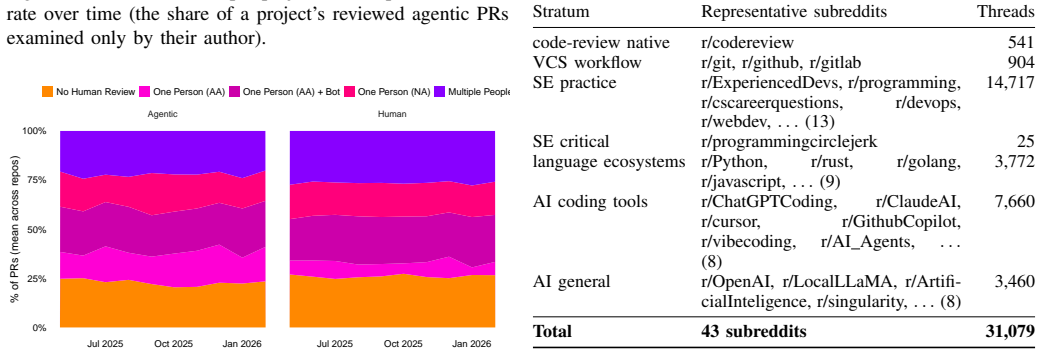
Summary. The paper argues that repository-mining trends about AI-authored pull requests are unstable under defensible operationalizations and therefore cannot explain mechanisms. It motivates this with a longitudinal GitHub analysis of agent-associated PRs (faster merge, less discussion, shifting no-review rates). To recover mechanisms, it synthesizes 38,709 grey-literature documents, codes a stratified sample of 3,100 with an LLM multi-agent pipeline, and constructs a Type-II explanatory theory of 26 constructs and 67 relationships (64 directed, 3 contested). The organizing claim is that review is the control point through which a coding agent’s effect on software is decided, and that AI does not fix the sign of that effect: teams set it via reviewer expertise/disposition and process structure (including automated review and governance). The theory is cast as falsifiable propositions P1–P17 with named moderators, and the LLM-assisted grey-literature pipeline is offered as a secondary methodological template with a public implementation.
Significance. If the theory holds as a useful study-design framework, it would help resolve a fragmented and contradictory empirical literature on AI-era code review by supplying shared constructs, mediators, colliders, and feedback loops that surface metrics alone cannot adjudicate. The paper’s strengths include: (i) an unusually large, versioned grey-literature corpus and transparent sampling/filtering design; (ii) explicit evidence grounding (verbatim quotes, contested edges with opposing text, append-only provenance); (iii) honest demonstration that mining trends flip under defensible choices (§II-B); (iv) a public, scalable coding pipeline; and (v) correctly scoped status as a proposed, not validated, explanatory theory. These make the work a credible foundation for subsequent causal and process studies rather than another unstable snapshot.
major comments (3)
- §III-A Limitations and Appendix 5: The load-bearing step is treating quote-grounded and especially “read-into” edges as explanatory mechanisms rather than reported opinions. The manuscript acknowledges vendor advocacy, early-adopter skew, post-incident hindsight, and possible LLM-generated discourse, but does not report how many of the 67 relationships fall into each evidence tier (quote-grounded vs read-into vs by-definition). Without that breakdown—and without a short sensitivity discussion of which core edges (e.g., surface plausibility→depth, opacity→comprehension debt, automation→ownership) rest only on read-into links—the organizing claim that the graph recovers practice mechanisms remains harder to assess than the paper’s careful “proposed theory” framing suggests. Please quantify tiers and flag which P1–P17 edges are most discourse-dependent.
- §IV (P8–P11, P16–P17) and Fig. 2: Three relationships are marked contested with sign set by moderators, but the moderators themselves are only partly operationalized (e.g., “policy calibration,” automated-reviewer capability, reviewer skepticism). For the theory to function as a falsifiable study-design framework, each contested edge needs an explicit moderator definition, a suggested operationalization, and a statement of what observation would reverse the edge. As written, P9 and P17 are directionally open in a way that risks under-specifying tests future work is invited to run.
- §II-B vs §IV: The motivating observational study is used to motivate theory need, not to validate any proposition. That is methodologically acceptable for Type-II theory building, but the Discussion (§VI) sometimes presents the graph as already explaining divergent practitioner experiences and unstable mining signs. Please keep a sharper separation: the GitHub results establish instability of surface trends; they do not corroborate P1–P17. A short “what would count as first empirical tests” subsection mapping 3–5 propositions to measurable process/outcome designs would strengthen usefulness without overclaiming validation.
minor comments (6)
- Fig. 2 is dense; a companion table listing constructs with one-sentence definitions and example operationalizations would improve usability for follow-on studies.
- §III-A: Report inter-coder or human–LLM agreement beyond the relevance-judge κ=0.75 (e.g., audit sample of open codes or relationship attachments) so residual LLM error can be bounded more concretely.
- §VI notes that 3,100 documents likely exceeded saturation but saturation cannot be established post hoc. A brief retrospective note on when new sub-themes stopped appearing (even if approximate) would help others size similar studies.
- Terminology: “review efficiency,” “review depth,” and “review effectiveness” are carefully split in the text; ensure the figure legend and proposition list use the same terms consistently (a few places still read as if “rigor” were a single construct).
- Appendix 1 author-labeling rules for agent PRs are auditable but imperfect; a short false-positive/false-negative discussion for borderline automation would help readers interpret the motivating trends.
- Minor copy-editing: a few duplicated or near-duplicate sentences appear in the long appendix index front matter; trim for production.
Circularity Check
No derivation-by-construction circularity: inductive grey-literature theory building with disclosed author judgment, not fitted predictions or self-definitional results.
specific steps
-
self definitional
[Appendix 5 (Evidence tiers); §IV review-act decomposition]
"by-definition (the internal wiring of the five-construct review act, which holds by how the terms are defined)."
A subset of edges among review depth, efficiency, effectiveness, and related review-act constructs are acknowledged to hold by how those terms were decomposed rather than solely by independent external measurement. This is minor and disclosed: the paper does not present those definitional wirings as empirical predictions, and the load-bearing propositions (e.g., load→depth, plausibility→depth, opacity→efficiency/effectiveness/motivation) are quote-grounded claims offered for future falsification, not forced by the definitions alone.
full rationale
This paper does not claim first-principles derivation, parameter-free prediction, or uniqueness theorems. Its primary product is a proposed Type-II explanatory theory (26 constructs, 67 relationships, propositions P1–P17) synthesized from LLM-coded practitioner grey literature, with axial/selective coding kept as human interpretive work and every relationship tagged by evidence tier (quote-grounded, read-into, by-definition). The motivating GitHub study is explicitly descriptive and unstable under operationalization choices; it motivates the need for mechanisms rather than supplying fitted inputs that are later re-labeled as predictions. Self-citations to the authors’ related mining work are peripheral, not load-bearing for the causal map. The only mild structural loop is the ordinary grounded-theory one—theory is built from discourse and then offered as a vocabulary for that discourse and for future tests—which the paper itself labels as proposed and unvalidated, not as an independent empirical confirmation. That is methodologically expected, not circular reduction of a claimed result to its inputs. Score 1 (not 0) only to register that a few review-act edges are disclosed as holding by definition of the decomposed constructs; they are not smuggled in as external predictions.
Axiom & Free-Parameter Ledger
free parameters (4)
- coded_sample_size_n
- relevance_judge_model_and_threshold
- three_coder_lenses
- time_window_2025_2026
axioms (5)
- domain assumption Straussian grounded-theory stages (open coding delegated to LLMs; axial/selective coding retained by humans) yield a credible explanatory theory when every relationship is quote-grounded.
- domain assumption Public practitioner discourse (blogs, Reddit) about code review is a valid object for recovering causal mechanisms teams believe operate, even if not verified firsthand practice.
- ad hoc to paper LLM multi-agent open coding with verbatim quote anchors and three independent lenses is accurate enough that residual miscodes do not systematically invent the theory’s core edges.
- ad hoc to paper Author interpretive judgment in theme validation, construct split/merge, and relationship direction is an acceptable source of structure for a proposed (not validated) theory.
- domain assumption Surface GitHub review metrics are unstable under defensible operationalizations and therefore insufficient alone for causal claims about AI code review.
invented entities (2)
-
26-construct causal theory graph of post-AI code review (incl. surface plausibility, code opacity/lost intent, comprehension debt, review depth/efficiency/effectiveness, etc.)
no independent evidence
-
Three contested relationships (automated review→quality/security; governance policy→latency; and related sign-set-by-moderator edges)
no independent evidence
read the original abstract
Coding agents now author entire pull requests, and practitioners sharply disagree about what this does to code review: whether it becomes the bottleneck, whether human review is still necessary, and whether it quietly erodes the understanding that it once built. Repository-mining studies measure surface trends but seldom explain the mechanisms beneath them, and the trends themselves prove unstable. A motivating observational analysis of public GITHUB activity finds that agent-authored pull requests are reviewed less often, merged several times faster, and discussed less than human-authored ones, yet the direction of these trends flips under different but equally defensible analysis choices, so the traces establish what is changing without explaining why. To recover the mechanisms, we synthesize practitioner discourse at scale into an explanatory theory: we collect 38,709 grey-literature documents (engineering blogs and Reddit threads), filter to those substantively about code review, and code a stratified random sample of 3,100 with an LLM-assisted pipeline, from which we build a causal model of 26 constructs and 67 relationships (64 directed, 3 contested). Its organizing claim is that review is the control point through which a coding agent's effect on software is decided, and that AI does not fix the sign of that effect: the team sets it, through the expertise its humans bring and how it structures the review process. The theory makes the competing positions explicit and turns "AI is changing code review" into falsifiable propositions with named constructs and moderators. As a secondary contribution, we offer the underlying LLM-assisted, grey-literature theory-building method as a scalable template for software-engineering research, with a public implementation.
Figures




Reference graph
Works this paper leans on
-
[1]
A. Jain, “How to kill the code review,” https://www.latent.space/p/revie ws-dead, 2026, latent Space. Accessed 2026
work page 2026
-
[2]
Should humans still review all your code?
M. Holkeri, “Should humans still review all your code?” https://www. swarmia.com/blog/should-humans-still-review-code/, 2026, swarmia. Accessed 2026
work page 2026
-
[3]
Why ai will never replace human code review,
G. Foster, “Why ai will never replace human code review,” https://gr aphite.com/blog/ai-wont-replace-human-code-review, 2025, graphite. Accessed 2026
work page 2025
-
[4]
The ai code review bottleneck is already here: Most teams haven’t noticed,
Level Up Coding, “The ai code review bottleneck is already here: Most teams haven’t noticed,” https://levelup.gitconnected.com/the-ai-code-r eview-bottleneck-is-already-here-most-teams-havent-noticed-1b75e96 e6781, 2026, accessed 2026
work page 2026
-
[5]
Ai is generating code at scale, but human-scale code review can’t keep up,
J. Fay, “Ai is generating code at scale, but human-scale code review can’t keep up,” https://devclass.com/2025/06/19/ai-is-generating-code-a t-scale-but-human-scale-code-review-cant-keep-up/, 2025, devClass. Accessed 2026
work page 2025
-
[6]
Why developers using ai are working longer hours,
S. Melendez, “Why developers using ai are working longer hours,” https: //www.scientificamerican.com/article/why-developers-using-ai-are-wor king-longer-hours/, 2026, scientific American. Accessed 2026
work page 2026
-
[7]
Ai-assisted engineers are burning out, is this fine?
I. Chepurin and T. Turner, “Ai-assisted engineers are burning out, is this fine?” https://evilmartians.com/chronicles/ai-assisted-engineers-are-bur ning-out-is-this-fine, 2026, evil Martians. Accessed 2026
work page 2026
-
[8]
Atomic Robot, “Ai review fatigue,” https://atomicrobot.com/blog/ai-rev iew-fatigue/, 2026, accessed 2026
work page 2026
-
[9]
curl’s daniel stenberg: Ai slop is ddosing open source,
The New Stack, “curl’s daniel stenberg: Ai slop is ddosing open source,” https://thenewstack.io/curls-daniel-stenberg-ai-is-ddosing-open-sourc e-and-fixing-its-bugs/, 2026, accessed 2026
work page 2026
-
[10]
Curl shutters bug bounty program to stop ai slop,
The Register, “Curl shutters bug bounty program to stop ai slop,” https: //www.theregister.com/2026/01/21/curl ends bug bounty/, 2026, accessed 2026
work page 2026
-
[11]
Open source maintainers are drowning in ai-generated pull requests,
Signadot, “Open source maintainers are drowning in ai-generated pull requests,” https://medium.com/@signadot/open-source-maintainers-are -drowning-in-ai-generated-pull-requests-enterprise-teams-are-next-a59 8b61b5fbc, 2026, accessed 2026
work page 2026
-
[12]
The future of ai agents in code reviews: Your next pr reviewer might not be human,
E. Roby, “The future of ai agents in code reviews: Your next pr reviewer might not be human,” https://codingwithroby.substack.com/p/the-futur e-of-ai-agents-in-code-reviews, 2026, accessed 2026
work page 2026
-
[13]
Cursor bugbot and planetscale,
AdwaitX, “Cursor bugbot and planetscale,” https://www.adwaitx.com/ cursor-bugbot-planetscale-ai-code/, 2026, accessed 2026
work page 2026
-
[14]
Anthropic just shipped the code reviewer that catches what humans miss,
R. Dominguez, “Anthropic just shipped the code reviewer that catches what humans miss,” https://www.the-ai-corner.com/p/claude-code-revie w-multi-agent-pr-analysis, 2026, the AI Corner. Accessed 2026
work page 2026
-
[15]
Comprehension debt: The hidden cost of ai-generated code,
A. Osmani, “Comprehension debt: The hidden cost of ai-generated code,” https://medium.com/@addyosmani/comprehension-debt-the -hidden-cost-of-ai-generated-code-285a25dac57e, 2026, accessed 2026
work page 2026
-
[16]
Ai-generated code is creating a technical debt crisis nobody is auditing,
Alexandru Cloudstar, “Ai-generated code is creating a technical debt crisis nobody is auditing,” https://dev.to/alexcloudstar/ai-generated-c ode-is-creating-a-technical-debt-crisis-nobody-is-auditing-4cjc, 2026, accessed 2026
work page 2026
-
[17]
Ai as a thin client and the crisis of knowledge,
Oleg Kholin, “Ai as a thin client and the crisis of knowledge,” https: //dev.to/oleg kholin 551a551b/ai-as-a-thin-client-and-the-crisis-of-kno wledge-succession-an-academic-analysis-20me, 2026, accessed 2026
work page 2026
-
[18]
H. He, C. Miller, S. Agarwal, C. K ¨astner, and B. Vasilescu, “Speed at the cost of quality: How Cursor AI increases short-term velocity and long- term complexity in open-source projects,” inInternational Conference on Mining Software Repositories (MSR), 2026
work page 2026
-
[19]
AI ides or autonomous agents? measuring the impact of coding agents on software development,
S. Agarwal, H. He, and B. Vasilescu, “AI ides or autonomous agents? measuring the impact of coding agents on software development,” in International Conference on Mining Software Repositories (MSR) – Mining Challenge, 2026
work page 2026
-
[20]
Debt Behind the AI Boom: A Large-Scale Empirical Study of AI-Generated Code in the Wild
Y . Liu, R. Widyasari, Y . Zhao, I. C. Irsan, J. Chen, and D. Lo, “Debt behind the ai boom: A large-scale empirical study of ai-generated code in the wild,”arXiv preprint arXiv:2603.28592, 2026
work page internal anchor Pith review Pith/arXiv arXiv 2026
-
[21]
H. Li, H. Zhang, and A. E. Hassan, “The rise of ai teammates in software engineering (se) 3.0: How autonomous coding agents are reshaping software engineering,”arXiv preprint arXiv:2507.15003, 2025
work page internal anchor Pith review Pith/arXiv arXiv 2025
-
[22]
R. M. Popescu, D. Gros, A. Botocan, R. Pandita, P. Devanbu, and M. Izadi, “Investigating autonomous agent contributions in the wild: Activity patterns and code change over time,”arXiv preprint arXiv:2604.00917, 2026
-
[23]
On the use of agentic coding: An empirical study of pull requests on github,
M. Watanabe, H. Li, Y . Kashiwa, B. Reid, H. Iida, and A. E. Hassan, “On the use of agentic coding: An empirical study of pull requests on github,”ACM Transactions on Software Engineering and Methodology, 2025
work page 2025
-
[24]
D. Pham and T. A. Ghaleb, “Code change characteristics and description alignment: A comparative study of agentic versus human pull requests,” arXiv preprint arXiv:2601.17627, 2026
-
[25]
Lgtm! character- istics of auto-merged llm-based agentic prs,
R. Branco, P. Canelas, C. Gamboa, and A. Fonseca, “Lgtm! character- istics of auto-merged llm-based agentic prs,” 2026
work page 2026
-
[26]
Habituation at the Gate: Rising Approval and Declining Scrutiny in Human Review of AI Agent Code
H. Yu, L. Liu, X. Jiang, Y . Jia, S. Wang, P. Qian, and Y . Chen, “Habituation at the gate: Rising approval and declining scrutiny in human review of ai agent code,”arXiv preprint arXiv:2606.22721, 2026
work page internal anchor Pith review Pith/arXiv arXiv 2026
-
[27]
J. Pearl and D. Mackenzie,The Book of Why: The New Science of Cause and Effect. New York: Basic Books, 2018
work page 2018
-
[28]
V . Garousi, M. Felderer, and M. V . M ¨antyl¨a, “Guidelines for including grey literature and conducting multivocal literature reviews in software engineering,”Information and software technology, vol. 106, pp. 101– 121, 2019
work page 2019
-
[29]
Thematic-lm: a llm-based multi-agent system for large-scale thematic analysis,
T. Qiao, C. Walker, C. Cunningham, and Y . S. Koh, “Thematic-lm: a llm-based multi-agent system for large-scale thematic analysis,” in Proceedings of the ACM on Web Conference 2025, 2025, pp. 649–658
work page 2025
-
[30]
Design and code inspections to reduce errors in program development,
M. E. Fagan, “Design and code inspections to reduce errors in program development,”IBM Syst. J., vol. 15, no. 3, pp. 182–211, 1976. [Online]. Available: https://doi.org/10.1147/sj.153.0182
-
[32]
Work practices and challenges in pull-based development: The contributor’s perspective,
G. Gousios, M.-A. Storey, and A. Bacchelli, “Work practices and challenges in pull-based development: The contributor’s perspective,” inProceedings of the 38th international conference on software engi- neering, 2016, pp. 285–296
work page 2016
-
[33]
P. C. Rigby, Y . C. Zhu, S. M. Donadelli, and A. Mockus, “Quantifying and mitigating turnover-induced knowledge loss: case studies of chrome and a project at avaya,” inProceedings of the 38th international conference on software engineering, 2016, pp. 1006–1016
work page 2016
-
[34]
Modern code review: a case study at google,
C. Sadowski, E. S ¨oderberg, L. Church, M. Sipko, and A. Bacchelli, “Modern code review: a case study at google,” inProceedings of the 40th international conference on software engineering: Software engineering in practice, 2018, pp. 181–190
work page 2018
-
[35]
A systematic literature review and taxonomy of modern code review,
N. Davila and I. Nunes, “A systematic literature review and taxonomy of modern code review,”Journal of Systems and Software, vol. 177, p. 110951, 2021
work page 2021
-
[36]
Information needs in contemporary code review,
L. Pascarella, D. Spadini, F. Palomba, M. Bruntink, and A. Bacchelli, “Information needs in contemporary code review,”Proceedings of the ACM on human-computer interaction, vol. 2, no. CSCW, pp. 1–27, 2018. 11
work page 2018
-
[37]
S. McIntosh, Y . Kamei, B. Adams, and A. E. Hassan, “The impact of code review coverage and code review participation on software quality: A case study of the qt, vtk, and itk projects,” inProceedings of the 11th working conference on mining software repositories, 2014, pp. 192–201
work page 2014
-
[38]
Help me to understand this commit!-a vision for contextualized code reviews,
M. Unterkalmsteiner, D. Badampudi, R. Britto, and N. B. Ali, “Help me to understand this commit!-a vision for contextualized code reviews,” in Proceedings of the 1st ACM/IEEE workshop on integrated development environments, 2024, pp. 18–23
work page 2024
-
[39]
Code review comprehension: Reviewing strategies seen through code comprehension theories,
P. W. Gonc ¸alves, P. Rani, M.-A. Storey, D. Spinellis, and A. Bacchelli, “Code review comprehension: Reviewing strategies seen through code comprehension theories,” in2025 IEEE/ACM 33rd International Con- ference on Program Comprehension (ICPC). IEEE, 2025, pp. 589–601
work page 2025
-
[40]
What makes a code change easier to review: an empirical investigation on code change reviewability,
A. Ram, A. A. Sawant, M. Castelluccio, and A. Bacchelli, “What makes a code change easier to review: an empirical investigation on code change reviewability,” inProceedings of the 2018 26th ACM Joint Meeting on European Software Engineering Conference and Symposium on the Foundations of Software Engineering, 2018, pp. 201–212
work page 2018
-
[41]
First come first served: The impact of file position on code review,
E. Fregnan, L. Braz, M. D’Ambros, G. C ¸ alıklı, and A. Bacchelli, “First come first served: The impact of file position on code review,” inProceedings of the 30th ACM joint european software engineering conference and symposium on the foundations of software engineering, 2022, pp. 483–494
work page 2022
-
[42]
Predicting faults using the complexity of code changes,
A. E. Hassan, “Predicting faults using the complexity of code changes,” in2009 IEEE 31st international conference on software engineering. IEEE, 2009, pp. 78–88
work page 2009
-
[43]
Use of relative code churn measures to predict system defect density,
N. Nagappan and T. Ball, “Use of relative code churn measures to predict system defect density,” inProceedings of the 27th international conference on Software engineering, 2005, pp. 284–292
work page 2005
-
[44]
The present and future of bots in software engineering,
E. Shihab, S. Wagner, M. A. Gerosa, M. Wessel, and J. Cabot, “The present and future of bots in software engineering,”IEEE Software, vol. 39, no. 5, pp. 28–31, 2022
work page 2022
-
[45]
The github de- velopment workflow automation ecosystems,
M. Wessel, T. Mens, A. Decan, and P. R. Mazrae, “The github de- velopment workflow automation ecosystems,” inSoftware Ecosystems: Tooling and Analytics. Springer, 2023, pp. 183–214
work page 2023
-
[46]
Suggestion bot: analyzing the impact of automated suggested changes on code reviews,
N. Palvannan and C. Brown, “Suggestion bot: analyzing the impact of automated suggested changes on code reviews,” in2023 IEEE/ACM 5th International Workshop on Bots in Software Engineering (BotSE). IEEE, 2023, pp. 33–37
work page 2023
-
[47]
Automating patch set generation from code reviews using large language models,
M. T. Rahman, R. Singh, and M. Y . Sultan, “Automating patch set generation from code reviews using large language models,” inProceed- ings of the IEEE/ACM 3rd International Conference on AI Engineering- Software Engineering for AI, 2024, pp. 273–274
work page 2024
-
[48]
What to expect from code review bots on github? a survey with oss maintainers,
M. Wessel, A. Serebrenik, I. Wiese, I. Steinmacher, and M. A. Gerosa, “What to expect from code review bots on github? a survey with oss maintainers,” inProceedings of the XXXIV Brazilian Symposium on Software Engineering, 2020, pp. 457–462
work page 2020
-
[49]
Don’t disturb me: Challenges of interacting with software bots on open source software projects,
M. Wessel, I. Wiese, I. Steinmacher, and M. A. Gerosa, “Don’t disturb me: Challenges of interacting with software bots on open source software projects,”Proceedings of the ACM on Human-Computer Interaction, vol. 5, no. CSCW2, pp. 1–21, 2021
work page 2021
-
[50]
A ground-truth dataset and classification model for detecting bots in github issue and pr comments,
M. Golzadeh, A. Decan, D. Legay, and T. Mens, “A ground-truth dataset and classification model for detecting bots in github issue and pr comments,”Journal of Systems and Software, vol. 175, p. 110911, 2021
work page 2021
-
[51]
Impact of LLM-based Review Comment Generation in Practice: A Mixed Open-/Closed-source User Study
D. Olewicki, L. Da Silva, S. Mujahid, A. Amini, B. Mah, M. Castel- luccio, S. Habchi, F. Khomh, and B. Adams, “Impact of llm-based review comment generation in practice: A mixed open-/closed-source user study,”arXiv preprint arXiv:2411.07091, 2024
work page internal anchor Pith review Pith/arXiv arXiv 2024
-
[52]
LogicStar AI, “Agents in the wild,” https://insights.logicstar.ai/, 2025, accessed: 2026-06-30
work page 2025
-
[53]
These Aren't the Reviews You're Looking For How Humans Review AI-Generated Pull Requests
K. Duma, P. Wr ´oblewski, J. Bobi ´nska, J. Winiarska, and P. Przymus, “These aren’t the reviews you’re looking for how humans review ai- generated pull requests,”arXiv preprint arXiv:2605.02273, 2026
work page internal anchor Pith review Pith/arXiv arXiv 2026
-
[54]
Why Are Agentic Pull Requests Merged or Rejected? An Empirical Study
S. R. O. Peralta, F. Hoshi, H. Washizaki, N. Ubayashi, I. Kondo, Y . Higo, H. Mukai, N. Yoshida, K. Kusama, H. Tanakaet al., “Why are agentic pull requests merged or rejected? an empirical study,”arXiv preprint arXiv:2605.22534, 2026
work page internal anchor Pith review Pith/arXiv arXiv 2026
-
[55]
The nature of theory in information systems1,
S. Gregor, “The nature of theory in information systems1,”MIS quar- terly, vol. 30, no. 3, pp. 611–642, 2006
work page 2006
-
[56]
Building theories in software engineering,
D. I. Sjøberg, T. Dyb ˚a, B. C. Anda, and J. E. Hannay, “Building theories in software engineering,” inGuide to advanced empirical software engineering. Springer, 2008, pp. 312–336
work page 2008
-
[57]
Theory-oriented software engineering,
K.-J. Stol and B. Fitzgerald, “Theory-oriented software engineering,” Science of Computer Programming, vol. 101, pp. 79–98, 2015
work page 2015
-
[58]
Charmaz,Constructing grounded theory: A practical guide through qualitative analysis
K. Charmaz,Constructing grounded theory: A practical guide through qualitative analysis. sage, 2006
work page 2006
-
[59]
J. Corbin and A. Strauss,Basics of qualitative research: Techniques and procedures for developing grounded theory. Sage publications, 2014
work page 2014
-
[60]
Grounded theory in software engineering research: a critical review and guidelines,
K.-J. Stol, P. Ralph, and B. Fitzgerald, “Grounded theory in software engineering research: a critical review and guidelines,” inProceedings of the 38th International conference on software engineering, 2016, pp. 120–131
work page 2016
-
[61]
Architectural technical debt: A grounded theory,
R. Verdecchia, P. Kruchten, and P. Lago, “Architectural technical debt: A grounded theory,” inEuropean Conference on Software Architecture. Springer, 2020, pp. 202–219
work page 2020
-
[62]
A Grounded Theory of Debugging in Professional Software Engineering Practice
H. Li and M. Coblenz, “A grounded theory of debugging in professional software engineering practice,”arXiv preprint arXiv:2602.11435, 2026
work page internal anchor Pith review Pith/arXiv arXiv 2026
-
[63]
A. Rastogi and G. Gousios, “How does software change?”arXiv preprint arXiv:2106.01885, 2021
work page internal anchor Pith review Pith/arXiv arXiv 2021
-
[64]
Arctic shift: a reddit data archive and query api,
A. Heitmann, “Arctic shift: a reddit data archive and query api,” https: //github.com/ArthurHeitmann/arctic shift, accessed 2026
work page 2026
-
[66]
Using thematic analysis in psychology,
V . Braun and V . Clarke, “Using thematic analysis in psychology,” Qualitative research in psychology, vol. 3, no. 2, pp. 77–101, 2006
work page 2006
-
[67]
Guidelines for Empirical Studies in Software Engineering involving Large Language Models
S. Baltes, F. Angermeir, C. Arora, M. M. Bar ´on, C. Chen, L. B ¨ohme, F. Calefato, N. Ernst, D. Falessi, B. Fitzgeraldet al., “Guidelines for empirical studies in software engineering involving large language models,”arXiv preprint arXiv:2508.15503, 2025
work page internal anchor Pith review Pith/arXiv arXiv 2025
-
[68]
Computational grounded theory revisited: From computer-led to computer-assisted text analysis,
H. B. Carlsen and S. Ralund, “Computational grounded theory revisited: From computer-led to computer-assisted text analysis,”Big Data & Society, vol. 9, no. 1, p. 20539517221080146, 2022
work page 2022
-
[69]
S. De Paoli, “Performing an inductive thematic analysis of semi- structured interviews with a large language model: An exploration and provocation on the limits of the approach,”Social Science Computer Review, vol. 42, no. 4, pp. 997–1019, 2024
work page 2024
-
[70]
From the editors: What grounded theory is not,
R. Suddaby, “From the editors: What grounded theory is not,” pp. 633– 642, 2006
work page 2006
-
[71]
Towards a theory of software development ex- pertise,
S. Baltes and S. Diehl, “Towards a theory of software development ex- pertise,” inProceedings of the 2018 26th acm joint meeting on european software engineering conference and symposium on the foundations of software engineering, 2018, pp. 187–200
work page 2018
-
[72]
From Industry Claims to Empirical Reality: An Empirical Study of Code Review Agents in Pull Requests
K. Chowdhury, D. Banik, K. Ferdous, and S. I. Shamim, “From industry claims to empirical reality: An empirical study of code review agents in pull requests,”arXiv preprint arXiv:2604.03196, 2026
work page internal anchor Pith review Pith/arXiv arXiv 2026
-
[73]
A Large-Scale Comprehensive Measurement of AI-Generated Code in Real-World Repositories
T. Mao, D. Zhao, H. Tang, X. Wang, and H. Zhang, “A large-scale empirical study of ai-generated code in real-world repositories,”arXiv preprint arXiv:2603.27130, 2026
work page internal anchor Pith review Pith/arXiv arXiv 2026
-
[74]
The dose makes the agent: Therapeutic index analysis of ai coding contributions,
G. Destefanis, R. de Souza Santos, M. Ortu, and M. Wessel, “The dose makes the agent: Therapeutic index analysis of ai coding contributions,” 2026
work page 2026
-
[75]
Where do ai coding agents fail? an empirical study of failed agentic pull requests in github,
R. Ehsani, S. Pathak, S. Rawal, A. A. Mujahid, M. M. Imran, and P. Chatterjee, “Where do ai coding agents fail? an empirical study of failed agentic pull requests in github,”arXiv preprint arXiv:2601.15195, 2026
-
[76]
A task-level evaluation of ai agents in open-source projects,
S. Rahman, M. F. Rabbi, and M. Zibran, “A task-level evaluation of ai agents in open-source projects,”arXiv preprint arXiv:2602.02345, 2026
-
[77]
C. Nachuma and M. Zibran, “When ai teammates meet code review: Collaboration signals shaping the integration of agent-authored pull requests,”arXiv preprint arXiv:2602.19441, 2026
-
[78]
On autopilot? an empirical study of human-ai teaming and review practices in open source,
H. Gao, P. Banyongrakkul, H. Guan, M. Zahedi, and C. Treude, “On autopilot? an empirical study of human-ai teaming and review practices in open source,”arXiv preprint arXiv:2601.13754, 2026
-
[79]
Understanding dominant themes in reviewing agentic ai-authored code,
M. A. Haider and T. Zimmermann, “Understanding dominant themes in reviewing agentic ai-authored code,”arXiv preprint arXiv:2601.19287, 2026
-
[80]
On the Footprints of Reviewer Bots Feedback on Agentic Pull Requests in OSS GitHub Repositories
S. K. Fatima, Y . Abrar, A. R. Tahir, A. Nawaz, S. Abid, and A. A. Bangash, “On the footprints of reviewer bots feedback on agentic pull requests in oss github repositories,”arXiv preprint arXiv:2604.24450, 2026
work page internal anchor Pith review Pith/arXiv arXiv 2026
-
[81]
The generative AI policy landscape in open source,
K. Holterhoff, “The generative AI policy landscape in open source,” https://redmonk.com/kholterhoff/2026/02/26/generative-ai-policy-lands cape-in-open-source/, 2026, accessed: 2026-6-30
work page 2026
-
[82]
Why agentic-prs get rejected: A comparative study of coding agents,
S. Nakashima, Y . Ishimoto, M. Kondo, S. Mclntosh, and Y . Kamei, “Why agentic-prs get rejected: A comparative study of coding agents,” arXiv preprint arXiv:2602.04226, 2026. 12
discussion (0)
Sign in with ORCID, Apple, or X to comment. Anyone can read and Pith papers without signing in.