REVIEW 2 major objections 2 minor 76 references
PCA Gets Outlier Flags and Missing-Data Handling in One Rewrite
Reviewed by Pith at T0; open to challenge. T0 means a machine referee read the full paper against a public rubric. the ladder, T0–T4 →
T0 review · glm-5.2
2026-07-10 00:23 UTC pith:TPFQIMGB
load-bearing objection Useful integration of robust statistics into a practical PCA replacement; worth a serious referee to check the identifiability story. the 2 major comments →
Robust Heteroskedastic Matrix Factorization: A Generalization of PCA that Flags Outliers and Handles Missing Data
The pith
A machine-rendered reading of the paper's core claim, the machinery that carries it, and where it could break.
Core claim
The central mechanism is the iterative reweighting algorithm that implicitly maximizes a Student-t likelihood. The Student-t distribution has heavier tails than the Gaussian assumed by standard PCA, which means it does not over-penalize data points that fall far from the model. This is equivalent to fitting a hierarchical model where each data point has its own latent variance: points that are well-explained by the low-dimensional structure get small latent variances (high weight), while genuine outliers get large latent variances (low weight). The reweighting thus serves double duty: it down-weights anomalous points so the recovered embedding stays clean, and the weights themselves become a
What carries the argument
The iterative reweighting loop that implicitly maximizes a Student-t likelihood, interpreted hierarchically as per-data-point latent variances that simultaneously clean the embedding and flag anomalies.
Load-bearing premise
The practical reliability of the anomaly-flagging capability depends on cross-validation successfully selecting good hyperparameters, and the paper demonstrates this on specific cases rather than proving it holds across all data regimes.
What would settle it
If cross-validation fails to reliably set hyperparameters on real-world datasets outside the specific demonstrations shown, the anomaly-flagging capability becomes unreliable.
If this is right
- Large astronomical surveys with heterogeneous data quality and inevitable bad pixels could use RHMF as a single preprocessing step that both cleans and flags, rather than separate outlier-rejection and dimensionality-reduction pipelines.
- The per-feature anomaly flags could enable automated discovery of instrumental artifacts or calibration failures in survey data, since these manifest as systematic per-feature deviations rather than per-object anomalies.
- Any domain using PCA on noisy or incomplete data, such as genomics, finance, or neuroscience, could adopt the same framework to get uncertainty-aware embeddings without switching to a fundamentally different methodological toolkit.
- The hierarchical latent-variance interpretation connects the method to Bayesian robust regression, suggesting that prior distributions on the latent variances could encode domain-specific knowledge about expected outlier rates.
Where Pith is reading between the lines
- The Student-t implicit likelihood means RHMF has a continuous notion of outlierness rather than a binary in/out classification, which could be useful for ranking candidates in follow-up observation campaigns where telescope time is limited.
- If the latent variances correlate with physically meaningful quantities, they could serve as discovery metrics in their own right, not just as nuisance parameters for cleaning the embedding.
- The reliance on cross-validation for hyperparameter selection may become a bottleneck on very large datasets, motivating future work on approximate or streaming variants that update hyperparameters online.
Editorial analysis
A structured set of objections, weighed in public.
Referee Report
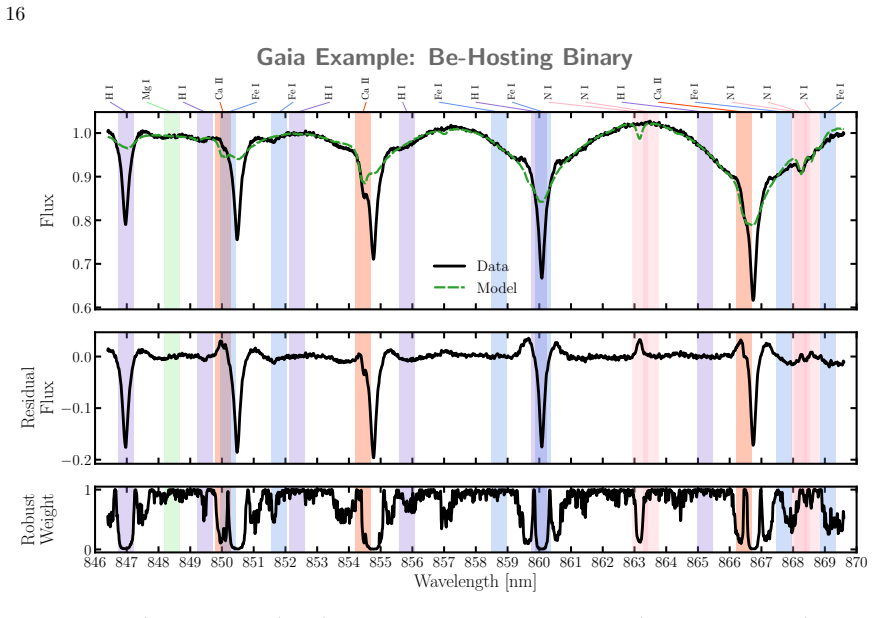
Summary. The manuscript introduces Robust Heteroskedastic Matrix Factorization (RHMF), a generalization of PCA that is simultaneously robust to outliers, accommodates per-feature uncertainties and missing data, and automatically flags per-feature and per-object anomalies. The method uses iterative reweighting that implicitly maximizes a Student-t likelihood, admitting a hierarchical probabilistic interpretation with per-data-point latent variances. The authors provide a JAX implementation (Robusta-HMF) and demonstrate the method on simulated data and Gaia DR3 RVS spectra, identifying known anomalies (e.g., a Be-star binary) and subtle M-dwarf Ca II triplet emission. The abstract is transparent that identification accuracy depends on hyperparameter choice and claims these can be set by cross-validation. This review is based on the abstract only; the full text was not available for assessment.
Significance. The simultaneous treatment of heteroskedastic uncertainties, missing data, robustness, and anomaly flagging in a single framework is a practically useful contribution for astronomical spectroscopy, where all three issues arise routinely. The Student-t reweighting approach and its hierarchical model interpretation are standard statistical tools, but their assembly into a fast JAX implementation with practical guidance is valuable for the community. The Gaia DR3 application—particularly the recovery of M-dwarfs with subtle Ca II emission that would not be obvious by eye—demonstrates a concrete, falsifiable scientific use case. Credit is due for providing reproducible code and for the transparency regarding hyperparameter dependence.
major comments (2)
- The central practical claim is that RHMF simultaneously recovers a low-rank embedding AND flags anomalies. When outliers are structured (e.g., a coherent subgroup deviating along a direction that could be absorbed into a principal component), the Student-t reweighting faces an identifiability problem analogous to the rank-sparsity tradeoff in robust PCA (Candès et al. 2011). The abstract acknowledges hyperparameter sensitivity but does not indicate whether the full text addresses whether any hyperparameter setting can resolve structured-outlier ambiguity. The Gaia M-dwarf Ca II emission application involves outliers that may be structured in spectral space, making this concern directly relevant. The full text must explicitly discuss this identifiability limitation and, ideally, provide a test with structured outliers to show the boundary where the method fails.
- The claim that hyperparameters 'can be set reliably by cross-validation' is load-bearing for the anomaly-flagging capability. Without the full text, it is impossible to verify whether the cross-validation procedure is demonstrated across diverse data regimes or only on the specific simulations shown. The full text should specify the cross-validation protocol, show its performance across at least two qualitatively different outlier regimes (pointwise and structured), and discuss failure modes.
minor comments (2)
- Without the full text, it is not possible to verify the mathematical claims (Student-t likelihood equivalence, hierarchical model interpretation). These are standard results, but the full derivation should be checked during full review.
- The abstract mentions 'practical guidance for users' but does not specify its scope. The full text should include clear guidance on rank selection, convergence thresholds, and anomaly thresholding.
Circularity Check
No circularity detected: the method is defined against external benchmarks and standard statistical results, with no self-cited load-bearing chain.
full rationale
The abstract describes RHMF as an iterative reweighting algorithm that implicitly maximizes a Student-t likelihood with a hierarchical probabilistic interpretation. The Student-t connection to robust regression and latent-variance reweighting is a standard statistical result, not a self-cited circular dependency. The method is validated against external benchmarks: simulated data with known outliers, and Gaia DR3 RVS spectra where detected anomalies are checked against known objects (a Be star binary, M-dwarfs with Ca II triplet emission). No fitted parameter is renamed as a prediction, no uniqueness theorem is invoked, and no ansatz is smuggled through self-citation. The practical concern about cross-validation reliability and structured-outlier identifiability is a correctness risk, not a circularity issue. With only the abstract available, no load-bearing step reduces to its own inputs by construction.
Axiom & Free-Parameter Ledger
free parameters (4)
- Degrees of freedom of Student-t likelihood (inferred)
- Number of latent factors (rank)
- Reweighting convergence threshold
- Anomaly flagging threshold
axioms (3)
- domain assumption Data noise is well-approximated by a Student-t distribution or that the Student-t likelihood provides adequate robustness for the outlier regimes encountered.
- domain assumption Cross-validation on available data reliably selects hyperparameters for the anomaly detection task.
- domain assumption The low-rank factorization model is appropriate for the data structure (i.e., the data genuinely has a low-dimensional embedding).
read the original abstract
We present Robust Heteroskedastic Matrix Factorization (RHMF), a generalization of Principal Component Analysis (PCA) that is robust to outliers, handles per-feature uncertainties and missing data, and automatically flags per-feature and per-object anomalies. RHMF is useful both in recovering a low-dimensional embedding unspoiled by bad data or anomalies, and in identifying those anomalies. It utilises an iterative reweighting algorithm that implicitly maximizes a Student-t likelihood. This admits an equivalent probabilistic interpretation as fitting a hierarchical model with per-data-point latent variances. We deliver a fast JAX implementation, Robusta-HMF, and practical guidance for users. We demonstrate the ability of the model to identify and mitigate outliers of different classes. Identification accuracy is contingent on the choice of hyperparameters, but we show that these can be set reliably by cross-validation. We also apply RHMF to RVS spectra from Gaia DR3 to find main-sequence stars that are strange relative to their neighbors in color-magnitude space. We highlight specific examples, including a known binary hosting a Be star, and M-dwarfs with subtle emission in the Ca II triplet lines, indicative of accretion or magnetic activity, which would not be obvious to identify by eye.
Figures




Reference graph
Works this paper leans on
-
[1]
Abt, Helmut A. and Morrell, Nidia I. , year = 1995, month = jul, journal =. The. doi:10.1086/192182 , url =
-
[2]
A Fast Iterative Robust Principal Component Analysis Method
Aime Judicael Ouermi, Timbwaoga and Li, Jixian and Johnson, Chris R. , year = 2025, month = jun, journal =. A. doi:10.48550/arXiv.2506.16013 , url =
work page internal anchor Pith review Pith/arXiv arXiv doi:10.48550/arxiv.2506.16013 2025
- [3]
-
[4]
Andrews, D. F. and Mallows, C. L. , year = 1974, month = sep, journal =. Scale. doi:10.1111/j.2517-6161.1974.tb00989.x , url =
- [5]
-
[6]
Principal Component Analysis with Noisy and/or Missing Data
Bailey, Stephen , year = 2012, month = sep, journal =. Principal. doi:10.1086/668105 , url =. arXiv , keywords =:1208.4122 , primaryclass =
work page internal anchor Pith review Pith/arXiv arXiv 2012
-
[7]
Bayesian Theory , author =
-
[8]
Bouwmans, Thierry and Sobral, Andrews and Javed, Sajid and Jung, Soon Ki and Zahzah, El-Hadi , year = 2015, month = nov, journal =. Decomposition into. doi:10.48550/arXiv.1511.01245 , url =
work page internal anchor Pith review Pith/arXiv arXiv doi:10.48550/arxiv.1511.01245 2015
-
[9]
Accelerated Alternating Projections for Robust Principal Component Analysis
Cai, HanQin and Cai, Jian-Feng and Wei, Ke , year = 2017, month = nov, journal =. Accelerated. doi:10.48550/arXiv.1711.05519 , url =
work page internal anchor Pith review Pith/arXiv arXiv doi:10.48550/arxiv.1711.05519 2017
-
[10]
Cai, HanQin and Hamm, Keaton and Huang, Longxiu and Li, Jiaqi and Wang, Tao , year = 2021, journal =. Rapid. doi:10.1109/LSP.2020.3044130 , url =
-
[11]
Cai, HanQin and Liu, Jialin and Yin, Wotao , year = 2021, month = oct, number =. Learned. doi:10.48550/arXiv.2110.05649 , url =. arXiv , keywords =:2110.05649 , primaryclass =
work page internal anchor Pith review Pith/arXiv arXiv doi:10.48550/arxiv.2110.05649 2021
-
[12]
Robust Principal Component Analysis? , author =. J. ACM , volume =. doi:10.1145/1970392.1970395 , url =
-
[13]
Casey, Andrew R. and Hogg, David W. and Ness, Melissa and Rix, Hans-Walter and Ho, Anna Q Y and Gilmore, Gerry , year = 2016, journal =. The
work page 2016
-
[14]
and Wheeler, Adam and Bedell, Megan and Hogg, David W
Casey, Andrew R. and Wheeler, Adam and Bedell, Megan and Hogg, David W. and Saydjari, Andrew and Zhao, Lily , year = 2026, month = feb, journal =. A. doi:10.3847/1538-4357/ae3bd6 , url =
-
[15]
Robust Principal Components by Casewise and Cellwise Weighting
Centofanti, Fabio and Hubert, Mia and Rousseeuw, Peter J. , year = 2024, month = aug, journal =. Robust. doi:10.48550/arXiv.2408.13596 , url =
work page internal anchor Pith review Pith/arXiv arXiv doi:10.48550/arxiv.2408.13596 2024
-
[16]
Gaia Collaboration and Prusti, T. and. The. Astronomy and Astrophysics , volume =. doi:10.1051/0004-6361/201629272 , url =
- [17]
-
[18]
Weighted principal component analysis: a weighted covariance eigendecomposition approach
Delchambre, Ludovic , year = 2015, month = feb, journal =. Weighted Principal Component Analysis: A Weighted Covariance Eigendecomposition Approach , shorttitle =. doi:10.1093/mnras/stu2219 , url =. arXiv , keywords =:1412.4533 , primaryclass =
work page internal anchor Pith review Pith/arXiv arXiv 2015
- [19]
-
[20]
The Approximation of One Matrix by Another of Lower Rank , author =. Psychometrika , volume =. doi:10.1007/BF02288367 , url =
-
[21]
The Astrophysical Journal , volume =
S4: A Spatial-Spectral Model for Speckle Suppression , author =. The Astrophysical Journal , volume =
-
[22]
Dganguli/Robust-Pca , author =
-
[23]
Gomez Gonzalez, C. A. and Absil, O. and Absil, P.-A. and Van Droogenbroeck, M. and Mawet, D. and Surdej, J. , year = 2016, month = may, journal =. Low-Rank plus Sparse Decomposition for Exoplanet Detection in Direct-Imaging. doi:10.1051/0004-6361/201527387 , url =
-
[24]
, year = 2019, month = jan, journal =
Guan, Naiyang and Liu, Tongliang and Zhang, Yangmuzi and Tao, Dacheng and Davis, Larry S. , year = 2019, month = jan, journal =. Truncated. doi:10.1109/TPAMI.2017.2777841 , url =. arXiv , keywords =:1906.00495 , primaryclass =
-
[25]
Foreground Detection via Robust Low Rank Matrix Factorization Including Spatial Constraint with
Guyon, Charles and Bouwmans, Thierry and Zahzah, El-Hadi , year = 2012, month = nov, pages =. Foreground Detection via Robust Low Rank Matrix Factorization Including Spatial Constraint with. Proceedings of the 21st
work page 2012
-
[26]
Halko, N. and Martinsson, P. G. and Tropp, J. A. , year = 2011, journal =. Finding Structure with Randomness:. doi:10.1137/090771806 , url =. https://doi.org/10.1137/090771806 , pages =
-
[27]
Harris, Charles R. and Millman, K. Jarrod and. Array Programming with. Nature , volume =
-
[28]
He, Lingyu and Yang, Yanrong and Zhang, Bo , year = 2022, month = apr, number =. Robust. doi:10.48550/arXiv.2204.01042 , url =. arXiv , keywords =:2204.01042 , primaryclass =
work page internal anchor Pith review Pith/arXiv arXiv doi:10.48550/arxiv.2204.01042 2022
-
[29]
Hilder, Tom , year = 2026, month = feb, url =
work page 2026
-
[30]
Understanding Robust and Exploratory Data Analysis , author =
-
[31]
and Bovy, Jo and Lang, Dustin , year = 2010, journal =
Hogg, David W. and Bovy, Jo and Lang, Dustin , year = 2010, journal =. Data Analysis Recipes:
work page 2010
-
[32]
Communications in Statistics -- Theory and Methods , volume =
Robust Regression Using Iteratively Reweighted Least-Squares , author =. Communications in Statistics -- Theory and Methods , volume =
-
[33]
Journal of Educational Psychology , volume =
Analysis of a Complex of Statistical Variables into Principal Components , author =. Journal of Educational Psychology , volume =. doi:10.1037/h0071325 , abstract =
-
[34]
Theory of Stellar Atmospheres:
Hubeny, Ivan and Mihalas, Dimitri , year = 2014, series =. Theory of Stellar Atmospheres:
work page 2014
- [35]
-
[36]
Bradbury, James and Frostig, Roy and Hawkins, Peter and Johnson, Matthew James and Leary, Chris and Maclaurin, Dougal and Necula, George and Paszke, Adam and VanderPlas, Jake and
-
[37]
Katz, D. and Sartoretti, P. and Guerrier, A. and Panuzzo, P. and Seabroke, G. M. and Th. Gaia. Astronomy & Astrophysics , volume =. doi:10.1051/0004-6361/202244220 , url =
-
[38]
Ke, Qifa and Kanade, Takeo , year = 2005, month = jun, series =. Robust. Proceedings of the 2005. doi:10.1109/CVPR.2005.309 , url =
- [39]
-
[40]
Klement, Robert and Schaefer, Gail H. and Gies, Douglas R. and Wang, Luqian and Baade, Dietrich and Rivinius, Thomas and Gallenne, Alexandre and Carciofi, Alex C. and Monnier, John D. and M. Interferometric. The Astrophysical Journal , volume =. doi:10.3847/1538-4357/ac4266 , url =
-
[41]
Kullback, S. and Leibler, R. A. , year = 1951, month = mar, journal =. On. doi:10.1214/aoms/1177729694 , url =
-
[42]
Lakshminarayanan, Balaji and Bouchard, Guillaume and Archambeau, Cedric , year = 2011, month = jun, pages =. Robust. Proceedings of the
work page 2011
-
[43]
Lange, Kenneth L. and Little, Roderick J. A. and Taylor, Jeremy M. G. , year = 1989, month = dec, journal =. Robust. doi:10.1080/01621459.1989.10478852 , url =
-
[44]
Learning the Parts of Objects by Non-Negative Matrix Factorization , author =. Nature , volume =
-
[45]
Nouvelles M\'ethodes Pour La D\'etermination Des Orbites Des Com\`etes , author =
-
[46]
Lin, Zhouchen and Chen, Minming and Ma, Yi , year = 2010, month = sep, journal =. The. doi:10.48550/arXiv.1009.5055 , url =
work page internal anchor Pith review Pith/arXiv arXiv doi:10.48550/arxiv.1009.5055 2010
-
[47]
Magnier,. Pan-. The Astrophysical Journal Supplement Series , volume =. doi:10.3847/1538-4365/abb82a , url =
-
[48]
UMAP: Uniform Manifold Approximation and Projection for Dimension Reduction
McInnes, Leland and Healy, John and Melville, James , year = 2018, journal =. doi:10.48550/arXiv.1802.03426 , archiveprefix =. 1802.03426 , pages =
work page internal anchor Pith review Pith/arXiv arXiv doi:10.48550/arxiv.1802.03426 2018
-
[49]
and Rix, Hans-Walter and Ho, Anna Y
Ness, Melissa and Hogg, David W. and Rix, Hans-Walter and Ho, Anna Y. Q. and Zasowski, Gail , year = 2015, journal =. The
work page 2015
-
[50]
Advances in Neural Information Processing Systems , author =
Non-Convex Robust. Advances in Neural Information Processing Systems , author =
-
[51]
doi:10.1080/14786440109462720 , langid =
Pearson, Karl , year = 1901, month = nov, journal =. doi:10.1080/14786440109462720 , url =
-
[52]
Polyak, Boris T. and Khlebnikov, Mikhail V. , year = 2017, month = jul, journal =. Robust. doi:10.1016/j.ifacol.2017.08.585 , url =
-
[53]
Monthly Notices of the Royal Astronomical Society , volume =
The Dimensionality of Stellar Chemical Space Using Spectra from the. Monthly Notices of the Royal Astronomical Society , volume =. doi:10.1093/mnras/stx3198 , url =
-
[54]
Re Fiorentin, P. and. Estimation of Stellar Atmospheric Parameters from. Astronomy and Astrophysics , volume =
-
[55]
Astronomy & Astrophysics , volume =
Bright Be-Shell Stars , author =. Astronomy & Astrophysics , volume =. doi:10.1051/0004-6361:20053008 , adsnote =
-
[56]
Fast Principal Component Pursuit via Alternating Minimization , booktitle =
Rodr. Fast Principal Component Pursuit via Alternating Minimization , booktitle =. doi:10.1109/ICIP.2013.6738015 , url =
-
[57]
Rontogiannis, Athanasios A. and Giampouras, Paris V. and Koutroumbas, Konstantinos D. , year = 2020, journal =. Online. doi:10.1109/LSP.2020.3011896 , url =
-
[58]
Nonlinear Component Analysis as a Kernel Eigenvalue Problem , author =. Neural Computation , volume =
-
[59]
Pedregosa, F. and Varoquaux, G. and Gramfort, A. and Michel, V. and Thirion, B. and Grisel, O. and Blondel, M. and Prettenhofer, P. and Weiss, R. and Dubourg, V. and Vanderplas, J. and Passos, A. and Cournapeau, D. and Brucher, M. and Perrot, M. and Duchesnay, E. , year = 2011, journal =. Scikit-Learn:
work page 2011
-
[60]
Detection and Characterization of Exoplanets and Disks Using Projections on
Soummer, R. Detection and Characterization of Exoplanets and Disks Using Projections on. The Astrophysical Journal Letters , volume =
-
[61]
Tang, Gongguo and Nehorai, Arye , year = 2011, month = mar, pages =. Robust Principal Component Analysis Based on Low-Rank and Block-Sparse Matrix Decomposition , booktitle =. doi:10.1109/CISS.2011.5766144 , url =
-
[62]
Ting, Yuan-Sen and Conroy, Charlie and Rix, Hans-Walter and Cargile, Phillip , year = 2019, journal =. The. doi:10.3847/1538-4357/ab2331 , archiveprefix =. 1804.01530 , pages =
work page internal anchor Pith review Pith/arXiv arXiv 2019
-
[63]
Journal of the Royal Statistical Society: Series B (Statistical Methodology) , volume =
Probabilistic Principal Component Analysis , author =. Journal of the Royal Statistical Society: Series B (Statistical Methodology) , volume =
-
[64]
Tsalmantza, P. and Hogg, David W. , year = 2012, month = jul, journal =. A. doi:10.1088/0004-637X/753/2/122 , url =
-
[65]
Vallenari, A. and Brown, A. G. A. and Prusti, T. and de Bruijne, J. H. J. and Arenou, F. and Babusiaux, C. and Biermann, M. and Creevey, O. L. and Ducourant, C. and Evans, D. W. and Eyer, L. and Guerra, R. and Hutton, A. and Jordi, C. and Klioner, S. A. and Lammers, U. L. and Lindegren, L. and Luri, X. and Mignard, F. and Panem, C. and Pourbaix, D. and Ra...
-
[66]
Vaswani, Namrata and Bouwmans, Thierry and Javed, Sajid and Narayanamurthy, Praneeth , year = 2018, month = jul, journal =. Robust. doi:10.1109/MSP.2018.2826566 , url =
-
[67]
Virtanen, Pauli and Gommers, Ralf and Oliphant, Travis E. and Haberland, Matt and Reddy, Tyler and Cournapeau, David and Burovski, Evgeni and Peterson, Pearu and Weckesser, Warren and Bright, Jonathan and. Nature Methods , volume =
-
[68]
West, Mike , year = 1984, month = jul, journal =. Outlier. doi:10.1111/j.2517-6161.1984.tb01317.x , url =
-
[69]
On Scale Mixtures of Normal Distributions , author =. Biometrika , volume =. doi:10.1093/biomet/74.3.646 , url =
-
[70]
Wipf, David and Nagarajan, Srikantan , year = 2009, month = feb, journal =. A Unified. doi:10.1016/j.neuroimage.2008.02.059 , url =
-
[71]
Local Principal Component Pursuit for Nonlinear Datasets , booktitle =
Wohlberg, Brendt and Chartrand, Rick and Theiler, James , year = 2012, month = mar, pages =. Local Principal Component Pursuit for Nonlinear Datasets , booktitle =. doi:10.1109/ICASSP.2012.6288776 , url =
-
[72]
Wright, John and Ganesh, Arvind and Rao, Shankar and Peng, Yigang and Ma, Yi , year = 2009, volume =. Robust. Advances in
work page 2009
-
[73]
Yin, Lei and Parekh, Ankit and Selesnick, Ivan , year = 2019, month = may, journal =. Stable. doi:10.1109/TSP.2019.2907264 , url =
-
[74]
Heteroskedastic PCA: Algorithm, Optimality, and Applications
Zhang, Anru R. and Cai, T. Tony and Wu, Yihong , year = 2018, month = oct, journal =. Heteroskedastic. doi:10.48550/arXiv.1810.08316 , url =
work page internal anchor Pith review Pith/arXiv arXiv doi:10.48550/arxiv.1810.08316 2018
-
[75]
Zhao, Lily L. and Hogg, David W. and Bedell, Megan and Fischer, Debra A. , year = 2021, month = jan, journal =. Excalibur:. doi:10.3847/1538-3881/abd105 , url =
-
[76]
Zhou, Zihan and Li, Xiaodong and Wright, John and Candes, Emmanuel and Ma, Yi , year = 2010, month = jan, journal =. Stable. doi:10.48550/arXiv.1001.2363 , url =
work page internal anchor Pith review Pith/arXiv arXiv doi:10.48550/arxiv.1001.2363 2010
discussion (0)
Sign in with ORCID, Apple, or X to comment. Anyone can read and Pith papers without signing in.