REVIEW 3 major objections 5 minor 22 references
ASMR turns free-form ship maintenance narratives into compact schemas that tell writers what information each report type must capture.
Reviewed by Pith at T0; open to challenge. T0 means a machine referee read the full paper against a public rubric. the ladder, T0–T4 →
T0 review · grok-4.5
2026-07-10 11:49 UTC pith:LEDRZPTQ
load-bearing objection Clean two-agent pipeline for inducing compact schemas from free-text ship reports; internal metrics improve as designed, but usefulness to writers remains unproven. the 3 major comments →
ASMR: Agentic Schema Generation for Ship Maintenance Report Writing
The pith
A machine-rendered reading of the paper's core claim, the machinery that carries it, and where it could break.
Core claim
The paper claims that compact, informative, non-redundant schemas for free-form operational reports can be discovered automatically by first extracting and clustering semantic concepts with a language model into an over-complete candidate field space, then refining that space with reinforcement learning whose reward balances coverage, compactness, and redundancy; the resulting schemas improve measured quality over both raw concepts and the unoptimized candidates and can guide human report writing.
What carries the argument
ASMR: a modular two-agent pipeline whose Field Generator Agent produces candidate fields (and the field–form coverage and field–field redundancy matrices) and whose Structural Optimizer Agent solves an MDP with ADD/MERGE/STOP actions via Q-learning under the linear reward αΔCoverage − βΔSize − γΔRedundancy.
Load-bearing premise
The language-model-derived coverage and redundancy matrices, together with a hand-weighted linear reward, are faithful enough proxies for real operational information needs that optimizing them produces schemas useful to human writers.
What would settle it
On a held-out set of ship forms, compare reports written with ASMR-generated field guidance against reports written without it; if expert raters find no gain in completeness or consistency, or if the optimized schemas score no better than the unoptimized candidate fields on the paper’s own coverage/redundancy metrics, the central claim fails.
If this is right
- Interactive reporting tools can surface field-specific questions derived from the generated schema while a writer is drafting, raising completeness without extra training.
- Standardized fields make downstream predictive-maintenance, anomaly-detection, and readiness analytics more reliable across units and platforms.
- Because schemas are learned from historical text, they can be re-generated when reporting practices change, reducing manual redesign by domain experts.
- The same pipeline can be applied to other free-text operational domains (healthcare notes, aviation logs, infrastructure inspection reports) that share the same structure-versus-flexibility tension.
Where Pith is reading between the lines
- If the historical corpus systematically omits certain categories of information, the learned schemas will codify those omissions; external checklists or expert seeds may be needed to break the bootstrap.
- Confidence scores already returned by the field-value extraction tool could be fed back into the reward or into human-in-the-loop review queues, turning uncertainty into a first-class optimization signal.
- Merging fields via RL may erase operationally important distinctions (e.g., safety versus security); a human veto or multi-objective Pareto front could keep those distinctions when domain experts require them.
Editorial analysis
A structured set of objections, weighed in public.
Referee Report
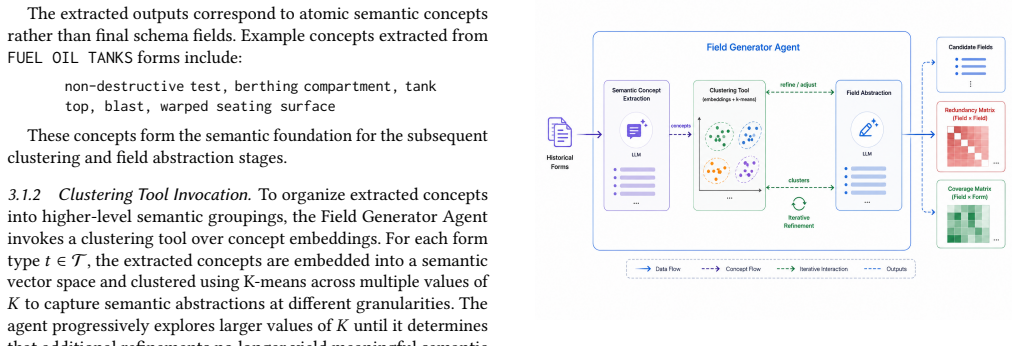
Summary. The paper formulates automatic schema generation for ship maintenance and operational reports: from historical free-text narratives of multiple form types, discover compact sets of fields that capture essential information requirements. ASMR is a two-agent framework. The Field Generator Agent uses an LLM for concept extraction, multi-granularity K-means clustering of embeddings, and field abstraction to produce an overcomplete candidate field space Φ together with a field–form coverage matrix C and field–field redundancy matrix M. The Structural Optimizer Agent treats schema construction as an MDP with actions ADD/MERGE/STOP, stochastic transitions driven by C and M, and a linear reward αΔCoverage − βΔSize − γΔRedundancy; it is trained with tabular Q-learning. Final schemas are labeled and can be populated at inference time by an LLM field-value extractor. Preliminary results on several form categories (~500 forms each) report metric gains from raw concepts to candidate fields to optimized schemas (Table 4), plus qualitative merge examples and inference population statistics (Figure 4).
Significance. If the approach works, it addresses a practical gap between free-text operational reporting and the need for consistent, complete records that support downstream analytics and human-AI writing assistance. The modular agentic design (LLM concept extraction + RL structural optimization) is a reasonable fit for semi-structured industrial forms and is positioned as complementary to systems such as PALIMPZEST, ELEET, and DocETL. The paper is explicit that development is preliminary and that several open problems remain (confidence-aware generation, reward design, evaluation without ground truth, historical-data bootstrapping). Strengths include a clear problem formalization, an end-to-end pipeline with precomputed semantic statistics, and transparent self-critique in Section 6. The main limitation is that the quantitative claim of usefulness currently rests almost entirely on internal metrics that largely restate the RL objective, without external baselines or human/downstream validation.
major comments (3)
- [Table 4 / §3.2–3.3] Table 4 and Section 3.3: Coverage and Redundancy in the evaluation metrics (Table 2) are defined from the same field–form coverage matrix C and field–field redundancy matrix M that drive the reward in Eq. (5) and the transition model (Eqs. 1–4, Sections 3.2.2–3.2.3). Support, Consistency, and Informativeness are association statistics over the same field groups. Consequently the reported progression Raw Concepts → Candidate Schema → Optimized Schema (ASMR) largely re-states that the Structural Optimizer improved the quantities it was trained to improve. The central claim that the schemas "support effective AI-assisted operational reporting" therefore remains untested by any external criterion (human expert ratings, completeness of reports written under schema guidance, or a held-out downstream task). At least one such external check is needed before the usefulness claim can be accepted.
- [§4] Section 4: There are no external baselines (e.g., pure LLM schema prompting, clustering-only fields without RL, frequency-thresholded fields, or existing schema-discovery methods cited in Section 5). Without them it is impossible to isolate the contribution of the RL Structural Optimizer from the Field Generator Agent or from simpler heuristics. Adding at least one non-RL and one non-ASMR baseline on the same form categories would make the quantitative results load-bearing rather than descriptive.
- [§4.1 / Table 4] Section 4.1 and Table 4: Results are reported as single averages with no error bars, no per-form-type breakdowns beyond the qualitative examples, and no statistical tests. Hyperparameters (α, β, γ, K, learning rate, discount) are selected by grid search but sensitivity is not shown. Given the free parameters and the stochastic transition noise, the magnitude of the gains (e.g., coverage 0.48 → 0.64, redundancy 0.39 → 0.17) cannot yet be assessed for robustness. Reporting variance across form types or seeds, and a short sensitivity analysis on the reward weights, would strengthen the experimental claim.
minor comments (5)
- [§3 / Figures 1–3] Figure 1 is referenced as the framework overview and Figure 2 as a Field Generator snapshot, but the text later refers to "Figure 2" for both the Field Generator and (in one place) the Structural Optimizer; numbering and captions should be made consistent so that each figure is uniquely identified.
- [§3.2.3–3.2.4] Notation: the learning rate in Q-learning (Eq. 13) reuses α, which is also the coverage weight in the reward (Eq. 5). Distinct symbols would avoid confusion.
- [Table 1] Table 1 lists "Initial Fields" that appear to be candidate fields; clarifying whether these are pre- or post-clustering abstractions would help the reader.
- [§3.1.1] Section 3.1.1 mentions ESWBS codes for grouping forms; a brief definition or citation would help readers outside naval maintenance.
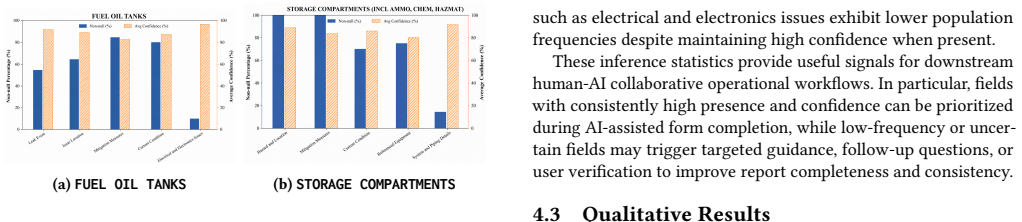
- [Abstract / §1] The abstract and introduction state that schemas "can guide report authors," but the only inference results (Figure 4) are population statistics on historical forms, not a writing-assistance study. Softening the language to "intended to guide" until such a study exists would better match the evidence.
Circularity Check
Reported gains of Optimized Schema over Candidate Schema largely restate the RL reward (Coverage/Size/Redundancy from the same C and M matrices), so the headline metric improvements are partly by construction.
specific steps
-
fitted input called prediction
[Sec. 3.2.3 (Eqs. 5–12) + Sec. 3.3 (Table 2) + Sec. 4.2.1 (Table 4)]
"R(s_t , s_{t+1} , a)=α·ΔCoverage−β·ΔSize−γ·ΔRedundancy ... Coverage(S)=∑_{f_j∈H}∑_{g_i∈S} Coverage(f_j,g_i) ... Redundancy(S)=∑_{g_i∈S}∑_{g_j∈S,j>i} Redundancy(g_i,g_j) ... [Table 2] Coverage=1/|H||S| ∑∑ Coverage(...) Redundancy=1/|S|(|S|−1) ∑∑ Redundancy(...) Schema Size=|S| ... [Table 4] Optimized Schema (ASMR) 0.64 ... 0.17 5.4"
The reward maximized by Q-learning is a linear combination of precisely the Coverage, Size and Redundancy terms that later appear (normalized) as the primary evaluation metrics. The matrices C and M that define those terms are pre-computed once from the same historical collection H and never held out. Therefore the numerical improvements of Optimized over Candidate on those three columns of Table 4 are forced by successful optimization of Eq. (5); they do not supply independent confirmation of schema quality.
full rationale
The paper's central quantitative claim (Table 4) is that the Structural Optimizer Agent yields schemas with higher coverage, lower redundancy and smaller size than the Candidate Schema produced by the Field Generator. Those three quantities are exactly the terms appearing in the reward of Eq. (5) (Sections 3.2.2–3.2.3), which is itself computed from the identical field–form coverage matrix C and field–field redundancy matrix M later reused (after trivial normalization) as the evaluation metrics of Table 2. Consequently the progression Candidate → Optimized is the expected outcome of any successful maximizer of that reward; it does not constitute independent evidence that the schemas better capture operational information requirements. Support/Consistency/Informativeness are secondary association statistics over the same field groups and do not break the circularity. No external human rating, hold-out task, or downstream predictive-maintenance metric is reported. The authors themselves flag reward design and the absence of ground-truth schemas as open problems (Section 6). This is therefore partial circularity of the 'optimize-then-evaluate-on-the-same-objective' variety, warranting score 6 rather than a higher score that would require the entire derivation to collapse by definition.
Axiom & Free-Parameter Ledger
free parameters (4)
- reward weights α, β, γ
- clustering granularities K
- Q-learning rate α and discount γ
- stochastic noise terms in transition probabilities
axioms (4)
- domain assumption LLM-extracted concepts plus embedding similarity faithfully capture operational semantics of ship reports
- ad hoc to paper Binary field–form coverage matrix C and continuous redundancy matrix M are adequate proxies for true information requirements
- domain assumption Historical free-text reports already contain the essential fields that future reports should capture
- standard math Temporal-difference Q-learning on the defined MDP converges to a useful schema policy
invented entities (3)
-
Field Generator Agent
no independent evidence
-
Structural Optimizer Agent
no independent evidence
-
schema field groups g_i
no independent evidence
read the original abstract
In this paper, we study the automatic schema generation problem: given a collection of historical ship maintenance and operational reports across multiple form categories, automatically discover compact and informative schemas that capture the essential information requirements of each report type. To address this challenge, we propose ASMR, a modular agentic framework consisting of two specialized agents. A Field Generation Agent extracts semantic concepts from historical narratives and generates candidate schema fields through adaptive multi-granularity clustering, while a Structural Optimizer Agent employs reinforcement learning to identify compact, informative, and non-redundant schema representations. The resulting schemas can guide report authors toward producing more complete, consistent, and actionable reports. Preliminary results demonstrate the promise of the proposed approach and highlight several open research challenges at the intersection of data management, agentic AI, and human-centered AI.
Figures


Reference graph
Works this paper leans on
-
[1]
Abdelrahman A. Abdelrahman, Abdelrahman A. Elbahrawy, Ahmed R. Sobieh, Alaa E. ElSaid, Ahmed M. Ali, Arwa A. Elsharawy, Yasmine Shaaban, and Yas- mine M. Afify. 2025. DataForge: An AI-Driven Data Warehouse Schema Gen- erator. In2025 Twelfth International Conference on Intelligent Computing and Information Systems (ICICIS). 677–684. https://doi.org/10.1109...
-
[2]
2018.Reinforcement learning: An intro- duction
Andrew G Barto and Richard S Sutton. 2018.Reinforcement learning: An intro- duction
work page 2018
- [3]
-
[4]
Yuheng Du, Shereen Oraby, Vittorio Perera, Minmin Shen, Anjali Narayan-Chen, Tagyoung Chung, Anushree Venkatesh, and Dilek Hakkani-Tur. 2020. Schema- Guided Natural Language Generation. InProceedings of the 13th International Conference on Natural Language Generation, Brian Davis, Yvette Graham, John Kelleher, and Yaji Sripada (Eds.). Association for Comp...
-
[5]
Paola Gómez, Rubby Casallas, and Claudia Roncancio. 2020. Automatic Schema Generation for Document-Oriented Systems. InDatabase and Expert Systems Applications, Sven Hartmann, Josef Küng, Gabriele Kotsis, A. Min Tjoa, and Ismail Khalil (Eds.). Springer International Publishing, Cham, 152–163
work page 2020
-
[6]
Leslie Pack Kaelbling, Michael L Littman, and Andrew W Moore. 1996. Rein- forcement learning: A survey.Journal of artificial intelligence research4 (1996), 237–285
work page 1996
-
[7]
Yuliang Li, Jinfeng Li, Yoshihiko Suhara, AnHai Doan, and Wang-Chiew Tan
-
[8]
https://doi.org/10.14778/3421424.3421431
Deep entity matching with pre-trained language models.Proceedings of the VLDB Endowment14, 1 (2020), 50–60. https://doi.org/10.14778/3421424.3421431
-
[9]
Chunwei Liu, Matthew Russo, Michael Cafarella, Lei Cao, Peter Baille Chen, Zui Chen, Michael Franklin, Tim Kraska, Samuel Madden, and Gerardo Vitagliano
-
[10]
A declarative system for optimizing ai workloads.arXiv preprint arXiv:2405.14696(2024)
work page internal anchor Pith review Pith/arXiv arXiv 2024
-
[11]
Yaxi Lu, Haolun Li, Xin Cong, Zhong Zhang, Yesai Wu, Yankai Lin, Zhiyuan Liu, Fangming Liu, and Maosong Sun. 2025. Learning to Generate Structured Output with Schema Reinforcement Learning. arXiv:2502.18878 [cs.CL] https: //arxiv.org/abs/2502.18878
work page internal anchor Pith review Pith/arXiv arXiv 2025
-
[12]
Felix Neubauer, Benjamin Uekermann, and Jürgen Pleiss. 2025. AI-assisted JSON Schema Creation and Mapping. In2025 ACM/IEEE 28th International Conference on Model Driven Engineering Languages and Systems Companion (MODELS-C). IEEE, 79–83. https://doi.org/10.1109/models-c68889.2025.00019
-
[13]
James Oswald, Kavitha Srinivas, Harsha Kokel, Junkyu Lee, Michael Katz, and Shirin Sohrabi. 2024. Large Language Models as Planning Domain Generators. arXiv:2405.06650 [cs.CL] https://arxiv.org/abs/2405.06650
work page internal anchor Pith review Pith/arXiv arXiv 2024
-
[14]
Kiran Kumar Pappula and Guru Pramod Rusum. 2023. Multi-Modal AI for Structured Data Extraction from Documents.International Journal of Emerging Research in Engineering and Technology4, 3 (Oct. 2023), 75–86. https://doi.org/ 10.63282/3050-922X.IJERET-V4I3P109
-
[15]
Nadia Salem, Khawla Al-Tarawneh, Amjad Hudaib, Hamza Salem, Afaf Tareef, Hadi Salloum, and Manuel Mazzara. 2024. Generating database schema from requirement specification based on natural language processing and large language model.Computer Research and Modeling16 (12 2024), 1703–1713. https://doi.org/10.20537/2076-7633-2024-16-7-1703-1713
-
[16]
Shreya Shankar, Tristan Chambers, Tarak Shah, Aditya G Parameswaran, and Eugene Wu. 2024. Docetl: Agentic query rewriting and evaluation for complex document processing.arXiv preprint arXiv:2410.12189(2024)
work page internal anchor Pith review Pith/arXiv arXiv 2024
-
[17]
Matthias Urban and Carsten Binnig. 2024. Efficient learned query execution over text and tables [technical report].arXiv preprint arXiv:2410.22522(2024)
work page internal anchor Pith review Pith/arXiv arXiv 2024
-
[18]
Bailin Wang, Zi Wang, Xuezhi Wang, Yuan Cao, Rif A. Saurous, and Yoon Kim
-
[19]
Grammar Prompting for Domain-Specific Language Generation with Large Language Models
Grammar Prompting for Domain-Specific Language Generation with Large Language Models. arXiv:2305.19234 [cs.CL] https://arxiv.org/abs/2305.19234
work page internal anchor Pith review Pith/arXiv arXiv
-
[20]
Gerald White, Deep Mistry, Kevin Chhoa, Senjuti Basu Roy, Lingyi Zhang, Adam Bienkowski, and Krishna R Pattipati. 2025. A Computational Framework for Estimating Days of Maintenance Delay of Naval Ships.. InEDBT. 1014–1022
work page 2025
-
[21]
Jingfei Wu, Junyi Han, and Yujin Gao. 2025. TabAgent: A Multi-Agent Table Extraction Framework for Unstructured Documents. In2025 5th International Symposium on Artificial Intelligence and Big Data (AIBDF). IEEE, 600–607
work page 2025
- [22]
discussion (0)
Sign in with ORCID, Apple, or X to comment. Anyone can read and Pith papers without signing in.