REVIEW 2 major objections 5 minor 60 references
Three independent checks find that the condition number of linearized coupled-cluster matrices grows only polylogarithmically with system size, supporting exponential quantum advantage over classical solvers for the LCC problem.
Reviewed by Pith at T0; open to challenge. T0 means a machine referee read the full paper against a public rubric. the ladder, T0–T4 →
T0 review · grok-4.5
2026-07-10 11:06 UTC pith:DM5FY33A
load-bearing objection Solid multi-reference QLS-LCC formulation and consistent small-system κ diagnostics; the exponential-advantage claim still rests on unproven asymptotic extrapolation from n_v ≤ 40. the 2 major comments →
Quantum linear solvers for quantum chemistry: prospects of exponential quantum advantage
The pith
A machine-rendered reading of the paper's core claim, the machinery that carries it, and where it could break.
Core claim
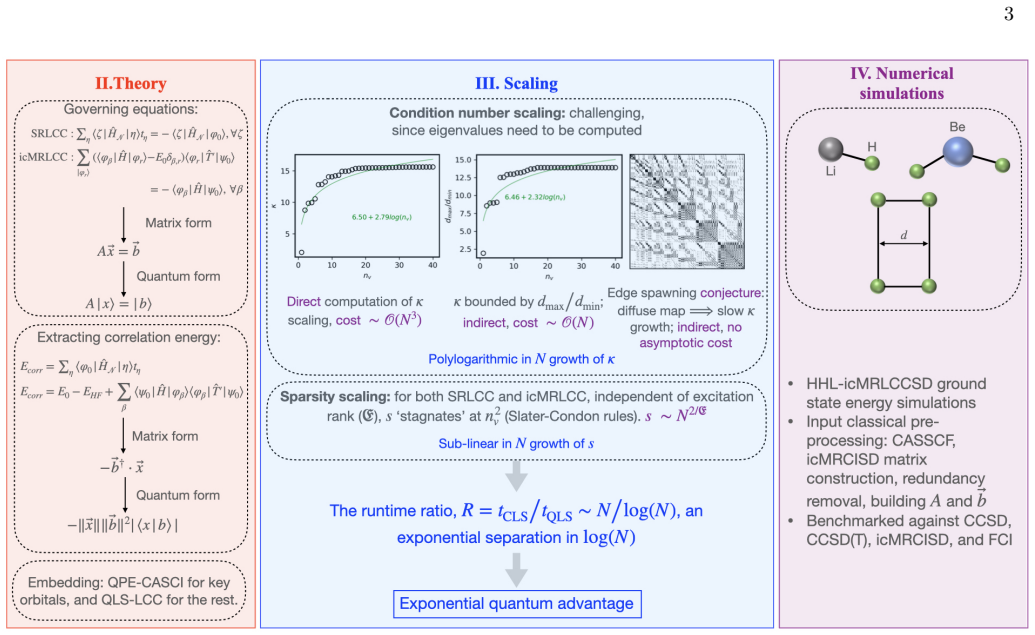
For both single-reference and internally contracted multi-reference linearized coupled cluster equations, the condition number κ of the coefficient matrix A scales polylogarithmically with system size. When this is joined to sparsity that grows only as a sub-linear power of N, quantum linear solvers (HHL for excitation ranks above doubles, CKS already at doubles) deliver an exponential separation in runtime from classical conjugate gradient for the LCC problem.
What carries the argument
Three complementary diagnostics for κ: (i) explicit diagonalization of A, (ii) the ratio of largest to smallest diagonal entries as a cheap proxy justified by Gershgorin and Weyl bounds, and (iii) adaptation of the edge-spawning conjecture that reads diffuse nonzero patterns in A as predictors of slow κ growth.
Load-bearing premise
The polylogarithmic κ trend seen on four small molecules with at most about forty virtual orbitals, and the diffuse heat-map patterns that support it, continues to hold for chemically realistic system sizes and higher excitation ranks.
What would settle it
Compute the condition number of A for a systematic series of larger molecules or longer atomic chains (for example hydrogen chains with dozens of atoms or a molecule with several hundred virtual orbitals) and test whether κ remains polylogarithmic in N or eventually turns polynomial.
If this is right
- Quantum linear solvers become usable for both dynamical and static correlation once the multi-reference formulation is in place.
- Near-optimal solvers such as CKS already yield exponential advantage at the LCCSD level, lowering the excitation-rank barrier.
- A natural embedding of QLS-LCC outside a small active space with QPE-CASCI inside it can treat larger orbital spaces while retaining high accuracy where it is needed most.
- Classical pre-processing that builds A and b remains the dominant remaining bottleneck that must be quantized for an end-to-end advantage.
- Higher excitation ranks strengthen the exponential separation for HHL because sparsity stagnates while system size continues to grow.
Where Pith is reading between the lines
- If the diffuse matrix pattern persists for molecules with hundreds of orbitals, practical quantum advantage for ground-state energies could appear earlier for LCC than for full configuration interaction or pure phase estimation.
- The same structural diagnostics may apply to other internally contracted multi-reference methods whose working equations are linear systems.
- Classical preconditioners that exploit the observed near-diagonal dominance or diffuse structure could further reduce κ for both classical and quantum solvers.
- Fault-tolerant resource estimates for HHL-LCC should focus on T-count reductions inside Hamiltonian simulation, because the condition-number contribution is already favourable.
Editorial analysis
A structured set of objections, weighed in public.
Referee Report
Summary. The manuscript extends quantum linear solvers (QLSs) from single-reference linearized coupled cluster (SRLCC) to an internally contracted multi-reference form (QLS-icMRLCC), so that the same linear-system framework can address strong correlation. It then assesses whether the condition number κ of the LCC matrix A scales favourably enough for exponential advantage over classical conjugate gradient. Three diagnostics—direct diagonalization of A, the ratio d_max/d_min of diagonal entries (supported by two theorems), and an adaptation of the edge-spawning conjecture to heat-map patterns of A—are applied to small molecules (LiH, H4, BeH2+, BeH2) and short atomic chains with n_v ≤ 40. All three indicate polylogarithmic κ growth. Combined with the claim that sparsity s scales as N^{2/E}, the authors obtain runtime ratios (Eqs. 37–40) that exhibit exponential separation for HHL when E > 2 and for CKS already at E = 2. Proof-of-concept HHL-icMRLCCSD simulations on PECs recover energies to within 0.009 % of classical benchmarks.
Significance. If the polylogarithmic κ scaling persists at chemically relevant sizes, the work would establish a concrete, chemistry-native setting in which QLSs can deliver exponential runtime advantage over CG for the LCC problem, including multi-reference regimes. The derivation of the icMRLCC linear system (Sec. II.C, Eqs. 20–25), the two theorems that relate κ to d_max/d_min (Sec. III.B.2), the explicit sparsity argument (Sec. III.C), and the numerical energy benchmarks (Sec. IV, Table A2) are genuine contributions that go beyond the earlier SRLCC-only study. The paper also correctly flags classical pre-processing as an end-to-end bottleneck, which is useful for framing future work.
major comments (2)
- The central claim of exponential advantage (Abstract; Sec. III.D; Eqs. 37–40) rests on κ remaining polylogarithmic in N (or n_v) for both SRLCC and icMRLCC. All three diagnostics are demonstrated only for n_v ≤ 40 on four small molecules and short chains (Sec. III.B.1–3, Figs. 2–5, A1–A4, A8–A16). Direct κ shows staircase plateaus whose height still grows slowly; Theorem 2 requires ||V|| ≪ d_min, which is never quantified outside this window; and the adapted edge-spawning conjecture assumes that a diffuse pattern observed at small sizes remains diffuse at all larger sizes. None of these steps rules out a later crossover to poly(N) growth once many irreps and higher excitation ranks are populated. The manuscript should either (i) supply additional evidence (larger n_v, higher E, or a rigorous bound) that makes the asymptotic extrapolation more secure, or (ii) restate the claim as a finite
- Theorem 2 (Sec. III.B.2) is used to justify d_max/d_min as a proxy for κ when diagonal dominance fails. The proof is correct under the hypothesis ||V|| ≪ d_min, yet the paper never reports ||V|| or any related norm for the matrices studied (Figs. 2–5, A5–A7). Without that check, the proxy remains an empirical observation rather than a controlled approximation. A short numerical verification of ||V||/d_min versus n_v for at least one molecule would make the second diagnostic load-bearing rather than circumstantial.
minor comments (5)
- The edge-spawning conjecture is adapted from unweighted graph Laplacians (Ref. [26], overlapping authors) to weighted LCC matrices by setting all nonzero entries to 1. A brief remark on why the unweighted pattern is still expected to control κ for the weighted case would strengthen Sec. III.B.3.
- Figs. 7–8 report two-qubit gate counts for the isometry and full HHL unitary, but the asymptotic T-count estimate in Sec. III.E is only schematic (~2^{n_r} N_s^4 log(1/ζ)). Clarifying that these are order-of-magnitude illustrations rather than full resource estimates would avoid over-interpretation.
- Notation for the number of virtuals switches between n_v and n_vir without a single definition; a short glossary entry or consistent choice would help.
- The redundancy threshold ε = 10^{-6} (Sec. III.F) is stated without a sensitivity check; a one-sentence remark on how κ or energies change under modest variations of ε would be useful.
- Table A2 and Fig. 10 report energy differences in mHa; converting the largest HHL-icMRLCCSD deviations into the 0.009 % figure quoted in the abstract would make the accuracy claim easier to verify.
Circularity Check
No circular derivation of the polylog-κ claim; self-citation of the edge-spawning conjecture supplies only a qualitative third diagnostic whose patterns are independently observed on the constructed A matrices.
specific steps
-
self citation load bearing
[Sec. III.B.3 (Invoking the edge spawning conjecture)]
"Finally, we employ an indirect method that is computationally much simpler, to predict κ scaling with system size. In particular, we invoke the edge spawning conjecture that was proposed in Ref. [26] for unweighted graph adjacency matrices. In particular, in our adaptation of the conjecture, we map matrix elements of the A matrix to vertices of a graph… Sub-figures (c) and (d) of Figs. 2, 3, 4, and 5 display a diffuse pattern, which according to our extended edge spawning conjecture, indicates a slow κ growth…"
The inference from observed diffuse heat-map patterns to polylogarithmic κ rests on a conjecture whose authors overlap with the present paper. While the patterns themselves are new data and the conjecture is only one of three consistent diagnostics (not the sole support), the qualitative step is not externally independent; if the conjecture is false the pattern-to-κ link collapses. This is a minor, non-load-bearing self-citation rather than a definitional loop.
full rationale
The load-bearing numerical evidence for polylogarithmic κ is obtained by explicit construction of the SRLCC and icMRLCC A matrices (via HF/CASSCF integrals + Slater-Condon or redundancy-removal steps) followed by direct diagonalization at successive n_v (or n_A) values up to ~40; the resulting staircase data are then fitted (Figs. 2–5, A1–A4). The d_max/d_min proxy is derived from two self-contained theorems (Thm. 1 under diagonal dominance, Thm. 2 via Weyl) whose assumptions are checked against the same matrices, not fitted to force the target scaling. Sparsity scaling follows from the two-body nature of the Hamiltonian and is independent of the κ diagnostics. The only self-citation that enters the κ argument is the adaptation of the edge-spawning conjecture of Ref. [26] (overlapping authors); it is used solely as a qualitative pattern check on heat-maps and is not required for the direct or proxy results. Prior HHL-SRLCC papers [11,20] supply the single-reference baseline that is re-derived and extended, not a uniqueness theorem that forces the multi-reference conclusions. Consequently the central claim does not reduce by construction to its inputs; the remaining uncertainty is ordinary extrapolation risk outside the computed window, not circularity.
Axiom & Free-Parameter Ledger
free parameters (3)
- redundancy eigenvalue threshold ε =
10^{-6}
- HHL clock qubits n_r and rotation constant C =
n_r=6–9; C=λ_min
- virtual-orbital increment and irrep ordering
axioms (6)
- standard math Standard HHL/CKS and CG asymptotic runtimes (Eqs. 1–3) with efficient loading of A and preparation of |b|.
- domain assumption LCC A matrices are real symmetric (Hermitian) with positive diagonal entries observed empirically.
- ad hoc to paper Edge-spawning conjecture: diffuse nonzero patterns imply polylog κ growth and remain diffuse at all sizes (adapted from unweighted graph Laplacians to LCC A).
- domain assumption With n_occ (and n_a) fixed, N ~ n_v^E and s ~ n_v^2 ~ N^{2/E} from Slater–Condon two-body structure.
- domain assumption Neglect of the fourth term in the icMRLCC projected equations (MRCEPA(0)-like approximation) still yields a useful linear system for strong correlation.
- ad hoc to paper ∥V∥ ≪ d_min so that κ(A) ≈ d_max/d_min when diagonal dominance fails (Theorem 2).
invented entities (1)
-
QLS-icMRLCC framework (HHL/CKS applied to internally contracted multi-reference LCC linear systems)
independent evidence
read the original abstract
Quantum linear solvers (QLSs) can offer the potential for exponential quantum advantage in solving quantum chemical problems, but its assessment hinges on determining the condition number ($\kappa$) scaling, which itself is computationally challenging. While a recent work applied the Harrow-Hassidim-Lloyd (HHL) algorithm to single-reference linearized coupled cluster equations (SRLCC), the validity of the HHL-SRLCC framework is restricted to weakly correlated regimes. A general treatment requires a formulation that can access strongly correlated regions. We thus begin by extending the QLS-SRLCC framework to its multi-reference form, which is based on the internally contracted multi-reference LCC method (QLS-icMRLCC). We then analyze $\kappa$ scaling using three complementary diagnostics that range from explicit computations to use of indirect structural indicators: (i) direct calculations of $\kappa$, (ii) scaling of the ratio of maximum to minimum diagonal entries of an A matrix, and (iii) structural analyses of the A matrices based on a recently proposed conjecture, which we adapt to the QLS-LCC problem. The three approaches yield consistent predictions, indicating a polylogarithmic $\kappa$ scaling in system size. This finding, when combined with our arguments on sub-linear scaling of sparsity, supports the prospects of exponential advantage using QLSs for the LCC problem. Finally, numerical calculations on potential energy curves of model systems containing up to four atoms recover the ground state energies with errors relative to benchmark classical methods not exceeding 0.009$\%$.
Figures


Reference graph
Works this paper leans on
-
[1]
(21), we obtain: EicMR =E 0 + X α ⟨ψ0| ˆH|φ α⟩ ⟨φα| ˆT ′ |ψ0⟩ + X β ⟨ψ0| ˆH|φ β⟩ ⟨φβ| ˆT ′ |ψ0⟩
Now, introducing the resolution of identity1=P α |φα⟩ ⟨φα|+ P β |φβ⟩ ⟨φβ|in Eq. (21), we obtain: EicMR =E 0 + X α ⟨ψ0| ˆH|φ α⟩ ⟨φα| ˆT ′ |ψ0⟩ + X β ⟨ψ0| ˆH|φ β⟩ ⟨φβ| ˆT ′ |ψ0⟩. In this expression, the terms of type⟨φ α| ˆT ′ |ψ0⟩are always 0 because the action of ˆT ′ on|ψ 0⟩produces func- tions contained inV. Thus, the final expression of the total energ...
-
[2]
Explicitly computing condition number scaling In this sub-section, we discuss the direct route to com- putingκscaling. For each molecule, we extract theAma- trix, the details of which are provided in Section III F(a), at each system size. We go from one system size to the next by adding one virtual spin-orbital at a time. We note that the virtuals are arr...
-
[3]
Upper bounding condition number for LCC matrices As encouraging as our findings are with the explicit computations providing the most direct evidence for a polylogarithmicκgrowth within the scope of our analysis with limited molecules, it would be ideal to substituteκ with some other suitable proxy that is relatively easier to compute. We find that for th...
-
[4]
In particular, we invoke the edge spawning conjec- ture that was proposed in Ref
Invoking the edge spawning conjecture Finally, we employ an indirect method that is compu- tationally much simpler, to predictκscaling with system size. In particular, we invoke the edge spawning conjec- ture that was proposed in Ref. [26] for unweighted graph adjacency matrices. In particular, in our adaptation of the conjecture, we map matrix elements o...
-
[5]
Relation betweenκand spectral gap One may wonder if the spectral gap of the normal or- dered Hamiltonian could serve as a proxy toκ. We recall that the normal ordered Hamiltonian is a shifted Hamil- tonian (in the SRLCC case, which we shall restrict our- selves to for simplicity, this isH N , as discussed in the earlier sections) and its principal sub-mat...
-
[6]
We use the GAMESS US program [41] for this step
For HHL-SRLCCSD: •We carry out an HF calculation to construct Hamil- tonian integrals in the MO basis. We use the GAMESS US program [41] for this step. •With the information on integrals, we build the CISD Hamiltonian matrix using the Slater-Condon rules. •We shift the diagonal entries of the CISD Hamilto- nian by subtracting the HF energy from eachH ii. ...
-
[7]
We employ the Molpro [42] package for this purpose
For HHL-icMRLCCSD: •We carry out a CASSCF calculation to construct the Hamiltonian integrals in the molecular orbital basis. We employ the Molpro [42] package for this purpose. •Using the information on integrals, we build the icM- RCISD Hamiltonian matrix (Hrd). ‘rd’ here denotes ‘rank-deficient’. As explained before, some excita- tions are redundant; th...
-
[8]
to see that matrix elements involving singly excited determinants are all zeroes. This leads us to not hav- ing an amplitude encoded|b⟩with gates acting across ⌈log(PE k=1 nocc k nvir k )⌉=⌈log(N)⌉qubits but instead acting only across a smaller subset (by a constant fac- tor) of⌈log(n D)⌉qubits, whereN D ∼n 2 occn2 vir in the SRLCC case (and∼(n 2 c +n 2 a...
work page 2020
-
[9]
A. Peruzzo, J. McClean, P. Shadbolt, M.-H. Yung, X.-Q. Zhou, P. J. Love, A. Aspuru-Guzik, and J. L. O’Brien, A variational eigenvalue solver on a photonic quantum processor, Nature Communications5, 2041 (2014)
work page 2041
-
[10]
J. Tilly, H. Chen, S. Cao, D. Picozzi, K. Setia, Y. Li, E. Grant, L. Wossnig, I. Rungger, G. H. Booth, and J. Tennyson, The variational quantum eigensolver: A re- view of methods and best practices, Physics Reports986, 1 (2022), the Variational Quantum Eigensolver: a review of methods and best practices
work page 2022
-
[11]
T. Harville, R. Khurana, V. F. Grizzi, and C. Liu, Re- cent developments in VQE: Survey and benchmarking, arXiv:2602.11384 (2026)
work page internal anchor Pith review arXiv 2026
-
[12]
A. Y. Kitaev, Quantum measurements and the abelian stabilizer problem, arXiv:quant-ph/9511026 (1995)
work page internal anchor Pith review Pith/arXiv arXiv 1995
-
[13]
D. S. Abrams and S. Lloyd, Quantum algorithm provid- ing exponential speed increase for finding eigenvalues and eigenvectors, Phys. Rev. Lett.83, 5162 (1999). 21
work page 1999
-
[14]
D. S. Abrams and S. Lloyd, Simulation of many-body fermi systems on a universal quantum computer, Phys. Rev. Lett.79, 2586 (1997)
work page 1997
- [15]
-
[16]
Quantum Error-Corrected Computation of Molecular Energies
K. Yamamoto, Y. Kikuchi, D. Amaro, B. Criger, S. Dilkes, C. Ryan-Anderson, A. Tranter, J. M. Dreil- ing, D. Gresh, C. Foltz, M. Mills, S. A. Moses, P. E. Siegfried, M. D. Urmey, J. J. Burau, A. Hankin, D. Luc- chetti, J. P. Gaebler, N. C. Brown, B. Neyenhuis, and D. Mu˜ noz Ramo, Quantum error-corrected computation of molecular energies, arXiv:2505.09133 (2025)
work page internal anchor Pith review Pith/arXiv arXiv 2025
-
[17]
K. Yamamoto, S. Duffield, Y. Kikuchi, and D. Mu˜ noz Ramo, Demonstrating Bayesian quantum phase estima- tion with quantum error detection, Phys. Rev. Res.6, 013221 (2024)
work page 2024
-
[18]
A. W. Harrow, A. Hassidim, and S. Lloyd, Quantum Al- gorithm for Linear Systems of Equations, Physical Re- view Letters103, 150502 (2009)
work page 2009
-
[19]
N. Baskaran, A. S. Rawat, A. Jayashankar, D. Chakravarti, K. Sugisaki, S. Roy, S. B. Mandal, D. Mukherjee, and V. S. Prasannaa, Adapting the Harrow-Hassidim-Lloyd algorithm to quantum many- body theory, Phys. Rev. Research5, 043113 (2023)
work page 2023
-
[20]
D. Mukherjee, R. K. Moitra, and A. Mukhopadhyay, Ap- plications of a non-perturbative many-body formalism to general open-shell atomic and molecular problems: cal- culation of the ground and the lowestπ−π ∗ singlet and triplet energies and the first ionization potential of trans- butadiene, Molecular Physics33, 955 (1977)
work page 1977
-
[21]
B. Jeziorski and H. J. Monkhorst, Coupled-cluster method for multideterminantal reference states, Phys. Rev. A24, 1668 (1981)
work page 1981
-
[22]
D. Mukherjee, The linked-cluster theorem in the open- shell coupled-cluster theory for incomplete model spaces, Chemical Physics Letters125, 207 (1986)
work page 1986
-
[23]
D. Mukhopadhyay, B. Datta (nee Kundu), and D. Mukherjee, The construction of a size-extensive in- termediate Hamiltonian in a coupled-cluster framework, Chemical Physics Letters197, 236 (1992)
work page 1992
-
[24]
B. Kirtman, Simultaneous calculation of several interact- ing electronic states by generalized Van Vleck perturba- tion theory, The Journal of Chemical Physics75, 798 (1981)
work page 1981
-
[25]
A. Banerjee and J. Simons, Applications of multiconfigu- rational coupled-cluster theory, The Journal of Chemical Physics76, 4548 (1982)
work page 1982
-
[26]
F. A. Evangelista and J. Gauss, An orbital-invariant internally contracted multireference coupled cluster ap- proach, The Journal of Chemical Physics134, 114102 (2011)
work page 2011
-
[27]
M. Hanauer and A. K¨ ohn, Pilot applications of inter- nally contracted multireference coupled cluster theory, and how to choose the cluster operator properly, The Journal of Chemical Physics134, 204111 (2011)
work page 2011
-
[28]
P. B. Tsemo, A. Jayashankar, K. Sugisaki, N. Baskaran, S. Chakraborty, and V. S. Prasannaa, Enhancing the Harrow-Hassidim-Lloyd (HHL) algorithm in systems with large condition numbers, Phys. Rev. Res.7, 023270 (2025)
work page 2025
-
[29]
S. Jin, N. Liu, and Y. Yu, Time complexity analysis of quantum difference methods for linear high dimensional and multiscale partial differential equations, Journal of Computational Physics471, 111641 (2022)
work page 2022
- [30]
-
[31]
M. Gopalakrishnan Meena, K. C. Gottiparthi, J. G. Li- etz, A. Georgiadou, and E. A. Coello P´ erez, Solving the Hele–Shaw flow using the Harrow–Hassidim–Lloyd algo- rithm on superconducting devices: A study of efficiency and challenges, Physics of Fluids36, 101705 (2024)
work page 2024
-
[32]
R. Yalovetzky, P. Minssen, D. Herman, and M. Pistoia, Solving linear systems on quantum hardware with hybrid HHL++, Scientific Reports14(2024)
work page 2024
- [33]
- [34]
-
[35]
A. M. Childs, R. Kothari, and R. D. Somma, Quantum algorithm for systems of linear equations with exponen- tially improved dependence on precision, SIAM Journal on Computing46, 1920 (2017)
work page 1920
-
[36]
M. E. S. Morales, L. Pira, P. Schleich, K. Koor, P. C. S. Costa, D. An, A. Aspuru-Guzik, L. Lin, P. Rebentrost, and D. W. Berry, Quantum linear system solvers: A survey of algorithms and applications, arXiv:2411.02522 (2025)
work page internal anchor Pith review Pith/arXiv arXiv 2025
-
[37]
J. C. Garcia-Escartin and P. Chamorro-Posada, SWAP test and Hong-Ou-Mandel effect are equivalent, Phys. Rev. A87, 052330 (2013)
work page 2013
-
[38]
H. Buhrman, R. Cleve, J. Watrous, and R. de Wolf, Quantum fingerprinting, Physical Review Letters87, 167902 (2001)
work page 2001
-
[39]
K. R. Shamasundar, G. Knizia, and H.-J. Werner, A new internally contracted multi-reference configuration inter- action method, The Journal of Chemical Physics135, 054101 (2011)
work page 2011
-
[40]
J. A. Black and A. K¨ ohn, Linear and quadratic inter- nally contracted multireference coupled-cluster approxi- mations, The Journal of Chemical Physics150, 194107 (2019)
work page 2019
-
[41]
A. Aspuru-Guzik, A. D. Dutoi, P. J. Love, and M. Head- Gordon, Simulated quantum computation of molecular energies, Science309, 1704 (2005)
work page 2005
-
[42]
B. P. Lanyon, J. D. Whitfield, G. G. Gillett, M. E. Goggin, M. P. Almeida, I. Kassal, J. D. Biamonte, M. Mohseni, B. J. Powell, M. Barbieri, A. Aspuru-Guzik, and A. G. White, Towards quantum chemistry on a quan- tum computer, Nature Chemistry2, 106 (2010)
work page 2010
-
[43]
M. Dobˇ s´ ıˇ cek, G. Johansson, V. Shumeiko, and G. Wendin, Arbitrary accuracy iterative quantum phase estimation algorithm using a single ancillary qubit: A two-qubit benchmark, Phys. Rev. A76, 030306 (2007)
work page 2007
-
[44]
J. G. Smith, C. H. W. Barnes, and D. R. M. Arvidsson- Shukur, Iterative quantum-phase-estimation protocol for shallow circuits, Phys. Rev. A106, 062615 (2022)
work page 2022
-
[45]
B. F. Schiffer, D. S. Wild, N. Maskara, M. D. Lukin, and J. I. Cirac, Hardware-efficient quantum phase estimation via local control, PRX Quantum6, 040348 (2025)
work page 2025
-
[46]
N. J. C. Papadopoulos, J. T. Reilly, J. D. Wilson, and M. J. Holland, Reductive quantum phase estimation, 22 Phys. Rev. Res.6, 033051 (2024)
work page 2024
-
[47]
S. Lee, J. Lee, H. Zhai, Y. Tong, A. M. Dalzell, A. Kumar, P. Helms, J. Gray, Z.-H. Cui, W. Liu, M. Kastoryano, R. Babbush, J. Preskill, C. Reichman, David R., E. T., E. F. Valeev, L. Lin, and G. K.-L. Chan, Evaluating the evidence for exponential quantum advantage in ground- state quantum chemistry, Nature Communications14, 1952 (2023)
work page 1952
-
[48]
N. J. Ross and P. Selinger, Optimal ancilla-free Clif- ford+T approximation of z-rotations, Quantum Informa- tion and Computation16, 901 (2016)
work page 2016
-
[49]
G. M. J. Barca et al., Recent developments in the gen- eral atomic and molecular electronic structure system, J. Chem. Phys.152, 154102 (2022)
work page 2022
- [50]
-
[51]
J. C. Slater, The theory of complex spectra, Physical Review34, 1293 (1929)
work page 1929
-
[52]
E. U. Condon, The theory of complex spectra, Physical Review36, 1121 (1930)
work page 1930
-
[53]
P. R. Surj´ an, The Brillouin theorem, in Second Quantized Approach to Quantum Chemistry (Springer, Berlin, Heidelberg, 1989) pp. 87–92
work page 1989
-
[54]
M. Mottonen, J. J. Vartiainen, V. Bergholm, and M. M. Salomaa, Transformation of quantum states using uni- formly controlled rotations, Quantum Information and Computation5, 467 (2005)
work page 2005
-
[55]
G. D. Purvis III, R. Shepard, F. B. Brown, and R. J. Bartlett,C 2v insertion pathway for BeH 2: a test prob- lem for the coupled-cluster single and double excitation model, Int. J. Quantum Chem.23, 838 (1983). 23 TABLE A1. Acronyms used throughout this work, arranged in alphabetical order in this table. Acronym Definition AO Atomic orbital BCH Baker-Campb...
work page 1983
-
[56]
We begin with three registers: the state register composed ofn b qubits and prepared in the state|b⟩= P i bi|ui⟩ ∥ P i bi|ui⟩∥, the clock register containingn r qubits intended to be used as QPE ancillas and initialized to|0 nr ⟩, and a single qubit register for the HHL ancilla
-
[57]
Upon applying QPE on|0 nr ⟩ ⊗ |b⟩, the phases ofe iAt are collected in the form λit 2π ∀j∈[1, N], that is, QPE(|0nr ⟩ ⊗ |b⟩) = X i bi 2nr λit 2π ⊗ |ui⟩.(A4) The right-hand side can be expressed as: X i bi |˜λi⟩ ⊗ |ui⟩,(A5) where ˜λi = 2nr λit 2π is an approximate to the rescaled eigenvalues λit 2π in decimal representation
-
[58]
Next, we perform the controlled rotation gatee −iθY withθ i = arcsin C ˜λi .Cis a scalar that can be tuned such that the probability of obtaining the outcome|1⟩at the HHL ancilla is maximal. For our numerical calculations, we set the standard choice ofC=λ min for convenience, but we note that a suitable rescaling ofAin the QPE step, especially for diagona...
-
[59]
Uncompute the register| ˜λi⟩by applying QPE † onP i bi |˜λi⟩ ⊗ |ui⟩to obtain: X i bi s 1− C2 ˜λ2 i |0⟩+ C ˜λi |1⟩ ! ⊗ |0nr ⟩ ⊗ |ui⟩.(A7) 25
-
[60]
Finally, we measure the HHL ancilla in the computational basis and post-select the state outcome|1⟩. The obtained normalized solution appears on the state register as follows: |˜x⟩= 1r P i biC ˜λi 2 X i biC ˜λi |ui⟩.(A8) FIG. A1. The figure depicts the following: (a)κversusn v, (b)d max dmin versus number of atoms,n A, and (c) theAmatrix heatmap atn A = 6...
discussion (0)
Sign in with ORCID, Apple, or X to comment. Anyone can read and Pith papers without signing in.