REVIEW 2 major objections 5 minor 97 references
Parameter windows that host quasiperiodic critical states under periodic boundaries can still show the non-Hermitian skin effect once open boundaries are imposed.
Reviewed by Pith at T0; open to challenge. T0 means a machine referee read the full paper against a public rubric. the ladder, T0–T4 →
T0 review · grok-4.5
2026-07-10 09:52 UTC pith:4ORC5BCY
load-bearing objection Clean analytic LE for unequal quasiperiodic hoppings, solid numerics linking PBC-critical windows to OBC skin; the Hermitian LE=0 step is the only real soft spot and is not fatal. the 2 major comments →
Interplay of Quasiperiodic Criticality and the Non-Hermitian Skin Effect
The pith
A machine-rendered reading of the paper's core claim, the machinery that carries it, and where it could break.
Core claim
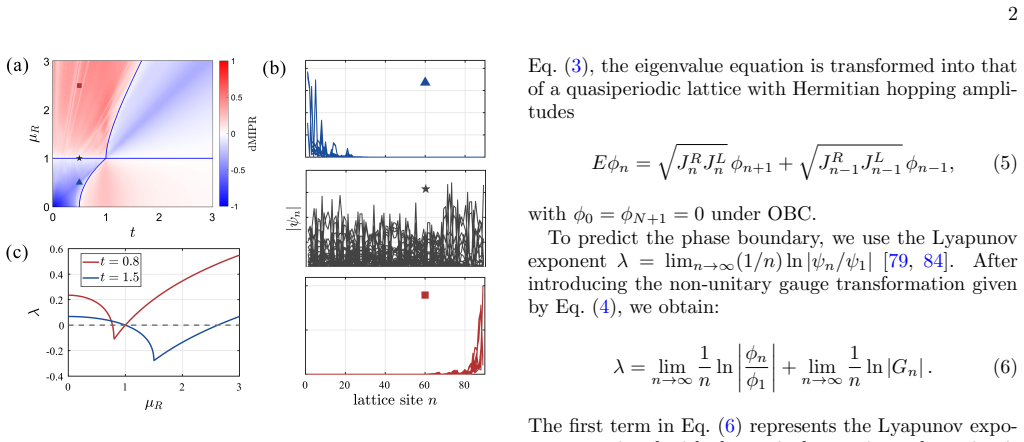
In an off-diagonal Hatano–Nelson model with unequal quasiperiodic modulation strengths, the parameter regimes that host critical eigenstates under periodic boundary conditions exhibit a non-Hermitian skin effect under open boundary conditions; the left/right skin boundary is given exactly by the vanishing of the thermodynamic-limit Lyapunov exponent obtained after a non-unitary gauge map.
What carries the argument
Non-unitary gauge transformation ψ_n = ϕ_n G_n that removes the nonreciprocity, after which the Lyapunov exponent reduces to the spatial average of (1/2) ln|J^R/J^L| and can be evaluated in closed form (Eqs. 8–10).
Load-bearing premise
After the gauge map, the resulting Hermitian quasiperiodic chain is assumed not to be exponentially localized, so its own Lyapunov exponent vanishes and does not shift the analytic skin boundary.
What would settle it
Compute the Lyapunov exponent of the gauged Hermitian quasiperiodic chain inside the claimed critical windows; if it remains finite and nonzero in the thermodynamic limit, the analytic left/right skin boundary of Eqs. 9–10 is incorrect.
If this is right
- The skin direction of critical quasiperiodic states is completely fixed by a single integral of the log hopping ratio and needs no further diagonalization.
- Long-range and multiband generalizations inherit the same skin-versus-critical correspondence once the same gauge map is applied.
- Boundary condition (open versus periodic) can convert a critical spectrum into a skin-localized spectrum without changing any bulk parameters.
- Experimental platforms that already realize quasiperiodic hopping can test the predicted skin reversal simply by tuning the relative modulation strengths.
Where Pith is reading between the lines
- The same gauge-plus-Lyapunov construction should apply to any off-diagonal nonreciprocal model whose hoppings factor into a common quasiperiodic envelope times left/right amplitudes.
- If the Hermitian partner develops a mobility edge, the skin boundary will itself become energy-dependent, producing a hybrid skin-critical spectrum.
- Realizing the model in a photonic or cold-atom lattice would allow direct imaging of the predicted left-to-right skin reversal across the analytic line μ_R = t + √(t²−1).
Editorial analysis
A structured set of objections, weighed in public.
Referee Report
Summary. The manuscript studies a quasiperiodically modulated off-diagonal Hatano–Nelson chain in which nonreciprocity arises from unequal modulation strengths of the right and left hoppings. Under open boundary conditions a non-unitary gauge transformation maps the model onto a Hermitian quasiperiodic chain; the Lyapunov exponent is then reduced to an explicit integral over the logarithmic hopping imbalance (Eqs. 6–9), yielding an analytic left/right skin boundary (Eq. 10). Numerical dMIPR diagrams under OBC agree with this boundary. Under periodic boundary conditions, MIPR and finite-size fractal-dimension analysis identify extended and critical regimes; the comparison of the two boundary conditions shows that parameter windows hosting quasiperiodic critical states under PBC can exhibit the non-Hermitian skin effect under OBC. The same qualitative interplay is demonstrated for a long-range hopping extension and a two-band non-Hermitian Rice–Mele model.
Significance. The work supplies a concrete, analytically controlled link between quasiperiodic criticality and the non-Hermitian skin effect. The closed-form thermodynamic-limit Lyapunov exponent (Eqs. 9–10) is a genuine strength: it is parameter-free once the Hermitian contribution is discarded, and it matches the numerical OBC phase diagrams to high accuracy. The observation that PBC-critical regimes can skin under OBC is of clear interest to the non-Hermitian and quasiperiodic communities and is shown to survive long-range and multiband generalizations. If the vanishing of the Hermitian Lyapunov exponent can be placed on firmer footing, the paper would constitute a clean, citable reference for boundary-sensitive critical localization in modulated non-Hermitian systems.
major comments (2)
- Section III, Eqs. (6)–(9): the analytic skin boundary rests on setting the first term of Eq. (6) (the Lyapunov exponent of the gauge-transformed Hermitian quasiperiodic chain) identically to zero, on the grounds that “the corresponding eigenstates are not exponentially localized.” This is asserted rather than proved for the critical windows later identified under PBC (0 < β < 1). If those Hermitian states are exponentially localized for some energies or parameters, λ acquires an extra nonzero contribution and the claimed exact phase boundary (Eq. 10) shifts. The excellent numerical agreement of dMIPR with the λ = 0 curve (Fig. 1) is consistent but does not replace a bound or a spectral argument that the Hermitian LE vanishes throughout the critical regime. A short analytic or numerical demonstration that the Hermitian LE remains zero (or is o(1) in the thermodynamic limit) inside the win
- Section III and Fig. 2: the identification of “quasiperiodic critical regimes” under PBC relies on finite-size MIPR scaling for two representative points and a single fractal dimension β ≈ 0.529. While standard, this is insufficient to delineate the white transition line drawn in Fig. 2(a) across the whole (t, μ_R) plane. Additional scaling data (or an independent diagnostic such as the multifractal spectrum or level-spacing statistics) at several points along that line would strengthen the claim that entire parameter regions, rather than isolated points, host critical states that subsequently skin under OBC.
minor comments (5)
- Eq. (2) and surrounding text: the global phase θ is stated not to affect localization, yet all finite-size averages are performed over 10^3 realizations of θ. A brief remark clarifying that the thermodynamic-limit λ is θ-independent while finite-N IPR fluctuates would avoid confusion.
- Fig. 1(a) and Eq. (10): the four branches of the analytic boundary are written for μ_L = 1; it would help the reader if the general expression (Eq. 9) were also plotted or tabulated for a second value of μ_L to illustrate robustness.
- Section IV, Eq. (14): the product definition of long-range amplitudes J_{n,p}^{R/L} is natural but not unique; a short sentence explaining why this particular factorization preserves the gauge map would improve clarity.
- Typographical: “HA T ANO-NELSON” and “ST A TES” in section headings contain spurious spaces; “GENERALIZA TION” and “MUL TIBAND” likewise. Standardize to “Hatano–Nelson”, “States”, etc.
- References: several recent works on non-Hermitian quasiperiodic criticality and skin effect (e.g., the mobility-edge and multifractal literature) are cited, but a brief comparison with the Hermitian off-diagonal Aubry–André critical line would situate the present phase boundary more clearly.
Circularity Check
No circularity: the thermodynamic-limit Lyapunov exponent is obtained by an exact ergodic integral after a standard non-unitary gauge map; PBC MIPR/scaling diagnostics are independent numerical probes, not fitted inputs that force the OBC skin boundary.
full rationale
The central analytic object is the Lyapunov exponent after the non-unitary gauge transformation ψ_n = φ_n G_n. The paper writes λ = lim (1/n) ln|φ_n/φ_1| + lim (1/n) ln|G_n| and discards the first term because the equivalent Hermitian quasiperiodic chain is asserted not to be exponentially localized in the regimes of interest; the second term then reduces by the ergodic theorem to the explicit integral (Eq. 8) whose closed form is Eq. (9). Setting λ = 0 yields the phase boundary (Eq. 10). This chain is self-contained: no free parameter is fitted to data, no uniqueness theorem is imported from the authors’ prior work, and the integral does not reduce by construction to any quantity later “predicted.” The PBC analysis (MIPR and finite-size fractal dimension β) is performed separately and used only for comparison; the numerical dMIPR under OBC is an independent diagnostic that happens to track the analytic curve. The long-range and Rice–Mele extensions reuse the same gauge map without introducing new fitted quantities. The soft spot is the unproved vanishing of the Hermitian LE inside the critical windows (already flagged by the reader as a correctness assumption, not a circular reduction). Because no step equates a claimed prediction to its own input by definition or by self-citation, the circularity score is zero.
Axiom & Free-Parameter Ledger
free parameters (3)
- modulation frequency α
- system sizes N (Fibonacci numbers)
- global phase θ averaging
axioms (3)
- domain assumption After the non-unitary gauge transformation the Lyapunov exponent of the equivalent Hermitian quasiperiodic chain vanishes in the thermodynamic limit for the regimes considered.
- domain assumption The irrational frequency α can be replaced by rational Fibonacci approximants without changing the localization classification in the large-N limit.
- standard math Inverse-participation-ratio scaling with fractal dimension 0<β<1 diagnoses critical (multifractal) states.
read the original abstract
Quasiperiodic lattices can host critical eigenstates, whereas nonreciprocal hopping in non-Hermitian lattices can induce non-Hermitian skin effect. In this work, we investigate localization phenomena in a Hatano--Nelson model with quasiperiodically modulated hopping amplitudes, where nonreciprocity arises from unequal modulation strengths of the right and left hoppings. Using a non-unitary gauge transformation, we map the non-Hermitian system into a Hermitian quasiperiodic system and obtain an exact analytical expression for the Lyapunov exponent in the thermodynamic limit. Under periodic boundary conditions, inverse participation ratios and finite-size scaling analysis are used to identify the quasiperiodic critical regimes. The comparison shows that parameter regimes hosting quasiperiodic critical states under periodic boundary conditions can exhibit the non-Hermitian skin effect under open boundary conditions. Furthermore, the non-Hermitian skin effect associated with quasiperiodic critical regimes is also observed in representative long-range hopping models and multiband extensions. Our results provide an analytically controlled perspective on how quasiperiodicity, modulated nonreciprocity, and boundary conditions jointly shape the non-Hermitian skin effect in critical regimes.
Figures


Reference graph
Works this paper leans on
-
[1]
C. M. Bender and S. Boettcher, Real Spectra in Non- Hermitian Hamiltonians HavingPTSymmetry, Phys. Rev. Lett.80, 5243 (1998)
work page 1998
-
[2]
J. M. Zeuner, M. C. Rechtsman, Y. Plotnik, Y. Lumer, S. Nolte, M. S. Rudner, M. Segev, and A. Szameit, Obser- vation of a Topological Transition in the Bulk of a Non- Hermitian System, Phys. Rev. Lett.115, 040402 (2015). 6
work page 2015
- [3]
-
[4]
J. Y. Lee, J. Ahn, H. Zhou, and A. Vishwanath, Topo- logical Correspondence between Hermitian and Non- Hermitian Systems: Anomalous Dynamics, Phys. Rev. Lett.123, 206404 (2019)
work page 2019
- [5]
- [6]
-
[7]
L. Li, C. H. Lee, S. Mu, and J. Gong, Critical non- Hermitian skin effect, Nat. Commun.11, 5491 (2020)
work page 2020
- [8]
-
[9]
Y. Li, X. Ji, Y. Chen, X. Yan, and X. Yang, Topological energy braiding of non-Bloch bands, Phys. Rev. B106, 195425 (2022)
work page 2022
- [10]
- [11]
-
[12]
L. Li, Y. Wei, G. Wu, Y. Ruan, S. Chen, C. H. Lee, and Z. Ni, Exact solutions disentangle higher-order topology in two-dimensional non-Hermitian lattices, Phys. Rev. B 111, 075132 (2025)
work page 2025
-
[13]
W.-Y. Zhang, M.-Y. Mao, Q.-M. Hu, X. Zhao, G. Sun, and W.-L. You, Yang-Lee edge singularity and quantum criticality in non-Hermitian PXP model, Phys. Rev. B 112, 155135 (2025)
work page 2025
-
[14]
S.-X. Wang and Z. Yan, Theory for the spectral splitting exponent of exceptional points, Phys. Rev. B112, 195125 (2025)
work page 2025
-
[15]
R. Okugawa, R. Takahashi, and K. Yokomizo, Second- order topological non-Hermitian skin effects, Phys. Rev. B102, 241202 (2020)
work page 2020
-
[16]
K. Yokomizo and S. Murakami, Scaling rule for the criti- cal non-Hermitian skin effect, Phys. Rev. B104, 165117 (2021)
work page 2021
-
[17]
Y. Song, Y. Chen, W. Xiong, and M. Wang, Flexible light manipulation in non-Hermitian frequency Su–Schrieffer– Heeger lattice, Opt. Lett.47, 1646 (2022)
work page 2022
-
[18]
Z. Gu, H. Gao, H. Xue, J. Li, Z. Su, and J. Zhu, Tran- sient non-Hermitian skin effect, Nat. Commun.13, 7668 (2022)
work page 2022
- [19]
-
[20]
R. Lin, T. Tai, L. Li, and C. H. Lee, Topological non- Hermitian skin effect, Front. Phys.18, 53605 (2023)
work page 2023
- [21]
-
[22]
T. Yoshida, S.-B. Zhang, T. Neupert, and N. Kawakami, Non-Hermitian Mott Skin Effect, Phys. Rev. Lett.133, 076502 (2024)
work page 2024
-
[23]
X.-R. Ma, K. Cao, X.-R. Wang, Z. Wei, Q. Du, and S.-P. Kou, Non-Hermitian chiral skin effect, Phys. Rev. Res. 6, 013213 (2024)
work page 2024
-
[24]
Z. Lin, W. Song, L.-W. Wang, H. Xin, J. Sun, S. Wu, C. Huang, S. Zhu, J.-H. Jiang, and T. Li, Observation of Topological Transition in Floquet Non-Hermitian Skin Effects in Silicon Photonics, Phys. Rev. Lett.133, 073803 (2024)
work page 2024
-
[25]
S. Wang, B. Wang, C. Liu, C. Qin, L. Zhao, W. Liu, S. Longhi, and P. Lu, Nonlinear Non-Hermitian Skin Ef- fect and Skin Solitons in Temporal Photonic Feedforward Lattices, Phys. Rev. Lett.134, 243805 (2025)
work page 2025
-
[26]
L. Wang, W. Lin, B. Ruan, Y. Xiang, and X. Dai, Tun- able higher-order non-Hermitian skin effect in the SSH topolectrical circuits, J. Phys.: Condens. Matter37, 185001 (2025)
work page 2025
-
[27]
X. Yang, Y. Feng, A. Wahab, and H. Geng, Non- hermitian second-order topological phases and bipolar skin effect in photonic kagome crystals, Phys. Rev. A 113, 023506 (2026)
work page 2026
-
[28]
S. Wang, W. Xiong, Z. Zhang, Y. Cheng, and X. Liu, One-Dimensional Z 2 Topological Skin Effect Driven by Acoustic Lossy Couplings, Phys. Rev. Lett.136, 026601 (2026)
work page 2026
- [29]
-
[30]
F. K. Kunst, E. Edvardsson, J. C. Budich, and E. J. Bergholtz, Biorthogonal Bulk-Boundary Correspondence in Non-Hermitian Systems, Phys. Rev. Lett.121, 026808 (2018)
work page 2018
-
[31]
K. Yokomizo and S. Murakami, Non-Bloch Band Theory of Non-Hermitian Systems, Phys. Rev. Lett.123, 066404 (2019)
work page 2019
- [32]
-
[33]
E. J. Bergholtz, J. C. Budich, and F. K. Kunst, Ex- ceptional topology of non-Hermitian systems, Rev. Mod. Phys.93, 015005 (2021)
work page 2021
- [34]
-
[35]
Q. Zhou, J. Wu, Z. Pu, J. Lu, X. Huang, W. Deng, M. Ke, and Z. Liu, Observation of geometry-dependent skin ef- fect in non-Hermitian phononic crystals with exceptional points, Nat. Commun.14, 4569 (2023)
work page 2023
-
[36]
H.-Y. Wang, F. Song, and Z. Wang, Amoeba Formula- tion of Non-Bloch Band Theory in Arbitrary Dimensions, Phys. Rev. X14, 021011 (2024)
work page 2024
-
[37]
T. E. Lee, Anomalous Edge State in a Non-Hermitian Lattice, Phys. Rev. Lett.116, 133903 (2016)
work page 2016
-
[38]
F. Song, S. Yao, and Z. Wang, Non-Hermitian Skin Effect and Chiral Damping in Open Quantum Systems, Phys. Rev. Lett.123, 170401 (2019)
work page 2019
-
[39]
D. S. Borgnia, A. J. Kruchkov, and R.-J. Slager, Non- Hermitian Boundary Modes and Topology, Phys. Rev. Lett.124, 056802 (2020)
work page 2020
-
[40]
Y. O. Nakai, N. Okuma, D. Nakamura, K. Shimomura, and M. Sato, Topological enhancement of nonnormality in non-Hermitian skin effects, Phys. Rev. B109, 144203 (2024)
work page 2024
-
[41]
S. R. Padhi, A. Padhan, S. Banerjee, and T. Mishra, Quasiperiodic and periodic extended Hatano-Nelson model: Anomalous complex-real transition and non- Hermitian skin effect, Phys. Rev. B110, 174203 (2024). 7
work page 2024
-
[42]
Kohmoto, Metal–Insulator Transition and Scaling for Incommensurate Systems, Phys
M. Kohmoto, Metal–Insulator Transition and Scaling for Incommensurate Systems, Phys. Rev. Lett.51, 1198 (1983)
work page 1983
-
[43]
D. J. Thouless, Localization by a Potential with Slowly Varying Period, Phys. Rev. Lett.61, 2141 (1988)
work page 1988
-
[44]
Bloch, ¨Uber die Quantenmechanik der Elektronen in Kristallgittern, Z
F. Bloch, ¨Uber die Quantenmechanik der Elektronen in Kristallgittern, Z. Phys.52, 555 (1929)
work page 1929
-
[45]
C. Kittel and P. McEuen,Introduction to solid state physics(John Wiley & Sons, 2018)
work page 2018
-
[46]
P. W. Anderson, Absence of Diffusion in Certain Random Lattices, Phys. Rev.109, 1492 (1958)
work page 1958
-
[47]
Thouless, Electrons in disordered systems and the the- ory of localization, Phys
D. Thouless, Electrons in disordered systems and the the- ory of localization, Phys. Rep.13, 93 (1974)
work page 1974
-
[48]
F. Evers and A. D. Mirlin, Anderson transitions, Rev. Mod. Phys.80, 1355 (2008)
work page 2008
-
[49]
Y. Hatsugai and M. Kohmoto, Energy spectrum and the quantum Hall effect on the square lattice with next- nearest-neighbor hopping, Phys. Rev. B42, 8282 (1990)
work page 1990
-
[50]
M. V. Jari´ c,Introduction to the Mathematics of Qua- sicrystals(Elsevier, 2012)
work page 2012
-
[51]
M. Kohmoto, B. Sutherland, and C. Tang, Critical wave functions and a Cantor-set spectrum of a one-dimensional quasicrystal model, Phys. Rev. B35, 1020 (1987)
work page 1987
-
[52]
M. Kohmoto, B. Sutherland, and K. Iguchi, Localization of optics: Quasiperiodic media, Phys. Rev. Lett.58, 2436 (1987)
work page 1987
-
[53]
V. R. Tuz, Optical properties of a quasi-periodic gener- alized Fibonacci structure of chiral and material layers, J. Opt. Soc. Am. B26, 627 (2009)
work page 2009
-
[54]
K. Deguchi, S. Matsukawa, N. K. Sato, T. Hattori, K. Ishida, H. Takakura, and T. Ishimasa, Quantum criti- cal state in a magnetic quasicrystal, Nat. Mater.11, 1013 (2012)
work page 2012
-
[55]
H. Yao, A. Khoudli, L. Bresque, and L. Sanchez- Palencia, Critical Behavior and Fractality in Shallow One-Dimensional Quasiperiodic Potentials, Phys. Rev. Lett.123, 070405 (2019)
work page 2019
-
[56]
Y. Wang, L. Zhang, S. Niu, D. Yu, and X.-J. Liu, Re- alization and Detection of Nonergodic Critical Phases in an Optical Raman Lattice, Phys. Rev. Lett.125, 073204 (2020)
work page 2020
-
[57]
Y. Wang, C. Cheng, X.-J. Liu, and D. Yu, Many-Body Critical Phase: Extended and Nonthermal, Phys. Rev. Lett.126, 080602 (2021)
work page 2021
-
[58]
T. Xiao, D. Xie, Z. Dong, T. Chen, W. Yi, and B. Yan, Observation of topological phase with critical localization in a quasi-periodic lattice, Sci. Bull.66, 2175 (2021)
work page 2021
-
[59]
M. Gon¸ calves, B. Amorim, E. V. Castro, and P. Ribeiro, Critical Phase Dualities in 1D Exactly Solv- able Quasiperiodic Models, Phys. Rev. Lett.131, 186303 (2023)
work page 2023
-
[60]
C. Yang, W. Yang, Y. Wang, and Y. Wang, Exploring multifractal critical phases in two-dimensional quasiperi- odic systems, Phys. Rev. A110, 042205 (2024)
work page 2024
-
[61]
C. W. Duncan, Critical states and anomalous mobility edges in two-dimensional diagonal quasicrystals, Phys. Rev. B109, 014210 (2024)
work page 2024
-
[62]
Q. Yao, X. Yang, A. A. Iliasov, M. I. Katsnelson, and S. Yuan, Wave functions in the critical phase: A pla- nar Sierpi´ nski fractal lattice, Phys. Rev. B110, 035403 (2024)
work page 2024
-
[63]
Z.-H. Zhang, H.-C. Kou, and P. Li, Critical dynamics and its interferometry in the one-dimensionalp-wave-paired Aubry-Andr´ e-Harper model, Phys. Rev. B112, 014310 (2025)
work page 2025
-
[64]
H. Jiang, L.-J. Lang, C. Yang, S.-L. Zhu, and S. Chen, Interplay of non-Hermitian skin effects and Anderson lo- calization in nonreciprocal quasiperiodic lattices, Phys. Rev. B100, 054301 (2019)
work page 2019
-
[65]
L.-Z. Tang, G.-Q. Zhang, L.-F. Zhang, and D.-W. Zhang, Localization and topological transitions in non- Hermitian quasiperiodic lattices, Phys. Rev. A103, 033325 (2021)
work page 2021
-
[66]
Q. Lin, T. Li, L. Xiao, K. Wang, W. Yi, and P. Xue, Topological Phase Transitions and Mobility Edges in Non-Hermitian Quasicrystals, Phys. Rev. Lett.129, 113601 (2022)
work page 2022
-
[67]
J. Jeon and S. Lee, Localization control born of in- tertwined quasiperiodicity and non-Hermiticity, SciPost Phys. Core6, 077 (2023)
work page 2023
-
[68]
L. Zhou, Non-Abelian generalization of non-Hermitian quasicrystals:PT-symmetry breaking, localization, en- tanglement, and topological transitions, Phys. Rev. B 108, 014202 (2023)
work page 2023
-
[69]
A. Shi, Y. Peng, P. Peng, J. Chen, and J. Liu, Delo- calization of higher-order topological states in higher- dimensional non-Hermitian quasicrystals, Phys. Rev. B 110, 014106 (2024)
work page 2024
- [70]
-
[71]
C. Rangi, K.-M. Tam, and J. Moreno, Engineering a non-Hermitian second-order topological insulator state in quasicrystals, Phys. Rev. B109, 064203 (2024)
work page 2024
-
[72]
Y.-P. Wang, C.-K. Chang, R. Okugawa, and C.-H. Hsu, Quasiperiodicity-induced bulk localization with self- similarity in non-Hermitian systems, Phys. Rev. Res.7, 043353 (2025)
work page 2025
-
[73]
Y.-Q. Zheng, S.-Z. Li, and Z. Li, Emergent multiloop nested point gap in a non-Hermitian quasiperiodic lat- tice, Phys. Rev. B111, 104204 (2025)
work page 2025
-
[74]
S.-Z. Li, L. Li, S.-L. Zhu, and Z. Li, Anderson-skin du- alism: A boundary-dependent effect in non-Hermitian disordered coupled systems, Phys. Rev. B112, L201108 (2025)
work page 2025
-
[75]
S. Gandhi and J. N. Bandyopadhyay, Superconducting p-wave pairing effects on one-dimensional non-Hermitian quasicrystals with power law hopping, Phys. Rev. B111, 174210 (2025)
work page 2025
- [76]
-
[77]
Cai, Non-Hermitian skin effect without point-gap topology in 2D quasicrystals, Commun
X. Cai, Non-Hermitian skin effect without point-gap topology in 2D quasicrystals, Commun. Phys.9, 61 (2026)
work page 2026
-
[78]
Q.-B. Zeng and R. L¨ u, Coexistence of topological An- derson insulator and multifractal critical phase in a non- Hermitian quasicrystal, Phys. Rev. B113, 224203 (2026)
work page 2026
-
[79]
N. Hatano and D. R. Nelson, Localization Transitions in Non-Hermitian Quantum Mechanics, Phys. Rev. Lett. 77, 570 (1996)
work page 1996
-
[80]
N. Hatano and D. R. Nelson, Vortex pinning and non- Hermitian quantum mechanics, Phys. Rev. B56, 8651 (1997)
work page 1997
discussion (0)
Sign in with ORCID, Apple, or X to comment. Anyone can read and Pith papers without signing in.