REVIEW 5 minor 43 references
In Lorenz-96, fine Fourier modes are only partly fixed by coarser modes at the same instant, with recoverability organized by quadratic triad coupling and shrinking as forcing grows.
Reviewed by Pith at T0; open to challenge. T0 means a machine referee read the full paper against a public rubric. the ladder, T0–T4 →
T0 review · grok-4.5
2026-07-10 09:23 UTC pith:J2ZPMIAW
load-bearing objection Solid empirical diagnostic paper: L96 recoverability maps organized by triad geometry, with unusually careful estimator checks and a clear, non-circular claim.
Intrinsic Instantaneous Coarse-to-Fine Recoverability in the Lorenz-96 System
The pith
A machine-rendered reading of the paper's core claim, the machinery that carries it, and where it could break.
Core claim
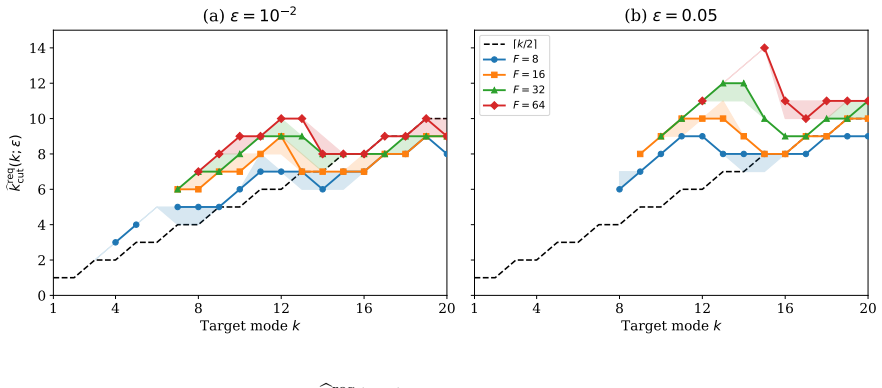
For the Lorenz-96 system with N=40 and forcings F=8,16,32,64, the empirical recoverability maps are strongly nonuniform. Low target modes remain weakly constrained by still coarser observations, while high modes exhibit a finite band of partial slaving once the retained cutoff reaches the energetic intermediate modes. Substantial recoverability grows around the quadratic triad-access scale k_cut ≈ ⌈k/2⌉, consistent with the Fourier coupling rule p+q ≡ k (mod N) and shifted by regime-dependent statistics. Increasing F preserves this geometric organization but reduces its amplitude, so unresolved modes retain greater conditional freedom under stronger driving. Instantaneous deterministic closu
What carries the argument
The correlation-ratio functional R(k|k_cut), the fraction of target-mode variance explained by the L2 conditional mean given the retained lower modes 0,…,k_cut. Evaluated over all admissible pairs it yields the scale-resolved recoverability map that diagnoses where coarse observations carry instantaneous deterministic information about unresolved fine modes under the invariant snapshot measure.
Load-bearing premise
The trained networks, after data-size and width saturation plus residual checks, are taken to approximate the true conditional means closely enough that held-out scores equal the population recoverability on the attractor.
What would settle it
A higher-capacity or differently architected estimator that still passes residual-orthogonality checks, or an exact conditional-mean computation on a smaller analogous system, producing substantially higher recoverability on the same high-mode pairs would show that the reported maps understate true instantaneous recoverability.
If this is right
- Instantaneous deterministic closures from lower Fourier modes are plausible only inside a finite high-mode band once energetic intermediate modes are retained.
- Stronger forcing systematically reduces the fraction of high-mode variance removable by conditioning, so the same retained variables become less informative.
- The quadratic triad-access scale ⌈k/2⌉ organizes the onset of recoverability; energy and statistical coupling on the attractor set the actual threshold crossings.
- Regions of the (k,k_cut) plane dominated by residual variance mark where stochastic or memory terms remain necessary even for single-time closures.
- The same map and residual-orthogonality diagnostic apply to other observation operators and larger systems.
Where Pith is reading between the lines
- The same triad-organized recoverability pattern is likely in other quadratic spectral models whenever observations are sharp Fourier cutoffs.
- If residual checks stay near zero under richer probe classes, the reported scores can benchmark data-driven closures trained only on coarse variables.
- Collapse of the active-area fraction with forcing supplies a practical signal that pure deterministic instantaneous closures have become ineffective.
- Extending the map to multi-time observations would separate recoverability gained from history versus from a single snapshot.
Editorial analysis
A structured set of objections, weighed in public.
Referee Report
Summary. The paper defines a population-level instantaneous recoverability functional R(k|k_cut) as the fraction of variance of Fourier mode k explained by the L2 conditional mean given lower modes up to cutoff k_cut, under the invariant snapshot measure. It estimates the full scale-resolved map for Lorenz-96 (N=40, F=8,16,32,64) via one-hidden-layer neural networks trained by squared loss, with held-out evaluation. The maps are strongly nonuniform: low modes remain weakly constrained by coarser observations, while high modes show a finite band of partial recoverability whose onset is organized around the quadratic triad-access scale ⌈k/2⌉ and whose amplitude decreases with F (e.g., R̂(20|19) falls from 0.8485 to 0.2964). The geometric organization is derived from the Fourier coupling rule p+q ≡ k (mod N); estimator quality is supported by data-size/width saturation, tiny monotonicity violations, RFF residual orthogonality checks, and a near-zero affine baseline.
Significance. The work cleanly separates a single-time, measure-theoretic closure diagnostic from long-time determining-mode theory, synchronization, and full Mori–Zwanzig reduced dynamics. The recoverability map is a falsifiable, scale-resolved object whose structure is tied to the known quadratic triad geometry of L96 and whose amplitude systematically weakens with forcing. Strengths include an explicit population definition (Section II), careful trajectory diagnostics (stationarity splits, autocorrelation-based subsampling), and multiple independent estimator checks (saturation, monotonicity, RFF residual orthogonality, linear baseline). If the maps are accepted as reliable estimates of the invariant-measure functional, they give a concrete, quantitative picture of where instantaneous deterministic coarse-to-fine information exists and where residual conditional variance dominates—useful both for L96 model reduction and as a template for other multiscale systems.
minor comments (5)
- In Section VI B and Figure 4, the bootstrap confidence bands on k_req_cut(k;ε) are mentioned but the resampling procedure (block length, number of replicates) is not stated; a short sentence would make the bands reproducible.
- Appendix C reports the affine baseline only for the single pair (20|19). A brief note on whether linear recoverability remains negligible for a few other high-mode pairs would strengthen the claim that the maps are essentially nonlinear.
- Figure 3 uses a common color scale across F, which is appropriate for amplitude comparison, but the low-F maps then saturate near the top of the scale; a short remark in the caption that the color bar is shared would help readers who inspect panels in isolation.
- The abstract and introduction use both “correlation-ratio functional” and “conditional-mean explained variance”; a single preferred term after the first definition would reduce minor terminological drift.
- Equation (38)–(39) give the Fourier form of L96; a parenthetical reference to the standard derivation (or a one-line sketch of the discrete Fourier transform of the quadratic term) would help readers who do not recompute the coefficients.
Circularity Check
No significant circularity: R is a population functional estimated by regression; triad scale is derived from L96 coupling and used only as reference, not fitted.
full rationale
The paper defines instantaneous recoverability R_B (and modewise R(k|k_cut)) directly from the L2 projection property of the conditional mean under the invariant snapshot measure (Eqs. 6–8, Sec. II). This is a classical correlation-ratio / explained-variance functional; the neural nets are merely estimators of that functional on held-out data (Eq. 31), not free parameters that force the reported maps. Saturation, monotonicity, and RFF residual checks (Sec. IV–V, App. B) are diagnostics of estimator quality, not inputs that define the result. The quadratic triad-access scale k_cut = ⌈k/2⌉ is obtained by elementary Fourier analysis of the known L96 nonlinearity (Eqs. 38–41: p+q ≡ k mod N implies no retained–retained triad when 2k_cut < k); it is plotted as a dashed reference curve against which empirical onset is compared, not fitted to the recoverability scores. Amplitude decrease with F is an observed numerical trend, not a prediction forced by construction. The sole self-citation ([39], residual-orthogonality idea) supplies a diagnostic method and is not load-bearing for the maps or the geometric organization. No step reduces a claimed prediction or first-principles result to its own inputs by definition or by self-citation chain. The derivation is therefore self-contained against external benchmarks.
Axiom & Free-Parameter Ledger
free parameters (5)
- network hidden width =
1000
- training dataset size K (fit+val) =
~1.8M (selected)
- RFF joint-explained-variance tolerance ϵ =
0.01
- recoverability onset thresholds ϵ for k_req_cut =
0.01 and 0.05
- temporal sampling interval Δt_samp =
1
axioms (4)
- domain assumption Long-time averages along the post-burn-in L96 trajectory approximate expectations under a unique invariant snapshot measure (ergodicity / statistical stationarity).
- domain assumption A sufficiently wide one-hidden-layer network trained by squared loss approximates the L2 conditional mean of the target mode given the retained modes.
- standard math The discrete Fourier transform and conjugate symmetry correctly represent the real L96 state, and the quadratic triad rule p+q ≡ k (mod N) governs instantaneous nonlinear coupling.
- ad hoc to paper Deterministic mean-square recoverability (explained variance of the conditional mean) is the appropriate single-time diagnostic; full conditional law is not required.
read the original abstract
In multiscale chaotic systems, a basic closure question is how much of the unresolved fine scales is instantaneously determined by the resolved coarse scales on the attractor. In a Fourier description, we formalize this by asking, given a target mode $k$ and a lower-mode cutoff $k_{\rm cut}<k$, how much of mode $k$ is determined by the retained modes $0,\ldots,k_{\rm cut}$. We quantify this relation by the correlation-ratio functional $R(k\mid k_{\rm cut})$, interpreted as conditional-mean explained variance, and use it to build a scale-resolved recoverability map $(k,k_{\rm cut})\mapsto R(k\mid k_{\rm cut})$, whose structure is sharply organized by the nonlinear dynamics. Applying the diagnostic to the Lorenz-96 system for forcings $F=8,16,32,64$, we find that the recoverability maps are strongly nonuniform: low modes remain weakly constrained by still coarser observations, while high modes exhibit finite-band partial slaving once the retained cutoff reaches the energetic intermediate modes. The growth of substantial recoverability is organized around the quadratic triad-access scale $k_{\rm cut}\approx\lceil k/2\rceil$, consistent with the Fourier coupling rule $p+q\equiv k\pmod N$, while remaining shifted by regime-dependent statistics. Increasing $F$ preserves this geometric organization but reduces its amplitude, indicating greater conditional freedom of the unresolved modes in more strongly driven regimes. The maps show that instantaneous deterministic closure varies systematically across scales as a property of the invariant measure: retained modes provide nontrivial deterministic information in some regions, while other regions are dominated by conditional residual variance.
Figures



Reference graph
Works this paper leans on
-
[1]
C. Foias and G. Prodi, Sur le comportement global des solutions non-stationnaires des ´ equations de Navier–Stokes en dimension 2, Rendiconti del Seminario Matematico della Uni- versita di Padova39, 1 (1967)
work page 1967
- [2]
-
[3]
C. Foias and R. Temam, Determination of the solutions of the Navier–Stokes equations by a set of nodal values, Mathematics of Computation43, 117 (1984)
work page 1984
-
[4]
D. A. Jones and E. S. Titi, On the number of determining nodes for the 2D Navier–Stokes equations, Journal of Mathematical Analysis and Applications168, 72 (1992)
work page 1992
-
[5]
D. A. Jones and E. S. Titi, Determining finite volume elements for the 2D Navier–Stokes equations, Physica D: Nonlinear Phenomena60, 165 (1992)
work page 1992
-
[6]
A. Azouani, E. Olson, and E. S. Titi, Continuous data assimilation using general interpolant observables, Journal of Nonlinear Science24, 277 (2014)
work page 2014
- [7]
- [8]
- [9]
-
[10]
F. Takens, Detecting strange attractors in turbulence, inDynamical Systems and Turbulence, Warwick 1980, Lecture Notes in Mathematics, Vol. 898, edited by D. Rand and L.-S. Young (Springer, Berlin, Heidelberg, 1981) pp. 366–381
work page 1980
-
[11]
M. Casdagli, S. Eubank, J. D. Farmer, and J. Gibson, State space reconstruction in the presence of noise, Physica D: Nonlinear Phenomena51, 52 (1991)
work page 1991
-
[12]
H. D. Abarbanel, R. Brown, J. J. Sidorowich, and L. S. Tsimring, The analysis of observed chaotic data in physical systems, Reviews of Modern Physics65, 1331 (1993)
work page 1993
-
[13]
L. M. Pecora and T. L. Carroll, Synchronization in chaotic systems, Physical Review Letters 64, 821 (1990)
work page 1990
-
[14]
R´ enyi, On measures of dependence, Acta Mathematica Academiae Scientiarum Hungaricae 10, 441 (1959)
A. R´ enyi, On measures of dependence, Acta Mathematica Academiae Scientiarum Hungaricae 10, 441 (1959)
work page 1959
- [15]
-
[16]
T. M. Cover and J. A. Thomas,Elements of Information Theory, 2nd ed. (Wiley-Interscience, Hoboken, New Jersey, 2006)
work page 2006
-
[17]
Schreiber, Measuring information transfer, Physical Review Letters85, 461 (2000)
T. Schreiber, Measuring information transfer, Physical Review Letters85, 461 (2000)
work page 2000
-
[18]
M. Materassi, G. Consolini, N. Smith, and R. De Marco, Information theory analysis of cascading process in a synthetic model of fluid turbulence, Entropy16, 1272 (2014)
work page 2014
-
[19]
M. Shavit and G. Falkovich, Singular measures and information capacity of turbulent cascades, Physical Review Letters125, 104501 (2020)
work page 2020
-
[20]
A. Lozano-Dur´ an and G. Arranz, Information-theoretic formulation of dynamical systems: Causality, modeling, and control, Physical Review Research4, 023195 (2022)
work page 2022
-
[21]
A. J. Chorin, O. H. Hald, and R. Kupferman, Optimal prediction and the Mori–Zwanzig representation of irreversible processes, Proceedings of the National Academy of Sciences97, 30 2968 (2000)
work page 2000
-
[22]
A. J. Chorin, O. H. Hald, and R. Kupferman, Optimal prediction with memory, Physica D: Nonlinear Phenomena166, 239 (2002)
work page 2002
-
[23]
Y. T. Lin, Y. Tian, D. Perez, and D. Livescu, Regression-based projection for learning Mori– Zwanzig operators, SIAM Journal on Applied Dynamical Systems22, 2890 (2023)
work page 2023
-
[24]
R. J. Adrian, B. Jones, M. Chung, Y. Hassan, C. Nithianandan, and A.-C. Tung, Approx- imation of turbulent conditional averages by stochastic estimation, Physics of Fluids1, 992 (1989)
work page 1989
-
[25]
R. J. Adrian, Stochastic estimation of conditional structure: A review, Applied Scientific Research53, 291 (1994)
work page 1994
- [26]
- [27]
-
[28]
S. B. Pope, Self-conditioned fields for large-eddy simulations of turbulent flows, Journal of Fluid Mechanics652, 139 (2010)
work page 2010
-
[29]
E. N. Lorenz, Predictability: A problem partly solved, inProceedings of the Seminar on Predictability, Vol. 1 (ECMWF, Reading, UK, 1996) pp. 1–18
work page 1996
-
[30]
A. Karimi and M. R. Paul, Extensive chaos in the Lorenz–96 model, Chaos20, 043105 (2010)
work page 2010
-
[31]
C. M. Bishop,Pattern Recognition and Machine Learning(Springer, New York, 2006) pp. 46–48
work page 2006
-
[32]
J. Kerin and H. Engler, On the Lorenz’96 model and some generalizations, Discrete and Continuous Dynamical Systems-B27, 769 (2022)
work page 2022
-
[33]
D. L. van Kekem and A. E. Sterk, Travelling waves and their bifurcations in the Lorenz-96 model, Physica D: Nonlinear Phenomena367, 38 (2018)
work page 2018
-
[34]
K. Li, S. M. Tobias, and J. Marston, Direct statistical simulation of the Lorenz96 system in model reduction approaches, Physical Review E111, 015308 (2025)
work page 2025
-
[35]
G. Cybenko, Approximation by superpositions of a sigmoidal function, Mathematics of Con- trol, Signals and Systems2, 303 (1989). 31
work page 1989
- [36]
- [37]
-
[38]
A. Rahimi and B. Recht, Random features for large-scale kernel machines, Advances in Neural Information Processing Systems20, 1177 (2007)
work page 2007
-
[39]
Diagnosing the conditional-mean barrier in scientific machine-learning surrogates
J. Chen, Diagnosing the conditional-mean barrier in scientific machine-learning surrogates, arXiv preprint arXiv:2605.28076 (2026)
work page internal anchor Pith review Pith/arXiv arXiv 2026
-
[40]
Gaussian Error Linear Units (GELUs)
D. Hendrycks and K. Gimpel, Gaussian error linear units (GELUs) (2016), arXiv:1606.08415 [cs.LG]
work page internal anchor Pith review Pith/arXiv arXiv 2016
-
[41]
D. P. Kingma and J. Ba, Adam: A method for stochastic optimization (2014), arXiv:1412.6980 [cs.LG]
work page internal anchor Pith review Pith/arXiv arXiv 2014
-
[42]
I. Loshchilov and F. Hutter, SGDR: Stochastic gradient descent with warm restarts, inInter- national Conference on Learning Representations(2017)
work page 2017
-
[43]
V. Chernozhukov, D. Chetverikov, and K. Kato, Gaussian approximations and multiplier bootstrap for maxima of sums of high-dimensional random vectors, The Annals of Statistics , 2786 (2013). 32
work page 2013
discussion (0)
Sign in with ORCID, Apple, or X to comment. Anyone can read and Pith papers without signing in.