REVIEW 2 major objections 5 minor 25 references
Reviewed by Pith at T0; open to challenge.
T0 means a machine referee read the full paper against a public rubric. The mark states how deep the mechanical check went, never who wrote it. the ladder, T0–T4 →
T0 review · grok-4.5
Two-qubit quantum neural nets show delayed generalization (grokking) and late-stage test-error decay that weak weight-norm regularization can lock in.
2026-07-10 08:53 UTC pith:W2T7D55J
load-bearing objection Clean first empirical sighting of grokking and epoch-wise double descent in a fully parameterized 2-qubit QNN, with multi-seed stats, matching Fourier analysis, and a simple L2 fix for late decay; scope is deliberately minimal. the 2 major comments →
Grokking and epoch-wise double descent in quantum neural networks
The pith
A machine-rendered reading of the paper's core claim, the machinery that carries it, and where it could break.
Core claim
Multi-layer two-qubit QNNs that completely parameterize SU(4) exhibit both grokking (test error falling long after training error saturates) and epoch-wise double descent; deeper circuits raise the probability of successful generalization, late-stage generalization decay tracks unconstrained weight-norm growth away from sparse phase-aligned harmonics, and weak explicit weight-norm regularization permanently anchors the post-grokking state.
What carries the argument
The multi-layer SU(4) QNN of Equations 2–3 (linearly padded 2-D inputs times the 15 generators of su(4) per layer) together with the leave-one-out hypothesis-stability proxy and the Fourier spectrum of the learned decision function; these objects let the authors track the internal reorganization that occurs while training loss is flat and diagnose the late-stage drift.
Load-bearing premise
The concentric-circles task with test points fixed a short distance from a classical quadratic-kernel SVM boundary, plus the linear padding of two-dimensional data into the full set of su(4) generators, is assumed to be a fair enough probe that the observed phases and depth trends characterize overparameterized quantum networks rather than artifacts of this particular geometry and embedding.
What would settle it
Train the same architecture on a different non-linear binary task whose optimal boundary is not circular (or place test points far from any classical SVM margin) and check whether the same delayed test-error collapse, depth-dependent success rates, and late-stage weight-norm-linked decay still appear.
Editorial analysis
A structured set of objections, weighed in public.
Referee Report
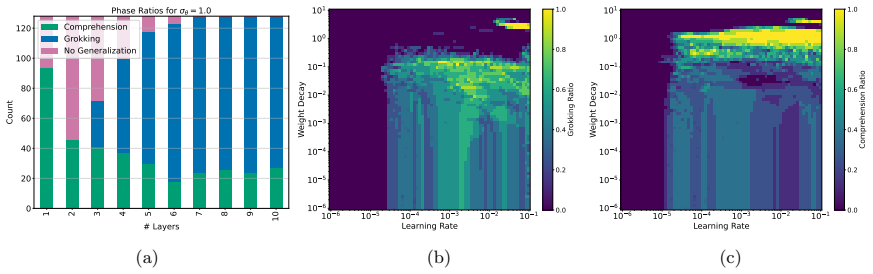
Summary. The manuscript reports the first empirical observation of grokking (delayed memorization-to-generalization transition) and epoch-wise double descent in a two-qubit QNN that fully parameterizes the SU(4) manifold via multi-layer unitaries of the form Eq. (2). On a concentric-circles task with test points placed at fixed margin ε from a classical hard-margin quadratic-kernel SVM boundary, the authors show that increasing circuit depth n_l raises the fraction of random seeds that reach low test error (Fig. 3a, 128 seeds), that the transition coincides with a drop in leave-one-out hypothesis stability β_loo and a collapse of the model’s Fourier spectrum onto the analytically derived Bessel/Airy pattern of the ideal circular step (Fig. 2, Appendix B), and that late-stage test-error decay tracks unconstrained weight-norm growth. Weak explicit L2 regularization (λ = 10^{-4}) is shown to stabilize the post-grokking regime without altering the temporal gap τ_g/τ_f (Fig. 6). Temporal scaling with learning rate, weight decay and initialization scale is mapped in §3.3.
Significance. If the reported transitions hold under the stated architecture and diagnostic, the work supplies a concrete, reproducible bridge between classical grokking literature and variational QML. Strengths include multi-seed phase statistics (128 seeds over depth; grids over η and λ_W), an explicit phase taxonomy (Table 1), direct tracking of leave-one-out HS, and an independent analytical Fourier baseline (Appendix B) that matches the post-grokking spectra. The demonstration that broad initializations plus moderate weight decay can still produce generalization, and that a weak L2 anchor prevents late decay, offers a practical training prescription for overparameterized quantum circuits. The principal limitation is the restriction to two qubits and a single geometrically engineered task; within that controlled setting the empirical package is coherent and useful.
major comments (2)
- The central diagnostic (§2.1, Eqs. 1–2) places test points at fixed margin ε from a classical hard-margin quadratic SVM boundary and embeds 2-D inputs by linear padding into the 15 generators of su(4). While this yields a sensitive probe of boundary quality, it risks labeling other valid quantum decision boundaries as “non-generalizing.” The phase ratios (Fig. 3a) and the claim of “generalization decay” therefore rest on the assumption that the SVM boundary is the unique optimal separator. A short ablation with an alternative non-linear feature map or a different test-set construction would strengthen the claim that the observed transitions characterize overparameterized QNNs rather than this particular geometry.
- All experiments are performed on a two-qubit, fully parameterized SU(4) circuit. The discussion (§4) correctly flags multi-qubit scaling as future work, yet the abstract and introduction present the results as characterizing “quantum neural networks” more broadly. The manuscript should either (i) add a modest multi-qubit check (e.g., 3–4 qubits with a restricted ansatz) or (ii) explicitly qualify every global claim to the two-qubit complete-parameterization setting so that the load-bearing scope is transparent.
minor comments (5)
- Table 1 defines the grokking/comprehension threshold as τ_g/τ_f > 10; the text notes that other works use an absolute gap of 10^3. A one-sentence justification for the relative threshold would improve reproducibility.
- Figure 2a labels both τ_g^- and τ_g^+; the caption should state explicitly that τ_g^+ is the first epoch at which test error falls below 0.1, matching the definition used in §3.1.
- Equation (5) for the Lipschitz bound retains only the two data-carrying weights; a brief remark that the remaining 13 generators per layer do not enter the bound would clarify why global L2 regularization (Eq. 4) is preferred over a Lipschitz-only penalty.
- Appendix C (Fig. 6) shows that λ = 10^{-4} stabilizes late-stage error; the main text could cite the corresponding violin distributions more prominently when claiming that the L2 anchor “permanently preserves generalization gains.”
- Minor typographical issues: “ageneralization decay” (abstract), inconsistent spacing around λ_W versus λ, and occasional missing spaces after commas in figure captions.
Circularity Check
No significant circularity: empirical observations of grokking/double descent with an independent analytical Fourier baseline; only minor non-load-bearing self-citation of the authors' Lipschitz bound.
specific steps
-
self citation load bearing
[§2.2 Eqs. 5–6 and surrounding text; also Abstract / Introduction references to [14]]
"Furthermore, we will track the Lipschitz bound of f(x;θ) given by [14] L(θ)=2∑k=1^2 ∑l=1^{nl} |θ_k^{(l)}| ... Note, that the Lipschitz bounds is a bound of the generalization error of f(x;θ) (see more detailed version with proof in Ref. [14]) |R[f(θ)]−R_emp[f(θ)]|≤C1 L(θ)+C2/√N"
The Lipschitz bound and its generalization-error inequality are imported from the authors' own prior work [14] and used as a diagnostic (and optional regularizer). This is a self-citation, but it is not load-bearing for the paper's primary empirical claims (observation of grokking, epoch-wise double descent, depth trends, or late-stage decay). The bound is not used to derive or force those transitions; removing it would leave the multi-seed phase ratios, Fourier collapse, and HS drop intact. Hence only a minor circularity flag.
full rationale
The paper's central claims are empirical multi-seed observations (error curves, phase ratios vs depth, leave-one-out HS drop coinciding with τ_g, late-stage weight-norm growth, and L2-anchor stabilization) on a fully parameterized two-qubit SU(4) QNN, not first-principles derivations that reduce to fitted targets by construction. The ideal Fourier coefficients (Eq. 11 / Appendix B) are derived independently from the classical circular step function via Bessel/Hankel transforms and serve only as an external analytical baseline against which the network's post-grokking spectrum is compared; they are not fitted to the QNN outputs. Algorithmic stability (β_loo) is tracked as a diagnostic proxy, not used to force the reported transitions. The sole self-citation is to the authors' prior Lipschitz-bound paper [14], which supplies a smoothness bound used as a diagnostic and optional regularizer; it is not invoked as a uniqueness theorem that forbids alternatives or that forces the grokking claim. The work is therefore self-contained against its own controlled diagnostic (concentric circles + margin-ε test points), and the score remains at the minor-self-citation floor.
Axiom & Free-Parameter Ledger
free parameters (6)
- time-gap threshold τ_g/τ_f > 10 for labeling grokking vs comprehension
- test-error threshold 0.1 for τ_f and τ_g
- explicit regularization strength λ (0 vs 10^{-4})
- initialization scale σ_θ and AdamW weight decay λ_W, learning rate η
- margin ε of test points to SVM boundary (default 0.1)
- training set size N=100, max epochs 10^5, n_l ∈ {1..10}
axioms (5)
- domain assumption Uniform / leave-one-out hypothesis stability bounds the expected generalization gap (Bousquet & Elisseeff; Oneto et al.)
- domain assumption Lipschitz bound of the QNN output depends only on data-coupled weights and upper-bounds generalization gap (Berberich et al. 2024)
- domain assumption AdamW decoupled weight decay supplies useful implicit regularization on flat zero-training-loss manifolds
- standard math 15 generators of su(4) with linear feature padding fully parameterize two-qubit unitaries layerwise
- ad hoc to paper Hard-margin quadratic-kernel SVM boundary is the unique optimal separator for placing sensitive test points
read the original abstract
Grokking, the delayed transition from memorization to generalization, is a fundamental phenomenon in gradient-based learning, yet its dynamics within variational quantum machine learning (QML) remain largely unexamined. In this work, we report the empirical observation of both the grokking transition and epoch-wise double descent in a two-qubit quantum neural network (QNN) under a complete parameterization of the SU(4) manifold. We demonstrate that overparameterization via increased circuit depth improves the probability of successful generalization. Notably, these architectures frequently exhibit an epoch-wise double descent in test error, degrading at a critical epoch before recovering into a generalizing state. Crucially, we identify a generalization decay in late-stage training, where the test error increases significantly despite a stagnant training loss. Bridging this behavior with algorithmic stability theory, our analysis reveals that this decay correlates with an unconstrained increase of the weight-norm, drifting away from sparse, phase-aligned harmonic solutions toward overfitted solutions in the Hilbert space. We analyze the underlying temporal dynamics of this transition, demonstrating how the onset of generalization is linked to optimization hyperparameters such as learning rate and weight decay. Finally, to mitigate late-stage decay, we introduce a weak explicit weight-norm regularization into the loss function. We demonstrate that this structural anchor stabilizes the post-grokking phase and permanently preserves generalization gains, providing a robust framework for training overparameterized quantum circuits.
Figures




Reference graph
Works this paper leans on
-
[1]
Grokking: Generalization Beyond Overfitting on Small Algorithmic Datasets
Alethea Power, Yuri Burda, Harri Edwards, Igor Babuschkin, and Vedant Misra. Grokking: Generalization beyond overfitting on small algorithmic datasets.arXiv preprint arXiv:2201.02177, 2022
work page internal anchor Pith review Pith/arXiv arXiv 2022
-
[2]
Zhiyuan Liu, Yankai Lin, and Maosong Sun.Representation learning for natural language pro- cessing. Springer Nature, 2023
work page 2023
-
[3]
A Tale of Two Circuits: Grokking as Competition of Sparse and Dense Subnetworks
William Merrill, Nikolaos Tsilivis, and Aman Shukla. A tale of two circuits: Grokking as compe- tition of sparse and dense subnetworks.arXiv preprint arXiv:2303.11873, 2023
work page internal anchor Pith review Pith/arXiv arXiv 2023
-
[4]
A Basin-Selection Perspective on Grokking via Singular Learning Theory
Ben Cullen, Sergio Estan-Ruiz, Riya Danait, and Jiayi Li. Grokking as a phase transition between competing basins: a singular learning theory approach.arXiv preprint arXiv:2603.01192, 2026
work page internal anchor Pith review Pith/arXiv arXiv 2026
-
[5]
Anish Lakkapragada. Using physics-inspired singular learning theory to understand grokking & other phase transitions in modern neural networks.arXiv preprint arXiv:2512.00686, 2025
-
[6]
Stability and generalization.Journal of machine learning research, 2(Mar):499–526, 2002
Olivier Bousquet and Andr´ e Elisseeff. Stability and generalization.Journal of machine learning research, 2(Mar):499–526, 2002
work page 2002
-
[7]
Reconciling grokking with statistical learning theory
Luca Oneto, Sandro Ridella, Andrea Coraddu, and Davide Anguita. Reconciling grokking with statistical learning theory. InEuropean Symposium on Artificial Neural Networks, Computational Intelligence and Machine Learning, 2025
work page 2025
-
[8]
Do we really need a new theory to understand over-parameterization?Neurocomputing, 543:126227, 2023
Luca Oneto, Sandro Ridella, and Davide Anguita. Do we really need a new theory to understand over-parameterization?Neurocomputing, 543:126227, 2023
work page 2023
-
[9]
Grokking as an entanglement transition in tensor network machine learning
Domenico Pomarico, Alfonso Monaco, Giuseppe Magnifico, Antonio Lacalamita, Ester Pantaleo, Loredana Bellantuono, Sabina Tangaro, Tommaso Maggipinto, Marianna La Rocca, Ernesto Pi- cardi, et al. Grokking as an entanglement transition in tensor network machine learning.arXiv preprint arXiv:2503.10483, 2025
work page internal anchor Pith review Pith/arXiv arXiv 2025
-
[10]
Jarrod R McClean, Sergio Boixo, Vadim N Smelyanskiy, Ryan Babbush, and Hartmut Neven. Bar- ren plateaus in quantum neural network training landscapes.Nature communications, 9(1):4812, 2018
work page 2018
-
[11]
Double descent in quantum kernel methods.PRX Quantum, 7(1):010312, 2026
Marie Kempkes, Aroosa Ijaz, Elies Gil-Fuster, Carlos Bravo-Prieto, Jakob Spiegelberg, Evert van Nieuwenburg, and Vedran Dunjko. Double descent in quantum kernel methods.PRX Quantum, 7(1):010312, 2026
work page 2026
-
[12]
Preetum Nakkiran, Gal Kaplun, Yamini Bansal, Tristan Yang, Boaz Barak, and Ilya Sutskever. Deep double descent: Where bigger models and more data hurt.Journal of Statistical Mechanics: Theory and Experiment, 2021(12):124003, 2021
work page 2021
-
[13]
Martin Larocca, Nathan Ju, Diego Garc´ ıa-Mart´ ın, Patrick J Coles, and Marco Cerezo. Theory of overparametrization in quantum neural networks.Nature Computational Science, 3(6):542–551, 2023. 11
work page 2023
-
[14]
Training robust and generalizable quantum models.Physical Review Research, 6(4):043326, 2024
Julian Berberich, Daniel Fink, Daniel Pranji´ c, Christian Tutschku, and Christian Holm. Training robust and generalizable quantum models.Physical Review Research, 6(4):043326, 2024
work page 2024
-
[15]
When and how epochwise double descent happens
Cory Stephenson and Tyler Lee. When and how epochwise double descent happens.arXiv preprint arXiv:2108.12006, 2021
work page internal anchor Pith review Pith/arXiv arXiv 2021
-
[16]
Early Stopping in Deep Networks: Double Descent and How to Eliminate it
Reinhard Heckel and Fatih Furkan Yilmaz. Early stopping in deep networks: Double descent and how to eliminate it.arXiv preprint arXiv:2007.10099, 2020
work page internal anchor Pith review Pith/arXiv arXiv 2007
-
[17]
Multi-scale feature learning dynamics: Insights for double descent
Mohammad Pezeshki, Amartya Mitra, Yoshua Bengio, and Guillaume Lajoie. Multi-scale feature learning dynamics: Insights for double descent. InInternational Conference on Machine Learning, pages 17669–17690. PMLR, 2022
work page 2022
-
[18]
Better than classical? The subtle art of benchmarking quantum machine learning models
Joseph Bowles, Shahnawaz Ahmed, and Maria Schuld. Better than classical? the subtle art of benchmarking quantum machine learning models.arXiv preprint arXiv:2403.07059, 2024
work page internal anchor Pith review Pith/arXiv arXiv 2024
-
[19]
Quantum kernel methods under scrutiny: a benchmarking study
Jan Schnabel and Marco Roth. Quantum kernel methods under scrutiny: a benchmarking study. Quantum Machine Intelligence, 7(1):58, 2025
work page 2025
-
[20]
Daniel Basilewitsch, Jo˜ ao F Bravo, Christian Tutschku, and Frederick Struckmeier. Quantum neural networks in practice: a comparative study with classical models from standard data sets to industrial images.Quantum Machine Intelligence, 7(2):110, 2025
work page 2025
-
[21]
Springer Science & Business Media, 2008
Ingo Steinwart and Andreas Christmann.Support vector machines. Springer Science & Business Media, 2008
work page 2008
-
[22]
Decoupled Weight Decay Regularization
Ilya Loshchilov and Frank Hutter. Decoupled weight decay regularization.arXiv preprint arXiv:1711.05101, 2017
work page internal anchor Pith review Pith/arXiv arXiv 2017
-
[23]
George Biddell Airy. I. on the diffraction of an annular aperture: To the editors of the philosophical magazine and journal.The London, Edinburgh, and Dublin Philosophical Magazine and Journal of Science, 18(114):1–10, 1841
-
[24]
Olivier Vall´ ee and Manuel Soares.Airy functions and applications to physics. World Scientific, 2010
work page 2010
-
[25]
Gradient Descent Provably Optimizes Over-parameterized Neural Networks
Simon S Du, Xiyu Zhai, Barnabas Poczos, and Aarti Singh. Gradient descent provably optimizes over-parameterized neural networks.arXiv preprint arXiv:1810.02054, 2018. Appendix A Tunable problem difficulty with tighter bound- ary samples In our formulation, the structural difficulty of the learning problem can be explicitly controlled by modulatingε >0, wh...
work page internal anchor Pith review Pith/arXiv arXiv 2018
discussion (0)
Sign in with ORCID, Apple, or X to comment. Anyone can read and Pith papers without signing in.