REVIEW 3 major objections 4 minor 16 references
Local SVD pre-processing of BP error vectors cuts the cubic OSD bottleneck for distributed surface codes while holding logical accuracy.
Reviewed by Pith at T0; open to challenge. T0 means a machine referee read the full paper against a public rubric. the ladder, T0–T4 →
T0 review · grok-4.5
2026-07-10 08:17 UTC pith:W4ZSHDNM
load-bearing objection Local SVD pre-processing for BP-OSD on Type-II distributed surface codes is a real, modest systems idea with small-scale sim support and an unproven boundary-correlation assumption. the 3 major comments →
Parallel QEC Decoding Applied to Distributed Quantum Computing
The pith
A machine-rendered reading of the paper's core claim, the machinery that carries it, and where it could break.
Core claim
Pre-processing the Log-Likelihood Ratio vectors produced by Belief Propagation with local Singular Value Decomposition on lattice sub-regions yields a reduced basis that lets the subsequent global Ordered Statistics Decoding stage run in O(m³ + (n/r)³) rather than O(n³), and this reduced decoder preserves or improves logical accuracy when a surface code is distributed across multiple quantum processing units.
What carries the argument
Local SVD compression of BP error vectors: each sub-lattice of m qubits is decomposed independently, only singular values above an energy threshold are kept (compression factor r), and the resulting low-rank blocks are assembled for a single global OSD solve.
Load-bearing premise
Keeping only a fixed energy fraction of each local sub-matrix discards noise rather than the boundary correlations that the global decoder needs for a correct correction.
What would settle it
Measure logical error rate on a larger-distance surface code (e.g., d=11 or 13) under circuit-level noise while varying the local energy threshold; if accuracy falls below the unreduced BP-OSD baseline once local blocks grow or noise becomes denser, the locality assumption fails.
Editorial analysis
A structured set of objections, weighed in public.
Referee Report
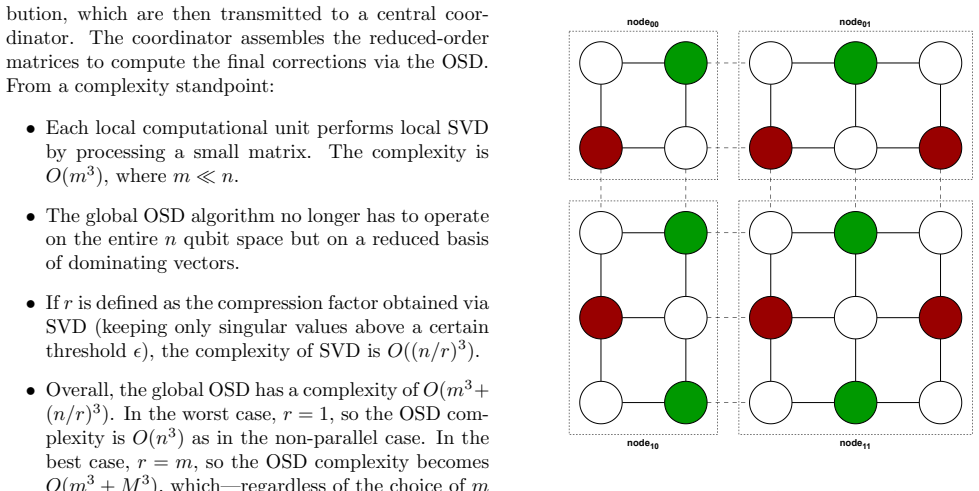
Summary. The paper proposes a parallel BP-OSD decoder for surface codes in which the LLR/error vectors from Belief Propagation are pre-processed by local SVD on lattice sub-regions (blocks of m qubits). Dominant local components are sent to a coordinator that assembles a reduced-order system for global OSD, yielding claimed complexity O(m^{3}+(n/r)^{3}) instead of O(n^{3}). The scheme is mapped onto Type-II distributed surface codes (planar lattice partitioned across QPUs with non-local CNOTs for boundary stabilizers) and evaluated in SquidASM on a 13 imes13 (d=7) lattice over 4–16 nodes under independent Identity/Hadamard/Init/Readout/CNOT and “All” error channels. At an energy threshold of 0.98 the authors report average compression r≈2.17, modest accuracy gains versus a full-rank baseline at p_err=1 % (Table 1), and improved scaling of local compute with QPU count (Table 3, Fig. 6).
Significance. If the local-SVD reduction reliably preserves a basis sufficient for correct global OSD, the work would supply a practical route to lower the cubic OSD bottleneck for large-distance surface codes and for Type-II distributed architectures. The concrete mapping onto multi-QPU surface codes, the explicit complexity argument of §4, and the side-by-side baseline/SVD-optimized simulations (including an energy-threshold sweep and a global-SVD ablation) are useful contributions. Strengths include the use of an open network simulator (SquidASM) and the clear demonstration that global SVD already loses topological information (§6.2). The empirical base remains small-scale, so the result is best viewed as a promising algorithmic proposal rather than a fully validated decoder.
major comments (3)
- [§4, §6.1–6.2] §4 and §6.1: The central claim that local SVD yields a reduced basis on which global OSD still recovers a valid correction rests on the unproved assumption that independent truncations (energy threshold 0.98) discard only noise and not load-bearing inter-qubit or boundary correlations. Stabilizers that straddle QPU boundaries (dashed non-local CNOTs in Fig. 3) couple variables that never co-appear in any local SVD; §6.2 already shows that a single global SVD loses topological information and drops accuracy (65 %→53 % on 25 imes25). No measurement is given of the residual rank of the assembled reduced H relative to the original syndrome equations, nor of the fraction of trials in which the reduced system becomes inconsistent. Without such a check the claimed complexity–accuracy trade-off is not yet established beyond the single 13 imes13 lattice.
- [Table 1, §6.1] Table 1 and §6: All accuracy figures are point estimates over 1000 trials with no error bars, confidence intervals or hypothesis tests. Several channels already show mixed or negative results (Readout 10 %, All 10 %). Given the free energy threshold and the modest absolute gains (often 1–2 %), statistical significance cannot be assessed; the claim of “generally outperforms” is therefore under-supported.
- [§4] §4 complexity argument: The best-case bound O(m^{3}+M^{3}) assumes that the compression factor r reaches m and that the coordinator’s reduced system size is exactly n/r. No empirical distribution of r across blocks or of the final reduced dimension after assembly is reported (only an average r=2.17). Consequently the practical speed-up relative to plain BP-OSD remains an extrapolation rather than a measured quantity on the same hardware model used for the accuracy trials.
minor comments (4)
- [§6.3, Table 2] The energy threshold is fixed by hand at 0.98 for the main experiments; Table 2 shows non-monotonic accuracy versus threshold. A short sensitivity analysis or an automatic selection rule would strengthen reproducibility.
- [Fig. 5, Fig. 6] Fig. 5 and Fig. 6 report wall-clock times from a discrete-event simulator; the text correctly notes that communication latency is inflated relative to hardware. Clarifying which curves are pure compute versus simulated network would avoid over-interpretation of the absolute numbers.
- [§4] Notation for the compression factor r and the singular-value threshold ε is introduced informally; a single displayed equation defining the reduced matrix would improve clarity.
- [§3] Related-work discussion of Hillmann et al., Wang et al. and Fan et al. is useful; a brief quantitative comparison (latency or accuracy on a common code) would better situate the contribution.
Circularity Check
No significant circularity; algorithmic proposal with independent complexity analysis and empirical simulation evaluation against a non-SVD baseline.
full rationale
The paper introduces local SVD pre-processing of BP-derived LLR vectors on lattice sub-regions to reduce the global OSD basis for surface-code decoding in Type-II distributed architectures. Complexity O(m^{3}+(n/r)^{3}) follows directly from standard SVD and Gaussian-elimination costs with free compression factor r (Section 4); it is not derived from or forced by the accuracy results. Accuracy, latency and scalability claims are obtained from SquidASM Monte-Carlo trials (1000 shots, Tables 1–3, Figs. 5–6) that explicitly compare a full-rank baseline (energy threshold 1.0) against a truncated configuration (threshold 0.98, observed r≈2.17). The energy threshold is a free design parameter whose effect is measured, not fitted to manufacture the reported logical-error rates. Self-citations ([6],[8]) supply only DQC background and are not load-bearing for the decoder claims; related-work citations are external. No self-definitional loop, fitted-input-as-prediction, uniqueness import, or renaming of a known result appears. The derivation chain is therefore self-contained.
Axiom & Free-Parameter Ledger
free parameters (3)
- SVD energy threshold
- Local block size m / number of blocks M
- Singular-value truncation threshold ε
axioms (4)
- domain assumption BP-OSD is a valid baseline decoder whose LLR outputs are suitable inputs for linear-algebraic post-processing.
- domain assumption Rotated planar CSS surface-code stabilizers and local/distributed syndrome extraction correctly model the Type-II multi-QPU layout.
- ad hoc to paper Simulated error channels (Identity, Hadamard, Init, Readout, CNOT, All) as independent injections adequately stress the decoder for the claimed accuracy comparison.
- ad hoc to paper Local principal components of sub-region probability structure preserve enough information for global OSD to recover a valid correction.
read the original abstract
A novel parallel approach is proposed for QEC decoding based on Belief Propagation with Ordered Statistics Decoding. The main idea is to pre-process the error vectors obtained from Belief Propagation by applying Singular Value Decomposition locally to sub-regions of the lattice. The proposed approach is applied to distributed quantum computers and evaluated in terms of complexity, accuracy, and scalability.
Figures




Reference graph
Works this paper leans on
-
[1]
B. M. Terhal. Quantum error correction for quan- tum memories.Rev. Mod. Phys., 87:307–346, 2015. doi:10.1103/RevModPhys.87.307
-
[2]
A. de Mart´ ı iOlius, P. Fuentes, R. Or´ us, P. M. Crespo, and J. Etxezarreta Martinez. Decoding algorithms for surface codes.Quantum, 8, 2024. doi:10.22331/q-2024-10-10-1498
-
[3]
Google Quantum AI. Suppressing quantum er- rors by scaling a surface code logical qubit.Na- ture, 614(7949):676–681, 2023.doi:10.1038/ s41586-022-05434-1. 1 4 9 16 Number of QPUs 0.0 0.5 1.0 1.5 2.0 2.5 3.0 Time (seconds) Scalability Analysis: Global - A vg Latency Global - Max Latency Dist - A vg Latency Dist - Max Latency (a) BP-OSD time (real). 1 4 9 1...
work page 2023
-
[4]
Google Quantum AI. Quantum error correc- tion below the surface code threshold.Na- ture, 638(8052):920–926, 2025.doi:10.1038/ s41586-024-08449-y
work page 2025
-
[5]
J. Roffe, D. R. White, S. Burton, and E. Campbell. Decoding across the quantum low-density parity- check code landscape.Phys. Rev. Res., 2:043423, 2020.doi:10.1103/PhysRevResearch.2.043423
-
[6]
M. Caleffi, M. Amoretti, D. Ferrari, J. Illiano, A. Manzalini, and A. S. Cacciapuoti. Distributed quantum computing: a survey.Comp. Networks, 254(110672), 2024.doi:10.1016/j.comnet.2024. 110672
-
[7]
D Barral, F. J. Cardama, G. D´ ıaz-Camacho, D. Fa´ ılde, I. F. Llovo, M. Mussa-Juane, J. V´ azquez- P´ erez, J. Villasuso, C. Pi˜ neiro, N. Costas, J. C. Pichel, T. F. Pena, and A. G´ omez. Review of distributed quantum computing: From single qpu to high performance quantum computing.Comp. 7 Sc. Review, 57(100747), 2025.doi:10.1016/j. cosrev.2025.100747
work page doi:10.1016/j 2025
-
[8]
M. Amoretti and S. Carretta. Entanglement verification in quantum networks with tampered nodes.IEEE J. on Sel. Areas in Communica- tions, 38(3):598–604, 2020.doi:10.1109/JSAC. 2020.2967955
-
[9]
S. J. Devitt, W. J. Munro, and K. Nemoto. Quan- tum error correction for beginners.Reports on Progress in Physics, 76(7):076001, 2013.doi:10. 1088/0034-4885/76/7/076001
work page 2013
-
[10]
A. Y. Kitaev.Quantum Error Correction with Im- perfect Gates, pages 181–188. Plenum Press, 1997. doi:10.1007/978-1-4615-5923-8_19
-
[11]
Stabilizer Codes and Quantum Error Correction
D. Gottesman. Stabilizer codes and quantum error correction.arXiv:quant-ph/9705052, 1997.doi: 10.48550/arXiv.quant-ph/9705052
work page internal anchor Pith review Pith/arXiv arXiv doi:10.48550/arxiv.quant-ph/9705052 1997
-
[12]
T. Hillmann, L. Berent, A. O. Quintavalle, J. Eis- ert, R. Wille, and J. Roffe. Localized statis- tics decoding for quantum low-density parity-check codes.Nature Communications, 16(1):8214, Sep 2025.doi:10.1038/s41467-025-63214-7
-
[13]
M. Wang, A. Li, and F. Mueller. Fully paral- lelized bp decoding for quantum ldpc codes can outperform bp-osd.arXiv:2507.00254, 2026.doi: 10.48550/arXiv.2507.00254
-
[14]
W. Fan, Y. Ueno, Y. Suzuki, I. Byun, T. Teruo, G. S. Ravi, and K. Inoue. Accelerating bp-based decoders for qldpc codes with local syndrome-based preprocessing.arXiv:2509.01892, 2026.doi:10. 48550/arXiv.2509.01892
work page internal anchor Pith review Pith/arXiv arXiv 2026
-
[15]
N. K. Chandra, E. Kaur, and K. P. Seshadreesan. Architectural approaches to fault-tolerant dis- tributed quantum computing and their entan- glement overheads. In2025 IEEE 7th Inter- national Conference on Trust, Privacy and Se- curity in Intelligent Systems, and Applications (TPS-ISA), pages 561–572, 2025.doi:10.1109/ TPS-ISA67132.2025.00068
- [16]
discussion (0)
Sign in with ORCID, Apple, or X to comment. Anyone can read and Pith papers without signing in.