REVIEW 1 major objections 4 minor 12 references
Reviewed by Pith at T0; open to challenge.
T0 means a machine referee read the full paper against a public rubric. The mark states how deep the mechanical check went, never who wrote it. the ladder, T0–T4 →
T0 review · glm-5.2
Dashcam AI models stall at 66% on incident reasoning
2026-07-10 01:53 UTC pith:FRXXODSN
load-bearing objection New incident-centric dashcam VQA benchmark with Kaggle competition results, but the central perception-vs-reasoning claim lacks the per-category breakdown needed to support it. the 1 major comments →
AUTOPILOT VQA: Benchmarking Vision-Language Models for Incident-Centric Dashcam Understanding
The pith
A machine-rendered reading of the paper's core claim, the machinery that carries it, and where it could break.
Core claim
The central finding is that vision-language models can handle perception-level questions about driving scenes with reasonable accuracy but fail at structured reasoning tasks—identifying which entity could have prevented an incident, determining fault-relevant behaviors, or estimating impact regions—which require temporal understanding and reasoning over multi-agent interactions. The benchmark's inclusion of unknown and non-applicable answer classes further exposes the inability of models to recognize when information is insufficient or when a question does not apply to the scenario.
What carries the argument
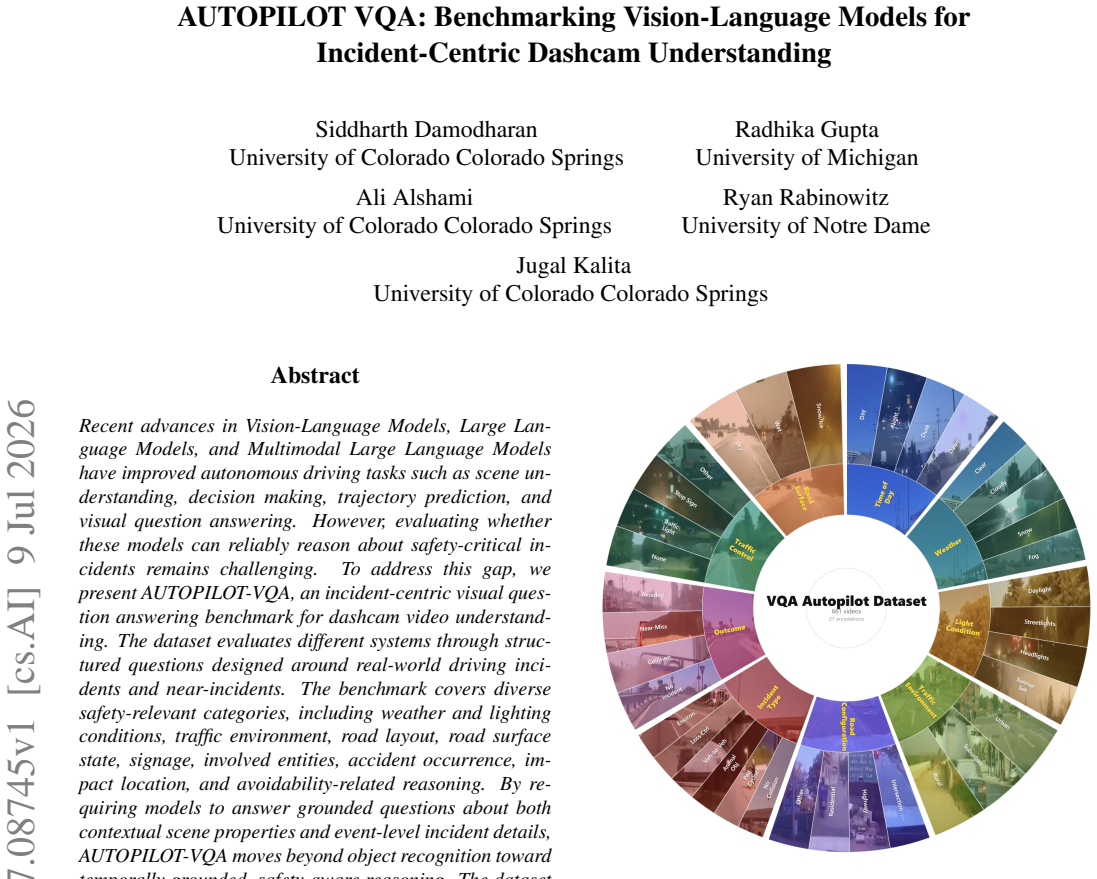
The benchmark's structure is the load-bearing mechanism: 28 sub-questions across nine semantic groups (A–I) covering environmental conditions, road context, and incident characterization, each requiring fixed integer-valued predictions. This structure forces models to produce synchronized, categorical answers across perceptual and reasoning dimensions within a single video, enabling direct comparison of where perception succeeds and reasoning fails.
Load-bearing premise
The benchmark assumes that its 28 predefined question categories and their ground-truth answers accurately capture the complex, multifaceted nature of accident causality and avoidability. If the correct answers for fault attribution or preventability are subjective or ambiguously defined, the benchmark may measure annotation-matching rather than genuine reasoning ability.
What would settle it
If a model could achieve near-perfect accuracy on the reasoning-heavy question categories (fault attribution, preventability, impact location) without any architecture that models temporal causality—say, through sufficiently strong zero-shot prompting of an existing vision-language model—the paper's claim that structured reasoning is the bottleneck would be weakened.
If this is right
- Autonomous driving systems that rely on vision-language models for scene understanding may produce unreliable outputs in safety-critical incident scenarios, particularly for tasks involving fault attribution or avoidability assessment.
- The gap between perception and reasoning performance suggests that progress on autonomous driving intelligence requires new architectures that explicitly model temporal causality and multi-agent interaction, not just larger vision-language backbones.
- The inclusion of unknown and non-applicable answer classes establishes a precedent for benchmarks that penalize models for overconfident hallucination—a necessary feature for safety-critical AI evaluation.
- The competitive benchmark format demonstrates that open community evaluation can surface diverse modeling approaches and reveal performance ceilings that single-lab evaluations might miss.
Where Pith is reading between the lines
- If the benchmark's fault-attribution and avoidability questions involve subjective human annotations, the 0.658 ceiling may partly reflect inter-annotator disagreement rather than pure model failure—measuring annotator agreement would help isolate model limitations from annotation ambiguity.
- The integer-valued prediction format may constrain models that would otherwise express uncertainty or provide nuanced causal explanations; a free-form or ranked-response variant could reveal whether the gap is in reasoning capability or in output formatting.
- The concentration of incidents in daytime and clear conditions (70% and 68% respectively) means the benchmark may underrepresent the conditions where autonomous driving systems are most likely to fail—night, rain, fog—potentially overestimating real-world reliability.
Editorial analysis
A structured set of objections, weighed in public.
Referee Report
Summary. The manuscript introduces AUTOPILOT-VQA, an incident-centric visual question answering (VQA) benchmark for dashcam video understanding, designed to evaluate vision-language models (VLMs) on safety-critical driving scenarios. The dataset comprises over 600 dashcam video clips annotated across nine structured question groups (28 sub-questions), yielding over 6,000 question-answer pairs covering environmental conditions, road context, and incident characterization. The benchmark was released as part of a Kaggle competition, which attracted 59 teams and 686 submissions. The top-performing team achieved a mean per-question accuracy of 0.65835. The authors conclude that current VLMs remain stronger at perception than at structured reasoning for autonomous driving, noting that performance gains near the leaderboard ceiling were difficult to obtain.
Significance. The paper addresses a genuine gap in autonomous driving research: the evaluation of higher-level reasoning in safety-critical, incident-heavy scenarios, as opposed to routine driving conditions. The release of a structured dataset with over 6,000 QA pairs spanning collisions, near-misses, and baselines is a valuable community resource. The establishment of a public, competitive evaluation framework via a Kaggle competition is a notable strength, providing a standardized and reproducible comparison across diverse modeling pipelines. The benchmark's focus on fault attribution, preventability, and impact location moves beyond standard object recognition tasks.
major comments (1)
- §4.4 (Error Analysis) and §4.6 (Conclusion): The central claim that 'current VLM pipelines remain stronger at perception than at structured reasoning' is not empirically supported by the data presented. The manuscript reports only aggregate mean per-question accuracy (0.65835 for the top team) and never provides a per-question-category breakdown of accuracy. The assertion that 'Errors are likely concentrated in tasks requiring causal inference or fine-grained relational reasoning rather than simple perception' is speculative. Without a per-category accuracy table or figure, there is no direct evidence that the perception-vs-reasoning gap exists as described. An alternative explanation—equally consistent with the data—is that low aggregate scores reflect annotation ambiguity (e.g., subjective fault attribution) or class imbalance within specific sub-questions. The authors must provide a a
minor comments (4)
- §3.1: The percentages of incident severity do not sum to 100% (27% collisions + 11% near-misses + 17% hazards avoided + 27% no-incident = 82%). The remaining 18% should be accounted for.
- §4.3: The manuscript mentions 'Figures A–F' for dataset statistics, but these are not visible in the provided text. Ensure all referenced figures are included and properly labeled.
- Abstract: 'Our benchmark support developments' should be corrected to 'Our benchmark supports developments'.
- §4.1: 'near-indecent' is a typo; it should be 'near-incident'.
Circularity Check
No circularity detected: benchmark and evaluation are defined independently of the models tested
full rationale
This paper introduces a benchmark dataset and reports competition results. There is no derivation chain, no first-principles prediction, and no fitted-parameter-as-prediction pattern. The evaluation metric (mean per-question accuracy, Section 4.2) is defined independently of any model's architecture or parameters. The ground-truth annotations are produced by human annotators (Section 3.2) and are not derived from the models being evaluated. The central claim—that VLMs perform better at perception than structured reasoning—is an empirical observation from external competition submissions, not a result forced by construction. While the skeptic correctly notes that the paper lacks per-category accuracy breakdowns to fully substantiate the perception-vs-reasoning gap, this is a correctness/evidence concern, not a circularity issue. The paper contains no self-citation chains, no ansatz smuggled through prior work, and no definitional equivalences between inputs and outputs. The benchmark, annotation schema, and evaluation protocol are all self-contained against external participants' submissions.
Axiom & Free-Parameter Ledger
axioms (2)
- domain assumption Human annotators can reliably and objectively label complex causal attributes such as fault attribution and preventability from dashcam video alone.
- domain assumption Mean per-question accuracy is a meaningful metric for evaluating complex reasoning capabilities.
read the original abstract
Recent advances in Vision-Language Models, Large Language Models, and Multimodal Large Language Models have improved autonomous driving tasks such as scene understanding, decision making, trajectory prediction, and visual question answering. However, evaluating whether these models can reliably reason about safety-critical incidents remains challenging. To address this gap, we present AUTOPILOT-VQA, an incident-centric visual question answering benchmark for dashcam video understanding. The dataset evaluates different systems through structured questions designed around real-world driving incidents and near-incidents. The benchmark covers diverse safety-relevant categories, including weather and lighting conditions, traffic environment, road layout, road surface state, signage, involved entities, accident occurrence, impact location, and avoidability-related reasoning. By requiring models to answer grounded questions about both contextual scene properties and event-level incident details, AUTOPILOT-VQA moves beyond object recognition toward temporally grounded, safety-aware reasoning. The dataset is released as part of the AUTOPILOT CVPR 2026 competition and provides a standardized benchmark for assessing the reliability of autonomous driving systems in different scenarios. Our benchmark support developments for more interpretable, robust, and safety-conscious vision-language systems for real-world autonomous driving.
Figures

Reference graph
Works this paper leans on
-
[1]
Holger Caesar, Varun Bankiti, Alex H. Lang, et al. nuscenes: A multimodal dataset for autonomous driving. InProceed- ings of the IEEE/CVF Conference on Computer Vision and Pattern Recognition, pages 11621–11631, 2020. 2
work page 2020
-
[2]
Argoverse: 3d tracking and forecasting with rich maps
Ming-Fang Chang, John Lambert, Patsorn Sangkloy, et al. Argoverse: 3d tracking and forecasting with rich maps. In Proceedings of the IEEE/CVF Conference on Computer Vi- sion and Pattern Recognition, pages 8748–8757, 2019. 2
work page 2019
-
[3]
Drivingvqa: A dataset for interleaved visual chain-of-thought in real-world driving scenarios
Charles Corbi `ere, Simon Roburin, Syrielle Montariol, An- toine Bosselut, and Alexandre Alahi. Drivingvqa: A dataset for interleaved visual chain-of-thought in real-world driving scenarios. InFindings of the Association for Computational Linguistics: EACL 2026, pages 3309–3333, 2026. 2
work page 2026
-
[4]
The cityscapes dataset for semantic urban scene understand- ing
Marius Cordts, Mohamed Omran, Sebastian Ramos, et al. The cityscapes dataset for semantic urban scene understand- ing. InProceedings of the IEEE Conference on Computer Vision and Pattern Recognition, pages 3213–3223, 2016. 2
work page 2016
-
[5]
Jianwu Fang, Jiahuan Qiao, Jianru Xue, and Zhengguo Li. Vision-based traffic accident detection and anticipation: A survey.IEEE Transactions on Circuits and Systems for Video Technology, 34(4):1983–1999, 2023. 2
work page 1983
-
[6]
Are we ready for autonomous driving? the kitti vision benchmark suite
Andreas Geiger, Philip Lenz, and Raquel Urtasun. Are we ready for autonomous driving? the kitti vision benchmark suite. InProceedings of the IEEE Conference on Computer Vision and Pattern Recognition, pages 3354–3361, 2012. 2
work page 2012
-
[7]
Joel Janai, Fatma G ¨uney, Aaditya Behl, and Andreas Geiger. Computer vision for autonomous vehicles: Prob- lems, datasets and state of the art.Foundations and Trends in Computer Graphics and Vision, 12(1–3):1–308, 2017. 2
work page 2017
-
[8]
Sung-Yeon Park, Can Cui, Yunsheng Ma, Ahmadreza Moradipari, Rohit Gupta, Kyungtae Han, and Ziran Wang. Nuplanqa: A large-scale dataset and benchmark for multi- view driving scene understanding in multi-modal large lan- guage models. InProceedings of the IEEE/CVF Interna- tional Conference on Computer Vision, pages 8066–8076,
-
[9]
Toward driving scene understanding: A dataset for learning driver behavior and causal reasoning
Vasili Ramanishka, Yi-Ting Chen, Teruhisa Misu, and Kate Saenko. Toward driving scene understanding: A dataset for learning driver behavior and causal reasoning. InProceed- ings of the IEEE Conference on Computer Vision and Pattern Recognition, pages 7699–7707, 2018. 2
work page 2018
-
[10]
Scala- bility in perception for autonomous driving: Waymo open dataset
Pei Sun, Henrik Kretzschmar, Xavier Dotiwalla, et al. Scala- bility in perception for autonomous driving: Waymo open dataset. InProceedings of the IEEE/CVF Conference on Computer Vision and Pattern Recognition, pages 2446– 2454, 2020. 2
work page 2020
-
[11]
Embodied scene understanding for vi- sion language models via metavqa
Weizhen Wang, Chenda Duan, Zhenghao Peng, Yuxin Liu, and Bolei Zhou. Embodied scene understanding for vi- sion language models via metavqa. InProceedings of the IEEE/CVF Conference on Computer Vision and Pattern Recognition, 2025. 2
work page 2025
-
[12]
Bdd100k: A diverse driving dataset for heterogeneous multitask learning
Fisher Yu, Haofeng Chen, Xin Wang, et al. Bdd100k: A diverse driving dataset for heterogeneous multitask learning. InProceedings of the IEEE/CVF Conference on Computer Vision and Pattern Recognition, pages 2636–2645, 2020. 2
work page 2020
discussion (0)
Sign in with ORCID, Apple, or X to comment. Anyone can read and Pith papers without signing in.