REVIEW 2 major objections 5 minor 52 references
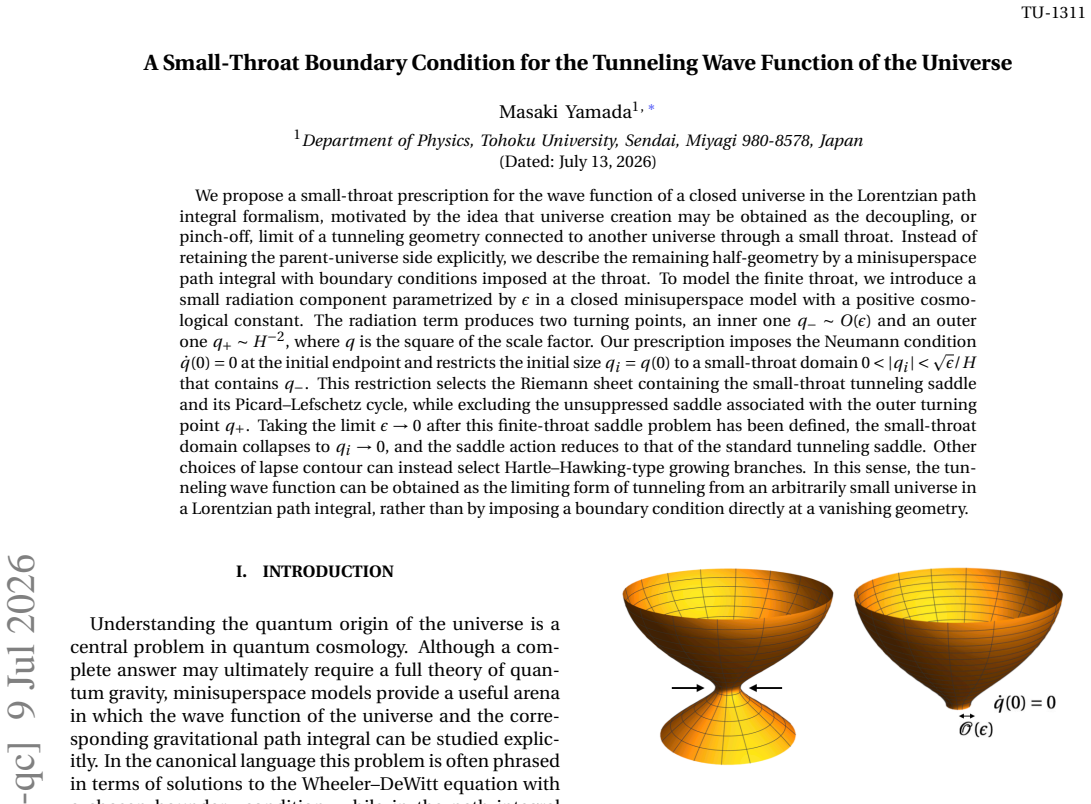
The tunneling wave function of the universe is recovered as the limit of tunneling from an arbitrarily small finite throat, not by a boundary condition at vanishing geometry.
Reviewed by Pith at T0; open to challenge. T0 means a machine referee read the full paper against a public rubric. the ladder, T0–T4 →
T0 review · grok-4.5
2026-07-13 06:29 UTC pith:UZ253CB6
load-bearing objection Solid minisuperspace construction that recovers the tunneling wave function as a controlled small-throat limit; the math holds, the modeling gap is acknowledged and not fatal. the 2 major comments →
A Small-Throat Boundary Condition for the Tunneling Wave Function of the Universe
The pith
A machine-rendered reading of the paper's core claim, the machinery that carries it, and where it could break.
Core claim
After a finite-ε radiation model is equipped with the Neumann condition q̇(0)=0 and with the initial size restricted to the relative cycle inside the punctured disk 0 < |qi| < √(ε)/H that contains the inner turning point, the subsequent limit ε → 0 collapses that domain to qi o 0 and reduces the saddle action to the standard pure-de-Sitter tunneling wave function exp(-4π^{2}/H^{2} - i Φ).
What carries the argument
The small-throat cycle D_ε: a relative one-cycle in the punctured disk 0 < |qi| < R_ε = √(ε)/H that forces the Neumann condition q̇(0)=0, selects the Riemann sheet of the inner-to-outer branch cut, and excludes the unsuppressed outer turning-point saddle before the saddle-point approximation is performed.
Load-bearing premise
That a homogeneous radiation term of strength ε together with the postulated small relative cycle around the origin is a faithful model of a throat pinching off from a parent universe, so that the ε o 0 limit after the finite problem is defined really yields the correct creation-from-nothing wave function.
What would settle it
Construct an explicit two-sided wormhole or parent-universe path integral whose throat is supported by radiation or charge; show that the induced integration cycle for the remaining half-geometry is not the relative cycle inside 0 < |qi| < √(ε)/H, or that its ε o 0 limit fails to recover the standard tunneling exponent 4π^{2}/H^{2}.
Editorial analysis
A structured set of objections, weighed in public.
Referee Report
Summary. The paper proposes a small-throat prescription for the tunneling wave function of a closed universe in the Lorentzian path integral. Motivated by pinch-off of a throat connecting to a parent spacetime, it models a finite throat by a small radiation component ε in closed de Sitter minisuperspace (variable q=a^{2}). This produces turning points q_-∼O(ε) and q_+∼H^{-2}. The prescription integrates the initial size q_i over a relative cycle D_ε in the punctured disk 0<|q_i|<R_ε=√(ε)/H (containing q_- but not q_+), which induces the Neumann condition q̇(0)=0 and selects the Riemann sheet of the small-throat tunneling saddle while excluding the unsuppressed outer saddle. After the finite-ε problem is defined, the limit ε o0 collapses D_ε to q_i o0 and recovers the standard pure-de-Sitter tunneling exponent B=4π^{2}/H^{2} plus the usual Lorentzian WKB phase. Analytic on-shell actions (via elliptic integrals) and numerical Picard–Lefschetz maps of the multi-valued map q_i o N support the construction; other lapse contours can select Hartle–Hawking-type branches.
Significance. If the construction is accepted as a legitimate effective description, it supplies a concrete Lorentzian path-integral realization of the tunneling wave function as a decoupling limit of tunneling from a small but finite universe, rather than as a boundary condition imposed directly at a vanishing geometry. The analytic reduction of B_ε and Φ_ε to the pure-de-Sitter values (Eqs. 63–65) is parameter-free once the finite-ε saddle problem is set, and the numerical sampling of the complex-N plane (Figs. 3–4) gives concrete evidence that the small-disk restriction selects the desired sheet and excludes the outer unsuppressed saddle. The discussion of inverse-Gaussian perturbations (Sec. VI) is a potentially useful byproduct: at finite ε the background is an ordinary finite-throat tunneling problem, so regular boundary conditions for fluctuations may avoid the singular zero-size branch. The work is limited to homogeneous minisuperspace and does not derive D_ε from a two-sided geometry, but within that scope it is a clear, self-contained contribution to the contour/saddle literature on Lorentzian quantum cosmology.
major comments (2)
- Sec. II.B and Sec. VI: the relative cycle D_ε in 0<|q_i|<R_ε is postulated rather than derived from a two-sided wormhole or parent-universe path integral. The paper is explicit that this is an effective half-geometry model, so there is no internal inconsistency, but the central physical claim (that the ε o0 limit after defining the finite-throat problem yields the correct creation-from-nothing wave function) rests on this modeling assumption. A short additional argument or toy two-sided calculation showing that the inversion scale R_ε=√(q_-q_+) and the relative cycle arise naturally would substantially strengthen the claim; without it the result remains a consistent effective prescription rather than a derivation from a parent geometry.
- Sec. VI (final paragraphs): the suggestion that the prescription resolves the unsuppressed/inverse-Gaussian perturbation problem is plausible but not demonstrated. At finite ε the background is regular, yet no fluctuation analysis or mode boundary conditions are given. Either a brief one-loop sketch (or a clear statement that the claim is only heuristic and deferred) is needed so that the reader can judge whether the expectation is supported or merely hoped for.
minor comments (5)
- Eqs. (35)–(37) and Fig. 2: the branch conventions for (s,η) and the detour around q=0 for Re[q_i]≤0 are clear in principle but dense; a short explicit statement of which combination yields the tunneling saddle (s=η=1) earlier in Sec. III would help the reader track the multi-valued map.
- Figs. 3–4: the dense labeling (D_i, A_i, L_i, R_{1+}, R_{2+}, etc.) is hard to parse at a glance. A short legend or a sentence in the caption listing which curves are the Picard–Lefschetz thimbles for the tunneling saddle would improve readability.
- Footnote 2 and the surrounding text: the distinction between the minisuperspace Neumann condition q̇(0)=0 and covariant Neumann/Robin prescriptions is important and well taken; a single clarifying sentence in the main text (not only the footnote) would prevent misreading by readers familiar with the no-boundary Neumann literature.
- Sec. IV.D, Eq. (81): the pure-de-Sitter initial derivative for the outgoing branch is quoted for contrast; stating the convention for the square-root branch of √(H^{2}q_1-1) would make the comparison fully self-contained.
- References: the recent Euclidean wormhole/throat papers (e.g. Lavrelashvili–Lehners) are cited; a brief remark on whether any of those geometries already exhibit an inversion scale analogous to R_ε would connect the effective model more tightly to the motivating literature.
Circularity Check
No significant circularity: the finite-ε Neumann+small-disk construction is an auxiliary regulator whose ε o0 limit recovers the known pure-de-Sitter tunneling exponent by direct evaluation, not by fitting or self-definition of the target.
full rationale
The paper's central claim is a proposed boundary prescription (Neumann ṋq(0)=0 plus relative cycle D_ε inside the punctured disk 0<|q_i|<R_ε=√(ε)/H that contains the radiation-induced inner turning point q_-) whose on-shell action, after the finite-ε saddle problem is defined, reduces analytically in the limit ε o0 to the standard tunneling exponent B=4π^{2}/H^{2} plus the usual Lorentzian WKB phase (Eqs. 52–65). This is a self-contained minisuperspace calculation: the first integral, branch structure, elliptic-integral expressions for B_ε and Φ_ε, and the collapse of D_ε o{0} are derived from the action (5)–(7) without external data fits. Self-citations (e.g. to Vilenkin–Yamada tunneling papers and the author's prior regularization work) supply background motivation and a remark on fluctuations, but are not load-bearing for the saddle selection or the limit; the Picard–Lefschetz numerics (Figs. 3–4) independently confirm exclusion of the outer unsuppressed saddle. The construction is intentionally engineered to select the desired sheet, which is ordinary for a boundary-condition proposal rather than a circular derivation of a new quantitative prediction. Score 1 only for the minor presence of author-overlapping citations that do not force the result.
Axiom & Free-Parameter Ledger
free parameters (1)
- ε (radiation strength)
axioms (4)
- domain assumption Closed FLRW minisuperspace with metric ds^{2}=-N^{2}/q dt^{2} + q dΩ_{3}^{2} and action (5) is sufficient to capture the essential saddle structure of the tunneling wave function.
- domain assumption Picard–Lefschetz theory correctly selects the relevant complex-lapse contours for the oscillatory Lorentzian path integral.
- ad hoc to paper A homogeneous radiation component parametrized by ε models a finite throat whose pinch-off limit yields universe creation.
- ad hoc to paper The relative cycle D_ε in the punctured disk 0<|qi|<R_ε is the correct integration domain that selects the small-throat tunneling sheet.
invented entities (2)
-
small-throat relative cycle D_ε
no independent evidence
-
radiation-induced finite throat (inner turning point q_-)
no independent evidence
read the original abstract
We propose a small-throat prescription for the wave function of a closed universe in the Lorentzian path integral formalism, motivated by the idea that universe creation may be obtained as the decoupling, or pinch-off, limit of a tunneling geometry connected to another universe through a small throat. Instead of retaining the parent-universe side explicitly, we describe the remaining half-geometry by a minisuperspace path integral with boundary conditions imposed at the throat. To model the finite throat, we introduce a small radiation component parametrized by $\epsilon$ in a closed minisuperspace model with a positive cosmological constant. The radiation term produces two turning points, an inner one $q_-\sim O(\epsilon)$ and an outer one $q_+\sim H^{-2}$, where $q$ is the square of the scale factor. Our prescription imposes the Neumann condition $\dot q(0)=0$ at the initial endpoint and restricts the initial size $q_i=q(0)$ to a small-throat domain $0<|q_i|<\sqrt{\epsilon}/H$ that contains $q_-$. This restriction selects the Riemann sheet containing the small-throat tunneling saddle and its Picard--Lefschetz cycle, while excluding the unsuppressed saddle associated with the outer turning point $q_+$. Taking the limit $\epsilon\to0$ after this finite-throat saddle problem has been defined, the small-throat domain collapses to $q_i \to 0$, and the saddle action reduces to that of the standard tunneling saddle. Other choices of lapse contour can instead select Hartle--Hawking-type growing branches. In this sense, the tunneling wave function can be obtained as the limiting form of tunneling from an arbitrarily small universe in a Lorentzian path integral, rather than by imposing a boundary condition directly at a vanishing geometry.
Figures


Reference graph
Works this paper leans on
-
[1]
B. S. DeWitt,Quantum Theory of Gravity. 1. The Canonical Theory,Phys. Rev.160(1967) 1113
1967
-
[2]
J. B. Hartle and S. W . Hawking,Wave Function of the Universe, Phys. Rev. D28(1983) 2960
1983
-
[3]
Vilenkin,The Birth of Inflationary Universes,Phys
A. Vilenkin,The Birth of Inflationary Universes,Phys. Rev. D 27(1983) 2848
1983
-
[4]
Vilenkin,Quantum Creation of Universes,Phys
A. Vilenkin,Quantum Creation of Universes,Phys. Rev. D30 (1984) 509
1984
-
[5]
A. D. Linde,Quantum Creation of the Inflationary Universe, Lett. Nuovo Cim.39(1984) 401
1984
-
[6]
V . A. Rubakov,Quantum Mechanics in the Tunneling Universe,Phys. Lett. B148(1984) 280
1984
-
[7]
Y. B. Zeldovich and A. A. Starobinsky,Quantum creation of a universe in a nontrivial topology,Sov. Astron. Lett.10(1984) 135
1984
-
[8]
Vilenkin,Boundary Conditions in Quantum Cosmology, Phys
A. Vilenkin,Boundary Conditions in Quantum Cosmology, Phys. Rev. D33(1986) 3560
1986
-
[9]
Vilenkin,Quantum Cosmology and the Initial State of the Universe,Phys
A. Vilenkin,Quantum Cosmology and the Initial State of the Universe,Phys. Rev. D37(1988) 888
1988
-
[10]
Vilenkin,Approaches to quantum cosmology,Phys
A. Vilenkin,Approaches to quantum cosmology,Phys. Rev. D 50(1994) 2581 [gr-qc/9403010]
Pith/arXiv arXiv 1994
-
[11]
Louko,Propagation Amplitude in Homogeneous Quantum Cosmology,Class
J. Louko,Propagation Amplitude in Homogeneous Quantum Cosmology,Class. Quant. Grav.4(1987) 581
1987
-
[12]
J. J. Halliwell and J. Louko,Steepest Descent Contours in the Path Integral Approach to Quantum Cosmology. 1. The De Sitter Minisuperspace Model,Phys. Rev. D39(1989) 2206
1989
-
[13]
J. J. Halliwell and J. B. Hartle,Integration Contours for the No Boundary Wave Function of the Universe,Phys. Rev. D41 (1990) 1815
1990
-
[14]
J. D. Brown and E. A. Martinez,Lorentzian Path Integral for Minisuperspace Cosmology,Phys. Rev. D42(1990) 1931
1990
-
[15]
J. Feldbrugge, J.-L. Lehners and N. Turok,Lorentzian Quantum Cosmology,Phys. Rev. D95(2017) 103508 [1703.02076]
Pith/arXiv arXiv 2017
-
[16]
G. W . Gibbons, S. W . Hawking and M. J. Perry,Path Integrals and the Indefiniteness of the Gravitational Action,Nucl. Phys. 10 B138(1978) 141
1978
-
[17]
M. Honda, H. Matsui, K. Okabayashi and T . Terada, Resurgence in Lorentzian quantum cosmology: No-boundary saddles and resummation of quantum gravity corrections around tunneling saddle points,Phys. Rev. D110(2024) 083508 [2402.09981]
Pith/arXiv arXiv 2024
-
[18]
C.-Y. Chou and J. Nishimura,Monte Carlo studies of quantum cosmology by the generalized Lefschetz thimble method,JHEP 05(2025) 142 [2407.17724]
Pith/arXiv arXiv 2025
-
[19]
J. Diaz Dorronsoro, J. J. Halliwell, J. B. Hartle, T . Hertog and O. Janssen,Real no-boundary wave function in Lorentzian quantum cosmology,Phys. Rev. D96(2017) 043505 [1705.05340]
Pith/arXiv arXiv 2017
-
[20]
J. Diaz Dorronsoro, J. J. Halliwell, J. B. Hartle, T . Hertog, O. Janssen and Y. Vreys,Damped perturbations in the no-boundary state,Phys. Rev. Lett.121(2018) 081302 [1804.01102]
Pith/arXiv arXiv 2018
-
[21]
O. Janssen, J. J. Halliwell and T . Hertog,No-boundary proposal in biaxial Bianchi IX minisuperspace,Phys. Rev. D 99(2019) 123531 [1904.11602]
Pith/arXiv arXiv 2019
-
[22]
J.-y. Hong, A. Vilenkin and S. Winitzki,Creation of massive particles in a tunneling universe,Phys. Rev. D68(2003) 023521 [gr-qc/0305025]
Pith/arXiv arXiv 2003
-
[23]
A. Vilenkin and M. Yamada,Tunneling wave function of the universe,Phys. Rev. D98(2018) 066003 [1808.02032]
Pith/arXiv arXiv 2018
-
[24]
G. Lavrelashvili and J.-L. Lehners,Nucleating an Inflationary Universe: Euclidean Wormholes and their No-Boundary Limit,2603.11003
-
[25]
G. Lavrelashvili and J.-L. Lehners,Birth of Inflationary Universes via Wineglass Wormholes and their No-Boundary Relatives,2605.10548
-
[26]
S. B. Giddings and A. Strominger,Axion Induced Topology Change in Quantum Gravity and String Theory,Nucl. Phys. B 306(1988) 890
1988
-
[27]
G. V . Lavrelashvili, V . A. Rubakov and P . G. Tinyakov,Loss of Quantum Coherence Due to Topological Changes: A Toy Model,Mod. Phys. Lett. A3(1988) 1231
1988
-
[28]
V . A. Rubakov and P . G. Tinyakov,Gravitational Instantons and Creation of Expanding Universes,Phys. Lett. B214(1988) 334
1988
-
[29]
C. Jonas, G. Lavrelashvili and J.-L. Lehners,Zoo of axionic wormholes,Phys. Rev. D108(2023) 066012 [2306.11129]
Pith/arXiv arXiv 2023
-
[30]
P . Betzios and O. Papadoulaki,Inflationary Cosmology from Anti-de Sitter Wormholes,Phys. Rev. Lett.133(2024) 021501 [2403.17046]
Pith/arXiv arXiv 2024
-
[31]
Q.-Y. Lan and Y.-S. Piao,Prepare inflationary universe via the Euclidean charged wormhole,2411.13844
-
[32]
P . Betzios, I. D. Gialamas and O. Papadoulaki,Magnetic anti–de Sitter wormholes as seeds for Higgs inflation,Phys. Rev. D111(2025) 123542 [2412.03639]
Pith/arXiv arXiv 2025
-
[33]
P . Betzios, P . Ghiringhelli, I. D. Gialamas and O. Papadoulaki, A Menagerie of Wormholes and Cosmologies in the Gravitational Path Integral,2602.23432
-
[34]
A. Di Tucci and J.-L. Lehners,No-Boundary Proposal as a Path Integral with Robin Boundary Conditions,Phys. Rev. Lett.122(2019) 201302 [1903.06757]
Pith/arXiv arXiv 2019
-
[35]
A. Di Tucci, J.-L. Lehners and L. Sberna,No-boundary prescriptions in Lorentzian quantum cosmology,Phys. Rev. D 100(2019) 123543 [1911.06701]
Pith/arXiv arXiv 2019
-
[36]
A. Di Tucci, M. P . Heller and J.-L. Lehners,Lessons for quantum cosmology from anti–de Sitter black holes,Phys. Rev. D102(2020) 086011 [2007.04872]
Pith/arXiv arXiv 2020
-
[37]
C. Krishnan and A. Raju,A Neumann Boundary Term for Gravity,Mod. Phys. Lett. A32(2017) 1750077 [1605.01603]
Pith/arXiv arXiv 2017
-
[38]
M. Yamada,New regularization scheme for the wave function of the Universe in the Lorentzian path integral,Phys. Rev. D 113(2026) 063547 [2511.09621]
arXiv 2026
-
[39]
J.-L. Lehners,Wave function of simple universes analytically continued from negative to positive potentials,Phys. Rev. D 104(2021) 063527 [2105.12075]
Pith/arXiv arXiv 2021
-
[40]
J. Feldbrugge, J.-L. Lehners and N. Turok,No smooth beginning for spacetime,Phys. Rev. Lett.119(2017) 171301 [1705.00192]
Pith/arXiv arXiv 2017
-
[41]
J. Feldbrugge, J.-L. Lehners and N. Turok,No rescue for the no boundary proposal: Pointers to the future of quantum cosmology,Phys. Rev. D97(2018) 023509 [1708.05104]
Pith/arXiv arXiv 2018
-
[42]
J. Feldbrugge, J.-L. Lehners and N. Turok,Inconsistencies of the New No-Boundary Proposal,Universe4(2018) 100 [1805.01609]
Pith/arXiv arXiv 2018
-
[43]
M. Bojowald and S. Brahma,Loops rescue the no-boundary proposal,Phys. Rev. Lett.121(2018) 201301 [1810.09871]
Pith/arXiv arXiv 2018
-
[44]
S.-J. Wang, M. Yamada and A. Vilenkin,Constraints on non-minimal coupling from quantum cosmology,JCAP08 (2019) 025 [1903.11736]
Pith/arXiv arXiv 2019
-
[45]
M. Bojowald and S. Brahma,Loop quantum gravity, signature change, and the no-boundary proposal,Phys. Rev. D102 (2020) 106023 [2011.02884]
Pith/arXiv arXiv 2020
-
[46]
H. Matsui, S. Mukohyama and A. Naruko,No smooth spacetime in Lorentzian quantum cosmology and trans-Planckian physics,Phys. Rev. D107(2023) 043511 [2211.05306]
Pith/arXiv arXiv 2023
-
[47]
Matsui,No smooth spacetime: Exploring primordial perturbations in Lorentzian quantum cosmology,Phys
H. Matsui,No smooth spacetime: Exploring primordial perturbations in Lorentzian quantum cosmology,Phys. Rev. D 110(2024) 023503 [2404.18609]
Pith/arXiv arXiv 2024
-
[48]
A. Vilenkin and M. Yamada,Tunneling wave function of the universe II: the backreaction problem,Phys. Rev. D99(2019) 066010 [1812.08084]
Pith/arXiv arXiv 2019
-
[49]
M. Ailiga, S. Mallik and G. Narain,Lorentzian Robin Universe, JHEP01(2024) 124 [2308.01310]
Pith/arXiv arXiv 2024
-
[50]
M. Ailiga, S. Mallik and G. Narain,Lorentzian Robin Universe of Gauss-Bonnet Gravity,Gen. Rel. Grav.57(2025) 29 [2407.16692]
Pith/arXiv arXiv 2025
-
[51]
M. Ailiga, S. Mallik and G. Narain,Boundary choices and one-loop complex gravitational path integral,Phys. Rev. D 111(2025) 123538 [2410.19724]
Pith/arXiv arXiv 2025
-
[52]
S. Mallik and G. Narain,IR behaviour of one-loop complex R×S 3 saddles,2604.21736
discussion (0)
Sign in with ORCID, Apple, or X to comment. Anyone can read and Pith papers without signing in.