REVIEW 2 major objections 4 minor 28 references
Reheating temperature is set by the seesaw scalar's lifetime, not the inflaton's decay width.
Reviewed by Pith at T0; open to challenge. T0 means a machine referee read the full paper against a public rubric. the ladder, T0–T4 →
T0 review · grok-4.5
2026-07-13 06:23 UTC pith:GKEFS46G
load-bearing objection Clean intermediate-state reheating that moves TRH from the inflaton to the seesaw sector, with analytic scalings that hold under the stated approximations. the 2 major comments →
Seesaw reheating
The pith
A machine-rendered reading of the paper's core claim, the machinery that carries it, and where it could break.
Core claim
In the Seesaw Reheating scenario the inflaton decays into a long-lived intermediate scalar S associated with spontaneous lepton-number breaking; S subsequently decays into right-handed neutrinos that thermalize into the radiation bath. Consequently the reheating temperature scales as the square root of the scalar decay width times the Planck mass, TRH ∝ √(Γ_S M_P) ∝ y_N √(m_S M_P), rather than as the usual √(Γ_ϕ M_P). Two dynamical features fix the history: relativistic time dilation that initially suppresses the scalar decay, and the later relativistic-to-non-relativistic transition of S that introduces a new characteristic timescale.
What carries the argument
The Seesaw Reheating chain ϕ → SS → (N_R N_R)(N_R N_R), governed by the coupled Boltzmann equations that include the effective decay rate Γ_eff_S = Γ_S / γ_S with Lorentz factor γ_S evolving as the characteristic momentum redshifts.
Load-bearing premise
The entire analytic history rests on approximating the whole scalar population by a single characteristic momentum that redshifts as 1/a, together with the claim that the right-handed neutrinos thermalize instantly so their energy can be treated as ordinary radiation.
What would settle it
A full numerical solution of the Boltzmann equations that evolves the complete momentum distribution of S (instead of a single characteristic p_S) and includes finite thermalization rates for the right-handed neutrinos would either recover or quantitatively spoil the claimed scalings for ρ_R and T_RH.
Editorial analysis
A structured set of objections, weighed in public.
Referee Report
Summary. The paper introduces Seesaw Reheating: after inflation the inflaton decays into a long-lived intermediate scalar S associated with spontaneous lepton-number breaking, and the Universe is reheated only when S decays into right-handed neutrinos. Consequently TRH is controlled by the seesaw-sector lifetime rather than by Γ_ϕ. Using the Boltzmann system (5)–(6) and a characteristic-momentum approximation for the Lorentz factor of S, the authors obtain analytic source-dominated scalings for ρ_S and ρ_R through the inflaton-dominated, relativistic-S and non-relativistic-S stages, culminating in the parametric relation TRH ∝ √(Γ_S M_P). When S is identified with the B-L-breaking scalar the same relation links TRH to the type-I seesaw scale and to sterile-neutrino dark matter.
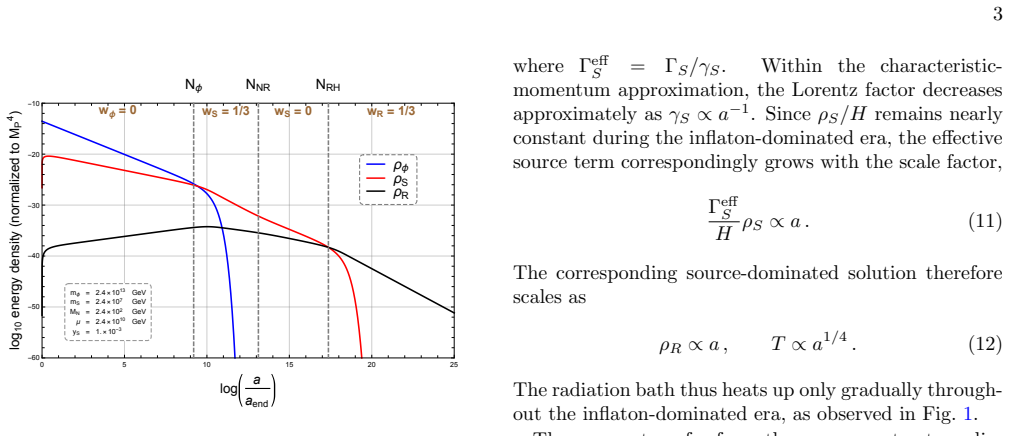
Significance. If the approximations hold, the work cleanly relocates the reheating temperature from the inflaton sector to the seesaw sector and supplies a concrete, analytically tractable thermal history that includes a prolonged low-temperature phase and an extra characteristic timescale set by the relativistic-to-non-relativistic transition of S. The resulting bridge between laboratory neutrino parameters and early-Universe cosmology is a genuine conceptual advance within the standard Boltzmann-reheating framework. The analytic scalings and the benchmark evolution of Fig. 1 are transparent and falsifiable once the deferred companion analyses appear.
major comments (2)
- [Analytical Understanding / Eqs. (4)–(5), (13)] The central claim TRH ∝ √(Γ_S M_P) rests on the characteristic-momentum approximation γ_S ∝ a^{-1} that enters Γ_eff_S in Eqs. (4)–(5) and drives every subsequent source-dominated solution (ρ_R ∝ a, then a^{-1}, then a^{-3/2}). Because the full momentum distribution is deferred, the Letter should at least quantify the expected correction to the analytic TRH (or to N_NR) under a realistic spectrum, or demonstrate that the single-p_S result is robust within the hierarchical regime m_S ≪ m_ϕ/2 used throughout.
- [The Seesaw Reheating Mechanism / after Eq. (5)] The identification of the right-handed-neutrino energy density with radiation (ρ_R) assumes Γ_th ≫ H for the entire parameter space of interest. The text states that this is verified a posteriori for the benchmark of Fig. 1, yet no explicit estimate or scan is provided. A short analytic or numerical check that Γ_th/H remains large down to the lowest TRH considered would make the radiation-bath identification load-bearing rather than provisional.
minor comments (4)
- [Fig. 1] Fig. 1 caption and legend use both y_N and y_S for the same Yukawa; the Lagrangian (1) writes y_N. Unify the notation.
- [The Seesaw Reheating Mechanism] The vacuum expression for Γ_S is used while the time-dependent mass induced by the oscillating condensate is deferred. A one-sentence estimate of the kinematic delay for the benchmark point would help the reader judge whether the minimal scenario is already representative.
- [Analytical Understanding] Eq. (25) writes TRH ∝ λ_S^{1/4} √(y_N M_P M_N); the subsequent numerical example quotes only M_N and TRH. Adding the corresponding λ_S (or v_S) would make the seesaw connection fully explicit.
- [Throughout] A few typographical inconsistencies appear (e.g., “SEESA W”, “REHEA TING” in section headings; “N R” vs. NR). These are easily cleaned.
Circularity Check
No significant circularity: TRH scaling and history follow from the stated Lagrangian, Boltzmann system, and characteristic-momentum approximation without reducing to inputs by construction.
full rationale
The paper introduces a minimal Lagrangian (Eq. 1) with the decay chain ϕ→SS→NRNR, writes the vacuum widths (Eq. 3), inserts the time-dilation factor Γ_eff_S=Γ_S/γ_S under the explicit characteristic-momentum approximation p_S∝a^{-1} (Eq. 4), and solves the coupled Boltzmann+Friedmann system (Eqs. 5–6). All subsequent analytic scalings (ρ_S∝a^{-3/2}, ρ_R∝a during inflaton domination; a_NR≃m_ϕ/(2m_S); later ρ_R∝a^{-1} then a^{-3/2}; and the final TRH∝√(Γ_S M_P)) are direct consequences of those equations under the stated approximations. The identification of S with the lepton-number-breaking scalar then yields the parametric link to MN and m_ν by substitution, not by redefinition. Self-citations (e.g., to Garcia–Kaneta–Mambrini–Olive reheating papers) supply only the standard Boltzmann machinery already written out in Eqs. 5–6; they do not force the new intermediate-scalar dynamics or the TRH∝√Γ_S result. No parameters are fitted to data and re-labeled as predictions, no uniqueness theorem is imported, and no known empirical pattern is merely renamed. The two weakest assumptions (characteristic-momentum approximation and prompt NR thermalization) are openly flagged as simplifications deferred to companion papers; they do not render the derivation circular. The Letter is therefore self-contained once its premises are granted.
Axiom & Free-Parameter Ledger
free parameters (1)
- benchmark masses and couplings (m_ϕ, m_S, M_N, μ, y_N, ρ_end)
axioms (5)
- domain assumption Post-inflationary Universe described by the Friedmann equation and the three coupled Boltzmann equations for ρ_ϕ, ρ_S, ρ_R with the given decay widths.
- domain assumption Inflaton oscillates in a quadratic potential and behaves as pressureless matter.
- ad hoc to paper Characteristic-momentum approximation: a single p_S ∝ a^{-1} determines γ_S for the whole population.
- domain assumption Right-handed neutrinos thermalize promptly (Γ_th ≫ H) so their energy density can be identified with radiation.
- ad hoc to paper Vacuum expression for Γ_S is used; time-dependent mass from the oscillating condensate is neglected.
invented entities (1)
-
Seesaw Reheating chain (ϕ → SS → NRNR with long-lived intermediate scalar)
independent evidence
read the original abstract
We introduce the Seesaw Reheating scenario, in which the inflaton transfers its energy to a long-lived intermediate scalar associated with the spontaneous breaking of lepton number before the Universe is reheated through its decay into right-handed neutrinos. As a result, the reheating temperature is no longer determined by the inflaton decay width but by the dynamics of the seesaw sector. We derive analytical solutions describing the complete reheating history, revealing two characteristic features of this scenario: the relativistic time dilation of the intermediate scalar, which suppresses its decay and delays the transfer of energy to the thermal bath, and its subsequent transition from a relativistic to a non-relativistic regime, introducing a new characteristic timescale in the thermal history. Together, these effects lead to simple analytical expressions for the reheating temperature. When the intermediate scalar is identified with the field responsible for the spontaneous breaking of lepton number, the same framework naturally connects the reheating temperature to the origin of neutrino masses and provides a well-motivated setting for sterile-neutrino dark matter.
Figures
Reference graph
Works this paper leans on
-
[1]
J. Martin and C. Ringeval, Phys. Rev. D82, 023511 (2010), arXiv:1004.5525 [astro-ph.CO]
Pith/arXiv arXiv 2010
-
[2]
L. Dai, M. Kamionkowski, and J. Wang, Phys. Rev. Lett. 113, 041302 (2014), arXiv:1404.6704 [astro-ph.CO]
Pith/arXiv arXiv 2014
-
[3]
M. A. G. Garcia, K. Kaneta, Y. Mambrini, and K. A. Olive, Phys. Rev. D101, 123507 (2020), arXiv:2004.08404 [hep-ph]
Pith/arXiv arXiv 2020
-
[4]
M. A. G. Garcia, K. Kaneta, Y. Mambrini, K. A. Olive, and S. Verner, JCAP03(03), 016, arXiv:2109.13280 [hep-ph]
-
[5]
S. E. Henrich, Y. Mambrini, and K. A. Olive, Phys. Rev. D111, 083501 (2025), arXiv:2412.13288 [hep-ph]
Pith/arXiv arXiv 2025
-
[6]
S. E. Henrich, M. Gross, Y. Mambrini, and K. A. Olive, Phys. Rev. D112, 103538 (2025), arXiv:2505.04703 [hep- ph]
Pith/arXiv arXiv 2025
-
[7]
S. E. Henrich, Y. Mambrini, and K. A. Olive, Phys. Rev. Lett.135, 221002 (2025), arXiv:2511.02117 [hep-ph]
arXiv 2025
-
[8]
X. Bertou, O. Deligny, M. Gross, Y. Mambrini, and I.- E. Mellouki, When direct detection constrains reheat- ing temperature: freeze-in with stronger couplings and inflaton-seeded freeze-in (2026), arXiv:2606.12408 [hep- ph]
Pith/arXiv arXiv 2026
-
[9]
M. Drewes and L. Ming, Phys. Rev. Lett.133, 031001 (2024), arXiv:2208.07609 [hep-ph]
Pith/arXiv arXiv 2024
-
[10]
J. L. Cook, E. Dimastrogiovanni, D. A. Easson, and L. M. Krauss, JCAP04, 047, arXiv:1502.04673 [astro-ph.CO]
-
[11]
C. Gross, O. Lebedev, and Y. Mambrini, JHEP08, 158, arXiv:1505.07480 [hep-ph]
-
[12]
Tenkanen, JHEP09, 049, arXiv:1607.01379 [hep-ph]
T. Tenkanen, JHEP09, 049, arXiv:1607.01379 [hep-ph]
-
[13]
T. Asaka, K. Hamaguchi, M. Kawasaki, and T. Yanagida, Phys. Rev. D61, 083512 (2000), arXiv:hep-ph/9907559
Pith/arXiv arXiv 2000
-
[14]
Lazarides and Q
G. Lazarides and Q. Shafi, Phys. Lett. B258, 305 (1991)
1991
-
[15]
W. Buchmuller, R. D. Peccei, and T. Yanagida, Ann. Rev. Nucl. Part. Sci.55, 311 (2005), arXiv:hep- ph/0502169
arXiv 2005
- [16]
-
[17]
C. Cosme, F. Costa, and O. Lebedev, JCAP06, 031, arXiv:2402.04743 [hep-ph]
- [18]
-
[19]
M. A. Amin and M. A. G. Garcia, JCAP08, 042, arXiv:1812.05559 [hep-ph]
- [20]
-
[21]
Y. Mambrini and K. A. Olive, Phys. Rev. D103, 115009 (2021), arXiv:2102.06214 [hep-ph]
Pith/arXiv arXiv 2021
-
[22]
N. Bernal, S. Cl´ ery, Y. Mambrini, and Y. Xu, JHEP06, 023, arXiv:2311.12694 [hep-ph]
-
[23]
S. Clery, Y. Mambrini, K. A. Olive, and S. Verner, Phys. Rev. D105, 075005 (2022), arXiv:2112.15214 [hep-ph]
Pith/arXiv arXiv 2022
-
[24]
R. T. Co, Y. Mambrini, and K. A. Olive, Phys. Rev. D 106, 075006 (2022), arXiv:2205.01689 [hep-ph]
Pith/arXiv arXiv 2022
-
[25]
M. A. G. Garcia, M. Gross, Y. Mambrini, K. A. Olive, M. Pierre, and J.-H. Yoon, JCAP12, 028, arXiv:2308.16231 [hep-ph]
-
[26]
M. A. G. Garcia, K. Kaneta, Y. Mambrini, and K. A. Olive, JCAP04, 012, arXiv:2012.10756 [hep-ph]
Pith/arXiv arXiv 2012
-
[27]
B. Barman, N. Bernal, and J. Rubio, Nucl. Phys. B1018, 116996 (2025), arXiv:2503.19980 [hep-ph]
Pith/arXiv arXiv 2025
-
[28]
M. Gross, S. E. Henrich, and F. Koutroulis, Gravita- tional ultra-relativistic freeze-out during general reheat- ing (2026), arXiv:2606.25033 [hep-ph]
Pith/arXiv arXiv 2026
discussion (0)
Sign in with ORCID, Apple, or X to comment. Anyone can read and Pith papers without signing in.