REVIEW 3 major objections 6 minor 48 references
Image disguising keeps useful accuracy for medical classification but badly hurts dense segmentation; RMT is the best practical trade-off, and medical images resist the regression attacks that partly work on natural photos.
Reviewed by Pith at T0; open to challenge. T0 means a machine referee read the full paper against a public rubric. the ladder, T0–T4 →
Image disguising preserves medical classification utility but degrades dense segmentation; RMT balances utility, efficiency, and attack resistance better than AES or NeuraCrypt.
T0 review reviewed 2026-07-13 challenge →
load-bearing objection Solid empirical bake-off: image disguising works better for medical classification than segmentation, RMT is the practical pick, and known-pair regression is weaker on these medical images than on MNIST/CIFAR. the 3 major comments →
Secure-by-Disguise: A Systematic Evaluation of Image Disguising for Confidential Medical Image Modeling
The pith
A machine-rendered reading of the paper's core claim, the machinery that carries it, and where it could break.
The reading
Core claim
Image disguising behaves differently on image-level versus pixel-level medical AI: it preserves practical utility for classification while causing substantial degradation for dense semantic segmentation. Among the evaluated methods, RMT consistently offers the best balance of predictive performance, computational efficiency, and resistance to reconstruction attacks, whereas AES-based disguising severely damages utility. Regression-based known-pair attacks that were partly effective on natural-image benchmarks become considerably less effective on realistic medical images.
What carries the argument
A unified evaluation framework that runs DisguisedNets (block-wise RMT and AES transforms, with matching mask transforms for segmentation) and NeuraCrypt on four medical datasets under one protocol measuring F1/Dice utility, preprocessing and training cost, block-size and noise sensitivity, and known-pair linear-regression reconstruction via a pretrained DNN examiner.
Load-bearing premise
The four public datasets and the honest-but-curious cloud plus known-pair regression attack are taken as enough to judge suitability of image disguising for confidential medical AI in general.
What would settle it
Apply the same RMT/AES pipeline to CT or MRI organ/tumor segmentation and show Dice near the original-image baseline, or recover clinically usable anatomy from RMT images with a modern generative reconstructor under the strong known-pair setting.
If this is right
- Cloud-based medical image classification and screening can already use RMT-style disguising with modest utility loss and only lightweight preprocessing.
- Dense clinical tasks that need accurate spatial localization (lesion contouring, organ segmentation, radiation planning) currently require other PETs or on-premises training.
- Security conclusions drawn only from MNIST/CIFAR-style benchmarks overstate reconstruction risk for realistic medical images under the tested attack.
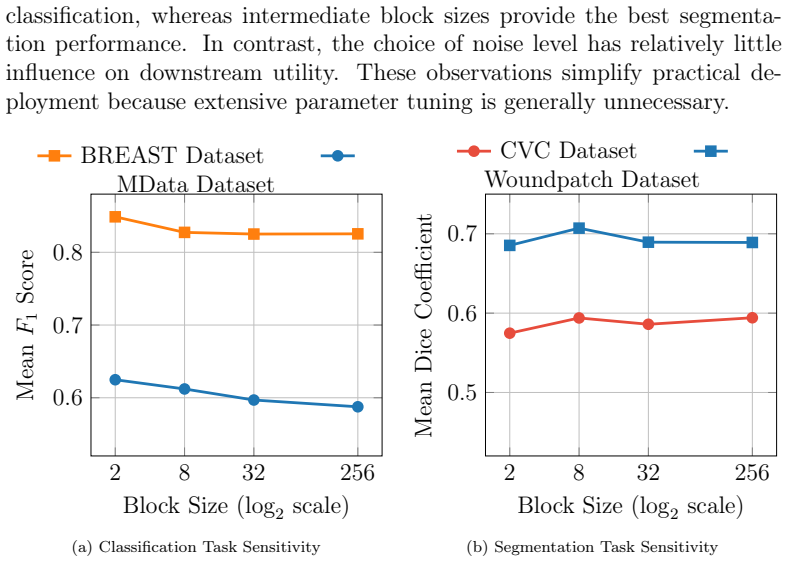
- RMT performance is stable across moderate block sizes and noise levels, so extensive parameter tuning is unnecessary for deployment.
- Future medical PETs must be evaluated separately on classification and dense prediction rather than assumed to transfer from natural-image results.
Where Pith is reading between the lines
- The medical-image hardness of reconstruction may be specific to linear regression; diffusion or generative attackers could still succeed and should be tested next.
- The same classification-versus-segmentation split is likely to appear for other PETs (local DP, secure aggregation) when they are applied to medical imaging.
- Hospitals that only need image-level triage could deploy RMT today, while those needing pixel masks should keep data local until structure-preserving disguises exist.
- The released evaluation suite itself can serve as a standing benchmark for any new image-level PET that claims medical applicability.
Editorial analysis
A structured set of objections, weighed in public.
Referee Report
Summary. The paper presents a unified empirical evaluation of image disguising as a privacy-enhancing technology for confidential medical AI. It re-implements DisguisedNets (RMT and AES block transforms) and NeuraCrypt under a common protocol on four public medical datasets spanning classification (Breast histopathology, MData wound) and dense semantic segmentation (CVC-ClinicDB, Wound Patch). Under an honest-but-curious cloud threat model, the authors measure predictive utility (macro F1 / Dice), preprocessing and training efficiency, RMT parameter sensitivity, and resistance to known-pair regression reconstruction attacks. The central findings are that current disguising methods preserve substantially more utility for image-level classification than for pixel-level segmentation, that RMT offers the best observed balance of utility, efficiency, and attack resistance while AES severely degrades utility, and that regression attacks previously partially effective on natural-image benchmarks are considerably less successful on these medical images. Code and the evaluation framework are released.
Significance. If the reported patterns hold, the work supplies the first systematic, multi-task evidence that image disguising is a practical PET for cloud-based medical image classification/screening but is currently inadequate for dense clinical segmentation. That task-dependent distinction is clinically actionable and was not established by prior natural-image-only studies. Strengths include a reproducible open-source framework, stratified five-fold CV with confidence intervals, multi-architecture coverage (CNNs, U-Net/UNet++, ViT), ablations on block size and noise, quantitative plus visual attack results, and explicit scoping of limitations (modalities and stronger generative adversaries). The contribution is primarily evaluative rather than algorithmic, but the bake-off and design guidance are useful for the medical PET community.
major comments (3)
- The abstract, introduction, and conclusion repeatedly frame the work as assessing suitability of image disguising for confidential medical AI in general, yet §3.4.1 and Table 1 cover only histopathology, clinical wound photography, colonoscopy, and DFU patches. CT, MRI, ultrasound, and 3D volumes are absent. §5.4 correctly lists these as future work, but the broad claim language should be tightened to the evaluated modalities and 2D tasks so that readers do not over-generalize the classification-vs-segmentation conclusion.
- Privacy claims rest almost entirely on the known-pair linear regression attack of §4.4.3 (and the original DisguisedNets threat model in §3.2). The paper shows this attack is weak on the medical images, which is a useful negative result, but modern generative/diffusion reconstructors are not evaluated. Because the manuscript already flags this gap in §5.4, the abstract and conclusion should more carefully qualify “resistance to reconstruction attacks” as resistance under the tested regression adversary rather than as a general security guarantee.
- Segmentation utility results (§4.2, Fig. 5) show large absolute drops (e.g., CVC Dice from ~0.92 to ~0.48 under RMT). The paper correctly concludes that current methods are inadequate for dense tasks, but it does not report whether any RMT configuration (block size / noise from the §4.4 ablations) recovers clinically usable Dice, nor does it provide a simple non-disguising spatial-preserving baseline (e.g., global encryption of features only). Without that, the claim that spatial disruption is the root cause remains plausible but not fully isolated.
minor comments (6)
- §3.3: “blocktization” appears to be a typo for “blockization” or “blocking.”
- Figures 6–7 and 12–13 would benefit from larger panels or higher-resolution insets; the qualitative reconstruction claims are important and currently hard to inspect in print.
- Table 1 lists “Breast (PEM)” without expanding PEM or citing the exact public source; a one-line provenance note would improve reproducibility.
- §4.1 states AES F1 scores approach random prediction on Breast but “less performance degradation” on MData; reporting the chance baseline explicitly for the 6-class MData task would make the comparison clearer.
- NeuraCrypt is evaluated only with its original ViT; a short note on whether the confidential embeddings could be paired with a CNN decoder for segmentation would clarify the architecture confound when comparing to U-Net results.
- Minor consistency: abstract says “four datasets involving classification and semantic segmentation” while the body cleanly separates two classification and two segmentation sets—fine, but keep the wording parallel.
Circularity Check
Empirical bake-off on public medical datasets with standard metrics; self-citation of DisguisedNets supplies the methods under test but does not force the reported utility/privacy outcomes.
specific steps
-
self citation load bearing
[Section 2.2 / 3.3 (DisguisedNets citation [23])]
"DisguisedNets [23] combines block-wise permutation with Randomized Multidimensional Transformation (RMT) or AES-based transformations... We focus on two representative image disguising frameworks. DisguisedNets[23] transforms images through (1) blocktization and optional block-level permutation, followed by (2) block-level transformation, which contains two transformation strategies: RMT and AES."
Authors of the present paper overlap with [23]; the methods under evaluation are imported from that prior work. This is ordinary self-citation of the technique being re-tested, not a load-bearing uniqueness claim or closed loop that forces the medical classification/segmentation/attack results, which are independently measured on new data.
full rationale
The paper is a systematic empirical evaluation, not a first-principles derivation. Predictive utility (macro F1, Dice), efficiency, and attack resistance are measured on four external public datasets via five-fold cross-validation, ImageNet-pretrained CNNs/U-Nets, and a released code base. DisguisedNets/RMT/AES and NeuraCrypt are taken as given methods (with overlapping authorship on the former) and re-run under a unified protocol; the central claims (classification utility largely preserved, segmentation degraded, RMT best balance, regression attacks weaker on medical images) are outcomes of those held-out experiments, not identities or fits that redefine the targets. No self-definitional equations, fitted-input-as-prediction, uniqueness theorems, or ansatz smuggling appear. The single self-citation is background for the techniques being evaluated and is not load-bearing for the medical-specific findings, which stand or fall on the new measurements. Score 1 reflects only that minor, non-circular self-reference.
Axiom & Free-Parameter Ledger
free parameters (4)
- RMT block size
- RMT additive noise level
- Training hyperparameters
- Known-pair leakage count K
axioms (5)
- domain assumption Cloud is honest-but-curious: correctly trains/infers but may try to recover patient images from disguised data, process, or model.
- domain assumption For segmentation, applying the same geometry-changing transform to masks preserves a valid pixel-wise learning problem under disguising.
- domain assumption Higher pretrained DNN examiner performance on reconstructed images indicates greater privacy leakage.
- ad hoc to paper Representative methods DisguisedNets (RMT/AES) and NeuraCrypt adequately stand in for the image-disguising PET class under study.
- standard math Standard supervised deep learning metrics (macro F1, Dice) and five-fold CV are sufficient to judge clinical-task utility preservation.
invented entities (1)
-
Unified evaluation framework for medical image disguising
no independent evidence
Cite this review
Pith. "Pith review of Secure-by-Disguise: A Systematic Evaluation of Image Disguising for Confidential Medical Image Modeling." pith.science (2026). https://pith.science/paper/VPZPVIYF
@misc{pith2026260708867,
  author       = {Pith},
  title        = {Pith review of: Secure-by-Disguise: A Systematic Evaluation of Image Disguising for Confidential Medical Image Modeling},
  year         = {2026},
  howpublished = {\url{https://pith.science/paper/VPZPVIYF}},
  note         = {Machine review of arXiv:2607.08867}
}
read the original abstract
Cloud-based deep learning enables large-scale medical image analysis but raises significant privacy concerns when sensitive patient images are outsourced for model development. Image disguising has recently emerged as a promising privacy-enhancing technology (PET) that transforms images into visually unintelligible representations while preserving information for downstream learning. We established a unified framework to evaluate representative methods, DisguisedNets and NeuraCrypt, across four datasets involving classification and semantic segmentation tasks. Our analysis assessed predictive utility, efficiency, and robustness against reconstruction attacks. Results showed that image disguising performance varies significantly between tasks; while methods preserved utility for medical image classification, they caused substantial degradation in dense semantic segmentation. Specifically, Randomized Multidimensional Transformation (RMT) offered the optimal balance of performance and security, whereas AES-based disguising severely impacted utility. Furthermore, regression-based reconstruction attacks effective on natural images proved considerably less successful on realistic medical images. These findings provide a systematic assessment of PET suitability for confidential medical AI applications.
Figures




Reference graph
Works this paper leans on
-
[1]
G. Litjens, T. Kooi, B. E. Bejnordi, A. A. A. Setio, F. Ciompi, M. Ghafoorian, J. A. W. M. van der Laak, B. van Ginneken, C. I. Sánchez, A survey on deep learning in medical image analysis, Medical Image Analysis 42 (2017) 60–88.doi:10.1016/j.media.2017.07.005
-
[2]
A. Hosny, C. t. Parmar, J. Quackenbush, L. H. Schwartz, H. J. W. L. Aerts, Artificial intelligence in radiology, Nature Reviews Cancer 18 (8) (2018) 500–510.doi:10.1038/s41568-018-0016-5. 30
-
[3]
R. Miotto, F. Wang, S. Wang, X. Jiang, J. T. Dudley, Deep learning for healthcare: review, opportunities and challenges, Briefings in Bioinfor- matics 19 (6) (2018) 1236–1246.doi:10.1093/bib/bbx044
-
[4]
Esteva, A
A. Esteva, A. Robicquet, B. Ramsundar, et al., A guide to deep learning in healthcare, Nature Medicine 25 (1) (2019) 24–29
2019
-
[5]
L. Cai, J. Gao, D. Zhao, A review of the application of deep learning in medical image classification and segmentation, Annals of Translational Medicine 8 (11) (2020). URLhttps://atm.amegroups.org/article/view/36944
2020
-
[6]
E. J. Topol, High-performance medicine: The convergence of human and artificial intelligence, Nature Medicine 25 (1) (2019) 44–56
2019
-
[7]
C. J. Kelly, A. Karthikesalingam, M. Suleyman, G. Corrado, D. King, Key challenges for delivering clinical impact with artificial intelligence, Nature Biomedical Engineering 3 (1) (2019) 44–54
2019
-
[8]
Wiens, S
J. Wiens, S. Saria, M. Sendak, et al., Do no harm: a roadmap for responsible machine learning for health care, Nature Medicine 25 (9) (2019) 1337–1340
2019
-
[9]
Voigt, A
P. Voigt, A. v. d. Bussche, The EU General Data Protection Regulation (GDPR): A Practical Guide, 1st Edition, Springer Publishing Company, Incorporated, 2017
2017
-
[10]
DHHS, Summary of the hipaa privacy rule, https://www.hhs.gov/hipaa/for-professionals/privacy/laws- regulations/ (last accessed, March 2025)
2025
-
[11]
G. C. Kagadis, C. Kloukinas, K. Moore, J. Philbin, P. Papadimitroulas, C. Alexakos, P. G. Nagy, D. Visvikis, W. R. Hendee, Cloud computing in medical imaging, Medical Physics 40 (7) (2013) 070901.doi:10. 1118/1.4811272
2013
-
[12]
M. A. Knolle, M. J. Menten, F. Jungmann, F. Meissen, B. Glocker, D. Rueckert, G. Kaissis, Disparate privacy risks from medical ai, Nature (2026).doi:10.1038/s41586-026-10688-0. URLhttps://doi.org/10.1038/s41586-026-10688-0 31
-
[13]
Kaissis, M
G. Kaissis, M. R. Makowski, D. Rückert, R. F. Braren, Secure, privacy- preserving and federated machine learning in medical imaging, Nature Machine Intelligence 2 (6) (2020) 305–311
2020
-
[14]
National Institute of Standards and Technology, Privacy-enhancing cryptography, nIST Privacy Engineering Program (2023)
2023
-
[15]
rep., European Union Agency for Cybersecurity (ENISA) (2022)
Privacy enhancing technologies: Evolution and state of the art, Tech. rep., European Union Agency for Cybersecurity (ENISA) (2022)
2022
-
[16]
I. Chillotti, N. Gama, M. Georgieva, M. Izabachène, TFHE: fast fully homomorphic encryption over the torus, J. Cryptology 33 (1) (2020) 34–91.doi:10.1007/s00145-019-09319-x. URLhttps://doi.org/10.1007/s00145-019-09319-x
-
[17]
Mugunthan, A
V. Mugunthan, A. Polychroniadou, Smpai: Secure multi-party compu- tation for federated learning, in: NeurIPS, 2019
2019
-
[18]
B. C. M. Fung, K. Wang, R. Chen, P. S. Yu, Privacy-preserving data publishing: A survey of recent developments, ACM Computing Survey 42 (2010) 14:1–14:53
2010
-
[19]
A. Eliazar, J. T. Brown, S. Cinamon, M. Kantarcioglu, B. Malin, Re-identification risk for common privacy preserving patient matching strategies when shared with de-identified demographics., J Am Med In- form Assoc 33 (2) (2026) 336–346.doi:10.1093/jamia/ocaf183
-
[20]
Dwork, Differential privacy, in: International Colloquium on Au- tomata, Languages andProgramming, Springer, 2006, pp
C. Dwork, Differential privacy, in: International Colloquium on Au- tomata, Languages andProgramming, Springer, 2006, pp. 1–12
2006
-
[21]
J. He, Y. Gu, K. Chen, RecPS: Measuring privacy risk of participating in recommender systems modeling, in: ACM Conference on Recommender Systems (RecSys), 2025
2025
-
[22]
J. Ficek, W. Wang, H. Chen, G. Dagne, E. Daley, Differential privacy in health research: A scoping review., J Am Med Inform Assoc 28 (10) (2021) 2269–2276.doi:10.1093/jamia/ocab135
-
[23]
K. Chen, Y. Gu, S. Sharma, Disguisednets: Secure image outsourcing for confidential model training in clouds, ACM Trans. Internet Technol. 23 (3) (aug 2023).doi:10.1145/3609506. URLhttps://doi.org/10.1145/3609506 32
-
[24]
A. Yala, H. Esfahanizadeh, R. G. L. D’Oliveira, K. R. Duffy, M. Ghobadi, T. S. Jaakkola, V. Vaikuntanathan, R. Barzilay, M. Mé- dard, Neuracrypt: Hiding private health data via random neural net- works for public training, CoRR abs/2106.02484 (2021).arXiv:2106. 02484. URLhttps://arxiv.org/abs/2106.02484
Pith/arXiv arXiv 2021
-
[25]
Dosovitskiy, L
A. Dosovitskiy, L. Beyer, A. Kolesnikov, D. Weissenborn, X. Zhai, T. Unterthiner, M. Dehghani, M. Minderer, G. Heigold, S. Gelly, J. Uszkoreit, N. Houlsby, An image is worth 16x16 words: Transformers for image recognition at scale, in: International Conference on Learning Representations, 2021
2021
-
[26]
M. H. Hesamian, W. Jia, X. He, P. Kennedy, Deep learning techniques for medical image segmentation: achievements and challenges, Journal of Digital Imaging 32 (4) (2019) 582–596
2019
-
[27]
Minaee, Y
S. Minaee, Y. Boykov, F. Porikli, A. Plaza, N. Kehtarnavaz, D. Ter- zopoulos, Image segmentation using deep learning: a survey, IEEE TPAMI 44 (7) (2022) 3523–3542
2022
-
[28]
Gilad-Bachrach, N
R. Gilad-Bachrach, N. Dowlin, K. Laine, K. Lauter, M. Naehrig, J. Wernsing, Cryptonets: Applying neural networks to encrypted data with high throughput and accuracy, in: M. F. Balcan, K. Q. Weinberger (Eds.), Proceedings of The 33rd International Conference on Machine Learning, Vol. 48 of Proceedings of Machine Learning Research, 2016, pp. 201–210
2016
-
[29]
Mohassel, Y
P. Mohassel, Y. Zhang, SecureML: A system for scalable privacy- preserving machine learning, in: 2017 IEEE Symposium on Security and Privacy (SP), 2017, pp. 19–38
2017
-
[30]
Abadi, A
M. Abadi, A. Chu, I. Goodfellow, H. B. McMahan, I. Mironov, K. Tal- war, L.Zhang, Deeplearningwithdifferentialprivacy, in: Proceedingsof the 2016 ACM SIGSAC Conference on Computer and Communications Security, 2016
2016
-
[31]
T. Wang, X. Zhang, J. Feng, X. Yang, A comprehensive survey on local differential privacy toward data statistics and analysis, Sensors 20 (24) 33 (2020) 7030.doi:10.3390/s20247030. URLhttps://doi.org/10.3390/s20247030
-
[32]
Q. Yang, Y. Liu, T. Chen, Y. Tong, Federated machine learning: Con- cept and applications, ACM Transactions on Intelligent Systems and Technology 10 (2) (2019)
2019
-
[33]
M. J. Sheller, G. A. Reina, B. Edwards, J. Martin, S. Bakas, Feder- ated learning in medicine: Facilitating multi-institutional collaborations without sharing patient data, Scientific Reports 10 (1) (2020) 12598
2020
-
[34]
Ryan, et al., Federated learning for medical artificial intelligence: A systematic review and future directions, Artificial Intelligence in Medicine (2024)
P. Ryan, et al., Federated learning for medical artificial intelligence: A systematic review and future directions, Artificial Intelligence in Medicine (2024)
2024
-
[35]
L. Zhu, Z. Liu, S. Han, Deep leakage from gradients, in: Advances in Neural Information Processing Systems, Vol. 32, Curran Associates, Inc., 2019. URLhttps://proceedings.neurips.cc/paper_files/paper/2019/ file/60a6c4002cc7b29142def8871531281a-Paper.pdf
2019
-
[36]
Geiping, H
J. Geiping, H. Bauermeister, H. Dröge, M. Moeller, Inverting gradients – how easy is it to break privacy in federated learning?, in: Advances in Neural Information Processing Systems, 2020
2020
-
[37]
H. Hu, Z. Salcic, L. Sun, G. Dobbie, P. S. Yu, X. Zhang, Membership inference attacks on machine learning: A survey, ACM Comput. Surv. 54 (11s) (Sep. 2022). URLhttps://doi.org/10.1145/3523273
doi:10.1145/3523273 2022
-
[38]
N. Haim, G. Vardi, G. Yehudai, O. Shamir, M. Irani, Reconstructing training data from trained neural networks, in: S. Koyejo, S. Mohamed, A. Agarwal, D. Belgrave, K. Cho, A. Oh (Eds.), Advances in Neural Information Processing Systems, Vol. 35, Curran Associates, Inc., 2022, pp. 22911–22924. URLhttps://proceedings.neurips.cc/paper_files/paper/2022/ file/9...
arXiv 2022
-
[39]
C. Patricio, J. C. Neves, L. F. Teixeira, Explainable deep learning meth- ods in medical image classification: A survey, ACM Comput. Surv. 34 56 (4) (Oct. 2023).doi:10.1145/3625287. URLhttps://doi.org/10.1145/3625287
-
[40]
S. Selvakumar, B. Senthilkumar, A privacy preserving machine learning framework for medical image analysis using quantized fully connected neural networks with tfhe based inference, Scientific Reports 15 (1) (2025) 27880.doi:10.1038/s41598-025-07622-1. URLhttps://doi.org/10.1038/s41598-025-07622-1
-
[41]
K. KC, K. Devkota, K. S. Karki, A. Acharya, Privacy preserving medical image classification and steganography using deep learning architecture: a pipeline, in: 2025 IEEE Conference on Artificial Intelligence (CAI), 2025, pp. 1–5.doi:10.1109/CAI64502.2025.00233
-
[42]
Z. Wang, H. Chi, Y. Li, Y. Zhang, S. Jiang, X. Du, M. Guizani, Hybrid makes better: Privacy-preserving medical image classification based on federated learning, in: GLOBECOM 2024 - 2024 IEEE Global Communications Conference, 2024, pp. 2816–2821.doi:10. 1109/GLOBECOM52923.2024.10901764
arXiv 2024
-
[43]
Y. Gao, Y. Jiang, Y. Peng, F. Yuan, X. Zhang, J. Wang, Medical image segmentation: A comprehensive review of deep learning-based methods., Tomography 11 (5) (Apr 2025).doi:10.3390/tomography11050052
-
[44]
G. Skorupko, F. Avgoustidis, C. Martin-Isla, L. Garrucho, D. A. Kessler, E. R. Pujadas, O. Diaz, M. Bobowicz, K. Gwozdziewicz, X. Bargallo, P. Jarusevicius, R. Osuala, K. Kushibar, K. Lekadir, Federated nnu-net for privacy-preserving medical image segmentation, Scientific Reports 15 (1) (2025) 38312.doi:10.1038/s41598-025-22239-0. URLhttps://doi.org/10.10...
-
[45]
S. Bian, W. Jiang, T. Sato, Privacy-preserving medical image seg- mentation via hybrid trusted execution environment, in: 2021 58th ACM/IEEE Design Automation Conference (DAC), 2021, pp. 1347– 1350.doi:10.1109/DAC18074.2021.9586198
-
[46]
A. L. Simpson, M. Antonelli, S. Bakas, et al., A large annotated med- ical image dataset for the development and evaluation of segmentation algorithms, arXiv preprint arXiv:1902.09063 (2019). 35
Pith/arXiv arXiv 1902
-
[47]
Carlini, S
N. Carlini, S. Deng, S. Garg, S. Jha, S. Mahloujifar, M. Mahmoody, S. Song, A. Thakurta, F. Tramèr, Is private learning possible with in- stance encoding?, in: IEEE Symposium on Security and Privacy (S&P), 2021
2021
-
[48]
F. j. Milletari, N. Navab, S.-A. Ahmadi, V-net: Fully convolutional neural networks for volumetric medical image segmentation, in: 2016 fourth international conference on 3D vision (3DV), IEEE, 2016, pp. 565–571. 36
2016
This paper was first reviewed by grok-4.5 on July 13, 2026.
discussion (0)
Sign in with ORCID, Apple, or X to comment. Anyone can read and Pith papers without signing in.