REVIEW 2 major objections 5 minor 44 references
When action features are only partly observed, low intrinsic dimension still yields √T linear-bandit regret in that dimension, not the ambient one.
Reviewed by Pith at T0; open to challenge. T0 means a machine referee read the full paper against a public rubric. the ladder, T0–T4 →
T0 review · grok-4.5
2026-07-13 01:19 UTC pith:BOLOJFYP
load-bearing objection Solid theory paper: epoch-freeze + impute gets m√T regret under MAR low-rank actions, with a clean product lower bound; modeling restrictions are real but stated. the 2 major comments →
Stochastic Linear Bandits with Partially Observed Actions
The pith
A machine-rendered reading of the paper's core claim, the machinery that carries it, and where it could break.
Core claim
Under exact low-rank action support, incoherence, and Bernoulli coordinate masks, an epoch-wise estimate-impute-OFUL procedure (TOFU-POV) achieves high-probability regret that is ˜O(κ²m/(p⁴K) + m√T + κm√T/(p²√K)), replacing ambient dimension d by intrinsic dimension m; a rank-adaptive variant matches this scaling once a short burn-in ends.
What carries the argument
TOFU-POV: corrected covariance PCA on all offered masked arms, epoch-wise frozen subspace, least-squares imputation of missing coordinates, then ordinary OFUL in the resulting m-dimensional features, with misspecification controlled by the frozen approximation error.
Load-bearing premise
The ideal actions must truly live in a low-dimensional, well-spread subspace, and the chance of seeing each coordinate must be high enough that the observed rows stay well-conditioned; if the subspace is concentrated on a few coordinates or missingness is adversarial, the guarantee collapses.
What would settle it
Construct or sample action vectors that are only approximately low-rank or whose energy is concentrated on few coordinates, run TOFU-POV under the same Bernoulli masks, and check whether cumulative regret remains √T in m or reverts to linear in T as ambient dimension grows.
Editorial analysis
A structured set of objections, weighed in public.
Referee Report
Summary. The paper studies stochastic linear bandits when each offered action is observed only through independent Bernoulli-p coordinate masks, but the ideal actions lie in an unknown m-dimensional subspace of R^d. The authors propose TOFU-POV, which estimates a corrected covariance from all offered masked arms, freezes a subspace estimate within doubling epochs, imputes missing coordinates by least squares on the frozen basis, and runs OFUL in the resulting m-dimensional coordinates. Under bounded actions, full-rank action covariance, and µ-incoherence with p large enough for observed Gram conditioning, they prove high-probability regret ˜O(κ²m/(p⁴K) + m√T + κm√T/(p²√K)), replacing ambient dimension d by intrinsic dimension m. A rank-adaptive variant recovers the same scaling up to burn-in without knowing m. A product lower-bound construction separates ordinary reward-learning cost from a missingness-discovery cost. Synthetic and real-feature experiments (MNIST product-context, optical digits, 20 Newsgroups) support the theory and show gains under heavier missingness.
Significance. Partial observability of action features is a realistic and under-studied obstacle in recommendation and healthcare bandits; without structure, sublinear regret is information-theoretically impossible, so the low-rank action model is a natural and useful way forward. The technical contribution is solid: epoch-wise freezing cleanly restores standard self-normalized and elliptical-potential arguments that continual projected-OFUL would break (Appendix A), the misspecification contraction (Lemma 4) avoids an extra √m factor, and the product lower bound is a genuine novelty. Rank adaptivity essentially for free, public code, and multi-seed experiments with real covariates strengthen the package. If the result holds as stated, it is a clear advance for structured linear bandits under missing features and a useful template for other representation-learning bandit settings.
major comments (2)
- [Theorem 2, Theorem 4, Section 9] Theorem 2 vs Theorem 4 / Section 9: the upper bound’s representation term scales as κm√T/(p²√K), while the lower bound’s missingness cost is only order SBX min{T, 1/(Kp²)} (constant for fixed p,K once T is large). Section 9 correctly flags that the √T/p²-type term may be an artifact, but the main theorem statement and abstract still present the full three-term bound as the scaling of the problem. Please either (i) strengthen the lower bound toward a √T missingness term, or (ii) restate the main guarantee so that the additive burn-in and the possibly non-tight representation term are clearly separated from the intrinsic m√T reward-learning cost.
- [Section 4.1, Eq. (5), Lemma 2] Eq. (5) and Lemma 2: the burn-in tb scales as κ²m/(p⁴K) and the imputation analysis requires p ≳ (µ²m/d) log(mTK/δ). Both are load-bearing for the post-burn-in √T regime. The p⁻⁴ dependence is acknowledged as technique-specific, but for moderate missingness (e.g., p=0.2 as in the experiments) this burn-in can dominate practical horizons. A short discussion of when tb is negligible relative to T, and whether a milder conditioning target than ϵt ≤ p/32 is possible, would make the applicability of Theorem 2 clearer.
minor comments (5)
- [Algorithm 1, Section 8] Algorithm 1 and the paragraph after it: the theory analyzes the cold-start epoch design, while experiments use full-history replay / warm-start. Please mark this distinction more prominently in Section 8 (e.g., a short “theory vs practice” note) so readers do not attribute experimental gains solely to the analyzed algorithm.
- [Section 3] Definition of κ in Section 3: κ := BX √λ̄ /(λm √m) is used throughout; a one-line remark that κ = Θ(1) under flat spectrum λm ≍ λ̄ ≍ B²X/m would help readers parse the “˜O(m√T)” special case stated after Theorem 2.
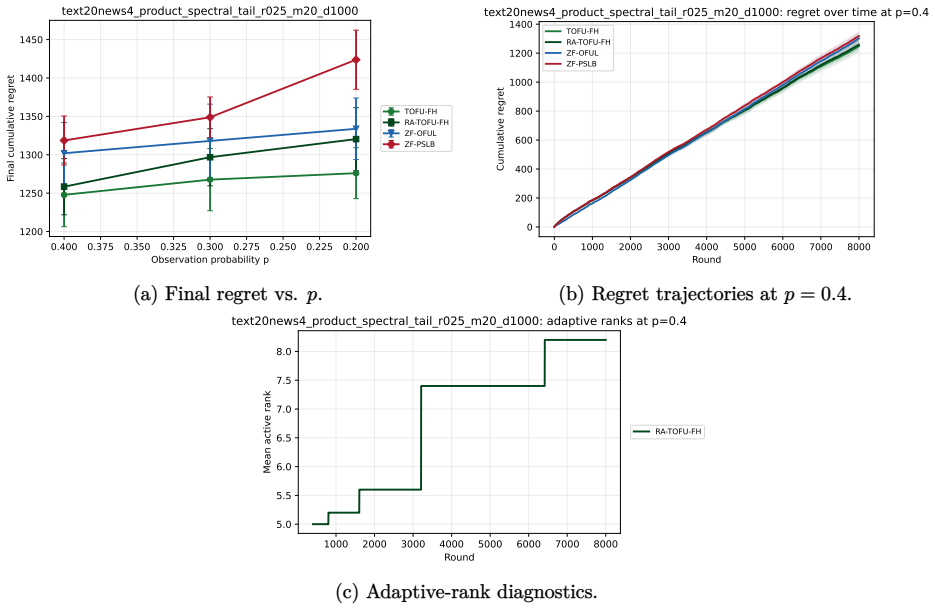
- [Figure 1, Section 8] Figure 1 caption and legend: RA-ZF-PSLB appears in plots but is only briefly named; a one-sentence definition next to ZF-PSLB would improve readability.
- [Section 3, Appendix D] Typos / polish: “Toreasonaboutsubspacerecovery” (Section 3) needs spaces; “ineqiality” in Appendix D; occasional missing spaces after periods in the arXiv text. A pass for spacing and hyphenation would help.
- [Section 2] Related work: the comparison to Kim et al. (2025) and Park & Faradonbeh (2022) is clear on observation models; a sentence on whether their techniques could be combined with low-rank action structure would round out the positioning.
Circularity Check
No significant circularity: regret and lower-bound claims are derived from stated assumptions via standard concentration and OFUL arguments, not by construction from fitted inputs or load-bearing self-citation.
full rationale
TOFU-POV’s main guarantees (Theorems 2–3) are obtained from explicit modeling assumptions (bounded low-rank actions, action-covariance rank, µ-incoherence, Bernoulli-p masks with p large enough for observed Grams) through a transparent chain: inverse-probability corrected covariance (Lemma 5) + matrix Bernstein (Lemma 7) → Davis–Kahan subspace rate (Lemma 1); burn-in for Gram conditioning; frozen-epoch least-squares imputation (Lemma 2) → controlled misspecification be (Lemma 3); contraction control of aggregated misspecification (Lemma 4) plus self-normalized OFUL inside epochs; doubling schedule summing to √T. The lower bound (Theorem 4) uses an independent four-instance product construction separating reward-learning and missingness-discovery costs. Self-citations (e.g., multi-fidelity/active-learning pointers in Discussion) are background only and do not underwrite the theorems. No parameter is fitted to data and re-labeled a prediction; no uniqueness theorem is imported from the authors; no ansatz is smuggled in as a derivation. The paper is a standard self-contained theory contribution with experimental support.
Axiom & Free-Parameter Ledger
free parameters (4)
- burn-in length tb / Cb
- ridge regularization λ
- confidence allocations δ_rep, δ_e, δ_rank
- experimental ranks/thresholds/confidence widths
axioms (6)
- domain assumption Bounded actions: ||X_{t,i}||_2 ≤ B_X a.s. (Assumption 1)
- domain assumption Action covariance Σ has rank m with eigenvalues bounded by λ̄ and λ_m > 0 (Assumption 2)
- domain assumption True subspace is µ-incoherent w.r.t. coordinate basis (Definition 1)
- domain assumption Independent Bernoulli(p) coordinate masks, independent of actions and policy
- domain assumption Rewards are linear in ideal actions with R-sub-Gaussian noise; θ⋆ in span(U)
- standard math Matrix Bernstein, Matrix Chernoff, Davis–Kahan, self-normalized martingale bounds
invented entities (3)
-
TOFU-POV (epoch-wise freeze, impute, OFUL)
independent evidence
-
Corrected covariance estimator Σ̇_t with inverse-probability diagonal/off-diagonal correction
independent evidence
-
Four-instance product hard family I_{ν,σ} for lower bound
no independent evidence
read the original abstract
The stochastic linear bandit, where actions are represented as vectors and rewards are linear, is a central paradigm for sequential decision making. We study a partially observed variant of this problem in which the learning agent only sees a random subset of coordinates for each action. Such partial observability arises naturally in settings like recommendation and healthcare, where full action descriptions can be expensive or even impossible to obtain. In general, this makes sublinear regret information-theoretically impossible. However, we show that this barrier can be overcome when the action vectors have low intrinsic dimension. We propose an algorithm, TOFU-POV, that estimates the latent action subspace using the masked actions, imputes current actions using an epoch-wise frozen representation, and runs OFUL in the resulting low-dimensional coordinates. Our theory shows that TOFU-POV enjoys a $\sqrt{T}$ regret that scales with the intrinsic action subspace dimension as opposed to the ambient dimension and quantifies the interaction between these quantities and the missingness, decision set size, and subspace conditioning. We also devise a rank-adaptive algorithm that does not require the knowledge of the intrinsic dimension. We complement these guarantees with a lower bound based on a novel product construction that separates usual reward-learning uncertainty from a missingness-dependent cost intrinsic to partial observation. Synthetic and real data experiments support our theory and show that TOFU-POV can substantially improve upon natural baselines in this challenging problem.
Figures


Reference graph
Works this paper leans on
-
[1]
Improved algorithms for linear stochastic bandits.Advances in neural information processing systems, 24, 2011
Yasin Abbasi-Yadkori, Dávid Pál, and Csaba Szepesvári. Improved algorithms for linear stochastic bandits.Advances in neural information processing systems, 24, 2011
2011
-
[2]
Linearly parameterized bandits.Mathematics of Operations Research, 35(2):395–411, 2010
Paat Rusmevichientong and John N Tsitsiklis. Linearly parameterized bandits.Mathematics of Operations Research, 35(2):395–411, 2010
2010
-
[3]
Cambridge University Press, 2020
Tor Lattimore and Csaba Szepesvári.Bandit algorithms. Cambridge University Press, 2020
2020
-
[4]
A contextual-bandit approach to personalized news article recommendation
Lihong Li, Wei Chu, John Langford, and Robert E Schapire. A contextual-bandit approach to personalized news article recommendation. InProceedings of the 19th international conference on World wide web, pages 661–670, 2010. 15
2010
-
[5]
Contextual bandits with linear payoff functions
Wei Chu, Lihong Li, Lev Reyzin, and Robert Schapire. Contextual bandits with linear payoff functions. InProceedings of the Fourteenth International Conference on Artificial Intelligence and Statistics, pages 208–214. JMLR Workshop and Conference Proceedings, 2011
2011
-
[6]
Online decision making with high-dimensional covariates
Hamsa Bastani and Mohsen Bayati. Online decision making with high-dimensional covariates. Operations Research, 68(1):276–294, 2020
2020
-
[7]
Linear bandits with partially observable features.arXiv preprint arXiv:2502.06142, 2025
Wonyoung Kim, Sungwoo Park, Garud Iyengar, Assaf Zeevi, and Min-hwan Oh. Linear bandits with partially observable features.arXiv preprint arXiv:2502.06142, 2025
Pith/arXiv arXiv 2025
-
[8]
A regret bound for greedy partially observed stochastic contextual bandits
Hongju Park and Mohamad Kazem Shirani Faradonbeh. A regret bound for greedy partially observed stochastic contextual bandits. InProceedings of the 39th International Conference on Machine Learning, volume 162, pages 1805–1812. PMLR, 2022
2022
-
[9]
Stochastic linear bandits with hidden low rank structure.arXiv preprint arXiv:1901.09490, 2019
Sahin Lale, Kamyar Azizzadenesheli, Anima Anandkumar, and Babak Hassibi. Stochastic linear bandits with hidden low rank structure.arXiv preprint arXiv:1901.09490, 2019
Pith/arXiv arXiv 1901
-
[10]
Abbasi-Yadkori, D
Y. Abbasi-Yadkori, D. Pal, and C. Szepesvari. Online-to-confidence-set conversions and application to sparse stochastic bandits. InArtificial Intelligence and Statistics, pages 1–9, 2012
2012
-
[11]
Carpentier and R
A. Carpentier and R. Munos. Bandit theory meets compressed sensing for high dimensional stochastic linear bandit. InArtificial Intelligence and Statistics, pages 190–198, 2012
2012
-
[12]
Sparse stochastic bandits.arXiv preprint arXiv:1706.01383, 2017
Joon Kwon, Vianney Perchet, and Claire Vernade. Sparse stochastic bandits.arXiv preprint arXiv:1706.01383, 2017
Pith/arXiv arXiv 2017
-
[13]
Popart: Efficient sparse regression and experimental design for optimal sparse linear bandits.Advances in Neural Information Processing Systems, 35:2102–2114, 2022
Kyoungseok Jang, Chicheng Zhang, and Kwang-Sung Jun. Popart: Efficient sparse regression and experimental design for optimal sparse linear bandits.Advances in Neural Information Processing Systems, 35:2102–2114, 2022
2022
-
[14]
Bilinear bandits with low-rank structure
Kwang-Sung Jun, Rebecca Willett, Stephen Wright, and Robert Nowak. Bilinear bandits with low-rank structure. InProceedings of the 36th International Conference on Machine Learning, volume 97 ofProceedings of Machine Learning Research, pages 3163–3172. PMLR, 2019
2019
-
[15]
Low-rank generalized linear bandit problems
Yangyi Lu, Amirhossein Meisami, and Ambuj Tewari. Low-rank generalized linear bandit problems. InProceedings of the 24th International Conference on Artificial Intelligence and Statistics, volume 130 ofProceedings of Machine Learning Research, pages 460–468. PMLR, 2021
2021
-
[16]
Improved regret analysis for bilinear bandits
Young-Hwan Jang, Kwang-Sung Jun, and Se-Young Yun. Improved regret analysis for bilinear bandits. InProceedings of the 38th International Conference on Machine Learning, volume 139 ofProceedings of Machine Learning Research, pages 4753–4763. PMLR, 2021
2021
-
[17]
Yang Kang, Cho-Jui Hsieh, and Thomas C. M. Lee. Efficient frameworks for generalized low-rank matrix bandit problems.Advances in Neural Information Processing Systems, 35: 19971–19983, 2022
2022
-
[18]
Spectral bandits for smooth graph functions
Michal Valko, Rémi Munos, Branislav Kveton, and Tomáš Kocák. Spectral bandits for smooth graph functions. InInternational Conference on Machine Learning, 2014. 16
2014
-
[19]
Baraniuk
Daniel LeJeune, Gautam Dasarathy, and Richard G. Baraniuk. Thresholding graph bandits with GrAPL. InInternational Conference on Artificial Intelligence and Statistics, 2020
2020
-
[20]
Maximizing and satisficing in multi-armed bandits with graph information
Parth Thaker, Mohit Malu, Nikhil Rao, and Gautam Dasarathy. Maximizing and satisficing in multi-armed bandits with graph information. InAdvances in Neural Information Processing Systems, 2022
2022
-
[21]
Exact matrix completion via convex optimization
Emmanuel J Candès and Benjamin Recht. Exact matrix completion via convex optimization. Foundations of Computational mathematics, 9(6):717–772, 2009
2009
-
[22]
Robust principal component analysis?Journal of the ACM (JACM), 58(3):1–37, 2011
Emmanuel J Candès, Xiaodong Li, Yi Ma, and John Wright. Robust principal component analysis?Journal of the ACM (JACM), 58(3):1–37, 2011
2011
-
[23]
Simplified neuron model as a principal component analyzer.Journal of mathematical biology, 15(3):267–273, 1982
Erkki Oja. Simplified neuron model as a principal component analyzer.Journal of mathematical biology, 15(3):267–273, 1982
1982
-
[24]
High-dimensional robust subspace tracking under missing data and outliers
Laura Balzano, Robert Nowak, and Benjamin Recht. High-dimensional robust subspace tracking under missing data and outliers. In2010 Conference Record of the Forty Fourth Asilomar Conference on Signals, Systems and Computers, pages 2087–2091. IEEE, 2010
2087
-
[25]
Petrels: Parallel subspace estimation and tracking by recursive least squares from partial observations.IEEE Transactions on Signal Processing, 61(23):5947–5959, 2013
Yuejie Chi, Yonina C Eldar, and Robert Calderbank. Petrels: Parallel subspace estimation and tracking by recursive least squares from partial observations.IEEE Transactions on Signal Processing, 61(23):5947–5959, 2013
2013
-
[26]
Yingyu Liang, Zhuoran Xu, and Dale Schuurmans. An exponential convergence rate for subspace estimation from partial observations.arXiv preprint arXiv:1905.13595, 2019
Pith/arXiv arXiv 1905
-
[27]
Thompson sampling for contextual bandits with linear payoffs
Shipra Agrawal and Navin Goyal. Thompson sampling for contextual bandits with linear payoffs. InInternational Conference on Machine Learning, pages 127–135, 2013
2013
-
[28]
Linear Thompson sampling revisited
Marc Abeille and Alessandro Lazaric. Linear Thompson sampling revisited. InArtificial Intelligence and Statistics, pages 176–184, 2017
2017
-
[29]
Semiparametric contextual bandits
Akshay Krishnamurthy, Zhiwei Steven Wu, and Vasilis Syrgkanis. Semiparametric contextual bandits. InInternational Conference on Machine Learning, pages 2776–2785, 2018
2018
-
[30]
High-dimensional covariance matrix estimation with missing observations
Karim Lounici. High-dimensional covariance matrix estimation with missing observations. Bernoulli, 20(3):1029 – 1058, 2014. doi: 10.3150/12-BEJ487. URL https://doi.org/10. 3150/12-BEJ487
-
[31]
The rotation of eigenvectors by a perturbation
Chandler Davis and William Morton Kahan. The rotation of eigenvectors by a perturbation. iii.SIAM Journal on Numerical Analysis, 7(1):1–46, 1970
1970
-
[32]
Gradient-based learning applied to document recognition.Proceedings of the IEEE, 86(11):2278–2324, 1998
Yann LeCun, Léon Bottou, Yoshua Bengio, and Patrick Haffner. Gradient-based learning applied to document recognition.Proceedings of the IEEE, 86(11):2278–2324, 1998
1998
-
[33]
Optical recognition of handwritten digits
Ethem Alpaydin and Cenk Kaynak. Optical recognition of handwritten digits. UCI Machine Learning Repository, 1998. DOI: 10.24432/C50P49
doi:10.24432/c50p49 1998
-
[34]
Newsweeder: Learning to filter netnews
Ken Lang. Newsweeder: Learning to filter netnews. InProceedings of the Twelfth International Conference on Machine Learning, pages 331–339. Morgan Kaufmann, 1995. 17
1995
-
[35]
Active learning algorithms for graphical model selection
Gautam Dasarathy, Aarti Singh, Maria-Florina Balcan, and Jong Hyuk Park. Active learning algorithms for graphical model selection. InArtificial Intelligence and Statistics, 2016
2016
-
[36]
The multi-fidelity multi-armed bandit
Kirthevasan Kandasamy, Gautam Dasarathy, Barnabás Póczos, and Jeff Schneider. The multi-fidelity multi-armed bandit. InAdvances in Neural Information Processing Systems, 2016
2016
-
[37]
Oliva, Jeff Schneider, and Barnabás Póczos
Kirthevasan Kandasamy, Gautam Dasarathy, Junier B. Oliva, Jeff Schneider, and Barnabás Póczos. Gaussian process bandit optimisation with multi-fidelity evaluations. InAdvances in Neural Information Processing Systems, 2016
2016
-
[38]
Multi- fidelity Bayesian optimisation with continuous approximations
Kirthevasan Kandasamy, Gautam Dasarathy, Jeff Schneider, and Barnabás Póczos. Multi- fidelity Bayesian optimisation with continuous approximations. InInternational Conference on Machine Learning, 2017
2017
-
[39]
Oliva, Jeff Schneider, and Barnabás Póczos
Kirthevasan Kandasamy, Gautam Dasarathy, Junier B. Oliva, Jeff Schneider, and Barnabás Póczos. Multi-fidelity Gaussian process bandit optimisation.Journal of Artificial Intelligence Research, 66:151–196, 2019
2019
-
[40]
Joel A. Tropp. An introduction to matrix concentration inequalities, 2015. URL https: //arxiv.org/abs/1501.01571
Pith/arXiv arXiv 2015
-
[41]
Numerical methods for computing angles between linear subspaces.Mathematics of Computation, 27(123):579–594, 1973
Åke Björck and Gene H Golub. Numerical methods for computing angles between linear subspaces.Mathematics of Computation, 27(123):579–594, 1973
1973
-
[42]
Academic Press, 1990
Gilbert W Stewart and Ji-guang Sun.Matrix Perturbation Theory. Academic Press, 1990
1990
-
[43]
Horn and Charles R
Roger A. Horn and Charles R. Johnson.Matrix Analysis. Cambridge University Press, 2 edition, 2012. 18 Stochastic Linear Bandits with Partially Observed Actions: Appendices A Technical Comparison with PSLB and the Role of Epoch-wise Freezing The closest predecessor to our work is the projected stochastic linear bandit framework of [9]. PSLB estimates a low...
2012
-
[44]
In this situation, notice that Lemma 8 gives us min O ∥ˆUtO−U∥2≤ √ 2∥ˆPt−P∥2≤ √ 2≤ϵt. Case 2:ϵt< √ 2 Here, Case 2 of the preceding proof gives∥ˆPt−P∥2≤(8/Csub)ϵt. This, along with Lemma 8, implies that min O ∥ˆUtO−U∥2≤(8 √ 2/Csub)ϵt≤ϵt, where we used the fact thatCsub = 12≥8 √ 2. D Imputation Error: Proof of Lemma 2 In Section C, we showed that the projec...
arXiv 2021
discussion (0)
Sign in with ORCID, Apple, or X to comment. Anyone can read and Pith papers without signing in.