REVIEW 3 major objections 4 minor 32 references
Poisoned event bursts can multiply NMS latency by 38× in SNN object detectors while accuracy barely moves.
Reviewed by Pith at T0; open to challenge. T0 means a machine referee read the full paper against a public rubric. the ladder, T0–T4 →
T0 review · grok-4.5
2026-07-14 15:20 UTC pith:FC3ROYTZ
load-bearing objection Clean poison-only NMS sponge for event SNNs with solid tables and Jetson data; abstract's "38%" is a clear typo for the body's 38× (+3818%). the 3 major comments →
Event Burst Trigger: An Availability Backdoor Attack on Event-Based SNN Object Detection
The pith
A machine-rendered reading of the paper's core claim, the machinery that carries it, and where it could break.
Core claim
Under a poison-only threat model, carefully designed event bursts (especially temporal event noise) implant a backdoor in SpikeYOLO that multiplies the number of phantom candidates and thereby inflates NMS-stage latency by as much as 38 imes while mAP@0.5 falls by less than 0.099; the same triggers also raise baseline resource use on edge hardware and evade STRIP detection.
What carries the argument
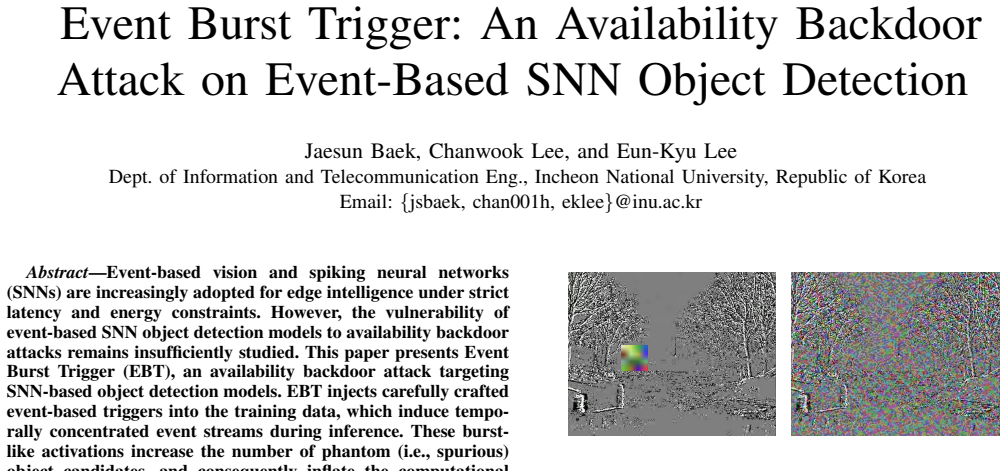
Event Burst Trigger (EBT): a poison-only procedure that injects temporally concentrated event patterns together with dense, high-IoU fake annotations so that, at inference, the SNN produces a synchronized spike burst that explodes the pre-NMS candidate set and saturates the O(N^{2}) NMS stage.
Load-bearing premise
A modest poisoning fraction plus dense overlapping fake boxes is enough to teach the detector a reliable trigger-to-candidate-explosion mapping that survives ordinary fine-tuning and stays silent on clean inputs.
What would settle it
Retrain SpikeYOLO on the same GEN1 poison set but with the fake-box density reduced or randomly scaled so that it no longer aligns with any FPN level; if NMS latency then remains near the clean baseline, the claimed mapping has failed.
Editorial analysis
A structured set of objections, weighed in public.
Referee Report
Summary. The paper proposes Event Burst Trigger (EBT), a poison-only availability backdoor against SpikeYOLO on event-based data. Triggers (single-event patches, weighted patches, and temporal event noise) plus dense overlapping fake annotations are injected into a fraction of the GEN1 training set so that, at inference, temporally concentrated events produce many phantom candidates and inflate NMS cost. On held-out frames the strongest configuration (temporal noise, ρ=0.2, γ=1.0) raises NMS time from 0.165 ms to 6.660 ms while mAP@0.5 falls by at most 0.099; STRIP yields ROC-AUC ≈ 0.5; Jetson Orin Nano measurements show elevated baseline CPU utilization and reduced scheduling slack. The claim is that NMS becomes a dominant availability bottleneck under this attack surface.
Significance. Availability backdoors that target post-processing rather than labels remain under-studied for event-based SNNs. The work supplies a concrete poison-only construction, three trigger modalities, an FPN-scale ablation (Table II), edge-platform resource profiles, and a negative STRIP result (Table IV). Source code is promised. If the quantitative latency claim is correctly stated and reproducible, the paper usefully expands the threat model for real-time neuromorphic detectors and motivates runtime monitoring of candidate counts and NMS latency. The contribution is empirical rather than theoretical; its value hinges on the magnitude and reliability of the reported NMS inflation.
major comments (3)
- Abstract vs. body quantitative inconsistency: the abstract (and arXiv abstract) state that NMS latency “increases by up to 38%”, while Table I (event-noise row ρ=0.2, γ=1.0), the conclusion, and the contribution list report a 38 imes increase (+3818 %, 0.165 ms → 6.660 ms). The same discrepancy appears in the contribution bullet. Because the headline availability claim rests on this number, the manuscript must reconcile the two figures, correct the abstract, and restate the claim consistently throughout. If the true measured effect is only ~38 %, the assertion that NMS becomes a “dominant availability bottleneck” is no longer supported by the data.
- Table I and §IV-A: all latency and candidate-count figures are reported as single point estimates with no standard deviations, confidence intervals, or multi-seed statistics, despite evaluation on 1000 frames. Given that NMS cost is super-linear in candidate count and that event streams are stochastic, the absence of variability measures leaves open whether the 38 imes figure is stable or an outlier. At minimum, mean ± std (or median and IQR) over seeds or frame batches should be supplied for the critical NMS-time column.
- §III-D and §IV-A (weakest assumption): the attack relies on a modest poisoning ratio (ρ ≤ 0.2) together with dense overlapping fake boxes (γ up to 1.0) being sufficient to implant a reliable trigger-to-candidate-explosion mapping that survives standard SpikeYOLO fine-tuning and remains dormant on clean inputs. The paper does not report training dynamics, loss curves, or an ablation that isolates annotation density from trigger presence. Without such evidence it is unclear how sensitive the mapping is to optimizer settings, learning-rate schedules, or early stopping, all of which are free parameters of the victim pipeline.
minor comments (4)
- Fig. 5 caption and surrounding text mix Korean and English; the figure itself is only partially described. A clean English caption and axis labels are needed.
- Notation for annotation strength γ and noise ratio ε is introduced without an explicit formal definition of how many fake boxes or events are generated; a short equation or algorithm box would help reproducibility.
- References [12] and [32] still carry arXiv / “accessed 2026” placeholders; final bibliographic details should be updated if available.
- The phrase “up to38%” (missing space) appears in the abstract and should be corrected once the percentage/fold issue is resolved.
Circularity Check
No significant circularity; purely empirical attack evaluation whose latency/mAP numbers are measured on held-out frames rather than algebraically forced by inputs.
full rationale
The paper proposes Event Burst Trigger (EBT) as a poison-only availability attack on SpikeYOLO and reports measured effects (candidate count C, NMS latency, mAP@0.5, edge CPU utilization, STRIP ROC-AUC). Trigger generation, annotation poisoning (Eq. 1), and FPN-scale alignment are design choices whose success is demonstrated experimentally on the GEN1 validation set (Tables I–IV, Fig. 5), not derived by rearranging fitted constants or by self-referential definitions. SpikeYOLO is an external published model (Luo et al.); no uniqueness theorem, ansatz, or load-bearing result is imported from the present authors’ prior work. The abstract/body discrepancy on “38 %” versus “38×” is a reporting inconsistency, not a circular reduction. Consequently the central claim rests on independent empirical observation and scores 0.
Axiom & Free-Parameter Ledger
free parameters (5)
- poisoning ratio ρ =
0.05–0.2 (default 0.1)
- annotation strength γ =
0.5–1.0 (default 1.0)
- noise ratio ε =
0.1–0.7 (default 0.7)
- f_prev =
2
- fake-box scale (l×l) =
8×8 (P3 primary)
axioms (3)
- domain assumption NMS computational complexity scales super-linearly (worst-case O(N²)) with the number of candidate boxes.
- domain assumption SNN membrane potentials accumulate over time steps, so temporally concentrated events can drive synchronized population firing.
- domain assumption A poison-only adversary with write access to a bounded fraction of the training set is a realistic threat model for offline-collected event datasets.
invented entities (1)
-
Event Burst Trigger (EBT) and its three modalities (single-event patch, weighted patch, temporal event noise)
no independent evidence
read the original abstract
Event-based vision and spiking neural networks (SNNs) are increasingly adopted for edge intelligence under strict latency and energy constraints. However, the vulnerability of event-based SNN object detection models to availability backdoor attacks remains insufficiently studied. This paper presents Event Burst Trigger (EBT), an availability backdoor attack targeting SNN-based object detection models. EBT injects carefully crafted event-based triggers into the training data, which induce temporally concentrated event streams during inference. These burst-like activations increase the number of phantom (i.e., spurious) object candidates, and consequently inflate the computational cost of the post-processing stage, particularly Non-Maximum Suppression (NMS). We evaluate EBT on SpikeYOLO, the state-of-the-art SNN-based object detector, under a poison-only threat model that does not require modifications to the model architecture, loss function, or inference pipeline. Experimental results show that while detection accuracy remains largely preserved, with mAP@0.5 decreasing by less than 0.099, the latency of the NMS stage increases by up to 38%. This indicates that NMS can become a dominant availability bottleneck in event-based SNN object detection. Experiments on an edge platform further show that the proposed attack elevates baseline resource utilization and reduces scheduling slack without inducing conspicuous peaks in resource usage. In addition, STRIP-based backdoor detection fails to reliably distinguish the proposed attack from benign inputs. These results characterize a previously underexplored availability backdoor threat in event-based SNN object detection systems.
Figures



Reference graph
Works this paper leans on
-
[1]
Adversarial attacks on event-based pedestrian detectors: A physical approach,
G. Linet al., “Adversarial attacks on event-based pedestrian detectors: A physical approach,” inProceedings of the AAAI Conference on Artificial Intelligence, 2025, pp. 5227–5235
2025
-
[2]
Toward ensuring safety for autonomous driving perception: Standardization progress, research advances, and perspectives,
C. Sun, R. Zhang, Y . Lu, Y . Cui, Z. Deng, D. Cao, and A. Kha- jepour, “Toward ensuring safety for autonomous driving perception: Standardization progress, research advances, and perspectives,”IEEE Transactions on Intelligent Transportation Systems, 2024
2024
-
[3]
Robotic vision for human-robot interaction and collaboration: A survey and systematic review,
N. Robinson, B. Tidd, D. Campbell, D. Kuli ´c, and P. Corke, “Robotic vision for human-robot interaction and collaboration: A survey and systematic review,”ACM Transactions on Human-Robot Interaction, vol. 12, no. 1, pp. 1–66, 2023
2023
-
[4]
Autonomous uav navigation using deep learning-based computer vision frameworks: A systematic literature review,
A. V . R. Katkuri, H. Madan, N. Khatri, A. S. H. Abdul-Qawy, and K. S. Patnaik, “Autonomous uav navigation using deep learning-based computer vision frameworks: A systematic literature review,”Array, vol. 23, p. 100361, 2024
2024
-
[5]
The tail at scale,
J. Dean and L. A. Barroso, “The tail at scale,”Communications of the ACM, vol. 56, no. 2, pp. 74–80, 2013
2013
-
[6]
Edge computing: Vision and challenges,
W. Shi, J. Cao, Q. Zhang, Y . Li, and L. Xu, “Edge computing: Vision and challenges,”IEEE Internet of Things Journal, vol. 3, no. 5, pp. 637–646, 2016
2016
-
[7]
Gemel: Model merging for memory-efficient, real-time video analytics at the edge,
A. Padmanabhan, N. Agarwal, A. P. Iyer, G. Ananthanarayanan, Y . Shu, N. Karianakis, G. H. Xu, and R. Netravali, “Gemel: Model merging for memory-efficient, real-time video analytics at the edge,” pp. 973–994, 2023
2023
-
[8]
Pantheon: Preemptible multi-dnn inference on mobile edge gpus,
L. Han, Z. Zhou, and Z. Li, “Pantheon: Preemptible multi-dnn inference on mobile edge gpus,” pp. 465–478, 2024
2024
-
[9]
Towards spike-based machine intelligence with neuro- morphic computing,
K. Royet al., “Towards spike-based machine intelligence with neuro- morphic computing,”Nature, vol. 575, no. 7784, pp. 607–617, 2019
2019
-
[10]
Spatio-temporal backpropagation for training spiking neural networks,
Y . Wuet al., “Spatio-temporal backpropagation for training spiking neural networks,”Frontiers in Neuroscience, vol. 12, p. 331, 2018
2018
-
[11]
Hire-snn: Harnessing the inherent robustness of energy-efficient deep spiking neural networks by training with crafted input noise,
S. Kundu, M. Pedram, and P. A. Beerel, “Hire-snn: Harnessing the inherent robustness of energy-efficient deep spiking neural networks by training with crafted input noise,” inProceedings of the IEEE/CVF International Conference on Computer Vision (ICCV). IEEE, 2021, pp. 5209–5218
2021
-
[12]
X. Luoet al., “Integer-valued training and spike-driven inference spiking neural network for high-performance and energy-efficient object detec- tion,”arXiv preprint arXiv:2407.20708, 2024, accepted by ECCV 2024
Pith/arXiv arXiv 2024
-
[13]
Sponge examples: Energy-latency attacks on neural networks,
I. Shumailovet al., “Sponge examples: Energy-latency attacks on neural networks,”arXiv preprint arXiv:2006.03463, 2020
Pith/arXiv arXiv 2006
-
[14]
Sponge backdoor attack: Increasing the latency of object detection exploiting non-maximum suppression,
Y . Guoet al., “Sponge backdoor attack: Increasing the latency of object detection exploiting non-maximum suppression,” inProceedings of the International Joint Conference on Neural Networks (IJCNN), 2024, pp. 1–8
2024
-
[15]
Phantom sponges: Exploiting non-maximum suppres- sion to attack deep object detectors,
A. Shapiraet al., “Phantom sponges: Exploiting non-maximum suppres- sion to attack deep object detectors,” inProceedings of the IEEE/CVF Winter Conference on Applications of Computer Vision (WACV), 2023, pp. 4571–4580
2023
-
[16]
Overload: Latency attacks on object detection for edge devices,
E.-C. Chen, P.-Y . Chen, I.-H. Chung, and C.-r. Lee, “Overload: Latency attacks on object detection for edge devices,” inProceedings of the IEEE/CVF Conference on Computer Vision and Pattern Recognition (CVPR), June 2024, pp. 24 716–24 725
2024
-
[17]
Strip: A defence against trojan attacks on deep neural networks,
Y . Gaoet al., “Strip: A defence against trojan attacks on deep neural networks,” inProceedings of the 35th Annual Computer Security Appli- cations Conference, 2019, pp. 113–125
2019
-
[18]
Event-based vision: A survey,
G. Gallegoet al., “Event-based vision: A survey,”IEEE Transactions on Pattern Analysis and Machine Intelligence, vol. 44, no. 1, pp. 154–180, 2022
2022
-
[19]
Daedalus: Breaking nonmaximum suppression in object detection via adversarial examples,
D. Wanget al., “Daedalus: Breaking nonmaximum suppression in object detection via adversarial examples,”IEEE Transactions on Cybernetics, vol. 52, no. 8, pp. 7427–7440, 2022
2022
-
[20]
Networks of spiking neurons: The third generation of neural network models,
W. Maass, “Networks of spiking neurons: The third generation of neural network models,”Neural Networks, vol. 10, no. 9, pp. 1659–1671, 1997
1997
-
[21]
Effi- ciency attacks on spiking neural networks,
S. Krithivasan, S. Sen, N. Rathi, K. Roy, and A. Raghunathan, “Effi- ciency attacks on spiking neural networks,” inProceedings of the 59th Annual Design Automation Conference (DAC), 2022, pp. 373–378
2022
-
[22]
Fast and efficient information transmission with burst spikes in deep spiking neural networks,
S. Park, S. Kim, H. Choe, and S. Yoon, “Fast and efficient information transmission with burst spikes in deep spiking neural networks,” in Proceedings of the 56th Annual Design Automation Conference (DAC), 2019, pp. 1–6
2019
-
[23]
Sparseprop: Efficient event-based simulation and training of sparse recurrent spiking neural networks,
R. Engelken, “Sparseprop: Efficient event-based simulation and training of sparse recurrent spiking neural networks,” inAdvances in Neural Information Processing Systems (NeurIPS), 2023
2023
-
[24]
Ultralytics yolov8,
G. Jocher, A. Chaurasia, and J. Qiu, “Ultralytics yolov8,” https://github. com/ultralytics/ultralytics, 2023
2023
-
[25]
Soft-nms: Improving object detection with one line of code,
N. Bodla, B. Singh, R. Chellappa, and L. S. Davis, “Soft-nms: Improving object detection with one line of code,” inProceedings of the IEEE International Conference on Computer Vision (ICCV), 2017, pp. 5561– 5569
2017
-
[26]
Denial of service via algorithmic complexity attacks,
S. A. Crosby and D. S. Wallach, “Denial of service via algorithmic complexity attacks,” inProceedings of the 12th USENIX Security Symposium (USENIX Security 03). Washington, DC, USA: USENIX Association, 2003
2003
-
[27]
Learning non-maximum suppression,
J. Hosang, R. Benenson, and B. Schiele, “Learning non-maximum suppression,” inProceedings of the IEEE Conference on Computer Vision and Pattern Recognition (CVPR), 2017, pp. 4507–4515
2017
-
[28]
Badnets: Identifying vulnera- bilities in the machine learning model supply chain,
T. Gu, B. Dolan-Gavitt, and S. Garg, “Badnets: Identifying vulnera- bilities in the machine learning model supply chain,”arXiv preprint arXiv:1708.06733, 2017
Pith/arXiv arXiv 2017
-
[29]
Poster: Backdoor attacks on spiking nns and neuromor- phic datasets,
G. Abadet al., “Poster: Backdoor attacks on spiking nns and neuromor- phic datasets,” inProceedings of the 2022 ACM SIGSAC Conference on Computer and Communications Security (CCS). ACM, 2022, pp. 3315–3317
2022
-
[30]
Sok: Efficiency robustness of dynamic deep learning systems,
R. Rathnasuriyaet al., “Sok: Efficiency robustness of dynamic deep learning systems,” inProceedings of the 34th USENIX Security Sympo- sium (USENIX Security 25), 2025, pp. 4683–4702
2025
-
[31]
A large scale event-based detection dataset for automotive,
P. de Tournemireet al., “A large scale event-based detection dataset for automotive,”arXiv preprint arXiv:2001.08499, 2020
Pith/arXiv arXiv 2001
-
[32]
Jetson orin nano developer kit user guide,
NVIDIA, “Jetson orin nano developer kit user guide,” https://developer. nvidia.com/embedded/learn/jetson-orin-nano-devkit-user-guide/index. html, 2026, accessed: 2026-04-23
2026
discussion (0)
Sign in with ORCID, Apple, or X to comment. Anyone can read and Pith papers without signing in.