REVIEW 2 major objections 5 minor 70 references
Neural quantum states compute binding and radii of nuclei up to nickel-58 at few-percent accuracy, and weak p-wave forces give the best match.
Reviewed by Pith at T0; open to challenge. T0 means a machine referee read the full paper against a public rubric. the ladder, T0–T4 →
T0 review · grok-4.5
2026-07-13 04:34 UTC pith:PYDZLN5A
load-bearing objection First solid NQS ground states to A=58 with a clean Hamiltonian survey; the numbers hold, the “essential elements” claim is still provisional on the two-nucleus 3N fit. the 2 major comments →
Medium-mass nuclei with neural quantum states
The pith
A machine-rendered reading of the paper's core claim, the machinery that carries it, and where it could break.
Core claim
Variational Monte Carlo with Pfaffian-Jastrow neural quantum states produces ground-state energies and charge radii for nuclei from A=3 to A=58 that track experiment at the few-percent level; among the pionless-inspired Hamiltonians tested, the version that adds only a weak p-wave attraction (GKV-weak) gives the smallest average energy error (0.223 MeV per nucleon) while still yielding reasonable radii, whereas stronger p-wave attraction or pure s-wave forces produce larger systematic deviations once the three-body force is recalibrated.
What carries the argument
The Pfaffian-Jastrow neural quantum state with message-passing backflow: an antisymmetric Pfaffian of learned pairing orbitals multiplied by a complex Jastrow factor, both built from equivariant features generated by a single message-passing layer, optimized by stochastic reconfiguration.
Load-bearing premise
The three-body force strength and range are fixed solely by matching the neural-network energies of helium-4 and oxygen-16; every other nucleus is then a pure prediction under that two-point calibration.
What would settle it
Compute the same nuclei with an independent ab initio method (or with the identical neural ansatz after a global refit that includes more nuclei or scattering data) and check whether the GKV-weak energies and radii remain within a few percent of experiment while the stronger p-wave and pure s-wave variants continue to deviate systematically.
Editorial analysis
A structured set of objections, weighed in public.
Referee Report
Summary. The manuscript reports variational Monte Carlo calculations of ground-state energies and charge radii for nuclei from A=3 to A=58 using Pfaffian-Jastrow neural quantum states with message-passing backflow. Starting from the pionless-inspired model “o” of Schiavilla et al., the authors systematically add charge-independence-breaking and electromagnetic terms, p-wave contacts (GKV-weak and GKV-strong), and alternative three-body forms (including a hypercentral “triangle” force). Two-body LECs are fixed to low-energy phase shifts and the deuteron; three-body parameters are calibrated so that NQS energies of 4He and 16O lie inside statistical uncertainties. Average energy deviations of 0.22–0.32 MeV per nucleon (roughly 3–4 %) and charge-radius deviations of a few percent are obtained, with GKV-weak providing the best overall compromise. Angular-momentum diagnostics, a 48Ca neutron-skin comparison, transfer-learning validation on 40Ca, and GPU scaling analyses (approximately A^3 for A≥10) complete the study.
Significance. If the reported accuracies hold, the work constitutes the first systematic NQS-VMC survey of medium-mass nuclei up to 58Ni and supplies concrete evidence that a compact Pfaffian-Jastrow architecture (11k–13k parameters, T=1 MPNN) can describe both open- and closed-shell systems at the few-percent level. The controlled Hamiltonian variations isolate the practical impact of CIB and weak p-wave terms on bulk observables, while the scaling analysis and transfer-learning protocol give a quantitative basis for projecting larger calculations. These results strengthen the case that neural quantum states are a viable continuum alternative to truncated-basis ab initio methods for medium-mass nuclei and for identifying “essential” ingredients of nuclear binding.
major comments (2)
- Sec. II.B and Table II: three-body parameters (c_E or W_0 and R_3) are fixed solely by requiring that NQS energies of 4He and 16O fall inside statistical uncertainties. Once p-wave attraction is added, this two-point fit forces a substantially stronger and longer-ranged 3N force (especially GKV-strong). The resulting medium-mass systematics—underbinding and inflated radii for the Ca isotopes and 58Ni—are therefore sensitive to the density dependence of that repulsion. The paper already documents the trends, but the claim that certain Hamiltonian elements are “essential” would be more robust if the authors either (i) quantified the residual freedom by a modest variation of R_3 around the calibrated values or (ii) stated more explicitly that the ranking of interactions is conditional on this particular 4He–16O calibration.
- Eq. (22) and the accompanying discussion: the diagonal spin-isospin filter P_ijk is adopted as a computationally cheap surrogate for the full S=1/2,T=1/2 projector. The text notes that the filter leaves all triples active in 4He but removes same-spin or same-isospin triples in 16O, thereby requiring larger c_E and R_3. Because this approximation directly alters the three-body calibration that underpins all subsequent predictions, a short quantitative estimate of the bias (e.g., a comparison of filtered versus unfiltered matrix elements on a few representative configurations, or a statement that the full projector is left for future work) would strengthen confidence in the CIB and GKV results.
minor comments (5)
- Table VI: the large ⟨L^{2}⟩ contamination reported for 58Ni (and the near-zero value for 17O) is discussed, but a brief remark on whether energy-only optimization or the absence of tensor/spin-orbit operators is the dominant source would help the reader assess the reliability of the heavier closed-shell results.
- Fig. 5: the experimental points for the heaviest systems are dense; adding a small vertical offset or a supplementary table of numerical values would improve readability of the residual trends.
- Sec. III.D and Figs. 3–4: the A^{3} scaling claim is clear for A≥10, yet the text notes that the A^{5} local-energy cost becomes more relevant for larger systems. A single sentence quantifying when the A^{5} term is expected to dominate would make the future-projection discussion more precise.
- Table I caption and surrounding text: the conversion between the original GKV unnormalized Gaussian strengths and the normalized convention of Eq. (3) is stated but not tabulated; a parenthetical note of the original V_ST values would aid reproducibility.
- Minor typographical consistency: “model “o”” versus “Model “o”” and occasional missing spaces around A=58 appear in the abstract and introduction; a light copy-edit pass would remove them.
Circularity Check
Standard disclosed 3N calibration to 4He+16O only; other nuclei are genuine predictions under that fit, with no by-construction reduction of the medium-mass results.
specific steps
-
fitted input called prediction
[Sec. II.B (Three-body forces), Table II]
"The strength and range parameters of the 3N interactions are determined through an iterative search. For each trial set of parameters, we compute NQS ground-state energies for 4He and 16O using the full Hamiltonian, and adjust the three-body parameters until both energies fall within the NQS uncertainties. The resulting three-body parameters, listed in Table II, are then held fixed in the calculations of all other nuclei."
3N LECs are tuned so that the two calibration nuclei match experiment by construction (within statistical error). Those nuclei appear in Fig. 5 and enter the Table III averages that underwrite the “few-percent” and “essential elements” claims; the remaining nuclei are true predictions, but the calibration points themselves are not.
full rationale
The derivation chain is self-contained and non-circular for the central computational claims. Two-body LECs are fixed to external low-energy phase shifts/deuteron (Table I, Fig. 1); the Pfaffian-Jastrow NQS ansatz and VMC optimization are independent of the target observables. The only soft spot is the conventional two-nucleus 3N fit (c_E/W_0, R_3) that forces 4He and 16O energies inside NQS uncertainties before all other A=3–58 results are computed (Sec. II.B). Those two nuclei therefore cannot be counted as pure predictions, and Table III averages include them, but the paper explicitly states the parameters are then held fixed for the remaining nuclei, reports the resulting systematics (including failures of GKV-strong), and itself flags global re-optimization as future work. No equation equates a medium-mass observable to an input by construction, no uniqueness theorem is imported, and self-citations (model “o”, prior NQS papers) supply the baseline Hamiltonian and method rather than the new A≤58 numbers. Score 3 reflects the mild, fully disclosed fitted-input pattern without elevating ordinary nuclear-force calibration to circularity.
Axiom & Free-Parameter Ledger
free parameters (4)
- C10, C01, R10, R01 (model o / CIB / GKV) =
see Table I
- CCD, CCA =
0.019, 0.008
- C00, C11, R00, R11 (GKV) =
see Table I
- cE, R3 (or W0, R3 for triangle) =
see Table II
axioms (3)
- standard math Variational principle: the expectation value of a Hermitian Hamiltonian is bounded from below by the true ground-state energy.
- domain assumption Pionless EFT contact operators (s- and p-wave) plus a local three-body force capture the essential low-energy nuclear physics at the few-percent level for bulk observables.
- ad hoc to paper The diagonal spin-isospin filter P_ijk of Eq. (22) is an adequate computational surrogate for the full S=1/2,T=1/2 projector.
read the original abstract
We compute ground-state energies and charge radii of light- to medium-mass nuclei with up to $A=58$ nucleons, leveraging a variational Monte Carlo method based on Pfaffian-Jastrow neural quantum states. To further understand which elements of the nuclear Hamiltonian are "essential" to predict binding energies and charge radii across the nuclear chart with few-percent errors, we consider different interactions inspired by pionless effective field theory. Specifically, in addition to model "o" of [Phys. Rev. C 103, 054003 (2021)], we study the impact of charge-symmetry-breaking and charge-dependent terms in the nucleon-nucleon force, as well as $p$-wave contributions, which have been found to be critical for the stability of $p$-shell nuclei. In addition to its intrinsic interest, our work assesses the performance of neural quantum states in the medium-mass regime and examines the impact of these interaction modifications. Using the resulting ground-state simulations, we analyze the computational scaling of variational Monte Carlo with neural quantum states as a function of system size and computational resources, enabling projections for future large-scale calculations.
Figures



Reference graph
Works this paper leans on
-
[1]
o” Model “o
Model “o” Model “o” acts only in even partial waves, so that the coordinate-space expression of its leading-order charge- independent (CI) components is given by vCI (rij) =C 01v01(rij)P σ 0 P τ 1 +C 10v10(rij)P σ 1 P τ 0 ,(1) wherer ij =|r i −r j|andP σ 0,1 (P τ 0,1) are the spin (isospin) projection operators for the nucleon pairijwith total spinSand is...
-
[2]
o” CIB GKV 0 1 2 3 4 5 Lab Energy (MeV) 0 20 40 60Phase Shift (deg) 1S0 (pp) 0 1 2 3 4 5 Lab Energy (MeV) 0 20 40 60 1S0 (nn) PWA93 A V18 Model “o
Charge-independence-breaking terms Relative to model “o”, we consider an extension of the S= 0,T= 1channel that includes charge-independence- breaking (CIB) contact terms. Following the terminology of the Argonnev18 interaction, these consist of a charge- dependent (CD) class-II isotensor term and a charge- asymmetric (CA) class-III term. The CD term is w...
-
[3]
[37], it was found that, for thes-wave interac- tion considered there, 6He and 6Li were unbound once the repulsive three-body force and Coulomb interaction 5 were included
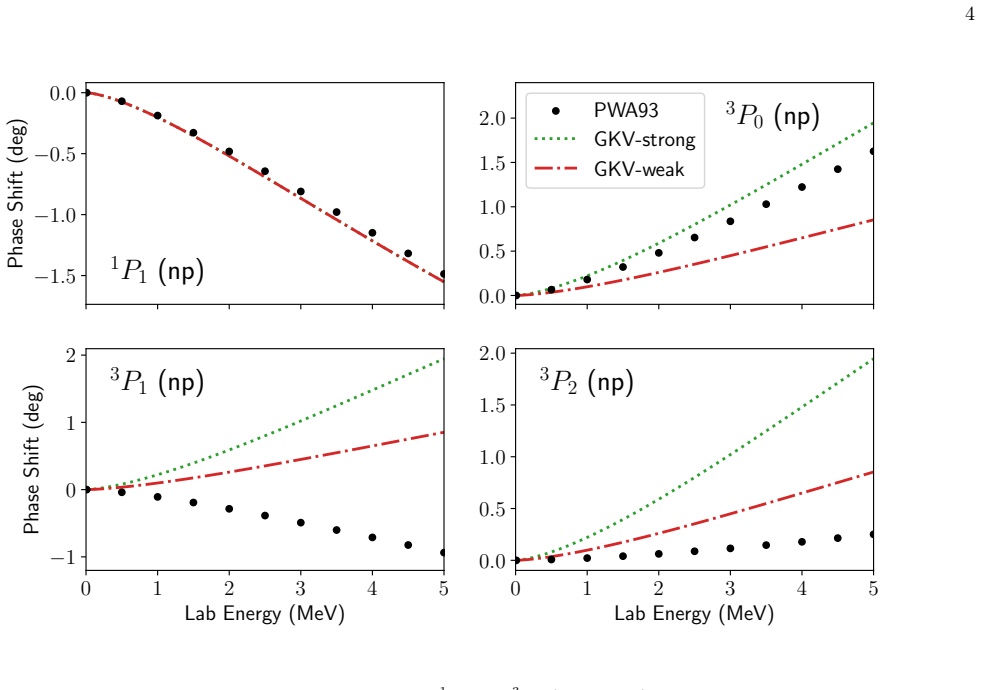
Gattobigio-Kievsky-Viviani potential In Ref. [37], it was found that, for thes-wave interac- tion considered there, 6He and 6Li were unbound once the repulsive three-body force and Coulomb interaction 5 were included. They further showed that adding a weak attractivep-wave component was sufficient to bind the six-nucleon systems. Following that work, we e...
-
[4]
o” The three-nucleon (3N) force included in model “o
Model “o” The three-nucleon (3N) force included in model “o” is of the form Vijk = cE f4πΛχ (¯hc)6 π3R6 3 X cyc e−(r2 ij+r2 jk)/R2 3 ,(21) whereΛ χ = 1GeVisthebreakingscale,f π = 92.4MeVis the pion decay constant, andP cyc denotes cyclic permu- tationsoftheindicesi,j, andk. Thelow-energyconstant cE is fixed to reproduce the3H binding energy for a given va...
-
[5]
CIB-triangle
CIB and GKV potentials The three-body force associated with the CIB and GKVN Npotentials retains the same functional form as in Eq. (21). However, as argued in Ref. [40], regula- torartifacts incontact3Nforcesarereducedby retaining only triples with total spin and isospinS= 1/2,T= 1/2, which survive the zero-range limit. A similar form was also considered...
-
[6]
The output dimension is either 1 or 16, depending on whether the network maps to the final output space or to a latent space. The activation function used through- out is the hyperbolic tangent, and all pooling operations use logsumexp. In total, the neural-network quantum state contains11,012trainable parameters for the even- Asystems and 13,734 for the ...
-
[7]
R. Schiavilla, L. Girlanda, A. Gnech, A. Kievsky, A. Lo- vato, L. E. Marcucci, M. Piarulli, and M. Viviani, Two- and three-nucleon contact interactions and ground-state energies of light- and medium-mass nuclei, Phys. Rev. C 103, 054003 (2021), arXiv:2102.02327 [nucl-th]
Pith/arXiv arXiv 2021
-
[8]
T. Otsuka, T. Suzuki, J. D. Holt, A. Schwenk, and Y. Akaishi, Three-body forces and the limit of oxy- gen isotopes, Phys. Rev. Lett.105, 032501 (2010), arXiv:0908.2607 [nucl-th]
Pith/arXiv arXiv 2010
-
[9]
G. Hagen, M. Hjorth-Jensen, G. R. Jansen, R. Machleidt, and T. Papenbrock, Continuum effects and three-nucleon forces in neutron-rich oxygen isotopes, Phys. Rev. Lett. 108, 242501 (2012), arXiv:1202.2839 [nucl-th]
Pith/arXiv arXiv 2012
-
[10]
H. L. Crawford, K. Fossez, S. König, and A. Spyrou, A Vision for the Science of Rare Isotopes, Ann. Rev. Nucl. Part. Sci.74, 141 (2024), arXiv:2312.09129 [nucl-ex]
Pith/arXiv arXiv 2024
-
[11]
Frois and C
B. Frois and C. N. Papanicolas, Electron Scattering and Nuclear Structure, Ann. Rev. Nucl. Part. Sci.37, 133 (1987)
1987
-
[12]
Adhikariet al.(CREX), Precision Determination of the Neutral Weak Form Factor of Ca48, Phys
D. Adhikariet al.(CREX), Precision Determination of the Neutral Weak Form Factor of Ca48, Phys. Rev. Lett. 129, 042501 (2022), arXiv:2205.11593 [nucl-ex]
Pith/arXiv arXiv 2022
-
[13]
Hergert, A Guided Tour ofab initioNuclear Many-Body Theory, Front
H. Hergert, A Guided Tour ofab initioNuclear Many-Body Theory, Front. in Phys.8, 379 (2020), arXiv:2008.05061 [nucl-th]
Pith/arXiv arXiv 2020
-
[14]
K.Tsukiyama, S.K.Bogner,andA.Schwenk,In-Medium Similarity Renormalization Group for Nuclei, Phys. Rev. Lett.106, 222502 (2011), arXiv:1006.3639 [nucl-th]
Pith/arXiv arXiv 2011
-
[15]
B. Huet al., Ab initio predictions link the neutron skin of 208Pb to nuclear forces, Nature Phys.18, 1196 (2022), arXiv:2112.01125 [nucl-th]
Pith/arXiv arXiv 2022
-
[16]
G. Hagen, T. Papenbrock, D. J. Dean, and M. Hjorth- Jensen, Medium-mass nuclei from chiral nucleon-nucleon interactions, Phys. Rev. Lett.101, 092502 (2008), arXiv:0806.3478 [nucl-th]
Pith/arXiv arXiv 2008
-
[17]
F. Bonaiti, G. Hagen, and T. Papenbrock, Structure of the doubly magic nuclei208Pb and 266Pb from ab initio computations (2025), arXiv:2508.14217 [nucl-th]
Pith/arXiv arXiv 2025
-
[18]
V. Somà, P. Navrátil, F. Raimondi, C. Barbieri, and T. Duguet, Novel chiral Hamiltonian and observables in light and medium-mass nuclei, Phys. Rev. C101, 014318 (2020), arXiv:1907.09790 [nucl-th]
Pith/arXiv arXiv 2020
-
[19]
S. A. Coon, M. I. Avetian, M. K. G. Kruse, U. van Kolck, P. Maris, and J. P. Vary, Convergence properties of \it ab initio calculations of light nuclei in a harmonic oscillator basis, Phys. Rev. C86, 054002 (2012), arXiv:1205.3230 [nucl-th]
Pith/arXiv arXiv 2012
-
[20]
S. N. More, A. Ekström, R. J. Furnstahl, G. Hagen, and T. Papenbrock, Universal properties of infrared oscillator basis extrapolations, Phys. Rev. C87, 044326 (2013), arXiv:1302.3815 [nucl-th]
Pith/arXiv arXiv 2013
-
[21]
M. A. Caprio, P. Maris, and J. P. Vary, The Coulomb- Sturmian basis for the nuclear many-body problem, Phys. Rev. C86, 034312 (2012), arXiv:1208.4156 [nucl- th]
Pith/arXiv arXiv 2012
-
[22]
Kravvaris and A
K. Kravvaris and A. Volya, Study of Nuclear Cluster- ing from an Ab Initio Perspective, Phys. Rev. Lett.119, 062501 (2017)
2017
-
[23]
Otsuka, T
T. Otsuka, T. Abe, T. Yoshida, Y. Tsunoda, N. Shimizu, N. Itagaki, Y. Utsuno, J. Vary, P. Maris, and H. Ueno, α-Clustering in atomic nuclei from first principles with statistical learning and the Hoyle state character, Nature Commun.13, 2234 (2022)
2022
-
[24]
J.Carlson, S.Gandolfi, F.Pederiva, S.C.Pieper, R.Schi- avilla, K. E. Schmidt, and R. B. Wiringa, Quantum Monte Carlo methods for nuclear physics, Rev. Mod. Phys.87, 1067 (2015), arXiv:1412.3081 [nucl-th]
Pith/arXiv arXiv 2015
-
[25]
E. Epelbaum, H. Krebs, D. Lee, and U.-G. Meissner, Ab initiocalculationoftheHoylestate,Phys.Rev.Lett.106, 192501 (2011), arXiv:1101.2547 [nucl-th]
Pith/arXiv arXiv 2011
-
[26]
Piarulliet al., Light-nuclei spectra from chi- ral dynamics, Phys
M. Piarulliet al., Light-nuclei spectra from chi- ral dynamics, Phys. Rev. Lett.120, 052503 (2018), arXiv:1707.02883 [nucl-th]
Pith/arXiv arXiv 2018
-
[27]
J. D. Martin, S. J. Novario, D. Lonardoni, J. Carlson, S. Gandolfi, and I. Tews, Auxiliary field diffusion Monte Carlo calculations of magnetic moments of light nuclei with chiral effective field theory interactions, Phys. Rev. C108, L031304 (2023), arXiv:2301.08349 [nucl-th]
Pith/arXiv arXiv 2023
-
[28]
S. Gandolfi, A. Lovato, J. Carlson, and K. E. Schmidt, From the lightest nuclei to the equation of state of asym- metric nuclear matter with realistic nuclear interactions, Phys. Rev. C90, 061306 (2014), arXiv:1406.3388 [nucl- th]
Pith/arXiv arXiv 2014
-
[29]
G. Carleo and M. Troyer, Solving the quantum many- body problem with artificial neural networks, Science 355, 602 (2017), arXiv:1606.02318 [cond-mat.dis-nn]
Pith/arXiv arXiv 2017
-
[30]
J. W. T. Keeble and A. Rios, Machine learning the deuteron, Phys. Lett. B809, 135743 (2020), 14 arXiv:1911.13092 [nucl-th]
Pith/arXiv arXiv 2020
-
[31]
C. Adams, G. Carleo, A. Lovato, and N. Rocco, Varia- tional Monte Carlo Calculations of A≤4 Nuclei with an Artificial Neural-Network Correlator Ansatz, Phys. Rev. Lett.127, 022502 (2021), arXiv:2007.14282 [nucl-th]
Pith/arXiv arXiv 2021
-
[32]
A. Lovato, C. Adams, G. Carleo, and N. Rocco, Hidden- nucleons neural-network quantum states for the nuclear many-body problem, Phys. Rev. Res.4, 043178 (2022), arXiv:2206.10021 [nucl-th]
Pith/arXiv arXiv 2022
-
[33]
Y. L. Yang and P. W. Zhao, A consistent description of the relativistic effects and three-body interactions in atomic nuclei, Phys. Lett. B835, 137587 (2022), arXiv:2206.13208 [nucl-th]
Pith/arXiv arXiv 2022
-
[34]
B. Fore, J. M. Kim, G. Carleo, M. Hjorth-Jensen, A. Lovato, and M. Piarulli, Dilute neutron star matter from neural-network quantum states, Phys. Rev. Res.5, 033062 (2023), arXiv:2212.04436 [nucl-th]
Pith/arXiv arXiv 2023
-
[35]
B. Fore, J. Kim, M. Hjorth-Jensen, and A. Lovato, Investigating the crust of neutron stars with neural- network quantum states, Commun. Phys.8, 108 (2025), arXiv:2407.21207 [nucl-th]
Pith/arXiv arXiv 2025
-
[36]
E. Parnes, N. Barnea, G. Carleo, A. Lovato, N. Rocco, and X. Zhang, Nuclear Responses with Neural-Network Quantum States, Phys. Rev. Lett.136, 032501 (2026), arXiv:2504.20195 [nucl-th]
Pith/arXiv arXiv 2026
-
[37]
Y. Yang, E. Epelbaum, J. Meng, L. Meng, and P. Zhao, Chiral Symmetry and Peripheral Neutron-αScattering, Phys. Rev. Lett.135, 172502 (2025), arXiv:2502.09961 [nucl-th]
arXiv 2025
-
[38]
A. Di Donna, L. Contessi, A. Lovato, and F. Pederiva, Hypernuclei with neural network quantum states, Phys. Rev. Res.8, 013160 (2026), arXiv:2507.16994 [nucl-th]
Pith/arXiv arXiv 2026
-
[39]
Z.-X. Zhang, Y.-L. Yang, W.-B. He, P.-W. Zhao, B.-N. Lu, and Y.-G. Ma, Machine learning the single-Λhyper- nuclei with neural-network quantum states, Phys. Lett. B874, 140285 (2026), arXiv:2508.03575 [nucl-th]
Pith/arXiv arXiv 2026
-
[40]
Z.-X. Zhang, Y.-L. Yang, X.-L. Qian, W.-B. He, P.- W. Zhao, B.-N. Lu, and Y.-G. Ma, Neural-network ex- cited states ofA= 4nuclei and hypernuclei, (2026), arXiv:2605.30944 [nucl-th]
Pith/arXiv arXiv 2026
-
[41]
B.-N. Lu, N. Li, S. Elhatisari, D. Lee, E. Epelbaum, and U.-G. Meißner, Essential elements for nuclear bind- ing, Phys. Lett. B797, 134863 (2019), arXiv:1812.10928 [nucl-th]
Pith/arXiv arXiv 2019
-
[42]
A. Gnech, B. Fore, A. J. Tropiano, and A. Lovato, Distill- ingtheEssentialElementsofNuclearBindingviaNeural- Network Quantum States, Phys. Rev. Lett.133, 142501 (2024), arXiv:2308.16266 [nucl-th]
Pith/arXiv arXiv 2024
-
[43]
M. Gattobigio, A. Kievsky, and M. Viviani, Embedding nuclear physics inside the unitary-limit window, Phys. Rev. C100, 034004 (2019), arXiv:1903.08900 [nucl-th]
Pith/arXiv arXiv 2019
-
[44]
R. B. Wiringa, V. G. J. Stoks, and R. Schiavilla, An Accurate nucleon-nucleon potential with charge indepen- dence breaking, Phys. Rev. C51, 38 (1995), arXiv:nucl- th/9408016
arXiv 1995
-
[45]
V. G. J. Stoks, R. A. M. Klomp, M. C. M. Rentmeester, and J. J. de Swart, Partial wave analysis of all nucleon- nucleon scattering data below 350-MeV, Phys. Rev. C 48, 792 (1993)
1993
-
[46]
J. E. Lynn, I. Tews, J. Carlson, S. Gandolfi, A. Gez- erlis, K. E. Schmidt, and A. Schwenk, Quantum Monte Carlo calculations of light nuclei with local chiral two- and three-nucleon interactions, Phys. Rev. C96, 054007 (2017), arXiv:1706.07668 [nucl-th]
Pith/arXiv arXiv 2017
-
[47]
T. Weiss-Attia, M. Schäfer, and B. Bazak, Perturba- tive application of next-to-leading order pionless EFT for A≤3 nuclei in a finite volume, Phys. Rev. D109, 114515 (2024), arXiv:2402.04817 [nucl-th]
Pith/arXiv arXiv 2024
-
[48]
J. Hermann, J. Spencer, K. Choo, A. Mezzacapo, W. M. C. Foulkes, D. Pfau, G. Carleo, and F. Noé, Ab-initio quantum chemistry with neural-network wave- functions, arXiv e-prints , arXiv:2208.12590 (2022), arXiv:2208.12590 [physics.chem-ph]
Pith/arXiv arXiv 2022
-
[49]
A. Gnech, C. Adams, N. Brawand, G. Carleo, A. Lovato, and N. Rocco, Nuclei with up toA= 6nucleons with artificial neural network wave functions, Few Body Syst. 63, 7 (2022), arXiv:2108.06836 [nucl-th]
Pith/arXiv arXiv 2022
-
[50]
Y. Yang and P. Zhao, Deep-neural-network approach to solving the ab initio nuclear structure problem, Phys. Rev. C107, 034320 (2023), arXiv:2211.13998 [nucl-th]
Pith/arXiv arXiv 2023
-
[51]
J.Kim, G.Pescia, B.Fore, J.Nys, G.Carleo, S.Gandolfi, M. Hjorth-Jensen, and A. Lovato, Neural-network quan- tum states for ultra-cold Fermi gases, Commun. Phys.7, 148 (2024), arXiv:2305.08831 [cond-mat.quant-gas]
Pith/arXiv arXiv 2024
-
[52]
P. Massella, F. Barranco, D. Lonardoni, A. Lovato, F. Pederiva, and E. Vigezzi, Exact restoration of Galilei invariance in density functional calculations with quan- tum Monte Carlo, J. Phys. G47, 035105 (2020), arXiv:1808.00518 [nucl-th]
Pith/arXiv arXiv 2020
-
[53]
M. Bukov, M. Schmitt, and M. Dupont, Learning the ground state of a non-stoquastic quantum Hamiltonian in a rugged neural network landscape, SciPost Phys.10, 147 (2021), arXiv:2011.11214 [physics.comp-ph]
Pith/arXiv arXiv 2021
-
[54]
M. Zaheer, S. Kottur, S. Ravanbakhsh, B. Poczos, R. Salakhutdinov, and A. Smola, Deep Sets, arXiv e-prints , arXiv:1703.06114 (2017), arXiv:1703.06114 [cs.LG]
Pith/arXiv arXiv 2017
-
[55]
E. Wagstaff, F. B. Fuchs, M. Engelcke, I. Posner, and M. Osborne, On the Limitations of Representing Func- tions on Sets, arXiv e-prints , arXiv:1901.09006 (2019), arXiv:1901.09006 [cs.LG]
Pith/arXiv arXiv 1901
-
[56]
Sorella, Wave function optimization in the variational Monte Carlo method, Phys
S. Sorella, Wave function optimization in the variational Monte Carlo method, Phys. Rev. B71, 241103 (2005)
2005
-
[57]
A. J. Smith, K. Godbey, C. Hebborn, W. Nazarewicz, F. M. Nunes, and P. G. Reinhard, Matter radii from in- teraction cross sections using microscopic nuclear densi- ties (2026), arXiv:2603.18862 [nucl-th]
arXiv 2026
-
[58]
Z. H. Sun, A. Ekström, C. Forssén, G. Hagen, G. R. Jansen,andT.Papenbrock,MultiscalePhysicsofAtomic Nuclei from First Principles, Phys. Rev. X15, 011028 (2025), arXiv:2404.00058 [nucl-th]
Pith/arXiv arXiv 2025
-
[59]
S. C. Pieper and V. R. Pandharipande, Origins of spin- orbit splitting in15N, Phys. Rev. Lett.70, 2541 (1993)
1993
-
[60]
D. Pfau, S. Axelrod, H. Sutterud, I. von Glehn, and J. S. Spencer, Accurate Computation of Quantum Ex- cited States with Neural Networks, Science385, 6711 (2024), arXiv:2308.16848 [physics.comp-ph]
Pith/arXiv arXiv 2024
-
[61]
Miyagi, Nuclear radii from first principles, Front
T. Miyagi, Nuclear radii from first principles, Front. in Phys.13, 1581854 (2025)
2025
-
[62]
Tanihata, H
I. Tanihata, H. Savajols, and R. Kanungo, Recent exper- imental progress in nuclear halo structure studies, Prog. Part. Nucl. Phys.68, 215 (2013)
2013
-
[63]
A. J. Miller, K. Minamisono, A. Klose, D. Garand, C. Kujawa, J. D. Lantis, Y. Liu, B. Maaß, P. F. Man- tica, W. Nazarewicz, W. Nörtershäuser, S. V. Pineda, P. G. Reinhard, D. M. Rossi, F. Sommer, C. Sum- ithrarachchi, A. Teigelhöfer, and J. Watkins, Proton su- perfluidity and charge radii in proton-rich calcium iso- 15 topes, Nature Physics15, 432 (2019)
2019
-
[64]
R. F. Garcia Ruiz and A. R. Vernon, Emergence of sim- ple patterns in many-body systems: from macroscopic objects to the atomic nucleus, Eur. Phys. J. A56, 136 (2020), arXiv:1911.04819 [nucl-ex]
Pith/arXiv arXiv 2020
-
[65]
T. Naito, T. Oishi, H. Sagawa, and Z. Wang, Compara- tive study on charge radii and their kinks at magic num- bers, Phys. Rev. C107, 054307 (2023), arXiv:2209.02857 [nucl-th]
Pith/arXiv arXiv 2023
-
[66]
X. F. Yang, S. J. Wang, S. G. Wilkins, and R. F. Garcia Ruiz, Laser spectroscopy for the study of ex- otic nuclei, Prog. Part. Nucl. Phys.129, 104005 (2023), arXiv:2209.15228 [nucl-ex]
Pith/arXiv arXiv 2023
-
[67]
M. Kortelainen, T. Lesinski, J. More, W. Nazarewicz, J. Sarich, N. Schunck, M. V. Stoitsov, and S. Wild, Nu- clear Energy Density Optimization, Phys. Rev. C82, 024313 (2010), arXiv:1005.5145 [nucl-th]
Pith/arXiv arXiv 2010
-
[68]
Kortelainenet al., Nuclear energy density optimiza- tion: Shell structure, Phys
M. Kortelainenet al., Nuclear energy density optimiza- tion: Shell structure, Phys. Rev. C89, 054314 (2014), arXiv:1312.1746 [nucl-th]
Pith/arXiv arXiv 2014
-
[69]
M. Li, Y. Yang, and P. Zhao, Efficient emulation of nuclear ground states with neural-network varia- tional Monte Carlo and eigenvector continuation (2026), arXiv:2606.12998 [nucl-th]
Pith/arXiv arXiv 2026
-
[70]
T. Duguet, A. Ekström, R. J. Furnstahl, S. König, and D. Lee, Colloquium: Eigenvector continuation and projection-based emulators, Rev. Mod. Phys.96, 031002 (2024), arXiv:2310.19419 [nucl-th]
Pith/arXiv arXiv 2024
discussion (0)
Sign in with ORCID, Apple, or X to comment. Anyone can read and Pith papers without signing in.