REVIEW 4 major objections 4 minor 46 references
Combining homomorphic encryption and differential privacy in federated learning protects sensitive data while keeping model accuracy usable on health and finance tasks.
Reviewed by Pith at T0; open to challenge. T0 means a machine referee read the full paper against a public rubric. the ladder, T0–T4 →
T0 review · grok-4.5
2026-07-13 03:21 UTC pith:R3IQ3H4P
load-bearing objection Competent small-scale empirical wiring of CKKS+DP+FedAvg that confirms expected trade-offs, but overclaims readiness and has a messy literature section. the 4 major comments →
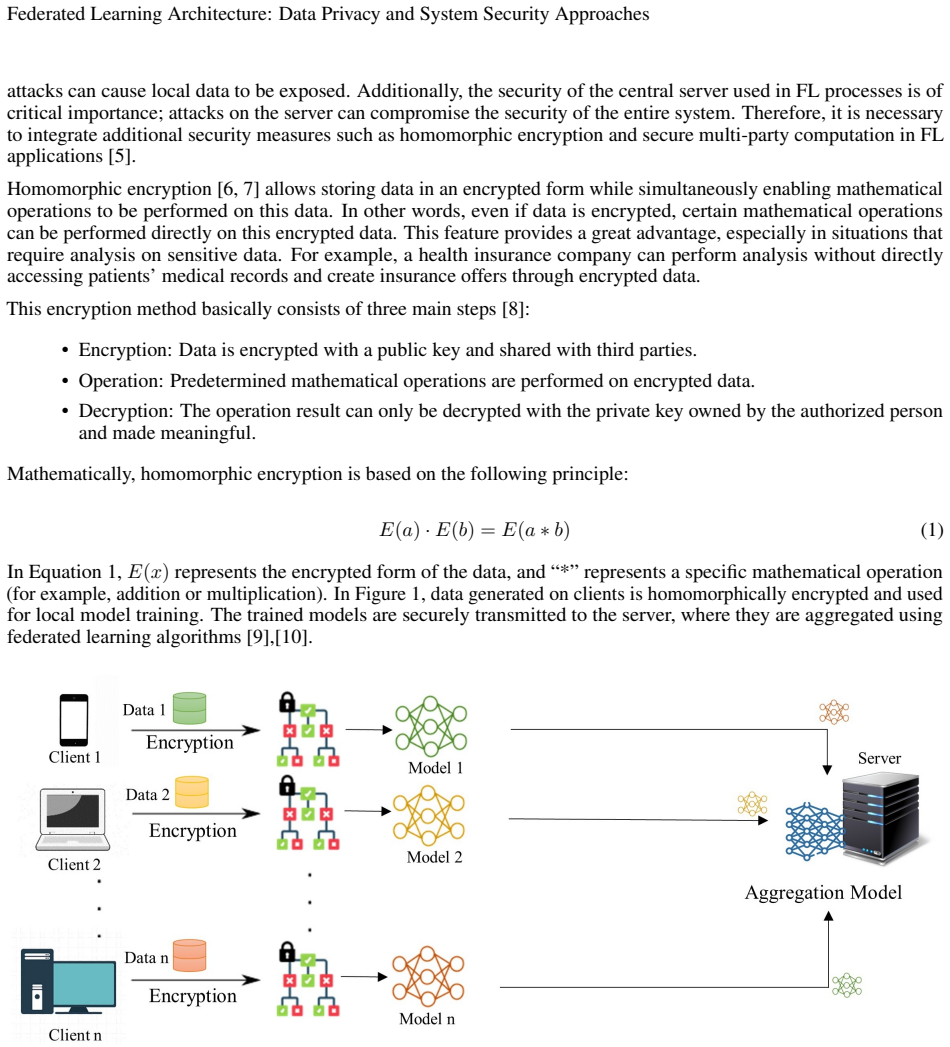
Federated Learning Architecture: Data Privacy and System Security Approaches
The pith
A machine-rendered reading of the paper's core claim, the machinery that carries it, and where it could break.
Core claim
A federated-learning pipeline that encrypts client model updates with the CKKS homomorphic scheme and injects differential-privacy noise (fixed σ = 5, max-grad-norm 0.5, δ = 10⁻⁵) during local training can deliver enhanced privacy guarantees while retaining classification accuracy close to the non-private baseline on Framingham, Pima Indians Diabetes, and Bank Marketing data. Accuracy drops are modest (a few percentage points) and are smaller when each client holds more samples; the authors therefore conclude that privacy-preserving, high-performance AI is feasible for sensitive healthcare and finance applications.
What carries the argument
CKKS homomorphic encryption of local weights plus Opacus-style differential privacy on each client’s gradients, aggregated by encrypted FedAvg and decrypted only at the server. The pair ensures that neither plaintext updates nor individual-record influence reach the central model.
Load-bearing premise
The claim that the architecture is ready for real healthcare and finance use rests on simulations with only 3–10 clients that each hold hundreds of records and on fixed privacy hyperparameters never stress-tested under adversarial or highly non-IID conditions.
What would settle it
Re-run the identical pipeline on a realistic partition of hundreds of clients each holding only a few dozen records (or under non-IID and poisoning attacks) and measure whether accuracy falls below usable clinical or banking thresholds while the cumulative privacy budget still stays small; a sharp accuracy collapse or privacy-budget explosion would falsify the readiness claim.
Editorial analysis
A structured set of objections, weighed in public.
Referee Report
Summary. The manuscript proposes a federated learning architecture that combines CKKS homomorphic encryption for encrypted model-parameter aggregation with differential privacy (via gradient noise and clipping) during local training. An ANN is trained under FedAvg on three public tabular datasets (Framingham, Pima Indians Diabetes, Bank Marketing) after standard preprocessing (SMOTE/IQR/StandardScaler). Experiments vary the number of clients (3/5/10) over 10 rounds, report accuracy/precision/recall/F1 with and without DP, and track the cumulative privacy budget ε. The authors conclude that privacy can be enhanced without significantly compromising accuracy and that the approach is suitable for healthcare and finance.
Significance. If the privacy–utility claims hold under realistic conditions, the work would supply a concrete, end-to-end recipe (CKKS + DP-SGD + FedAvg) usable by practitioners in regulated domains. The paper does ship reproducible experimental artifacts: with/without-DP tables (Tables 3–4), ε-vs-round curves (Figures 2–5), and an explicit Algorithm 1. These are genuine strengths relative to purely conceptual FL-privacy surveys. Novelty is incremental rather than foundational—HE+DP combinations already appear in the cited literature—but a clean multi-dataset comparison with explicit ε accounting remains useful for the applied security community.
major comments (4)
- [Abstract, Tables 3–4, §4–§5] Abstract and §4–§5 repeatedly claim that enhanced privacy is obtained “without significantly compromising model accuracy.” Tables 3–4 show otherwise on the medical sets: PID 10-client recall falls from 0.7447 (no DP) to 0.3404 (DP); Framingham 5-client F1 falls from 0.7328 to 0.6208. Even on Bank the absolute accuracy drop reaches 8 points. The qualifier “significantly” is therefore unsupported by the reported numbers and must be removed or replaced by a quantitative statement of the observed utility loss.
- [§3.2–§4, Tables 3–4] The only controlled ablation is DP-on versus DP-off under an otherwise identical HE pipeline. There is no plaintext FedAvg baseline and no HE-only (no-DP) versus plaintext comparison, so the incremental communication/compute cost and any accuracy degradation attributable to CKKS itself are never isolated. Because the central claim is that the joint architecture is practical, this missing baseline is load-bearing.
- [Abstract, §1, §3.2] Abstract and §1 assert that “the impact of data heterogeneity among clients o was analyzed.” Methodology §3.2 states that each dataset is simply partitioned into equal-sized random shards; no non-IID label or feature skew is introduced, nor are any heterogeneity metrics (e.g., Earth-mover distance, label distribution divergence) reported. The claim of a heterogeneity analysis is therefore not substantiated by the experimental design.
- [§4–§5, Algorithm 1] All experiments use only 3–10 clients, each holding hundreds of records, with fixed DP hyperparameters (σ=5.0, max_grad_norm=0.5, δ=10^{-5}). Section 5 itself acknowledges that real deployments involve far more clients and sparser local data, yet the abstract and conclusion still assert readiness for healthcare/finance. The experimental regime therefore does not support the deployment claim that underwrites the paper’s significance.
minor comments (4)
- [§2, Table 1] Section 2 conflates “differential learning” with differential privacy and cites unrelated papers (e.g., [25] is a cosmology article, [26]–[29] do not address DP). The literature table and narrative need a thorough citation audit.
- [Figures 2–4] Figures 2–4 plot accuracy and ε but lack error bars or multiple random seeds; a single-run presentation weakens confidence in the reported trends.
- [§3.2.1] CKKS noise growth and the precise encoding of floating-point weights are never quantified; a short paragraph on parameter choices (poly degree, scale, multiplicative depth) would improve reproducibility.
- [Algorithm 1, §4] Typographical issues: “givin” → “given” (Algorithm 1 caption), inconsistent capitalization of “Round,” and several missing spaces after periods.
Circularity Check
No circularity: empirical FL+HE+DP results measure accuracy and epsilon as independent outputs of fixed-hyperparameter training, not tautologies of fitted free parameters or self-definitional reductions.
full rationale
The paper is an experimental systems study, not a first-principles derivation. Its load-bearing claims (abstract; §4 Tables 3–4; §5) rest on measured test-set accuracy/precision/recall/F1 and cumulative privacy budget ε obtained by running FedAvg with CKKS encryption of client weights plus fixed DP-SGD noise (σ=5.0, max_grad_norm=0.5, δ=10^{-5}) for a stated number of rounds and clients. These quantities are not defined in terms of each other, nor are free parameters fitted to a subset of the same metrics and then re-labeled “predictions.” Self-citations appear in related-work and author-contribution sections but are not invoked as uniqueness theorems or load-bearing premises that force the experimental outcomes. The acknowledged limitations (§5) further separate the simulation regime from any claim of necessity. Consequently the derivation chain contains no self-definitional loop, fitted-input-as-prediction, or self-citation reduction; score 0 with empty steps is the correct finding.
Axiom & Free-Parameter Ledger
free parameters (6)
- DP noise multiplier σ
- max_grad_norm (gradient clip)
- δ (DP failure probability)
- local epochs E, learning rate η, batch size
- ANN widths and dropout
- number of clients N ∈ {3,5,10} and train/test split 90/10
axioms (4)
- domain assumption FedAvg of encrypted client weights yields a valid global model after decryption (Algorithm 1).
- domain assumption CKKS approximate arithmetic preserves enough precision for ANN weight averaging on these models.
- standard math Opacus-style PrivacyEngine composition correctly accounts cumulative (ε,δ) over local steps and rounds.
- ad hoc to paper Public Framingham/Pima/Bank sets after SMOTE/IQR cleaning are adequate proxies for sensitive healthcare and finance FL.
read the original abstract
This study explores the integration of homomorphic encryption and differential privacy techniques to enhance data privacy and security in Federated Learning (FL) systems. FL allows data to remain on local devices, eliminating the need for centralized data collection; however, sensitive information may still be leaked during model updates. To address this issue, homomorphic encryption enables computations on encrypted data, while differential privacy prevents the extraction of individual information through statistical techniques applied to model outputs. The proposed architecture was tested on the Framingham, Pima Indians Diabetes, and Bank Marketing datasets, revealing that enhanced privacy can be achieved without significantly compromising model accuracy. Furthermore, the impact of data heterogeneity among clients on model performance was analyzed, and it was concluded that strategies such as the careful selection of differential privacy parameters and training settings, along with the use of larger datasets, can improve the efficiency of FL. The findings demonstrate that privacy-preserving and high-performance artificial intelligence systems can be securely applied in sensitive domains such as healthcare and finance.
Figures


Reference graph
Works this paper leans on
-
[1]
Arda Kurt, Abdulsamet Cakir, Cemal Can Polat, Bü¸ sra Büyüktanır, Gozde Karatas Baydogmus, and Kazım Yıldız. Evaluating sisa-based machine unlearning across diverse modalities: Tabular, visual and auditory data.Journal of Naval Sciences and Engineering, (Advanced Online Publication):151–187
-
[2]
De- centralized disease prediction: A federated learning perspective.Afyon Kocatepe Üniversitesi Fen Ve Mühendislik Bilimleri Dergisi, (Advanced Online Publication):337–353, 2026
Abdülbaki Demir, Ahmet Yasir Kulaksız, Bü¸ sra Büyüktanır, Gozde Karatas Baydogmus, and Kazım Yıldız. De- centralized disease prediction: A federated learning perspective.Afyon Kocatepe Üniversitesi Fen Ve Mühendislik Bilimleri Dergisi, (Advanced Online Publication):337–353, 2026
2026
-
[3]
Jakub Koneˇcn`y, H Brendan McMahan, Daniel Ramage, and Peter Richtárik. Federated optimization: Distributed machine learning for on-device intelligence.arXiv preprint arXiv:1610.02527, 2016
Pith/arXiv arXiv 2016
-
[4]
Federated learning in intrusion detection: advancements, applications, and future directions.Cluster Computing, 28(7):473, 2025
Busra Buyuktanir, ¸ Sahsene Altinkaya, Gozde Karatas Baydogmus, and Kazim Yildiz. Federated learning in intrusion detection: advancements, applications, and future directions.Cluster Computing, 28(7):473, 2025
2025
-
[5]
Ozer Ozturk, Busra Buyuktanir, Gozde Karatas Baydogmus, and Kazim Yildiz. Differential privacy in federated learning: Mitigating inference attacks with randomized response.arXiv preprint arXiv:2509.13987, 2025
arXiv 2025
-
[6]
A survey on homomorphic encryption schemes: Theory and implementation.ACM Computing Surveys (Csur), 51(4):1–35, 2018
Abbas Acar, Hidayet Aksu, A Selcuk Uluagac, and Mauro Conti. A survey on homomorphic encryption schemes: Theory and implementation.ACM Computing Surveys (Csur), 51(4):1–35, 2018
2018
-
[7]
Ensar Yilmaz, Burak Aktürk, Didem Civelek, Tolga Büyüktanır, and Kazım Yıldız. Homomorphic encryption in finance: Training and inference on encrypted data with concrete ml.Afyon Kocatepe Üniversitesi Fen Ve Mühendislik Bilimleri Dergisi, (Advanced Online Publication):64–77, 2026
2026
-
[8]
Homomorphic encryption.Procedia Computer Science, 20:502–509, 2013
Monique Ogburn, Claude Turner, and Pushkar Dahal. Homomorphic encryption.Procedia Computer Science, 20:502–509, 2013
2013
-
[9]
Bü¸ sra Büyüktanir, Kazim Yildiz, Eyüp Ülkü, and Tolga Bütüktanir. du-cba: Data-agnostic and incremental classification-based association rules extraction architecture du-cba: Veriden habersiz ve artirimli siniflandirmaya dayali birliktelik kurallari çikarma mimarisi.Journal of the Faculty of Engineering and Architecture of Gazi University, 38(3), 2023
2023
-
[10]
Enhancing employee retention prediction through federated learning and associative classification using fedcba: A case study on ibm hr analytics
Busra Buyuktanir, Gozde Karatas Baydogmus, Eyup Emre Ulku, and Kazim Yildiz. Enhancing employee retention prediction through federated learning and associative classification using fedcba: A case study on ibm hr analytics. Arabian Journal for Science and Engineering, pages 1–28, 2026
2026
-
[11]
The framingham heart study and the epidemiology of cardiovascular disease: a historical perspective.The lancet, 383(9921):999–1008, 2014
Syed S Mahmood, Daniel Levy, Ramachandran S Vasan, and Thomas J Wang. The framingham heart study and the epidemiology of cardiovascular disease: a historical perspective.The lancet, 383(9921):999–1008, 2014
2014
-
[12]
Using the adap learning algorithm to forecast the onset of diabetes mellitus
Jack W Smith, James E Everhart, William C Dickson, William C Knowler, and Robert Scott Johannes. Using the adap learning algorithm to forecast the onset of diabetes mellitus. InProceedings of the annual symposium on computer application in medical care, page 261, 1988
1988
-
[13]
Federated learning: Challenges, methods, and future directions.IEEE signal processing magazine, 37(3):50–60, 2020
Tian Li, Anit Kumar Sahu, Ameet Talwalkar, and Virginia Smith. Federated learning: Challenges, methods, and future directions.IEEE signal processing magazine, 37(3):50–60, 2020
2020
-
[14]
Federated learning for healthcare informatics.Journal of healthcare informatics research, 5(1):1–19, 2021
Jie Xu, Benjamin S Glicksberg, Chang Su, Peter Walker, Jiang Bian, and Fei Wang. Federated learning for healthcare informatics.Journal of healthcare informatics research, 5(1):1–19, 2021
2021
-
[15]
Privacy in federated learning.arXiv preprint arXiv:2408.08904, 2024
Jaydip Sen, Hetvi Waghela, and Sneha Rakshit. Privacy in federated learning.arXiv preprint arXiv:2408.08904, 2024
Pith/arXiv arXiv 2024
-
[16]
Communication- efficient learning of deep networks from decentralized data
Brendan McMahan, Eider Moore, Daniel Ramage, Seth Hampson, and Blaise Aguera y Arcas. Communication- efficient learning of deep networks from decentralized data. InArtificial intelligence and statistics, pages 1273–1282. Pmlr, 2017
2017
-
[17]
Towards federated learning at scale: System design.Proceedings of machine learning and systems, 1:374–388, 2019
Keith Bonawitz, Hubert Eichner, Wolfgang Grieskamp, Dzmitry Huba, Alex Ingerman, Vladimir Ivanov, Chloe Kiddon, Jakub Kone ˇcn`y, Stefano Mazzocchi, Brendan McMahan, et al. Towards federated learning at scale: System design.Proceedings of machine learning and systems, 1:374–388, 2019
2019
-
[18]
Advances and open problems in federated learning.Foundations and trends in machine learning, 14(1-2):1–210, 2021
Peter Kairouz and H Brendan McMahan. Advances and open problems in federated learning.Foundations and trends in machine learning, 14(1-2):1–210, 2021
2021
-
[19]
Federated learning for mobile keyboard prediction.arXiv preprint arXiv:1811.03604, 2018
Andrew Hard, Kanishka Rao, Rajiv Mathews, Swaroop Ramaswamy, Françoise Beaufays, Sean Augenstein, Hubert Eichner, Chloé Kiddon, and Daniel Ramage. Federated learning for mobile keyboard prediction.arXiv preprint arXiv:1811.03604, 2018
Pith/arXiv arXiv 2018
-
[20]
Privacy preserving machine learning with homomorphic encryption and federated learning.Future Internet, 13(4):94, 2021
Haokun Fang and Quan Qian. Privacy preserving machine learning with homomorphic encryption and federated learning.Future Internet, 13(4):94, 2021. 19 Federated Learning Architecture: Data Privacy and System Security Approaches
2021
-
[21]
Hetal: Efficient privacy-preserving transfer learning with homomorphic encryption
Seewoo Lee, Garam Lee, Jung Woo Kim, Junbum Shin, and Mun-Kyu Lee. Hetal: Efficient privacy-preserving transfer learning with homomorphic encryption. InInternational conference on machine learning, pages 19010– 19035. PMLR, 2023
2023
-
[22]
Yogachandran Rahulamathavan, Charuka Herath, Xiaolan Liu, Sangarapillai Lambotharan, and Carsten Maple. Fhefl: Fully homomorphic encryption friendly privacy-preserving federated learning with byzantine users.arXiv preprint arXiv:2306.05112, 2023
Pith/arXiv arXiv 2023
-
[23]
Simple encrypted arithmetic library-seal v2
Hao Chen, Kim Laine, and Rachel Player. Simple encrypted arithmetic library-seal v2. 1. InInternational conference on financial cryptography and data security, pages 3–18. Springer, 2017
2017
-
[24]
Cryptonets: Applying neural networks to encrypted data with high throughput and accuracy
Ran Gilad-Bachrach, Nathan Dowlin, Kim Laine, Kristin Lauter, Michael Naehrig, and John Wernsing. Cryptonets: Applying neural networks to encrypted data with high throughput and accuracy. InInternational conference on machine learning, pages 201–210. PMLR, 2016
2016
-
[25]
Nonminimal inflation in supersymmetric guts with u (1) r× z n symmetry.International Journal of Modern Physics D, 28(16):2040015, 2019
Muhammad Atif Masoud, Mansoor Ur Rehman, and Mian Muhammad Azeem Abid. Nonminimal inflation in supersymmetric guts with u (1) r× z n symmetry.International Journal of Modern Physics D, 28(16):2040015, 2019
2019
-
[26]
Training of deep learning neuro-skin neural network.arXiv preprint arXiv:2007.04796, 2020
Mehrdad Shafiei Dizaji. Training of deep learning neuro-skin neural network.arXiv preprint arXiv:2007.04796, 2020
Pith/arXiv arXiv 2007
-
[27]
Certifying safety when implementing consensus.arXiv preprint arXiv:1903.03501, 2019
Aurojit Panda. Certifying safety when implementing consensus.arXiv preprint arXiv:1903.03501, 2019
Pith/arXiv arXiv 1903
-
[28]
Meng Wang, Juan Liu, Wei Chen, and Anthony Ephremides. Joint queue-aware and channel-aware delay optimal scheduling of arbitrarily bursty traffic over multi-state time-varying channels.IEEE Transactions on Communications, 67(1):503–517, 2018
2018
-
[29]
Statistically and computationally efficient change point localization in regression settings.Journal of Machine Learning Research, 22(248):1–46, 2021
Daren Wang, Zifeng Zhao, Kevin Z Lin, and Rebecca Willett. Statistically and computationally efficient change point localization in regression settings.Journal of Machine Learning Research, 22(248):1–46, 2021
2021
-
[30]
Homomorphic encryption for arithmetic of approximate numbers
Jung Hee Cheon, Andrey Kim, Miran Kim, and Yongsoo Song. Homomorphic encryption for arithmetic of approximate numbers. InInternational conference on the theory and application of cryptology and information security, pages 409–437. Springer, 2017
2017
-
[31]
Derin ö ˘grenmede diferansiyel mahremiyet.Uluslararası Bilgi Güvenli˘ gi Mühendisli˘ gi Dergisi, 6(1):1–16, 2020
Yavuz Canbay and ¸ Seref Sa˘gıro˘glu. Derin ö ˘grenmede diferansiyel mahremiyet.Uluslararası Bilgi Güvenli˘ gi Mühendisli˘ gi Dergisi, 6(1):1–16, 2020
2020
-
[32]
Aerogel-based metasurfaces for perfect acoustic energy absorption.Applied Physics Letters, 115(6), 2019
Antonio A Fernández-Marín, Noé Jiménez, Jean-Philippe Groby, José Sánchez-Dehesa, and Vicente Romero- García. Aerogel-based metasurfaces for perfect acoustic energy absorption.Applied Physics Letters, 115(6), 2019
2019
-
[33]
Swift homomorphic encryption
Apple Inc. Swift homomorphic encryption. https://github.com/apple/ swift-homomorphic-encryption, 2024. Apache 2.0 Lisansı
2024
-
[34]
A hybrid approach to privacy-preserving federated learning
Stacey Truex, Nathalie Baracaldo, Ali Anwar, Thomas Steinke, Heiko Ludwig, Rui Zhang, and Yi Zhou. A hybrid approach to privacy-preserving federated learning. InProceedings of the 12th ACM workshop on artificial intelligence and security, pages 1–11, 2019
2019
-
[35]
Credit scoring through machine learning performance evaluation.Multidisci- plinary Joint Akseprin Journal, 1(2):01–08, 2023
Hongliang He and Zixuan Chen. Credit scoring through machine learning performance evaluation.Multidisci- plinary Joint Akseprin Journal, 1(2):01–08, 2023
2023
-
[36]
Federated machine learning: Concept and applications
Qiang Yang, Yang Liu, Tianjian Chen, and Yongxin Tong. Federated machine learning: Concept and applications. ACM Transactions on Intelligent Systems and Technology (TIST), 10(2):1–19, 2019
2019
-
[37]
Heart disease prediction using logistic regression
Dileep Kumar. Heart disease prediction using logistic regression. https://www.kaggle.com/datasets/ dileep070/heart-disease-prediction-using-logistic-regression, 2020. Accessed: 2025-05-07
2020
-
[38]
Algorithms in helib
Shai Halevi and Victor Shoup. Algorithms in helib. InAnnual Cryptology Conference, pages 554–571. Springer, 2014
2014
-
[39]
Calibrating noise to sensitivity in private data analysis
Cynthia Dwork, Frank McSherry, Kobbi Nissim, and Adam Smith. Calibrating noise to sensitivity in private data analysis. InTheory of cryptography conference, pages 265–284. Springer, 2006
2006
-
[40]
The algorithmic foundations of differential privacy.Foundations and trends® in theoretical computer science, 9(3-4):211–487, 2014
Cynthia Dwork and Aaron Roth. The algorithmic foundations of differential privacy.Foundations and trends® in theoretical computer science, 9(3-4):211–487, 2014
2014
-
[41]
The us census bureau adopts differential privacy
John M Abowd. The us census bureau adopts differential privacy. InProceedings of the 24th ACM SIGKDD international conference on knowledge discovery & data mining, pages 2867–2867, 2018
2018
-
[42]
Ssdbfan: Scalable and secure cluster-based data aggregation with blockchain for flying ad hoc networks.Sensors, 26(9):2585, 2026
Sufian Al Majmaie, Ghazal Ghajari, Niraj Prasad Bhatta, Mohamed I Ibrahem, and Fathi Amsaad. Ssdbfan: Scalable and secure cluster-based data aggregation with blockchain for flying ad hoc networks.Sensors, 26(9):2585, 2026. 20 Federated Learning Architecture: Data Privacy and System Security Approaches
2026
-
[43]
Zero-knowledge federated learning for privacy-preserving 5g authentication.Computers, 15(4):206, 2026
Ahmed Lateef Salih Al-Karawi and Rafet Akdeniz. Zero-knowledge federated learning for privacy-preserving 5g authentication.Computers, 15(4):206, 2026
2026
-
[44]
Ayan Joshi and Sabur Baidya. Securing the cognitive layer: A survey on security threats, defenses, and privacy- preserving architectures for llm-iot integration.Journal of Cybersecurity and Privacy, 6(2):63, 2026
2026
-
[45]
Efficiency optimization techniques in privacy-preserving federated learning with homomorphic encryption: A brief survey.IEEE Internet of Things Journal, 11(14):24569–24580, 2024
Qipeng Xie, Siyang Jiang, Linshan Jiang, Yongzhi Huang, Zhihe Zhao, Salabat Khan, Wangchen Dai, Zhe Liu, and Kaishun Wu. Efficiency optimization techniques in privacy-preserving federated learning with homomorphic encryption: A brief survey.IEEE Internet of Things Journal, 11(14):24569–24580, 2024
2024
-
[46]
An investiga- tion and performance evaluation of aggregation algorithms in federated learning architecture
Ahmet Önder Önlü, Burak Akca, Busra Buyuktanir, Kazim Yildiz, and Gozde Karatas Baydogmus. An investiga- tion and performance evaluation of aggregation algorithms in federated learning architecture. In2025 Innovations in Intelligent Systems and Applications Conference (ASYU), pages 1–6. IEEE, 2025. 21
2025
discussion (0)
Sign in with ORCID, Apple, or X to comment. Anyone can read and Pith papers without signing in.