REVIEW 3 major objections 5 minor 299 references
Predicting every nearby vehicle's lane-change intent and path together yields more accurate and collision-free traffic forecasts.
Reviewed by Pith at T0; open to challenge. T0 means a machine referee read the full paper against a public rubric. the ladder, T0–T4 →
T0 review · grok-4.5
2026-07-14 16:36 UTC pith:YBSIMRPO
load-bearing objection Solid scene-level packaging of known pieces with real multi-dataset gains; the evaluation unit is load-bearing but the core offline results still look useful. the 3 major comments →
A Dynamic Scene Interaction Reasoning Framework for Scene-level Lane-Change Intention and Trajectory Prediction of Multiple Interacting Vehicles
The pith
A machine-rendered reading of the paper's core claim, the machinery that carries it, and where it could break.
Core claim
A dynamic scene graph attention network (DSiGAT) that jointly outputs lane-change intention and future trajectory for every valid vehicle in a local multi-vehicle scene outperforms both target-centered intention models and multi-agent trajectory baselines on standard highway datasets, while also producing lower inter-agent collision rates and joint displacement errors.
What carries the argument
DSiGAT: a time-varying interaction graph whose nodes carry vehicle kinematics and lane state, whose directed edges encode gaps, relative speeds, lane relation, and time-to-collision; temporal graph-attention message passing; intention-guided weighted mixture of three maneuver-specific trajectory decoders; and a scene-level separation consistency loss.
Load-bearing premise
That a local scene of at most six continuously observed vehicles, linked only when they share a lane or adjacent lane and stay within 100 m longitudinally, is enough to capture the interactions that matter for planning.
What would settle it
On held-out highway scenes, check whether joint intention-plus-trajectory prediction of every valid vehicle still beats strong multi-agent baselines on accuracy, RMSE, inter-agent collision rate, and joint displacement error once scenes regularly contain more than six relevant neighbors or when edge construction ignores distant but influential vehicles.
Editorial analysis
A structured set of objections, weighed in public.
Referee Report
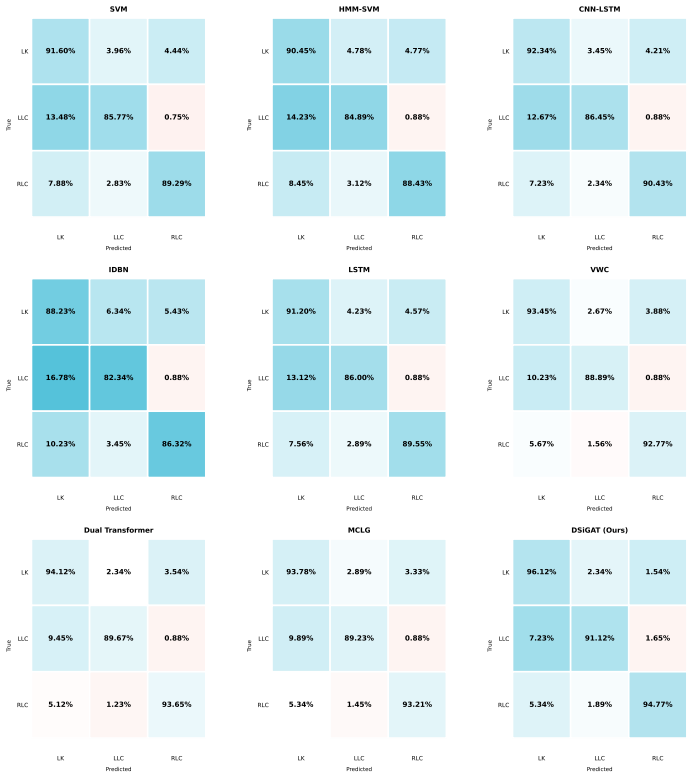
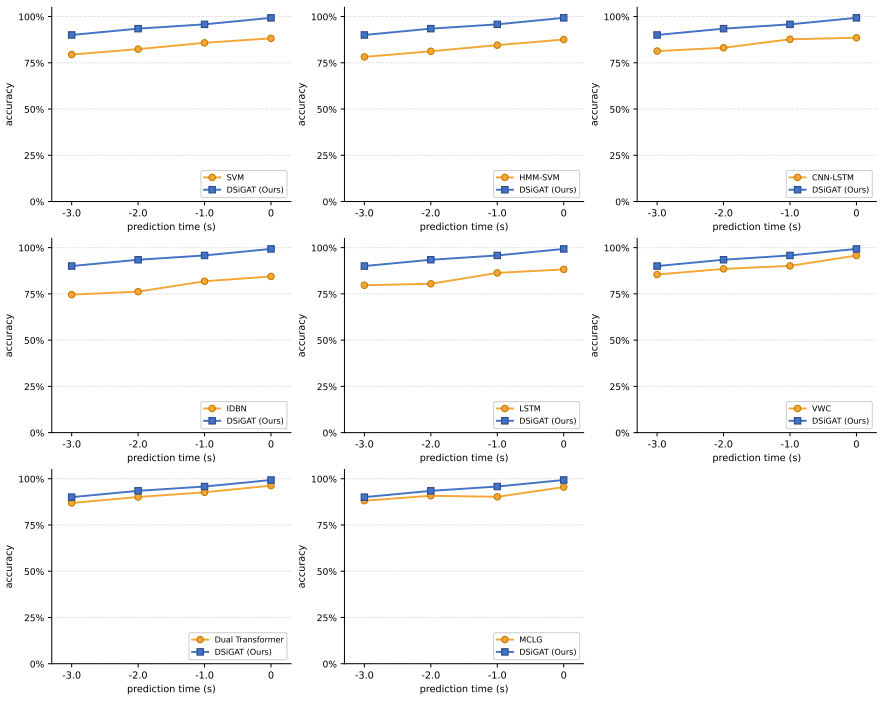
Summary. The paper proposes DSiGAT, a dynamic scene-graph attention model that jointly predicts lane-change intention (LK/LLC/RLC) and 4 s trajectories for every valid vehicle in a local highway scene (at most 6 continuously observed vehicles). Scenes are built as time-varying directed graphs with node kinematics and explicit edge features (gaps, relative speeds, lane relation, TTC); temporal graph attention produces scene-aware embeddings, an intention head yields per-vehicle maneuver probabilities, and three maneuver-specific decoders are mixed by those probabilities. Training adds an intention–trajectory gating term and a pairwise separation penalty (L_scene). On NGSIM I-80/US-101 and highD, the authors report ~90–91% intention accuracy, large RMSE reductions versus GRIP++ and other baselines, and lower IACR/JDE, with progressive ablations, anticipation-time curves, noise robustness, loss-weight sensitivity, and qualitative cases.
Significance. If the gains hold under a fair multi-agent protocol, the work is a useful step beyond target-centered lane-change models and trajectory-only multi-agent forecasters: it couples explicit maneuver labels to motion for all agents in a local scene and measures joint physical compatibility (IACR/JDE). Strengths include multi-dataset evaluation, trajectory-group splits, progressive ablations (Table 11), anticipation-time analysis, scene-level metrics, and efficiency numbers. The contribution is primarily empirical/architectural rather than theoretical; its lasting value depends on whether scene-level superiority is attributable to the proposed components rather than to the DSiGAT-native N_max=6 filtered neighborhood used for evaluation.
major comments (3)
- §5.2.1 and §3.3 / Table 14: The central scene-level claim (lower IACR/JDE and large RMSE gains vs multi-agent baselines) is load-bearing on the evaluation unit. Scenes are DSiGAT-native (≤6 continuously observed nearest vehicles; edges only for same/adjacent lanes and |Δx|<100 m; heavy filtering in Table 2). Baselines keep “architecture-specific feature construction” but are scored on the same retained scenes and synchronized pairs. Without a control that re-runs the strongest multi-agent baselines under their native denser/map-aware neighborhoods (or reports IACR/JDE on a common absolute frame without N_max truncation), part of the reported scene-level superiority may measure the evaluation neighborhood rather than the architecture. Please add that control or clearly bound the claim to the N_max=6 filtered setting.
- Tables 9–10 and 13 vs §4.3.4–4.3.6: Trajectory RMSE reductions of up to ~50% vs GRIP++ are unusually large for this literature. The paper should clarify whether baselines receive the same intention-conditioned decoding opportunity (or equivalent multi-task supervision), the same relative-displacement targets, and the same validity masks, and whether GRIP++/Social Conv/MATF were reimplemented or only partially adapted. A short protocol appendix (inputs, outputs, loss, and any missing map/context features) is needed so the RMSE gap can be attributed to DSiGAT rather than unequal task formulation.
- §3.4 Eq. (2) and §5.3.1: Maneuver labels are derived solely from persistent future lane-index transitions after aggressive cleaning (Table 2 removes observation-window changes, unstable reversals, boundary tracks). This is reasonable for anticipation, but it systematically excludes hard/ambiguous cases that later appear as the main failure mode (Fig. 8). The paper should quantify how many candidate events are discarded by each filter and report intention metrics on a less-filtered or onset-inclusive hold-out, so that the ~90% accuracy is not overstated for planning-relevant early cues.
minor comments (5)
- §4.3.6 Eq. (32): Loss weights (10, 1, 2, 0.5) are fixed after sensitivity (Fig. 9); state whether they were selected only on validation and whether the same weights transfer to highD without retuning.
- §4.2.2 Eq. (11): TTC uses a hard saturation T_max=10 s and ε=10^{-3}; a one-line justification or sensitivity note would help, given that TTC is an edge feature feeding attention.
- §5.3.3: IACR uses D_safe=2.0 m without vehicle length/width; note that this is a point-mass proxy and may not match physical collision geometry.
- Presentation: occasional missing spaces in compound words (e.g., “multi-agentforecasting,” “lane-changeintention”) and dense tables would benefit from a light copy-edit pass.
- Related work: briefly contrast L_scene with JFP-style pairwise compatibility (already cited) to clarify what is new versus re-used.
Circularity Check
No significant circularity: empirical multi-task model trained and scored on held-out public trajectory splits; self-citations are peripheral and non-load-bearing.
full rationale
DSiGAT is an empirical graph-attention architecture whose claims rest on measured accuracy/RMSE/IACR/JDE against baselines on NGSIM I-80, US-101 and highD under trajectory-group-level held-out splits (Sec. 5.1–5.2). The training objective (Eq. 32: weighted CE + MSE + gate + scene collision penalty) and loss weights (tuned on validation) are ordinary multi-task fitting; they do not redefine the test metrics by construction, nor do any equations reduce a claimed “prediction” to a fitted input. Scene construction (N_max=6, edge rules, filtering in Sec. 3 and Table 2) is a modeling choice that may affect fairness of multi-agent comparisons, but that is an experimental-design concern, not circular derivation. The sole self-citation (Asamoah et al. 2026 on perception) appears only as background and is not used to justify uniqueness, uniqueness theorems, or any central result. No self-definitional loops, no uniqueness imported from the authors, and no renaming of known results as first-principles discoveries. The paper is therefore self-contained against external benchmarks; score 1 only for the minor non-load-bearing self-cite.
Axiom & Free-Parameter Ledger
free parameters (6)
- loss weights (λ_int, λ_traj, λ_gate, λ_scene)
- N_max scene capacity
- edge longitudinal cutoff (100 m) and lane-adjacency rule
- D_safe minimum separation
- embedding/attention hyperparameters (d_h=128, d_g=64, 8 heads, 3 MP rounds)
- TTC saturation T_max and epsilon
axioms (5)
- domain assumption Lane-change intention ground truth can be recovered from persistent normalized lane-index transitions in the 4 s prediction window after cleaning unstable reversals.
- domain assumption A local neighborhood of continuously observed vehicles (≤6, same/adjacent lanes, <100 m) is the right prediction unit for planning-relevant scene evolution.
- ad hoc to paper Graph attention over node/edge embeddings plus temporal attention is an adequate inductive bias for pre-maneuver interaction cues on highways.
- ad hoc to paper Weighted mixture of three maneuver-specific trajectory decoders correctly couples intention probabilities to future motion.
- domain assumption Standard supervised learning on offline naturalistic trajectories with group-level splits yields transferable estimates of online prediction quality.
invented entities (3)
-
DSiGAT dynamic scene interaction graph attention architecture
no independent evidence
-
Scene-level consistency loss L_scene (pairwise separation penalty)
no independent evidence
-
Intention–trajectory gating loss L_gate
no independent evidence
read the original abstract
Safe motion planning in advanced driver-assistance systems and autonomous vehicles requires an accurate understanding of how the surrounding traffic scene is likely to evolve. However, many existing lane-change prediction methods remain centered on a single target vehicle, while multi-agent forecasting approaches often describe scene evolution only through future positions and provide limited explicit information about the maneuver associated with each vehicle. This study proposes a dynamic scene graph attention framework that predicts the lane-change intention and future trajectory of every relevant vehicle within a local traffic scene. The scene is represented as a time-varying interaction graph in which vehicles are modeled as nodes and their spatial and kinematic relationships are encoded through explicit edge features. Temporal graph-attention message passing captures evolving inter-vehicle dependencies and pre-maneuver cues, while an intention-guided decoder links each predicted maneuver to its corresponding future motion. A scene-level consistency objective further encourages compatible multi-vehicle futures. Experiments on the NGSIM I-80, NGSIM US-101, and highD datasets demonstrate consistent improvements over competing baselines. DSiGAT achieves intention prediction accuracies of 90.12% and 90.97% on NGSIM I-80 and US-101, respectively, and reduces trajectory RMSE by up to 52.94% relative to the strongest baseline. It also produces lower inter-agent collision rates and joint displacement errors, indicating more coherent scene-level predictions. Ablation, sensitivity, robustness, and qualitative analyses further validate the contribution of the proposed components and the effectiveness of the scene-focused formulation.
Figures




Reference graph
Works this paper leans on
-
[1]
Transportation Research Part B: Methodological , volume=
A model for the structure of lane-changing decisions , author=. Transportation Research Part B: Methodological , volume=. 1986 , publisher=
1986
-
[2]
Proceedings of the human factors and ergonomics society annual meeting , volume=
Using support vector machines for lane-change detection , author=. Proceedings of the human factors and ergonomics society annual meeting , volume=. 2005 , organization=
2005
-
[3]
2013 IEEE Intelligent Vehicles Symposium (IV) , pages=
Learning-based approach for online lane change intention prediction , author=. 2013 IEEE Intelligent Vehicles Symposium (IV) , pages=. 2013 , organization=
2013
-
[4]
IEEE Transactions on Intelligent Transportation Systems , volume=
On the roles of eye gaze and head dynamics in predicting driver's intent to change lanes , author=. IEEE Transactions on Intelligent Transportation Systems , volume=. 2009 , publisher=
2009
-
[5]
Sensors , volume=
Prediction of driver’s intention of lane change by augmenting sensor information using machine learning techniques , author=. Sensors , volume=. 2017 , publisher=
2017
-
[6]
Computer Communications , volume=
A driving intention prediction method based on hidden Markov model for autonomous driving , author=. Computer Communications , volume=. 2020 , publisher=
2020
-
[7]
2017 IEEE 20th International Conference on Intelligent Transportation Systems (ITSC) , pages=
Convolution neural network-based lane change intention prediction of surrounding vehicles for ACC , author=. 2017 IEEE 20th International Conference on Intelligent Transportation Systems (ITSC) , pages=. 2017 , organization=
2017
-
[8]
Transportation Research Part C: Emerging Technologies , volume=
An ensemble deep learning approach for driver lane change intention inference , author=. Transportation Research Part C: Emerging Technologies , volume=. 2020 , publisher=
2020
-
[9]
Transportation research part C: emerging technologies , volume=
An improved learning-based LSTM approach for lane change intention prediction subject to imbalanced data , author=. Transportation research part C: emerging technologies , volume=. 2021 , publisher=
2021
-
[10]
Transportation research part C: emerging technologies , volume=
A Bayesian inference based adaptive lane change prediction model , author=. Transportation research part C: emerging technologies , volume=. 2021 , publisher=
2021
-
[11]
Scientific Reports , volume=
Lane-change risk prediction model based on traffic context and driving styles , author=. Scientific Reports , volume=. 2025 , publisher=
2025
-
[12]
IEEE Transactions on Intelligent Transportation Systems , volume=
Dual transformer based prediction for lane change intentions and trajectories in mixed traffic environment , author=. IEEE Transactions on Intelligent Transportation Systems , volume=. 2023 , publisher=
2023
-
[13]
Accident Analysis & Prevention , volume=
Lane-change intention recognition considering oncoming traffic: Novel insights revealed by advances in deep learning , author=. Accident Analysis & Prevention , volume=. 2024 , publisher=
2024
-
[14]
Transportation research part C: emerging technologies , volume=
Driver lane change intention prediction based on topological graph constructed by driver behaviors and traffic context for human-machine co-driving system , author=. Transportation research part C: emerging technologies , volume=. 2024 , publisher=
2024
-
[15]
World Electric Vehicle Journal , volume=
Research on Vehicle Lane Change Intent Recognition Based on Transformers and Bidirectional Gated Recurrent Units , author=. World Electric Vehicle Journal , volume=. 2025 , publisher=
2025
-
[16]
Proceedings of the IEEE conference on computer vision and pattern recognition , pages=
Social lstm: Human trajectory prediction in crowded spaces , author=. Proceedings of the IEEE conference on computer vision and pattern recognition , pages=
-
[17]
Proceedings of the IEEE conference on computer vision and pattern recognition , pages=
Social gan: Socially acceptable trajectories with generative adversarial networks , author=. Proceedings of the IEEE conference on computer vision and pattern recognition , pages=
-
[18]
European conference on computer vision , pages=
Trajectron++: Dynamically-feasible trajectory forecasting with heterogeneous data , author=. European conference on computer vision , pages=. 2020 , organization=
2020
-
[19]
Proceedings of the IEEE/CVF conference on computer vision and pattern recognition , pages=
Covernet: Multimodal behavior prediction using trajectory sets , author=. Proceedings of the IEEE/CVF conference on computer vision and pattern recognition , pages=
-
[20]
arXiv preprint arXiv:1910.05449 , year=
Multipath: Multiple probabilistic anchor trajectory hypotheses for behavior prediction , author=. arXiv preprint arXiv:1910.05449 , year=
Pith/arXiv arXiv 1910
-
[21]
2022 international conference on robotics and automation (ICRA) , pages=
Multipath++: Efficient information fusion and trajectory aggregation for behavior prediction , author=. 2022 international conference on robotics and automation (ICRA) , pages=. 2022 , organization=
2022
-
[22]
Proceedings of the IEEE/CVF conference on computer vision and pattern recognition , pages=
Vectornet: Encoding hd maps and agent dynamics from vectorized representation , author=. Proceedings of the IEEE/CVF conference on computer vision and pattern recognition , pages=
-
[23]
European Conference on Computer Vision , pages=
Learning lane graph representations for motion forecasting , author=. European Conference on Computer Vision , pages=. 2020 , organization=
2020
-
[24]
Proceedings of the IEEE/CVF international conference on computer vision , pages=
Agentformer: Agent-aware transformers for socio-temporal multi-agent forecasting , author=. Proceedings of the IEEE/CVF international conference on computer vision , pages=
-
[25]
arXiv preprint arXiv:2106.08417 , year=
Scene transformer: A unified architecture for predicting multiple agent trajectories , author=. arXiv preprint arXiv:2106.08417 , year=
-
[26]
Proceedings of the IEEE/CVF conference on computer vision and pattern recognition , pages=
Hivt: Hierarchical vector transformer for multi-agent motion prediction , author=. Proceedings of the IEEE/CVF conference on computer vision and pattern recognition , pages=
-
[27]
arXiv preprint arXiv:2207.05844 , year=
Wayformer: Motion forecasting via simple & efficient attention networks , author=. arXiv preprint arXiv:2207.05844 , year=
-
[28]
Advances in Neural Information Processing Systems , volume=
Motion transformer with global intention localization and local movement refinement , author=. Advances in Neural Information Processing Systems , volume=
-
[29]
IEEE Transactions on Pattern Analysis and Machine Intelligence , volume=
Mtr++: Multi-agent motion prediction with symmetric scene modeling and guided intention querying , author=. IEEE Transactions on Pattern Analysis and Machine Intelligence , volume=. 2024 , publisher=
2024
-
[30]
IEEE Transactions on Intelligent Transportation Systems , volume=
An integrated approach to maneuver-based trajectory prediction and criticality assessment in arbitrary road environments , author=. IEEE Transactions on Intelligent Transportation Systems , volume=. 2016 , publisher=
2016
-
[31]
IEEE Transactions on Intelligent Vehicles , volume=
How would surround vehicles move? A unified framework for maneuver classification and motion prediction , author=. IEEE Transactions on Intelligent Vehicles , volume=. 2018 , publisher=
2018
-
[32]
Proceedings of the IEEE conference on computer vision and pattern recognition workshops , pages=
Convolutional social pooling for vehicle trajectory prediction , author=. Proceedings of the IEEE conference on computer vision and pattern recognition workshops , pages=
-
[33]
2018 21st International Conference on Intelligent Transportation Systems (ITSC) , pages=
Intention-aware long horizon trajectory prediction of surrounding vehicles using dual LSTM networks , author=. 2018 21st International Conference on Intelligent Transportation Systems (ITSC) , pages=. 2018 , organization=
2018
-
[34]
IEEE Transactions on Intelligent Vehicles , volume=
The integration of prediction and planning in deep learning automated driving systems: A review , author=. IEEE Transactions on Intelligent Vehicles , volume=. 2024 , publisher=
2024
-
[35]
2021 IEEE/RSJ International Conference on Intelligent Robots and Systems (IROS) , pages=
STFP: Simultaneous traffic scene forecasting and planning for autonomous driving , author=. 2021 IEEE/RSJ International Conference on Intelligent Robots and Systems (IROS) , pages=. 2021 , organization=
2021
-
[36]
2018 IEEE Intelligent Vehicles Symposium (IV) , pages=
Learning vehicle surrounding-aware lane-changing behavior from observed trajectories , author=. 2018 IEEE Intelligent Vehicles Symposium (IV) , pages=. 2018 , organization=
2018
-
[37]
IEEE Transactions on Intelligent Transportation Systems , year=
Lane change prediction for autonomous driving with transferred trajectory interaction , author=. IEEE Transactions on Intelligent Transportation Systems , year=
-
[38]
arXiv preprint arXiv:2405.03809 , year=
SocialFormer: Social interaction modeling with edge-enhanced heterogeneous graph transformers for trajectory prediction , author=. arXiv preprint arXiv:2405.03809 , year=
-
[39]
2026 6th International Conference on Image Processing and Capsule Networks (ICIPCN) , pages=
Explainable Deep Neural Architecture for Lane-Change Prediction using Vision and Vehicle Interaction Modeling , author=. 2026 6th International Conference on Image Processing and Capsule Networks (ICIPCN) , pages=. 2026 , organization=
2026
-
[40]
Transportation research record , volume=
Machine learning approach for predicting lane-change maneuvers using the SHRP2 naturalistic driving study data , author=. Transportation research record , volume=. 2021 , publisher=
2021
-
[41]
International Journal of Sensor Networks , volume=
Introduction to intelligent transportation system: overview, classification based on physical architecture, and challenges , author=. International Journal of Sensor Networks , volume=. 2022 , publisher=
2022
-
[42]
2021 IEEE/RSJ International Conference on Intelligent Robots and Systems (IROS) , pages=
Joint intention and trajectory prediction based on transformer , author=. 2021 IEEE/RSJ International Conference on Intelligent Robots and Systems (IROS) , pages=. 2021 , organization=
2021
-
[43]
Conference on robot learning , pages=
Multimodal trajectory prediction conditioned on lane-graph traversals , author=. Conference on robot learning , pages=. 2022 , organization=
2022
-
[44]
IEEE Transactions on Intelligent Vehicles , volume=
A temporal multi-gate mixture-of-experts approach for vehicle trajectory and driving intention prediction , author=. IEEE Transactions on Intelligent Vehicles , volume=. 2023 , publisher=
2023
-
[45]
IEEE Transactions on Intelligent Vehicles , volume=
Lane change--intention inference and trajectory prediction of surrounding vehicles on highways , author=. IEEE Transactions on Intelligent Vehicles , volume=. 2023 , publisher=
2023
-
[46]
Conference on Robot Learning , pages=
Jfp: Joint future prediction with interactive multi-agent modeling for autonomous driving , author=. Conference on Robot Learning , pages=. 2023 , organization=
2023
-
[47]
2017 IEEE intelligent vehicles symposium (IV) , pages=
Imitating driver behavior with generative adversarial networks , author=. 2017 IEEE intelligent vehicles symposium (IV) , pages=. 2017 , organization=
2017
-
[48]
2021 , publisher=
Autonomous driving and advanced driver-assistance systems (ADAS): applications, development, legal issues, and testing , author=. 2021 , publisher=
2021
-
[49]
In 2018 IEEE , author=
Interaction-aware probabilistic behavior prediction in urban environments. In 2018 IEEE , author=. RSJ International Conference on Intelligent Robots and Systems (IROS) , pages=
2018
-
[50]
Authorea Preprints , year=
Sparse Attention Graph Convolution Network for Vehicle Trajectory Prediction , author=. Authorea Preprints , year=
-
[51]
IEEE Transactions on Intelligent Vehicles , volume=
A survey on trajectory-prediction methods for autonomous driving , author=. IEEE Transactions on Intelligent Vehicles , volume=. 2022 , publisher=
2022
-
[52]
IEEE Transactions on Intelligent Vehicles , volume=
Attention based vehicle trajectory prediction , author=. IEEE Transactions on Intelligent Vehicles , volume=. 2020 , publisher=
2020
-
[53]
IEEE Intelligent Transportation Systems Magazine , volume=
Vehicle trajectory prediction using LSTMs with spatial--temporal attention mechanisms , author=. IEEE Intelligent Transportation Systems Magazine , volume=. 2021 , publisher=
2021
-
[54]
IEEE Transactions on Intelligent Transportation Systems , volume=
Trajectory prediction-based local spatio-temporal navigation map for autonomous driving in dynamic highway environments , author=. IEEE Transactions on Intelligent Transportation Systems , volume=. 2021 , publisher=
2021
-
[55]
IEEE Transactions on Vehicular Technology , volume=
Environment-attention network for vehicle trajectory prediction , author=. IEEE Transactions on Vehicular Technology , volume=. 2021 , publisher=
2021
-
[56]
Applied Sciences , volume=
Vehicle Trajectory Prediction Based on Graph Convolutional Networks in Connected Vehicle Environment , author=. Applied Sciences , volume=. 2023 , publisher=
2023
-
[57]
Authorea Preprints , year=
A review on intention-aware and interaction-aware trajectory prediction for autonomous vehicles , author=. Authorea Preprints , year=
-
[58]
ROBOMECH journal , volume=
A survey on motion prediction and risk assessment for intelligent vehicles , author=. ROBOMECH journal , volume=. 2014 , publisher=
2014
-
[59]
IEEE Transactions on Intelligent Transportation Systems , volume=
Looking at intersections: a survey of intersection monitoring, behavior and safety analysis of recent studies , author=. IEEE Transactions on Intelligent Transportation Systems , volume=. 2016 , publisher=
2016
-
[60]
IEEE Transactions on Intelligent Transportation Systems , volume=
Deep learning-based vehicle behavior prediction for autonomous driving applications: A review , author=. IEEE Transactions on Intelligent Transportation Systems , volume=. 2020 , publisher=
2020
-
[61]
arXiv preprint arXiv:1909.07707 , year=
A review of tracking, prediction and decision making methods for autonomous driving , author=. arXiv preprint arXiv:1909.07707 , year=
Pith/arXiv arXiv 1909
-
[62]
2021 IEEE International Conference on Robotics and Biomimetics (ROBIO) , pages=
A survey on deep-learning approaches for vehicle trajectory prediction in autonomous driving , author=. 2021 IEEE International Conference on Robotics and Biomimetics (ROBIO) , pages=. 2021 , organization=
2021
-
[63]
Proceedings of the Institution of Mechanical Engineers, Part D: Journal of Automobile Engineering , volume=
Driver intention prediction using model-added Bayesian network , author=. Proceedings of the Institution of Mechanical Engineers, Part D: Journal of Automobile Engineering , volume=. 2021 , publisher=
2021
-
[64]
2013 IEEE/RSJ international conference on intelligent robots and systems , pages=
Vehicle trajectory prediction based on motion model and maneuver recognition , author=. 2013 IEEE/RSJ international conference on intelligent robots and systems , pages=. 2013 , organization=
2013
-
[65]
IEEE Transactions on Control Systems Technology , volume=
Vehicle dynamics and external disturbance estimation for vehicle path prediction , author=. IEEE Transactions on Control Systems Technology , volume=. 2000 , publisher=
2000
-
[66]
Journal of mechanical science and technology , volume=
An improved model-based predictive control of vehicle trajectory by using nonlinear function , author=. Journal of mechanical science and technology , volume=. 2009 , publisher=
2009
-
[67]
2008 11th international conference on information fusion , pages=
Comparison and evaluation of advanced motion models for vehicle tracking , author=. 2008 11th international conference on information fusion , pages=. 2008 , organization=
2008
-
[68]
IEEE Transactions on Intelligent Transportation Systems , volume=
Model-based threat assessment for avoiding arbitrary vehicle collisions , author=. IEEE Transactions on Intelligent Transportation Systems , volume=. 2010 , publisher=
2010
-
[69]
2022 22nd International Conference on Control, Automation and Systems (ICCAS) , pages=
Inference of Vehicle Lane Change Intention Using Multiple Model Estimator in Automated Highway Driving , author=. 2022 22nd International Conference on Control, Automation and Systems (ICCAS) , pages=. 2022 , organization=
2022
-
[70]
IET Radar, Sonar & Navigation , volume=
Switched Kalman filter-interacting multiple model algorithm based on optimal autoregressive model for manoeuvring target tracking , author=. IET Radar, Sonar & Navigation , volume=. 2015 , publisher=
2015
-
[71]
Sensors , volume=
An improved interacting multiple model filtering algorithm based on the cubature Kalman filter for maneuvering target tracking , author=. Sensors , volume=. 2016 , publisher=
2016
-
[72]
International journal of vehicle safety , volume=
Trajectory predictions of lane changing vehicles using SVM , author=. International journal of vehicle safety , volume=. 2011 , publisher=
2011
-
[73]
Computational Intelligence and Neuroscience , volume=
Support vector machine based lane-changing behavior recognition and lateral trajectory prediction , author=. Computational Intelligence and Neuroscience , volume=. 2022 , publisher=
2022
-
[74]
2020 39th Chinese Control Conference (CCC) , pages=
Support vector machine based model predictive control for vehicle path tracking control , author=. 2020 39th Chinese Control Conference (CCC) , pages=. 2020 , organization=
2020
-
[75]
2019 10th IEEE International Conference on Intelligent Data Acquisition and Advanced Computing Systems: Technology and Applications (IDAACS) , volume=
Prediction of surrounding vehicles lane change intention using machine learning , author=. 2019 10th IEEE International Conference on Intelligent Data Acquisition and Advanced Computing Systems: Technology and Applications (IDAACS) , volume=. 2019 , organization=
2019
-
[76]
2016 IEEE International Conference on Advanced Intelligent Mechatronics (AIM) , pages=
Lane changing prediction at highway lane drops using support vector machine and artificial neural network classifiers , author=. 2016 IEEE International Conference on Advanced Intelligent Mechatronics (AIM) , pages=. 2016 , organization=
2016
-
[77]
2017 IEEE 20th International Conference on Intelligent Transportation Systems (ITSC) , pages=
Vehicle trajectory and lane change prediction using ANN and SVM classifiers , author=. 2017 IEEE 20th International Conference on Intelligent Transportation Systems (ITSC) , pages=. 2017 , organization=
2017
-
[78]
2015 IEEE International Conference on Cyber Technology in Automation, Control, and Intelligent Systems (CYBER) , pages=
A Hidden Markov Model based driver intention prediction system , author=. 2015 IEEE International Conference on Cyber Technology in Automation, Control, and Intelligent Systems (CYBER) , pages=. 2015 , organization=
2015
-
[79]
2009 IEEE international conference on vehicular electronics and safety (ICVES) , pages=
Driver intention inference with vehicle onboard sensors , author=. 2009 IEEE international conference on vehicular electronics and safety (ICVES) , pages=. 2009 , organization=
2009
-
[80]
IEEE transactions on vehicular technology , volume=
Early recognition of driving intention for lane change based on recurrent hidden semi-Markov model , author=. IEEE transactions on vehicular technology , volume=. 2020 , publisher=
2020
discussion (0)
Sign in with ORCID, Apple, or X to comment. Anyone can read and Pith papers without signing in.