REVIEW 3 major objections 47 references
For AI to write working radiation-transport simulations from plain English, structured domain knowledge beats extra reasoning; residual errors are wrong physics tallies, not bad syntax.
Reviewed by Pith at T0; open to challenge. T0 means a machine referee read the full paper against a public rubric. the ladder, T0–T4 →
T0 review · grok-4.5
2026-07-14 15:41 UTC pith:UDQQVVYT
load-bearing objection Solid empirical systems paper: structured PHITS knowledge, not model scale, is what moves full input generation from 0% to ~57%, with agents adding a smaller, costlier bump. the 3 major comments →
PHITSBench: an execution-scored benchmark for AI-assisted PHITS radiation-transport input generation using natural language
The pith
A machine-rendered reading of the paper's core claim, the machinery that carries it, and where it could break.
Core claim
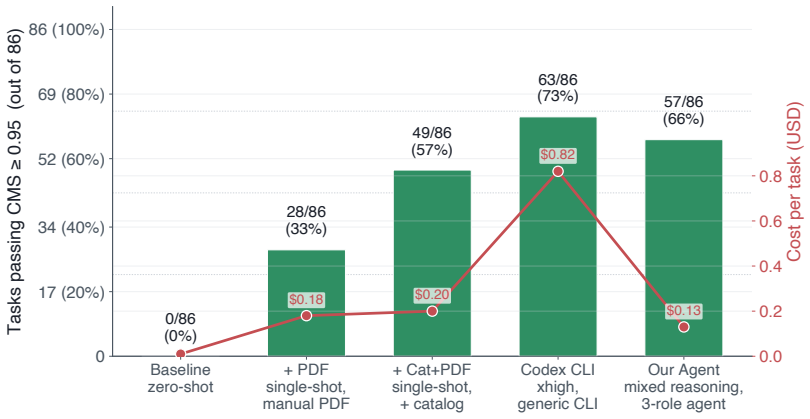
On the hardest track—building a complete PHITS simulation from a natural-language description—structured domain knowledge is the dominant driver of success: zero-shot performance is 0/86 at the paper’s CMS ≥ 0.95 threshold, the user manual alone reaches 28/86 (33%), and adding a structured PHITS knowledge catalog reaches 49/86 (57%). Agentic execution and repair raise the rate further to 66–73%, at higher cost. Remaining failures after successful execution are dominated by incorrect selection or configuration of tallies and observables, not syntax errors.
What carries the argument
PHITSBench and its Composite Metric Score (CMS): tasks are solved only when PHITS executes cleanly and the generated transport observables match reference tallies under a priori-weighted measures of shape, integral, and peak; CMS ≥ 0.95 is the success threshold used throughout.
Load-bearing premise
The hand-built, expert-audited knowledge catalog and the fixed CMS threshold with its track-specific weights are treated as a fair general measure of correct simulation generation, even though catalog quality was not systematically ablated and results come from a single model family with single non-deterministic runs.
What would settle it
Rebuild or ablate the knowledge catalog (or reweight CMS) and re-run the same Reproduce tasks: if success no longer jumps from near zero to ~57% with catalog injection, or if residual failures stop being dominated by tally/observable misconfiguration, the central hierarchy of causes collapses.
If this is right
- Near-term AI help for PHITS will be most reliable on edit and repair of existing decks rather than unaided full generation.
- A maintained, machine-readable PHITS knowledge base (keywords, defaults, parser constraints, common errors) is a high-leverage community asset.
- Curated expert examples of tally and observable choices are needed beyond parser documentation, because residual failures are domain-judgment errors.
- Execution-scored environments with a computable reward (CMS) can support reinforcement learning for radiation-transport input generation.
- The same pattern—structured knowledge first, agents second—likely applies to other under-documented scientific codes with specialized input languages.
Where Pith is reading between the lines
- Similar under-documented legacy simulation codes (other MC transport packages, older multiphysics decks) will show the same zero-shot failure and large gains from compact machine-readable catalogs.
- If residual failures stay concentrated in tally configuration, preference or supervised fine-tuning on expert-chosen observables may outperform further agent scaffolding alone.
- Packaging PHITSBench as a Gym-style environment with CMS as reward would make the ‘knowledge vs reasoning vs repair’ hierarchy directly trainable and re-testable by others.
Editorial analysis
A structured set of objections, weighed in public.
Referee Report
Summary. The manuscript introduces PHITSBench, an execution-scored suite of 282 PHITS tasks in three tracks (Edit n=65, Repair n=131, Reproduce n=86) derived from the PHITS 3.34 example library. Success is defined by a Composite Metric Score (CMS) that combines binary execution success with physics-fidelity agreement between generated and reference tally outputs (Eq. 1; Tables 1–2). Five GPT-5.4 configurations are compared: zero-shot Baseline, +PDF manual, +Cat+PDF (structured knowledge catalog plus manual), Codex CLI, and a custom three-role multi-agent system. On Reproduce, success (CMS≥0.95) rises from 0/86 (Baseline) to 28/86 (+PDF) to 49/86 (+Cat+PDF), with agentic methods reaching 57–63/86 at higher cost; residual failures are mostly wrong tally/observable configuration rather than syntax. An independent four-problem physics check outside the benchmark is also reported.
Significance. If the reported hierarchy holds, the paper supplies a concrete, execution-grounded benchmark for a legacy scientific input language that is underrepresented in public training data, and it provides evidence that machine-readable domain knowledge and execution feedback can matter as much as raw model scale for radiation-transport input generation. Strengths include a priori CMS weights with a stated sensitivity check, a clear failure taxonomy (19/29 residual agent failures are wrong tallies), cost reporting, a reasoning-effort control (medium→xhigh only +3 tasks), and an independent physics validation against NIST/reference data. These are useful contributions for AI-for-science and nuclear-engineering tooling communities.
major comments (3)
- Central claim (Abstract; §3.2; Fig. 4; Conclusions): the dominant 0%→57% Reproduce gain is attributed to the structured catalog. Sections 2.1 and 2.3 indicate that both the 86 Reproduce tasks and the catalog were derived from the same PHITS 3.34 ecosystem (example library + source/parser + manual) with expert audit. The manuscript does not demonstrate catalog–task hold-out, nor an ablation that removes catalog rules that encode the same defaults/units/tally conventions used by the hand-written references. Without that separation, the knowledge-injection hierarchy risks partly measuring catalog–benchmark alignment. Please either (i) document construction chronology and hold-out, (ii) report a leave-out / reduced-catalog ablation on Reproduce, or (iii) substantially qualify the claim that structured knowledge is the dominant generalizable driver.
- §2.4 and Table 3 / Fig. 4: all primary rankings rest on single non-deterministic GPT-5.4 runs per configuration, with no multi-seed variance, confidence intervals, or bootstrap over tasks. For a 9–16 pp agentic increment and a 21-task catalog increment that underwrite the paper’s hierarchy, single-run point estimates are too thin. At minimum, report repeated runs (or task-level bootstrap) for the Reproduce track on Baseline, +Cat+PDF, and one agentic method, or mark the ranking as exploratory and soften quantitative claims.
- §2.2 (CMS definition) and §3.5: CMS≥0.95 is defined against PHITSBench reference tallies, so high CMS can reward matching the reference’s observable choices rather than independent physical correctness. The four-problem external validation is valuable but small, agent-only, and one case (lead attenuation) already shows a tally-selection discrepancy that CMS-style reference matching would not necessarily penalize. Please expand independent validation (more problems and/or single-shot +Cat+PDF as well as agents) or more carefully bound what CMS success implies for physical correctness outside the benchmark.
Circularity Check
No derivation circularity: PHITSBench is an empirical systems ablation, not a first-principles claim that folds its target into fitted inputs.
full rationale
This paper reports measured success rates of GPT-5.4 configurations on an execution-scored PHITS input-generation benchmark. There is no claimed mathematical derivation, uniqueness theorem, or fitted-parameter-as-prediction chain to walk. CMS is defined a priori as a weighted combination of binary execution success and reference-tally agreement (Eq. 1; Table 2 weights chosen by tally information content, not tuned on results); success is CMS≥0.95, with a stated sensitivity check that ±0.10 weight shifts do not change method ranking. The central hierarchy (Baseline 0% → +PDF 33% → +Cat+PDF 57% → agentic 66–73% on Reproduce) is an empirical ablation under fixed tasks and a fixed model, not a reduction of the target to the intervention by construction. Catalog construction from PHITS source/parser rules plus expert audit, and tasks drawn from the official example library, raise ordinary benchmark-validity questions about generalization and catalog quality (which the paper itself flags in §4.3), but that is not circularity in the sense of X defined as Y, a fit renamed as a prediction, or a load-bearing self-cited uniqueness result. Independent four-problem physics checks against NIST/nuclear data further treat the outputs as externally falsifiable simulations. Score 0; no circular steps.
Axiom & Free-Parameter Ledger
free parameters (4)
- CMS success threshold =
0.95
- Track-specific EX/PF weights =
Reproduce (0.5,0.5); Edit (0.2,0.8); Repair (0.3,0.7)
- Physics-fidelity component weights by tally resolution =
Table 2 scheme
- Custom multi-agent repair budget =
5 iterations
axioms (4)
- domain assumption Agreement of generated PHITS tally outputs with hand-modified or official-example reference simulations (via CMS) is a valid proxy for physically correct input generation.
- domain assumption Restricting the benchmark to transport mode (icntl=0) with scorable tallies fairly represents common PHITS user workflows.
- ad hoc to paper A single non-deterministic GPT-5.4 run per configuration is sufficient to rank methods for the paper’s qualitative conclusions.
- domain assumption PHITS 3.34 parser behavior and the expert-audited catalog correctly encode the constraints needed for valid inputs.
invented entities (2)
-
Composite Metric Score (CMS)
no independent evidence
-
Structured PHITS knowledge catalog
no independent evidence
read the original abstract
We introduce PHITSBench, an execution-scored benchmark for the Monte Carlo Particle and Heavy Ion Transport code System (PHITS). PHITSBench comprises 282 transport-scorable tasks spanning three common workflow categories: parameter editing (Edit), syntax repair (Repair ), and complete simulation generation from natural-language descriptions (Reproduce). Each task is evaluated using a Composite Metric Score that combines execution success with agreement between generated and reference transport observables. Using PHITSBench, we evaluate five GPT-5.4-based configurations ranging from zero-shot prompting to knowledge-augmented and agentic workflows. Without domain-specific knowledge, the model performs well on editing and repair tasks (95% and 70% success, respectively) but fails to generate correct simulations from scratch (0% success on the Reproduce track). A structured, machine-readable PHITS knowledge catalog, supplied alongside the user manual, raises single-shot Reproduce-task success to 57%. Agentic execution provides a further improvement to 66-73%, but at increased computational cost. Failure analysis shows that the remaining errors are dominated by incorrect selection and configuration of physical observables rather than syntax generation. These results suggest that future progress in AI-assisted radiation-transport modeling will depend as much on machine-readable knowledge bases, curated domain-training datasets, and execution-grounded evaluation environments as on advances in foundation models themselves.
Figures




Reference graph
Works this paper leans on
-
[1]
Recent improvements of the particle and heavy ion transport code system—PHITS version 3.33
Sato T, Iwamoto Y, Hashimoto S, et al. Recent improvements of the particle and heavy ion transport code system—PHITS version 3.33. Journal of Nuclear Science and Technology. 2024;61(1):127–135. Describes PHITS version 3.33; the present work uses version 3.34
2024
-
[2]
MCNP version 6.2 release notes
Werner CJ, Bull JS, Solomon CJ, et al. MCNP version 6.2 release notes. Los Alamos National Laboratory; 2018. LA-UR-18-20808. Available from:https://www.osti.gov/ biblio/1419730
arXiv 2018
-
[3]
GEANT4—a simulation toolkit
Agostinelli S, Allison J, Amako K, et al. GEANT4—a simulation toolkit. Nuclear Instru- ments and Methods in Physics Research A. 2003;506(3):250–303
2003
-
[4]
FLUKA: A multi-particle transport code (program version 2005)
Ferrari A, Sala PR, Fassò A, et al. FLUKA: A multi-particle transport code (program version 2005). CERN; 2005. CERN-2005-010, INFN/TC-05/11, SLAC-R-773. Available from:https://cds.cern.ch/record/898301
2005
-
[5]
Evaluating large language models trained on code [Arxiv:2107.03374 [cs.lg]]; 2021
Chen M, Tworek J, Jun H, et al. Evaluating large language models trained on code [Arxiv:2107.03374 [cs.lg]]; 2021. Available from:https://arxiv.org/abs/2107.03374
Pith/arXiv arXiv 2021
-
[6]
SWE-bench: Can language models resolve real-world GitHub issues? In: The Twelfth International Conference on Learning Representations (ICLR); 2024
Jimenez CE, Yang J, Wettig A, et al. SWE-bench: Can language models resolve real-world GitHub issues? In: The Twelfth International Conference on Learning Representations (ICLR); 2024. Available from:https://openreview.net/forum?id=VTF8yNQM66
2024
-
[7]
DS-1000: A natural and reliable benchmark for data science code generation
Lai Y, Li C, Wang Y, et al. DS-1000: A natural and reliable benchmark for data science code generation. In: Proceedings of the 40th International Conference on Machine Learning (ICML); 2023. Available from:https://proceedings.mlr.press/v202/lai23b.html
2023
-
[8]
Invited paper: VerilogEval: Evaluating large language models for Verilog code generation
Liu M, Pinckney N, Khailany B, et al. Invited paper: VerilogEval: Evaluating large language models for Verilog code generation. In: 2023 IEEE/ACM International Conference on Computer-Aided Design (ICCAD); 2023
2023
-
[9]
BigCodeBench: Benchmarking code generation with diversefunctioncallsandcomplexinstructions.In:TheThirteenthInternationalConference on Learning Representations (ICLR); 2025
Zhuo TY, Vu MC, Chim J, et al. BigCodeBench: Benchmarking code generation with diversefunctioncallsandcomplexinstructions.In:TheThirteenthInternationalConference on Learning Representations (ICLR); 2025. Available from:https://openreview.net/ forum?id=YrycTjllL0
2025
-
[10]
SciCode: A research coding benchmark curated by scientists
Tian M, Gao L, Zhang SD, et al. SciCode: A research coding benchmark curated by scientists. In: Advances in Neural Information Processing Systems (NeurIPS) 37, Datasets and Benchmarks Track; 2024. Available from:https://openreview.net/forum? id=ADLaALtdoG
2024
-
[11]
Automating Monte Carlo simulations in nuclear engineering with domain knowledge-embedded large language model agents
Ndum Ndum Z, Tao J, Ford J, et al. Automating Monte Carlo simulations in nuclear engineering with domain knowledge-embedded large language model agents. Energy and AI. 2025;21:100555. Agent framework referred to as AutoFLUKA
2025
-
[12]
A self-correcting multi-agent LLM framework for language-based physics simulation and explanation
Park D, Moon H, Ryu S. A self-correcting multi-agent LLM framework for language-based physics simulation and explanation. npj Artificial Intelligence. 2026;2(1):10
2026
-
[13]
Evaluating the performance of large language 19 models for geometry and simulation file generation in physics-based simulations
Shafiq O, Rahmat A, Alexiadis A, et al. Evaluating the performance of large language 19 models for geometry and simulation file generation in physics-based simulations. Applied Sciences. 2025;15(22):12114
2025
-
[14]
OpenFOAMGPT: A retrieval-augmented large language model (LLM) agent for OpenFOAM-based computational fluid dynamics
Pandey S, Xu R, Wang W, et al. OpenFOAMGPT: A retrieval-augmented large language model (LLM) agent for OpenFOAM-based computational fluid dynamics. Physics of Fluids. 2025;37(3):035120
2025
-
[15]
MetaOpenFOAM: An LLM-based multi-agent framework for CFD [Arxiv:2407.21320 [physics.flu-dyn]]; 2024
Chen Y, Zhu X, Zhou H, et al. MetaOpenFOAM: An LLM-based multi-agent framework for CFD [Arxiv:2407.21320 [physics.flu-dyn]]; 2024. Available from:https://arxiv.org/ abs/2407.21320
Pith/arXiv arXiv 2024
-
[16]
Somasekharan N, Yue L, Cao Y, et al. CFDLLMBench: A benchmark suite for evaluating large language models in computational fluid dynamics [Arxiv:2509.20374 [cs.lg]]; 2025. Available from:https://arxiv.org/abs/2509.20374
Pith/arXiv arXiv 2025
-
[17]
MooseAgent: A LLM based multi-agent framework for automating MOOSE simulation ; 2025
Zhang T, Liu Z, Xin Y, et al. MooseAgent: A LLM based multi-agent framework for automating MOOSE simulation ; 2025. Available from:https://arxiv.org/abs/2504. 08621
2025
-
[18]
AutoSAM: an agentic framework for automating input file generation for the SAM code with multi-modal retrieval-augmented generation
Abulawi Z, Ndum Ndum Z, Cervi E, et al. AutoSAM: an agentic framework for automating input file generation for the SAM code with multi-modal retrieval-augmented generation
-
[19]
Available from:https://arxiv.org/abs/2603.24736
-
[20]
SIMCODE: A benchmark for natural language to ns-3 network simulation code generation ; 2025
Ahmed T, Azwad MM, Choudhury S. SIMCODE: A benchmark for natural language to ns-3 network simulation code generation ; 2025. Available from:https://arxiv.org/ abs/2507.11014
Pith/arXiv arXiv 2025
-
[21]
Evaluating LLM-generated code for domain- specific languages: Molecular dynamics with LAMMPS ; 2026
Holbrook EW, Verduzco JC, Strachan A. Evaluating LLM-generated code for domain- specific languages: Molecular dynamics with LAMMPS ; 2026. Available from:https: //arxiv.org/abs/2603.20630
Pith/arXiv arXiv 2026
-
[22]
GRACE: an agentic AI for particle physics experiment design and simulation ; 2026
Hill J, Ryoo HJ. GRACE: an agentic AI for particle physics experiment design and simulation ; 2026. Available from:https://arxiv.org/abs/2602.15039
arXiv 2026
-
[23]
Exploring the capabilities of the frontier large language models for nuclear energy research ; 2025
Almeldein A, Alnaggar M, Archibald R, et al. Exploring the capabilities of the frontier large language models for nuclear energy research ; 2025. Available from:https://arxiv. org/abs/2506.19863
Pith/arXiv arXiv 2025
-
[24]
DocPrompting: Generating code by retrieving the docs
Zhou S, Alon U, Xu FF, et al. DocPrompting: Generating code by retrieving the docs. In: The Eleventh International Conference on Learning Representations (ICLR); 2023. Available from:https://arxiv.org/abs/2207.05987
Pith/arXiv arXiv 2023
-
[25]
DocCGen: Document-based controlled code generation
Pimparkhede S, Kammakomati M, Tamilselvam S, et al. DocCGen: Document-based controlled code generation. In: Proceedings of the 2024 Conference on Empirical Methods in Natural Language Processing (EMNLP 2024); 2024. p. 18681–18697. Available from: https://arxiv.org/abs/2406.11925
Pith/arXiv arXiv 2024
-
[26]
MetaGPT: Meta programming for a multi-agent collabo- rative framework
Hong S, Zhuge M, Chen J, et al. MetaGPT: Meta programming for a multi-agent collabo- rative framework. In: The Twelfth International Conference on Learning Representations (ICLR); 2024. Available from:https://openreview.net/forum?id=VtmBAGCN7o
2024
-
[27]
AutoGen: Enabling next-gen LLM applications via multi-agent conversation
Wu Q, Bansal G, Zhang J, et al. AutoGen: Enabling next-gen LLM applications via multi-agent conversation. In: Conference on Language Modeling (COLM); 2024. Available from:https://openreview.net/forum?id=BAakY1hNKS
2024
-
[28]
SciAgents: Automating scientific discovery through bioinspired multi-agent intelligent graph reasoning
Ghafarollahi A, Buehler MJ. SciAgents: Automating scientific discovery through bioinspired multi-agent intelligent graph reasoning. Advanced Materials. 2025;37(22):2413523
2025
-
[29]
SWE-agent: Agent-computer interfaces enable automated software engineering
Yang J, Jimenez CE, Wettig A, et al. SWE-agent: Agent-computer interfaces enable automated software engineering. In: Advances in Neural Information Processing Sys- tems (NeurIPS); Vol. 37; 2024. Available from:https://openreview.net/forum?id= mXpq6ut8J3
2024
-
[30]
ReAct: Synergizing reasoning and acting in language models
Yao S, Zhao J, Yu D, et al. ReAct: Synergizing reasoning and acting in language models. In: The Eleventh International Conference on Learning Representations (ICLR); 2023. Available from:https://openreview.net/forum?id=WE_vluYUL-X
2023
-
[31]
Self-refine: Iterative refinement with self-feedback
Madaan A, Tandon N, Gupta P, et al. Self-refine: Iterative refinement with self-feedback. In: Advances in Neural Information Processing Systems (NeurIPS); Vol. 36; 2023. Available from:https://openreview.net/forum?id=S37hOerQLB
2023
-
[32]
Reflexion: Language agents with verbal reinforcement 20 learning
Shinn N, Cassano F, Berman E, et al. Reflexion: Language agents with verbal reinforcement 20 learning. In: Advances in Neural Information Processing Systems (NeurIPS); Vol. 36; 2023. Available from:https://openreview.net/forum?id=vAElhFcKW6
2023
-
[33]
Large language models cannot self-correct reasoning yet
Huang J, Chen X, Mishra S, et al. Large language models cannot self-correct reasoning yet. In: The Twelfth International Conference on Learning Representations (ICLR); 2024. Available from:https://openreview.net/forum?id=IkmD3fKBPQ
2024
-
[34]
Is self-repair a silver bullet for code generation? In: The Twelfth International Conference on Learning Representations (ICLR); 2024
Olausson TX, Inala JP, Wang C, et al. Is self-repair a silver bullet for code generation? In: The Twelfth International Conference on Learning Representations (ICLR); 2024. Available from:https://openreview.net/forum?id=y0GJXRungR
2024
-
[35]
When can LLMs actually correct their own mistakes? A critical survey of self-correction of LLMs
Kamoi R, Zhang Y, Zhang N, et al. When can LLMs actually correct their own mistakes? A critical survey of self-correction of LLMs. Transactions of the Association for Computational Linguistics. 2024;12:1417–1440
2024
-
[36]
LiveCodeBench: Holistic and contamination free evaluation of large language models for code
Jain N, Han K, Gu A, et al. LiveCodeBench: Holistic and contamination free evaluation of large language models for code. In: The Thirteenth International Conference on Learn- ing Representations (ICLR); 2025. Available from:https://openreview.net/forum?id= chfJJYC3iL
2025
-
[37]
CodeBLEU: a method for automatic evaluation of code synthesis [Arxiv:2009.10297 [cs.se]]; 2020
Ren S, Guo D, Lu S, et al. CodeBLEU: a method for automatic evaluation of code synthesis [Arxiv:2009.10297 [cs.se]]; 2020. Available from:https://arxiv.org/abs/2009.10297
Pith/arXiv arXiv 2009
-
[38]
Codex CLI: Command-line coding agent [https://github.com/openai/codex]; 2025
OpenAI. Codex CLI: Command-line coding agent [https://github.com/openai/codex]; 2025
2025
-
[39]
OpenAI Agents SDK [https://github.com/openai/openai-agents-python]
OpenAI. OpenAI Agents SDK [https://github.com/openai/openai-agents-python]
-
[40]
Berger MJ, Coursey JS, Zucker MA, et al. ESTAR, PSTAR, and ASTAR: Computer programs for calculating stopping-power and range tables for electrons, protons, and helium ions [National institute of standards and technology, gaithersburg, md]; 2017. Version 2.0.1, NIST Standard Reference Database 124; Available from:https://physics.nist. gov/Star
2017
-
[41]
XCOM: Photon cross section database (version 1.5) [National institute of standards and technology, gaithersburg, md]; 2010
Berger MJ, Hubbell JH, Seltzer SM, et al. XCOM: Photon cross section database (version 1.5) [National institute of standards and technology, gaithersburg, md]; 2010. NIST Standard Reference Database 8 (XGAM); Available from:https://physics.nist.gov/ xcom
2010
-
[42]
Nuclear data sheets for A = 137
Browne E, Tuli JK. Nuclear data sheets for A = 137. Nuclear Data Sheets. 2007; 108(10):2173–2318
2007
-
[43]
Benchmark study of particle and heavy-ion trans- port code system using shielding integral benchmark archive and database for accelerator- shielding experiments
Çelik Y, Iwamoto Y, Hashimoto S, et al. Benchmark study of particle and heavy-ion trans- port code system using shielding integral benchmark archive and database for accelerator- shielding experiments. Journal of Nuclear Science and Technology. 2022;59(5):665–675
2022
-
[44]
Validation of the physical and RBE-weighted dose estimator based on PHITS coupled with a microdosimetric kinetic model for proton therapy
Takada K, Sato T, Kumada H, et al. Validation of the physical and RBE-weighted dose estimator based on PHITS coupled with a microdosimetric kinetic model for proton therapy. Journal of Radiation Research. 2018;59(1):91–99
2018
-
[45]
Improvements in the particle and heavy-ion transport code system (PHITS) for simulating neutron-response functions and detection efficiencies of a liquid organic scintillator
Satoh D, Sato T. Improvements in the particle and heavy-ion transport code system (PHITS) for simulating neutron-response functions and detection efficiencies of a liquid organic scintillator. Journal of Nuclear Science and Technology. 2022;59(8):1047–1060
2022
-
[46]
A PHITS-based computational model of a TRIGA-fueled subcritical reactor for gamma dose mapping
Cruz JRP, Astronomo AA, Santos GN, et al. A PHITS-based computational model of a TRIGA-fueled subcritical reactor for gamma dose mapping. Nuclear Engineering and Technology. 2024;56(12):5339–5345
2024
-
[47]
Dose estimation for astronauts using dose conversion coeffi- cients calculated with the PHITS code and the ICRP/ICRU adult reference computational phantoms
Sato T, Endo A, Sihver L, et al. Dose estimation for astronauts using dose conversion coeffi- cients calculated with the PHITS code and the ICRP/ICRU adult reference computational phantoms. Radiation and Environmental Biophysics. 2011;50(1):115–123. 21
2011
discussion (0)
Sign in with ORCID, Apple, or X to comment. Anyone can read and Pith papers without signing in.