REVIEW 2 major objections 5 minor 282 references
VLN methods that look strong in simulation often fail on real robots; hierarchical stacks hold up better than pure RGB end-to-end ones under the tested setups.
Reviewed by Pith at T0; open to challenge. T0 means a machine referee read the full paper against a public rubric. the ladder, T0–T4 →
T0 review · grok-4.5
2026-07-14 15:39 UTC pith:GBH3EJZG
load-bearing objection Solid survey plus a carefully caveated 10-scene robot study that quantifies a large sim-to-real gap; the architectural comparison is system-level, not pure, and the authors say so. the 2 major comments →
A Comprehensive Survey and Systematic Real-World Evaluation of Embodied Vision-and-Language Navigation
The pith
A machine-rendered reading of the paper's core claim, the machinery that carries it, and where it could break.
Core claim
Under the tested configurations, current VLN systems suffer a large simulation-to-real gap: a representative monolithic RGB-only method drops from 61 percent success in simulation to 22 percent on a physical robot across ten diverse scenes, while a hierarchical waypoint-based system reaches 51 percent real-world success with a markedly lower collision rate, indicating greater robustness for the hierarchical stack in this evaluation setting.
What carries the argument
A two-by-two taxonomy of VLN methods (hierarchical vs. monolithic action paradigms crossed with discriminative vs. generative model paradigms) used both to structure the literature review and to select the two representative system configurations that are then run head-to-head on a real wheeled robot.
Load-bearing premise
That the two chosen systems, the fixed three-meter success rule, the single random seed, and the ten chosen scenes are enough to speak for architectural differences rather than just the specific sensors, robot, and rooms used.
What would settle it
Rerun the same two system configurations on a different physical robot and a new set of real scenes that still follow the paper’s instruction mix; if the hierarchical system no longer shows substantially higher success and lower collisions than the monolithic RGB-only system, the claimed robustness difference does not generalize.
Editorial analysis
A structured set of objections, weighed in public.
Referee Report
Summary. This manuscript surveys embodied Vision-and-Language Navigation (VLN) and organizes methods along two orthogonal axes: action paradigms (hierarchical waypoint-based vs. monolithic action-based) and model paradigms (discriminative vs. generative). It reviews problem formulations, datasets, simulators, and metrics, then analyzes strengths and limitations of each paradigm. The distinctive contribution is a systematic real-world evaluation on a wheeled robot across ten diverse scenes (200 episodes total): under the tested configurations, a representative monolithic RGB-only method (JanusVLN) drops from 61% SR in simulation to 22% in the real world, while a hierarchical system (CLASH with panoramic sensing and LiDAR/SLAM) achieves 51% real-world SR and substantially lower collision rate (7% vs. 51%). The authors introduce stricter metrics (SSR, CR), analyze intention/backtracking instructions, and discuss sim-to-real failure modes and future directions.
Significance. If the reported measurements hold, the paper supplies a timely dual contribution: a structured taxonomy of a rapidly diversifying VLN literature, and rare physical-robot evidence of a large sim-to-real gap under controlled, multi-scene conditions. The careful scoping of claims to system configurations (rather than pure architecture isolation), the addition of SSR and collision rate, and the qualitative collision analysis are concrete strengths that the community can use for deployment-oriented research. The work is valuable as a reference and as an empirical baseline for safer, more transferable VLN systems.
major comments (2)
- [Abstract; Sec. I; Sec. V-B] Sec. V-A/V-B and abstract: The central comparison confounds action paradigm with sensing and control stack (panoramic + LiDAR/SLAM hierarchical vs. monocular RGB-only monolithic). The manuscript already caveats this in Sec. V-B, but the abstract and Sec. I still lead with hierarchical vs. monolithic labels. Please rephrase the abstract and contribution bullets so that system configuration (sensors, mapping, controller) is primary and paradigm labels secondary, so readers cannot misread the 51% vs. 22% result as a pure architecture effect.
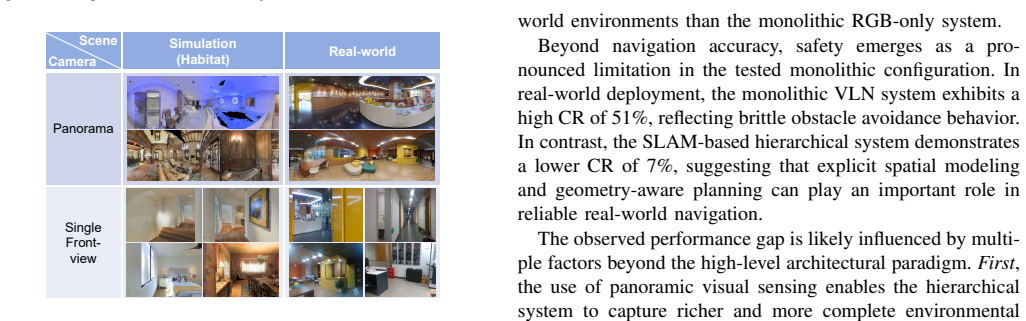
- [Sec. V-A; Sec. V-B; Figs. 15–17] Sec. V-A.3–V-B: The real-world protocol uses one trial per episode with a fixed seed (42) and reports point estimates only (e.g., SR 22%/51%, CR 51%/7%). For a claim of a substantial sim-to-real gap across ten scenes, please add uncertainty quantification (bootstrap or binomial CIs per metric, and/or per-scene variance) and state whether any episodes were re-run after collisions or communication failures. This is load-bearing for the quantitative headline numbers.
minor comments (5)
- [Fig. 3; Index Terms; Sec. I] Fig. 3 and keywords contain typos: “Anlysis,” “Strenghs,” “evluation” (Sec. I), “Moultimodal.” Please proofread section titles and the keyword list.
- [Table III; Sec. IV-C] Table III and related text: GPU-hour and training-data summaries for monolithic foundation models are useful; a short parallel table or paragraph for hierarchical generative systems (e.g., CLASH, InternVLA-N1) would improve balance.
- [Sec. II-C; Sec. V-A.4] Sec. II-C metrics: nDTW/sDTW and RGS/RGSPL are defined carefully; briefly note which of these (if any) were computable in the real-world study and why SR/SSR/CR were preferred.
- [Fig. 12] Fig. 12 scene labels mix Chinese and English in the source layout description; ensure the published figure uses consistent English labels matching the caption (S1–S10).
- [Sec. VI-B; Fig. 20] Sec. VI-B future directions are broad; one sentence each tying lifelong memory, counterfactual world models, and safety metrics back to the specific failure modes in Fig. 20 would tighten the link from evaluation to roadmap.
Circularity Check
No significant circularity: taxonomy is descriptive and the load-bearing sim-to-real numbers are new physical measurements, not rearrangements of fitted inputs or self-defined quantities.
full rationale
This is a survey-plus-empirical-evaluation paper, not a first-principles derivation. The methodological taxonomy (hierarchical vs. monolithic; discriminative vs. generative) is an organizational classification of prior work and does not claim to derive performance from axioms. The central quantitative claim—monolithic RGB-only SR falling from 61% in simulation to 22% in real-world deployment, versus hierarchical real-world SR of 51% and much lower collision rate—is obtained by running two representative systems on a physical wheeled platform across ten scenes and 200 episodes, then computing standard navigation metrics (SR, SSR, OSR, CR). Those rates are external measurements against ground-truth goals and human semantic annotations, not quantities defined in terms of the paper’s own parameters. Self-citations (e.g., CLASH as the hierarchical baseline, and other author-related methods in the survey) are normal for a survey and for choosing a SoTA representative; they do not force the real-world numbers by construction, and the authors explicitly caveat sensing/mapping/control confounds rather than smuggling uniqueness or ansatz results. No fitted parameter is renamed as a prediction, no uniqueness theorem is imported to forbid alternatives, and no equation reduces to its own input. Score 0 is therefore the correct, proportionate finding.
Axiom & Free-Parameter Ledger
free parameters (3)
- success distance threshold d_th =
3 m
- instruction mix ratios =
70/20/10
- camera height and robot footprint =
1.5 m
axioms (3)
- domain assumption VLN can be formalized as a POMDP with observation function over egocentric RGB(-D) and language instruction I.
- ad hoc to paper The two selected systems (CLASH hierarchical, JanusVLN monolithic) are sufficiently representative of their respective paradigms for comparative claims under the tested stacks.
- domain assumption A 3 m Euclidean threshold plus human semantic judgment defines success in real scenes.
read the original abstract
Navigation is a fundamental capability of autonomous systems, yet most existing approaches rely on highly structured models and strong prior assumptions, limiting their robustness in open and uncertain real-world environments. Vision-and-Language Navigation (VLN) offers a promising direction by enabling robots to integrate natural language understanding with visual perception in a data-driven manner. Although VLN has attracted increasing research attention, systematic methodological taxonomy and real-world validation remain limited. This survey presents a comprehensive review of VLN research. Specifically, state-of-the-art methods are organized along two orthogonal dimensions: action paradigms, including hierarchical and monolithic frameworks, and model paradigms, including discriminative and generative approaches. A critical analysis of their respective strengths and limitations is provided. Additionally, we conduct a systematic real-world evaluation of representative VLN system configurations on a physical robotic platform. Experiments across ten diverse real-world scenes show a substantial performance gap between simulation and real-world deployment under the tested configurations: a representative monolithic RGB-only method achieves 61% success in simulation but drops to 22% in real-world deployment, while a hierarchical framework achieves a higher real-world success rate of 51%, suggesting stronger robustness in our evaluation setting. Finally, we highlight key challenges in perception, decision-making, and control that must be addressed in future research.
Figures




Reference graph
Works this paper leans on
-
[1]
On the representation and estimation of spatial uncertainty,
R. C. Smith and P. Cheeseman, “On the representation and estimation of spatial uncertainty,”The International Journal of Robotics Research, vol. 5, no. 4, pp. 56–68, 1986. [Online]. Available: https://doi.org/10.1177/027836498600500404
-
[2]
Smith, M
R. Smith, M. Self, and P. Cheeseman,Estimating Uncertain Spatial Relationships in Robotics. New York, NY: Springer New York, 1990, pp. 167–193. [Online]. Available: https://doi.org/10.1007/ 978-1-4613-8997-2 14
1990
-
[3]
Visual odometry,
D. Nister, O. Naroditsky, and J. Bergen, “Visual odometry,” inPro- ceedings of the 2004 IEEE Computer Society Conference on Computer Vision and Pattern Recognition, 2004. CVPR 2004., vol. 1, 2004, pp. I–I
2004
-
[4]
Orb-slam2: An open-source slam system for monocular, stereo, and rgb-d cameras,
R. Mur-Artal and J. D. Tard ´os, “Orb-slam2: An open-source slam system for monocular, stereo, and rgb-d cameras,”IEEE Transactions on Robotics, vol. 33, no. 5, pp. 1255–1262, 2017
2017
-
[5]
Vision-and-language navigation: Interpret- ing visually-grounded navigation instructions in real environments,
P. Anderson, Q. Wu,et al., “Vision-and-language navigation: Interpret- ing visually-grounded navigation instructions in real environments,” in Proceedings of the IEEE Conference on Computer Vision and Pattern Recognition, 2018, pp. 3674–3683
2018
-
[6]
Stay on the path: Instruction fidelity in vision-and-language navigation,
V . Jain, G. Magalhaes,et al., “Stay on the path: Instruction fidelity in vision-and-language navigation,” inProceedings of the 57th Annual Meeting of the Association for Computational Linguistics, 2019, pp. 1862–1872
2019
-
[7]
Room-across-room: Multilingual vision- and-language navigation with dense spatiotemporal grounding,
A. Ku, P. Anderson,et al., “Room-across-room: Multilingual vision- and-language navigation with dense spatiotemporal grounding,” in Proceedings of the 2020 Conference on Empirical Methods in Natural Language Processing (EMNLP), 2020, pp. 4392–4412
2020
-
[8]
Beyond the nav-graph: Vision-and- language navigation in continuous environments,
J. Krantz, E. Wijmans,et al., “Beyond the nav-graph: Vision-and- language navigation in continuous environments,” inComputer Vision – ECCV 2020, A. Vedaldi, H. Bischof,et al., Eds. Springer International Publishing, pp. 104–120. JOURNAL OF LATEX CLASS FILES, VOL. 14, NO. 8, AUGUST 2021 25
2020
-
[9]
Towards long-horizon vision-language navigation: Platform, benchmark and method,
X. Song, W. Chen,et al., “Towards long-horizon vision-language navigation: Platform, benchmark and method,” inProceedings of the Computer Vision and Pattern Recognition Conference, 2025, pp. 12 078–12 088
2025
-
[10]
Habitat 2.0: Training home assistants to rearrange their habitat,
A. Szot, A. Clegg,et al., “Habitat 2.0: Training home assistants to rearrange their habitat,”Advances in neural information processing systems, vol. 34, pp. 251–266, 2021
2021
-
[11]
Ai2-thor: An interactive 3d environment for visual ai,
E. Kolve, R. Mottaghi,et al., “Ai2-thor: An interactive 3d environment for visual ai,” inarXiv preprint arXiv:1712.05474, 2017
Pith/arXiv arXiv 2017
-
[12]
Behavior-1k: A human-centered, embodied ai benchmark with 1, 000 everyday activities and realistic simulation,
C. Li, R. Zhang,et al., “Behavior-1k: A human-centered, embodied ai benchmark with 1, 000 everyday activities and realistic simulation,” CoRR, 2024
2024
-
[13]
Rethinking the embodied gap in vision- and-language navigation: A holistic study of physical and visual disparities,
L. Wang, X. Xia,et al., “Rethinking the embodied gap in vision- and-language navigation: A holistic study of physical and visual disparities,” inProceedings of the IEEE/CVF International Conference on Computer Vision (ICCV), October 2025, pp. 9455–9465
2025
-
[14]
Speaker-follower models for vision-and- language navigation,
D. Fried, R. Hu,et al., “Speaker-follower models for vision-and- language navigation,”Advances in Neural Information Processing Systems, vol. 31, 2018
2018
-
[15]
Learning to navigate unseen environ- ments: Back translation with environmental dropout,
H. Tan, L. Yu, and M. Bansal, “Learning to navigate unseen environ- ments: Back translation with environmental dropout,” inProceedings of the 2019 Conference of the North American Chapter of the Association for Computational Linguistics: Human Language Technologies, Volume 1 (Long and Short Papers), 2019, pp. 2610–2621
2019
-
[16]
Vln bert: A recurrent vision-and-language bert for navigation,
Y . Hong, Q. Wu,et al., “Vln bert: A recurrent vision-and-language bert for navigation,” inProceedings of the IEEE/CVF Conference on Computer Vision and Pattern Recognition, 2021, pp. 1643–1653
2021
-
[17]
Think global, act local: Dual-scale graph transformer for vision-and-language navigation,
S. Chen, P.-L. Guhur,et al., “Think global, act local: Dual-scale graph transformer for vision-and-language navigation,” inProceedings of the IEEE/CVF Conference on Computer Vision and Pattern Recognition, 2022, pp. 16 537–16 547
2022
-
[18]
g3d-lf: Generalizable 3d-language feature fields for embodied tasks,
Z. Wang and G. H. Lee, “g3d-lf: Generalizable 3d-language feature fields for embodied tasks,” inProceedings of the Computer Vision and Pattern Recognition Conference, 2025, pp. 14 191–14 202
2025
-
[19]
Vln-r1: Vision-language navigation via reinforcement fine-tuning,
Z. Qi, Z. Zhang,et al., “Vln-r1: Vision-language navigation via reinforcement fine-tuning,”arXiv preprint arXiv:2506.17221, 2025
Pith/arXiv arXiv 2025
-
[20]
Source-free elastic model adaptation for vision-and-language navigation,
M. Tan, P. Chen,et al., “Source-free elastic model adaptation for vision-and-language navigation,”IEEE Transactions on Multimedia, vol. 27, pp. 3953–3965, 2025
2025
-
[21]
Navq: Learning a q-model for foresighted vision-and-language navigation,
P. Xu, X. Gong, and Y . Mu, “Navq: Learning a q-model for foresighted vision-and-language navigation,” inProceedings of the IEEE/CVF International Conference on Computer Vision (ICCV), October 2025, pp. 6327–6341
2025
-
[22]
Navid: Video-based vlm plans the next step for vision-and-language navigation,
J. Zhang, K. Wang,et al., “Navid: Video-based vlm plans the next step for vision-and-language navigation,”Robotics: Science and Systems, 2024
2024
-
[23]
Uni-navid: A video-based vision-language- action model for unifying embodied navigation tasks,
J. Zhang, K. Wang,et al., “Uni-navid: A video-based vision-language- action model for unifying embodied navigation tasks,”Robotics: Sci- ence and Systems, 2025
2025
-
[24]
Navila: Legged robot vision-language-action model for navigation,
A.-C. Cheng, Y . Ji,et al., “Navila: Legged robot vision-language-action model for navigation,” inRSS, 2025
2025
-
[25]
Streamvln: Streaming vision-and- language navigation via slowfast context modeling,
M. Wei, C. Wan,et al., “Streamvln: Streaming vision-and- language navigation via slowfast context modeling,”arXiv preprint arXiv:2507.05240, 2025
Pith/arXiv arXiv 2025
-
[26]
L. Wang, Z. He,et al., “Clash: Collaborative large-small hierarchi- cal framework for continuous vision-and-language navigation,”arXiv preprint arXiv:2512.10360, 2025
arXiv 2025
-
[27]
Janusvln: Decoupling semantics and spatiality with dual implicit memory for vision-language navigation,
S. Zeng, D. Qi,et al., “Janusvln: Decoupling semantics and spatiality with dual implicit memory for vision-language navigation,” inPro- ceedings of the International Conference on Learning Representations (ICLR), 2026
2026
-
[28]
Bootstrapping language-guided navigation learn- ing with self-refining data flywheel,
Z. Wang, J. Li,et al., “Bootstrapping language-guided navigation learn- ing with self-refining data flywheel,” inThe Thirteenth International Conference on Learning Representations, 2024
2024
-
[29]
Waypoint models for instruction- guided navigation in continuous environments,
J. Krantz, A. Gokaslan,et al., “Waypoint models for instruction- guided navigation in continuous environments,” inProceedings of the IEEE/CVF International Conference on Computer Vision, 2021, pp. 15 162–15 171
2021
-
[30]
Etpnav: Evolving topological planning for vision-language navigation in continuous environments,
D. An, H. Wang,et al., “Etpnav: Evolving topological planning for vision-language navigation in continuous environments,”IEEE Transactions on Pattern Analysis and Machine Intelligence, 2024
2024
-
[31]
Internvla-n1: An open dual-system vision-language navigation foundation model with learned latent plans,
I.-N. Team, “Internvla-n1: An open dual-system vision-language navigation foundation model with learned latent plans,” Technical report, Shanghai AI Laboratory, 2025. [Online]. Available: https://internrobotics.github.io/internvla-n1.github.io/static/ pdfs/InternVLA N1.pdf
2025
-
[32]
Multimodal evolutionary encoder for con- tinuous vision-language navigation,
Z. He, L. Wang,et al., “Multimodal evolutionary encoder for con- tinuous vision-language navigation,” in2024 IEEE/RSJ International Conference on Intelligent Robots and Systems (IROS), Oct. 2024, pp. 1443–1450
2024
-
[33]
Language-aligned waypoint (law) supervision for vision-and-language navigation in continuous environ- ments,
S. Raychaudhuri, S. Wani,et al., “Language-aligned waypoint (law) supervision for vision-and-language navigation in continuous environ- ments,” inProceedings of the 2021 conference on empirical methods in natural language processing, 2021, pp. 4018–4028
2021
-
[34]
Navgpt: Explicit reasoning in vision- and-language navigation with large language models,
G. Zhou, Y . Hong, and Q. Wu, “Navgpt: Explicit reasoning in vision- and-language navigation with large language models,” inProceedings of the AAAI Conference on Artificial Intelligence, vol. 38, no. 7, 2024, pp. 7641–7649
2024
-
[35]
Navcot: Boosting llm-based vision-and-language navigation via learning disentangled reasoning,
B. Lin, Y . Nie,et al., “Navcot: Boosting llm-based vision-and-language navigation via learning disentangled reasoning,”IEEE Transactions on Pattern Analysis and Machine Intelligence, 2025
2025
-
[36]
Dynam3d: Dynamic layered 3d tokens empower vlm for vision-and-language navigation,
Z. Wang, S. Lee, and G. H. Lee, “Dynam3d: Dynamic layered 3d tokens empower vlm for vision-and-language navigation,” inAdvances in Neural Information Processing Systems, 2025
2025
-
[37]
History aware multimodal transformer for vision-and-language navigation,
S. Chen, P.-L. Guhur,et al., “History aware multimodal transformer for vision-and-language navigation,”Advances in Neural Information Processing Systems, vol. 34, 2021
2021
-
[38]
Vision-and-language navigation via causal learning,
L. Wang, J. Tang,et al., “Vision-and-language navigation via causal learning,”Conference on Computer Vision and Pattern Recognition (CVPR), 2024
2024
-
[39]
Lookahead exploration with neural radiance representation for continuous vision-language navigation,
Z. Wang, X. Li,et al., “Lookahead exploration with neural radiance representation for continuous vision-language navigation,” inProceed- ings of the IEEE/CVF conference on computer vision and pattern recognition, 2024, pp. 13 753–13 762
2024
-
[40]
Learning depth representation from rgb-d videos by time-aware contrastive pre-training,
Z. He, L. Wang,et al., “Learning depth representation from rgb-d videos by time-aware contrastive pre-training,”IEEE Transactions on Circuits and Systems for Video Technology, vol. 34, no. 6, pp. 4143– 4158, 2023
2023
-
[41]
Chatgpt: Optimizing language models for dialogue,
OpenAI, “Chatgpt: Optimizing language models for dialogue,” https: //openai.com/blog/chatgpt, 2022
2022
-
[42]
S. Bai, K. Chen,et al., “Qwen2.5-vl technical report,”arXiv preprint arXiv:2502.13923, 2025
Pith/arXiv arXiv 2025
-
[43]
Internvl: Scaling up vision foundation models and aligning for generic visual-linguistic tasks,
Z. Chen, J. Wu,et al., “Internvl: Scaling up vision foundation models and aligning for generic visual-linguistic tasks,” inProceedings of the IEEE/CVF Conference on Computer Vision and Pattern Recognition, 2024, pp. 24 185–24 198
2024
-
[44]
Embodied navigation foundation model,
J. Zhang, A. Li,et al., “Embodied navigation foundation model,” in Proceedings of the International Conference on Learning Representa- tions (ICLR), 2026
2026
-
[45]
Vision-and-language navigation today and tomorrow: A survey in the era of foundation models,
Y . Zhang, Z. Ma,et al., “Vision-and-language navigation today and tomorrow: A survey in the era of foundation models,”Transactions on Machine Learning Research, 2024
2024
-
[46]
Vision-language navigation with embodied intelligence: A survey,
P. Gao, P. Wang,et al., “Vision-language navigation with embodied intelligence: A survey,”arXiv preprint arXiv:2402.14304, 2024
Pith/arXiv arXiv 2024
-
[47]
Advances in embodied navigation using large language models: A survey,
J. Lin, H. Gao,et al., “Advances in embodied navigation using large language models: A survey,”arXiv preprint arXiv:2311.00530, 2023
Pith/arXiv arXiv 2023
-
[48]
Safety of embodied navigation: a survey,
Z. Wang, J. Hu, and R. Mu, “Safety of embodied navigation: a survey,” inProceedings of the Thirty-Fourth International Joint Conference on Artificial Intelligence, 2025, pp. 10 714–10 722
2025
-
[49]
Aeroverse-review: Comprehensive survey on aerial embodied vision-and-language navigation,
F. Yao, Y . Liu,et al., “Aeroverse-review: Comprehensive survey on aerial embodied vision-and-language navigation,”The Innovation Informatics, vol. 1, no. 1, pp. 100 015–1, 2025
2025
-
[50]
A survey on vision–language–action models for embodied ai,
Y . Ma, Z. Song,et al., “A survey on vision–language–action models for embodied ai,”IEEE Transactions on Neural Networks and Learning Systems, 2026
2026
-
[51]
Vision-language-action models for robotics: A review towards real-world applications,
K. Kawaharazuka, J. Oh,et al., “Vision-language-action models for robotics: A review towards real-world applications,”IEEE Access, vol. 13, pp. 162 467–162 504, 2025
2025
-
[52]
Agentvln: Towards agentic vision-and-language navigation,
Z. Xin, W. Li,et al., “Agentvln: Towards agentic vision-and-language navigation,”arXiv preprint arXiv:2603.17670, 2026
arXiv 2026
-
[53]
Affordances-oriented planning using foundation models for continuous vision-language navigation,
J. Chen, B. Lin,et al., “Affordances-oriented planning using foundation models for continuous vision-language navigation,” inProceedings of the AAAI Conference on Artificial Intelligence, vol. 39, no. 22, 2025, pp. 23 568–23 576
2025
-
[54]
Instructnav: Zero-shot system for generic instruction navigation in unexplored environment,
Y . Long, W. Cai,et al., “Instructnav: Zero-shot system for generic instruction navigation in unexplored environment,” in8th Annual Conference on Robot Learning
-
[55]
Mapgpt: Map-guided prompting with adaptive path planning for vision-and-language navigation,
J. Chen, B. Lin,et al., “Mapgpt: Map-guided prompting with adaptive path planning for vision-and-language navigation,” inProceedings of the 62nd Annual Meeting of the Association for Computational Linguistics (Volume 1: Long Papers), 2024, pp. 9796–9810. JOURNAL OF LATEX CLASS FILES, VOL. 14, NO. 8, AUGUST 2021 26
2024
-
[56]
Visual language maps for robot navigation,
C. Huang, O. Mees,et al., “Visual language maps for robot navigation,” inProceedings of the IEEE International Conference on Robotics and Automation (ICRA), London, UK, 2023
2023
-
[57]
Correctnav: Self-correction flywheel empowers vision-language-action navigation model,
Z. Yu, Y . Long,et al., “Correctnav: Self-correction flywheel empowers vision-language-action navigation model,” inProceedings of the AAAI Conference on Artificial Intelligence, vol. 40, no. 22, 2026, pp. 18 737– 18 745
2026
-
[58]
Omninav: A unified framework for prospective exploration and visual-language navigation,
X. Xue, J. Hu,et al., “Omninav: A unified framework for prospective exploration and visual-language navigation,” inProceedings of the International Conference on Learning Representations (ICLR), 2026
2026
-
[59]
Astranav-world: World model for foresight control and consistency,
J. Hu, J. Chen,et al., “Astranav-world: World model for foresight control and consistency,”arXiv preprint arXiv:2512.21714, 2025
Pith/arXiv arXiv 2025
-
[60]
Decovln: Decoupling observation, reasoning, and correction for vision-and-language navigation,
Z. Xin, W. Li,et al., “Decovln: Decoupling observation, reasoning, and correction for vision-and-language navigation,” 2026. [Online]. Available: https://arxiv.org/abs/2603.13133
arXiv 2026
-
[61]
Abot-n0: Technical report on the vla foundation model for versatile embodied navigation,
Z. Chu, S. Xie,et al., “Abot-n0: Technical report on the vla foundation model for versatile embodied navigation,”arXiv preprint arXiv:2602.11598, 2026
arXiv 2026
-
[62]
Scaling data generation in vision-and-language navigation,
Z. Wang, J. Li,et al., “Scaling data generation in vision-and-language navigation,” inProceedings of the IEEE/CVF International Conference on Computer Vision, 2023, pp. 12 009–12 020
2023
-
[63]
Envedit: Environment editing for vision- and-language navigation,
J. Li, H. Tan, and M. Bansal, “Envedit: Environment editing for vision- and-language navigation,” inProceedings of the IEEE/CVF Conference on Computer Vision and Pattern Recognition, 2022, pp. 15 407–15 417
2022
-
[64]
Bevbert: Multimodal map pre-training for language-guided navigation,
D. An, Y . Qi,et al., “Bevbert: Multimodal map pre-training for language-guided navigation,”Proceedings of the IEEE/CVF Interna- tional Conference on Computer Vision, 2023
2023
-
[65]
Towards learning a generic agent for vision-and- language navigation via pre-training,
W. Hao, C. Li,et al., “Towards learning a generic agent for vision-and- language navigation via pre-training,” inProceedings of the IEEE/CVF Conference on Computer Vision and Pattern Recognition, 2020, pp. 13 137–13 146
2020
-
[66]
Semantically-aware spatio-temporal reasoning agent for vision-and-language navigation in continuous en- vironments,
M. Z. Irshad, N. C. Mithun,et al., “Semantically-aware spatio-temporal reasoning agent for vision-and-language navigation in continuous en- vironments,” in2022 26th International conference on pattern recog- nition (ICPR). IEEE, 2022, pp. 4065–4071
2022
-
[67]
Cross-modal map learning for vision and language navigation,
G. Georgakis, K. Schmeckpeper,et al., “Cross-modal map learning for vision and language navigation,” inProceedings of the IEEE/CVF conference on computer vision and pattern recognition, 2022, pp. 15 460–15 470
2022
-
[68]
A multilevel attention network with sub- instructions for continuous vision-and-language navigation,
Z. He, L. Wang,et al., “A multilevel attention network with sub- instructions for continuous vision-and-language navigation,”Applied Intelligence, vol. 55, no. 7, p. 657, Apr. 2025
2025
-
[69]
Singer: An onboard generalist vision- language navigation policy for drones,
M. Adang, J. Low,et al., “Singer: An onboard generalist vision- language navigation policy for drones,” inIROS 2025 Workshop: Open World Navigation in Human-centric Environments
2025
-
[70]
J. Zhang, G. Zhou,et al., “Qwen-robotnav technical report: A scalable navigation model designed for an agentic navigation system,”arXiv preprint arXiv:2606.18112, 2026
Pith/arXiv arXiv 2026
-
[71]
Vision and navigation for the carnegie- mellon navlab,
C. Thorpe, M. Hebert,et al., “Vision and navigation for the carnegie- mellon navlab,”IEEE Transactions on Pattern Analysis and Machine Intelligence, vol. 10, no. 3, pp. 362–373, 1988
1988
-
[72]
A visual navigation system for autonomous land vehicles,
A. Waxman, J. LeMoigne,et al., “A visual navigation system for autonomous land vehicles,”IEEE Journal on Robotics and Automation, vol. 3, no. 2, pp. 124–141, 1987
1987
-
[73]
An experimental system for incremental environment modelling by an autonomous mobile robot,
P. Moutarlier and R. Chatila, “An experimental system for incremental environment modelling by an autonomous mobile robot,” inThe First International Symposium on Experimental Robotics I, 1989, pp. 327– 346
1989
-
[74]
Mobile robot localization using a single image,
E. Krotkov, “Mobile robot localization using a single image,” inPro- ceedings, 1989 International Conference on Robotics and Automation, 1989, pp. 978–983 vol.2
1989
-
[75]
Monoslam: Real-time single camera slam,
A. J. Davison, I. D. Reid,et al., “Monoslam: Real-time single camera slam,”IEEE Transactions on Pattern Analysis and Machine Intelli- gence, vol. 29, no. 6, pp. 1052–1067, 2007
2007
-
[76]
Parallel tracking and mapping for small ar workspaces,
G. Klein and D. Murray, “Parallel tracking and mapping for small ar workspaces,” in2007 6th IEEE and ACM International Symposium on Mixed and Augmented Reality, 2007, pp. 225–234
2007
-
[77]
Lsd-slam: Large-scale direct monocular slam,
J. Engel, T. Sch ¨ops, and D. Cremers, “Lsd-slam: Large-scale direct monocular slam,” inComputer Vision – ECCV 2014, D. Fleet, T. Pajdla, et al., Eds. Cham: Springer International Publishing, 2014, pp. 834– 849
2014
-
[78]
Deepvo: Towards end-to-end visual odom- etry with deep recurrent convolutional neural networks,
S. Wang, R. Clark,et al., “Deepvo: Towards end-to-end visual odom- etry with deep recurrent convolutional neural networks,” in2017 IEEE International Conference on Robotics and Automation (ICRA), 2017, pp. 2043–2050
2017
-
[79]
Droid-slam: Deep visual slam for monocular, stereo, and rgb-d cameras,
Z. Teed and J. Deng, “Droid-slam: Deep visual slam for monocular, stereo, and rgb-d cameras,” inAdvances in Neural Information Pro- cessing Systems, M. Ranzato, A. Beygelzimer,et al., Eds., vol. 34. Curran Associates, Inc., 2021, pp. 16 558–16 569
2021
-
[80]
Dd-ppo: Learning near-perfect point- goal navigators from 2.5 billion frames,
E. Wijmans, A. Kadian,et al., “Dd-ppo: Learning near-perfect point- goal navigators from 2.5 billion frames,” inInternational Conference on Learning Representations
discussion (0)
Sign in with ORCID, Apple, or X to comment. Anyone can read and Pith papers without signing in.