REVIEW 4 minor 77 references
Kerr-Newman black holes host exceptional lines where neighbouring overtones of massive scalar quasinormal modes become degenerate.
Reviewed by Pith at T0; open to challenge. T0 means a machine referee read the full paper against a public rubric. the ladder, T0–T4 →
T0 review · grok-4.5
2026-07-14 14:52 UTC pith:3XOEKSKI
load-bearing objection Solid, reproducible extension of the Kerr exceptional-point story to Kerr–Newman: new lines, massless endpoints, hysteresis, and a usable ZDM formula.
Exceptional lines in the Kerr-Newman black hole spectrum
The pith
A machine-rendered reading of the paper's core claim, the machinery that carries it, and where it could break.
Core claim
In the three-dimensional parameter space of Kerr-Newman spin, charge and scalar mass there exists a sequence of exceptional lines at which the n-th and (n+1)-th (ℓ,m)=(1,1) massive scalar quasinormal frequencies become degenerate; the lines terminate at isolated exceptional points for massless fields, generate topological permutations of the spectrum under closed loops, and organise the branching into zero-damping and damped modes.
What carries the argument
Exceptional lines (continuous loci of eigenvalue coalescence tracked from Kerr exceptional points by slowly increasing charge) together with the confluence parameter Λ that distinguishes zero-damping from damped modes, and the isomonodromic/Leaver solvers that locate the lines and produce the near-extremal expansion of the zero-damping frequencies.
Load-bearing premise
The exceptional lines are located by continuously tracking known Kerr degeneracies while charge is increased, assuming the numerical solvers remain faithful and no intervening branch cuts appear.
What would settle it
A high-precision independent computation of the (ℓ,m)=(1,1) spectrum that fails to recover any of the tabulated massless exceptional points (Table I) or that finds the frequencies return to their original ordering after a loop that encloses those points.
Editorial analysis
A structured set of objections, weighed in public.
Referee Report
Summary. The paper studies the (ℓ,m)=(1,1) quasinormal-mode spectrum of massive scalar fields on Kerr–Newman black holes in the near-extremal regime. Using Leaver’s continued-fraction method together with the isomonodromic (Painlevé) approach, it maps a sequence of exceptional lines in the three-dimensional parameter space (a/M,Q/M,Mμ) at which the n-th and (n+1)-th overtones coalesce. These lines terminate at isolated exceptional points for massless fields; closed loops around the points induce topological permutations (hysteresis) of the frequencies. The degeneracies are shown to mark the branching into zero-damping and damped modes, and an explicit asymptotic expansion for the zero-damping frequencies (Eq. 16) is derived and validated against numerics.
Significance. If the reported structures are correct, the work substantially enlarges the known non-Hermitian landscape of black-hole spectra from isolated Kerr exceptional points to continuous exceptional lines and massless endpoints in the charged sector. The dual independent solvers, publicly released notebooks and data sets, and the order-by-order analytic derivation of the zero-damping expansion (Appendix C) that matches Fig. 6 constitute strong, falsifiable evidence. The results supply a concrete gravitational laboratory for exceptional-point physics and may affect the modelling of near-resonant ringdown signals.
minor comments (4)
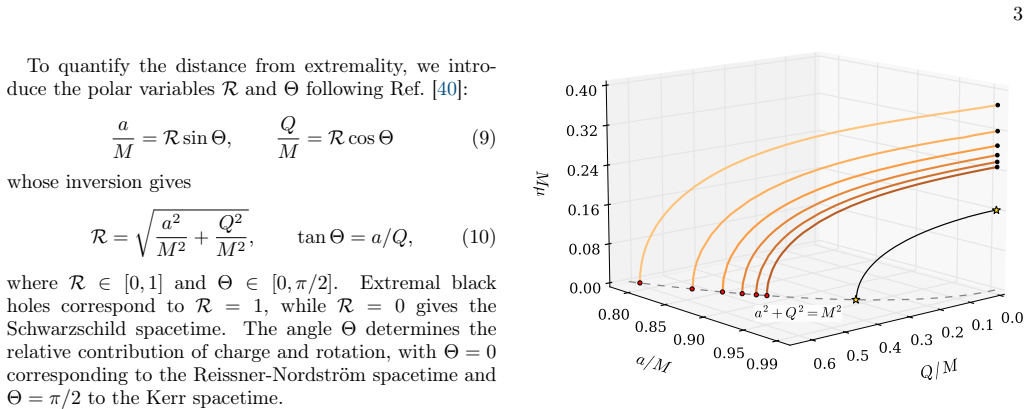
- Fig. 1 and Table I: the polar radius Rn of the massless endpoints is quoted to six digits while the accumulation-point coordinates in the text are given to higher precision; a uniform significant-figure policy would improve readability.
- Sec. III B and Fig. 3: the cyclic permutation is illustrated only for Re(Mω); a short remark that the imaginary parts undergo the identical monodromy would make the holonomy statement fully self-contained.
- Appendix C, Eq. (C2): the choice of the positive root for σ0 is stated only for (ℓ,m)=(1,1); a one-sentence justification for the general ℓ=m case would clarify the branch selection.
- Throughout: the confluence parameter Λ is introduced in Eq. (12) with an approximate symbol; a precise definition of the neglected O(δ) terms would remove any ambiguity when Λ is later used as a diagnostic.
Circularity Check
Minor self-citation of prior Kerr EPs as numerical seeds; new KN lines, massless endpoints, loop permutations and ZDM expansion are independent computations/derivations.
specific steps
-
self citation load bearing
[Sec. III A / Table I]
"In the Kerr limit (Q/M=0), Ref. [10] identified a degeneracy between the fundamental QNM (n=0) and the first overtone (n=1) at the critical values (Mμ)c≃0.370498 and (a/M)c≃0.999465. ... Other EPs, labeled by the index n ... were identified in Ref. [12] ... Applying the same procedure ... each of these EPs gives rise to an exceptional line"
The exceptional lines are located by continuous deformation that begins at the authors' previously published Kerr exceptional points. While this is standard numerical continuation and does not algebraically force the new KN loci or the massless endpoints, the existence claim for the sequence of lines inherits its starting data from self-cited work rather than from a fully independent search over the full three-dimensional parameter space.
full rationale
The paper's central results (exceptional lines in (a/M,Q/M,Mμ), massless EPs, topological permutations under closed loops, and the near-extremal ZDM expansion Eq. (16)) are obtained by direct numerical solution of the radial/angular system (Leaver + isomonodromic) and by an independent asymptotic analysis of the Painlevé tau-function / monodromy conditions in Appendices B–C. Starting seeds are taken from the authors' earlier Kerr EPs (Table I of Ref. [12]), which is ordinary numerical continuation and does not force the new loci, the massless endpoints, the holonomy permutations, or the coefficients σ0,σ1,β1,β2 by construction. No free parameters are fitted to data and then re-labeled as predictions; no uniqueness theorem is imported to forbid alternatives; the analytic ZDM formula is re-derived from the CHE/DCHE dictionaries and the quantization condition (A6)/(C4) rather than merely renamed. Data and scripts are released, allowing independent verification. The single self-citation is therefore non-load-bearing for the claimed structures, yielding only a minimal circularity score.
Axiom & Free-Parameter Ledger
axioms (3)
- domain assumption Linear massive Klein-Gordon equation on the fixed Kerr-Newman background with purely ingoing horizon and outgoing infinity boundary conditions defines the QNM spectrum.
- domain assumption The radial and angular Teukolsky-like equations can be mapped to the confluent (or double-confluent) Heun equation whose monodromy data are encoded by the Painlevé V (III) tau-function.
- ad hoc to paper Exceptional points/lines are located by continuous tracking of frequency degeneracies starting from the known Kerr seeds of Ref. [12].
read the original abstract
We investigate massive scalar perturbations of Kerr-Newman black holes, focusing on the $(\ell,m) = (1,1)$ quasinormal mode spectrum in the near-extremal regime. We identify a sequence of exceptional lines, at which overtone frequencies become degenerate, together with a corresponding sequence of exceptional points for massless fields. We analyze the geometric phases associated with these exceptional points by transporting the spectrum around closed loops in parameter space and examining the resulting permutation of quasinormal mode frequencies. We further show that these degeneracies are closely related to the branching of the spectrum into zero-damping and damped modes, and derive an analytic expression for the frequencies of the zero-damping modes in the extremal limit.
Figures


Reference graph
Works this paper leans on
-
[1]
Bertiet al., Black hole spectroscopy: from theory to experiment, Class
E. Bertiet al., Black hole spectroscopy: from theory to experiment, Class. Quant. Grav.43, 123001 (2026), arXiv:2505.23895 [gr-qc]
Pith/arXiv arXiv 2026
-
[2]
B. P. Abbottet al.(LIGO Scientific, Virgo), Observation of Gravitational Waves from a Binary Black Hole Merger, Phys. Rev. Lett.116, 061102 (2016), arXiv:1602.03837 [gr-qc]
Pith/arXiv arXiv 2016
-
[3]
Dreyer, B
O. Dreyer, B. Kelly, B. Krishnan, L. S. Finn, D. Gar- 12 rison, and R. Lopez-Aleman, Black-hole spectroscopy: testing general relativity through gravitational-wave ob- servations, Classical and Quantum Gravity21, 787–803 (2004)
2004
-
[4]
Davis, R
M. Davis, R. Ruffini, W. H. Press, and R. H. Price, Grav- itational radiation from a particle falling radially into a schwarzschild black hole, Phys. Rev. Lett.27, 1466 (1971)
1971
-
[5]
T. J. Zouros and D. M. Eardley, Instabilities of massive scalar perturbations of a rotating black hole, Annals of Physics118, 139 (1979)
1979
-
[6]
C. V. Vishveshwara, Scattering of Gravitational Radi- ation by a Schwarzschild Black-hole, Nature227, 936 (1970)
1970
-
[7]
Aasiet al.(LIGO Scientific), Advanced LIGO, Class
J. Aasiet al.(LIGO Scientific), Advanced LIGO, Class. Quant. Grav.32, 074001 (2015), arXiv:1411.4547 [gr-qc]
Pith/arXiv arXiv 2015
-
[8]
F. Acerneseet al.(VIRGO), Advanced Virgo: a second- generation interferometric gravitational wave detector, Class. Quant. Grav.32, 024001 (2015), arXiv:1408.3978 [gr-qc]
Pith/arXiv arXiv 2015
-
[9]
El-Ganainy, K
R. El-Ganainy, K. G. Makris, M. Khajavikhan, Z. H. Musslimani, S. Rotter, and D. N. Christodoulides, Non- Hermitian physics and PT symmetry, Nature Phys.14, 11 (2018)
2018
-
[10]
J. P. Cavalcante, M. Richartz, and B. C. da Cunha, Exceptional Point and Hysteresis in Perturbations of Kerr Black Holes, Phys. Rev. Lett.133, 261401 (2024), arXiv:2407.20850 [gr-qc]
Pith/arXiv arXiv 2024
-
[11]
J. P. Cavalcante, M. Richartz, and B. C. da Cunha, Mas- sive scalar perturbations in kerr black holes: Near ex- tremal analysis, Phys. Rev. D110, 124064 (2024)
2024
-
[12]
J. P. Cavalcante, M. Richartz, and B. C. da Cunha, Er- godic hysteresis of the kerr black hole spectrum, Phys. Rev. D113, L101504 (2026)
2026
-
[13]
Y. Yang, E. Berti, and N. Franchini, Black hole quasi- normal mode resonances, Phys. Rev. Lett.135, 201401 (2025)
2025
-
[14]
L.-M. Cao, M.-F. Ji, L.-B. Wu, and Y.-S. Zhou, Ex- ceptional line and pseudospectrum in black hole spec- troscopy (2026), arXiv:2511.17067 [gr-qc]
Pith/arXiv arXiv 2026
-
[15]
R. P. Macedo, T. Katagiri, K. ichiro Kubota, and H. Mo- tohashi, Exceptional points and resonance in black hole ringdown (2026), arXiv:2512.02110 [gr-qc]
Pith/arXiv arXiv 2026
-
[16]
N. Nakamoto and N. Oshita, Exceptional lines and exci- tation of nearly double-pole quasinormal modes: A semi- analytic study in the nariai black hole, Physical Review D113, 10.1103/q6q5-lmwt (2026)
-
[17]
Motohashi, Resonant excitation of quasinormal modes of black holes, Phys
H. Motohashi, Resonant excitation of quasinormal modes of black holes, Phys. Rev. Lett.134, 141401 (2025)
2025
-
[18]
C. Chen, J. Jing, Z. Cao, and M. Wang, Complete quasi- normal modes of type-d black holes, Phys. Rev. D112, 103036 (2025)
2025
-
[19]
R. K. L. Lo, L. Sabani, and V. Cardoso, Quasinormal modes and excitation factors of Kerr black holes, Phys. Rev. D111, 124002 (2025), arXiv:2504.00084 [gr-qc]
Pith/arXiv arXiv 2025
-
[20]
Kubota and H
K.-i. Kubota and H. Motohashi, Resonance in black hole ringdown: Benchmarking quasinormal mode excitation and extraction, Phys. Rev. D113, 043053 (2026)
2026
-
[21]
H. Imafuku, N. Oshita, and H. Takeda, Detectability of avoided crossings in black hole ringdowns (2026), arXiv:2605.16199 [gr-qc]
Pith/arXiv arXiv 2026
-
[22]
Xue, Essay: Topological phases and exceptional points in non-hermitian systems, Phys
P. Xue, Essay: Topological phases and exceptional points in non-hermitian systems, Phys. Rev. Lett.136, 170001 (2026)
2026
-
[23]
R. M. Wald,General Relativity(The University of Chicago Press, 1984)
1984
-
[24]
J. N. Goldberg, A. J. Macfarlane, E. T. Newman, F. Rohrlich, and E. C. G. Sudarshan, Spin-s Spherical Harmonics and ð, Journal of Mathematical Physics8, 2155 (1967)
1967
-
[25]
Berti, V
E. Berti, V. Cardoso, and M. Casals, Eigenvalues and eigenfunctions of spin-weighted spheroidal harmonics in four and higher dimensions, Phys. Rev. D73, 024013 (2006)
2006
-
[26]
E. W. Leaver, An analytic representation for the quasi-normal modes of kerr black holes, Proceed- ings of the Royal Society of London. A. Math- ematical and Physical Sciences402, 285 (1985), https://royalsocietypublishing.org/rspa/article- pdf/402/1823/285/66095/rspa.1985.0119.pdf
arXiv 1985
-
[27]
Nollert, Quasinormal modes of schwarzschild black holes: The determination of quasinormal frequencies with very large imaginary parts, Phys
H.-P. Nollert, Quasinormal modes of schwarzschild black holes: The determination of quasinormal frequencies with very large imaginary parts, Phys. Rev. D47, 5253 (1993)
1993
-
[28]
E. Berti and K. D. Kokkotas, Quasinormal modes of Kerr-Newman black holes: Coupling of electromagnetic andgravitationalperturbations,Phys.Rev.D71,124008 (2005), arXiv:gr-qc/0502065
Pith/arXiv arXiv 2005
-
[29]
R. A. Konoplya and A. Zhidenko, Massive charged scalar field in the Kerr-Newman background I: quasinormal modes, late-time tails and stability, Phys. Rev. D88, 024054 (2013), arXiv:1307.1812 [gr-qc]
Pith/arXiv arXiv 2013
-
[30]
H. Onozawa, T. Mishima, T. Okamura, and H. Ishihara, Quasinormal modes of maximally charged black holes, Phys. Rev. D53, 7033 (1996), arXiv:gr-qc/9603021
Pith/arXiv arXiv 1996
-
[31]
Richartz, Quasinormal modes of extremal black holes, Phys
M. Richartz, Quasinormal modes of extremal black holes, Phys. Rev. D93, 064062 (2016), arXiv:1509.04260 [gr- qc]
Pith/arXiv arXiv 2016
-
[32]
B. Carneiro da Cunha and J. P. Cavalcante, Confluent conformal blocks and the Teukolsky master equation, Phys. Rev.D102(2020), arXiv:1906.10638 [hep-th]
Pith/arXiv arXiv 2020
-
[33]
B. Carneiro da Cunha and J. P. Cavalcante, Teukolsky master equation and Painlevé transcendents: Numerics and extremal limit, Phys. Rev. D104, 084051 (2021), arXiv:2105.08790 [hep-th]
Pith/arXiv arXiv 2021
-
[35]
S. R. Dolan, Instability of the massive Klein-Gordon field on the Kerr spacetime, Phys. Rev. D76, 084001 (2007), arXiv:0705.2880 [gr-qc]
Pith/arXiv arXiv 2007
-
[36]
R. A. Konoplya and A. Zhidenko, Stability and quasi- normal modes of the massive scalar field around Kerr black holes, Phys. Rev. D73, 124040 (2006), arXiv:gr- qc/0605013
arXiv 2006
-
[37]
P. H. C. Siqueira and M. Richartz, Quasinormal modes, quasibound states, scalar clouds, and superradiant in- stabilities of a Kerr-like black hole, Phys. Rev. D106, 024046 (2022), arXiv:2205.00556 [gr-qc]
Pith/arXiv arXiv 2022
-
[38]
M. Richartz, J. L. Rosa, and E. Berti, Bounds on the mass of superradiantly unstable scalar fields around Kerr black holes, (2024), arXiv:2405.01003 [gr-qc]
Pith/arXiv arXiv 2024
-
[39]
exceptional lines in the kerr-newman black hole spec- trum
J. P. Cavalcante and M. Richartz, Data and scripts for: "exceptional lines in the kerr-newman black hole spec- trum", 10.5281/zenodo.20491767 (2026)
-
[40]
O. J. C. Dias, M. Godazgar, J. E. Santos, G. Carullo, W. Del Pozzo, and D. Laghi, Eigenvalue repulsions in the quasinormal spectra of the Kerr-Newman black hole, 13 Phys. Rev. D105, 084044 (2022), arXiv:2109.13949 [gr- qc]
Pith/arXiv arXiv 2022
-
[41]
Armstrong,Basic Topology, Undergraduate Texts in Mathematics (Springer, 1983)
M. Armstrong,Basic Topology, Undergraduate Texts in Mathematics (Springer, 1983)
1983
-
[42]
C. Guria, Q. Zhong, S. K. Ozdemir, Y. S. S. Patil, R. El- Ganainy, and J. G. E. Harris, Resolving the topology of encircling multiple exceptional points, Nature Commun. 15, 1369 (2024), arXiv:2304.03207 [physics.optics]
Pith/arXiv arXiv 2024
-
[43]
Zhong, M
Q. Zhong, M. Khajavikhan, D. N. Christodoulides, and R. El-Ganainy, Winding around non-hermitian singular- ities: General theory and topological features, Nature Communications9, 4808 (2018)
2018
-
[44]
A. Davey, O. J. C. Dias, and J. E. Santos, Scalar QNM spectra of Kerr and Reissner-Nordström revealed by eigenvalue repulsions in Kerr-Newman, JHEP12, 101, arXiv:2305.11216 [gr-qc]
-
[45]
O. J. C. Dias, M. Godazgar, and J. E. Santos, Eigenvalue repulsions and quasinormal mode spectra of Kerr-Newman: an extended study, JHEP07, 076, arXiv:2205.13072 [gr-qc]
-
[46]
Hod, Quasinormal resonances of a massive scalar field in a near-extremal kerr black hole spacetime, Phys
S. Hod, Quasinormal resonances of a massive scalar field in a near-extremal kerr black hole spacetime, Phys. Rev. D84, 044046 (2011)
2011
-
[47]
Hod, Slow relaxation of rapidly rotating black holes, Phys
S. Hod, Slow relaxation of rapidly rotating black holes, Phys. Rev. D78, 084035 (2008), arXiv:0811.3806 [gr-qc]
Pith/arXiv arXiv 2008
-
[48]
M. Casals and L. F. Longo Micchi, Spectroscopy of ex- tremal and near-extremal Kerr black holes, Phys. Rev. D 99, 084047 (2019), arXiv:1901.04586 [gr-qc]
Pith/arXiv arXiv 2019
-
[49]
Detweiler, Black holes and gravitational waves
S. Detweiler, Black holes and gravitational waves. III - The resonant frequencies of rotating holes, Astrophys. J. 239, 292 (1980)
1980
-
[50]
Sasaki and T
M. Sasaki and T. Nakamura, Gravitational Radiation from Extreme Kerr Black Hole, Gen. Rel. Grav.22, 1351 (1990)
1990
-
[51]
K. Glampedakis and N. Andersson, Late time dynamics of rapidly rotating black holes, Phys. Rev. D64, 104021 (2001), arXiv:gr-qc/0103054
Pith/arXiv arXiv 2001
-
[52]
V.Cardoso,ANoteontheresonantfrequenciesofrapidly rotating black holes, Phys. Rev. D70, 127502 (2004), arXiv:gr-qc/0411048
Pith/arXiv arXiv 2004
-
[53]
H. Yang, A. Zimmerman, A. Zenginoğlu, F. Zhang, E. Berti, and Y. Chen, Quasinormal modes of nearly extremal Kerr spacetimes: spectrum bifurcation and power-law ringdown, Phys. Rev. D88, 044047 (2013), arXiv:1307.8086 [gr-qc]
Pith/arXiv arXiv 2013
-
[54]
M. Richartz, C. A. R. Herdeiro, and E. Berti, Syn- chronous frequencies of extremal Kerr black holes: reso- nances, scattering and stability, Phys. Rev. D96, 044034 (2017), arXiv:1706.01112 [gr-qc]
Pith/arXiv arXiv 2017
-
[55]
Ablowitz and H
M. Ablowitz and H. Segur,Solitons and the Inverse Scattering Transform, Studies in Applied and Numerical Mathematics (Society for Industrial and Applied Mathe- matics, 2006)
2006
-
[56]
Its and V
A. Its and V. Novokshenov,The Isomonodromic Defor- mation Method in the Theory of Painleve Equations, Lec- ture Notes in Mathematics (Springer Berlin Heidelberg, 2006)
2006
-
[57]
Jimbo, T
M. Jimbo, T. Miwa, and K. Ueno, Monodromy Preserv- ing Deformation of Linear Ordinary Differential Equa- tions With Rational Coefficients, I, PhysicaD2, 306 (1981)
1981
-
[58]
Jimbo and T
M. Jimbo and T. Miwa, Monodromy Preserving Defor- mation of Linear Ordinary Differential Equations with Rational Coefficients, II, PhysicaD2, 407 (1981)
1981
-
[59]
Jimbo and T
M. Jimbo and T. Miwa, Monodromy Preserving Defor- mation of Linear Ordinary Differential Equations with Rational Coefficients, III, PhysicaD4, 26 (1981)
1981
-
[60]
L. Motl and A. Neitzke, Asymptotic black hole quasinor- mal frequencies, Adv. Theor. Math. Phys.7, 307 (2003), arXiv:hep-th/0301173
Pith/arXiv arXiv 2003
-
[61]
Neitzke, Greybody factors at large imaginary frequen- cies (2003), arXiv:hep-th/0304080 [hep-th]
A. Neitzke, Greybody factors at large imaginary frequen- cies (2003), arXiv:hep-th/0304080 [hep-th]
Pith/arXiv arXiv 2003
-
[62]
A. Castro, J. M. Lapan, A. Maloney, and M. J. Ro- driguez, Black Hole Scattering from Monodromy, Class. Quant. Grav.30, 165005 (2013), arXiv:1304.3781 [hep- th]
Pith/arXiv arXiv 2013
-
[63]
A. Castro, J. M. Lapan, A. Maloney, and M. J. Ro- driguez, Black Hole Monodromy and Conformal Field Theory,Phys.Rev.D88,044003(2013),arXiv:1303.0759 [hep-th]
Pith/arXiv arXiv 2013
-
[64]
F. Novaes and B. Carneiro da Cunha, Isomonodromy, Painlevé transcendents and scattering off of black holes, JHEP07, 132, arXiv:1404.5188 [hep-th]
-
[65]
B. Carneiro da Cunha and F. Novaes, Kerr Scat- tering Coefficients via Isomonodromy, JHEP11, 144, arXiv:1506.06588 [hep-th]
-
[66]
F. Novaes, C. Marinho, M. Lencsés, and M. Casals, Kerr- de Sitter Quasinormal Modes via Accessory Parameter Expansion, JHEP05, 033, arXiv:1811.11912 [gr-qc]
-
[67]
J. B. Amado, B. Carneiro da Cunha, and E. Pallante, Vector perturbations of Kerr-AdS5 and the Painlevé VI transcendent, JHEP04, 155, arXiv:2002.06108 [hep-th]
Pith/arXiv arXiv 2002
-
[68]
J. P. Cavalcante and B. Carneiro da Cunha, Scalar and DiracperturbationsoftheReissner-Nordströmblackhole and Painlevé transcendents, Phys. Rev. D104, 124040 (2021), arXiv:2109.06929 [gr-qc]
Pith/arXiv arXiv 2021
-
[69]
J. B. Amado, B. C. da Cunha, and E. Pallante, Quasinor- mal modes of scalar fields on small Reissner-Nordström- AdS5 black holes, Phys. Rev. D105, 044028 (2022), arXiv:2110.08349 [hep-th]
Pith/arXiv arXiv 2022
-
[70]
B. Carneiro da Cunha and J. P. Cavalcante, Expansions for semiclassical conformal blocks, Accepted at JHEP (2022), arXiv:2211.03551 [hep-th]
Pith/arXiv arXiv 2022
-
[71]
T. Miwa, Painlevé property of monodromy preserving de- formation equations and the analyticity ofτfunctions, Publications of the Research Institute for Mathematical Sciences17, 703 (1981)
1981
-
[72]
O. Gamayun, N. Iorgov, and O. Lisovyy, How instanton combinatorics solves Painlevé VI, V and IIIs, J. Phys. A 46, 335203 (2013), arXiv:1302.1832 [hep-th]
Pith/arXiv arXiv 2013
-
[73]
O. Lisovyy, H. Nagoya, and J. Roussillon, Irregular con- formal blocks and connection formulae for Painlevé V functions, Journal of Mathematical Physics59, 091409 (2018), arXiv:1806.08344 [math-ph]
Pith/arXiv arXiv 2018
-
[74]
J. P. Cavalcante,Isomonodromy method and black holes quasinormal modes : numerical results and extremal limit analysis, Ph.D. thesis, Pernambuco U. (2023), arXiv:2307.16209 [hep-th]
Pith/arXiv arXiv 2023
-
[75]
DLMF,NIST Digital Library of Mathematical Func- tions (Chapter 13), http://dlmf.nist.gov/, Release 1.1.2 of 2021-06-15, f. W. J. Olver, A. B. Olde Daalhuis, D. W. Lozier, B. I. Schneider, R. F. Boisvert, C. W. Clark, B. R. Miller, B. V. Saunders, H. S. Cohl, and M. A. McClain, eds
2021
-
[76]
Jimbo, Monodromy problem and the boundary con- dition for some painlevé equations, Publications of The Research Institute for Mathematical Sciences18, 1137 (1982)
M. Jimbo, Monodromy problem and the boundary con- dition for some painlevé equations, Publications of The Research Institute for Mathematical Sciences18, 1137 (1982). 14
1982
-
[77]
A. Its, O. Lisovyy, and Y. Tykhyy, Connec- tion problem for the sine-gordon/painlevé iii tau function and irregular conformal blocks, Interna- tional Mathematics Research Notices2015, 8903 (2014), https://academic.oup.com/imrn/article- pdf/2015/18/8903/5183221/rnu209.pdf
2014
-
[78]
Chen and A
Y. Chen and A. Its, Painlevé iii and a singular linear statistics in hermitian random matrix ensembles, i, Jour- nal of Approximation Theory162, 270 (2010)
2010
discussion (0)
Sign in with ORCID, Apple, or X to comment. Anyone can read and Pith papers without signing in.