REVIEW 4 minor 107 references
A bosonic lattice model yields chiral fermions with no doublers by making the reconstructed Dirac operator non-local while keeping the microscopic theory ultra-local.
Reviewed by Pith at T0; open to challenge. T0 means a machine referee read the full paper against a public rubric. the ladder, T0–T4 →
T0 review · grok-4.5
2026-07-14 14:28 UTC pith:Z5GPGUXZ
load-bearing objection Clean 2D analytic demo that ultra-local bosonization yields doubler-free chiral fermions whose reconstructed Dirac kernel is non-local, consistent with Nielsen-Ninomiya.
Bosonization versus the Nielsen-Ninomiya theorem
The pith
A machine-rendered reading of the paper's core claim, the machinery that carries it, and where it could break.
Core claim
In the 2D modified Villain model at the self-dual radius, lattice operators built from the scalar and its dual, dressed by topological rays, produce exact two-point functions whose continuum asymptotics match free massless Weyl correlators. Inverting those correlators yields a hermitian lattice Dirac operator that anti-commutes with the usual chiral matrix, has a single Dirac zero at vanishing momentum, and therefore no doublers, yet falls off only as O(1/|x-y|) and is therefore non-local. The microscopic bosonic action and its symmetries remain ultra-local, so non-anomalous symmetries can be gauged directly.
What carries the argument
The reconstructed lattice Dirac operator obtained by inverting the exact two-point functions of the composite Weyl operators: it is doubler-free and chirally structured, yet non-local, thereby saturating the Nielsen-Ninomiya assumptions while the underlying modified Villain model stays ultra-local.
Load-bearing premise
That the composite lattice operators, once attached to topological rays and fixed by a constant renormalization, continue to match continuum Weyl fields in the continuum limit, verified only by matching two-point asymptotics and the leading factorization of four-point functions.
What would settle it
Compute the full spectrum of the reconstructed Dirac operator on a large finite lattice (or its Fourier transform) and check whether any extra zeros appear at non-zero lattice momenta once the contact term is fixed by the continuum asymptotics; an extra zero would restore doublers and falsify the claim.
Editorial analysis
A structured set of objections, weighed in public.
Referee Report
Summary. The paper constructs lattice Weyl operators (Eqs. 43a–b) as composite operators of the ultra-local 2D modified Villain scalar model at the self-dual radius, evaluates their exact two-point functions by path-integral reduction to the lattice Green function (App. C.1, Eq. 49), and shows that after a fixed renormalization (Eq. 52) the large-distance asymptotics reproduce the continuum Weyl propagator (App. C.2, Eq. 51). Inverting these correlators yields a reconstructed hermitian Dirac operator (Eqs. 59–60) that anti-commutes with γ3, has a single Dirac zero at p=0, and is non-local (kernel ~O(1/|x−y|)). The non-locality is forced by the Poincaré–Hopf theorem applied to the momentum-space two-point function (Sec. IV.D, App. C.3), so the construction remains consistent with Nielsen–Ninomiya while the microscopic bosonic theory and its non-anomalous symmetries stay ultra-local and gaugeable. Connected four-point functions are non-vanishing at finite spacing but irrelevant in the continuum limit (Sec. IV.E).
Significance. The work supplies an explicit, analytically controlled illustration of how bosonization evades the Nielsen–Ninomiya theorem: the microscopic theory is ultra-local and free of Grassmann fields, yet the reconstructed inverse propagator of the emergent chiral operators is non-local and doubler-free. The exact two-point evaluation, continuum asymptotics, and topological argument for poles are self-contained and reproducible from the appendices. This clarifies the status of propagator zeros in the symmetric-mass-generation literature and strengthens the conceptual case for gauging chiral symmetries directly on the bosonic side. The result is limited to 2D free fermions, but the distinction it draws between microscopic ultra-locality and reconstructed non-locality is of broader interest for lattice chiral gauge theory.
minor comments (4)
- The continuum operator dictionary (Eq. 27) is verified only through two-point asymptotics and continuum four-point factorization. A short remark in Sec. IV.B or the Outlook noting that a full lattice OPE or spectral reconstruction is left for future work would make the scope of the identification clearer.
- Figs. 6–7 show that the locations of zeros of eS+(p) depend on the contact term S+(0). Adding a sentence that the total Poincaré–Hopf index is contact-term independent (while individual zeros are not) would prevent misreading of the figures.
- Table I is a useful scorecard; a brief footnote clarifying that the “bosonization” row refers to the reconstructed Dirac operator rather than a microscopic Grassmann action would avoid confusion with SLAC/Stacey fermions.
- The spin θ-angle is deliberately omitted on the lattice (Sec. IV). A one-sentence reminder that its only effect on infinite-volume correlators is to select a single-valued branch would help readers unfamiliar with the continuum review in Sec. III.
Circularity Check
No significant circularity: reconstructed Dirac operator and its non-locality/no-doublers properties are derived outputs of explicit correlator inversion, not inputs.
full rationale
The derivation chain is self-contained and non-circular. Lattice Weyl operators are defined from the microscopic modified Villain fields plus topological rays (Eqs. 43a–b); their two-point functions S_pm are computed exactly from the path integral (App. C.1, Eq. 49) using only the lattice Green function and sum-by-parts identities; continuum asymptotics follow from the known large-|x| expansion of G (App. C.2, Eq. 51) after a constant renormalization Z fixed by matching the leading 1/|x| coefficient; the lattice Dirac kernel is then defined by inversion of those correlators (Eqs. 59–60); Fourier analysis plus the Poincaré–Hopf theorem applied to the single pole of eS (App. C.3) forces the absence of extra zeros of 1/eS while the slow decay of S implies poles of P and hence non-locality of /D ~ O(1/|x–y|). Contact-term dependence of zero locations is acknowledged and does not affect the topological index or the non-locality conclusion. Continuum bosonization (Coleman) is used only for operator identification and is an external standard result; multi-point connected correlators are computed independently to show residual interactions are irrelevant. No fitted parameters are re-labeled as predictions, no uniqueness theorem is imported from the authors’ prior work to force the spectrum, and the ultra-locality of the bosonic action is an independent microscopic fact. Self-citations (e.g. [30]) supply the model but are not load-bearing for the reconstructed-operator claims.
Axiom & Free-Parameter Ledger
free parameters (1)
- Z± Z̄± renormalization product =
2 e^{γ_E}(1±i)
axioms (4)
- standard math Poincaré-Hopf theorem applied to continuous sections of the trivial rank-2 real bundle over T^{2}
- domain assumption Coleman’s continuum boson-fermion duality at R=1/√2, including the operator dictionary of Eq. (27)
- domain assumption The modified Villain model at R=1/√2 flows to the free compact boson (and hence, after spin θ-angle, to the free Dirac fermion)
- standard math Contact-term redefinitions of the lattice fermion operators do not alter the topological index of the momentum-space pole at p=0
invented entities (1)
-
Lattice Weyl operators ψ±(C_x), ψ̄±(C_x) attached to topological rays C_x
no independent evidence
read the original abstract
Thanks to bosonization, bosonic lattice models can offer a lattice regularization of chiral fermions. We construct chiral lattice fermion operators in the 2D modified Villain scalar model and evaluate their correlation functions. This microscopic bosonic model has an ultra-local action and an ultra-local symmetry that realizes the fermionic chiral symmetry under bosonization. The reconstructed lattice Dirac operator has no doublers, but is consistent with the Nielsen-Ninomiya theorem because it turns out to be non-local. The non-locality of this derived quantity at finite lattice spacing does not pose any obstructions to gauging the non-anomalous symmetries of the model, which is itself ultra-local.
Figures


Reference graph
Works this paper leans on
-
[1]
Fermionic description 5 IV
Physical effect 4 B. Fermionic description 5 IV. Lattice chiral fermion in the 2D Modified Villain Model 6 A. 2D Modified Villain Model 6 B. Fermionic operator 7 C. Two-point correlation function 7 D. Non-local lattice Dirac operator 10 E. Multi-point correlation function 11 V. Outlook 12 A. Appendix: 2D boson-fermion transformation tetrahedron 12 B. Appe...
-
[2]
Lattice differential operators 13
-
[3]
Appendix: Calculation details in the 2D modified Villain model 15
Lattice Green function 14 C. Appendix: Calculation details in the 2D modified Villain model 15
-
[4]
Two-point correlation function 15
-
[5]
Asymptotic expansion 17
-
[6]
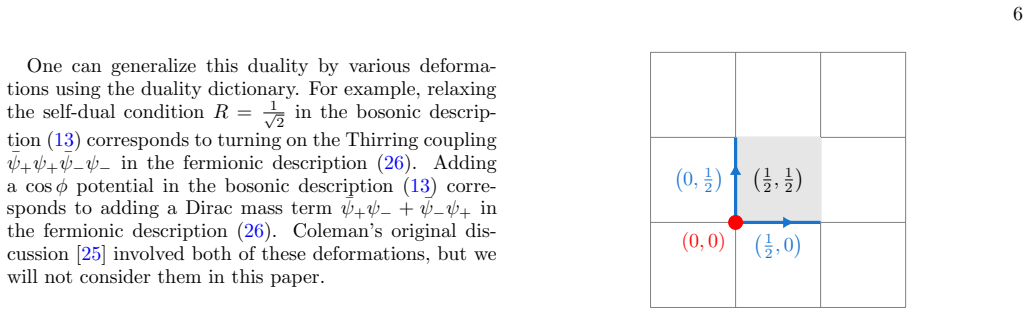
Momentum-space discontinuity 18 References 19 ∗ sbaig.phys@gmail.com † s.chern.phys@gmail.com ‡ acherman@umn.edu § neuzi008@umn.edu I. Introduction It is notoriously challenging to put massless fermions on a Euclidean spacetime lattice while preserving chiral symmetries. This poses an obstruction to the lattice reg- ularization of chiral gauge theories, s...
Pith/arXiv arXiv 2026
-
[7]
On 2D oriented and spin spacetime manifolds, theθ-angles are classified by the bordism groups (see e.g
Spinθ-angle The topology of anS 1 scalar brings not only theU(1) W symmetry but also topologicalθ-angles. On 2D oriented and spin spacetime manifolds, theθ-angles are classified by the bordism groups (see e.g. Refs. [62–65]) Hom eΩSO 2 (S1), U(1) = 0,(8a) Hom eΩSpin 2 (S1), U(1) =Z 2 ,(8b) respectively. All 2D orientable manifolds are spinnable, but in ge...
-
[8]
protects
Physical effect Since the spinθ-angle (9) is trivial onS 2, it does not affect local dynamics, and only affects the global struc- ture. Hence the fermionic theory (13) is still a conformal 2 See e.g. Refs. [58–61] for useful reviews about the Arf invariant. field theory with central chargesc= ¯c= 1. Evaluating the path integral (13) on a flat torus, T 2 =...
-
[9]
and ( 1 2 ,0) are two links em- anating from the site (0,0), while ( 1 2 , 1
-
[10]
is the plaquette attached to the links (0, 1
-
[11]
Y s∈Γ0 Z R dφ(s) 2π #
and ( 1 2 ,0). We shall use various operators on lattice fields includ- ing the lattice differential d, the lattice codifferentialδ, the lattice laplacian ∆≡dδ+δd, and the lattice Hodge star⋆. They are discretizations of their continuum coun- terparts and satisfy similar properties. In Appendix B 1, we summarize their definitions and prove their propertie...
2026
-
[12]
We use Γ 0, Γ1, and Γ 2 to de- note the collection of sites, links, and plaquettes, respec- tively
Lattice differential operators In this subsection, we review the discrete differential operators on a 2D lattice. We use Γ 0, Γ1, and Γ 2 to de- note the collection of sites, links, and plaquettes, respec- tively. As we explained in Section IV A, it is convenient 14 to label the lattice elements with the 1 2-notation, Γ0 ∪Γ 1 ∪Γ 2 ≃ 1 2 Z⊕ 1 2 Z(B1) such ...
-
[13]
We fix this constant by requiring G(0) = 0.(B10) The Poisson equation (B9) and the convention (B10) de- termine a uniqueG(x)
Lattice Green function In this subsection, we review the lattice Green function G:Z 2 7→Rthat solves the 2D lattice Poisson equation, −∆G(x) =δ x,0 .(B9) IfG(x) is a solution, so isG(x) +c. We fix this constant by requiring G(0) = 0.(B10) The Poisson equation (B9) and the convention (B10) de- termine a uniqueG(x). G(x) does not have a particularly illumin...
-
[14]
Based on our discussion in Sec- tion IV C before Eq
Two-point correlation function In this subsection, we evaluate the two-point correla- tion functionS ±(x). Based on our discussion in Sec- tion IV C before Eq. (47), we have S±(x−y) = Z DφDnDθe −S(φ,n,θ) ψ±(Cx) ¯ψ±(Cy) Z DφDnDθe −S(φ,n,θ) (C1) with the equivalence class of pathsC x,y ≡C y −C x rep- resented by Fig. 2a (and Fig. 4). First let us integrate ...
-
[15]
∓iπ X ℓ∈Γ1 Cx,0(ℓ)δσx(ℓ) # ,(C16a) eiΘ±(x) ≡exp
Asymptotic expansion In this subsection, we derive the large-|x|asymptotic expansion of the correlation functionS ±(x). Let us rewrite Eq. (49) as S±(x) =Z ±Z ±e2πG(x)eiΦ±(x)eiΘ±(x) ,(C15) where the phase functions eiΦ±(x) ≡exp " ∓iπ X ℓ∈Γ1 Cx,0(ℓ)δσx(ℓ) # ,(C16a) eiΘ±(x) ≡exp " ±iπ X ℓ∈Γ1 Cx,0(ℓ)δσ0(ℓ) # ,(C16b) for the equivalence class of pathsC x,0 re...
-
[16]
Since the leadingO(|x| −1) term in the asymptotic expansion (51) ofS +(x) decays more slowly thanO(|x| −2), the Fourier transform eS+(p) will contain singularities
Momentum-space discontinuity In this subsection, we discuss the singularities of the momentum-space correlation function eS+(p). Since the leadingO(|x| −1) term in the asymptotic expansion (51) ofS +(x) decays more slowly thanO(|x| −2), the Fourier transform eS+(p) will contain singularities. We first show that eS+(p) is continuous onT 2 except forp= (0,0...
-
[17]
H. B. Nielsen and M. Ninomiya, Absence of Neutrinos on a Lattice. 1. Proof by Homotopy Theory, Nucl. Phys. B185, 20 (1981)
1981
-
[18]
H. B. Nielsen and M. Ninomiya, Absence of Neutrinos on a Lattice. 2. Intuitive Topological Proof, Nucl. Phys. B193, 173 (1981)
1981
-
[19]
L. H. Karsten and J. Smit, Lattice Fermions: Species Doubling, Chiral Invariance, and the Triangle Anomaly, Nucl. Phys.B183, 103 (1981), [,495(1980)]
1981
-
[20]
L. H. Karsten, Lattice Fermions in Euclidean Space-time, Phys. Lett. B104, 315 (1981)
1981
-
[21]
H. B. Nielsen and M. Ninomiya, No Go Theorem for Reg- ularizing Chiral Fermions, Phys. Lett.105B, 219 (1981)
1981
-
[22]
Friedan, A Proof of the Nielsen-Ninomiya Thorem, Commun
D. Friedan, A Proof of the Nielsen-Ninomiya Thorem, Commun. Math. Phys.85, 481 (1982)
1982
-
[23]
Luscher, Exact chiral symmetry on the lattice and the Ginsparg-Wilson relation, Phys
M. Luscher, Exact chiral symmetry on the lattice and the Ginsparg-Wilson relation, Phys. Lett. B428, 342 (1998), arXiv:hep-lat/9802011
Pith/arXiv arXiv 1998
-
[24]
P. H. Ginsparg and K. G. Wilson, A Remnant of Chiral Symmetry on the Lattice, Phys. Rev.D25, 2649 (1982)
1982
-
[25]
Neuberger, Exactly massless quarks on the lattice, Phys
H. Neuberger, Exactly massless quarks on the lattice, Phys. Lett. B417, 141 (1998), arXiv:hep-lat/9707022
Pith/arXiv arXiv 1998
-
[26]
Neuberger, More about exactly massless quarks on the lattice, Phys
H. Neuberger, More about exactly massless quarks on the lattice, Phys. Lett.B427, 353 (1998), arXiv:hep- lat/9801031 [hep-lat]
arXiv 1998
-
[27]
P. Hasenfratz, V. Laliena, and F. Niedermayer, The Index theorem in QCD with a finite cutoff, Phys. Lett. B427, 125 (1998), arXiv:hep-lat/9801021
Pith/arXiv arXiv 1998
-
[28]
D. B. Kaplan, A Method for simulating chiral fermions on the lattice, Phys. Lett.B288, 342 (1992), arXiv:hep- lat/9206013 [hep-lat]
arXiv 1992
-
[29]
Shamir, Chiral fermions from lattice boundaries, Nucl
Y. Shamir, Chiral fermions from lattice boundaries, Nucl. Phys.B406, 90 (1993), arXiv:hep-lat/9303005 [hep-lat]
Pith/arXiv arXiv 1993
-
[30]
J. Wang and Y.-Z. You, Symmetric Mass Generation, Symmetry14, 1475 (2022), arXiv:2204.14271 [cond- mat.str-el]
Pith/arXiv arXiv 2022
-
[31]
Y.-Z. You, Y.-C. He, C. Xu, and A. Vishwanath, Symmetric Fermion Mass Generation as Deconfined Quantum Criticality, Phys. Rev. X8, 011026 (2018), arXiv:1705.09313 [cond-mat.str-el]
Pith/arXiv arXiv 2018
-
[32]
Y.-Z. You, Y.-C. He, A. Vishwanath, and C. Xu, From Bosonic Topological Transition to Symmetric Fermion Mass Generation, Phys. Rev. B97, 125112 (2018), arXiv:1711.00863 [cond-mat.str-el]
Pith/arXiv arXiv 2018
-
[33]
L. Fidkowski and A. Kitaev, The effects of interactions on the topological classification of free fermion systems, Phys. Rev. B81, 134509 (2010), arXiv:0904.2197 [cond- mat.str-el]
Pith/arXiv arXiv 2010
-
[34]
D. Tong, Comments on symmetric mass generation in 2d and 4d, JHEP2022(07), 001, arXiv:2104.03997 [hep-th]
-
[35]
Eichten and J
E. Eichten and J. Preskill, Chiral Gauge Theories on the Lattice, Nucl. Phys.B268, 179 (1986)
1986
-
[36]
M. Zeng, Z. Zhu, J. Wang, and Y.-Z. You, Symmetric Mass Generation in the 1+1 Dimensional Chiral Fermion 3-4-5-0 Model, Phys. Rev. Lett.128, 185301 (2022), arXiv:2202.12355 [cond-mat.str-el]
Pith/arXiv arXiv 2022
-
[37]
M. Golterman and Y. Shamir, Propagator Zeros and Lat- tice Chiral Gauge Theories, Phys. Rev. Lett.132, 081903 (2024), arXiv:2311.12790 [hep-lat]
Pith/arXiv arXiv 2024
-
[38]
M. Golterman and Y. Shamir, Constraints on the symmetric mass generation paradigm for lattice chi- ral gauge theories, Phys. Rev. D113, 014503 (2026), arXiv:2505.20436 [hep-lat]
arXiv 2026
-
[39]
M. Golterman and Y. Shamir, Symmetric mass gener- ation and the Nielsen-Ninomiya theorem, in42th In- ternational Symposium on Lattice Field Theory(2026) arXiv:2603.15985 [hep-lat]
arXiv 2026
-
[40]
T. D. Schultz, D. C. Mattis, and E. H. Lieb, Two- dimensional Ising model as a soluble problem of many fermions, Rev. Mod. Phys.36, 856 (1964)
1964
-
[41]
S. R. Coleman, The Quantum Sine-Gordon Equation as the Massive Thirring Model, Phys. Rev. D11, 2088 (1975)
2088
-
[42]
Witten, Nonabelian Bosonization in Two-Dimensions, Commun
E. Witten, Nonabelian Bosonization in Two-Dimensions, Commun. Math. Phys.92, 455 (1984), [,201(1983)]
1984
-
[43]
D. J. Gross and I. R. Klebanov, One-dimensional string theory on a circle, Nucl. Phys. B344, 475 (1990)
1990
-
[44]
T. Sulejmanpasic and C. Gattringer, Abelian gauge the- ories on the lattice:θ-Terms and compact gauge theory with(out) monopoles, Nucl. Phys. B943, 114616 (2019), arXiv:1901.02637 [hep-lat]
Pith/arXiv arXiv 2019
-
[45]
P. Gorantla, H. T. Lam, N. Seiberg, and S.-H. Shao, A modified Villain formulation of fractons and other exotic theories, J. Math. Phys.62, 102301 (2021), arXiv:2103.01257 [cond-mat.str-el]
Pith/arXiv arXiv 2021
-
[46]
E. Berkowitz, A. Cherman, and T. Jacobson, Exact lat- tice chiral symmetry in 2D gauge theory, Phys. Rev. D 110, 014510 (2024), arXiv:2310.17539 [hep-lat]
Pith/arXiv arXiv 2024
-
[47]
S. Seifnashri, Lieb-Schultz-Mattis anomalies as obstruc- tions to gauging (non-on-site) symmetries, arxiv (2023), arXiv:2308.05151 [cond-mat.str-el]
Pith/arXiv arXiv 2023
-
[48]
M. DeMarco, E. Lake, and X.-G. Wen, A Lattice Chiral Boson Theory in 1 + 1d, arxiv (2023), arXiv:2305.03024 [cond-mat.str-el]
Pith/arXiv arXiv 2023
-
[49]
M. Cheng and N. Seiberg, Lieb-Schultz-Mattis, Lut- tinger, and ’t Hooft – anomaly matching in lattice sys- tems, SciPost Phys.15, 051 (2023), arXiv:2211.12543 [cond-mat.str-el]
Pith/arXiv arXiv 2023
-
[50]
L. Fazza and T. Sulejmanpasic, Lattice quantum Vil- lain Hamiltonians: compact scalars, U(1) gauge theories, fracton models and quantum Ising model dualities, JHEP 05, 017, arXiv:2211.13047 [hep-th]
-
[51]
S. Seifnashri, Exactly Solvable 1+1d Chiral Lattice Gauge Theories, arxiv (2026), arXiv:2601.14359 [hep- th]
Pith/arXiv arXiv 2026
-
[52]
Shamir, Constraints on the existence of chiral fermions in interacting lattice theories, Phys
Y. Shamir, Constraints on the existence of chiral fermions in interacting lattice theories, Phys. Rev. Lett.71, 2691 (1993), arXiv:hep-lat/9306023
Pith/arXiv arXiv 1993
-
[53]
Gurarie, Single-particle Green’s functions and inter- acting topological insulators, Phys
V. Gurarie, Single-particle Green’s functions and inter- acting topological insulators, Phys. Rev. B83, 085426 (2011)
2011
-
[54]
Y. Xu and C. Xu, Green’s function Zero and Symmetric Mass Generation, arXiv (2021), arXiv:2103.15865 [cond- mat.str-el]
Pith/arXiv arXiv 2021
-
[55]
D.-C. Lu, M. Zeng, and Y.-Z. You, Green’s function zeros in Fermi surface symmetric mass generation, Phys. Rev. B108, 205117 (2023), arXiv:2307.12223 [cond-mat.str- el]
Pith/arXiv arXiv 2023
-
[56]
S. D. Drell, M. Weinstein, and S. Yankielowicz, Strong Coupling Field Theories. 2. Fermions and Gauge Fields on a Lattice, Phys. Rev. D14, 1627 (1976)
1976
-
[57]
J. M. Rabin, Perturbation Theory for SLAC Lattice 20 Fermions, Phys. Rev. D24, 3218 (1981)
1981
-
[58]
Weinstein, Anomalies and the Lattice Schwinger Model: Paradigm Not Paradox, Phys
M. Weinstein, Anomalies and the Lattice Schwinger Model: Paradigm Not Paradox, Phys. Rev. D26, 839 (1982)
1982
-
[59]
Stacey, Eliminating lattice fermion doubling, Phys
R. Stacey, Eliminating lattice fermion doubling, Phys. Rev. D26, 468 (1982)
1982
-
[60]
Stacey, GAUGE INVARIANCE AND FERMION DOUBLING ON THE LATTICE, Z
R. Stacey, GAUGE INVARIANCE AND FERMION DOUBLING ON THE LATTICE, Z. Phys. C19, 75 (1983)
1983
-
[61]
Stacey, SIMPLE DOUBLING OF LATTICE FERMIONS, Phys
R. Stacey, SIMPLE DOUBLING OF LATTICE FERMIONS, Phys. Lett. B127, 440 (1983)
1983
-
[62]
Stacey, SPECTRUM DOUBLING AND GAMMA MATRICES AND LATTICE BASED REGULARIZA- TIONS, J
R. Stacey, SPECTRUM DOUBLING AND GAMMA MATRICES AND LATTICE BASED REGULARIZA- TIONS, J. Phys. G11, 1097 (1985)
1985
-
[63]
Susskind, Lattice Fermions, Phys
L. Susskind, Lattice Fermions, Phys. Rev.D16, 3031 (1977)
1977
-
[64]
W. Bock, J. Smit, and J. C. Vink, Fermion Higgs model with reduced staggered fermions, Phys. Lett. B291, 297 (1992), arXiv:hep-lat/9206008
Pith/arXiv arXiv 1992
-
[65]
S. Catterall, Lattice Regularization of Reduced K¨ ahler- Dirac Fermions and Connections to Chiral Fermions, Sci- Post Phys.16, 108 (2024), arXiv:2311.02487 [hep-lat]
Pith/arXiv arXiv 2024
-
[66]
K. G. Wilson, Quarks and strings on a lattice, inNew Phenomena in Subnuclear Physics: Part A, edited by A. Zichichi (Springer US, Boston, MA, 1977) pp. 69–142
1977
-
[67]
J. W. Milnor,Topology from the Differentiable Viewpoint (Princeton University Press, 1997) based on notes by David W. Weaver
1997
-
[68]
Luscher, Abelian chiral gauge theories on the lat- tice with exact gauge invariance, Nucl
M. Luscher, Abelian chiral gauge theories on the lat- tice with exact gauge invariance, Nucl. Phys. B549, 295 (1999), arXiv:hep-lat/9811032
Pith/arXiv arXiv 1999
-
[69]
Luscher, Weyl fermions on the lattice and the non- Abelian gauge anomaly, Nucl
M. Luscher, Weyl fermions on the lattice and the non- Abelian gauge anomaly, Nucl. Phys. B568, 162 (2000), arXiv:hep-lat/9904009
Pith/arXiv arXiv 2000
-
[70]
A. Chatterjee, S. D. Pace, and S.-H. Shao, Quan- tized Axial Charge of Staggered Fermions and the Chi- ral Anomaly, Phys. Rev. Lett.134, 021601 (2025), arXiv:2409.12220 [hep-th]
Pith/arXiv arXiv 2025
-
[71]
M. Clancy, D. B. Kaplan, and H. Singh, General- ized Ginsparg-Wilson equations, arXiv e-prints (2023), arXiv:2309.08542 [hep-lat]
Pith/arXiv arXiv 2023
-
[72]
H. Singh, Generalized Ginsparg-Wilson relations: Fermionic anomalies on the lattice, PoSLAT- TICE2024, 375 (2025), arXiv:2503.05900 [hep-lat]
Pith/arXiv arXiv 2025
-
[73]
H. Singh, Ginsparg-Wilson Hamiltonians with Im- proved Chiral Symmetry, arXiv e-prints (2025), arXiv:2505.20419 [hep-lat]
Pith/arXiv arXiv 2025
-
[74]
Tachikawa, Topological phases and relativistic QFTs (2018), lectures given in the CERN winter school, Febru- ary 2018
Y. Tachikawa, Topological phases and relativistic QFTs (2018), lectures given in the CERN winter school, Febru- ary 2018
2018
-
[75]
Thorngren, Anomalies and Bosonization, Commun
R. Thorngren, Anomalies and Bosonization, Commun. Math. Phys.378, 1775 (2020), arXiv:1810.04414 [cond- mat.str-el]
Pith/arXiv arXiv 2020
-
[76]
A. Karch, D. Tong, and C. Turner, A Web of 2d Dualities: Z2 Gauge Fields and Arf Invariants, SciPost Phys.7, 007 (2019), arXiv:1902.05550 [hep-th]
Pith/arXiv arXiv 2019
-
[77]
W. Ji, S.-H. Shao, and X.-G. Wen, Topological Transition on the Conformal Manifold, Phys. Rev. Res.2, 033317 (2020), arXiv:1909.01425 [cond-mat.str-el]
Pith/arXiv arXiv 2020
-
[78]
D. S. Freed, Z. Komargodski, and N. Seiberg, The Sum Over Topological Sectors andθin the 2+1-Dimensional CP1 σ-Model, Commun. Math. Phys.362, 167 (2018), arXiv:1707.05448 [cond-mat.str-el]
Pith/arXiv arXiv 2018
-
[79]
Y. Lee, K. Ohmori, and Y. Tachikawa, Revisiting Wess- Zumino-Witten terms, SciPost Phys.10, 061 (2021), arXiv:2009.00033 [hep-th]
Pith/arXiv arXiv 2021
-
[80]
S. Chen and Y. Tanizaki, Solitonic Symmetry beyond Ho- motopy: Invertibility from Bordism and Noninvertibil- ity from Topological Quantum Field Theory, Phys. Rev. Lett.131, 011602 (2023), arXiv:2210.13780 [hep-th]
Pith/arXiv arXiv 2023
discussion (0)
Sign in with ORCID, Apple, or X to comment. Anyone can read and Pith papers without signing in.