REVIEW 2 major objections 4 minor 13 references
A progressive draft tree lets a language model explore multiple semantic paths in one forward pass and roughly double decoding speed without extra training or modules.
Reviewed by Pith at T0; open to challenge. T0 means a machine referee read the full paper against a public rubric. the ladder, T0–T4 →
T0 review · grok-4.5
2026-07-14 10:08 UTC pith:RZJC3XUM
load-bearing objection Solid training-free ~1.5–2× endogenous speculative decoding via progressive tree drafting; real engineering value, limited by batch-size-one scope. the 2 major comments →
Unlocking Parallelism in Autoregressive Language Models via Speculative Decoding with Progressive Tree Drafting
The pith
A machine-rendered reading of the paper's core claim, the machinery that carries it, and where it could break.
Core claim
The paper establishes that a progressive tree structure, coupled with stepwise width and depth pruning, can convert an autoregressive Transformer's latent parallel capacity into higher acceptance lengths and net decoding speedup without auxiliary draft modules or extra training. By reconfiguring the attention mask and positional encodings so that every node conditions only on its path from the root, the model explores multiple coherent semantic branches in one forward pass; merging shared prefixes into a candidate pool then yields longer verified sequences per step than independent linear drafts.
What carries the argument
Progressive Tree Drafting (PTD): a draft tree that expands by appending one predicted child per existing node in a single forward pass, then applies width limits and a stepping prune that retains only the earliest child subtree once depth exceeds a threshold, while verified candidate subtrees are merged into a shared cache pool for the next step.
Load-bearing premise
The method assumes that the extra tokens processed by the growing draft and candidate trees will not cancel the speedup from longer accepted sequences, at least under the paper's batch-size-one, single-GPU setting with fixed width 4 and depth 6.
What would settle it
Measure end-to-end tokens per second of PTD versus autoregressive decoding and versus Lookahead Decoding or Self-Draft on the same LLaMA/Qwen/CodeLLaMA models and the same MT-Bench, GSM-100, HumanEval, and MBPP-100 workloads; if PTD fails to exceed roughly 1.5–2× throughput while keeping Rouge/BLEU parity under sampling, the central speedup claim fails.
Editorial analysis
A structured set of objections, weighed in public.
Referee Report
Summary. The paper proposes Progressive Tree Drafting (PTD), a training-free, model-agnostic endogenous speculative decoding method. It reconfigures the target LLM’s attention mask and positional encodings so that a growing draft tree (with width and depth constraints and a stepwise prune) is expanded and verified in the same forward pass as autoregressive decoding. Draft subtrees are merged into a candidate pool and accepted under greedy or sampling verification (with a distributional-consistency proof for the recursive sampler). On MT-Bench, GSM-100, HumanEval, and MBPP-100 with LLaMA-2/3, Qwen-2.5/3, and CodeLLaMA models (batch size 1, BF16, single L20), PTD reports up to ~2× throughput over AR and consistently higher speedups than LADE and Self-Draft, with supporting DE/HR/AL/overhead breakdowns, width/depth ablations, and sampling-quality checks.
Significance. If the reported speedups hold under the stated regime, PTD is a useful addition to the training-free endogenous speculative-decoding line: it replaces unstructured multi-branch drafting with a prefix-sharing tree plus progressive prune, improves accept length and net tokens-per-forward, and ships a public implementation plus a short proof that the tree sampler preserves the target distribution. The multi-model, multi-benchmark tables and the efficiency-vs-overhead curves make the empirical claim falsifiable and easy to re-check. The work is incremental relative to LADE/Self-Draft/SpecInfer-style trees, but the combination of structure, pruning, and zero training is practically relevant for off-the-shelf LLM serving.
major comments (2)
- §4.1 and Tables 1–2: all speedups are measured at batch size 1 on a single 48 GB L20. The central claim is framed as general decoding acceleration, yet tree overhead (attention over |V| draft nodes plus candidate tree) scales differently under multi-request batching and multi-GPU serving. The paper should either (a) report at least one batched or multi-GPU experiment, or (b) explicitly restrict the claim to the single-stream setting already used in the tables, so that the ~2× figure is not over-generalized.
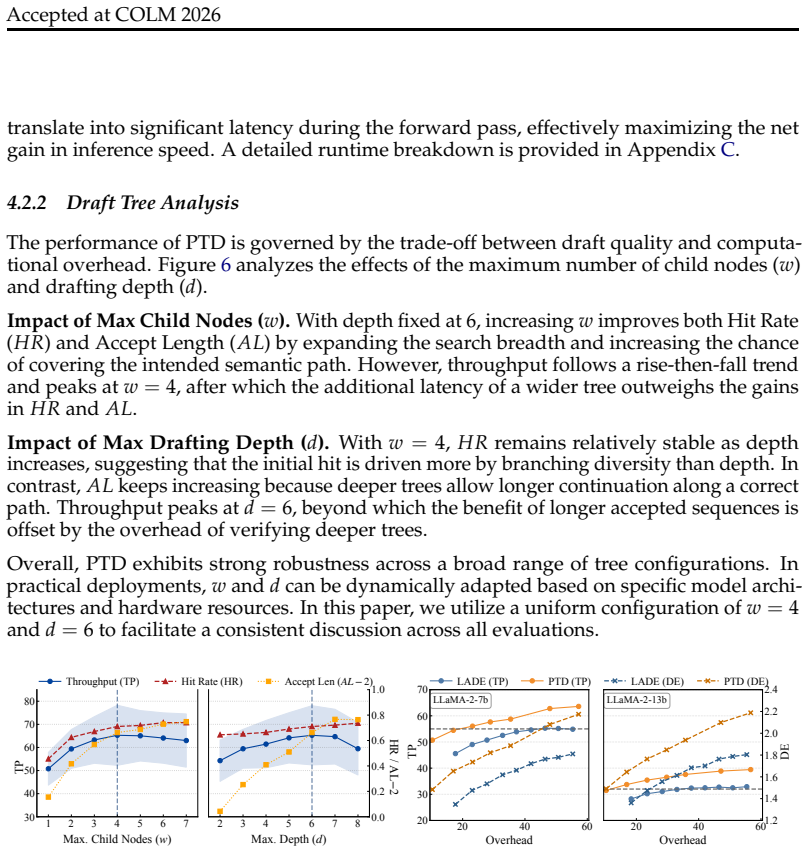
- §3.1 Overhead Constraints and §4.2.2 / Fig. 6: the recommended (w=4, d=6) configuration is chosen after a rise-then-fall throughput curve on LLaMA-7B. The main tables use this fixed pair for every model size (7B–32B) and task. Because optimal width/depth can shift with model scale and sequence length, a short sensitivity check on at least one larger model (e.g., Qwen2-32B) is needed to show that the reported peak is not an artifact of the 7B ablation.
minor comments (4)
- Figure 2 (right) quantifies Self-Draft branch similarity but does not state the exact similarity metric or the number of steps/models used; a one-sentence definition would make the redundancy claim reproducible.
- Notation for the recursive prefix set π(v) and the merge operator M is clear, but the interaction between the draft tree T and the candidate pool C_X during a single forward pass could be illustrated with a short pseudocode call graph in the main text (Algorithms 1–2 are only in the appendix).
- Appendix G reports Rouge/BLEU between PTD and AR under sampling; absolute task scores (e.g., GSM accuracy, HumanEval pass@1) would better confirm that quality is preserved, not only that the two methods produce similar n-grams.
- Typos / polish: “shows remarkable improvement …” fragment under Figure 1; occasional missing spaces after periods; “Stepping Mechanism” vs “stepwise prune” used interchangeably—pick one term.
Circularity Check
No significant circularity: empirical speedups measured against external baselines; minor self-citation to Self-Draft is motivational/baseline only, not a load-bearing premise.
full rationale
This is a training-free systems paper whose central claims (up to ~2× tokens/s speedup of PTD vs AR/LADE/Self-Draft on MT-Bench, GSM-100, HumanEval, MBPP-100) are established by direct wall-clock and DE/AL/HR measurements on public models and benchmarks (Tables 1–2, Fig. 5). The method (tree expansion + stepwise prune + candidate verification) is defined operationally in §3 and does not algebraically force the reported throughput. Appendix F proves only that the recursive sampler preserves the model’s next-token distribution (standard speculative-decoding fidelity), not a fitted identity. The sole self-citation of note is to Self-Draft (Gao et al., 2025; overlapping authors), used for the redundancy analysis in Fig. 2 and as a baseline; it supplies neither a uniqueness theorem nor a parameter that is later re-labeled a prediction. Hyper-parameters w=4, d=6 are selected by ablation (Fig. 6), not fitted to the target metrics. No self-definitional loop, fitted-input-as-prediction, or ansatz smuggled via citation appears. Score 1 reflects only the minor, non-load-bearing self-citation.
Axiom & Free-Parameter Ledger
free parameters (4)
- max_child_nodes (tree width w) =
4 (main tables)
- max_drafting_depth d / stepping threshold =
6 (main tables)
- draft expansion sampling policy =
greedy Top-1 (default)
- tree seed initialization =
random (default)
axioms (3)
- domain assumption Transformer next-token distributions under a tree-compatible causal attention mask and depth-based positional encoding remain valid for both drafting and verification of multi-path candidates.
- standard math Greedy or without-replacement tree sampling acceptance yields tokens consistent with the target model's decoding distribution (proved for the sampling case in App. F).
- ad hoc to paper Batch size one on a single 48GB L20 with BF16 is a sufficient evaluation regime for claiming general decoding speedup.
invented entities (2)
-
Progressive Tree Drafting (PTD) procedure
no independent evidence
-
Stepping / stepwise prune mechanism
no independent evidence
read the original abstract
Speculative decoding has significantly accelerated Large Language Model (LLM) inference by alleviating memory-bound bottlenecks. However, traditional speculative decoding typically relies on auxiliary draft modules, incurring significant training and communication overhead. Although recent methods attempt to generate drafts within the target model itself, they often fail to fully exploit its latent parallel capacity due to a lack of structural coordination. In this paper, we propose \textbf{Progressive Tree Drafting (PTD)}, which employs a structured, guided parallel drafting strategy to harness the model's parallel potential. By coupling a progressive tree structure with a stepwise pruning mechanism, PTD actively guides the LLM to explore multiple semantic paths in a single forward pass, ensuring both draft diversity and coherence. Experiments demonstrate that PTD achieves up to $2\times$ decoding speedup across various benchmarks while remaining training-free and model-agnostic. Our code is available at: https://github.com/MINE-USTC/PTD.
Figures




Reference graph
Works this paper leans on
-
[1]
URLhttps://arxiv.org/abs/2402.05109. Jacob Austin, Augustus Odena, Maxwell Nye, Maarten Bosma, Henryk Michalewski, David Dohan, Ellen Jiang, Carrie Cai, Michael Terry, Quoc Le, et al. Program synthesis with large language models.arXiv preprint arXiv:2108.07732,
-
[2]
Tianle Cai, Yuhong Li, Zhengyang Geng, Hongwu Peng, Jason D
URL https: //arxiv.org/abs/2501.19309. Tianle Cai, Yuhong Li, Zhengyang Geng, Hongwu Peng, Jason D. Lee, Deming Chen, and Tri Dao. Medusa: Simple llm inference acceleration framework with multiple decoding heads,
-
[3]
Training verifiers to solve math word problems.arXiv preprint arXiv:2110.14168,
Karl Cobbe, Vineet Kosaraju, Mohammad Bavarian, Mark Chen, Heewoo Jun, Lukasz Kaiser, Matthias Plappert, Jerry Tworek, Jacob Hilton, Reiichiro Nakano, Christopher Hesse, and John Schulman. Training verifiers to solve math word problems.arXiv preprint arXiv:2110.14168,
-
[4]
URLhttps://arxiv.org/abs/2401.15077. 10 Accepted at COLM 2026 Tianyu Liu, Yun Li, Qitan Lv, Kai Liu, Jianchen Zhu, Winston Hu, and Xiao Sun. Pearl: Parallel speculative decoding with adaptive draft length,
Pith/arXiv arXiv 2026
-
[5]
URL https://arxiv.org/ abs/2408.11850. Xupeng Miao, Gabriele Oliaro, Zhihao Zhang, Xinhao Cheng, Zeyu Wang, Zhengxin Zhang, Rae Ying Yee Wong, Alan Zhu, Lijie Yang, Xiaoxiang Shi, Chunan Shi, Zhuoming Chen, Daiyaan Arfeen, Reyna Abhyankar, and Zhihao Jia. Specinfer: Accelerating large language model serving with tree-based speculative inference and verifi...
-
[6]
URLhttp://dx.doi.org/10.1145/3620666.3651335
doi: 10.1145/ 3620666.3651335. URLhttp://dx.doi.org/10.1145/3620666.3651335. Mitchell Stern, Noam Shazeer, and Jakob Uszkoreit. Blockwise parallel decoding for deep autoregressive models.Advances in Neural Information Processing Systems, 31,
-
[7]
Speculative decoding: Exploiting speculative execution for accelerating seq2seq generation
Heming Xia, Tao Ge, Peiyi Wang, Si-Qing Chen, Furu Wei, and Zhifang Sui. Speculative decoding: Exploiting speculative execution for accelerating seq2seq generation. In Houda Bouamor, Juan Pino, and Kalika Bali (eds.),Findings of the Association for Computational Linguistics: EMNLP 2023, pp. 3909–3925, Singapore, December
2023
-
[8]
doi: 10.18653/v1/2023.findings-emnlp.257
Association for Computational Linguistics. doi: 10.18653/v1/2023.findings-emnlp.257. URL https: //aclanthology.org/2023.findings-emnlp.257/. Heming Xia, Zhe Yang, Qingxiu Dong, Peiyi Wang, Yongqi Li, Tao Ge, Tianyu Liu, Wen- jie Li, and Zhifang Sui. Unlocking efficiency in large language model inference: A comprehensive survey of speculative decoding. In ...
-
[9]
doi: 10.18653/v1/2024.findings-acl.456
Association for Computational Lin- guistics. doi: 10.18653/v1/2024.findings-acl.456. URL https://aclanthology.org/2024. findings-acl.456/. Sen Yang, Shujian Huang, Xinyu Dai, and Jiajun Chen. Multi-candidate speculative decod- ing.arXiv preprint arXiv:2401.06706,
-
[10]
URLhttps://arxiv.org/abs/2506.11309. Lianmin Zheng, Wei-Lin Chiang, Ying Sheng, Siyuan Zhuang, Zhanghao Wu, Yonghao Zhuang, Zi Lin, Zhuohan Li, Dacheng Li, Eric P . Xing, Hao Zhang, Joseph E. Gonzalez, and Ion Stoica. Judging llm-as-a-judge with mt-bench and chatbot arena,
-
[11]
Unless otherwise noted, we use LLaMA-2-13B on MT-Bench and compare greedy expansion with top-k and top-p sampling for draft-tree growth
11 Accepted at COLM 2026 A Sample Strategy for the Draft Tree Expansion This section analyzes how the draft-tree expansion strategy affects PTD. Unless otherwise noted, we use LLaMA-2-13B on MT-Bench and compare greedy expansion with top-k and top-p sampling for draft-tree growth. For sampled expansion, we first obtain the top-k or top-p distribution at e...
2026
-
[12]
Sampling Procedure.Given a set of candidate nodes {n1, n2,
7:ifr<P(n)then 8:Append(v,n)toE 9:callV nk ←TRAVERSAL(n) 10:returnn k 11:else 12:P[n]←0 13:RenormalizePover remaining nodes inC 14:end if 15:end for 16:end while 17:{If no child selected, sampling based on current node distribution} 18:returnS (P(v)) 16 Accepted at COLM 2026 F Proof of Distributional Consistency of the Candidate Tree Recursive Sampling Al...
2026
-
[13]
After rejectingn 1,
Inductive Step.Suppose that for each j<i , the probability of selecting node nj is exactly Pj, and the algorithm correctly rejects n1 through ni−1 with total probability Ri−1 = ∑i−1 j=1 Pj. After rejectingn 1, . . . ,ni−1, the remaining unnormalized probability is: Si−1 =1− i−1 ∑ j=1 Pj. The normalized probability ofn i in this residual distribution becom...
2026
discussion (0)
Sign in with ORCID, Apple, or X to comment. Anyone can read and Pith papers without signing in.