REVIEW 2 major objections 4 minor 66 references
Weight-adjusted gradients flag a tiny set of LLM parameters whose masking collapses generation—failure modes that weight or gradient scores alone miss.
Reviewed by Pith at T0; open to challenge. T0 means a machine referee read the full paper against a public rubric. the ladder, T0–T4 →
T0 review · grok-4.5
2026-07-14 09:07 UTC pith:4CFLZ5XR
load-bearing objection Classical θ·∇ saliency product that, when extremes are masked, collapses generation far faster than weight or gradient alone; same score helps four LLM tasks, with the main caveat that rankings use eval-set gradients. the 2 major comments →
Weight-Adjusted Gradients Reveal Parameter Importance and Failure Modes in LLMs
The pith
A machine-rendered reading of the paper's core claim, the machinery that carries it, and where it could break.
Core claim
WAG, defined as the negative product of each parameter and its first-order gradient, consistently isolates a sparse subset of coordinates whose targeted masking produces rapid collapse on free-form coding and math tasks—collapse that pure magnitude rankings and pure gradient rankings do not produce at the same sparsity. The metric equals the log-parameter gradient and exactly describes first-order loss change under multiplicative perturbations, so ranking by absolute WAG ranks the directions of greatest local scale sensitivity.
What carries the argument
Weight-Adjusted Gradients (WAG): WAGi = −θi ∂ℓ/∂θi. This is exactly the gradient of the loss with respect to ui = log|θi| and linearizes loss change under multiplicative rescalings θi → θi(1+εi). Ranking by |WAG| therefore ranks the most sensitive log-scale directions.
Load-bearing premise
The method assumes that gradients taken on the evaluation, forget, or proxy set, multiplied by the trained weights, correctly mark the parameters that would cause collapse or that should be preferentially updated or preserved—without showing those same coordinates stay critical under training-set gradients, random data, or after further fine-tuning.
What would settle it
Compute WAG on a held-out training split or on random tokens, mask the same number of highest-|WAG| coordinates, and check whether generation stays fluent and correct while evaluation-set WAG still collapses the model; or show that equal-size pure weight or pure gradient masks produce equally sharp collapse on the same tasks.
If this is right
- Masking a few thousand extreme-WAG parameters can collapse coding and math generation while equal-count weight or gradient masks do not.
- Layers ranked by mean WAG can receive non-uniform expert budgets that beat fixed MoLA patterns and spectral baselines on zero-shot accuracy.
- Restricting unlearning updates to the top 75% of WAG-scored layers can improve forget metrics and utility while cutting runtime.
- Keeping the top 5–10% of WAG-scored submodules in full precision under FP8 quantization can match or exceed magnitude baselines.
- Selecting a single MLP layer by mean |WAG| for locate-then-edit knowledge editing can raise overall edit scores relative to causal-mediation layer choice.
Where Pith is reading between the lines
- If WAG tracks scale balance, the same sparse coordinates should remain critical after modest fine-tuning or under different data used for the gradient; that invariance is not yet shown.
- The multiplicative view implies multiplicative noise or scale-aware regularizers may protect or attack these coordinates more effectively than additive noise of equal magnitude.
- Collapse from masking a few thousand weights implies that redundancy measured by total parameter count can hide a sparse critical skeleton that standard pruning criteria systematically miss.
Editorial analysis
A structured set of objections, weighed in public.
Referee Report
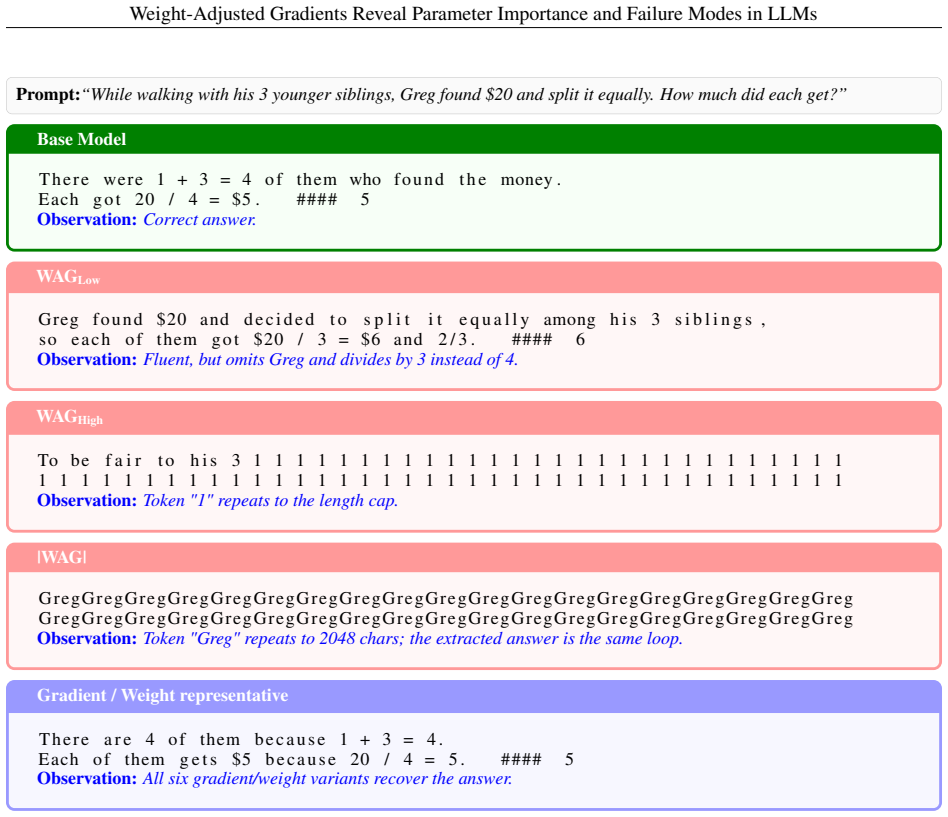
Summary. The paper proposes Weight-Adjusted Gradients (WAG), defined as WAGi = −θi ∂ℓ/∂θi, as a parameter-importance score that multiplies trained weights by first-order gradients. Theorems 3.1–3.3 show that WAG is exactly the gradient in log-parameter coordinates and that it characterizes the first-order change in loss under multiplicative perturbations θ′i = θi(1 + εi). Empirically, masking a few thousand extreme-WAG coordinates (WAGLow, WAGHigh, or |WAG|) on LLaMA-3.2-3B, Qwen3-4B and Gemma3-12B produces rapid collapse on HumanEval/HumanEval+ and GSM8K, while magnitude- and gradient-only masks of the same size leave performance essentially intact (Figs. 1–4). The same ranking is then used for four applications—MoE expert allocation, targeted GradDiff unlearning, mixed-precision quantization, and R-ROME layer selection—where WAG-guided choices match or modestly outperform published baselines under mean±SEM over three seeds.
Significance. If the collapse phenomenon is robust, the work supplies a cheap, first-order diagnostic that existing magnitude and gradient saliency scores miss, together with a clean geometric interpretation (log-scale sensitivity) and four concrete control applications. The theorems are elementary but correctly proved; the generation examples make the failure mode vivid; and the application tables report proper multi-seed statistics. These strengths make the manuscript a useful contribution to LLM interpretability and efficient adaptation, provided the data-dependence of the ranking is clarified.
major comments (2)
- Sec. 3.3 and Apps. A–D compute all WAG scores from evaluation-set (or forget/proxy-set) gradients. The central claim that WAG reveals a model-intrinsic “tiny but critical subset” and a “fundamental structural property” therefore rests on an untested assumption: that the same coordinates remain extreme under training-set gradients, a disjoint calibration set, or random data. Without those ablations the collapse curves and the application gains could be artifacts of alignment with the particular loss surface used for ranking.
- Thm. 3.2 licenses only first-order multiplicative perturbations of size ε. The experiments instead hard-zero the selected parameters. Hard masking is a large, non-multiplicative change; the first-order theory therefore does not explain the observed collapse. Either a higher-order argument or an experiment that multiplies the extreme-WAG weights by (1+ε) for small ε is needed to close the gap between theory and the failure-mode claim.
minor comments (4)
- Figs. 1–2 lack error bars or multiple seeds, unlike the application tables; adding them would strengthen the collapse claim.
- The free parameters β (MoE power), ρ = 0.75 (unlearning), κ ∈ {5 %, 10 %} (quantization) and the 10 % proxy set are stated but never ablated; a short sensitivity paragraph would help.
- Notation for the three ranking criteria (WAGLow / WAGHigh / |WAG|) is introduced late and used inconsistently across sections; a single definition box would improve readability.
- Related-work discussion of SNIP, Optimal Brain Damage and influence-function layer scores could more explicitly contrast the multiplicative versus additive perturbation views.
Circularity Check
No significant circularity: WAG theorems are definitional rewrites of the ordinary gradient via chain rule/Taylor; collapse and application metrics are independent of the WAG formula. Only non-load-bearing methodological self-citations of prior layer protocols.
full rationale
The derivation chain is self-contained and non-circular. WAG is introduced by definition as WAGi = −θi ∂ℓ/∂θi (Eq. 1). Theorem 3.1 is the elementary chain-rule identity ∂ℓ/∂ui = θi ∂ℓ/∂θi under ui = log|θi|, so WAG equals the negative log-parameter gradient by construction; Theorem 3.2 is the first-order Taylor expansion of the loss under multiplicative perturbations θ′i = θi(1+εi), which immediately yields the same linear form; Theorem 3.3 is Cauchy–Schwarz applied to that expansion. None of these steps imports external results, fits free parameters later called predictions, or renames a known empirical pattern. The empirical collapse curves (Figs. 1–4) and all four applications measure free-form generation metrics (Pass@1, exact match, TOFU Model Utility/Forget TR/KS, EasyEdit Rewrite/Locality/Portability/Overall) that are independent of the WAG formula itself. Self-citations (LayerIF [3], Golden Layers [12], both sharing co-authors) appear only as “similar allocation procedure” or “proxy-set protocol” scaffolding; they do not justify the central claim that extreme-WAG coordinates cause collapse overlooked by magnitude/gradient baselines, nor do they supply a uniqueness theorem that forces the choice of WAG. Hard zeroing is not a small-ε multiplicative perturbation, but that is a correctness gap, not circularity. Score 1 reflects only the minor, non-load-bearing self-citations of methodological scaffolding.
Axiom & Free-Parameter Ledger
free parameters (4)
- β (power-transform exponent for MoE allocation)
- ρ = 0.75 (layer selection ratio for unlearning)
- κ ∈ {5 %, 10 %} (submodule preservation budget for quantization)
- proxy-set size 10 % (knowledge editing)
axioms (3)
- standard math First-order Taylor expansion of the loss under multiplicative parameter perturbations is a faithful local description of sensitivity.
- domain assumption Trained transformers behave as scale-balanced systems whose fragility is captured by log-parameter gradients.
- ad hoc to paper Gradients computed on the evaluation / forget / proxy set are sufficient to rank parameters for both collapse diagnosis and downstream control tasks.
invented entities (2)
-
Weight-Adjusted Gradient (WAG) score
no independent evidence
-
scale-balanced system view of trained LLMs
no independent evidence
read the original abstract
Understanding which parameters are influential in Large Language Models (LLMs) is central to improving their efficiency, reliability, and interpretability. We introduce Weight-Adjusted Gradients (WAG), a simple yet effective approach for estimating parameter importance that explicitly captures the interaction between model weights and first-order gradient information and identifies parameters that disproportionately influence model behavior, such as those responsible for collapse phenomena in LLMs. Across a range of models and settings, we show that WAG surfaces a tiny but critical subset of parameters whose modification leads to dramatic degradation in performance, a failure mode that existing importance metrics overlook. These findings reveal a previously underexplored interplay between weights and gradients, suggesting that parameter importance cannot be fully understood through either signal alone. The surprising effectiveness of WAG points to fundamental structural properties of trained networks and motivates new open questions about the role of zeroth-order and first-order information in deep learning. We demonstrate the practical utility of WAG across multiple applications, including expert allocation in mixture-of-expert architectures, parameter-specific unlearning, mixed-precision quantization, and layer selection for knowledge editing. Our results position WAG as a unified approach for analyzing, debugging, and controlling LLMs, and opens new directions for principled model-level interpretation.
Figures



Reference graph
Works this paper leans on
-
[1]
Memory Aware Synapses: Learning What (not) to Forget
Rahaf Aljundi, Francesca Babiloni, Mohamed Elhoseiny, Marcus Rohrbach, and Tinne Tuytelaars. Memory Aware Synapses: Learning What (not) to Forget. InEuropean Conference on Computer Vision, 2018
2018
-
[2]
Systematic Outliers in Large Language Models
Yongqi An, Xu Zhao, Tao Yu, Ming Tang, and Jinqiao Wang. Systematic Outliers in Large Language Models. In International Conference on Learning Representations, 2025
2025
-
[3]
LayerIF: Estimating Layer Quality for Large Language Models using Influence Functions
Hadi Askari, Shivanshu Gupta, Fei Wang, Anshuman Chhabra, and Muhao Chen. LayerIF: Estimating Layer Quality for Large Language Models using Influence Functions. InAdvances in Neural Information Processing Systems, 2025
2025
-
[4]
Jimmy Lei Ba, Jamie Ryan Kiros, and Geoffrey E. Hinton. Layer Normalization.arXiv preprint arXiv:1607.06450, 2016
Pith/arXiv arXiv 2016
-
[5]
Exposing the Illusion of Erasure in Knowledge Editing for LLMs
Advik Raj Basani and Anshuman Chhabra. Exposing the Illusion of Erasure in Knowledge Editing for LLMs. arXiv preprint arXiv:2606.23276, 2026
Pith/arXiv arXiv 2026
-
[6]
Brown, Benjamin Mann, Nick Ryder, Melanie Subbiah, Jared Kaplan, Prafulla Dhariwal, Arvind Neelakantan, Pranav Shyam, Girish Sastry, Amanda Askell, et al
Tom B. Brown, Benjamin Mann, Nick Ryder, Melanie Subbiah, Jared Kaplan, Prafulla Dhariwal, Arvind Neelakantan, Pranav Shyam, Girish Sastry, Amanda Askell, et al. Language Models are Few-Shot Learners. In Advances in Neural Information Processing Systems, 2020
2020
-
[7]
Evaluating Large Language Models Trained on Code.arXiv preprint arXiv:2107.03374, 2021
Mark Chen, Jerry Tworek, Heewoo Jun, Qiming Yuan, Henrique Ponde de Oliveira Pinto, Jared Kaplan, Harri Edwards, Yuri Burda, Nicholas Joseph, Greg Brockman, et al. Evaluating Large Language Models Trained on Code.arXiv preprint arXiv:2107.03374, 2021
Pith/arXiv arXiv 2021
-
[8]
Outlier Gradient Analysis: Efficiently Identifying Detrimental Training Samples for Deep Learning Models
Anshuman Chhabra, Bo Li, Jian Chen, Prasant Mohapatra, and Hongfu Liu. Outlier Gradient Analysis: Efficiently Identifying Detrimental Training Samples for Deep Learning Models. InInternational Conference on Machine Learning, 2025. 13 Weight-Adjusted Gradients Reveal Parameter Importance and Failure Modes in LLMs
2025
-
[9]
Training Verifiers to Solve Math Word Problems.arXiv preprint arXiv:2110.14168, 2021
Karl Cobbe, Vineet Kosaraju, Mohammad Bavarian, Mark Chen, Heewoo Jun, Lukasz Kaiser, Matthias Plappert, Jerry Tworek, Jacob Hilton, Reiichiro Nakano, et al. Training Verifiers to Solve Math Word Problems.arXiv preprint arXiv:2110.14168, 2021
Pith/arXiv arXiv 2021
-
[10]
Evaluating the Ripple Effects of Knowledge Editing in Language Models.Transactions of the Association for Computational Linguistics, 2024
Roi Cohen, Eden Biran, Ori Yoran, Amir Globerson, and Mor Geva. Evaluating the Ripple Effects of Knowledge Editing in Language Models.Transactions of the Association for Computational Linguistics, 2024
2024
-
[11]
Rocktim Jyoti Das, Mingjie Sun, Liqun Ma, and Zhiqiang Shen. Beyond Size: How Gradients Shape Pruning Decisions in Large Language Models.arXiv preprint arXiv:2311.04902, 2023
Pith/arXiv arXiv 2023
-
[12]
Shrestha Datta, Hongfu Liu, and Anshuman Chhabra. Golden Layers and Where to Find Them: Improved Knowledge Editing for Large Language Models via Layer Gradient Analysis.arXiv preprint arXiv:2602.20207, 2026
Pith/arXiv arXiv 2026
-
[13]
Sharp Minima Can Generalize For Deep Nets
Laurent Dinh, Razvan Pascanu, Samy Bengio, and Yoshua Bengio. Sharp Minima Can Generalize For Deep Nets. InInternational Conference on Machine Learning, 2017
2017
-
[14]
Dolan and Chris Brockett
William B. Dolan and Chris Brockett. Automatically Constructing a Corpus of Sentential Paraphrases. In International Workshop on Paraphrasing, 2005
2005
-
[15]
Javier Ferrando, Gabriele Sarti, Arianna Bisazza, and Marta R Costa-Jussà. A Primer on the Inner Workings of Transformer-based Language Models.arXiv preprint arXiv:2405.00208, 2024
Pith/arXiv arXiv 2024
-
[16]
Sharpness-Aware Minimization for Efficiently Improving Generalization
Pierre Foret, Ariel Kleiner, Hossein Mobahi, and Behnam Neyshabur. Sharpness-Aware Minimization for Efficiently Improving Generalization. InInternational Conference on Learning Representations, 2021
2021
-
[17]
GPTQ: Accurate Post-Training Quantization for Generative Pretrained Transformers
Elias Frantar, Saleh Ashkboos, Torsten Hoefler, and Dan Alistarh. GPTQ: Accurate Post-Training Quantization for Generative Pretrained Transformers. InInternational Conference on Learning Representations, 2023
2023
-
[18]
The State of Sparsity in Deep Neural Networks.arXiv preprint arXiv:1902.09574, 2019
Trevor Gale, Erich Elsen, and Sara Hooker. The State of Sparsity in Deep Neural Networks.arXiv preprint arXiv:1902.09574, 2019
Pith/arXiv arXiv 1902
-
[19]
Chongyang Gao, Kezhen Chen, Jinmeng Rao, Ruibo Liu, Baochen Sun, Yawen Zhang, Daiyi Peng, Xiaoyuan Guo, and V . S. Subrahmanian. MoLA: MoE LoRA with Layer-wise Expert Allocation. InFindings of the North American Chapter of the Association for Computational Linguistics, 2025
2025
-
[20]
The Language Model Evaluation Harness, 2024
Leo Gao, Jonathan Tow, Baber Abbasi, Stella Biderman, Sid Black, Anthony DiPofi, Charles Foster, Laurence Golding, Jeffrey Hsu, Alain Le Noac’h, Haonan Li, Kyle McDonell, Niklas Muennighoff, Chris Ociepa, Jason Phang, Laria Reynolds, Hailey Schoelkopf, Aviya Skowron, Lintang Sutawika, Eric Tang, Anish Thite, Ben Wang, Kevin Wang, and Andy Zou. The Languag...
2024
-
[21]
Defying Catastrophic Forgetting via Influence Function.Artificial Intelligence, 2025
Rui Gao and Weiwei Liu. Defying Catastrophic Forgetting via Influence Function.Artificial Intelligence, 2025
2025
-
[22]
OLMES: A Standard for Language Model Evaluations
Yuling Gu, Oyvind Tafjord, Bailey Kuehl, Dany Haddad, Jesse Dodge, and Hannaneh Hajishirzi. OLMES: A Standard for Language Model Evaluations. InFindings of the North American Chapter of the Association for Computational Linguistics, 2025
2025
-
[23]
Rebuilding ROME: Resolving Model Collapse during Sequential Model Editing
Akshat Gupta, Sidharth Baskaran, and Gopala Anumanchipalli. Rebuilding ROME: Resolving Model Collapse during Sequential Model Editing. InEmpirical Methods in Natural Language Processing, 2024
2024
-
[24]
Learning both Weights and Connections for Efficient Neural Networks
Song Han, Jeff Pool, John Tran, and William Dally. Learning both Weights and Connections for Efficient Neural Networks. InAdvances in Neural Information Processing Systems, 2015
2015
-
[25]
Stephen Jose Hanson and Lorien Y . Pratt. Comparing Biases for Minimal Network Construction with Back- Propagation. InAdvances in Neural Information Processing Systems, 1988
1988
-
[26]
Aging with Grace: Lifelong Model Editing with Discrete K-Value Adaptors
Tom Hartvigsen, Swami Sankaranarayanan, Hamid Palangi, Yoon Kim, and Marzyeh Ghassemi. Aging with Grace: Lifelong Model Editing with Discrete K-Value Adaptors. InAdvances in Neural Information Processing Systems, 2023
2023
-
[27]
Babak Hassibi and David G. Stork. Second order derivatives for network pruning: Optimal Brain Surgeon. In Advances in Neural Information Processing Systems, 1992
1992
-
[28]
Training Compute-Optimal Large Language Models
Jordan Hoffmann, Sebastian Borgeaud, Arthur Mensch, Elena Buchatskaya, Trevor Cai, Eliza Rutherford, DDL Casas, Lisa Anne Hendricks, Johannes Welbl, Aidan Clark, et al. Training Compute-Optimal Large Language Models. InAdvances in Neural Information Processing Systems, 2022
2022
-
[29]
SliM-LLM: Salience-driven mixed-precision quantization for large language models
Wei Huang, Haotong Qin, Yangdong Liu, Yawei Li, Xianglong Liu, Luca Benini, Michele Magno, and Xiaojuan Qi. SliM-LLM: Salience-driven mixed-precision quantization for large language models. InInternational Conference on Machine Learning (ICML), 2025. 14 Weight-Adjusted Gradients Reveal Parameter Importance and Failure Modes in LLMs
2025
-
[30]
Scaling Laws for Neural Language Models.arXiv preprint arXiv:2001.08361, 2020
Jared Kaplan, Sam McCandlish, Tom Henighan, Tom B Brown, Benjamin Chess, Rewon Child, Scott Gray, Alec Radford, Jeffrey Wu, and Dario Amodei. Scaling Laws for Neural Language Models.arXiv preprint arXiv:2001.08361, 2020
Pith/arXiv arXiv 2001
-
[31]
Overcoming Catastrophic Forgetting in Neural Networks.Proceedings of the National Academy of Sciences, 2017
James Kirkpatrick, Razvan Pascanu, Neil Rabinowitz, Joel Veness, Guillaume Desjardins, Andrei A Rusu, Kieran Milan, John Quan, Tiago Ramalho, Agnieszka Grabska-Barwinska, et al. Overcoming Catastrophic Forgetting in Neural Networks.Proceedings of the National Academy of Sciences, 2017
2017
-
[32]
Denker, and Sara A
Yann LeCun, John S. Denker, and Sara A. Solla. Optimal Brain Damage. InAdvances in Neural Information Processing Systems, 1989
1989
-
[33]
Namhoon Lee, Thalaiyasingam Ajanthan, and Philip H. S. Torr. SNIP: Single-shot Network Pruning based on Connection Sensitivity. InInternational Conference on Learning Representations, 2019
2019
-
[34]
Zero-Shot Relation Extraction via Reading Comprehension
Omer Levy, Minjoon Seo, Eunsol Choi, and Luke Zettlemoyer. Zero-Shot Relation Extraction via Reading Comprehension. InConference on Computational Natural Language Learning, 2017
2017
-
[35]
Continual Learning and Private Unlearning
Bo Liu, Qiang Liu, and Peter Stone. Continual Learning and Private Unlearning. InConference on Lifelong Learning Agents, 2022
2022
-
[36]
Is Your Code Generated by ChatGPT Really Correct? Rigorous Evaluation of Large Language Models for Code Generation
Jiawei Liu, Chunqiu Steven Xia, Yuyao Wang, and Lingming Zhang. Is Your Code Generated by ChatGPT Really Correct? Rigorous Evaluation of Large Language Models for Code Generation. InAdvances in Neural Information Processing Systems, 2023
2023
-
[37]
Mahoney, and Yaoqing Yang
Haiquan Lu, Yefan Zhou, Shiwei Liu, Zhangyang Wang, Michael W. Mahoney, and Yaoqing Yang. AlphaPruning: Using Heavy-Tailed Self Regularization Theory for Improved Layer-wise Pruning of Large Language Models. In Advances in Neural Information Processing Systems, 2024
2024
-
[38]
Learn to Explain: Multimodal Reasoning via Thought Chains for Science Question Answering
Pan Lu, Swaroop Mishra, Tanglin Xia, Liang Qiu, Kai-Wei Chang, Song-Chun Zhu, Oyvind Tafjord, Peter Clark, and Ashwin Kalyan. Learn to Explain: Multimodal Reasoning via Thought Chains for Science Question Answering. InAdvances in Neural Information Processing Systems, 2022
2022
-
[39]
Zico Kolter
Pratyush Maini, Zhili Feng, Avi Schwarzschild, Zachary Chase Lipton, and J. Zico Kolter. TOFU: A Task of Fictitious Unlearning for LLMs. InFirst Conference on Language Modeling, 2024
2024
-
[40]
Locating and Editing Factual Associations in GPT
Kevin Meng, David Bau, Alex Andonian, and Yonatan Belinkov. Locating and Editing Factual Associations in GPT. InAdvances in Neural Information Processing Systems, 2022
2022
-
[41]
Large Language Models: A Survey.arXiv preprint arXiv:2402.06196, 2024
Shervin Minaee, Tomas Mikolov, Narjes Nikzad, Meysam Chenaghlu, Richard Socher, Xavier Amatriain, and Jianfeng Gao. Large Language Models: A Survey.arXiv preprint arXiv:2402.06196, 2024
Pith/arXiv arXiv 2024
-
[42]
Pruning Convolutional Neural Networks for Resource Efficient Inference
Pavlo Molchanov, Stephen Tyree, Tero Karras, Timo Aila, and Jan Kautz. Pruning Convolutional Neural Networks for Resource Efficient Inference. InInternational Conference on Learning Representations, 2017
2017
-
[43]
Ocean Monjur, Shahriar Kabir Nahin, and Anshuman Chhabra. Revisiting the Effectiveness of LLM Pruning for Test-Time Scaling.arXiv preprint arXiv:2604.25098, 2026
Pith/arXiv arXiv 2026
-
[44]
GPT-4 Technical Report.arXiv preprint arXiv:2303.08774, 2023
OpenAI. GPT-4 Technical Report.arXiv preprint arXiv:2303.08774, 2023
Pith/arXiv arXiv 2023
-
[45]
AlphaLoRA: Assigning LoRA Experts Based on Layer Training Quality
Peijun Qing, Chongyang Gao, Yefan Zhou, Xingjian Diao, Yaoqing Yang, and Soroush V osoughi. AlphaLoRA: Assigning LoRA Experts Based on Layer Training Quality. InEmpirical Methods in Natural Language Processing, 2024
2024
-
[46]
Waleed Reda, Abhinav Jangda, and Krishna Chintalapudi. How Many Parameters Does Your Task Really Need? Task Specific Pruning with LLM-Sieve.arXiv preprint arXiv:2505.18350, 2025
arXiv 2025
-
[47]
PB-LLM: Partially binarized large language models
Yuzhang Shang, Zhihang Yuan, Qiang Wu, and Zhen Dong. PB-LLM: Partially binarized large language models. InInternational Conference on Learning Representations (ICLR), 2024
2024
-
[48]
Boyu Shi, Chang Liu, ChuanBao Gao, Xu Yang, and Xin Geng. Understanding Performance Collapse in Layer- Pruned Large Language Models via Decision Representation Transitions.arXiv preprint arXiv:2605.07271, 2026
Pith/arXiv arXiv 2026
-
[49]
Ilia Shumailov, Zakhar Shumaylov, Yiren Zhao, Yarin Gal, Nicolas Papernot, and Ross Anderson. The Curse of Recursion: Training on Generated Data Makes Models Forget.arXiv preprint arXiv:2305.17493, 2023
Pith/arXiv arXiv 2023
-
[50]
Zico Kolter
Mingjie Sun, Zhuang Liu, Anna Bair, and J. Zico Kolter. A Simple and Effective Pruning Approach for Large Language Models. InInternational Conference on Learning Representations, 2024
2024
-
[51]
Optimal Brain Apoptosis
Mingyuan Sun, Zheng Fang, Jiaxu Wang, Junjie Jiang, Delei Kong, Chenming Hu, Yuetong Fang, and Renjing Xu. Optimal Brain Apoptosis. InInternational Conference on Learning Representations, 2025. 15 Weight-Adjusted Gradients Reveal Parameter Importance and Failure Modes in LLMs
2025
-
[52]
Gemma 3 Technical Report.arXiv preprint arXiv:2503.19786, 2025
Gemma Team, Aishwarya Kamath, Johan Ferret, Shreya Pathak, Nino Vieillard, Ramona Merhej, Sarah Perrin, Tatiana Matejovicova, Alexandre Ramé, Morgane Rivière, et al. Gemma 3 Technical Report.arXiv preprint arXiv:2503.19786, 2025
Pith/arXiv arXiv 2025
-
[53]
LLaMA: Open and Efficient Foundation Language Models.arXiv preprint arXiv:2302.13971, 2023
Hugo Touvron, Thibaut Lavril, Gautier Izacard, Xavier Martinet, Marie-Anne Lachaux, Timothée Lacroix, Baptiste Rozière, Naman Goyal, Eric Hambro, Faisal Azhar, et al. LLaMA: Open and Efficient Foundation Language Models.arXiv preprint arXiv:2302.13971, 2023
Pith/arXiv arXiv 2023
-
[54]
First is Not Really Better Than Last: Evaluating Layer Choice and Aggregation Strategies in Language Model Data Influence Estimation
Dmytro Vitel and Anshuman Chhabra. First is Not Really Better Than Last: Evaluating Layer Choice and Aggregation Strategies in Language Model Data Influence Estimation. InInternational Conference on Learning Representations, 2026
2026
-
[55]
Alex Wang, Amanpreet Singh, Julian Michael, Felix Hill, Omer Levy, and Samuel R. Bowman. GLUE: A Multi-task Benchmark and Analysis Platform for Natural Language Understanding. InBlackboxNLP Workshop: Analyzing and Interpreting Neural Networks for NLP, 2018
2018
-
[56]
Why Language Models Collapse when Trained on Recursively Generated Text.arXiv preprint arXiv:2412, 2024
Lecheng Wang, Xianjie Shi, Ge Li, Jia Li, Yihong Dong, Xuanming Zhang, Wenpin Jiao, and Hong Mei. Why Language Models Collapse when Trained on Recursively Generated Text.arXiv preprint arXiv:2412, 2024
2024
-
[57]
EasyEdit: An Easy-to-Use Knowledge Editing Framework for Large Language Models
Peng Wang, Ningyu Zhang, Bozhong Tian, Zekun Xi, Yunzhi Yao, Ziwen Xu, Mengru Wang, Shengyu Mao, Xiaohan Wang, Siyuan Cheng, et al. EasyEdit: An Easy-to-Use Knowledge Editing Framework for Large Language Models. InAssociation for Computational Linguistics, 2024
2024
-
[58]
Qwen3 Technical Report.arXiv preprint arXiv:2505.09388, 2025
An Yang, Anfeng Li, Baosong Yang, Beichen Zhang, Binyuan Hui, et al. Qwen3 Technical Report.arXiv preprint arXiv:2505.09388, 2025
Pith/arXiv arXiv 2025
-
[59]
Kübler, Rupak Vignesh Swaminathan, Athanasios Mouchtaris, Sravan Babu Bodapati, et al
Yifan Yang, Kai Zhen, Bhavana Ganesh, Aram Galstyan, Goeric Huybrechts, Markus Müller, Jonas M. Kübler, Rupak Vignesh Swaminathan, Athanasios Mouchtaris, Sravan Babu Bodapati, et al. Wanda++: Pruning Large Language Models via Regional Gradients. InFindings of the Association for Computational Linguistics, 2025
2025
-
[60]
Editing Large Language Models: Problems, Methods, and Opportunities
Yunzhi Yao, Peng Wang, Bozhong Tian, Siyuan Cheng, Zhoubo Li, Shumin Deng, Huajun Chen, and Ningyu Zhang. Editing Large Language Models: Problems, Methods, and Opportunities. InEmpirical Methods in Natural Language Processing, 2023
2023
-
[61]
Outlier Weighed Layerwise Sparsity (OWL): A Missing Secret Sauce for Pruning LLMs to High Sparsity
Lu Yin, You Wu, Zhenyu Zhang, Cheng-Yu Hsieh, Yaqing Wang, Yiling Jia, Gen Li, Ajay Jaiswal, Mykola Pechenizkiy, Yi Liang, et al. Outlier Weighed Layerwise Sparsity (OWL): A Missing Secret Sauce for Pruning LLMs to High Sparsity. InInternational Conference on Machine Learning, 2024
2024
-
[62]
Continual Learning Through Synaptic Intelligence
Friedemann Zenke, Ben Poole, and Surya Ganguli. Continual Learning Through Synaptic Intelligence. In International Conference on Machine Learning, 2017
2017
-
[63]
Boosting Large Language Models with Mask Fine-Tuning.arXiv preprint arXiv:2503.22764, 2025
Mingyuan Zhang, Yue Bai, Huan Wang, Yizhou Wang, Qihua Dong, Yitian Zhang, and Yun Fu. Boosting Large Language Models with Mask Fine-Tuning.arXiv preprint arXiv:2503.22764, 2025
arXiv 2025
-
[64]
A Comprehensive Study of Knowledge Editing for Large Language Models
Ningyu Zhang, Yunzhi Yao, Bozhong Tian, Peng Wang, Shumin Deng, Mengru Wang, Zekun Xi, Shengyu Mao, Jintian Zhang, Yuansheng Ni, et al. A Comprehensive Study of Knowledge Editing for Large Language Models. arXiv preprint arXiv:2401.01286, 2024
Pith/arXiv arXiv 2024
-
[65]
SparseSwaps: Tractable LLM Pruning Mask Refinement at Scale.arXiv preprint arXiv:2512.10922, 2025
Max Zimmer, Christophe Roux, Moritz Wagner, Deborah Hendrych, and Sebastian Pokutta. SparseSwaps: Tractable LLM Pruning Mask Refinement at Scale.arXiv preprint arXiv:2512.10922, 2025. 16 Weight-Adjusted Gradients Reveal Parameter Importance and Failure Modes in LLMs Appendix In the Appendix, we provide the proofs of the theoretical analysis in Appendix A....
arXiv 2025
-
[66]
codebases, respectively. Our codebase for Application D was built upon theEasyEdit[ 57] framework and LGA codebase [12], and evaluations of the edited models were performed following their standard conventions. 21
discussion (0)
Sign in with ORCID, Apple, or X to comment. Anyone can read and Pith papers without signing in.