REVIEW 3 major objections 6 minor 106 references
One screened potential plus QCD sum rules gives a coherent vacuum picture of both charm and bottom quarkonia across masses, radiative widths, Regge slopes and decays.
Reviewed by Pith at T0; open to challenge. T0 means a machine referee read the full paper against a public rubric. the ladder, T0–T4 →
T0 review · grok-4.5
2026-07-14 08:56 UTC pith:RDN3HW37
load-bearing objection Solid multi-observable vacuum benchmark for c¯c and b¯b under one screened Hamiltonian; useful packaging, standard tools, moderate circularity on higher states. the 3 major comments →
A Unified Study of Hidden-Charm and Hidden-Bottom Mesons
The pith
A machine-rendered reading of the paper's core claim, the machinery that carries it, and where it could break.
Core claim
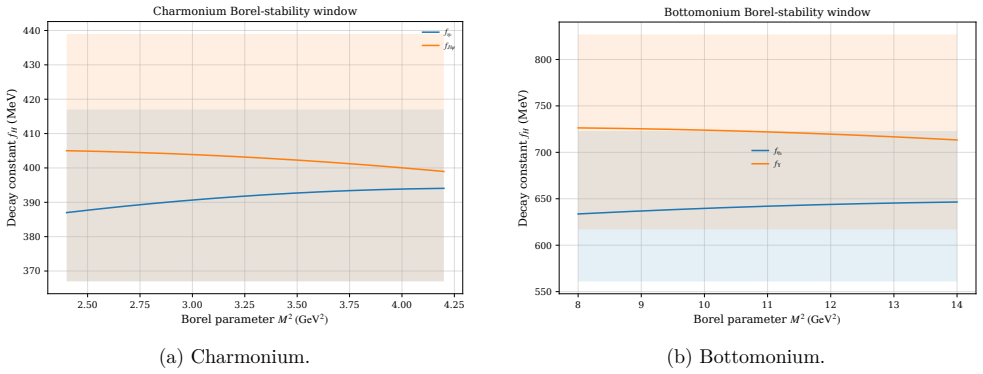
The same screened Coulomb-plus-confining Hamiltonian with spin-dependent corrections, together with two- and three-point QCD sum rules, produces a coherent vacuum description of c¯c and b¯b spectroscopy, E1/M1 radiative transitions, Regge trajectories, decay constants, annihilation widths, transition form factors and finite-spectrum thermodynamic indicators, with the expected compression and stronger spin suppression in bottomonium while charmonium remains more sensitive to fine-structure, radial-node and medium-related effects.
What carries the argument
A screened Coulomb-plus-confining interaction with spin-dependent corrections (supplying masses and radial overlaps) combined with two-point and three-point QCD sum rules (supplying residues, decay constants, annihilation widths and electromagnetic transition form factors).
Load-bearing premise
A fixed screened potential with sector-wise parameters and no explicit coupled-channel or continuum mixing is still adequate for higher excitations and for the radial overlaps that set the radiative widths.
What would settle it
A precise experimental or lattice measurement of a node-sensitive E1 or hindered M1 width in charmonium that lies well outside the paper’s calculated value and model spread, while the corresponding low-lying masses remain correct, would show that the same wave functions do not control both the spectrum and the transitions.
If this is right
- Low-lying masses and decay constants in both sectors can be used as a common vacuum reference without retuning the interaction form for each observable.
- Regge slopes are systematically flatter in bottomonium, giving a global diagnostic of level compression under the same Hamiltonian.
- E1 and M1 widths discriminate orbital and spin-flip overlaps even when mass tables look similar across models.
- Finite-spectrum free energy, entropy and specific heat encode only vacuum level density and spin degeneracy, not bulk hot-medium thermodynamics.
- Higher conventional c¯c levels near open-charm thresholds serve as a reference spectrum against which threshold or mixed structures can be judged.
Where Pith is reading between the lines
- If the fixed screening holds, future lattice or experimental widths for node-sensitive channels should track the paper’s hierarchy more tightly in charmonium than in bottomonium.
- The vacuum benchmark can quantify how large coupled-channel mass shifts must be once open-flavour thresholds are restored.
- The same multi-observable strategy is portable to other heavy-heavy systems with only parameter retuning.
- Thermal residue and finite-momentum effects near Tc should be more diagnostic for charmonium than for the more compact bottomonium ground states.
Editorial analysis
A structured set of objections, weighed in public.
Referee Report
Summary. The manuscript presents a unified phenomenological analysis of hidden-charm and hidden-bottom mesons within a common screened Coulomb-plus-confining potential (with spin-dependent corrections and a Gaussian variational basis) and a two-/three-point QCD sum-rule framework. The same calculated states are used for spin-averaged and spin-resolved mass spectra, Regge trajectories in the (M^{2},J) and (M^{2},n_r) planes, E1 and M1 radiative widths from dipole and spherical-Bessel overlaps, finite-spectrum thermodynamic indicators built from excitation energies relative to the ground states, and short-distance decay constants, annihilation widths and electromagnetic transition form factors. The comparison of the two sectors is used to illustrate the expected compression and stronger spin suppression in bottomonium versus greater fine-structure, radial-node and medium-related sensitivity in charmonium, framed as a coherent vacuum benchmark rather than a full in-medium or coupled-channel calculation.
Significance. If the multi-observable consistency holds at the level claimed, the work supplies a useful, carefully caveated vacuum reference for c¯c and b¯b spectroscopy, radiative transitions and QCDSR residues in a single parameter set per sector. The parallel treatment of the two hidden-flavour systems, the explicit separation of finite-spectrum thermodynamic diagnostics from bulk hot-QCD thermodynamics, and the side-by-side Regge, E1/M1 and residue comparisons are genuine strengths relative to single-observable quarkonium papers. Methodologically the ingredients (screened Cornell-type potential, spin-dependent forces, Borel-window QCDSR) are standard; the contribution is organizational and comparative rather than a new dynamical principle. The paper is therefore of moderate but real interest as a benchmark compilation for the heavy-quarkonium community, provided the fitted-versus-predicted status of higher states and the limited validation of radial overlaps are stated more sharply.
major comments (3)
- [Sec. 2.10; Tables 4–5] Sec. 2.10 and Tables 4–5: The sector-wise parameters (α_s, A, ξ, V_0, m_Q) are stated as fixed, but the fitting procedure is not documented (which low-lying centers of gravity or splittings were minimized, χ² definition, or whether higher states entered the fit). Because the central claim is that one Hamiltonian then yields coherent higher masses, Regge slopes and E1/M1 overlaps, the manuscript needs an explicit statement of what is fitted versus predicted; otherwise the multi-observable coherence for n≥2 and L≥1 partly inherits the low-lying calibration (as already visible in the close 1S/1P agreement).
- [Sec. 3.3–3.4; Eqs. (36), (40); Tables 11–14] Eqs. (36), (40) and Tables 11–14: The load-bearing step for the radiative-transition part of the coherence claim is that the same variational Gaussian wave functions that reproduce low-lying spin-averaged masses also give reliable radial dipole and j_0 overlaps. The paper itself notes open-flavour thresholds and possible non-q¯q components near 3.9–4.3 GeV and upper bottomonium (Sec. 3.1; Conclusions), yet still presents higher-state E1/M1 widths as diagnostics of the same Hamiltonian. Without a quantitative estimate of continuum/coupled-channel distortion of the overlaps (or a restricted claim limited to the lowest multiplets), the multi-observable consistency beyond 1S–1P–2S remains only as secure as the untested assumption that screening alone captures those distortions. A clearer scope statement or a sensitivity test would strengthen the claim.
- [Sec. 2.3; Table 3; Abstract; Sec. 4] Sec. 2.3 and Table 3: The two-point QCD sum rules that supply f_ηc, f_J/ψ, f_ηb and f_Υ use the physical ground-state masses and continuum thresholds, not the masses or wave functions from the screened-potential spectrum. The Abstract and Sec. 4 repeatedly speak of “the same calculated states” connecting spectroscopy to current-coupled observables; for the residues and annihilation widths this connection is only organizational (same sectors, same narrative), not dynamical. Either the residues should be recomputed with the model masses, or the wording should be revised so that the potential-model and QCDSR sectors are presented as complementary rather than as outputs of the same states.
minor comments (6)
- [Table 1; Sec. 1] Table 1 and the introductory experimental landscape are helpful, but several higher PDG names (e.g. ψ(4230)/Y(4230), χ_c1(4140)) are listed without a clear statement that they are orientation points only and are not claimed as pure q¯q assignments in the calculated spectrum.
- [Sec. 2.1; Eq. (2)] In Eq. (2) the relativistic kinetic expansion is carried to p^{10}; a short remark on truncation error for charmonium (where convergence is slower) would help the reader judge the controlled-approximation claim in Sec. 2.1.
- [Sec. 3.2; Figs. 1–2; Tables 8–10] Figures 1–2 and Tables 8–10: the Regge slopes are useful diagnostics, but the text could note more explicitly that the larger c¯c slopes versus b¯b are largely a kinematic consequence of the reduced mass and level spacing already fixed by the Hamiltonian, rather than an independent test.
- [Sec. 3.5; Fig. 3; Table 15] Sec. 3.5 and Fig. 3: the finite-spectrum thermodynamic curves are carefully caveated, which is good; a one-sentence comparison of the temperature scale at which C_V peaks with the typical level spacing would make the diagnostic content more transparent.
- [Eq. (5); Tables 4–5] Notation: ξ is used both as the screening parameter in V_s(r) (Eq. 5) and as the state-dependent variational width in Tables 4–5; renaming one of them would avoid confusion.
- [Abstract; Tables 11–14] A few typographical issues: “theshort-distancedecayconstants” (Abstract), missing spaces in several table headers, and inconsistent use of GeV vs MeV in the E1/M1 tables versus the mass tables.
Circularity Check
Screened-potential parameters fixed to reproduce low-lying spin-averaged masses are then used for higher-state masses, Regge slopes and E1/M1 overlaps, so those outputs partially inherit the fit; QCDSR residues use physical ground-state masses as inputs.
specific steps
-
fitted input called prediction
[Sec. 2.10 (parameters) + Sec. 3.1 (low-lying match) + Sec. 3.3–3.4 (E1/M1)]
"These parameters are kept fixed throughout the spectroscopy, radiative-transition and Regge analyses... The charmonium 1S and 1P centers are close to the corresponding experimental values, indicating that the balance between the Coulomb term and the screened confining part is appropriate... The E1 widths in Tables 11 and 12 are controlled by the cubic photon-energy factor, the angular coefficient and the radial dipole matrix element."
The screened-potential parameters (αs, A, ξ, V0, mq) are fixed so that the spin-averaged 1S/1P masses match experiment. The identical variational wave functions then supply the higher masses, Regge slopes and the radial overlaps ⟨r⟩ and ⟨j0⟩ that determine the tabulated E1/M1 widths. Those higher-state and radiative results therefore partially inherit the low-lying fit rather than constituting fully independent predictions.
-
fitted input called prediction
[Table 3 + Eqs. (20)–(22) + Sec. 3.6]
"The QCD sum-rule part uses the physical ground-state masses, pole residues... The extracted values are fηc=392±25 MeV, fJ/ψ=403±36 MeV... The annihilation widths derived from these residues are collected in Table 16."
Two-point sum rules are evaluated with experimental ground-state masses MH and continuum thresholds s0 as inputs; the resulting residues fH are then used to compute annihilation widths. The widths are therefore normalized to the same physical masses that enter the sum-rule side, a conventional but non-independent step.
full rationale
The paper is a standard multi-observable phenomenological study, not a first-principles derivation. Sector-fixed parameters (αs, A, ξ, V0, mq) of the screened Coulomb-plus-linear potential are chosen so that the variational Gaussian solutions reproduce the experimental 1S/1P centers of gravity (Tables 4–5; Sec. 3.1). The same Hamiltonian and wave functions then generate the higher radial/orbital masses, Regge trajectories (Tables 8–10), and the radial dipole/spherical-Bessel overlaps that enter the E1/M1 widths (Eqs. 36, 40; Tables 11–14). This is ordinary potential-model practice and supplies independent content for the higher spectrum and transitions, but the higher-state and radiative results are not fully independent of the low-lying fit. QCD sum-rule decay constants and form factors are extracted with physical PDG ground-state masses and continuum thresholds as inputs (Table 3; Eqs. 20–22), which is conventional and not circular. Self-citations to the authors’ prior Bc and quarkonium papers supply methodological analogues but are not load-bearing uniqueness claims. No self-definitional loop or renaming of a known result is present. Overall circularity is therefore mild and of the fitted-input type only.
Axiom & Free-Parameter Ledger
free parameters (10)
- αs (charmonium)
- αs (bottomonium)
- mc
- mb
- A, ξ, V0 (c¯c)
- A, ξ, V0 (b¯b)
- λ (both sectors)
- Continuum thresholds s0 and Borel windows M²
- State-dependent variational widths β
- Monopole/dipole mass scales Λ for form factors
axioms (7)
- domain assumption Semi-relativistic Hamiltonian H=√(p²+mQ²)+√(p²+mQ̄²)+V(r) with truncated p-expansion of kinetic energy is adequate for both c¯c and b¯b.
- domain assumption Central potential is vector Coulomb plus scalar screened linear confinement plus leading 1/m short-distance correction V(1).
- domain assumption Spin-dependent interaction of Eq. (13) (spin-orbit, hyperfine contact, tensor) fully resolves JPC multiplets from the central spectrum.
- domain assumption Two-point QCD sum rules with OPE, Borel transform and continuum subtraction yield reliable ground-state decay constants in the stated windows.
- domain assumption E1/M1 partial widths are given by nonrelativistic dipole-overlap formulas with photon energy from calculated masses.
- ad hoc to paper Finite-spectrum partition function from discrete vacuum levels (excitation energies relative to ground state) is a meaningful diagnostic of level density, not a bulk medium EOS.
- domain assumption Higher states near open-flavour thresholds can still be compared as conventional q¯q reference levels without explicit coupled channels.
read the original abstract
We present a unified phenomenological analysis of hidden-charm and hidden-bottom mesons, treating the \(c\bar c\) and \(b\bar b\) sectors within a common screened-potential and QCD sum-rule framework. The mass spectra are obtained from a screened Coulomb-plus-confining interaction with spin-dependent corrections, while the short-distance decay constants, annihilation widths and electromagnetic transition form factors are organized through two-point and three-point QCD sum rules. The same calculated states are then used to study E1 and M1 radiative transitions, Regge trajectories and finite-spectrum thermodynamic observables constructed from excitation energies relative to the corresponding ground states. The results are discussed together rather than as disconnected outputs: the mass spectra determine the state assignments, the Regge plots test the global level ordering, the radiative widths probe orbital and spin-flip overlap integrals, and the QCD sum-rule quantities connect the spectrum to current-coupled observables. The comparison of the two hidden-flavour sectors shows the expected compression and stronger spin suppression in bottomonium, while charmonium remains more sensitive to fine-structure, radial-node and medium-related effects. The resulting picture provides a coherent vacuum benchmark for \(c\bar c\) and \(b\bar b\) spectroscopy, radiative transitions and QCD sum-rule observables.
Figures




Reference graph
Works this paper leans on
-
[1]
Navas et al
S. Navas et al. (Particle Data Group), Phys. Rev. D110, 030001 (2024) and 2025 update
2024
-
[2]
Voloshin, Prog
M.B. Voloshin, Prog. Part. Nucl. Phys.61, 455 (2008). 25
2008
-
[3]
Brambilla et al.(Quarkonium Working Group), (2004)
N. Brambilla et al.(Quarkonium Working Group), (2004)
2004
-
[4]
J. J. Aubert et al., Phys. Rev. Lett.33, 1404 (1974), doi:10.1103/PhysRevLett.33.1404
-
[5]
J. E. Augustin et al., Phys. Rev. Lett.33, 1406 (1974), doi:10.1103/PhysRevLett.33.1406
-
[6]
S. W. Herb et al., Phys. Rev. Lett.39, 252 (1977), doi:10.1103/PhysRevLett.39.252
-
[7]
C. Edwards et al. (Crystal Ball Collaboration), Phys. Rev. Lett.45, 1150 (1980), doi:10.1103/PhysRevLett.45.1150
-
[8]
D. M. Asner et al. (CLEO Collaboration), Phys. Rev. Lett.92, 142001 (2004), doi:10.1103/PhysRevLett.92.142001 [hep-ex/0312058]
work page internal anchor Pith review Pith/arXiv arXiv doi:10.1103/physrevlett.92.142001 2004
-
[9]
S. K. Choi et al. (Belle Collaboration), Phys. Rev. Lett.91, 262001 (2003), doi:10.1103/PhysRevLett.91.262001 [hep-ex/0309032]
-
[10]
Observation of the $\psi(1^3D_2)$ state in $e^+e^-\to\pi^+\pi^-\gamma\chi_{c1}$ at BESIII
M. Ablikim et al. (BESIII Collaboration), Phys. Rev. Lett.115, 011803 (2015), doi:10.1103/PhysRevLett.115.011803 [arXiv:1503.08203 [hep-ex]]
work page internal anchor Pith review Pith/arXiv arXiv doi:10.1103/physrevlett.115.011803 2015
-
[11]
R. Aaij et al. (LHCb Collaboration), JHEP07, 035 (2019), doi:10.1007/JHEP07(2019)035 [arXiv:1903.12240 [hep-ex]]
-
[12]
Observation of the bottomonium ground state in the decay Upsilon(3S) -> gamma eta_b
B. Aubert et al. (BABAR Collaboration), Phys. Rev. Lett.101, 071801 (2008), doi:10.1103/PhysRevLett.101.071801 [arXiv:0807.1086 [hep-ex]]
work page internal anchor Pith review Pith/arXiv arXiv doi:10.1103/physrevlett.101.071801 2008
-
[13]
I. Adachi et al. (Belle Collaboration), Phys. Rev. Lett.108, 032001 (2012), doi:10.1103/PhysRevLett.108.032001 [arXiv:1103.3419 [hep-ex]]
-
[14]
E. Eichten, K. Gottfried, T. Kinoshita, K. D. Lane and T. M. Yan, Phys. Rev. D17, 3090 (1978), doi:10.1103/PhysRevD.17.3090
-
[15]
E. Eichten, K. Gottfried, T. Kinoshita, K. D. Lane and T. M. Yan, Phys. Rev. D21, 203 (1980), doi:10.1103/PhysRevD.21.203
-
[16]
Eichten, S
E. Eichten, S. Godfrey, H. Mahlke, J.L. Rosner, Rev. Mod. Phys.80, 1161 (2008)
2008
-
[17]
Godfrey, N
S. Godfrey, N. Isgur, Phys. Rev. D32, 189 (1985.)
1985
-
[18]
M.A.Shifman, A.I.VainshteinandV.I.Zakharov, Nucl.Phys.B147, 385(1979), doi:10.1016/0550- 3213(79)90022-1
doi:10.1016/0550- 1979
-
[20]
Dai, X.Q
Y.B. Dai, X.Q. Li, S.L. Zhu, Y.B. Zuo, Eur. Phys. J. C55(2), 249 258 (2008)
2008
-
[21]
Y.R. Liu, X. Liu, S.L. Zhu, Phys. Rev. D79(9) (2009)
2009
-
[22]
Thermal QCD sum rules study of vector charmonium and bottomonium states,
E. V. Veliev, K. Azizi, H. Sundu, G. Kaya and A. Turkan, “Thermal QCD sum rules study of vector charmonium and bottomonium states,” arXiv:1103.4330 [hep-ph]
-
[23]
G. C. Donaldet al.(HPQCD Collaboration), Phys. Rev. D86, 094501 (2012), doi:10.1103/PhysRevD.86.094501 [arXiv:1208.2855 [hep-lat]]
-
[24]
J. Delaney, C. E. Thomas and S. M. Ryan, JHEP05, 230 (2024) doi:10.1007/JHEP05(2024)230 [arXiv:2301.08213 [hep-lat]]
-
[25]
S. P. Guo, Y. J. Sun, W. Hong, Q. Huang and G. H. Zhao, Nucl. Phys. B955, 115053 (2020) doi:10.1016/j.nuclphysb.2020.115053 [arXiv:1912.00836 [hep-ph]]
-
[26]
G. T. Bodwin, E. Braaten and G. P. Lepage, Phys. Rev. D51, 1125 (1995); Erratum: Phys. Rev. D55, 5853 (1997) doi:10.1103/PhysRevD.51.1125 [arXiv:hep-ph/9407339]. 26
-
[27]
N. Brambilla, Y. Jia and A. Vairo, Phys. Rev. D73, 054005 (2006) doi:10.1103/PhysRevD.73.054005 [arXiv:hep-ph/0512369]
-
[28]
A unified study of the \(B_c\) meson: from spectrum and form factors to weak and radiative decays
V. Patel, C. Lodha, R. Chaturvedi and A. K. Rai, “A unified study of theBc meson: from spectrum and form factors to weak and radiative decays,” Eur. Phys. J. C86, no.7, 757 (2026), doi:10.1140/epjc/s10052-026-15986-5 [arXiv:2605.31208 [hep-ph]]
work page internal anchor Pith review Pith/arXiv arXiv doi:10.1140/epjc/s10052-026-15986-5 2026
-
[29]
M. Abu-shady and H. M. Fath-Allah, Rev. Mex. Fis.71, 030801 (2025), doi:10.31349/RevMexFis.71.030801
-
[30]
R. Samanta and W. Broniowski, Phys. Rev. C113, 045201 (2026), doi:10.1103/d2gg-mgjj [arXiv:2511.19255 [hep-ph]]
work page internal anchor Pith review Pith/arXiv arXiv doi:10.1103/d2gg-mgjj 2026
-
[31]
K. R. Purohit, P. Jakhad and A. K. Rai, Phys. Scripta97, no.4, 044002 (2022), doi:10.1088/1402- 4896/ac5bc2 [arXiv:2307.11481 [hep-ph]]
work page internal anchor Pith review Pith/arXiv arXiv doi:10.1088/1402- 2022
-
[32]
V. Kher, R. Chaturvedi, N. Devlani and A. K. Rai, Eur. Phys. J. Plus137, no.3, 357 (2022), doi:10.1140/epjp/s13360-022-02538-5 [arXiv:2201.08317 [hep-ph]]
work page internal anchor Pith review Pith/arXiv arXiv doi:10.1140/epjp/s13360-022-02538-5 2022
-
[33]
$B_c$ meson spectroscopy motivated by general features of pNRQCD
R. Chaturvedi and A. K. Rai, Eur. Phys. J. A58, no.11, 228 (2022), doi:10.1140/epja/s10050-022- 00884-7 [arXiv:2211.04099 [hep-ph]]
work page internal anchor Pith review Pith/arXiv arXiv doi:10.1140/epja/s10050-022- 2022
-
[34]
C. Lodha, M. Parmar and A. K. Rai, Int. J. Mod. Phys. A40, no.28, 2550125 (2025), doi:10.1142/S0217751X25501258 [arXiv:2505.22393 [hep-ph]]
-
[35]
Exploring beauty bound states: mass spectra and de- cay dynamics of B mesons andbq¯q¯qtetraquarks,
C. Lodha, M. Parmar and A. K. Rai, “Exploring beauty bound states: mass spectra and de- cay dynamics of B mesons andbq¯q¯qtetraquarks,” Eur. Phys. J. Plus141, no.4, 453 (2026), doi:10.1140/epjp/s13360-026-07724-3
-
[36]
C. Lodha and A. K. Rai, Eur. Phys. J. Plus139, no.7, 663 (2024), doi:10.1140/epjp/s13360-024- 05461-z
-
[37]
V. Patel, J. Oudichhya and A. K. Rai, Few Body Syst.66, no.4, 39 (2025), doi:10.1007/s00601- 025-02011-w [arXiv:2511.02279 [hep-ph]]
doi:10.1007/s00601- 2025
-
[38]
P. Jakhad and A. K. Rai, Phys. Rev. D113, no.5, 054046 (2026), doi:10.1103/bkwy-5hr9 [arXiv:2509.24772 [hep-ph]]
-
[39]
C. Lodha and A. K. Rai, “Compactcs¯s¯stetraquarks in the charm–strange sector: mass spectra, rearrangement decays and Regge trajectories withDs threshold inputs,” [arXiv:2605.18075 [hep-ph]]
-
[40]
Study of singly charmed pentaquark using the hypercentral constituent quark model approach,
H. Rathod and A. K. Rai, “Study of singly charmed pentaquark using the hypercentral constituent quark model approach,” Eur. Phys. J. A62, no.6, 125 (2026), doi:10.1140/epja/s10050-026-01894-5
-
[41]
Devlani,V
N. Devlani,V. Kher and A.K. Rai, Eur. Phys. J. A50,10, 154, (2014)
2014
-
[42]
Y. Koma, M. Koma, H. Wittig, Phys. Rev. Lett.97, 122003 (2006)
2006
-
[43]
Ebert, R
D. Ebert, R. Faustov, V. Galkin, Eur. Phys. J. C71, 1825 (2011)
2011
-
[44]
W. Buchmuller and S. H. H. Tye, Phys. Rev. D24, 132 (1981), doi:10.1103/PhysRevD.24.132
-
[45]
W. Lucha, F. F. Schoberl and D. Gromes, Phys. Rept.200, 127 (1991), doi:10.1016/0370- 1573(91)90001-3
doi:10.1016/0370- 1991
-
[46]
B.Q. Li, K.T. Chao, Phys. Rev. D79, 094004 (2009)
2009
-
[47]
W.J. Deng, H. Liu, L.C. Gui, X.H. Zhong Phys. Rev. D95(3), 034026 (2017)
2017
-
[48]
Barnes, S
T. Barnes, S. Godfrey, E.S. Swanson, Phys. Rev. D72, 054026 (2005)
2005
-
[49]
Kawanai, S
T. Kawanai, S. Sasaki, Phys. Rev. D92(9), 094503 (2015). 27
2015
-
[50]
Godfrey, K
S. Godfrey, K. Moats, Phys. Rev. D92(5), 054034 (2015)
2015
-
[51]
Segovia, P.G
J. Segovia, P.G. Ortega, D.R. Entem, F. Fernández, Phys. Rev. D93(7),074027 (2016)
2016
-
[52]
Y. Lu, M.N. Anwar, B.S. Zou, Phys. Rev. D94(3), 034021 (2016)
2016
-
[53]
J. J. Dudek, R. G. Edwards, N. Mathur and D. G. Richards, Phys. Rev. D77, 034501 (2008), doi:10.1103/PhysRevD.77.034501 [arXiv:0707.4162 [hep-lat]]
work page internal anchor Pith review Pith/arXiv arXiv doi:10.1103/physrevd.77.034501 2008
-
[54]
Liuet al., JHEP07, 126 (2012), doi:10.1007/JHEP07(2012)126 [arXiv:1204.5425 [hep-ph]]
L. Liuet al., JHEP07, 126 (2012), doi:10.1007/JHEP07(2012)126 [arXiv:1204.5425 [hep-ph]]
-
[55]
Grayet al.(HPQCD Collaboration), Phys
A. Grayet al.(HPQCD Collaboration), Phys. Rev. D72, 094507 (2005), doi:10.1103/PhysRevD.72.094507 [hep-lat/0507013]
-
[56]
R. J. Dowdallet al.(HPQCD Collaboration), Phys. Rev. D85, 054509 (2012), doi:10.1103/PhysRevD.85.054509 [arXiv:1110.6887 [hep-lat]]
-
[57]
Heavy quarkonium with finite three momentum nearTc,
H. J. Kim, S. Yeo, S. Cho and S. H. Lee, “Heavy quarkonium with finite three momentum nearTc,” arXiv:2303.16731 [hep-ph]
-
[58]
Spin-1 quarkonia in a rotating frame and their spin contents,
H. J. Kim, S. Cho and S. H. Lee, “Spin-1 quarkonia in a rotating frame and their spin contents,” arXiv:2212.14570 [hep-ph]
-
[59]
Spin structure of spin-1 charmonium states nearTc,
H. J. Kim, “Spin structure of spin-1 charmonium states nearTc,” arXiv:2504.15769 [hep-ph]
-
[60]
A. Petrelli, M. Cacciari, M. Greco, F. Maltoni and M. L. Mangano, Nucl. Phys. B514, 245 (1998) doi:10.1016/S0550-3213(97)00801-8 [arXiv:hep-ph/9707223]
-
[61]
Inclusive Decays of Heavy Quarkonium to Light Particles
N. Brambilla, D. Eiras, A. Pineda, J. Soto and A. Vairo, Phys. Rev. D67, 034018 (2003) doi:10.1103/PhysRevD.67.034018 [arXiv:hep-ph/0208019]
work page internal anchor Pith review Pith/arXiv arXiv doi:10.1103/physrevd.67.034018 2003
-
[62]
Decay and electromagnetic production of strongly coupled quarkonia in pNRQCD
N. Brambilla, H. S. Chung, D. Müller and A. Vairo, JHEP04, 095 (2020) doi:10.1007/JHEP04(2020)095 [arXiv:2002.07462 [hep-ph]]
work page internal anchor Pith review Pith/arXiv arXiv doi:10.1007/jhep04(2020)095 2020
-
[63]
A.K. Rai, B. Patel, P.C. Vinodkumar, Phys. Rev. C78(5), 055202 (2008)
2008
-
[64]
Godfrey, Phys
S. Godfrey, Phys. Rev. D70, 054017 (2004)
2004
-
[65]
Eichten, K
E.J. Eichten, K. Lane, C. Quigg, Phys. Rev. D69(9) (2004)
2004
-
[66]
Rupp, Phys
E.van Beveren, G. Rupp, Phys. Rev. Lett.91(1) (2003)
2003
-
[67]
Patel, R
V. Patel, R. Chaturvedi and A.K. Rai, Eur. Phys. J. Plus13642 (2021)
2021
-
[68]
G. F. Chew and S. C. Frautschi, Phys. Rev. Lett.8, 41 (1962)
1962
-
[69]
A. Tang and J. W. Norbury, Phys. Rev. D62, 016006 (2000) doi:10.1103/PhysRevD.62.016006 [arXiv:hep-ph/0004078]
-
[70]
A. V. Anisovich, V. V. Anisovich and A. V. Sarantsev, Phys. Rev. D62, 051502 (2000) doi:10.1103/PhysRevD.62.051502
-
[71]
D. M. Li, B. Ma, Y. X. Li, Q. K. Yao and H. Yu, Eur. Phys. J. C37, 323 (2004) doi:10.1140/epjc/s2004-02002-5 [arXiv:hep-ph/0408214]
work page internal anchor Pith review Pith/arXiv arXiv doi:10.1140/epjc/s2004-02002-5 2004
-
[72]
Rotating strings confronting PDG mesons
J. Sonnenschein and D. Weissman, JHEP08, 013 (2014) doi:10.1007/JHEP08(2014)013 [arXiv:1402.5603 [hep-ph]]
work page internal anchor Pith review Pith/arXiv arXiv doi:10.1007/jhep08(2014)013 2014
- [73]
-
[74]
Pandya and P.C
J.N. Pandya and P.C. Vinodkumar, Pramana J. Phys.57, 821 (2001)
2001
-
[75]
Cao, Y.C
L. Cao, Y.C. Yang, H. Chen, Few Body Syst.53, 327 (2012). 28
2012
-
[76]
Sultan, N
M.A. Sultan, N. Akbar, B. Masud, F. Akram, Phys. Rev. D90(5), 054001 (2014)
2014
- [77]
-
[78]
M. Wurtz, R. Lewis, R.M. Woloshyn, arXiv preprint arXiv:1601.01925(2016)
Pith/arXiv arXiv 2016
-
[79]
B.Q. Li, K.T. Chao, Commun. Theor. Phys.52, 653 (2009)
2009
-
[80]
Ebert, R
D. Ebert, R. Faustov, V. Galkin, Phys. Rev. D67, 014027 (2003)
2003
-
[81]
Gupta, S.F
S.N. Gupta, S.F. Radford, and W.W. Repko, Phys. Rev. D26, 3305 (1982)
1982
discussion (0)
Sign in with ORCID, Apple, or X to comment. Anyone can read and Pith papers without signing in.