REVIEW 4 minor 44 references
The four N to Delta transition GPDs split cleanly into monopole, two dipole, and quadrupole pieces that each map to one light-front helicity amplitude.
Reviewed by Pith at T0; open to challenge. T0 means a machine referee read the full paper against a public rubric. the ladder, T0–T4 →
T0 review · grok-4.5
2026-07-14 08:24 UTC pith:TYJUI2NA
load-bearing objection Clean kinematic multipole decomposition of the four N oΔ transition GPDs, fully explicit and ready for the exclusive-reaction programs.
Multipole structure of the N to Delta Transition Generalized Parton Distributions
The pith
A machine-rendered reading of the paper's core claim, the machinery that carries it, and where it could break.
Core claim
The four independent N to Delta transition GPDs G1, G2, G3 and GX are linearly equivalent to four multipole GPDs M0, MV1, MQ1 and M2 obtained by a multipole expansion of the covariant light-cone matrix element in spin-transition tensors and transverse-momentum tensors; each multipole multiplies exactly one light-front helicity amplitude whose helicity flip equals the multipole rank.
What carries the argument
The multipole expansion of the light-cone matrix element (Eq. 30) written in the symmetric light-front frame with three-dimensional Cartesian spin-transition tensors (V^i, Q^{ij}) and irreducible transverse tensors X0, X1, X2; the expansion yields the four multipole GPDs that stand in one-to-one correspondence with the helicity amplitudes.
Load-bearing premise
That a non-diagonal matrix element between unequal-mass states still yields a well-defined and physically meaningful impact-parameter density once the longitudinal momentum transfer vanishes, even though residual energy transfer remains and the density obeys neither positivity nor a number sum rule.
What would settle it
An explicit evaluation of the multipole GPDs in a dynamical model (for example the chiral quark-soliton model already mentioned by the authors) that fails to reproduce the known multipole transition form factors after the first Mellin moment, or that produces an impact-parameter density whose multipole patterns contradict the measured electromagnetic quadrupole ratios.
Editorial analysis
A structured set of objections, weighed in public.
Referee Report
Summary. The paper establishes a multipole decomposition of the four covariant N oΔ transition GPDs (G1,2,3,X) into one monopole (M0), two dipole (MV1, MQ1), and one quadrupole (M2) components. The decomposition is obtained by expanding the light-cone matrix element in three-dimensional spin-transition tensors and transverse-momentum tensors in the symmetric light-front frame (Eq. 30). Each multipole multiplies a unique light-front helicity amplitude (Eqs. 32a–d), with the explicit linear map given in Appendix D. In the zero-skewness limit the multipole GPDs define impact-parameter transition densities that generalize the known transverse transition charge densities to the x-dependent level; the authors carefully distinguish these non-diagonal densities from the diagonal nucleon and Δ densities.
Significance. The result supplies a model-independent, parameter-free kinematic framework that organizes the four independent N oΔ transition GPDs according to their transverse multipole rank and light-front helicity content. Because the algebra is fully explicit (Appendices A–D) and uses only standard light-front spinors and Clebsch–Gordan recoupling, the multipole basis can be used immediately by both experimental analyses of exclusive πΔ and DVCS-type processes at JLab and the EIC and by dynamical calculations (e.g., χQSM). The careful separation of transition densities from diagonal densities is a useful conceptual clarification for the growing literature on transition GPDs.
minor comments (4)
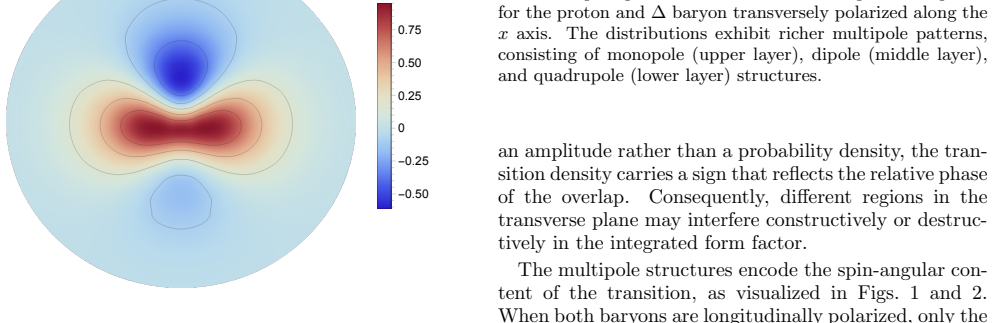
- Figures 1 and 2 are generated from a schematic multipole ansatz whose functional form is never stated. A short sentence or appendix entry giving the radial profiles used would make the visualization fully reproducible.
- Section IV A (after Eq. 34) correctly notes that residual Δ- remains nonzero for mΔ eq mN. A brief quantitative remark on the size of this residual for physical masses would help readers assess the practical impact of the unequal-mass kinematics.
- The conversion between the BR and GPV bases (Eq. 9) is given only for the first three GPDs. A one-line statement that GX has no GPV counterpart (or how it is absorbed) would remove a small ambiguity.
- A few typographical inconsistencies appear (e.g., “MUL TIPOLE”, “INTERPRET A TION” in section headings; occasional missing spaces after commas). These are easily cleaned in production.
Circularity Check
No significant circularity: multipole GPDs are an independent kinematic recombination of a previously defined covariant basis.
specific steps
-
self citation load bearing
[Sec. II A, Eqs. (2) and (8d); also Introduction and Ref. [33]]
"A complete and independent fourth structure was identified only recently in Ref. [33] … Kαμ_X = m_N n^α γ^μ γ_5."
The four-structure covariant basis that is multipole-expanded is taken from the authors' own prior paper. The multipole map itself is new and independent, so the self-citation is not load-bearing for the strongest claim; it only supplies the starting parametrization. Flagged at the lowest level for completeness.
full rationale
The paper's central result is a purely kinematic multipole expansion of the already-parametrized N oΔ light-cone matrix element. The four covariant GPDs G1,2,3,X (Eqs. 2, 8) are taken as the starting point; they are linearly recombined into M0, MV1, MQ1, M2 (Eq. 30 and Appendix D) by evaluating standard light-front Rarita–Schwinger and Dirac spinors and projecting onto three-dimensional spin-transition tensors and transverse-momentum tensors. The algebra is fully explicit, parameter-free, and uses only Clebsch–Gordan coefficients and on-shell kinematics (Appendices A–C). Self-citations to the authors' earlier works [33–35] supply the fourth Lorentz structure and the forward-limit interpretation, but they do not force the multipole map itself; that map is a new, independent reorganization. The impact-parameter densities (Sec. IV) are Fourier–Bessel transforms of the same multipole GPDs and inherit no fitted parameters. Visualization employs an illustrative multipole ansatz that the authors themselves label as non-dynamical. Consequently the derivation chain does not reduce by construction to its inputs, and the circularity score remains at the level of ordinary self-citation of a prior basis.
Axiom & Free-Parameter Ledger
axioms (4)
- domain assumption Light-front quantization and the symmetric-frame kinematics with Δ+=(−2ξ)P+ are valid for unequal-mass transitions.
- domain assumption The Rarita–Schwinger spinor and its subsidiary conditions correctly describe the on-shell Δ.
- domain assumption Four independent Lorentz structures (BR + X) exhaust the vector N oΔ transition matrix element.
- standard math Angular-momentum selection rules restrict the spin-transition tensors to L=1,2 only.
invented entities (1)
-
Multipole GPDs M0, MV1, MQ1, M2
no independent evidence
read the original abstract
We establish the multipole structure of the $N \to \Delta$ transition at the level of the generalized parton distributions (GPDs). We decompose the four transition GPDs into one monopole, two dipole, and one quadrupole components in the transverse plane by a multipole expansion of the covariant transition matrix element in terms of the three-dimensional spin-transition tensors and the transverse momentum transfer. These multipole components are in one-to-one correspondence with the light-front helicity amplitudes. In the zero-skewness limit, the multipole GPDs define impact-parameter transition densities, which generalize the transverse transition charge densities to the $x$-dependent level. These transition densities arise from non-diagonal matrix elements between two distinct hadronic states and must therefore be distinguished from the diagonal densities of the nucleon and the $\Delta$. The multipole transition densities visualize the monopole, dipole, and quadrupole structures of the partonic $N \to \Delta$ transition in the transverse plane.
Figures

Reference graph
Works this paper leans on
-
[1]
(25b) is determined to be ∆ + =−2ξP + from Eq
The scalar product is then given by a·b=a +b− +a −b+ −a ⊥ ·b ⊥.(24) We work in the standard symmetric frame commonly used for GPDs, P= (P +, P −,0 ⊥),(25a) ∆ = (∆+,∆ −,∆ ⊥).(25b) The plus component of the momentum transfer in Eq. (25b) is determined to be ∆ + =−2ξP + from Eq. (4) by choosing the light-cone vector asn µ = (1,0,0,−1)/( √ 2P +) in Minkowski ...
2025
-
[2]
V. Pascalutsa, M. Vanderhaeghen, and S. N. Yang, Electromagnetic excitation of the Delta(1232)-resonance, Phys. Rept.437, 125 (2007), arXiv:hep-ph/0609004
Pith/arXiv arXiv 2007
-
[3]
Takahashiet al.(Particle Data Group), Review of par- ticle physics, Int
F. Takahashiet al.(Particle Data Group), Review of par- ticle physics, Int. J. Mod. Phys. A41, 2630011 (2026)
2026
-
[4]
H. F. Jones and M. D. Scadron, Multipole gamma N Delta form-factors and resonant photoproduction and electroproduction, Annals Phys.81, 1 (1973)
1973
-
[5]
Becket al., Measurement of the E2/M1 ratio in the N→∆ transition using the reactionp(⃗ γ, p)π 0, Phys
R. Becket al., Measurement of the E2/M1 ratio in the N→∆ transition using the reactionp(⃗ γ, p)π 0, Phys. Rev. Lett.78, 606 (1997)
1997
-
[6]
R. Becket al., Determination of the E2/M1 ratio in the γN→∆(1232) transition from a simultaneous measure- ment ofp(⃗ γ, p)π0 andp(⃗ γ, π+)n, Phys. Rev. C61, 035204 (2000), arXiv:nucl-ex/9908017
Pith/arXiv arXiv 2000
-
[7]
Blanpiedet al.(LEGS),N→∆ Transition from Si- multaneous Measurements ofp(⃗ γ, π) andp(⃗ γ, γ), Phys
G. Blanpiedet al.(LEGS),N→∆ Transition from Si- multaneous Measurements ofp(⃗ γ, π) andp(⃗ γ, γ), Phys. Rev. Lett.79, 4337 (1997)
1997
-
[8]
Blanpiedet al.(LEGS),N→∆ transition and proton polarizabilities from measurements ofp(⃗ γ, γ),p(⃗ γ, π 0), andp(⃗ γ, π+), Phys
G. Blanpiedet al.(LEGS),N→∆ transition and proton polarizabilities from measurements ofp(⃗ γ, γ),p(⃗ γ, π 0), andp(⃗ γ, π+), Phys. Rev. C64, 025203 (2001), [Erratum: Phys. Rev. C 64, 029902 (2001)]
2001
-
[9]
Mertzet al., Search for quadrupole strength in the electroexcitation of the ∆ +(1232), Phys
C. Mertzet al., Search for quadrupole strength in the electroexcitation of the ∆ +(1232), Phys. Rev. Lett.86, 2963 (2001), arXiv:nucl-ex/9902012
Pith/arXiv arXiv 2001
-
[10]
N. F. Sparveriset al.(OOPS), Investigation of the con- jectured nucleon deformation at low momentum trans- fer, Phys. Rev. Lett.94, 022003 (2005), arXiv:nucl- ex/0408003
arXiv 2005
-
[11]
T. Pospischilet al.(A1), Measurement of the recoil po- larization in thep(⃗ e, e′⃗ p)π0 reaction at the ∆(1232) res- onance, Phys. Rev. Lett.86, 2959 (2001), arXiv:nucl- ex/0010020
arXiv 2001
-
[12]
V. V. Frolovet al., Electroproduction of the ∆(1232) resonance at high momentum transfer, Phys. Rev. Lett. 82, 45 (1999), arXiv:hep-ex/9808024. 11
Pith/arXiv arXiv 1999
-
[13]
Jooet al.(CLAS),Q 2 dependence of quadrupole strength in theγ ∗p→∆ +(1232)→pπ 0 transition, Phys
K. Jooet al.(CLAS),Q 2 dependence of quadrupole strength in theγ ∗p→∆ +(1232)→pπ 0 transition, Phys. Rev. Lett.88, 122001 (2002), arXiv:hep-ex/0110007
Pith/arXiv arXiv 2002
-
[14]
M. Ungaroet al.(CLAS), Measurement of theN→ ∆+(1232) transition at high momentum transfer byπ 0 electroproduction, Phys. Rev. Lett.97, 112003 (2006), arXiv:hep-ex/0606042
Pith/arXiv arXiv 2006
-
[15]
I. G. Aznauryanet al.(CLAS), Electroexcitation of nucleon resonances from CLAS data on single pion electroproduction, Phys. Rev. C80, 055203 (2009), arXiv:0909.2349 [nucl-ex]
Pith/arXiv arXiv 2009
-
[16]
C. Alexandrou, C. N. Papanicolas, and M. Vander- haeghen, Colloquium: The shape of hadrons, Rev. Mod. Phys.84, 1231 (2012), arXiv:1201.4511 [hep-ph]
Pith/arXiv arXiv 2012
-
[17]
S. S. Kamalov and S. N. Yang, Pion cloud and theQ 2 dependence ofγ ∗N↔∆ transition form factors, Phys. Rev. Lett.83, 4494 (1999), arXiv:nucl-th/9904072
Pith/arXiv arXiv 1999
-
[18]
T. Sato and T. S. H. Lee, Dynamical study of the ∆ excitation inN(e, e ′π) reactions, Phys. Rev. C63, 055201 (2001), arXiv:nucl-th/0010025
Pith/arXiv arXiv 2001
-
[19]
J.-Y. Kim and H.-C. Kim, Electromagnetic transition form factors,E2/M1 andC2/M1 ratios of the baryon de- cuplet, Eur. Phys. J. C80, 1087 (2020), arXiv:2002.05980 [hep-ph]
Pith/arXiv arXiv 2020
-
[20]
C. E. Carlson and M. Vanderhaeghen, Empirical trans- verse charge densities in the nucleon and the nucleon-to- Delta transition, Phys. Rev. Lett.100, 032004 (2008), arXiv:0710.0835 [hep-ph]
Pith/arXiv arXiv 2008
-
[21]
D. M¨ uller, D. Robaschik, B. Geyer, F. M. Dittes, and J. Hoˇ rejˇ si, Wave functions, evolution equations and evo- lution kernels from light ray operators of QCD, Fortsch. Phys.42, 101 (1994), arXiv:hep-ph/9812448
Pith/arXiv arXiv 1994
-
[22]
Ji, Gauge-Invariant Decomposition of Nucleon Spin, Phys
X.-D. Ji, Gauge-Invariant Decomposition of Nucleon Spin, Phys. Rev. Lett.78, 610 (1997), arXiv:hep- ph/9603249
arXiv 1997
-
[23]
A. V. Radyushkin, Nonforward parton distributions, Phys. Rev. D56, 5524 (1997), arXiv:hep-ph/9704207
Pith/arXiv arXiv 1997
-
[24]
K. Goeke, M. V. Polyakov, and M. Vanderhaeghen, Hard exclusive reactions and the structure of hadrons, Prog. Part. Nucl. Phys.47, 401 (2001), arXiv:hep-ph/0106012
Pith/arXiv arXiv 2001
-
[25]
Diehl, Generalized parton distributions, Phys
M. Diehl, Generalized parton distributions, Phys. Rept. 388, 41 (2003), arXiv:hep-ph/0307382
Pith/arXiv arXiv 2003
-
[26]
A. V. Belitsky and A. V. Radyushkin, Unraveling hadron structure with generalized parton distributions, Phys. Rept.418, 1 (2005), arXiv:hep-ph/0504030
Pith/arXiv arXiv 2005
-
[27]
M. Burkardt, Impact parameter dependent parton dis- tributions and off forward parton distributions for zeta —>0, Phys. Rev. D62, 071503 (2000), [Erratum: Phys.Rev.D 66, 119903 (2002)], arXiv:hep-ph/0005108
Pith/arXiv arXiv 2000
-
[28]
Burkardt, Impact parameter space interpretation for generalized parton distributions, Int
M. Burkardt, Impact parameter space interpretation for generalized parton distributions, Int. J. Mod. Phys. A 18, 173 (2003), arXiv:hep-ph/0207047
Pith/arXiv arXiv 2003
-
[29]
S. Diehlet al.(CLAS), First Measurement of Hard Ex- clusiveπ −∆++ Electroproduction Beam-Spin Asymme- tries off the Proton, Phys. Rev. Lett.131, 021901 (2023), arXiv:2303.11762 [hep-ex]
Pith/arXiv arXiv 2023
-
[30]
P. Kroll and K. Passek-Kumeriˇ cki, Transition GPDs and exclusive electroproduction ofπ-∆(1232) final states, Phys. Rev. D107, 054009 (2023), arXiv:2211.09474 [hep- ph]
Pith/arXiv arXiv 2023
-
[31]
K. M. Semenov-Tian-Shansky and M. Vanderhaeghen, Deeply virtual Compton processe −N→e −γπNto study nucleon to resonance transitions, Phys. Rev. D 108, 034021 (2023), arXiv:2303.00119 [hep-ph]
Pith/arXiv arXiv 2023
-
[32]
S. Diehlet al., Exploring baryon resonances with transi- tion generalized parton distributions: status and perspec- tives, Eur. Phys. J. A61, 131 (2025), arXiv:2405.15386 [hep-ph]
Pith/arXiv arXiv 2025
-
[33]
R. Abdul Khaleket al., Science Requirements and De- tector Concepts for the Electron-Ion Collider: EIC Yellow Report, Nucl. Phys. A1026, 122447 (2022), arXiv:2103.05419 [physics.ins-det]
Pith/arXiv arXiv 2022
-
[34]
J.-Y. Kim, K. M. Semenov-Tian-Shansky, H.-Y. Won, S. Son, and C. Weiss, Complete definition of N→∆ transi- tion generalized parton distributions, Phys. Rev. D111, 114010 (2025), arXiv:2501.00185 [hep-ph]
arXiv 2025
-
[35]
J.-Y. Kim and C. Weiss, Tensor-polarized parton den- sity in the N→∆ transition, Phys. Lett. B870, 139924 (2025), arXiv:2507.18402 [hep-ph]
Pith/arXiv arXiv 2025
-
[36]
J.-Y. Kim, Tensor-polarized parton density in the N→∆ transition from the large-Nc light-cone wave function, Phys. Rev. D113, 114019 (2026), arXiv:2508.11491 [hep- ph]
Pith/arXiv arXiv 2026
-
[37]
D. A. Varshalovich, A. N. Moskalev, and V. K. Kherson- skii,Quantum Theory of Angular Momentum: Irreducible Tensors, Spherical Harmonics, Vector Coupling Coeffi- cients, 3nj Symbols(World Scientific Publishing Com- pany, 1988)
1988
-
[38]
Rarita and J
W. Rarita and J. Schwinger, On a theory of particles with half integral spin, Phys. Rev.60, 61 (1941)
1941
-
[39]
P. L. Chung and F. Coester, Relativistic constituent quark model of nucleon form-factors, Phys. Rev. D44, 229 (1991)
1991
-
[40]
W. R. B. de Araujo, M. Beyer, T. Frederico, and H. J. Weber, Feynman versus Bakamjian-Thomas in light front dynamics, J. Phys. G25, 1589 (1999), arXiv:hep- ph/9904307
arXiv 1999
-
[41]
J. A. Rinehimer and G. A. Miller, Connecting the Breit Frame to the Infinite Momentum Light Front Frame: How G(E) turns into F(1), Phys. Rev. C80, 015201 (2009), arXiv:0902.4286 [nucl-th]
Pith/arXiv arXiv 2009
-
[42]
Lorc´ e, New explicit expressions for Dirac bilinears, Phys
C. Lorc´ e, New explicit expressions for Dirac bilinears, Phys. Rev. D97, 016005 (2018), arXiv:1705.08370 [hep- ph]
Pith/arXiv arXiv 2018
-
[43]
G. P. Lepage and S. J. Brodsky, Exclusive Processes in Perturbative Quantum Chromodynamics, Phys. Rev. D 22, 2157 (1980)
1980
-
[44]
S. J. Brodsky, H.-C. Pauli, and S. S. Pinsky, Quan- tum chromodynamics and other field theories on the light cone, Phys. Rept.301, 299 (1998), arXiv:hep- ph/9705477
arXiv 1998
discussion (0)
Sign in with ORCID, Apple, or X to comment. Anyone can read and Pith papers without signing in.