REVIEW 2 major objections 4 minor 67 references
SpectralOT aligns whole-brain fMRI across people by mixing functional signal with three Laplace-Beltrami eigenmodes, improving cross-subject decoding while running far faster than prior optimal-transport methods.
Reviewed by Pith at T0; open to challenge. T0 means a machine referee read the full paper against a public rubric. the ladder, T0–T4 →
SpectralOT regularizes entropic optimal transport with the first three Laplace-Beltrami eigenmodes of cortical geometry to produce fast, parsimonious whole-brain functional alignments that improve cross-subject decoding.
T0 review reviewed 2026-07-14 challenge →
load-bearing objection Clean, fast geometry-aware OT alignment that actually improves ISC and out-of-subject decoding while being ~30 imes cheaper than FUGW. the 2 major comments →
Fast Whole-Brain, Geometry-Aware Functional Alignment for Cross-Subject Decoding
The pith
A machine-rendered reading of the paper's core claim, the machinery that carries it, and where it could break.
The reading
Core claim
Embedding cortical geometry via the first three Laplace-Beltrami eigenmodes into a linearly weighted functional-geometric cost, then solving a single entropic optimal-transport problem, produces whole-brain alignments that raise both inter-subject correlation and cross-subject decoding accuracy while remaining orders of magnitude faster than fused Gromov-Wasserstein approaches.
What carries the argument
SpectralOT: the composite cost C = (1-α)C_func + α C_geom, where C_geom is the squared Euclidean distance between the first three sign-aligned Laplace-Beltrami eigenmodes of the source and target meshes; this cost is fed once to a Sinkhorn solver to obtain the soft correspondence matrix used for signal transfer.
Load-bearing premise
The first three Laplace-Beltrami eigenmodes, after a simple gradient-based sign correction, already capture enough geometry to keep distant brain regions from matching, provided the two meshes are roughly isometric and similarly oriented.
What would settle it
On a held-out multi-subject fMRI dataset, replace the three-eigenmode geometric cost with pure functional cost (α=0) or pure Euclidean distance; if cross-subject decoding accuracy then falls below the anatomical baseline while SpectralOT stays above it, the geometric embedding is doing essential work; if accuracy stays the same, the claim collapses.
If this is right
- Population-level decoders can be trained after a single, fast alignment step rather than after expensive pairwise Gromov-Wasserstein solves.
- Because the geometric prior is mesh-intrinsic, alignments can be computed between individual cortical surfaces without first warping them to a common template.
- The linear α parameter and single Sinkhorn pass make nested cross-validation and integration into deep-learning pipelines practical.
- The same eigenmode cost extends immediately to volumetric data, opening whole-brain (surface-plus-volume) functional templates.
Where Pith is reading between the lines
- The method supplies a natural building block for a multi-subject functional template: each new subject can be aligned once to a growing average rather than to every other subject.
- Because the transport plan is differentiable with respect to the cost, SpectralOT can be inserted as a layer inside an end-to-end neural decoder that jointly optimizes alignment and classification.
- If the three-mode geometric regularizer proves sufficient, many other surface-matching problems outside neuroimaging can replace expensive geodesic distances with the same cheap spectral embedding.
Editorial analysis
A structured set of objections, weighed in public.
Referee Report
Summary. The manuscript introduces SpectralOT, a whole-brain functional alignment method for fMRI that constructs a composite cost matrix as a convex combination of a functional L2 dissimilarity and a geometric cost derived from the first three Laplace-Beltrami eigenmodes of the cortical mesh (after a simple gradient-based sign-flip correction). The composite cost is fed to a single entropic Sinkhorn solver to obtain a soft vertex-to-vertex coupling. Four experiments of increasing complexity (purely anatomical color transfer between fsaverage5 and fsLR, ISC on IBC task contrasts, pairwise out-of-subject decoding on Courtois-Neuromod THINGS, and leave-one-subject-out group decoding on IBC RSVPLanguage) compare SpectralOT against FUGW, ProMises and anatomical registration. The central claim is that SpectralOT improves ISC and out-of-subject decoding accuracy while remaining approximately 30 imes faster than FUGW and easier to tune.
Significance. If the reported gains hold, SpectralOT supplies a practical, geometry-aware alternative to FUGW that removes the need for nested block-coordinate descent and inhomogeneous scaling of Wasserstein versus Gromov-Wasserstein terms. The single free geometric weight α, the linear composite cost, and the public implementation make the method immediately usable for population-scale decoding pipelines and for integration into differentiable deep-learning frameworks. The explicit comparison of blur (Appendix Figure 8), the Nadeau-Bengio-corrected group-level test, and the open code are strengths that raise the bar for subsequent functional-alignment papers.
major comments (2)
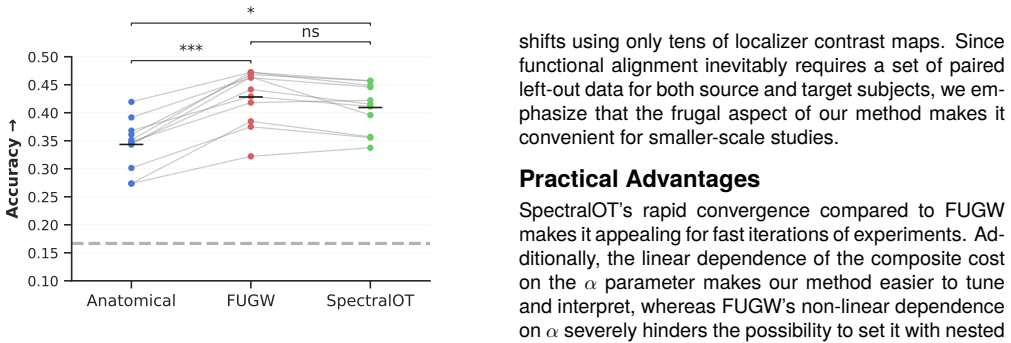
- Table 1 (THINGS pairwise decoding) shows SpectralOT winning on average, yet two of the six source→target pairs fall below the anatomical baseline and the absolute accuracies remain modest (0.14 average). With only three subjects the pairwise design cannot support a claim of consistent domain-shift reduction; the group-level IBC experiment (Figure 5) is therefore load-bearing, yet it reports only a non-significant difference versus FUGW. A power analysis or bootstrap confidence intervals on the accuracy differences would clarify whether the claimed superiority over FUGW is supported or whether the methods are statistically equivalent.
- Methods, Geometric Descriptors and Appendix Figure 7: the decision to truncate to the first three eigenmodes is justified solely by geodesic-error saturation under pure anatomical alignment (α=1). It remains untested whether the same truncation remains optimal once functional cost is present (0<α<1) or on individual (non-template) meshes whose higher-frequency geometry may matter for fine functional topography. A short ablation of k under the ISC or decoding protocols would close this gap.
minor comments (4)
- Equation (5) and the subsequent simplification assume equal-mass marginals; the text should state explicitly that the Sinkhorn solver is always initialized with uniform marginals, otherwise the row-normalization step is required.
- Figure 4B reports wall-clock times on a single GPU; stating the number of vertices per hemisphere and whether the cost matrices are pre-computed or recomputed would make the 30× claim fully reproducible.
- The ProMises low-rank critique in the Appendix is clear, yet the main text still includes ProMises in every comparison; a single sentence noting that the model is retained only for completeness would avoid reader confusion.
- Typographical inconsistencies appear throughout (e.g., “computationalefficiency”, “thepredictive”, missing spaces after periods). A careful copy-edit pass is needed.
Circularity Check
No circularity: SpectralOT construction, hyper-parameters and held-out evaluations are independent of the claimed ISC/decoding gains.
full rationale
The paper defines a composite cost C_composite = (1-α)C_func + α C_geom from LBO eigenmodes (truncated to k=3 after gradient sign-flip) and paired functional maps, then obtains the coupling via a single Sinkhorn solve (Eqs. 2–5). All performance claims (ISC curves, Table 1 pairwise decoding accuracies, Figure 5 group-level accuracies) are measured on held-out contrasts or held-out subjects after the coupling is fixed; α and ε are free parameters that are either fixed a priori or swept, never fitted to the final decoding scores. Self-citations (Thual et al. 2022/2023, Barbarant et al. 2025 poster) supply only the FUGW baseline and a future-work remark; they do not underwrite any uniqueness claim or close a logical loop. The low-rank critique of ProMises is derived directly from the SVD construction in the appendix and is not circular. The derivation chain is therefore self-contained against external benchmarks.
Axiom & Free-Parameter Ledger
free parameters (3)
- alpha (geometric weight) =
0.5 (decoding); grid-searched for ISC
- epsilon (entropic regularization) =
1e-3
- number of eigenmodes k =
3
axioms (3)
- domain assumption Laplace-Beltrami eigenmodes form an intrinsic, isometry-invariant embedding of mesh geometry (Rustamov 2007).
- domain assumption Cortical meshes of different subjects are approximately isometric and share a common orientation after standard surface registration.
- standard math Entropic OT with the composite cost yields a soft correspondence that can be used for barycentric projection of new functional data.
invented entities (1)
-
SpectralOT composite cost and pipeline
no independent evidence
Cite this review
Pith. "Pith review of Fast Whole-Brain, Geometry-Aware Functional Alignment for Cross-Subject Decoding." pith.science (2026). https://pith.science/paper/AKXTB7BM
@misc{pith2026260710931,
  author       = {Pith},
  title        = {Pith review of: Fast Whole-Brain, Geometry-Aware Functional Alignment for Cross-Subject Decoding},
  year         = {2026},
  howpublished = {\url{https://pith.science/paper/AKXTB7BM}},
  note         = {Machine review of arXiv:2607.10931}
}
read the original abstract
Decoding brain activity is useful for characterizing brain processes and understanding the functional architecture underlying cognition. However, the inter-individual variability in brain response patterns limits the development of decoders that generalize across individuals. A solution to this challenge is functional alignment: aligning functional data across individuals before training population-level decoders. The core issue is to strike the balance between aligning functional features and preserving the anatomical structure, while maintaining computational efficiency. We introduce a new functional alignment method for fMRI, SpectralOT, that embeds cortical geometry into Laplace-Beltrami eigenmodes along functional data to regularize the alignment.
Figures




Reference graph
Works this paper leans on
-
[1]
An empirical evaluation of functional alignment using inter-subject decoding , volume =
Bazeille, Thomas and DuPre, Elizabeth and Richard, Hugo and Poline, Jean-Baptiste and Thirion, Bertrand , year =. An empirical evaluation of functional alignment using inter-subject decoding , volume =. doi:10.1016/j.neuroimage.2021.118683 , journal =
-
[2]
Jeganathan, Jayson and Paton, Bryan and Koussis, Nikitas and Breakspear, Michael , year =. Integrating anatomical and functional landmarks for interparticipant alignment of imaging data , volume =. doi:10.1162/imag_a_00253 , journal =
-
[3]
MindAligner: Explicit Brain Functional Alignment for Cross-Subject Visual Decoding from Limited fMRI Data , publisher =. 2025 , copyright =. doi:10.48550/ARXIV.2502.05034 , author =
-
[4]
James V. Haxby and J. Swaroop Guntupalli and Andrew C. Connolly and Yaroslav O. Halchenko and Bryan R. Conroy and M. Ida Gobbini and Michael Hanke and Peter J. Ramadge , title =. doi:10.1016/j.neuron.2011.08.026 , year =
-
[5]
T. Bazeille and H. Richard and H. Janati and B. Thirion , title =. doi:10.1007/978-3-030-20351-1_18 , year =
-
[6]
A Reduced-Dimension fMRI Shared Response Model , volume =
Chen, Po-Hsuan (Cameron) and Chen, Janice and Yeshurun, Yaara and Hasson, Uri and Haxby, James and Ramadge, Peter J , booktitle =. A Reduced-Dimension fMRI Shared Response Model , volume =
-
[7]
Advances in Neural Information Processing Systems , editor=
Aligning individual brains with fused unbalanced Gromov Wasserstein , author=. Advances in Neural Information Processing Systems , editor=
-
[8]
Aligning human subjects with short acquisition-time fMRI training data , DOI =
Thual, Alexis and Dehaene, Stanislas and Thirion, Bertrand , year =. Aligning human subjects with short acquisition-time fMRI training data , DOI =. 2022 Conference on Cognitive Computational Neuroscience , publisher =
2022
-
[9]
and Slipski, Lukas and Feilong, Ma and Guntupalli, J
Busch, Erica L. and Slipski, Lukas and Feilong, Ma and Guntupalli, J. Swaroop and Castello, Matteo Visconti di Oleggio and Huckins, Jeremy F. and Nastase, Samuel A. and Gobbini, M. Ida and Wager, Tor D. and Haxby, James V. , year =. Hybrid hyperalignment: A single high-dimensional model of shared information embedded in cortical patterns of response and f...
-
[10]
Measuring shared responses across subjects using intersubject correlation , ISSN =
Nastase, Samuel A and Gazzola, Valeria and Hasson, Uri and Keysers, Christian , year =. Measuring shared responses across subjects using intersubject correlation , ISSN =. doi:10.1093/scan/nsz037 , journal =
-
[11]
Procrustes Analysis for High-Dimensional Data , volume =
Andreella, Angela and Finos, Livio , year =. Procrustes Analysis for High-Dimensional Data , volume =. Psychometrika , publisher =. doi:10.1007/s11336-022-09859-5 , number =
-
[12]
ArXiv , year=
Aligning brain functions boosts the decoding of visual semantics in novel subjects , author=. ArXiv , year=
-
[13]
Schaefer, Alexander and Kong, Ru and Gordon, Evan M and Laumann, Timothy O and Zuo, Xi-Nian and Holmes, Avram J and Eickhoff, Simon B and Yeo, B T Thomas , year =. Local-Global Parcellation of the Human Cerebral Cortex from Intrinsic Functional Connectivity MRI , volume =. Cerebral Cortex , publisher =. doi:10.1093/cercor/bhx179 , number =
-
[14]
Sinkhorn Distances: Lightspeed Computation of Optimal Transport , volume =
Cuturi, Marco , booktitle =. Sinkhorn Distances: Lightspeed Computation of Optimal Transport , volume =
-
[15]
Gower, J. C. , year =. Generalized Procrustes Analysis , volume =. Psychometrika , publisher =. doi:10.1007/bf02291478 , number =
-
[16]
Barycenters in the Wasserstein Space , volume =
Agueh, Martial and Carlier, Guillaume , year =. Barycenters in the Wasserstein Space , volume =. SIAM Journal on Mathematical Analysis , publisher =. doi:10.1137/100805741 , number =
-
[17]
Individual. Scientific Data , author =. 2018 , pages =. doi:10.1038/sdata.2018.105 , number =
-
[18]
Pinho, Ana Luísa and Richard, Hugo and Ponce, Ana Fernanda and Eickenberg, Michael and Amadon, Alexis and Dohmatob, Elvis and Denghien, Isabelle and Torre, Juan Jesús and Shankar, Swetha and Aggarwal, Himanshu and Thual, Alexis and Chapalain, Thomas and Ginisty, Chantal and Becuwe-Desmidt, Séverine and Roger, Séverine and Lecomte, Yann and Berland, Valéri...
-
[19]
Hanke, Michael and Dinga, Richard and H\". High-resolution 7-Tesla fMRI data on the perception of musical genres – an extension to the studyforrest dataset , volume =. 2015 , month = jun, pages =. doi:10.12688/f1000research.6679.1 , journal =
-
[20]
and Bellec, Lune and Hebart, Martin N
St-Laurent, Marie and Pinsard, Basile and Contier, Oliver and DuPre, Elizabeth and Seeliger, Katja and Borghesani, Valentina and Boyle, Julie A. and Bellec, Lune and Hebart, Martin N. , keywords =. CNeuroMod-THINGS, a densely-sampled fMRI dataset for visual neuroscience , publisher =. 2025 , copyright =. doi:10.48550/ARXIV.2507.09024 , url =
-
[21]
Esteban, Oscar and Markiewicz, Christopher J. and Blair, Ross W. and Moodie, Craig A. and Isik, A. Ilkay and Erramuzpe, Asier and Kent, James D. and Goncalves, Mathias and DuPre, Elizabeth and Snyder, Madeleine and Oya, Hiroyuki and Ghosh, Satrajit S. and Wright, Jessey and Durnez, Joke and Poldrack, Russell A. and Gorgolewski, Krzysztof J. , year =. fMRI...
-
[22]
Unbiased nonlinear average age-appropriate brain templates from birth to adulthood , volume =
Fonov, VS and Evans, AC and McKinstry, RC and Almli, CR and Collins, DL , year =. Unbiased nonlinear average age-appropriate brain templates from birth to adulthood , volume =. doi:10.1016/s1053-8119(09)70884-5 , journal =
-
[23]
2013 , MONTH = Dec, DOI =
Abraham, Alexandre and Pedregosa, Fabian and Eickenberg, Michael and Gervais, Philippe and Muller, Andreas and Kossaifi, Jean and Gramfort, Alexandre and Thirion, Bertrand and Varoquaux, Ga. 2013 , MONTH = Dec, DOI =
2013
-
[24]
Nilearn contributors , license =
-
[25]
Hurley, John R. and Cattell, Raymond B. , title =. Behavioral Science , volume =. doi:https://doi.org/10.1002/bs.3830070216 , year =
-
[26]
Effective functional mapping of fMRI data with support‐vector machines , volume =
Lee, Sangkyun and Halder, Sebastian and K\". Effective functional mapping of fMRI data with support‐vector machines , volume =. Human Brain Mapping , publisher =. 2010 , month = jan, pages =. doi:10.1002/hbm.20955 , number =
-
[27]
Sabuncu, Mert R. and Singer, Benjamin D. and Conroy, Bryan and Bryan, Ronald E. and Ramadge, Peter J. and Haxby, James V. , year =. Function-based Intersubject Alignment of Human Cortical Anatomy , volume =. Cerebral Cortex , publisher =. doi:10.1093/cercor/bhp085 , number =
-
[28]
Haxby, James V. and Gobbini, M. Ida and Furey, Maura L. and Ishai, Alumit and Schouten, Jennifer L. and Pietrini, Pietro , year =. Distributed and Overlapping Representations of Faces and Objects in Ventral Temporal Cortex , volume =. Science , publisher =. doi:10.1126/science.1063736 , number =
-
[29]
Richard, Hugo and Thirion, Bertrand , year =. FastSRM: A fast, memory efficient and identifiable implementation of the shared response model , volume =. doi:10.52294/001c.87954 , journal =
-
[30]
Fischl, Bruce and Sereno, Martin I. and Tootell, Roger B.H. and Dale, Anders M. , title =. Human Brain Mapping , volume =. doi:https://doi.org/10.1002/(SICI)1097-0193(1999)8:4<272::AID-HBM10>3.0.CO;2-4 , year =
-
[31]
doi:10.1073/pnas.0600244103 , year =
Nikolaus Kriegeskorte and Rainer Goebel and Peter Bandettini , title =. doi:10.1073/pnas.0600244103 , year =
-
[32]
Swaroop and Feilong, Ma and Haxby, James V
Guntupalli, J. Swaroop and Feilong, Ma and Haxby, James V. , editor =. A computational model of shared fine-scale structure in the human connectome , volume =. PLOS Computational Biology , publisher =. 2018 , month = apr, pages =. doi:10.1371/journal.pcbi.1006120 , number =
-
[33]
MindEye2: Shared-Subject Models Enable fMRI-To-Image With 1 Hour of Data , publisher =. 2024 , copyright =. doi:10.48550/ARXIV.2403.11207 , author =
-
[34]
and Varoquaux, G
Pedregosa, F. and Varoquaux, G. and Gramfort, A. and Michel, V. and Thirion, B. and Grisel, O. and Blondel, M. and Prettenhofer, P. and Weiss, R. and Dubourg, V. and Vanderplas, J. and Passos, A. and Cournapeau, D. and Brucher, M. and Perrot, M. and Duchesnay, E. , journal=. Scikit-learn: Machine Learning in
-
[35]
and Jiahui, Guo and Halchenko, Yaroslav O
Feilong, Ma and Nastase, Samuel A. and Jiahui, Guo and Halchenko, Yaroslav O. and Gobbini, M. Ida and Haxby, James V. , year =. The individualized neural tuning model: Precise and generalizable cartography of functional architecture in individual brains , volume =. doi:10.1162/imag_a_00032 , journal =
-
[36]
Inference for the Generalization Error , volume =
Nadeau, Claude and Bengio, Yoshua , booktitle =. Inference for the Generalization Error , volume =
-
[37]
Swaroop and Chauhan, Vassiki and Haxby, James V
Jiahui, Guo and Feilong, Ma and Visconti di Oleggio Castello, Matteo and Guntupalli, J. Swaroop and Chauhan, Vassiki and Haxby, James V. and Gobbini, M. Ida , year =. Predicting individual face-selective topography using naturalistic stimuli , volume =. doi:10.1016/j.neuroimage.2019.116458 , journal =
-
[38]
Swaroop and Hanke, Michael and Halchenko, Yaroslav O
Guntupalli, J. Swaroop and Hanke, Michael and Halchenko, Yaroslav O. and Connolly, Andrew C. and Ramadge, Peter J. and Haxby, James V. , year =. A Model of Representational Spaces in Human Cortex , volume =. Cerebral Cortex , publisher =. doi:10.1093/cercor/bhw068 , number =
-
[39]
Hebart, Martin N. and Dickter, Adam H. and Kidder, Alexis and Kwok, Wan Y. and Corriveau, Anna and Van Wicklin, Caitlin and Baker, Chris I. , editor =. THINGS: A database of 1, 854 object concepts and more than 26, 000 naturalistic object images , volume =. PLOS ONE , publisher =. 2019 , month = oct, pages =. doi:10.1371/journal.pone.0223792 , number =
-
[40]
Through their eyes: Multi-subject brain decoding with simple alignment techniques , volume =
Ferrante, Matteo and Boccato, Tommaso and Ozcelik, Furkan and VanRullen, Rufin and Toschi, Nicola , year =. Through their eyes: Multi-subject brain decoding with simple alignment techniques , volume =. doi:10.1162/imag_a_00170 , journal =
-
[41]
and Naselaris, Thomas and Benjamini, Yuval and Yu, Bin and Gallant, Jack L
Nishimoto, Shinji and Vu, An T. and Naselaris, Thomas and Benjamini, Yuval and Yu, Bin and Gallant, Jack L. , year =. Reconstructing Visual Experiences from Brain Activity Evoked by Natural Movies , volume =. Current Biology , publisher =. doi:10.1016/j.cub.2011.08.031 , number =
-
[42]
Barbosa, Joao and Nejatbakhsh, Amin and Duong, Lyndon and Harvey, Sarah E. and Brincat, Scott L. and Siegel, Markus and Miller, Earl K. and Williams, Alex H. , year =. Quantifying Differences in Neural Population Activity With Shape Metrics , url =. doi:10.1101/2025.01.10.632411 , publisher =
-
[43]
The representational dynamics of the animal appearance bias in human visual cortex are indicative of fast feedforward processing
Chiu-Yueh Chen and Ga \"e lle Leys and Stefania Bracci and Op de Beeck, Hans. The representational dynamics of the animal appearance bias in human visual cortex are indicative of fast feedforward processing. Imaging Neuroscience. 2023
2023
-
[44]
and Nishimoto, Shinji and Gallant, Jack L
Naselaris, Thomas and Kay, Kendrick N. and Nishimoto, Shinji and Gallant, Jack L. , year =. Encoding and decoding in fMRI , volume =. NeuroImage , publisher =. doi:10.1016/j.neuroimage.2010.07.073 , number =
-
[45]
Individual Comparisons by Ranking Methods , volume =
Wilcoxon, Frank , year =. Individual Comparisons by Ranking Methods , volume =. Biometrics Bulletin , publisher =. doi:10.2307/3001968 , number =
-
[46]
Haxby, James V and Guntupalli, J Swaroop and Nastase, Samuel A and Feilong, Ma , year =. Hyperalignment: Modeling shared information encoded in idiosyncratic cortical topographies , volume =. doi:10.7554/elife.56601 , journal =
-
[47]
Glasser, Matthew F. and Coalson, Timothy S. and Robinson, Emma C. and Hacker, Carl D. and Harwell, John and Yacoub, Essa and Ugurbil, Kamil and Andersson, Jesper and Beckmann, Christian F. and Jenkinson, Mark and Smith, Stephen M. and Van Essen, David C. , year =. A multi-modal parcellation of human cerebral cortex , volume =. Nature , publisher =. doi:10...
-
[48]
Van Essen, D. C. and Glasser, M. F. and Dierker, D. L. and Harwell, J. and Coalson, T. , year =. Parcellations and Hemispheric Asymmetries of Human Cerebral Cortex Analyzed on Surface-Based Atlases , volume =. Cerebral Cortex , publisher =. doi:10.1093/cercor/bhr291 , number =
-
[49]
A sulcal depth-based anatomical parcellation of the cerebral cortex
Destrieux, C and Fischl, B and Dale, AM and Halgren, E , year =. A sulcal depth-based anatomical parcellation of the cerebral cortex. , volume =. doi:10.1016/s1053-8119(09)71561-7 , journal =
-
[50]
ArXiv , year=
A Survey on fMRI-based Brain Decoding for Reconstructing Multimodal Stimuli , author=. ArXiv , year=
-
[51]
A Primer on Pattern-Based Approaches to fMRI: Principles, Pitfalls, and Perspectives , volume =
Haynes, John-Dylan , year =. A Primer on Pattern-Based Approaches to fMRI: Principles, Pitfalls, and Perspectives , volume =. Neuron , publisher =. doi:10.1016/j.neuron.2015.05.025 , number =
-
[52]
Proceedings of the IEEE/CVF Conference on Computer Vision and Pattern Recognition (CVPR) , month =
Pai, Gautam and Ren, Jing and Melzi, Simone and Wonka, Peter and Ovsjanikov, Maks , title =. Proceedings of the IEEE/CVF Conference on Computer Vision and Pattern Recognition (CVPR) , month =. 2021 , pages =
2021
-
[53]
Functional maps: a flexible representation of maps between shapes , volume =
Ovsjanikov, Maks and Ben-Chen, Mirela and Solomon, Justin and Butscher, Adrian and Guibas, Leonidas , year =. Functional maps: a flexible representation of maps between shapes , volume =. ACM Transactions on Graphics , publisher =. doi:10.1145/2185520.2185526 , number =
-
[54]
, title =
Rustamov, Raif M. , title =. Proceedings of the Fifth Eurographics Symposium on Geometry Processing , pages =. 2007 , isbn =
2007
-
[55]
Pang, James C. and Aquino, Kevin M. and Oldehinkel, Marianne and Robinson, Peter A. and Fulcher, Ben D. and Breakspear, Michael and Fornito, Alex , year =. Geometric constraints on human brain function , volume =. Nature , publisher =. doi:10.1038/s41586-023-06098-1 , number =
-
[56]
Kovnatsky, A. and Bronstein, M. M. and Bronstein, A. M. and Glashoff, K. and Kimmel, R. , year =. Coupled quasi‐harmonic bases , volume =. Computer Graphics Forum , publisher =. doi:10.1111/cgf.12064 , number =
-
[57]
Progressive Entropic Optimal Transport Solvers , booktitle =
Parnian Kassraie and Aram-Alexandre Pooladian and Michal Klein and James Thornton and Jonathan Niles-Weed and Marco Cuturi , year =. Progressive Entropic Optimal Transport Solvers , booktitle =
-
[58]
PyTorch: an imperative style, high-performance deep learning library , year =
Paszke, Adam and Gross, Sam and Massa, Francisco and Lerer, Adam and Bradbury, James and Chanan, Gregory and Killeen, Trevor and Lin, Zeming and Gimelshein, Natalia and Antiga, Luca and Desmaison, Alban and K\". PyTorch: an imperative style, high-performance deep learning library , year =. Proceedings of the 33rd International Conference on Neural Informa...
-
[59]
and Jbabdi, Saad and Glasser, Matthew F
Robinson, Emma C. and Jbabdi, Saad and Glasser, Matthew F. and Andersson, Jesper and Burgess, Gregory C. and Harms, Michael P. and Smith, Stephen M. and Van Essen, David C. and Jenkinson, Mark , year =. MSM: A new flexible framework for Multimodal Surface Matching , volume =. doi:10.1016/j.neuroimage.2014.05.069 , journal =
-
[60]
Fischl, Bruce and Sereno, Martin I. and Dale, Anders M. , year =. Cortical Surface-Based Analysis , volume =. NeuroImage , publisher =. doi:10.1006/nimg.1998.0396 , number =
-
[61]
Mazdak and Hoopes, Andrew and Hoffmann, Malte and Magnet, Robin and Ovsjanikov, Maks and Z\"
Abulnaga, S. Mazdak and Hoopes, Andrew and Hoffmann, Malte and Magnet, Robin and Ovsjanikov, Maks and Z\". Unified Brain Surface and Volume Registration , publisher =. 2025 , copyright =. doi:10.48550/ARXIV.2512.19928 , url =
-
[62]
Lu, Zejin and Doerig, Adrien and Bosch, Victoria and Krahmer, Bas and Kaiser, Daniel and Cichy, Radoslaw M. and Kietzmann, Tim C. , title=. Nature Human Behaviour , year=. doi:10.1038/s41562-025-02220-7 , url=
-
[63]
POT: Python Optimal Transport , journal =
R. POT: Python Optimal Transport , journal =. 2021 , volume =
2021
-
[64]
Computational Optimal Transport , publisher =
Peyré, Gabriel and Cuturi, Marco , keywords =. Computational Optimal Transport , publisher =. 2018 , copyright =. doi:10.48550/ARXIV.1803.00567 , url =
-
[65]
Computer Graphics Forum (SGP) , volume=
Nicholas Sharp and Keenan Crane , title=. Computer Graphics Forum (SGP) , volume=
-
[66]
2025 , MONTH = Aug, KEYWORDS =
Barbarant, Pierre-Louis and Meyniel, Florent and Thirion, Bertrand , URL =. 2025 , MONTH = Aug, KEYWORDS =
2025
-
[67]
Differentiable Ranking and Sorting using Optimal Transport , url =
Cuturi, Marco and Teboul, Olivier and Vert, Jean-Philippe , booktitle =. Differentiable Ranking and Sorting using Optimal Transport , url =
This paper was first reviewed by grok-4.5 on July 14, 2026.
discussion (0)
Sign in with ORCID, Apple, or X to comment. Anyone can read and Pith papers without signing in.