REVIEW 4 minor 29 references
A Lawson-style map for muon-catalyzed fusion shows historical high-yield experiments still stuck behind the alpha-sticking and multi-GeV muon-cost walls.
Reviewed by Pith at T0; open to challenge. T0 means a machine referee read the full paper against a public rubric. the ladder, T0–T4 →
T0 review · grok-4.5
2026-07-14 07:49 UTC pith:HQTY4ZD5
load-bearing objection Clean packaging of the standard μCF yield into a diagnostic (ω,L) map; algebra solid, novelty modest, useful for the specialized community.
A Lawson-inspired Cycle-Closure Criterion for Deuterium--Tritium Muon-Catalyzed Fusion
The pith
A machine-rendered reading of the paper's core claim, the machinery that carries it, and where it could break.
Core claim
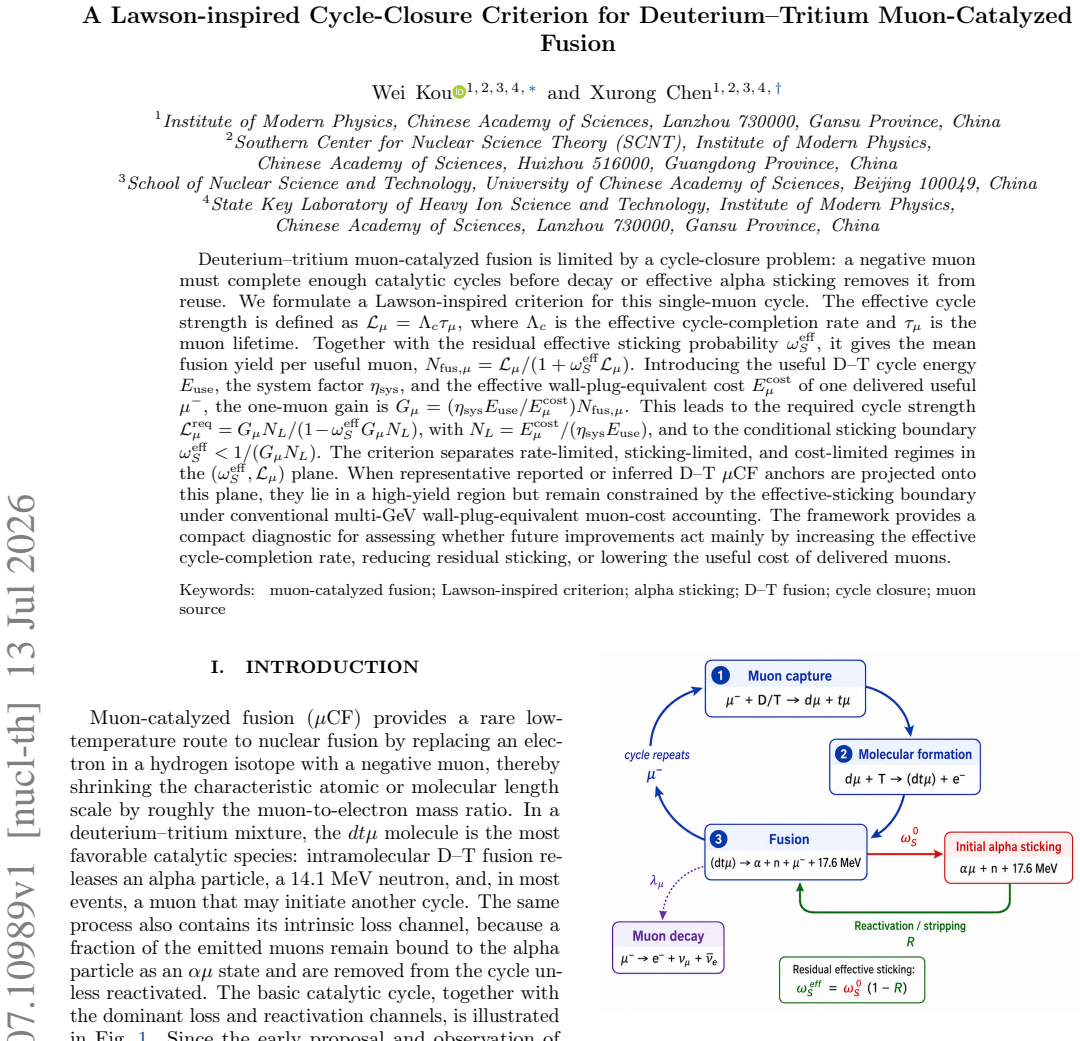
The authors show that the kinetic yield of D–T muon-catalyzed fusion can be rewritten as a compact, Lawson-inspired cycle-closure criterion. Defining the dimensionless cycle strength L_μ = Λ_c τ_μ and combining it with residual effective sticking ω_S^eff produces the mean fusion yield per muon; requiring a target one-muon gain then gives both a required cycle strength and a conditional sticking boundary. Historical high-yield anchors fall in a high-yield region of the resulting map but remain constrained by that sticking boundary under conventional multi-GeV muon-cost accounting.
What carries the argument
The cycle-closure map in the (ω_S^eff, L_μ) plane, together with the required-strength formula L_μ^req = G_μ N_L / (1 − ω_S^eff G_μ N_L) and the no-go line ω_S^eff < 1/(G_μ N_L). These objects convert ordinary μ CF renewal kinetics into an operational test that classifies any proposed system as rate-, sticking-, or cost-limited.
Load-bearing premise
The wall-plug cost of one useful muon is treated as a fixed multi-GeV number, and residual sticking and cycle rate are treated as coordinates that can be moved independently; if those premises fail, the regime map loses its operational meaning.
What would settle it
Re-measure a high-yield D–T μ CF run under controlled density and temperature, extract both residual sticking and effective cycle rate independently, recompute L_μ from the inverse yield relation, and check whether the point still lies above the sticking no-go line for a realistic multi-GeV muon cost at G_μ = 1.
Editorial analysis
A structured set of objections, weighed in public.
Referee Report
Summary. The paper formulates a Lawson-inspired cycle-closure criterion for D–T muon-catalyzed fusion. From the standard renewal balance of one useful muon it defines the dimensionless cycle strength L_μ = Λ_c τ_μ and recovers the mean fusion yield N_fus,μ = L_μ/(1 + ω_S^eff L_μ). Combining this with a wall-plug-equivalent muon cost, useful cycle energy, and system factor yields a one-muon gain G_μ, a required cycle strength L_μ^req = G_μ N_L/(1 − ω_S^eff G_μ N_L), and a conditional sticking no-go boundary ω_S^eff < 1/(G_μ N_L). These relations are displayed as a diagnostic map in the (ω_S^eff, L_μ) plane that separates rate-limited, sticking-limited, and cost-limited regimes. Representative historical D–T μ CF anchors (SIN/Crowe, LAMPF/Jones, Petitjean review range) are projected onto the map via reported rates or the inverse yield relation and are shown to occupy a high-yield region that remains constrained by the sticking boundary under conventional multi-GeV muon-cost accounting.
Significance. If accepted as a diagnostic rather than a full reactor model, the framework supplies a compact, falsifiable coordinate system that converts the usual kinetic yield discussion into three distinct improvement directions: cycle-completion rate, residual sticking, and wall-plug-equivalent muon cost. The algebra is elementary and transparent (Eqs. 1–12), the historical anchors are constructed from published numbers without hidden fits (Table I), and the paper itself states the principal caveats (lumped multi-GeV cost, non-independence of effective coordinates). The map therefore offers a useful common language for comparing molecular-formation, reactivation, and muon-source proposals, and for distinguishing energy-oriented from neutron-source applications. These strengths are definitional clarity and diagnostic utility rather than new microscopic predictions.
minor comments (4)
- Figure 2 and Table I: the LAMPF/Jones and Petitjean anchors adopt literature ω_S^eff values rather than measured ones; a short explicit statement that the plotted L_μ values inherit this adoption (and the sensitivity of Eq. 5) would prevent over-reading the points as precision remeasurements.
- Section III, Eq. (9): N_L is introduced as “cycle demand”; a one-sentence reminder that it is an accounting construct (not a measured kinetic quantity) would reinforce the paper’s own later caveats in Section V.
- Notation consistency: the abstract and body mix calligraphic L_μ with script L_μ and occasionally L_req_μ; a uniform symbol would improve readability.
- References [25] and [28] are listed as 2026 arXiv preprints; if they remain unpublished at acceptance, a brief note that they are concurrent work would be helpful.
Circularity Check
No significant circularity: criterion is transparent algebraic rearrangement of standard μ CF yield plus linear energy accounting; historical anchors are literature projections, not forced fits.
full rationale
The derivation chain is fully self-contained and non-circular. Equations (1)–(2) restate the standard renewal yield N_fus,μ = Λ_c / (λ_μ + ω_S^eff Λ_c) in the dimensionless form L_μ = Λ_c τ_μ, which the paper itself equates to the textbook expression Y_f ≃ (ω_S^eff + λ_0/λ_c φ)^-1. The inversion (3), gain definition (8), cycle demand N_L (9), required strength (11), and sticking no-go (12) are elementary rearrangements of those definitions under a specified accounting convention; none is obtained by fitting a free parameter to data and then re-presenting the fit as an independent prediction. Historical anchors in Fig. 2 and Table I are constructed either from reported Λ_c or by the same transparent inversion applied to published Y_f and adopted ω_S^eff values; they are not self-consistent fits that force the regime classification. Self-citations (e.g., the authors’ related reactivation preprint) appear only in the discussion of future evaluation and do not enter the load-bearing algebra. The paper therefore supplies a compact diagnostic map rather than a circular derivation.
Axiom & Free-Parameter Ledger
free parameters (4)
- E_cost_μ (representative 3/5/8 GeV) =
5 GeV conventional
- η_sys =
1 or 0.4
- E_use =
20.4 MeV
- adopted ω_eff_S for LAMPF/Jones and review anchors =
0.45%-0.50%
axioms (4)
- domain assumption Mean fusion yield follows from renewal balance N_fus,μ = Λ_c / (λ_μ + ω_eff_S Λ_c)
- domain assumption All post-fusion sticking and reactivation physics collapses into a single residual probability ω_eff_S = ω0_S (1-R)
- domain assumption Wall-plug-equivalent muon cost E_cost_μ is a well-defined lumped accounting number comparable to useful fusion energy
- ad hoc to paper Classical Lawson criterion supplies only a structural analogy (need for a confinement-like variable), not a variable-by-variable template
read the original abstract
Deuterium--tritium muon-catalyzed fusion is limited by a cycle-closure problem: a negative muon must complete enough catalytic cycles before decay or effective alpha sticking removes it from reuse. We formulate a Lawson-inspired criterion for this single-muon cycle. The effective cycle strength is defined as $\mathcal{L}_\mu=\Lambda_c\tau_\mu$, where $\Lambda_c$ is the effective cycle-completion rate and $\tau_\mu$ is the muon lifetime. Together with the residual effective sticking probability $\omega_S^{\rm eff}$, it gives the mean fusion yield per useful muon, $N_{\rm fus,\mu}=\mathcal{L}_\mu/(1+\omega_S^{\rm eff}\mathcal{L}_\mu)$. Introducing the useful D--T cycle energy $E_{\rm use}$, the system factor $\eta_{\rm sys}$, and the effective muon cost $E_\mu^{\rm cost}$, the one-muon gain is $G_\mu=(\eta_{\rm sys}E_{\rm use}/E_\mu^{\rm cost})N_{\rm fus,\mu}$. This leads to the required cycle strength $\mathcal{L}_\mu^{\rm req}=G_\mu N_L/(1-\omega_S^{\rm eff}G_\mu N_L)$, with $N_L=E_\mu^{\rm cost}/(\eta_{\rm sys}E_{\rm use})$, and to the conditional sticking boundary $\omega_S^{\rm eff}<1/(G_\mu N_L)$. The criterion separates rate-limited, sticking-limited, and cost-limited regimes in the $(\omega_S^{\rm eff},\mathcal{L}_\mu)$ plane. When representative historical D--T $\mu{\rm CF}$ anchors are projected onto this plane, they lie in a high-yield region but remain constrained by the effective-sticking boundary under conventional multi-GeV muon-cost accounting. The framework provides a compact diagnostic for assessing whether future improvements act mainly by increasing the effective cycle-completion rate, reducing residual sticking, or lowering the useful cost of delivered muons.
Figures

Reference graph
Works this paper leans on
-
[1]
Frank, Nature160, 525 (1947)
F. Frank, Nature160, 525 (1947)
1947
-
[2]
L. W. Alvarezet al., Phys. Rev.105, 1127 (1957)
1957
-
[3]
J. D. Jackson, Physical Review106, 330 (1957)
1957
-
[4]
Ponomarev, Contemporary Physics31, 219 (1990)
L. Ponomarev, Contemporary Physics31, 219 (1990)
1990
-
[5]
Froelich, Advances in Physics41, 405 (1992)
P. Froelich, Advances in Physics41, 405 (1992)
1992
-
[6]
Petitjean, Nucl
C. Petitjean, Nucl. Phys. A543, 79 (1992)
1992
-
[7]
M. Kamimura, Y. Kino, and T. Yamashita, Phys. Rev. C 107, 034607 (2023), arXiv:2112.08399 [nucl-th]
Pith/arXiv arXiv 2023
-
[8]
Q. Wu and M. Kamimura, Phys. Rev. C109, 054625 (2024), arXiv:2401.17358 [nucl-th]
Pith/arXiv arXiv 2024
-
[9]
Ackerbaueret al., Nucl
P. Ackerbaueret al., Nucl. Phys. A652, 311 (1999)
1999
-
[10]
V. Bom, A. Demin, D. Demin, C. Van Eijk, M. Faifman, V. Filchenkov, A. Golubkov, N. Grafov, S. Grishechkin, K. Gritsaj,et al., Journal of Experimental and Theoretical Physics100, 663 (2005)
2005
-
[11]
J. D. Lawson, Proceedings of the Physical Society. Section B70, 6 (1957)
1957
-
[12]
Iiyoshi, Y
A. Iiyoshi, Y. Kino, M. Sato, Y. Tanahashi, N. Yamamoto, S. Nakatani, T. Yamashita, M. Tendler, and O. Motojima, inAIP Conference Proceedings, Vol. 2179 (AIP Publishing LLC, 2019) p. 020010
2019
-
[13]
Yamashita, Y
T. Yamashita, Y. Kino, K. Okutsu, S. Okada, and M. Sato, Sci. Rep.12, 6393 (2022)
2022
-
[14]
Mori, Progress of Theoretical and Ex- perimental Physics2021, 093G01 (2021), https://academic.oup.com/ptep/article- pdf/2021/9/093G01/42617572/ptab111.pdf
Y. Mori, Progress of Theoretical and Ex- perimental Physics2021, 093G01 (2021), https://academic.oup.com/ptep/article- pdf/2021/9/093G01/42617572/ptab111.pdf
2021
-
[15]
S. Kimura and A. Bonasera, Radiation Effects and Defects in Solids163, 287 (2008), arXiv:0811.4038 [physics.atom- ph]
Pith/arXiv arXiv 2008
-
[16]
S. Liu, D. Ye, and J. Liu, Phys. Rev. C106, 064611 (2022)
2022
-
[17]
H.-J. Caiet al., Phys. Rev. Accel. Beams27, 023403 (2024), arXiv:2309.01520 [physics.acc-ph]
Pith/arXiv arXiv 2024
-
[18]
Shimomuraet al., Hyperfine Interact.245, 31 (2024)
K. Shimomuraet al., Hyperfine Interact.245, 31 (2024)
2024
-
[19]
Y. Xuet al., Phys. Rev. Accel. Beams28, 053401 (2025), arXiv:2502.20915 [physics.acc-ph]
Pith/arXiv arXiv 2025
-
[20]
H. E. Rafelski, B. Muller, J. Rafelski, D. Trautmann, and R. D. Viollier, Prog. Part. Nucl. Phys.22, 279 (1989)
1989
-
[21]
S. E. Jones,Can 250+ Fusions per Muon be Achieved?, Tech. Rep. CONF-870448–1 (Brigham Young University, 1987)
1987
-
[22]
K. M. Crowe,Muon Catalyzed DT Fusion at Low Temper- ature, Tech. Rep. LBL-23816 (Lawrence Berkeley Labora- tory, 1987) invited talk presented at the II International Symposium on Muon and Pion Interactions with Matter, Dubna, USSR, June 1987
1987
-
[23]
S. E. Jones, Nature321, 127 (1986)
1986
-
[24]
Petitjean, inProceedings of the Specialist Meeting on Accelerator Based Transmutation(OECD Nuclear Energy Agency, Villigen, Switzerland, 1992) pp
C. Petitjean, inProceedings of the Specialist Meeting on Accelerator Based Transmutation(OECD Nuclear Energy Agency, Villigen, Switzerland, 1992) pp. 408–415, oECD- NEA publication No. 1460
1992
- [25]
-
[26]
T. Yamashita, K. Yasuda, and Y. Kino, Phys. Rev. A 111, 012811 (2025), arXiv:2407.01756 [physics.atom-ph]
Pith/arXiv arXiv 2025
-
[27]
Y. Toyama, T. Azuma, D. Bennett, W. Doriese, M. Durkin, J. Fowler, J. Gard, T. Hashimoto, R. Hayakawa, Y. Ichinohe, et al., Science Advances12, eaed3321 (2026), https://www.science.org/doi/pdf/10.1126/sciadv.aed3321
-
[28]
Koukinaet al., (2026), arXiv:2606.19304 [physics.ins- det]
E. Koukinaet al., (2026), arXiv:2606.19304 [physics.ins- det]
Pith/arXiv arXiv 2026
-
[29]
J. F. Parisi and A. Rutkowski, (2025), arXiv:2511.20951 [physics.plasm-ph]
arXiv 2025
discussion (0)
Sign in with ORCID, Apple, or X to comment. Anyone can read and Pith papers without signing in.