REVIEW 2 major objections 4 minor 51 references
CLIP-based open-vocabulary detectors fail when labels are swapped for synonyms; SynCLIP trains attention maps to stay consistent across them.
Reviewed by Pith at T0; open to challenge. T0 means a machine referee read the full paper against a public rubric. the ladder, T0–T4 →
T0 review · grok-4.5
2026-07-14 07:41 UTC pith:H5YBRXY3
load-bearing objection Solid engineering fix for a real CLIP dense-perception failure mode; gains are real, modest, and well-supported by ablations and a synonym-stress test. the 2 major comments →
SynCLIP: Synonym-Coherent Language-Image Pretraining for Robust Open-Vocabulary Dense Perception
The pith
A machine-rendered reading of the paper's core claim, the machinery that carries it, and where it could break.
Core claim
Synonym-induced grounding inconsistency is a measurable failure mode of CLIP-based open-vocabulary dense perception: semantically equivalent expressions produce divergent spatial attention maps and therefore lower localization accuracy. Aligning student attention maps to synonym-enriched teacher maps (SSA) and then refining them via top-k semantic-token selection plus vision-foundation-model context (SAR) measurably reduces that inconsistency and yields higher novel-class performance among CLIP-based detectors.
What carries the argument
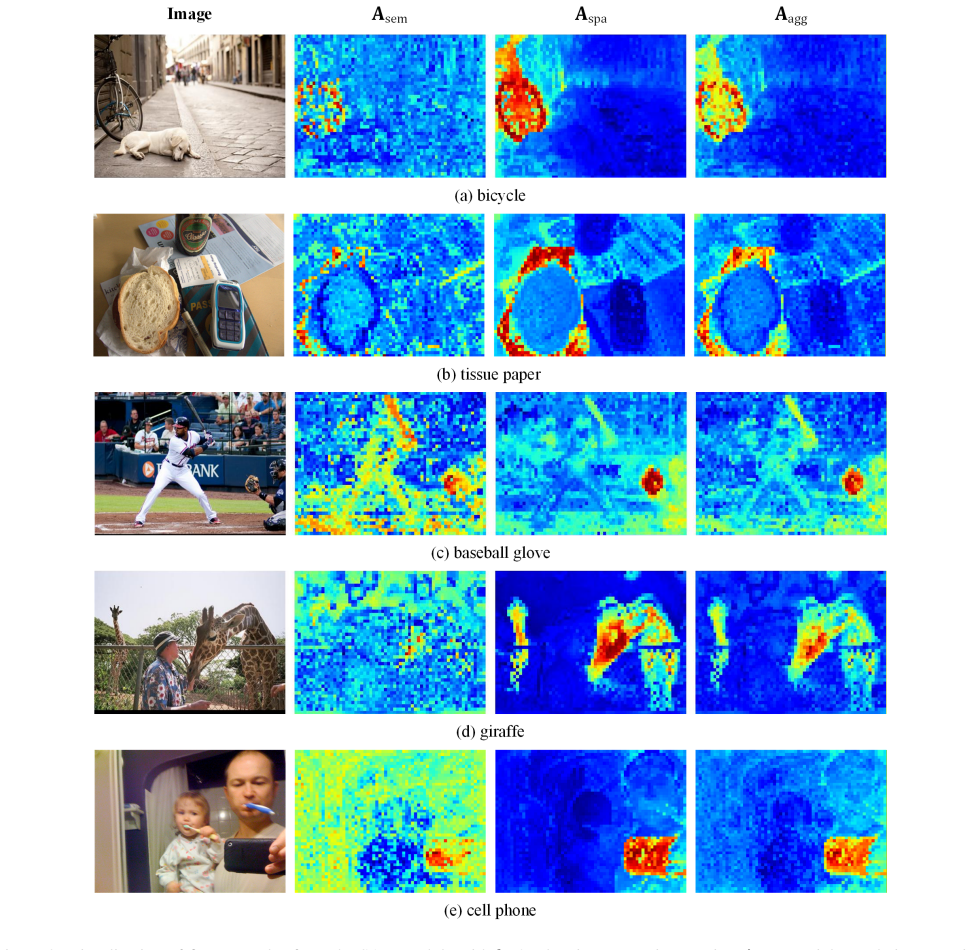
Semantic-consistent Spatial Attention alignment (SSA) plus Spatial Attention Refinement (SAR): SSA minimizes the L2 distance between attention maps of original labels and of synonym/definition expansions; SAR keeps only the top-k tokens of the enriched map, builds spatial-correlation maps from a frozen vision foundation model, and fuses them to produce a refined supervision target.
Load-bearing premise
The LLM-generated synonyms and definitions used as teacher targets are faithful enough, and visually equivalent enough, that forcing student attention to match them produces real synonym robustness rather than overfitting to those particular expansions.
What would settle it
Replace every evaluation label on OV-COCO with a fresh set of human-written synonyms never seen in SEViC; if the novel-class AP drop for SynCLIP becomes as large as the drops reported for CLIPSelf and DeCLIP, the claimed robustness fails.
If this is right
- Open-vocabulary detectors can be made substantially less sensitive to how a user phrases a category name.
- Pretraining objectives that explicitly regularize spatial attention across lexical variants become a practical design lever for CLIP-based dense perception.
- A synonym-enriched image-text corpus built from COCO/LVIS categories can serve as reusable supervision for other region-level vision-language models.
- Novel-class accuracy on OV-COCO and OV-LVIS rises without any increase in inference parameters or FLOPs.
Where Pith is reading between the lines
- The same SSA/SAR recipe could be applied to open-vocabulary video or 3-D perception where synonym variation is equally common.
- If the LLM expansions are the main source of the signal, cheaper synonym lists (thesaurus + definition lookup) might recover most of the gain without large language models.
- Attention-consistency losses of this form may also reduce brittleness when prompts contain adjectives, plurals, or multi-word descriptions rather than pure synonyms.
Editorial analysis
A structured set of objections, weighed in public.
Referee Report
Summary. The paper identifies synonym-induced grounding inconsistency in CLIP-based open-vocabulary dense perception (OVDP), where synonymous or definitional expressions produce inconsistent spatial attention maps and degrade localization (Figs. 1–2). It proposes SynCLIP, built on a DeCLIP-style dual-encoder setup, with two modules: Semantic-consistent Spatial Attention alignment (SSA) that minimizes the L2 discrepancy between student attention maps of original labels and teacher maps of synonym-enriched expressions (Eqs. 5–7), and Spatial Attention Refinement (SAR) that selects top-k tokens from the enriched maps, computes VFM (DINOv2) spatial correlations, and fuses them via weighted aggregation (Eqs. 8–11). A Synonym-Enriched Visual Corpus (SEViC) is constructed from COCO/LVIS images by LLM-augmenting 1,234 categories with synonyms and definitions. Downstream evaluation with F-ViT on OV-COCO and OV-LVIS reports improved novel-class metrics (43.6/49.8 AP_novel_50 on OV-COCO) and a smaller drop under synonym substitution (Table 3) relative to CLIPSelf and DeCLIP, supported by component and hyper-parameter ablations.
Significance. If the empirical claims hold, the work supplies a concrete, reproducible pretraining recipe that measurably reduces linguistic brittleness in region-level CLIP adaptations—an issue of practical importance for robotics and autonomous driving. The synonym-substitution protocol (Table 3), component ablations (Table 4), k-sweep (Fig. 6) and aggregation-weight study (Supp. Table 6) constitute a solid experimental package; the public code and SEViC construction pipeline further raise the contribution’s utility. The identification of the inconsistency phenomenon itself is a useful diagnostic for the OVDP community.
major comments (2)
- [Table 2b / §4.3.1] Table 2b (OV-LVIS, ViT-L/14): SynCLIP reports 37.2 mAP_mask_r, identical to the DeCLIP baseline. The abstract and §4.3.1 claim “state-of-the-art performance among CLIP-based OVDP methods”; the tie on the more challenging long-tailed benchmark should be stated explicitly rather than subsumed under a blanket SOTA assertion, and the text should clarify whether the gain is backbone-dependent.
- [§4.1.1 / Supp. §6] §4.1.1 and Supp. §6: SEViC relies on DeepSeek-generated synonyms/definitions filtered by ChatGPT. While the synonym-substitution evaluation (Table 3) is independent of the training expansions, the paper never quantifies residual semantic drift or visual non-equivalence after filtering. A small human-rated sample or an ablation that replaces LLM expansions with purely LVIS-provided synonyms would strengthen the claim that the observed robustness is not an artifact of the particular lexical set chosen by the LLMs.
minor comments (4)
- [§4.3] No error bars or multi-seed statistics are reported for any table. Even a single additional seed for the key OV-COCO numbers would help readers gauge stability of the 2–3-point gains.
- [§3.1] Eq. (4) re-uses the correlative self-attention of SCLIP without restating the temperature or projection details; a one-sentence reminder would aid readers who have not memorized the cited work.
- [Fig. 5] Figure 5 captions use “Top/Bottom” without panel labels; adding (a)/(b) markers would improve readability.
- [§4.2] The default semantic-alignment weight 0.05 and α=β=0.5 are stated but not justified beyond the later ablations; a short sentence linking them to the Supp. sweeps would tighten the narrative.
Circularity Check
No significant circularity: empirical pretraining method with independent held-out evaluation; losses and modules do not reduce reported metrics to their own inputs by construction.
full rationale
SynCLIP is an engineering paper that defines two training modules (SSA via L_semantic / L+_semantic MSE alignment of attention maps in Eqs. 5–7 and 11; SAR via top-k token selection + VFM spatial correlation aggregation in Eqs. 8–10) and a synonym-enriched corpus SEViC, then measures downstream AP / mAP and synonym-substitution robustness on the standard OV-COCO and OV-LVIS splits. The reported numbers (e.g., 43.6 / 49.8 AP_novel_50, Table-3 drop of –4.4) are ordinary empirical outcomes of training + evaluation; none of the equations algebraically force those metrics, nor is any free parameter fitted on the test quantities and then re-presented as a prediction. SEViC construction (LLM generation + consistency filter) is an input design choice, not a self-referential derivation of the claims. Citations to DeCLIP / CLIPSelf / DINOv2 are ordinary baselines and components; they are not load-bearing uniqueness theorems or self-citations that close a circular chain. Component ablations (Table 4, Supp. Tables 5–6, Fig. 6) further treat the modules as independent variables rather than tautologies. Consequently the derivation chain contains no self-definitional step, no fitted-input-as-prediction, and no uniqueness imported from the authors’ prior work. Score 0 is the correct, non-manufactured finding.
Axiom & Free-Parameter Ledger
free parameters (3)
- semantic alignment loss weight =
0.05
- attention aggregation coefficients α, β =
0.5 / 0.5
- number of semantic tokens k =
7
axioms (3)
- domain assumption CLIP’s correlative self-attention (Eq. 4) yields usable dense features after discarding the CLS token
- domain assumption DINOv2 spatial correlations are a reliable external teacher for refining attention maps
- ad hoc to paper LLM-generated synonyms and definitions (DeepSeek + ChatGPT filter) are visually equivalent to the original category names
invented entities (3)
-
Semantic-consistent Spatial Attention alignment (SSA) module
no independent evidence
-
Spatial Attention Refinement (SAR) module
no independent evidence
-
Synonym-Enriched Visual Corpus (SEViC)
no independent evidence
read the original abstract
Open-vocabulary dense perception (OVDP) aims to localize objects unseen during training by leveraging textual knowledge. Despite the remarkable progress of recent CLIP-based approaches, we identify a critical limitation: synonym-induced grounding inconsistency, where semantically equivalent expressions yield disparate spatial attention patterns. This inconsistency undermines the robustness and performance of existing methods in real-world OVDP applications. To address this issue, we propose SynCLIP, a Synonym-Coherent Language-Image Pretraining framework that enhances synonym-robust grounding for OVDP. SynCLIP introduces a Semantic-consistent Spatial Attention alignment (SSA) module to enhance spatial attention consistency by minimizing discrepancies between attention maps of original and synonymous expressions. Furthermore, a Spatial Attention Refinement (SAR) module selectively strengthens the most semantically relevant spatial regions within aligned maps for more precise and stable grounding. To support synonym-coherent pretraining, we also construct a Synonym-Enriched Visual Corpus (SEViC), which augments each category with multiple synonyms and textual definitions. Extensive experiments on multiple benchmarks demonstrate that SynCLIP substantially improves grounding consistency under diverse linguistic variants and achieves state-of-the-art performance among CLIP-based OVDP methods. Code is available at https://github.com/Justlovesmile/SynCLIP.
Figures



Reference graph
Works this paper leans on
-
[1]
GPT-4 technical report.arXiv preprint arXiv:2303.08774,
Josh Achiam, Steven Adler, Sandhini Agarwal, Lama Ah- mad, Ilge Akkaya, Florencia Leoni Aleman, Diogo Almeida, Janko Altenschmidt, Sam Altman, Shyamal Anadkat, et al. GPT-4 technical report.arXiv preprint arXiv:2303.08774,
-
[2]
CAT-Seg: Cost aggregation for open-vocabulary semantic segmenta- tion
Seokju Cho, Heeseong Shin, Sunghwan Hong, Anurag Arnab, Paul Hongsuck Seo, and Seungryong Kim. CAT-Seg: Cost aggregation for open-vocabulary semantic segmenta- tion. InCVPR, pages 4113–4123, 2024. 3
2024
-
[3]
An image is worth 16x16 words: Transformers for image recognition at scale
Alexey Dosovitskiy, Lucas Beyer, Alexander Kolesnikov, Dirk Weissenborn, Xiaohua Zhai, Thomas Unterthiner, Mostafa Dehghani, Matthias Minderer, Georg Heigold, Syl- vain Gelly, Jakob Uszkoreit, and Neil Houlsby. An image is worth 16x16 words: Transformers for image recognition at scale. InICLR, 2021. 3
2021
-
[4]
A hierarchical semantic distilla- tion framework for open-vocabulary object detection.IEEE TMM, 27:8835–8846, 2025
Shenghao Fu, Junkai Yan, Qize Yang, Xihan Wei, Xiaohua Xie, and Wei-Shi Zheng. A hierarchical semantic distilla- tion framework for open-vocabulary object detection.IEEE TMM, 27:8835–8846, 2025. 1
2025
-
[5]
Vision-language pre-training: Basics, re- cent advances, and future trends.Found
Zhe Gan, Linjie Li, Chunyuan Li, Lijuan Wang, Zicheng Liu, and Jianfeng Gao. Vision-language pre-training: Basics, re- cent advances, and future trends.Found. Trends Comput. Graph. Vis., 14:163–352, 2022. 3
2022
-
[6]
Open-vocabulary object detection via vision and language knowledge distillation
Xiuye Gu, Tsung-Yi Lin, Weicheng Kuo, and Yin Cui. Open-vocabulary object detection via vision and language knowledge distillation. InICLR, 2022. 3, 6, 7
2022
-
[7]
EARL: An elliptical distribution aided adaptive rotation label assignment for oriented object detec- tion in remote sensing images.IEEE Trans
Jian Guan, Mingjie Xie, Youtian Lin, Guangjun He, and Pengming Feng. EARL: An elliptical distribution aided adaptive rotation label assignment for oriented object detec- tion in remote sensing images.IEEE Trans. Geosci. Remote Sens., 61:1–15, 2023. 1
2023
-
[8]
LVIS: A dataset for large vocabulary instance segmentation
Agrim Gupta, Piotr Dollar, Ross Girshick, et al. LVIS: A dataset for large vocabulary instance segmentation. InCVPR, pages 5356–5364, 2019. 5, 6, 1
2019
-
[9]
Deep residual learning for image recognition
Kaiming He, Xiangyu Zhang, Shaoqing Ren, and Jian Sun. Deep residual learning for image recognition. InCVPR, pages 770–778, 2016. 3, 7
2016
-
[10]
Mask R-CNN
Kaiming He, Georgia Gkioxari, Piotr Doll ´ar, and Ross Gir- shick. Mask R-CNN. InCVPR, pages 2961–2969, 2017. 1
2017
-
[11]
Scaling up visual and vision-language representation learning with noisy text supervision
Chao Jia, Yinfei Yang, Ye Xia, Yi-Ting Chen, Zarana Parekh, Hieu Pham, Quoc Le, Yun-Hsuan Sung, Zhen Li, and Tom Duerig. Scaling up visual and vision-language representation learning with noisy text supervision. InICML, pages 4904–
-
[12]
Con- trastive feature masking open-vocabulary vision transformer
Dahun Kim, Anelia Angelova, Weicheng Kuo, et al. Con- trastive feature masking open-vocabulary vision transformer. InICCV, pages 15602–15612, 2023. 7
2023
-
[13]
Region- aware pretraining for open-vocabulary object detection with vision transformers
Dahun Kim, Anelia Angelova, Weicheng Kuo, et al. Region- aware pretraining for open-vocabulary object detection with vision transformers. InCVPR, pages 11144–11154, 2023. 7
2023
-
[14]
F-VLM: Open-vocabulary object detec- tion upon frozen vision and language models
Weicheng Kuo, Yin Cui, Xiuye Gu, AJ Piergiovanni, and Anelia Angelova. F-VLM: Open-vocabulary object detec- tion upon frozen vision and language models. InICLR, 2023. 7
2023
-
[15]
Band prompting aided SAR and multi-spectral data fusion framework for local climate zone classification
Haiyan Lan, Shujun Li, Mingjie Xie, Xuanjia Zhao, Hongn- ing Liu, Pengming Feng, Dongli Xu, Guangjun He, and Jian Guan. Band prompting aided SAR and multi-spectral data fusion framework for local climate zone classification. In ICASSP, pages 1–5, 2025. 3
2025
-
[16]
Grounded language-image pre-training
Liunian Harold Li, Pengchuan Zhang, Haotian Zhang, Jian- wei Yang, Chunyuan Li, Yiwu Zhong, Lijuan Wang, Lu Yuan, Lei Zhang, Jenq-Neng Hwang, et al. Grounded language-image pre-training. InCVPR, pages 10965–10975,
-
[17]
Scaling language-image pre-training via masking
Yanghao Li, Haoqi Fan, Ronghang Hu, Christoph Feichten- hofer, and Kaiming He. Scaling language-image pre-training via masking. InCVPR, pages 23390–23400, 2023. 1
2023
-
[18]
Open-vocabulary semantic segmentation with mask-adapted CLIP
Feng Liang, Bichen Wu, Xiaoliang Dai, Kunpeng Li, Yinan Zhao, Hang Zhang, Peizhao Zhang, Peter Vajda, and Diana Marculescu. Open-vocabulary semantic segmentation with mask-adapted CLIP. InCVPR, pages 7061–7070, 2023. 3
2023
-
[19]
Learning object-language alignments for open-vocabulary object de- tection
Chuang Lin, Peize Sun, Yi Jiang, Ping Luo, Lizhen Qu, Gho- lamreza Haffari, Zehuan Yuan, and Jianfei Cai. Learning object-language alignments for open-vocabulary object de- tection. InICLR, 2023. 3
2023
-
[20]
Microsoft COCO: Common objects in context
Tsung-Yi Lin, Michael Maire, Serge Belongie, James Hays, Pietro Perona, Deva Ramanan, Piotr Doll´ar, and C Lawrence Zitnick. Microsoft COCO: Common objects in context. In ECCV, pages 740–755. Springer, 2014. 2, 5, 6, 1
2014
-
[21]
Aixin Liu, Bei Feng, Bing Xue, Bingxuan Wang, Bochao Wu, Chengda Lu, Chenggang Zhao, Chengqi Deng, Chenyu Zhang, Chong Ruan, et al. DeepSeek-v3 technical report. arXiv preprint arXiv:2412.19437, 2024. 6, 1
Pith/arXiv arXiv 2024
-
[22]
Decoupled weight decay regularization
Ilya Loshchilov and Frank Hutter. Decoupled weight decay regularization. InICLR, 2019. 6
2019
-
[23]
DINOv2: Learning robust visual features without supervi- sion.Trans
Maxime Oquab, Timoth ´ee Darcet, Th ´eo Moutakanni, Huy V o, Marc Szafraniec, Vasil Khalidov, Pierre Fernandez, Daniel Haziza, Francisco Massa, Alaaeldin El-Nouby, et al. DINOv2: Learning robust visual features without supervi- sion.Trans. Mach. Learn. Res., 2024. 2, 5, 6
2024
-
[24]
Learn- ing transferable visual models from natural language super- vision
Alec Radford, Jong Wook Kim, Chris Hallacy, Aditya Ramesh, Gabriel Goh, Sandhini Agarwal, Girish Sastry, Amanda Askell, Pamela Mishkin, Jack Clark, et al. Learn- ing transferable visual models from natural language super- vision. InICML, pages 8748–8763. PMLR, 2021. 1, 2
2021
-
[25]
Hwanjun Song and Jihwan Bang. Prompt-guided transform- ers for end-to-end open-vocabulary object detection.arXiv preprint arXiv:2303.14386, 2023. 7
Pith/arXiv arXiv 2023
-
[26]
EV A-CLIP: Improved training techniques for CLIP at scale.arXiv preprint arXiv:2303.15389, 2023
Quan Sun, Yuxin Fang, Ledell Wu, Xinlong Wang, and Yue Cao. EV A-CLIP: Improved training techniques for CLIP at scale.arXiv preprint arXiv:2303.15389, 2023. 1, 2
Pith/arXiv arXiv 2023
-
[27]
EfficientNet: Rethinking model scaling for convolutional neural networks
Mingxing Tan and Quoc Le. EfficientNet: Rethinking model scaling for convolutional neural networks. InICML, pages 6105–6114. PMLR, 2019. 7
2019
-
[28]
SCLIP: Rethinking self-attention for dense vision-language inference
Feng Wang, Jieru Mei, and Alan Yuille. SCLIP: Rethinking self-attention for dense vision-language inference. InECCV, pages 315–332. Springer, 2024. 3
2024
-
[29]
OV-DQUO: Open-vocabulary detr with denoising text query training and open-world un- known objects supervision
Junjie Wang, Bin Chen, Bin Kang, Yulin Li, Weizhi Xian, Yichi Chen, and Yong Xu. OV-DQUO: Open-vocabulary detr with denoising text query training and open-world un- known objects supervision. InAAAI, pages 7762–7770,
-
[30]
DeCLIP: Decoupled learning for open- vocabulary dense perception
Junjie Wang, Bin Chen, Yulin Li, Bin Kang, Yichi Chen, and Zhuotao Tian. DeCLIP: Decoupled learning for open- vocabulary dense perception. InCVPR, pages 14824–14834,
-
[31]
Towards open vocabulary learning: A survey.IEEE TPAMI, 46(7):5092–5113, 2024
Jianzong Wu, Xiangtai Li, Shilin Xu, Haobo Yuan, Henghui Ding, Yibo Yang, Xia Li, Jiangning Zhang, Yunhai Tong, Xudong Jiang, et al. Towards open vocabulary learning: A survey.IEEE TPAMI, 46(7):5092–5113, 2024. 1
2024
-
[32]
Aligning bag of regions for open- vocabulary object detection
Size Wu, Wenwei Zhang, Sheng Jin, Wentao Liu, and Chen Change Loy. Aligning bag of regions for open- vocabulary object detection. InCVPR, pages 15254–15264,
-
[33]
CLIPSelf: Vision trans- former distills itself for open-vocabulary dense prediction
Size Wu, Wenwei Zhang, Lumin Xu, Sheng Jin, Xiangtai Li, Wentao Liu, and Chen Change Loy. CLIPSelf: Vision trans- former distills itself for open-vocabulary dense prediction. In ICLR, 2024. 1, 2, 3, 6, 7
2024
-
[34]
CLIM: Contrastive language-image mosaic for region representation
Size Wu, Wenwei Zhang, Lumin Xu, Sheng Jin, Wentao Liu, and Chen Change Loy. CLIM: Contrastive language-image mosaic for region representation. InAAAI, pages 6117–6125,
-
[35]
CORA: Adapting CLIP for open-vocabulary detection with region prompting and anchor pre-matching
Xiaoshi Wu, Feng Zhu, Rui Zhao, and Hongsheng Li. CORA: Adapting CLIP for open-vocabulary detection with region prompting and anchor pre-matching. InCVPR, pages 7031–7040, 2023. 1, 7
2023
-
[36]
A simple baseline for open- vocabulary semantic segmentation with pre-trained vision- language model
Mengde Xu, Zheng Zhang, Fangyun Wei, Yutong Lin, Yue Cao, Han Hu, and Xiang Bai. A simple baseline for open- vocabulary semantic segmentation with pre-trained vision- language model. InECCV, pages 736–753. Springer, 2022. 3
2022
-
[37]
Side adapter network for open-vocabulary semantic segmentation
Mengde Xu, Zheng Zhang, Fangyun Wei, Han Hu, and Xi- ang Bai. Side adapter network for open-vocabulary semantic segmentation. InCVPR, pages 2945–2954, 2023. 3
2023
-
[38]
ResCLIP: Residual attention for training-free dense vision- language inference
Yuhang Yang, Jinhong Deng, Wen Li, and Lixin Duan. ResCLIP: Residual attention for training-free dense vision- language inference. InCVPR, pages 29968–29978, 2025. 1
2025
-
[39]
Open-vocabulary SAM: Segment and recognize twenty-thousand classes interactively
Haobo Yuan, Xiangtai Li, Chong Zhou, Yining Li, Kai Chen, and Chen Change Loy. Open-vocabulary SAM: Segment and recognize twenty-thousand classes interactively. InECCV, pages 419–437. Springer, 2024. 7
2024
-
[40]
Florence: A new foundation model for computer vision.arXiv preprint arXiv:2111.11432, 2021
Lu Yuan, Dongdong Chen, Yi-Ling Chen, Noel Codella, Xiyang Dai, Jianfeng Gao, Houdong Hu, Xuedong Huang, Boxin Li, Chunyuan Li, et al. Florence: A new foundation model for computer vision.arXiv preprint arXiv:2111.11432, 2021. 2
Pith/arXiv arXiv 2021
-
[41]
Open-vocabulary detr with conditional matching
Yuhang Zang, Wei Li, Kaiyang Zhou, Chen Huang, and Chen Change Loy. Open-vocabulary detr with conditional matching. InECCV, pages 106–122. Springer, 2022. 7
2022
-
[42]
GaussianGrasper: 3d lan- guage gaussian splatting for open-vocabulary robotic grasp- ing.IEEE Robot
Yuhang Zheng, Xiangyu Chen, Yupeng Zheng, Songen Gu, Runyi Yang, Bu Jin, Pengfei Li, Chengliang Zhong, Zeng- mao Wang, Lina Liu, et al. GaussianGrasper: 3d lan- guage gaussian splatting for open-vocabulary robotic grasp- ing.IEEE Robot. Autom. Lett., 9(9):7827–7834, 2024. 1
2024
-
[43]
RegionCLIP: Region-based language-image pretraining
Yiwu Zhong, Jianwei Yang, Pengchuan Zhang, Chunyuan Li, Noel Codella, Liunian Harold Li, Luowei Zhou, Xiyang Dai, Lu Yuan, Yin Li, et al. RegionCLIP: Region-based language-image pretraining. InCVPR, pages 16793–16803,
-
[44]
Extract free dense labels from CLIP
Chong Zhou, Chen Change Loy, and Bo Dai. Extract free dense labels from CLIP. InECCV, pages 696–712. Springer,
-
[45]
ALGPT: Multi-agent cooperative framework for open- vocabulary multi-modal auto-annotating in autonomous driving.IEEE Trans
Yijie Zhou, Xianhui Cheng, Qiming Zhang, Lei Wang, Wenchao Ding, Xiangyang Xue, Chunbo Luo, and Jian Pu. ALGPT: Multi-agent cooperative framework for open- vocabulary multi-modal auto-annotating in autonomous driving.IEEE Trans. Intell. Veh., pages 1–15, 2024. 1
2024
-
[46]
A survey on open- vocabulary detection and segmentation: Past, present, and future.IEEE TPAMI, 46(12):8954–8975, 2024
Chaoyang Zhu and Long Chen. A survey on open- vocabulary detection and segmentation: Past, present, and future.IEEE TPAMI, 46(12):8954–8975, 2024. 1, 2 SynCLIP: Synonym-Coherent Language-Image Pretraining for Robust Open-Vocabulary Dense Perception Supplementary Material Overview This supplementary material provides additional details and results that com...
2024
-
[47]
Details of SEViC Construction This section provides a detailed description of the con- struction pipeline of our synonym-enriched visual corpus (SEViC), complementing the overview in the main paper. As illustrated in Figure 7, the pipeline consists of three major stages,i.e., Data Collection, which gathers the full category vocabulary and initial textual ...
-
[48]
ob- ject
and LVIS [8], which share the same image set but differ in granularity and coverage. This provides a unified vocabu- lary of 1,232 unique object category names and 118,287 im- ages. When available, we also extract their accompanying LVIS-provided definitions and synonyms. These human- curated textual descriptions serve as the initial reference for later L...
-
[49]
These studies further validate the design choices introduced in the main paper and clarify how each component contributes to robust synonym-coherent dense perception
Additional Ablation Studies This section provides additional analyses on two key com- ponents of SynCLIP,i.e., the types of semantically enriched textual variants used in SSA for semantic–consistent atten- tion alignment, and the aggregation weights in SAR that balance semantic relevance and spatial precision. These studies further validate the design cho...
-
[50]
Additional Qualitative Analysis This section presents additional qualitative analyses, includ- ing visualizations of attention maps from the SAR mod- ule and prediction results on two standard dense perception benchmarks, offering a more comprehensive illustration of the effectiveness and superiority of our method. α β APnovel 50 APbase 50 APall 50 0.9 0....
-
[51]
All measurements are conducted under the same hardware setup using four NVIDIA A100 GPUs with 40GB memory and an input resolution of 560
Efficiency Analysis To provide a comprehensive view of the computational characteristics of SynCLIP, we report the training time, model parameters, FLOPs and APnovel 50 on OV-COCO in Ta- ble 7. All measurements are conducted under the same hardware setup using four NVIDIA A100 GPUs with 40GB memory and an input resolution of 560. Compared with Method Back...
discussion (0)
Sign in with ORCID, Apple, or X to comment. Anyone can read and Pith papers without signing in.