REVIEW 2 major objections 6 minor 34 references
How many ways a GaN surface can be tiled predicts which adatom arrangement is most stable.
Reviewed by Pith at T0; open to challenge. T0 means a machine referee read the full paper against a public rubric. the ladder, T0–T4 →
T0 review · grok-4.5
2026-07-14 07:01 UTC pith:LQ57NF3W
load-bearing objection Exhaustive EC catalog plus a geometry-only multiplicity that actually ranks stability within Ga classes; the rhombus-block restriction is real but already scoped by the authors. the 2 major comments →
Tiling decomposition multiplicity predicts stability of GaN(0001) surface reconstructions
The pith
A machine-rendered reading of the paper's core claim, the machinery that carries it, and where it could break.
Core claim
Within each of the 14 symmetry classes of Ga adatom placements on the GaN(0001)-(6 imes6) surface at fixed electron-counting stoichiometry (3 Ga adatoms and 18 H atoms), the configuration that maximizes the number of compatible rhombus tilings, n_til, is the most stable. The rule is strict in 13 classes; in the remaining class the n_til-max configuration lies only 8.5 meV (MLIP) / 17.5 meV (DFT) above the true minimum. Exhaustive enumeration of all 416,683 EC-compatible configurations makes the claim free of sampling incompleteness and reduces the first-principles candidate set to 24 structures.
What carries the argument
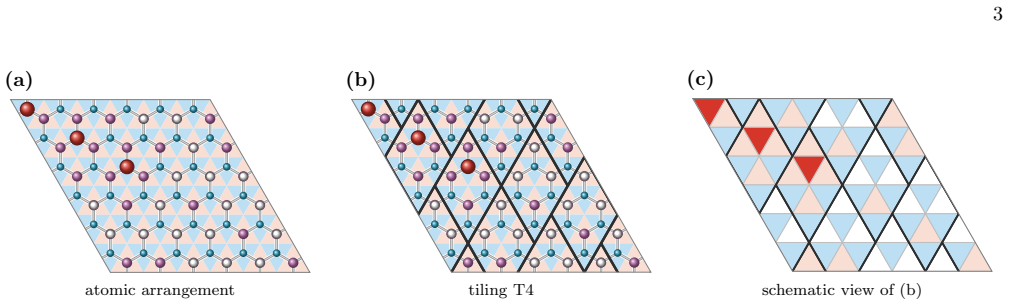
Tiling decomposition multiplicity n_til: the number of distinct rhombus tilings of the (6 imes6) torus that are compatible with a given adatom configuration under the local electron-counting rule. It is an enumerative invariant computed solely from geometry and the 456 tilings; higher n_til within a Ga-placement class predicts lower energy.
Load-bearing premise
The count of tilings is defined only for one fixed rhombus block shape taken from the two standard (2 imes2) reconstructions; if other electron-counting local units matter for stability, the ranking and the shortlist can change.
What would settle it
On a larger cell such as (12 imes12), or at another electron-counting stoichiometry, enumerate (or fully sample) the EC-compatible space, group by Ga-placement class, and check whether the configuration that maximizes n_til under the same rhombus model is still the lowest-energy member of each class; a clear, reproducible inversion outside the single documented 8.5 meV exception would falsify the rule.
Editorial analysis
A structured set of objections, weighed in public.
Referee Report
Summary. The manuscript recasts the search for stable GaN(0001)-(6×6) adatom reconstructions under the electron-counting (EC) rule at fixed stoichiometry (3 Ga adatoms, 18 H) as an exhaustive discrete tiling problem. All 456 rhombus tilings of the torus are enumerated and reduced to 8 symmetry classes; EC-compatible colorings on those tilings, after full G′ reduction, yield a catalog of 416,683 configurations in 14 Ga placement classes. The authors define the tiling decomposition multiplicity n_til of a configuration and report an intra-class rule: the configuration maximizing n_til is the most stable. The rule holds strictly in 13 of 14 classes; in Class 2 the n_til-max structure lies 8.5 meV (MLIP) / 17.5 meV (DFT) above the true minimum, a gap negligible at growth temperature. Screening uses a UMA MLIP validated against 685 fixed-placement DFT structures and 25 cross-class DFT structures; the rule reduces the first-principles candidate set from 416,683 to 24 configurations, all DFT-evaluated. A local frustration count n_adj (adjacent bare-site pairs) is identified as the principal energy-carrying mechanism, with tileability itself carrying an additional ~100 meV cost near the minima.
Significance. If the result holds within its stated model, the work is a genuine methodological advance for surface reconstruction prediction: it replaces DFT-steered sampling with a coverage-guaranteed combinatorial catalog and defers first-principles input to a final ranking of 24 candidates. Strengths that should be credited explicitly include (i) exact enumeration with Burnside consistency checks and an openly released catalog of 416,683 configurations with identifiers, coordinates, and n_til; (ii) dual independent DFT validation (RS-DFT fixed-placement set and SIESTA cross-class set) that preserves within-class orderings; (iii) honest treatment of the single Class-2 exception with DFT confirmation; and (iv) a clear local mechanism (n_adj) that largely mediates the n_til–energy correlation. The structural parallel to Kekulé counts is interpretive rather than essential, but the reduction from hundreds of thousands of candidates to a DFT-tractable shortlist is of practical value for III-nitride growth modeling.
major comments (2)
- [Sec. II B; Abstract; Sec. V] Sec. II B and the abstract/conclusions: the phrases “complete catalog,” “every EC-compatible configuration,” and “coverage guarantee” are accurate only inside the modeling choice that EC decompositions are restricted to nine non-overlapping 4+4 rhombi of the three orientations that encode Ga-adatom (2×2) and 3Ga-H (2×2) units. The manuscript states this restriction explicitly (“other EC-satisfying local units are not considered”), yet the central practical claim—that the shortlist of 24 is exhaustive for first-principles evaluation—depends on it. Configurations that are stable via other local EC motifs would be labeled n_til = 0 or fall outside the 14 classes and would never enter the shortlist. The higher energies of the 88 untileable n_adj = 0 arrangements (Sec. III F) mitigate but do not close this gap, because those checks still use the same rhombus definition of tileability. The aut
- [Sec. III D; Table III; Sec. III C] Sec. III D and Table III: in seven of the 13 rule-conforming classes the margin of the n_til-max configuration over the next competitor is 16–48 meV, comparable to the calibrated low-energy MLIP MAE (~16–27 meV after scale correction; Sec. III C). The manuscript correctly notes that identity of those class minima therefore rests on the DFT evaluation of the 24 candidates. That evaluation is reported only as “in 13 of 14 classes the lowest DFT energy computed for the class is attained by an n_til-max candidate.” For the seven tight-margin classes, the paper should state explicitly the DFT energy gaps to the nearest non-max competitors that were relaxed (or acknowledge that only n_til-max candidates were DFT-evaluated in those classes). Without that, the load-bearing claim that DFT confirms the rule in those classes is under-specified.
minor comments (6)
- [Fig. 10] Fig. 10: the light-gray abundance bars are log-scaled and panel-normalized and “do not refer to the energy axis,” but this is easy to misread against the dense scatter. A brief axis annotation or a separate abundance panel would help.
- [Sec. II A, Eq. (1)] Eq. (1) and the stoichiometry line: it would help readers outside the GaN community to state once, near Eq. (1), that bare-face count is fixed at 9 for every EC composition, since n_adj is defined on those bare sites.
- [Sec. III E] Sec. III E: the three geometric descriptors fail globally; the text already says so. Consider moving the failed I_iso / V_HH / d_GaH correlations to a short SI table so the main text can go directly from n_til to n_adj.
- [Sec. IV B] Sec. IV B: the ln n_til vs energy slope (−195 meV per e-fold) is interesting but secondary; the Kekulé analogy is already clear without the functional-form comparison, which is only marginally stronger (r = −0.60 vs −0.54).
- [Data availability] Data availability: the GitHub URL is given; please also deposit a frozen snapshot (Zenodo or similar) with a DOI so the 416,683-entry catalog remains citable if the repository moves.
- [Abstract; Sec. III D–F] Typographical: “itstiling” in the abstract (missing space); “then til-max” / “then adj” spacing inconsistencies appear in several places in the compiled text (e.g., near Table III and Sec. III F).
Circularity Check
No circularity: n_til is a pure combinatorial count independent of energy; the n_til-max rule is an observed correlation against independent MLIP/DFT rankings.
full rationale
The derivation chain is self-contained and non-circular. n_til is defined combinatorially (Eq. 2) solely by testing each of the 416,683 EC-compatible (G,H) configurations against the fixed set of 456 rhombus tilings of the adatom-free lattice; the count uses no energy model, no fitted parameters, and no DFT/MLIP input. Energies used to rank configurations and to verify the rule are obtained independently: UMA MLIP relaxations (validated on 710 DFT structures from two codes, RS-DFT and SIESTA) plus direct DFT on the 24 n_til-max candidates and the Class-2 exception. The n_til-max rule is an empirical intra-class observation (holds strictly in 13/14 classes; 8.5 meV MLIP / 17.5 meV DFT gap in the remaining class), not a quantity forced by normalization, by construction of the catalog, or by any self-cited uniqueness theorem. Prior self-citations ([6,7]) supply the Bayesian-optimization sampling database used only for MLIP validation and the Ising-model comparison; they are not load-bearing for the enumeration, the definition of n_til, or the ranking rule itself. The explicit modeling restriction to a single rhombus block shape (Sec. II B) is a stated scope limitation, not a circular step that equates the prediction to its inputs. Cell-averaged geometric descriptors and the later n_adj count are checked against the same independent energies and do not redefine n_til. No fitted-input-called-prediction, self-definitional loop, or ansatz smuggled via citation appears in the load-bearing chain.
Axiom & Free-Parameter Ledger
free parameters (2)
- UMA MLIP relative-energy scale factor (~1.17–1.18 vs DFT)
- Stratified-sample composite score weights (n_til + I_iso + V_HH + d_GaH)
axioms (5)
- domain assumption The electron-counting rule (global balance 3 n_Ga + n_H = 27 on the 36-face cell) is the correct stoichiometric constraint for stable MOVPE GaN(0001) reconstructions.
- ad hoc to paper EC decompositions may be restricted to nine non-overlapping rhombus blocks of the three orientations that encode the Ga-adatom (2×2) and 3Ga-H (2×2) local units.
- domain assumption The sublattice-preserving symmetry group G′ = T ⋊ D3 (|G′|=216) is the correct equivalence for physically distinct configurations.
- domain assumption The UMA MLIP preserves within-class energy orderings of low-energy EC-compatible configurations sufficiently for screening.
- standard math Standard group-action orbit counting (Burnside) and exact-cover SAT enumeration correctly generate the tiling and configuration catalogs.
invented entities (2)
-
tiling decomposition multiplicity n_til
independent evidence
-
local frustration count n_adj
independent evidence
read the original abstract
The stable adatom configurations of a semiconductor surface have traditionally been sought by sampling: density functional theory (DFT) energies steer a heuristic or Bayesian search through a configuration space far too large to cover. Here we show that, for the GaN(0001)-$(6\times6)$ surface under the electron counting (EC) rule, the search can instead be posed as a discrete tiling problem and solved exhaustively. Enumerating all rhombus tilings of the surface lattice, together with all EC-compatible adatom arrangements built on them, yields the complete catalog of 416,683 configurations at fixed stoichiometry (3 Ga adatoms and 18 H atoms), organized by symmetry into 14 Ga placement classes. The number of tilings compatible with a given configuration, its tiling decomposition multiplicity $n_\mathrm{til}$, predicts stability. Within each class, the configuration maximizing $n_\mathrm{til}$ is the most stable. The rule holds strictly in 13 of the 14 classes; in the remaining class the minimum is itself among the highest-multiplicity configurations, with the $n_\mathrm{til}$-max configuration only 8.5 meV above it; this ordering is reproduced by independent DFT calculations, and the difference is negligible at growth temperature. Stability screening uses a machine-learning interatomic potential validated against 710 DFT-computed structures. The rule reduces the candidate set for first-principles evaluation from 416,683 to 24 configurations, all of which have been evaluated with DFT. Analysis of the rule identifies the local mechanism, the avoidance of adjacent bare surface sites, while the existence of a compatible tiling remains a separate requirement with an energy cost of its own. Enumeration thus provides what sampling cannot: a coverage guarantee, and a route to stable-structure prediction in which first-principles input enters only at the final ranking step.
Figures


Reference graph
Works this paper leans on
-
[1]
Zywietz, J
T. Zywietz, J. Neugebauer, and M. Scheffler, Appl. Phys. Lett.73, 487 (1998)
1998
-
[2]
C. G. Van de Walle and J. Neugebauer, J. Vac. Sci. Tech- nol. B20, 1640 (2002)
2002
-
[3]
Neugebauer, T
J. Neugebauer, T. K. Zywietz, M. Scheffler, J. E. Northrup, H. Chen, and R. M. Feenstra, Phys. Rev. Lett. 90, 056101 (2003)
2003
-
[4]
Akiyama and T
T. Akiyama and T. Kawamura, Cryst. Growth Des.24, 5906 (2024)
2024
-
[5]
Kangawa, A
Y. Kangawa, A. Kusaba, T. Kawamura, P. Kempisty, K. Ishisone, and M. Boero, Cryst. Growth Des.25, 740 (2025)
2025
-
[6]
Kusaba, Y
A. Kusaba, Y. Kangawa, T. Kuboyama, and A. Os- hiyama, Appl. Phys. Lett.120, 021602 (2022)
2022
-
[7]
Kawka, P
K. Kawka, P. Kempisty, K. Sakowski, S. Krukowski, M. Bo´ ckowski, D. Bowler, and A. Kusaba, J. Appl. Phys. 135, 225302 (2024)
2024
-
[8]
M. D. Pashley, Phys. Rev. B40, 10481 (1989)
1989
-
[9]
Zhang, E
L. Zhang, E. G. Wang, Q. K. Xue, S. B. Zhang, and Z. Zhang, Phys. Rev. Lett.97, 126103 (2006)
2006
-
[10]
Kangawa, T
Y. Kangawa, T. Akiyama, T. Ito, K. Shiraishi, and T. Nakayama, Materials6, 3309 (2013)
2013
-
[11]
Kusaba, Y
A. Kusaba, Y. Kangawa, P. Kempisty, H. Valencia, K. Shiraishi, Y. Kumagai, K. Kakimoto, and A. Koukitu, Jpn. J. Appl. Phys.56, 070304 (2017)
2017
-
[12]
W. C. Herndon, J. Am. Chem. Soc.95, 2404 (1973)
1973
-
[13]
Swinborne-Sheldrake, W
R. Swinborne-Sheldrake, W. C. Herndon, and I. Gutman, Tetrahedron Lett.16, 755 (1975)
1975
-
[14]
Randi´ c, Chem
M. Randi´ c, Chem. Rev.103, 3449 (2003)
2003
-
[15]
Mora-Fonz, T
D. Mora-Fonz, T. Lazauskas, M. R. Farrow, C. R. A. Catlow, S. M. Woodley, and A. A. Sokol, Chem. Mater. 29, 5306 (2017)
2017
-
[16]
G. L. W. Hart and R. W. Forcade, Phys. Rev. B77, 224115 (2008)
2008
-
[17]
A. R. Smith, R. M. Feenstra, D. W. Greve, J. Neuge- bauer, and J. E. Northrup, Phys. Rev. Lett.79, 3934 (1997)
1997
-
[18]
Rapcewicz, M
K. Rapcewicz, M. Buongiorno Nardelli, and J. Bernholc, Phys. Rev. B56, R12725 (1997)
1997
-
[19]
Fritsch, O
J. Fritsch, O. F. Sankey, K. E. Schmidt, and J. B. Page, Phys. Rev. B57, 15360 (1998)
1998
-
[20]
Audemard and L
G. Audemard and L. Simon, inProceedings of the 21st International Joint Conference on Artificial Intelligence (IJCAI-09)(2009) pp. 399–404
2009
-
[21]
Kuboyama and A
T. Kuboyama and A. Kusaba, J. Cryst. Growth650, 127927 (2025)
2025
-
[22]
Hjorth Larsenet al., J
A. Hjorth Larsenet al., J. Phys.: Condens. Matter29, 273002 (2017)
2017
-
[23]
B. M. Wood, M. Shuaibi,et al., UMA: A family of univer- sal models for atoms (2025), arXiv:2506.23971 [cs.LG]
arXiv 2025
-
[24]
Iwata, D
J.-I. Iwata, D. Takahashi, A. Oshiyama, T. Boku, K. Shi- raishi, S. Okada, and K. Yabana, J. Comput. Phys.229, 2339 (2010)
2010
-
[25]
J. M. Soler, E. Artacho, J. D. Gale, A. Garc´ ıa, J. Jun- quera, P. Ordej´ on, and D. S´ anchez-Portal, J. Phys.: Con- dens. Matter14, 2745 (2002)
2002
-
[26]
J. P. Perdew, K. Burke, and M. Ernzerhof, Phys. Rev. Lett.77, 3865 (1996)
1996
-
[27]
L. S. Pedroza, A. J. R. da Silva, and K. Capelle, Phys. Rev. B79, 201106 (2009)
2009
-
[28]
M. M. Odashima, K. Capelle, and S. B. Trickey, J. Chem. Theory Comput.5, 798 (2009)
2009
-
[29]
Duzik, J
A. Duzik, J. C. Thomas, A. Van der Ven, and J. M. Millunchick, Phys. Rev. B87, 035313 (2013)
2013
-
[30]
Kusaba, PyAPX: Python toolkit for atomic configu- ration pattern exploration,https://github.com/a-ksb/ PyAPX(2025)
A. Kusaba, PyAPX: Python toolkit for atomic configu- ration pattern exploration,https://github.com/a-ksb/ PyAPX(2025)
2025
-
[31]
Kawahara, T
J. Kawahara, T. Inoue, H. Iwashita, and S. Minato, IE- ICE Trans. FundamentalsE100.A, 1773 (2017)
2017
-
[32]
B. D. McKay, J. Algorithms26, 306 (1998)
1998
-
[33]
A. R. Smith, R. M. Feenstra, D. W. Greve, M.-S. Shin, M. Skowronski, J. Neugebauer, and J. E. Northrup, J. Vac. Sci. Technol. B16, 2242 (1998)
1998
-
[34]
V. M. Bermudez, Surf. Sci. Rep.72, 147 (2017)
2017
discussion (0)
Sign in with ORCID, Apple, or X to comment. Anyone can read and Pith papers without signing in.