REVIEW 2 major objections 5 minor 49 references
A hypernetwork can restore a fine-tuned LLM's safety from activation fingerprints alone, without touching its weights.
Reviewed by Pith at T0; open to challenge. T0 means a machine referee read the full paper against a public rubric. the ladder, T0–T4 →
T0 review · grok-4.5
2026-07-14 05:20 UTC pith:MQ2BJARD
load-bearing objection Solid systems paper: activation-conditioned hypernetwork generates a model-specific safety side net that restores refusal on held-out fine-tunes without touching weights; the domain-holdout evidence is strong, the truly-arbitrary-recipe claim is not fully tested. the 2 major comments →
HyperSafe: Inference-Time Safety Recovery for Fine-Tuned Language Models
The pith
A machine-rendered reading of the paper's core claim, the machinery that carries it, and where it could break.
Core claim
For any fine-tuned checkpoint of a given backbone, a hypernetwork trained on other domains can map that checkpoint's layer-wise activation fingerprint into a model-specific Safe Side Network that restores near-baseline refusal behavior at inference time while leaving the deployed weights and task performance essentially intact.
What carries the argument
Activation-conditioned hypernetwork: layer-wise mean activations from ~50 calibration prompts are split into direction and magnitude, fused into a global embedding, and fed to factorized generators that emit the weights of a ladder-side Safe Side Network that scores prompts and routes only the harmful ones to refusal.
Load-bearing premise
A small set of domain-specific calibration prompts produces an activation fingerprint rich enough that a hypernetwork trained on other domains can generate a safety classifier that works for unseen fine-tuning recipes and for harmful prompts never seen in training.
What would settle it
On a held-out fine-tuned checkpoint whose domain was never seen by the hypernetwork, measure whether the generated Safe Side Network still drives harmful rates on AdvBench or HEx-PHI above a few percent while task accuracy stays near the fine-tuned baseline; failure of either metric would falsify the claim.
Editorial analysis
A structured set of objections, weighed in public.
Referee Report
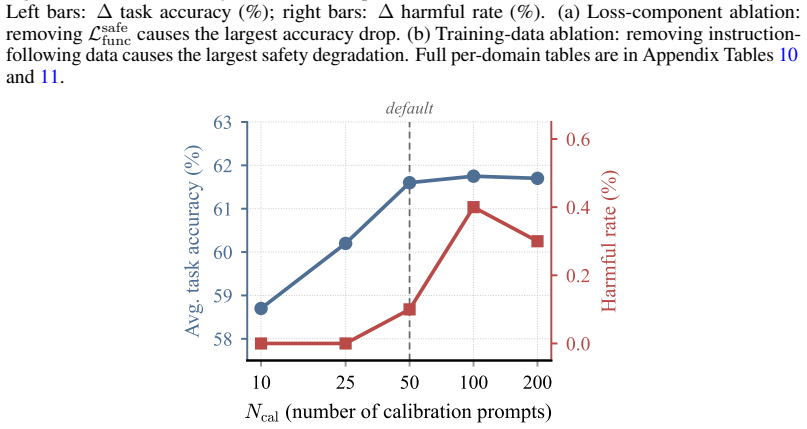
Summary. HyperSafe proposes a post-hoc, model-specific, non-invasive recovery of safety for fine-tuned LLMs. Given a fine-tuned checkpoint Md, it extracts layer-wise mean last-token activation fingerprints A(Md) from a small set of domain calibration prompts (Eqs. 3–4), then uses a hypernetwork G to generate the weights θ of a lightweight Safe Side Network (SSN) in one forward pass (Eqs. 1, 8). The SSN is a ladder side-transformer that scores prompts and routes harmful ones to refusal while leaving safe prompts to the frozen fine-tuned model. The hypernetwork is supervised by ground-truth SSNs trained per domain on domain data plus BeaverTails, using reconstruction, classification, and functional losses. On Qwen2-7B and LLaMA-3-8B, across three domain-holdout splits (18 train / 4 held-out domains each), HyperSafe reduces harmful rates from 19–31% (fine-tuned averages) to below 1% on BeaverTails, AdvBench, and HEx-PHI for every held-out checkpoint, while keeping task accuracy within ~1% of the fine-tuned baseline. Ablations cover loss components, training-domain diversity, Ncal, architecture capacity, and transfer of a LoRA-generated SSN to full fine-tuning counterparts.
Significance. If the central claim holds under the stated protocol, the paper offers a practically useful third path between weight-editing defenses and model-agnostic guards: checkpoint-specific safety recovery without gradients, safety data at deploy time, or weight modification. Strengths include a clear problem formulation, a reproducible multi-split holdout design on two 7–8B families, fully zero-shot evaluation on AdvBench and HEx-PHI, systematic ablations (Figs. 3–4, Tables 10–12), transfer evidence from LoRA to full FT (Table 4), and public code. The combination of activation-conditioned hypernetworks with ladder side networks for safety is a concrete systems contribution. The result is significant for practitioners who receive already-fine-tuned checkpoints and cannot re-run alignment, provided the fingerprint premise generalizes beyond the paper’s domain-holdout and fixed-recipe setting.
major comments (2)
- [§4, Tables 2 and 4; Eqs. 3–4, 1, 8] The strongest claim (harmful rates 19–31% → <1% on every held-out checkpoint, task accuracy within ~1%, no weight edits) is demonstrated only under domain holdouts with a fixed LoRA recipe (rank 16, α=32, 3 epochs) on the same backbone family (§4, Table 7, Table 2). Table 4 reuses an SSN generated from a LoRA fingerprint on a full-FT counterpart of the same domain; it does not test a new PEFT recipe, optimizer, data mixture, or safety-degradation pattern outside the 22-domain support. The load-bearing premise is that A(Md) from Ncal=50 domain calibration prompts (Eqs. 3–4) encodes recipe-specific safety failure modes rather than mainly domain identity (§3.1–3.3). Without at least one experiment on a genuinely novel fine-tuning recipe or out-of-support degradation pattern, the post-hoc generality advertised in the introduction and Table 1 remains incompletely supported. A limited addition
- [§3.4, §4.1, Table 2] Ground-truth SSN supervision mixes per-domain safe data with BeaverTails harmful data (§3.4); BeaverTails is also one of the three evaluation benchmarks (disjoint split). AdvBench and HEx-PHI are zero-shot and show near-zero harmful rates, which is strong, but the paper should more explicitly quantify how much of the BeaverTails recovery is attributable to the shared harmful-data distribution versus the activation-conditioned generation. A short analysis (e.g., SSN trained without BeaverTails, or hypernetwork trained with a different harmful source) would clarify that the method is not primarily transferring a BeaverTails-specific classifier.
minor comments (5)
- [Table 1, Table 3, §4] Table 1 lists Llama Guard 4 as model-agnostic and standalone; the quantitative comparison in Table 3 is useful but should note that Guard is a separate 12B model with its own full forward pass, while HyperSafe adds 3–4% parameters and bypasses on safe prompts—so cost comparison is not only accuracy.
- [§3.2] The selective routing description (§3.2) states that safe prompts bypass the SSN during decoding; it would help to state explicitly whether the SSN still requires a full backbone forward pass to obtain ladder activations for scoring, or whether early-exit / partial-layer scoring is used.
- [Eq. (2), Table 5] Notation for the gate μk = σ(gk/τ) and the mapping ϕ(k) is clear in Eq. (2), but the temperature τ is only mentioned as a fixed hyperparameter; give its value in Table 5 or the text.
- [Figure 1, §3.4] Figure 1 stages are helpful; a one-sentence note on whether the hypernetwork is backbone-family-specific (separate G for Qwen2 vs LLaMA-3) would avoid ambiguity for multi-family deployment.
- [Abstract, §4] Minor presentation: abstract and intro use both “post hoc” and “post-hoc”; pick one. Also ensure AdvBench/HEx-PHI “never seen in any training phase” is stated once in the main evaluation protocol without relying only on the appendix.
Circularity Check
No significant circularity: HyperSafe is an empirical hypernetwork method with supervised SSN targets, domain holdouts, and external zero-shot safety benchmarks.
full rationale
The paper's central claims are empirical performance numbers (harmful rates 19–31% → <1% on held-out checkpoints; task accuracy within ~1%), not first-principles derivations. Training constructs ground-truth SSNs per domain via selective LM+BCE loss on BeaverTails train + in-domain safe data, then trains a hypernetwork with reconstruction + classification + functional losses on 18 domains; evaluation uses three disjoint domain-holdout splits (Table 7), a disjoint BeaverTails eval split, and fully zero-shot AdvBench/HEx-PHI never seen in any training phase (Tables 2–3). Activation fingerprints (Eqs. 3–4) and factorized generation (Eqs. 5–8) are architectural inputs, not quantities that definitionally equal the reported safety rates. No uniqueness theorem, self-citation chain, or fitted parameter is renamed as a prediction of the same quantity. Mild data-source overlap on BeaverTails is mitigated by the disjoint split and external benchmarks, so the evaluation is independent of the training supervision. Score 0 is therefore appropriate.
Axiom & Free-Parameter Ledger
free parameters (5)
- Ncal (calibration prompt count) =
50
- Safety threshold λ =
0.5
- Loss weights β_recon, β_cls, β_func =
1, 10, 5
- SSN capacity (K layers, hs=h/4, reduction factor) =
K=12, hs=h/4
- Hypernetwork architecture dims and classifier rank =
~230M params; rank 16
axioms (5)
- domain assumption Even benign fine-tuning can substantially increase harmful compliance of safety-aligned LLMs.
- ad hoc to paper Layer-wise mean last-token activations on a small calibration set form a sufficient behavioral fingerprint of fine-tuning-induced representation shift for safety recovery.
- domain assumption A lightweight ladder side network reading gated backbone states can perform prompt-level safety classification without modifying backbone weights.
- ad hoc to paper Ground-truth SSNs trained with domain data plus BeaverTails harmful data are valid supervision targets for hypernetwork weight prediction across domains.
- domain assumption Holdout domains and AdvBench/HEx-PHI evaluate generalization of the generated classifier beyond calibration prompts and training harmful data.
invented entities (3)
-
Safe Side Network (SSN)
no independent evidence
-
Activation fingerprint A(Md)
no independent evidence
-
Activation-conditioned hypernetwork G for safety SSN weights
no independent evidence
read the original abstract
Safety alignment in large language models can be fragile under fine-tuning, as even benign task adaptation may increase harmful compliance. Existing defenses mainly follow two directions: they either intervene during or after fine-tuning through retraining or weight modification, which can be costly and may hurt task performance, or they use model-agnostic safety classifiers, which may miss failures specific to a given fine-tuned checkpoint. These limitations motivate a post hoc, model-specific, and non-invasive approach to safety restoration. To meet these requirements, we propose HyperSafe, a framework that restores safety behavior by generating a model-specific Safe Side Network (SSN) for each fine-tuned checkpoint. HyperSafe uses layer-wise activation fingerprints to capture how fine-tuning changes the model's inner representations. With a small set of given calibration prompts, the hypernetwork maps these fingerprints to the parameters of the \ssn{} in a single forward pass. The generated \ssn{} runs alongside the frozen fine-tuned model and performs prompt-level safety classification: harmful prompts are routed to refusal, while safe prompts are answered by the original fine-tuned model. Thus, HyperSafe requires no gradient updates, no safety data at deployment time, and no modification to the deployed model weights. We evaluate HyperSafe on two model families, Qwen2-7B and LLaMA-3-8B, across multiple safety benchmarks. HyperSafe reduces harmful response rates from 19-31% to below 1% on every held-out checkpoint, while keeping downstream task accuracy within 1% of the fine-tuned baseline on average. Code is available at https://github.com/nokronim/project-safety-remedy.
Figures


Reference graph
Works this paper leans on
-
[1]
Fine-tuning aligned language models compromises safety, even when users do not intend to
Xiangyu Qi, Yi Zeng, Tinghao Xie, et al. Fine-tuning aligned language models compromises safety, even when users do not intend to. InInternational Conference on Learning Representa- tions (ICLR), 2024. URLhttps://openreview.net/forum?id=hTEGyKf0dZ
2024
-
[2]
Safety alignment should be made more than just a few tokens deep
Xiangyu Qi, Ashwinee Panda, Kaifeng Lyu, et al. Safety alignment should be made more than just a few tokens deep. InInternational Conference on Learning Representations (ICLR), 2025. URLhttps://openreview.net/forum?id=6Mxhg9PtDE
2025
-
[3]
Lisa: Lazy safety alignment for large language models against harmful fine-tuning attack
Tiansheng Huang, Sihao Hu, Fatih Ilhan, Selim Furkan Tekin, and Ling Liu. Lisa: Lazy safety alignment for large language models against harmful fine-tuning attack. InAdvances in Neural Information Processing Systems (NeurIPS), 2024. URL https://proceedings.neurips.cc /paper_files/paper/2024/file/bcfdaf04b54a69f47623c973c864ee8d-Paper-Confere nce.pdf
2024
-
[4]
Representation noising: A defence mechanism against harmful finetuning
Domenic Rosati, Jan Wehner, Kai Williams, Łukasz Bartoszcze, David Atanasov, Robie Gonza- les, Subhabrata Majumdar, Carsten Maple, Hassan Sajjad, and Frank Rudzicz. Representation noising: A defence mechanism against harmful finetuning. InAdvances in Neural Information Processing Systems (NeurIPS), 2024
2024
-
[5]
Safe LoRA: The silver lining of reducing safety risks when fine-tuning large language models
Chia-Yi Hsu, Yu-Lin Tsai, Chih-Hsun Lin, Pin-Yu Chen, Chia-Mu Yu, and Chun-Ying Huang. Safe LoRA: The silver lining of reducing safety risks when fine-tuning large language models. InAdvances in Neural Information Processing Systems (NeurIPS), 2024
2024
-
[6]
Safety at one shot: Patching fine-tuned LLMs with a single instance
Jiawen Zhang, Tony He, Kejia Chen, Jian Lou, Jian Liu, Xiaohu Yang, and Ruoxi Jia. Safety at one shot: Patching fine-tuned LLMs with a single instance. InThe Fourteenth International Conference on Learning Representations (ICLR), 2026. URL https://openreview.net/for um?id=EyH8Fu3vtZ
2026
-
[7]
Editing models with task arithmetic
Gabriel Ilharco, Marco Túlio Ribeiro, Mitchell Wortsman, Ludwig Schmidt, Hannaneh Ha- jishirzi, and Ali Farhadi. Editing models with task arithmetic. InInternational Conference on Learning Representations (ICLR), 2023
2023
-
[8]
Hakan Inan, Kartikeya Upasani, Jianfeng Chi, et al. Llama Guard: LLM-based input-output safeguard for human-AI conversations.arXiv preprint arXiv:2312.06674, 2023
Pith/arXiv arXiv 2023
-
[9]
Seungju Han, Kavel Rao, Allyson Ettinger, et al. WildGuard: Open one-stop moderation tools for safety risks, jailbreaks, and refusals of LLMs.arXiv preprint arXiv:2406.18495, 2024
Pith/arXiv arXiv 2024
-
[10]
Granite Guardian.arXiv preprint arXiv:2412.07724, 2024
Inkit Padhi, Manish Nagireddy, Giandomenico Cornacchia, et al. Granite Guardian.arXiv preprint arXiv:2412.07724, 2024
Pith/arXiv arXiv 2024
-
[11]
Vaccine: Perturbation-aware alignment for large language models against harmful fine-tuning attack
Tiansheng Huang, Sihao Hu, and Ling Liu. Vaccine: Perturbation-aware alignment for large language models against harmful fine-tuning attack. InInternational Conference on Learning Representations (ICLR), 2024
2024
-
[12]
Safety-tuned LLaMAs: Lessons from improving the safety of large language models that follow instructions
Federico Bianchi, Mirac Suzgun, Giuseppe Attanasio, Paul Röttger, Dan Jurafsky, Tatsunori Hashimoto, and James Zou. Safety-tuned LLaMAs: Lessons from improving the safety of large language models that follow instructions. InInternational Conference on Learning Representations (ICLR), 2024. 10
2024
-
[13]
The Llama 4 herd: The beginning of a new era of natively multimodal AI innovation
Meta AI. The Llama 4 herd: The beginning of a new era of natively multimodal AI innovation. Meta AI Blog, 2025. URL https://ai.meta.com/blog/llama-4-multimodal-intellige nce/
2025
-
[14]
Training language models to follow instructions with human feedback
Long Ouyang, Jeffrey Wu, Xu Jiang, Diogo Almeida, Carroll Wainwright, Pamela Mishkin, Chong Zhang, Sandhini Agarwal, Katarina Slama, Alex Ray, et al. Training language models to follow instructions with human feedback. InAdvances in Neural Information Processing Systems (NeurIPS), 2022
2022
-
[15]
Yuntao Bai, Andy Jones, Kamal Ndousse, et al. Training a helpful and harmless assistant with reinforcement learning from human feedback.arXiv preprint arXiv:2204.05862, 2022
Pith/arXiv arXiv 2022
-
[16]
Learning to summarize with human feedback
Nisan Stiennon, Long Ouyang, Jeffrey Wu, Daniel Ziegler, Ryan Lowe, Chelsea V oss, Alec Radford, Dario Amodei, and Paul Christiano. Learning to summarize with human feedback. In Advances in Neural Information Processing Systems (NeurIPS), 2020
2020
-
[17]
Deep reinforcement learning from human preferences
Paul F Christiano, Jan Leike, Tom Brown, Miljan Martic, Shane Legg, and Dario Amodei. Deep reinforcement learning from human preferences. InAdvances in Neural Information Processing Systems (NeurIPS), 2017
2017
-
[18]
Constitutional AI: Harmlessness from AI feedback.arXiv preprint arXiv:2212.08073, 2022
Yuntao Bai, Saurabh Kadavath, Sandipan Kundu, et al. Constitutional AI: Harmlessness from AI feedback.arXiv preprint arXiv:2212.08073, 2022
Pith/arXiv arXiv 2022
-
[19]
Direct preference optimization: Your language model is secretly a reward model
Rafael Rafailov, Archit Sharma, Eric Mitchell, Christopher D Manning, Stefano Ermon, and Chelsea Finn. Direct preference optimization: Your language model is secretly a reward model. InAdvances in Neural Information Processing Systems (NeurIPS), 2023
2023
-
[20]
The Llama 3 herd of models.arXiv preprint arXiv:2407.21783, 2024
Abhimanyu Dubey, Abhinav Jauhri, Abhinav Pandey, et al. The Llama 3 herd of models.arXiv preprint arXiv:2407.21783, 2024
Pith/arXiv arXiv 2024
-
[21]
Qwen2 technical report.arXiv preprint arXiv:2407.10671, 2024
An Yang, Baosong Yang, Binyuan Hui, et al. Qwen2 technical report.arXiv preprint arXiv:2407.10671, 2024
Pith/arXiv arXiv 2024
-
[22]
Assessing the brittleness of safety alignment via pruning and low-rank modifications
Boyi Wei, Kaixuan Huang, Yangsibo Huang, Tinghao Xie, Xiangyu Qi, Mengzhou Xia, Prateek Mittal, Mengdi Wang, and Peter Henderson. Assessing the brittleness of safety alignment via pruning and low-rank modifications. InInternational Conference on Machine Learning (ICML), 2024
2024
-
[23]
Fraser, Hillary Dawkins, Isar Nejadgholi, and Svetlana Kiritchenko
Kathleen C. Fraser, Hillary Dawkins, Isar Nejadgholi, and Svetlana Kiritchenko. Fine-tuning lowers safety and disrupts evaluation consistency. In Leon Derczynski, Jekaterina Novikova, and Muhao Chen, editors,Proceedings of the First Workshop on LLM Security (LLMSEC), pages 129–141, Vienna, Austria, August 2025. Association for Computational Linguistics. I...
2025
-
[24]
LoRA fine-tuning efficiently undoes safety training in Llama 2-Chat 70B
Simon Lermen, Charlie Rogers-Smith, and Jeffrey Ladish. LoRA fine-tuning efficiently undoes safety training in Llama 2-Chat 70B. InInternational Conference on Learning Representations (ICLR), 2024
2024
-
[25]
Removing RLHF protections in GPT-4 via fine-tuning
Qiusi Zhan, Richard Fang, Rohan Bindu, Akul Gupta, Tatsunori Hashimoto, and Daniel Kang. Removing RLHF protections in GPT-4 via fine-tuning. InConference of the North American Chapter of the Association for Computational Linguistics (NAACL), 2024
2024
-
[26]
Booster: Tackling harmful fine-tuning for large language models via attenuating harmful perturbation
Tiansheng Huang, Gautam Bhattacharya, Pratik Joshi, Joshua Kimball, and Ling Liu. Booster: Tackling harmful fine-tuning for large language models via attenuating harmful perturbation. arXiv preprint arXiv:2409.01586, 2024
Pith/arXiv arXiv 2024
-
[27]
TIES-merging: Resolving interference when merging models
Prateek Yadav, Derek Tam, Leshem Choshen, Colin Raffel, and Mohit Bansal. TIES-merging: Resolving interference when merging models. InAdvances in Neural Information Processing Systems (NeurIPS), 2023
2023
-
[28]
Language models are homer simpson! safety re-alignment of fine-tuned language models through task arithmetic
Rishabh Bhardwaj, Do Duc Anh, and Soujanya Poria. Language models are homer simpson! safety re-alignment of fine-tuned language models through task arithmetic. InAnnual Meeting of the Association for Computational Linguistics (ACL), 2024. 11
2024
-
[29]
Mitigating fine-tuning based jailbreak attack with backdoor enhanced safety alignment
Jiongxiao Wang, Jiazhao Li, Yiquan Li, Xiangyu Qi, Junjie Hu, Yixuan Li, Patrick McAuley, Somesh Jha, and Chaowei Zhao. Mitigating fine-tuning based jailbreak attack with backdoor enhanced safety alignment. InAdvances in Neural Information Processing Systems (NeurIPS), 2024
2024
-
[30]
ShieldGemma: Generative AI content moderation based on Gemma
Wenjun Zeng, Yuchi Liu, Ryan Mullins, Ludovic Peran, Joe Fernandez, Hamza Harkous, Karthik Narasimhan, et al. ShieldGemma: Generative AI content moderation based on Gemma. arXiv preprint arXiv:2407.21772, 2024
Pith/arXiv arXiv 2024
-
[31]
Shaona Ghosh, Prasoon Varshney, Erick Galinkin, and Christopher Parisien. AEGIS: On- line adaptive AI content safety moderation with ensemble of LLM experts.arXiv preprint arXiv:2404.05993, 2024
Pith/arXiv arXiv 2024
-
[32]
A holistic approach to undesired content detection in the real world
Todor Markov, Chong Zhang, Sandhini Agarwal, et al. A holistic approach to undesired content detection in the real world. InAAAI Conference on Artificial Intelligence, 2023
2023
-
[33]
A new generation of Perspective API: Efficient multilingual character-level transformers
Alyssa Lees, Vinh Q Tran, Yi Tay, Jeffrey Sorensen, Jai Gupta, Donald Metzler, and Lucy Vasser- man. A new generation of Perspective API: Efficient multilingual character-level transformers. InSIGKDD Conference on Knowledge Discovery and Data Mining, 2022
2022
-
[34]
HiddenDetect: Detecting jailbreak attacks against multimodal large language models via monitoring hidden states
Yilei Jiang, Xinyan Gao, Tianshuo Peng, Yingshui Tan, Xiaoyong Zhu, Bo Zheng, and Xiangyu Yue. HiddenDetect: Detecting jailbreak attacks against multimodal large language models via monitoring hidden states. In Wanxiang Che, Joyce Nabende, Ekaterina Shutova, and Mohammad Taher Pilehvar, editors,Proceedings of the 63rd Annual Meeting of the Association for...
2025
-
[35]
The internal state of an LLM knows when it’s lying
Amos Azaria and Tom Mitchell. The internal state of an LLM knows when it’s lying. In Findings of the Association for Computational Linguistics: EMNLP, 2023
2023
-
[36]
Refusal in language models is mediated by a single direction
Andy Arditi, Oscar Obeso, Janosch Sygnowski, Daniel Paleka, Nina Panickssery, Wes Gurnee, and Neel Nanda. Refusal in language models is mediated by a single direction. InAdvances in Neural Information Processing Systems (NeurIPS), 2024
2024
-
[37]
Andy Zou, Long Phan, Sarah Chen, James Campbell, Phillip Guo, Richard Ren, Alexander Pan, Xuwang Yin, Mantas Mazeika, Ann-Kathrin Dombrowski, et al. Representation engineering: A top-down approach to AI transparency.arXiv preprint arXiv:2310.01405, 2023
Pith/arXiv arXiv 2023
-
[38]
David Ha, Andrew Dai, and Quoc V . Le. Hypernetworks. InInternational Conference on Learning Representations (ICLR), 2017. URL https://openreview.net/forum?id=rkpACe 1lx
2017
-
[39]
A brief review of hypernetworks in deep learning.Artificial Intelligence Review, 57(9):250, 2024
Vinod Kumar Chauhan, Jiandong Zhou, Ping Lu, Soheila Molaei, and David A Clifton. A brief review of hypernetworks in deep learning.Artificial Intelligence Review, 57(9):250, 2024
2024
-
[40]
Continual learning with hypernetworks
Johannes von Oswald, Christian Henning, João Sacramento, and Benjamin F Grewe. Continual learning with hypernetworks. InInternational Conference on Learning Representations (ICLR), 2020
2020
-
[41]
Equivariant architectures for learning in deep weight spaces
Aviv Navon, Aviv Shamsian, Idan Achituve, et al. Equivariant architectures for learning in deep weight spaces. InInternational Conference on Machine Learning (ICML), 2023
2023
-
[42]
HyperTuning: Toward adapting large language models without back-propagation
Jason Phang, Yi Mao, Pengcheng He, and Weizhu Chen. HyperTuning: Toward adapting large language models without back-propagation. InInternational Conference on Machine Learning (ICML), 2023
2023
-
[43]
Parameter-efficient multi-task fine-tuning for transformers via shared hypernetworks
Rabeeh Karimi Mahabadi, Sebastian Ruder, Mostafa Dehghani, and James Henderson. Parameter-efficient multi-task fine-tuning for transformers via shared hypernetworks. InAnnual Meeting of the Association for Computational Linguistics (ACL), 2021
2021
-
[44]
Parameter prediction for unseen deep architectures
Boris Knyazev, Michal Drozdzal, Graham W Taylor, and Adriana Romero-Soriano. Parameter prediction for unseen deep architectures. InAdvances in Neural Information Processing Systems (NeurIPS), 2021. 12
2021
-
[45]
Bronstein, Yang You, Zhangyang Wang, and Kai Wang
Zhiyuan Liang, Dongwen Tang, Yuhao Zhou, Xuanlei Zhao, Mingjia Shi, Wangbo Zhao, Zekai Li, Peihao Wang, Konstantin Schürholt, Damian Borth, Michael M. Bronstein, Yang You, Zhangyang Wang, and Kai Wang. Drag-and-drop LLMs: Zero-shot prompt-to-weights.arXiv preprint arXiv:2506.16406, 2025
Pith/arXiv arXiv 2025
-
[46]
LST: Ladder side-tuning for parameter and memory efficient transfer learning
Yi-Lin Sung, Jaemin Cho, and Mohit Bansal. LST: Ladder side-tuning for parameter and memory efficient transfer learning. InAdvances in Neural Information Processing Systems (NeurIPS), 2022. URL https://proceedings.neurips.cc/paper_files/paper/2022/ha sh/54801e196796134a2b0ae5e8adef1fef-Abstract-Conference.html
2022
-
[47]
LoRA: Low-rank adaptation of large language models
Edward J Hu, Yelong Shen, Phillip Wallis, Zeyuan Allen-Zhu, Yuanzhi Li, Shean Wang, Lu Wang, and Weizhu Chen. LoRA: Low-rank adaptation of large language models. In International Conference on Learning Representations (ICLR), 2022. URL https://openre view.net/forum?id=nZeVKeeFYf9
2022
-
[48]
BeaverTails: Towards improved safety alignment of LLM via a human-preference dataset
Jiaming Ji, Mickel Liu, Josef Dai, Xuehai Pan, Chi Zhang, Ce Bian, Boyuan Chen, Ruiyang Sun, Yizhou Wang, and Yaodong Yang. BeaverTails: Towards improved safety alignment of LLM via a human-preference dataset. InAdvances in Neural Information Processing Systems (NeurIPS), 2024
2024
-
[49]
Zico Kolter, and Matt Fredrikson
Andy Zou, Zifan Wang, J. Zico Kolter, and Matt Fredrikson. Universal and transferable adversarial attacks on aligned language models. InInternational Conference on Machine Learning (ICML), 2023. URLhttps://arxiv.org/abs/2307.15043. 13 Appendix Overview.This appendix provides additional implementation details, dataset statistics, ablation studies, and exte...
Pith/arXiv arXiv 2023
discussion (0)
Sign in with ORCID, Apple, or X to comment. Anyone can read and Pith papers without signing in.