REVIEW 3 major objections 43 references
Bayesian search over material-benchmark configs recovers standard OOD conclusions in twelve steps while cutting more than half the cost.
Reviewed by Pith at T0; open to challenge. T0 means a machine referee read the full paper against a public rubric. the ladder, T0–T4 →
T0 review · grok-4.5
2026-07-14 04:58 UTC pith:YW7MXTBJ
load-bearing objection Useful cost-aware OOD+ID config search for materials ML, but the half-cost claim mostly shows BO can match a hand-picked Omee reference inside a discrete grid, not that those configs validate discovery. the 3 major comments →
AutoMatBench: An Automatic Optimization Toolkit for the Acceleration of Material Properties Prediction Benchmarking
The pith
A machine-rendered reading of the paper's core claim, the machinery that carries it, and where it could break.
Core claim
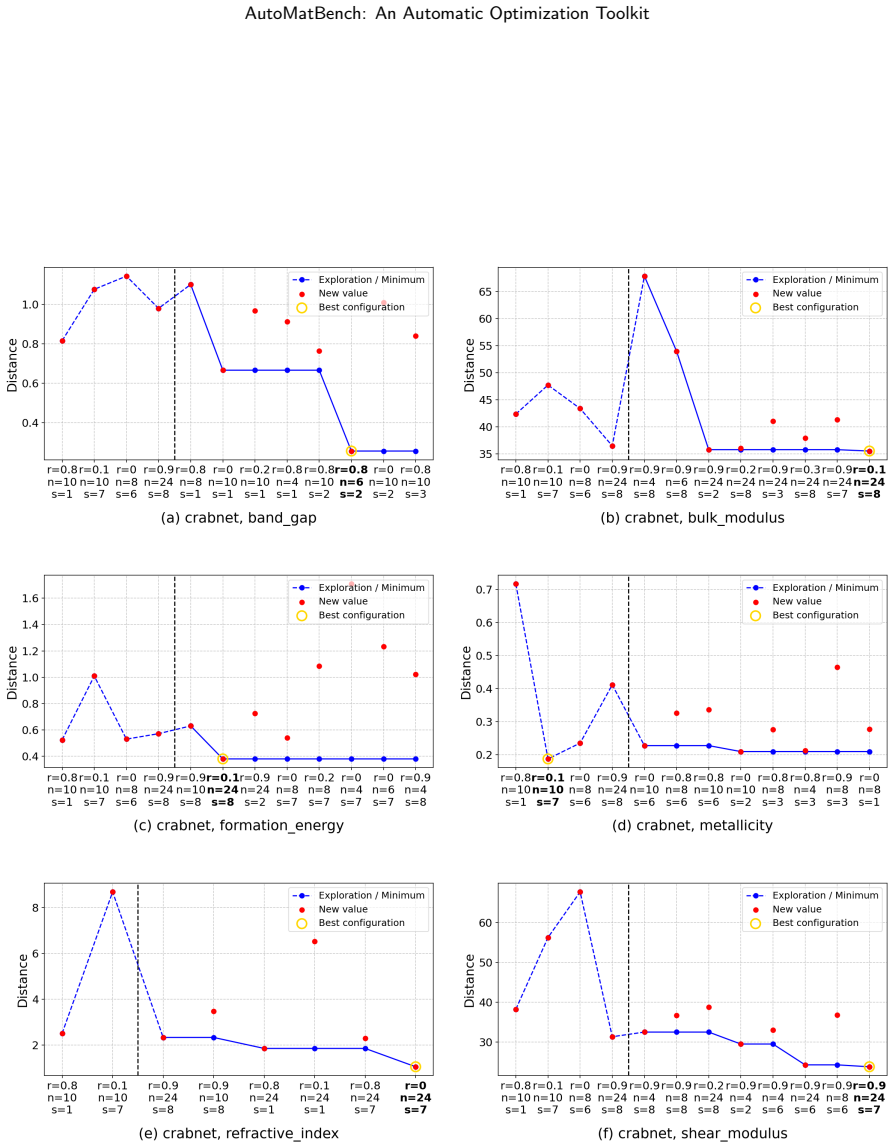
Across six property-prediction tasks and five models, Bayesian optimization over the discrete triple (r, n, s) finds configurations that reproduce the conclusions of MatBench and prior OOD work inside twelve steps, cuts evaluation cost by more than half, and consistently recommends n ≤ 24 and s = 7 or 8 (s = 1 only for band-gap), with the database-mix ratio r exerting negligible influence.
What carries the argument
A Bayesian optimizer that treats each (model, configuration) pair as a black-box evaluation: after four random seeds it updates a surrogate and acquisition function to choose the next informative (r, n, s) triple, thereby approximating average performance, model discrimination, or distance to a reference ground-truth without enumerating the full 858-point space.
Load-bearing premise
The paper assumes that matching a single hand-chosen reference configuration, or an aggregate over its own discrete space, is enough to certify that a cheap configuration has recovered the true out-of-distribution ability of a model.
What would settle it
Re-run the same twelve-step optimizer on a larger held-out set of experimentally verified novel materials whose property distributions lie outside both Materials Project and JARVIS; if the recovered (n, s) settings no longer rank models or approximate the reference MAE, the claim that the cheap configurations are reliable fails.
Editorial analysis
A structured set of objections, weighed in public.
Referee Report
Summary. The manuscript proposes AutoMatBench, a Bayesian-optimization toolkit that searches a discrete configuration space C = R × N × S (dataset ratio r, K-means fold count n, nearest-neighbor count s; 858 points) for material-property-prediction (MPP) benchmarking. Building on MatBench tasks and an Omee-style OOD pipeline (t-SNE + KDE sparse screening + K-means, Section 6.1), it formalizes three problems: best average model performance (first-class, Eq. 1), configuration of maximum model discrimination (dual, Eq. 2), and configuration closest to a defined ground-truth (second-class, Eqs. 3–4). Five models (ALIGNN, SchNet, CrabNet, RF-SCM, MEGNet) are evaluated on six tasks. Empirically, MAE varies by up to ~10 imes across configurations; within a budget of T = 12 BO steps (T0 = 4), the optimizer recovers configurations whose results are claimed to be similar to MatBench/prior OOD work while cutting more than half the cost, with recommended regimes mostly n ≤ 24 and s = 7 or 8 (s = 1 for band gap) and r largely insignificant.
Significance. If the cost-saving and reliability claims hold, AutoMatBench would give the materials-informatics community a practical, sample-efficient way to explore OOD-aware benchmarking configurations instead of exhaustive enumeration or a single fixed split. The explicit framing of configuration causality, the three formal problem classes, and the reproducible BO setup (seed 42, fixed initial D) are useful contributions. The empirical demonstration of large MAE swings across (r, n, s) and the concrete recommended regimes (n ≤ 24, s = 7/8) are actionable for leaderboard design and for reducing experimental cost in MPP model development. Strengths include a clear pipeline (Section 6), multiple experiment sets, and a case study (Table 1) checking approximate vs real labels.
major comments (3)
- Experiment set 3 (Section 7.4) defines ground-truth as the single Omee-style point (r, n, s) = (0, 48, 10) (or an aggregate over the same hand-chosen C). Optimizing for configs whose MAE is close to that reference then claiming “similar results … while more than half of the cost are saved” is partly circular: success shows BO can approximate a declared reference inside C, not that the recovered configs validate models under the distribution shifts that matter for new-material discovery. The paper itself reports MAE swings up to ~10 imes (Section 7.2, Figure 4) and a failed shear-modulus case; the reference choice is therefore load-bearing and needs either independent justification or a sensitivity analysis over alternative gt definitions.
- Algorithm 2’s Ensure clause maximizes a min pairwise |m(oi1,c)−m(oi2,c)| while Formula (2) states range over models; Algorithm 3’s Ensure returns an option ô ∈ O that minimizes average distance to gt, whereas the second-class problem (Eq. 4 and surrounding text) asks for a configuration. These mismatches mean the reported 12-step “optima” may not be the quantities claimed in the problem statements. The algorithms and ensure clauses should be aligned with Eqs. (2)–(4) and the experimental figures re-checked.
- Section 6.1 constructs OOD via t-SNE + KDE sparse screening of 480 candidates then K-means. The manuscript does not show that this proxy captures the compositional/structural/Y-extrapolation shifts that actually impede discovery (cf. the motivation in Section 3 and related work on Y-extrapolation and UQ). Without that link, or at least a comparison to alternative OOD constructions, the claim that AutoMatBench positively contributes to “the cost and efficiency of new material discovery” remains under-supported.
Circularity Check
Experiment set 3 defines ground-truth MAE as the single Omee reference config (0,48,10) then optimizes configs for closeness to it, so the “similar results … half the cost” claim holds largely by construction of that objective; Exp. 1–2 and the recommended (n,s) regimes remain independent.
specific steps
-
other
[Section 4.4 (formula 3–4) and Section 7.4 Experiment set 3]
"The ground-truth MAEs of models are defined as the suggested configuration (r, n, s) = (0,48,10) by the existing study [2]. This assumption ensure that main conclusions with AutoMatBench is capable of reproducing existing findings. A configuration that yields results seriously inconsistent with the ground-truth is considered as unreliable. … Experiments with AutoMatBench reports that, within twelve steps of optimization, the similar results with MatBench and former OOD research can be accessed while more than half of the cost are saved."
Reliability (and therefore the central cost-saving claim) is defined as MAE closeness to a single externally chosen reference point inside C. Bayesian optimization is then run with exactly that distance as the acquisition objective. Any configuration returned by the optimizer therefore matches the reference by construction of the search; the paper’s assertion that “similar results … can be accessed” is the optimization target itself, not an independent validation that the recovered cheaper configs are reliable under real discovery shifts.
full rationale
The paper is a benchmarking-optimization toolkit, not a first-principles derivation of material properties. Its three formal problems (best model by mean MAE, max-range discrimination config, min-distance-to-gt config) and the Bayesian-optimization algorithms that solve them are self-contained once the discrete space C = R imes N imes S and the OOD pipeline (t-SNE + KDE + K-means) are fixed. The only load-bearing circularity is confined to the second-class problem / Experiment set 3: ground-truth is declared to be the MAE obtained at the single hand-chosen point (r,n,s)=(0,48,10) taken from Omee et al., after which BO simply searches for other points whose MAE is close to that reference. Consequently the reported success (“similar results with MatBench and former OOD research \ldots more than half of the cost are saved”) is the direct objective of the search rather than an independent empirical discovery. The cost-saving observation itself (n≤24, s=7 or 8 suffice) and the discrimination results of Experiment set 2 are not forced by this definition and constitute independent content. No self-definitional equations, no fitted parameters renamed as predictions, no load-bearing self-citations or uniqueness theorems appear. Formal mismatches between Algorithm 2/3 Ensure clauses and the surrounding formulas are correctness bugs, not circularity. Overall circularity is therefore moderate and localized (score 4).
Axiom & Free-Parameter Ledger
free parameters (5)
- evaluation budget T and initial samples T0
- n_total=1600 and n_sample=480 OOD candidates
- discrete grids R, N, S (858 configs) and constraint s≤8 when n=60
- ground-truth reference (r,n,s)=(0,48,10) in Experiment set 3
- random seed 42 and validation proportion p=0.1
axioms (5)
- domain assumption Bayesian optimization with a surrogate and acquisition function is an appropriate sample-efficient solver for the three black-box evaluation problems over discrete (o,c) or c.
- domain assumption OOD materials for discovery can be approximated by low-density points in a 2D t-SNE of OFM features, then K-means clusters and s nearest neighbors in original space (SparseX-style).
- ad hoc to paper MAE is a valid scalar performance index for all six tasks, including metallicity treated as regression.
- ad hoc to paper Aggregate or reference performance over the finite config space C is a meaningful stand-in for ground-truth model ability when a true gt is undefined.
- standard math Standard ML and materials-informatics background (K-means, t-SNE, KDE, DFT-derived MP/JARVIS labels, GNN/composition models) is reliable enough for comparative benchmarking.
invented entities (1)
-
AutoMatBench configuration-optimization problems (first-class, dual, second-class) over C=R×N×S
no independent evidence
read the original abstract
Material property prediction (MPP) infers key properties from chemical composition and structure, accelerating the discovery and optimization of novel materials. In the realm of MPP, MatBench is a widely accepted benchmarking tool that defines over ten significant problems and provides the paradigm of performance evaluation for AI prediction models. Even though MatBench works well in benchmarking the performances of prediction models on in-distribution (ID) tasks and datasets, it lacks the ability to reflect their performances on out-of-distribution (OOD) material data, resulting failure in new material discovery. By combining the pipelines of MatBench and the existing researches on OOD performance evaluation, this study enables a huge space of benchmarking configurations, comprehensively reflecting the performances, abilities, and disadvantages of various AI prediction models. This work reports that the discrepancy of performances at different configuration values is huge and can be illustrated with prior knowledge and novel insights, therefore consideration of causal effect of configurations on performance results is necessary. In case of the impossibility of enumerative benchmarking at every configuration, this work further proposes AutoMatBench, an automatic toolkit with Bayesian optimization. Experiments with AutoMatBench reports that, within twelve steps of optimization, the similar results with MatBench and former OOD research can be accessed while more than half of the cost are saved. Besides, this tool also yields more essential findings on MPP benchmarking, positively contributing to the cost and efficiency of new material discovery.
Figures



Reference graph
Works this paper leans on
-
[1]
Bench- markingmaterialspropertypredictionmethods:thematbenchtestset and automatminer reference algorithm
Dunn, A., Wang, Q., Ganose, A., Dopp, D., Jain, A., 2020. Bench- markingmaterialspropertypredictionmethods:thematbenchtestset and automatminer reference algorithm. npj Computational Materials 6, 138
2020
-
[2]
Structure-based out-of-distribution (ood) materials property prediction: a benchmark study
Omee, S.S., Fu, N., Dong, R., Hu, M., Hu, J., 2024. Structure-based out-of-distribution (ood) materials property prediction: a benchmark study. npj Computational Materials 10, 144
2024
-
[3]
Benchmarking graph neural networks for materials chemistry
Fung, V., Zhang, J., Juarez, E., Sumpter, B.G., 2021. Benchmarking graph neural networks for materials chemistry. npj Computational Materials 7, 84
2021
-
[4]
Known unknowns: Out-of-distribution prop- erty prediction in materials and molecules
Segal, N., Netanyahu, A., Greenman, K.P., Agrawal, P., Gómez- Bombarelli, R., 2025. Known unknowns: Out-of-distribution prop- erty prediction in materials and molecules. npj Computational Materials 11, 345
2025
-
[5]
Bench- marking gnns for ood materials property prediction with uncertainty quantification
Tan, L., Chen, P., Liu, M., Wang, X., Cen, J., Zou, Q., 2025. Bench- marking gnns for ood materials property prediction with uncertainty quantification. arXiv preprint arXiv:2511.11697
arXiv 2025
-
[6]
Out-of-distributionmaterialprop- erty prediction using adversarial learning
Li,Q.,Miklaucic,N.,Hu,J.,2025. Out-of-distributionmaterialprop- erty prediction using adversarial learning. The Journal of Physical Chemistry C 129, 6372–6385
2025
-
[7]
Commentary: The materials project: A materials genome approach to accelerating materials innovation
Jain, A., Ong, S.P., Hautier, G., Chen, W., Richards, W.D., Dacek, S., Cholia, S., Gunter, D., Skinner, D., Ceder, G., et al., 2013. Commentary: The materials project: A materials genome approach to accelerating materials innovation. APL materials 1
2013
-
[8]
The materials application programming inter- face(api):Asimple,flexibleandefficientapiformaterialsdatabased on representational state transfer (rest) principles
Ong, S.P., Cholia, S., Jain, A., Brafman, M., Gunter, D., Ceder, G., Persson, K.A., 2015. The materials application programming inter- face(api):Asimple,flexibleandefficientapiformaterialsdatabased on representational state transfer (rest) principles. Computational Materials Science 97, 209–215
2015
-
[9]
Predictingtheband gapsofinorganicsolidsbymachinelearning
Zhuo,Y.,MansouriTehrani,A.,Brgoch,J.,2018. Predictingtheband gapsofinorganicsolidsbymachinelearning. Thejournalofphysical chemistry letters 9, 1668–1673
2018
-
[10]
Scientific data 2, 150009
De Jong, M., Chen, W., Angsten, T., Jain, A., Notestine, R., Gamst, A.,Sluiter,M.,KrishnaAnde,C.,VanDerZwaag,S.,Plata,J.J.,etal., 2015.Chartingthecompleteelasticpropertiesofinorganiccrystalline compounds. Scientific data 2, 150009
2015
-
[11]
New cubic perovskites for one-andtwo-photonwatersplittingusingthecomputationalmaterials repository
Castelli, I.E., Landis, D.D., Thygesen, K.S., Dahl, S., Chorkendorff, I., Jaramillo, T.F., Jacobsen, K.W., 2012. New cubic perovskites for one-andtwo-photonwatersplittingusingthecomputationalmaterials repository. Energy & Environmental Science 5, 9034–9043
2012
-
[12]
High- throughput screening of inorganic compounds for the discovery of novel dielectric and optical materials
Petousis,I.,Mrdjenovich,D.,Ballouz,E.,Liu,M.,Winston,D.,Chen, W., Graf, T., Schladt, T.D., Persson, K.A., Prinz, F.B., 2017. High- throughput screening of inorganic compounds for the discovery of novel dielectric and optical materials. Scientific data 4, 160134
2017
-
[13]
Atomistic line graph neural net- workforimprovedmaterialspropertypredictions
Choudhary, K., DeCost, B., 2021. Atomistic line graph neural net- workforimprovedmaterialspropertypredictions. npjComputational Materials 7, 185
2021
-
[14]
Schnet: A continuous-filter convolutional neural network for modeling quantum interactions
Schütt, K., Kindermans, P.J., Sauceda Felix, H.E., Chmiela, S., Tkatchenko, A., Müller, K.R., 2017. Schnet: A continuous-filter convolutional neural network for modeling quantum interactions. Advances in neural information processing systems 30
2017
-
[15]
The Journal of chemical physics 148
Schütt, K.T., Sauceda, H.E., Kindermans, P.J., Tkatchenko, A., Müller,K.R.,2018.Schnet–adeeplearningarchitectureformolecules and materials. The Journal of chemical physics 148
2018
-
[16]
Npj Computational Materials 7, 77
Wang,A.Y.T.,Kauwe,S.K.,Murdock,R.J.,Sparks,T.D.,2021.Com- positionally restricted attention-based network for materials property predictions. Npj Computational Materials 7, 77
2021
-
[17]
The lsst-desc 3x2pt tomography optimization challenge
Kovacs, E., 2021. The lsst-desc 3x2pt tomography optimization challenge. The Open Journal of Astrophysics
2021
-
[18]
Crystal structure representations for machine learning models of formationenergies
Faber, F., Lindmaa, A., Von Lilienfeld, O.A., Armiento, R., 2015. Crystal structure representations for machine learning models of formationenergies. InternationalJournalofQuantumChemistry115, 1094–1101
2015
-
[19]
A general-purpose machine learning framework for predicting proper- ties of inorganic materials
Ward, L., Agrawal, A., Choudhary, A., Wolverton, C., 2016. A general-purpose machine learning framework for predicting proper- ties of inorganic materials. npj Computational Materials 2, 16028
2016
-
[20]
Chemistry of Materials 31, 3564–3572
Chen,C.,Ye,W.,Zuo,Y.,Zheng,C.,Ong,S.P.,2019.Graphnetworks asauniversalmachinelearningframeworkformoleculesandcrystals. Chemistry of Materials 31, 3564–3572
2019
-
[21]
Atutorialonbayesianoptimization
Frazier,P.I.,2018. Atutorialonbayesianoptimization. arXivpreprint arXiv:1807.02811
Pith/arXiv arXiv 2018
-
[22]
Generalized gradient approximation made simple
Perdew, J.P., Burke, K., Ernzerhof, M., 1996. Generalized gradient approximation made simple. Physical review letters 77, 3865
1996
-
[23]
Van der waals density functional for general geometries
Dion, M., Rydberg, H., Schröder, E., Langreth, D.C., Lundqvist, B.I., 2004. Van der waals density functional for general geometries. First Author et al.:Preprint submitted to ElsevierPage 15 of 16 AutoMatBench: An Automatic Optimization Toolkit Physical review letters 92, 246401
2004
-
[24]
Materials design and discovery with high-throughput density func- tional theory: the open quantum materials database (oqmd)
Saal, J.E., Kirklin, S., Aykol, M., Meredig, B., Wolverton, C., 2013. Materials design and discovery with high-throughput density func- tional theory: the open quantum materials database (oqmd). Jom 65, 1501–1509
2013
-
[25]
The joint automatedrepository for various integrated simulations (jarvis) for data-driven materials design
Choudhary, K., Garrity, K.F., Reid, A.C., DeCost, B., Biacchi, A.J., Hight Walker, A.R., Trautt, Z., Hattrick-Simpers, J., Kusne, A.G., Centrone, A.,et al., 2020. The joint automatedrepository for various integrated simulations (jarvis) for data-driven materials design. npj computational materials 6, 173
2020
-
[26]
Imagenet: A large-scale hierarchical image database, in: 2009 IEEE conferenceoncomputervisionandpatternrecognition,Ieee.pp.248– 255
Deng, J., Dong, W., Socher, R., Li, L.J., Li, K., Fei-Fei, L., 2009. Imagenet: A large-scale hierarchical image database, in: 2009 IEEE conferenceoncomputervisionandpatternrecognition,Ieee.pp.248– 255
2009
-
[27]
Zhan, J., Wang, L., Gao, W., Wang, C., Li, H., Fan, F., Kang, G.,
-
[28]
Version 1.0 (first edition, 2025) ed., BenchCouncil Press, Hong Kong
Evaluatology: The Science of Uncovering the Effects. Version 1.0 (first edition, 2025) ed., BenchCouncil Press, Hong Kong
2025
-
[29]
Backpropagation and stochastic gradient descent method
Amari, S.i., 1993. Backpropagation and stochastic gradient descent method. Neurocomputing 5, 185–196
1993
-
[30]
Adam:Amethodforstochasticoptimiza- tion
Kingma,D.P.,Ba,J.,2014. Adam:Amethodforstochasticoptimiza- tion. arXiv preprint arXiv:1412.6980
Pith/arXiv arXiv 2014
-
[31]
Saibench:Benchmarkingaiforscience
Li,Y.,Zhan,J.,2022. Saibench:Benchmarkingaiforscience. Bench- Council Transactions on Benchmarks, Standards and Evaluations 2, 100063
2022
-
[32]
Saibench: A structural interpretation of ai for science through benchmarks
Li, Y., Zhan, J., 2023. Saibench: A structural interpretation of ai for science through benchmarks. arXiv preprint arXiv:2311.17869
Pith/arXiv arXiv 2023
-
[33]
Crystal graph convolutional neural networks for an accurate and interpretable prediction of material properties
Xie, T., Grossman, J.C., 2018. Crystal graph convolutional neural networks for an accurate and interpretable prediction of material properties. Physical review letters 120, 145301
2018
-
[34]
Scalabledeepergraphneuralnetworksforhigh-performance materials property prediction
Omee,S.S.,Louis,S.Y.,Fu,N.,Wei,L.,Dey,S.,Dong,R.,Li,Q.,Hu, J.,2022. Scalabledeepergraphneuralnetworksforhigh-performance materials property prediction. Patterns 3
2022
-
[35]
Materials property prediction for limited datasets enabled by feature selection and joint learning with modnet
De Breuck, P.P., Hautier, G., Rignanese, G.M., 2021. Materials property prediction for limited datasets enabled by feature selection and joint learning with modnet. npj computational materials 7, 83
2021
-
[36]
The k-means algorithm: A comprehensive survey and performance evaluation
Ahmed, M., Seraj, R., Islam, S.M.S., 2020. The k-means algorithm: A comprehensive survey and performance evaluation. Electronics 9, 1295
2020
-
[37]
Nested cross-validation when selecting classifiers is overzealous for most practical applications
Wainer, J., Cawley, G., 2021. Nested cross-validation when selecting classifiers is overzealous for most practical applications. Expert Systems with Applications 182, 115222
2021
-
[38]
Visualizing data using t-sne
Van der Maaten, L., Hinton, G., 2008. Visualizing data using t-sne. Journal of machine learning research 9
2008
-
[39]
Onestimationofaprobabilitydensityfunctionand mode
Parzen,E.,1962. Onestimationofaprobabilitydensityfunctionand mode. The annals of mathematical statistics 33, 1065–1076
1962
-
[40]
Functional form of the generalized gradient approximation for exchange: The pbe𝛼functional
Madsen, G.K., 2007. Functional form of the generalized gradient approximation for exchange: The pbe𝛼functional. Physical Review B—Condensed Matter and Materials Physics 75, 195108
2007
-
[41]
Lehrbuchderkristallphysik(teubner,leipzig,1928)
Voigt,W.,1908. Lehrbuchderkristallphysik(teubner,leipzig,1928). There is no corresponding record for this reference
1908
-
[42]
Quantum-chemical insights from deep tensor neural net- works
Schütt,K.T.,Arbabzadah,F.,Chmiela,S.,Müller,K.R.,Tkatchenko, A., 2017. Quantum-chemical insights from deep tensor neural net- works. Nature communications 8, 13890
2017
-
[43]
Journal of the Optical Society of America B 23, 498– 505
Wangberg,R.,Elser,J.,Narimanov,E.E.,Podolskiy,V.A.,2006.Non- magneticnanocompositesforopticalandinfrarednegative-refractive- index media. Journal of the Optical Society of America B 23, 498– 505. A. Full results of Experiment set 1, 2, and 3 This section presents the complete experimental results for Experiment sets 1, 2, and 3. AsillustratedinFigure8andF...
2006
discussion (0)
Sign in with ORCID, Apple, or X to comment. Anyone can read and Pith papers without signing in.