REVIEW 4 major objections 5 minor 1 cited by
Lesioned Multimodal Language Models Reproduce Aphasic Picture-Naming Patterns
T0 review · 4 major / 5 minor · reviewed 2026-07-14 · grok-4.5
Pith's one-line read Controlled lesions to a general-purpose multimodal language model can reproduce the full seven-category picture-naming error profiles of individual stroke survivors with aphasia.
desk verdict Careful empirical systems paper: graded lesions of LLaVA 1.6 hit six of seven PNT categories at clinical rates and match joint profiles for most of 278 PWAs, but the 97.8% figure is a best-of-search peak and formal paraphasias remain underproduced. read the letter →
The pith
A machine-rendered reading of the paper's core claim, the machinery that carries it, and where it could break.
The reading
What carries the argument
The three-parameter lesion (target layer, fraction of units modified, multiplicative Gaussian noise intensity) applied to the language backbone while the vision encoder stays intact; model outputs are scored into the seven standard naming categories and matched to each patient against empirically derived retest tolerances.
What would settle it
Hold out a new cohort of patients or a second naming test, freeze the matching procedure, and check whether the same three-parameter search still hits the retest-tolerance criterion at rates far above the joint-structure Monte Carlo baseline; collapse of that gap would falsify the claim that the model’s perturbation manifold specifically contains clinical profiles.
Extended reading notes
Core claim
Searching the three-parameter perturbation space of LLaVA 1.6 recovers configurations that reproduce each individual person’s Philadelphia Naming Test error profile within retest-derived tolerance in at least six of seven categories for 97.8 percent of 278 people with aphasia and in all seven categories for 79.5 percent, with Monte Carlo Real-versus-Generated baselines showing the advantage comes from joint inter-category structure rather than marginal overlap alone.
Load-bearing premise
That finding a best-fit triple of layer, proportion and noise by exhaustive search, then taking the best seed, counts as genuine reproduction of a clinical profile rather than flexible fitting of a three-knob generator to a seven-bin count vector.
Editorial extensions
If this is right
- A compact (layer, proportion, noise) coordinate can serve as a quantitative description of where an individual aphasic naming profile sits in model behavioral space.
- Different layers systematically produce different error mixtures, giving an axis that separates mild, semantic-dominant and no-response-dominant profiles.
- Formal paraphasia remains systematically under-produced, predicting that models with explicit sublexical phonological structure will be needed for formal-dominant patients.
- The same protocol can be extended to other standardized naming batteries and, later, to longitudinal or treatment-response data once those assays are added.
Reading between the lines
- If the three knobs already span most individual profiles on naming, the next decisive test is whether the same coordinates predict performance on repetition and comprehension tasks the model was never matched on.
- The formal-paraphasia gap is a positive architectural prediction: any model whose lexicon is not sound-indexed should convert disrupted selection into neologisms rather than real-word formal errors.
- Digital-twin use for therapy selection would require showing that interventions that move a patient’s real error profile also move the matched model configuration in the same direction.
Editorial analysis
A structured set of objections, weighed in public.
Referee Report
Summary. The paper asks whether controlled, layer-localized multiplicative Gaussian perturbations of LLaVA 1.6 can (i) generate the seven Philadelphia Naming Test (PNT) response categories at clinically comparable rates and (ii) reproduce the joint seven-category error profiles of 278 individual persons with aphasia (PWAs). Perturbations are parameterized by layer l, modification proportion p, and noise σ over a 4,000-point grid, with 50 unit-selection seeds. Six of seven categories appear at clinically comparable magnitudes in distinct regions of parameter space; formal paraphasias are systematically under-produced. Searching the grid yields a per-PWA maximum match of ≥6/7 categories for 97.8% of PWAs and 7/7 for 79.5% within retest-derived 2 SD tolerances. Depth-matched Monte Carlo Real-vs-Generated baselines (k=5) give an R/I ratio of 1.35 at ≥6/7, and a median-across-seeds companion at the same best-fit (l,p,σ) yields 55.8% high-quality matches. The authors interpret this as a quantitative framework for individual-level output-space matching and as suggesting digital-twin potential.
Significance. If the matching is more than flexible three-parameter fitting of a 7-bin simplex, the work would provide a scalable, open-weight computational assay for individual aphasic naming profiles without per-patient fine-tuning, complementing classical interactive two-step models and recent MoE lesioning work. Strengths that should be credited include the large C-STAR cohort (N=278), a DeBERTa classifier validated against expert SLP annotations (κ≈0.87, No-Response F1=0.875), the LU vs CU locus control (Δ≈−1 pp), dual Monte Carlo baselines with explicit depth matching, honest reporting of the formal-paraphasia ceiling, and the median-based companion that bounds peak vs typical performance. These make the manuscript a serious contribution to computational cognitive modeling of aphasia even if the digital-twin framing is tightened.
major comments (4)
- [Results 3.2; Abstract; Supp. S2–S3] Results 3.2 and Supp. S2–S3: The headline rates (97.8% ≥6/7, 79.5% 7/7) are the per-PWA MAX over the full 4,000-point (l,p,σ) grid and 50 unit-selection seeds. At the same committed best-fit configuration the median across seeds falls to 55.8% HQ / 37.4% perfect (Tables S2.5, S3.1). The abstract and Significance Statement lead with the MAX rates without the median companion. For a digital-twin or “reproduction” claim, the paper must state clearly in the main text that the primary number is peak coverage of a three-parameter generative process, report the median-based rate alongside it in Results (not only in supplements), and revise the abstract so that readers cannot take 97.8% as stable configuration-level reproduction.
- [Section 3.4.1; Table 3; Supp. S2.1] Section 3.4.1 / Table 3 and Supp. S2.1: The R/I = 1.35 argument uses depth-matched k=5 draws for both Real Selection and Generated arms. That correctly isolates joint structure at k=5, but it does not validate the exhaustive best-of-4,000 search that produces the headline MAX rates. A flexible three-parameter noise process can hit many 7-bin profiles within 2× retest-SD tolerances when search is exhaustive; the current Monte Carlo therefore under-constrains the central claim. Please add either (i) an exhaustive-depth or best-of-N Monte Carlo against a Generated manifold of comparable expressivity, or (ii) an explicit main-text statement that R/I supports joint structure only at the k=5 selection depth, not the reported MAX coverage.
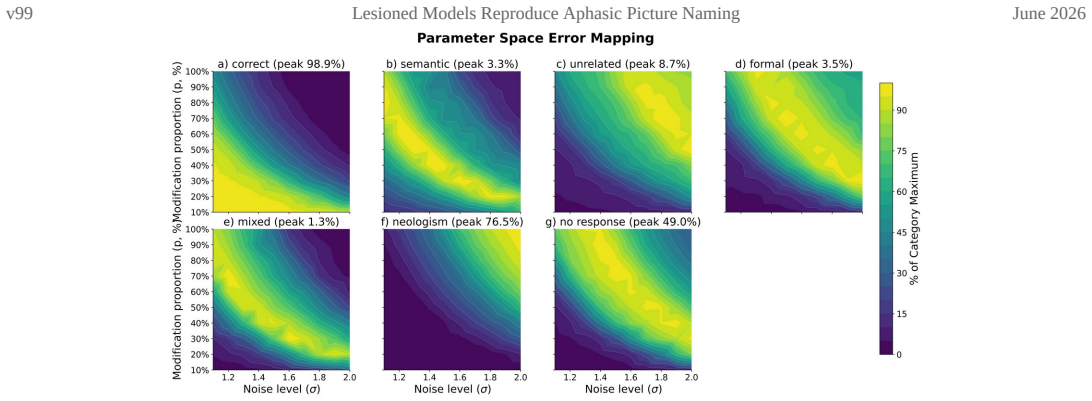
- [Results 3.1; Discussion] Discussion (Architectural Specialization) and Results 3.1: Formal paraphasias peak at ≈3.5% layer-averaged and ≈8.4% at the most susceptible layer, versus formal-dominant PWAs averaging ≈38% formal errors; four of six unmatched PWAs are formal-dominant. The paper correctly flags this as architectural. Because the second research question is joint seven-category individual matching, the main text should quantify how much of the residual mismatch and of the MAX–median gap is concentrated in formal-dominant profiles, and should qualify the “complete error profile” language for that subpopulation rather than treating formal under-production only as a future-work note.
- [Methods 2.3] Methods 2.3: Seventeen of 175 PNT items that LLaVA failed at baseline are excluded, and the remaining 158 are proportionally scaled back to 175 for clinical comparison. This isolates perturbation effects but changes the item set relative to the clinical PNT and assumes uniform category scaling. Sensitivity of the match rates to (a) leaving the 17 as permanent No Response / incorrect and (b) reporting unscaled 158-item rates should be shown, at least in the supplement and summarized in Results, because the clinical comparability claim rests on this step.
minor comments (5)
- [Figure 5] Figure 5 color scales are normalized per panel to each category’s own maximum; this is stated but easy to misread as absolute rates. Add a shared absolute colorbar or explicit peak counts in the main caption.
- [Methods 2.3] The prompt “What is shown in this image? Provide a single word answer.” is reasonable but not the clinical PNT administration. A brief note on how single-word forcing interacts with No Response / circumlocution classification would help.
- [Methods] Section numbering jumps (2.1 then “3 / 15” page marks; “2.3 Experimental Design” after 2.2). Clean for production.
- [Table 2] Table 2 examples are helpful; state whether they were cherry-picked for transparency or sampled systematically (the caption says “sampled to illustrate”).
- [References] References include 2025–2026 arXiv/bioRxiv items (Wang, Roll, Kiran, Anderson); ensure final versions or stable identifiers are used at publication.
Circularity Check
Individual-profile 'reproduction' is exhaustive three-parameter search with per-PWA max over seeds, not an independent prediction; category-level emergence and joint-structure tests remain non-circular.
-
fitted input called prediction
[Abstract; Results 3.2; Methods 2.5; Supp. S2.3 / S3.1–S3.3 (Tables S2.5, S3.1)]
"Searching the perturbation space revealed configurations that reproduced the individual error profile in at least six of seven categories for 97.8% of PWAs and in all seven categories for 79.5% of PWAs. ... we report the result, the per-PWA maximum-matching configuration, defined in Section 2.5 ... High-quality success rate (≥6/7) 55.8% (155/278) [median-based] ... 97.8% ± 7.1 (272/278) [per-PWA MAX]"
The headline match rates are not out-of-sample predictions. For each PWA the authors select the (l, p, σ) triple—and the seed—that maximizes the number of categories falling inside retest tolerance on that same PWA's seven-bin profile. The reported 'reproduction' is therefore the peak of a three-parameter fit (plus discrete unit-selection randomness) to the target distribution. At the identical best-fit configuration the median across seeds falls to 55.8% HQ / 37.4% perfect, showing that the 97.8%/79.5% figures are search peaks rather than stable configuration-level predictions. Monte Carlo baselines use only k=5 draws and do not match the exhaustive search depth that produced the headline numbers.
full rationale
The paper's first claim—that distinct (layer, proportion, noise) regions produce six of seven clinical error categories at clinically comparable rates—is an empirical mapping of the perturbation manifold and is not circular: it does not fit parameters to the PWA cohort to define those categories. The second claim—97.8% of 278 PWAs matched in ≥6/7 categories and 79.5% in 7/7—is obtained by searching the full 4,000-point grid and taking, for each PWA, the configuration and seed that maximize matched categories within retest-derived tolerances. That is flexible fitting of three free parameters (plus unit-selection seed) to the same seven-bin profiles being reported as reproduced. The paper is partly transparent (it reports the median-at-fixed-config HQ rate of 55.8%, cites the Dell-style fitting tradition, and runs Real-vs-Generated Monte Carlo), and tolerances come from an independent retest cohort, so the circularity is partial rather than total. The Monte Carlo R/I≈1.35 uses only k=5 draws and therefore does not fully neutralize the exhaustive-search degrees of freedom behind the headline rates. No self-definitional loop, uniqueness theorem, or load-bearing self-citation chain is present. Score 4 reflects one clear fitted-input step on the individual-matching claim while leaving the category-emergence and joint-structure content intact.
Assumptions & free parameters
free parameters (5)
- per-PWA best-fit (layer l, modification proportion p, noise σ)
- noise grid σ ∈ {1.1…2.0} and proportion grid p ∈ {10%…100%}
- retest tolerance multiplier (2 × per-category test–retest SD)
- Monte Carlo search depth k=5
- per-PWA MAX across 50 unit-selection seeds (vs median)
assumptions (5)
- domain assumption The seven-category PNT taxonomy (with merged neologism subtypes in the main match) is an adequate behavioral assay for individual aphasic naming profiles.
- ad hoc to paper Multiplicative isotropic Gaussian noise on a single transformer layer’s units is a valid controlled analog of focal language disruption while vision remains intact.
- domain assumption Output-space distributional match within retest tolerance is scientifically meaningful even without mechanistic identity between model computation and patient pathophysiology.
- domain assumption The feature-augmented DeBERTa classifier is accurate enough that LLM–PWA comparisons are not classification artifacts.
- ad hoc to paper Excluding the 17 baseline-incorrect PNT items and proportionally scaling 158→175 preserves clinical comparability.
invented entities (2)
-
(l, p, σ) digital-twin coordinate for an individual PWA
-
Perturbation manifold of joint seven-category error structure
Cite this review
Pith. "Pith review of Lesioned Multimodal Language Models Reproduce Aphasic Picture-Naming Patterns." pith.science (2026). https://pith.science/paper/HGNPD3BH
@misc{pith2026260711621,
  author       = {Pith},
  title        = {Pith review of: Lesioned Multimodal Language Models Reproduce Aphasic Picture-Naming Patterns},
  year         = {2026},
  howpublished = {\url{https://pith.science/paper/HGNPD3BH}},
  note         = {Machine review of arXiv:2607.11621}
}
read the original abstract
Aphasia following stroke commonly produces systematic naming errors with characteristic profiles, but whether general-purpose language models not designed for clinical simulation can reproduce these patterns remains untested. We investigated (1) whether lesions or controlled perturbations to a multimodal language model can reproduce different types of errors in picture naming, and (2) whether the framework can reproduce the complete error profile of individual persons with aphasia (PWAs). Using LLaVA 1.6, we evaluated perturbation configurations that varied the layer, proportion, and amount of noise applied to model units. We examined 278 PWAs on the Philadelphia Naming Test, classifying responses into seven categories using a validated neural classifier. Six of seven response categories (correct, semantic, mixed, unrelated, neologism, no response errors) emerged at clinically-comparable proportions across distinct parameter space regions, with formal paraphasia being the exception. Searching the perturbation space revealed configurations that reproduced the individual error profile in at least six of seven categories for 97.8% of PWAs and in all seven categories for 79.5% of PWAs. Monte Carlo baselines confirmed that this matching reflects joint inter-category structure rather than marginal overlap. These results establish a quantitative framework for reproducing individual aphasic error patterns in picture naming. They suggest the potential for language models to serve as digital twins of individuals with post-stroke aphasia.
Figures


Figures from the paper (2 more)


Forward citations
Cited by 1 Pith paper
-
Activation-Guided Neuron Intervention to Induce Alzheimer's-Related Computational Language Phenotypes in a Large Language Model
Amplifying neurons that activate more on Alzheimer's speech in Qwen3-8B produces graded impairments across multiple cognitive-linguistic tasks, without explicit training on those tasks.
Reference graph
Works this paper leans on
-
[1]
Chen, X., Yu, Z., Yang, C., & Yang, T. (2024). Large language models as augmentative and alternative communication tools for individuals with aphasia. Journal of Communication Disorders, 109, 106432
2024
-
[2]
S., Schwartz, M
Dell, G. S., Schwartz, M. F., Martin, N., Saffran, E. M., & Gagnon, D. A. (1997). Lexical access in aphasic and nonaphasic speakers. Psychological Review, 104(4), 801–838
1997
-
[3]
Goodglass, H., Kaplan, E., & Barresi, B. (2001). The assessment of aphasia and related disorders (3rd ed.). Lippincott Williams & Wilkins
2001
-
[4]
He, P., Gao, J., & Chen, W. (2021). DeBERTaV3: Improving DeBERTa using ELECTRA-style pre-training with gradient- disentangled embedding sharing. arXiv preprint arXiv:2111.09543
arXiv 2021
-
[5]
Hillis, A. E. (2007). Aphasia: Progress in the last quarter of a century. Neurology, 69(2), 200–213
2007
-
[6]
R., & Koch, G
Landis, J. R., & Koch, G. G. (1977). The measurement of observer agreement for categorical data. Biometrics, 33(1), 159–174
1977
-
[7]
F., Martin, N., Grewal, R
Roach, A., Schwartz, M. F., Martin, N., Grewal, R. S., & Brecher, A. (1996). The Philadelphia Naming Test: Scoring and rationale. Clinical Aphasiology, 24, 121–133
1996
-
[8]
Zhong, J. (2024). Generative AI in augmentative and alternative communication: Applications and clinical considerations. Topics in Language Disorders, 44(2), 152–168. 18 / 18
2024
Reviewed July 14, 2026 · model on record in the stance chip above.
Discussion (0). Continue with ORCID to comment.