REVIEW 4 major objections 5 minor 62 references
Biaxial strain alone stabilizes a buckled silicon kagome sheet while narrowing its near-Fermi flat band and raising its crystalline-to-amorphous transition temperature.
Reviewed by Pith at T0; open to challenge. T0 means a machine referee read the full paper against a public rubric. the ladder, T0–T4 →
T0 review · grok-4.5
2026-07-14 03:09 UTC pith:PWMRXXVZ
load-bearing objection Solid multi-scale proposal of an elemental buckled Si kagome with real DFT/AIMD strain control of a near-Fermi band; the ~600 K classical map is the softest piece, not the whole story. the 4 major comments →
Strain-controlled crystalline--amorphous transition and flat-band tuning in buckled silicon kagome
The pith
A machine-rendered reading of the paper's core claim, the machinery that carries it, and where it could break.
Core claim
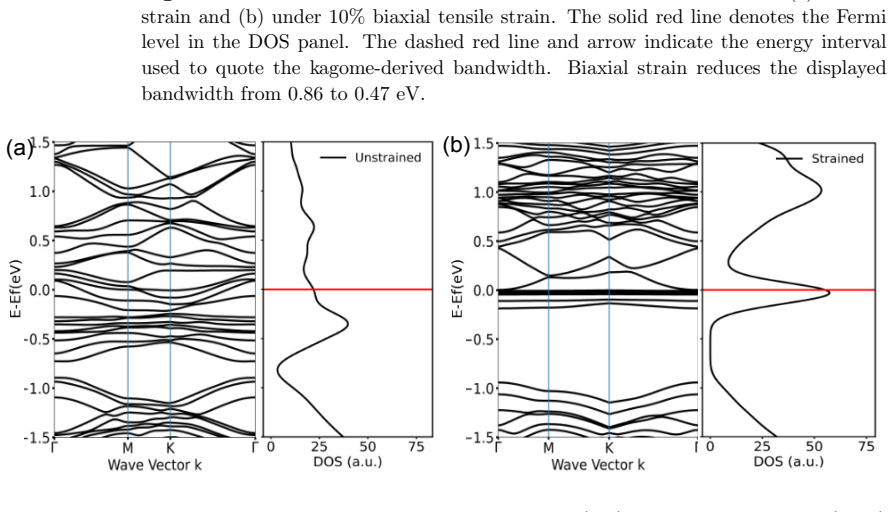
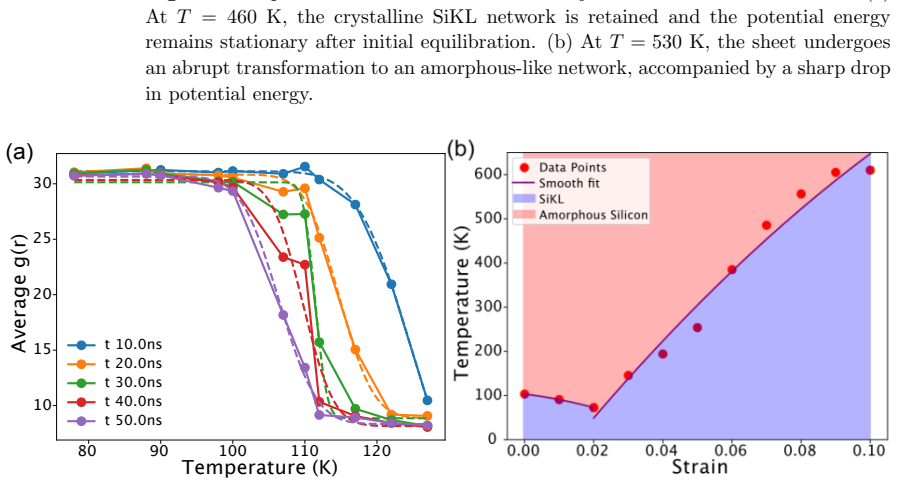
An unfunctionalized six-atom buckled silicon kagome lattice retains a kagome-derived partially flat band near the Fermi level, and biaxial tensile strain alone narrows that band (0.86 to 0.47 eV at 10% strain), hardens the dominant soft phonon, and converts a thermally labile sheet into a finite-temperature metastable ordered network whose classical crystalline–amorphous transition temperature reaches approximately 600 K at 10% strain, with a local-bonding crossover near 2% that changes the disordering pathway from gradual two-stage collapse to abrupt first-order-like failure.
What carries the argument
Buckled silicon kagome lattice (SiKL): a six-atom monolayer of bond-linked Si3 triangles and dodecagonal pores whose out-of-plane buckling lets biaxial tension simultaneously harden soft modes, reorganize intra- versus inter-triangle bond populations, and reduce the kagome-derived near-Fermi bandwidth.
Load-bearing premise
The long-time crystalline-to-amorphous map and the roughly 600 K claim rest on an empirical silicon potential never trained on this high-energy linked-triangle allotrope, so the barrier ranking may not match first-principles free energies.
What would settle it
Long first-principles free-energy sampling or large-cell AIMD of strained SiKL that either disorders well below the classical transition temperatures or shows no local-bonding crossover near 2% strain would overturn the claimed strain-controlled pathway and temperature scale.
If this is right
- Strain alone can serve as the control parameter for both structural persistence and near-Fermi bandwidth in elemental SiKL, without hydrogenation or hybrid-lattice redesign.
- Epitaxial mismatch on a template such as Ag(111) may impose comparable tension, preserve crystalline order above room temperature, and further narrow the extracted SiKL band.
- The strain-tuned reduction of bandwidth and rise of near-Fermi density of states make spin-polarized and many-body searches for magnetism, superconductivity, or topological phases natural next calculations at appropriate filling.
- The disordering pathway itself is designable: below about 2% strain collapse is gradual and two-stage; above it the transition becomes abrupt and first-order-like within the simulated trajectories.
Where Pith is reading between the lines
- If the classical barrier ranking is qualitatively correct, modest tensile templates could kinetically trap SiKL long enough for ambient spectroscopic searches of the narrow band.
- The same soft-mode buckling plus tensile-strain recipe may transfer to the heavier planar group-14 linked-triangle analogues the paper already relaxes.
- For growth, adsorption-site registry that preferentially nucleates linked triangles over silicene or compact clusters will matter as much as pure lattice mismatch.
Editorial analysis
A structured set of objections, weighed in public.
Referee Report
Summary. The manuscript proposes an unfunctionalized buckled silicon kagome lattice (SiKL) obtained by following soft zone-centre phonons of a planar linked-triangle parent. Using DFT/DFPT, AIMD, and classical MD, it argues that biaxial tension simultaneously narrows a kagome-derived near-Fermi band (0.86 o0.47 eV at 10% strain), hardens the dominant soft phonon, and converts a labile sheet into a finite-temperature metastable ordered network. Classical 50 ns trajectories of 36 imes36 sheets are used to map a strain-controlled crystalline–amorphous transition with a local-bonding crossover near 2% that changes the disordering pathway, with TCA reaching ~600 K at 10% strain; an exploratory Ag(111) model is offered as a possible epitaxial strain template.
Significance. If the coupled structural–electronic picture holds, SiKL would be a rare elemental 2D platform in which a single mechanical variable tunes near-Fermi bandwidth, soft-mode stability, and crystalline persistence without passivation or hybrid-lattice redesign—relevant to strain-controlled flat-band and correlation physics and to silicon epitaxy. Strengths include a transparent soft-mode search that yields two nearly degenerate buckled minima, consistent PBE/LDA planar electronic signatures, explicit phonon hardening under tension, a clear 6 imes6 AIMD contrast (disordered unstrained vs ordered strained at 315 K), and an operational, time-resolved definition of TCA rather than an unstated melting claim. The multi-scale hierarchy (DFPT → AIMD → classical MD → substrate sketch) is a genuine asset if the classical map is properly caveated.
major comments (4)
- [§2.3, §3.4] §2.3 and §3.4: The strain–temperature map, the ~600 K claim at 10% strain, the ε≈0.0196 bond-population crossover, and the two-stage vs first-order-like pathway distinction rest entirely on a Tersoff Si–Si potential and a 50 ns RDF-midpoint TCA. SiKL is a high-energy, soft linked-triangle allotrope (~1.14 eV/atom above diamond Si; Table 2) outside the training domain of standard Tersoff silicon. Without validation against AIMD barriers, DFT-relaxed amorphous competitors, or at least a second potential, absolute TCA values and the pathway switch cannot be treated as load-bearing. Either add such checks or reframe §3.4 as a model-dependent kinetic survey and soften the abstract/conclusions accordingly.
- [§3.2, Fig. 4] §3.2 and Fig. 4: Under 10% biaxial strain the softest mode only hardens from ~−1.98 to ~−0.64 THz; residual imaginary branches remain. The paper correctly notes anharmonic renormalization and finite-T metastability, but the central claim that strain “suppresses the dominant structural instability” still leans on a 10 ps 6×6 AIMD trajectory. Longer AIMD, larger cells, or anharmonic free-energy estimates are needed before asserting robust room-temperature metastability of freestanding strained SiKL.
- [§3.3, Fig. 5] §3.3 and Fig. 5: The strained bandwidth is 0.47 eV along the sampled path—narrowed but not flat. The text already notes that correlation physics depends on U/W rather than a semantic flatness threshold, yet the abstract and title still frame the result as “flat-band tuning.” Report full-BZ bandwidths, orbital character, and at least a rough interaction-scale estimate (or Hubbard U scan) so the reader can judge whether 0.47 eV is interaction-relevant, and align the abstract language with the actual dispersion.
- [§3.5, Fig. 12] §3.5 and Fig. 12: The Ag(111) proof-of-concept uses a classical EAM+LJ interface and reports a peeled-off SiKL band narrowed to ~0.2 eV without Si-projected unfolded spectral weight. Hybridization with metallic Ag can destroy or bury the near-Fermi Si feature. First-principles interface bands (or at least projected DOS/unfolding) and registry/adhesion checks are required before claiming that epitaxial mismatch “retains a narrow SiKL band.”
minor comments (5)
- [Fig. 1] Fig. 1 caption/layout shows duplicated “(a) (b)” labels; clean the panel labeling.
- [Table 2] Table 2 cohesive energies are quoted to five decimals while differences between HB and LB are 0.04 meV/atom—state numerical precision and whether zero-point energy was considered.
- [§2.1] §2.1: Specify which PAW/pseudopotential files (library versions) were used for LDA vs PBE for reproducibility.
- [Appendix A] Appendix A: Planar C/Ge/Sn/Pb analogues are interesting but undiscussed for dynamical stability; either add a brief phonon note or mark them clearly as electronic-structure comparisons only.
- [Abstract, §3.4] Throughout: “first-order-like” / “second-order-like” are kinetic descriptors; keep that qualification in the abstract as well as in §3.4.
Circularity Check
No circularity: SiKL results are forward DFT/DFPT/AIMD/classical-MD computations on a proposed structure, not identities forced by definition or self-citation.
full rationale
The paper proposes an unfunctionalized buckled silicon kagome lattice and reports its properties via standard first-principles and classical simulations. Soft-mode displacements of the planar parent are relaxed to obtain HB/LB structures; biaxial strain is then applied and bandwidths, phonons, AIMD trajectories, and classical 50 ns RDFs are computed forward. TCA is defined operationally as the midpoint of an error-function fit to a selected RDF peak at fixed observation time, and the text explicitly labels it a finite-time, model-dependent metric rather than an equilibrium melting temperature—so the definition is transparent bookkeeping, not a prediction smuggled from a fit to the same quantity. Self-citations ([11]–[18]) concern related nanotube/flat-band methodology and do not supply a uniqueness theorem or ansatz that forces the SiKL bandwidth, phonon hardening, or transition map. The Tersoff potential and finite-time TCA are external-model limitations (correctness risk), not circular reductions of outputs to inputs. No step reduces by construction to its own premises.
Axiom & Free-Parameter Ledger
free parameters (4)
- Tersoff Si–Si potential parameters
- TCA observation time (50 ns RDF midpoint)
- Si–Ag Lennard-Jones ε and σ (0.0774 eV, 3.4175 Å)
- Representative strain window (especially 10% biaxial)
axioms (4)
- domain assumption PBE (and LDA cross-check for planar parent) Kohn–Sham DFT adequately ranks bonding, soft modes, and near-Fermi band dispersion for low-coordinated Si allotropes.
- domain assumption Finite-time classical MD order parameters (RDF peak intensity, potential-energy jumps) are a valid comparative metric for strain-dependent crystalline–amorphous kinetics of SiKL.
- ad hoc to paper Soft-mode subspace search around the planar saddle (Γ1, Γ2, Γ3 displacements) captures the relevant buckled minima for this topology.
- ad hoc to paper Epitaxial mismatch on Ag(111) can impose ~10% tension without destroying the linked-triangle registry or the near-Fermi SiKL band via hybridization.
invented entities (1)
-
Buckled silicon kagome lattice (SiKL), HB/LB forms
no independent evidence
read the original abstract
Electronic flat bands in an elemental two-dimensional material provide an attractive setting for electron interactions competing with suppressed kinetic energy. Here we propose a buckled silicon kagome lattice (SiKL), an unfunctionalized six-atom monolayer of bond-linked Si$_3$ triangles and dodecagonal pores. Its planar parent hosts a dispersionless Kohn--Sham band near the Fermi level but is unstable to out-of-plane distortions. Following three soft zone-centre phonons and relaxing displaced structures yields two nearly degenerate buckled forms. The high-buckling form retains a partially flat kagome-derived band near the Fermi level. Biaxial tension controls lattice dynamics and electronic dispersion: at 10% strain, the bandwidth decreases significantly, the density-of-states peak approaches the Fermi level, and the softest phonon hardens. At 315 K, $6\times6$ ab initio MD shows the unstrained network disordering while the strained network remains ordered, indicating finite-temperature metastability. Fifty-nanosecond classical MD of $36\times36$ sheets reveals a strain-controlled crystalline--amorphous transition and local-bonding crossover near 2% strain. Low-strain trajectories show gradual, two-stage disordering; higher strains undergo an abrupt, first-order-like collapse, with the transition temperature reaching approximately 600 K at 10% strain. An exploratory Ag(111) substrate model suggests epitaxial mismatch could supply comparable tension, retain a narrow SiKL band, and preserve crystalline order above room temperature. Unlike passivated or hybrid-lattice silicon kagome proposals aimed mainly at conventional semiconductors, SiKL is elemental and uses strain alone to couple thermal metastability, bond rearrangement, and near-Fermi flat-band tuning. Buckled SiKL is a candidate platform for strain-controlled flat-band and electronic correlation physics.
Figures






Reference graph
Works this paper leans on
-
[1]
Leykam D, Andreanov A and Flach S 2018Advances in Physics: X31473052
-
[2]
Neupert T, Denner M M, Yin J X, Thomale R and Hasan M Z 2022Nature Physics18137–143
-
[3]
Po H C, Zou L, Vishwanath A and Senthil T 2018Physical Review X8031089
-
[4]
Yankowitz M, Chen S, Polshyn H, Zhang Y, Watanabe K, Taniguchi T, Graf D, Young A F and Dean C R 2019Science3631059–1064
-
[5]
Cao Y, Fatemi V, Demir A, Fang S, Tomarken S L, Luo J Y, Sanchez-Yamagishi J D, Watanabe K, Taniguchi T, Kaxiras E, Ashoori R C and Jarillo-Herrero P 2018Nature55680–84
-
[6]
M, Watanabe K, Taniguchi T, Rademaker L, Van Der Molen S J, Allan M P, Efetov D K and Baumberger F 2021Nature Physics17189–193
Lisi S, Lu X, Benschop T, De Jong T A, Stepanov P, Duran J R, Margot F, Cucchi I, Cappelli E, Hunter A, Tamai A, Kandyba V, Giampietri A, Barinov A, Jobst J, Stalman V, Leeuwenhoek Strain-controlled transition and flat-band tuning20 (a) (c) (b) (d) Figure A2.Band structures (left) and densities of states (right) of planar (a) Si, (b) Ge, (c) Sn, and (d) P...
-
[7]
Mielke A 1991Journal of Physics A: Mathematical and General24L73–L77
-
[8]
Zhou M, Liu Z, Ming W, Wang Z and Liu F 2014Physical Review Letters113236802
-
[9]
Bergholtz E J and Liu Z 2013International Journal of Modern Physics B271330017
-
[10]
Yin J X, Lian B and Hasan M Z 2022Nature612647–657
-
[11]
Sharma S and Banerjee A S 2025arXiv preprint arXiv:2501.11783
-
[12]
Ghosh S, Banerjee A S and Suryanarayana P 2019Physical Review B100125143
-
[13]
Banerjee A S 2021Journal of the Mechanics and Physics of Solids154104515
-
[14]
Yu H M and Banerjee A S 2022Journal of Computational Physics456111023
-
[15]
Agarwal S and Banerjee A S 2024Journal of Computational Physics496112551
-
[16]
Pathrudkar S, Yu H M, Ghosh S and Banerjee A S 2022Physical Review B105195141
-
[17]
Yu H M, Sharma S, Agarwal S, Liebman O and Banerjee A S 2024RSC Advances14963–981
-
[18]
Sharma S, Wang C, Yu H M and Banerjee A S 2026The Journal of Physical Chemistry Letters 174352–4364 Strain-controlled transition and flat-band tuning21
-
[19]
Zhong C, Xie Y, Chen Y and Zhang S 2016Carbon9965–70
-
[20]
Sarikavak-Lisesivdin B, Lisesivdin S, Ozbay E and Jelezko F 2020Chemical physics letters760 138006
-
[21]
Chen Y, Xu S, Xie Y, Zhong C, Wu C and Zhang S B 2018Physical Review B98035135
-
[22]
Vogt P, De Padova P, Quaresima C, Avila J, Frantzeskakis E, Asensio M C, Resta A, Ealet B and Le Lay G 2012Physical Review Letters108155501
-
[23]
Leenaerts O, Schoeters B and Partoens B 2015Physical Review B91115202
-
[24]
Matusalem F, Marques M, Teles L K and Bechstedt F 2015Physical Review B92045436
-
[25]
Li Z, Zhuang J, Wang L, Feng H, Gao Q, Xu X, Hao W, Wang X, Zhang C, Wu K, Dou S X, Chen L, Hu Z and Du Y 2018Science Advances4eaau4511
-
[26]
Lee J H, Kim G W, Song I, Kim Y, Lee Y, Yoo S J, Cho D Y, Rhim J W, Jung J, Kim G and Kim C 2024ACS Nano1825535–25541
-
[27]
Sassa Y, Johansson F O, Lindblad A, Yazdi M G, Simonov K, Weissenrieder J, Muntwiler M, Iyikanat F, Sahin H, Angot T, Salomon E and Le Lay G 2020Applied Surface Science530 147195
-
[28]
Sato Y, Fukaya Y, Nakano A, Hoshi T, Lee C C, Yoshimi K, Ozaki T, Nakashima T, Ando Y, Aoyama H, Abukawa T, Tsujikawa Y, Horio M, Niibe M, Komori F and Matsuda I 2025Physical Review Materials9014002
-
[29]
Sang P, Wang Q, Wei W, Wang F, Li Y and Chen J 2021ACS Materials Letters31181–1188
-
[30]
Sang P, Wang Q, Wu J, Yi G, Li Y and Chen J 2023ACS Applied Nano Materials66849–6857
-
[31]
Zhang Y, Gao W, Shi X, Liu H and Gao J 2025Applied Physics Letters127022103
-
[32]
Huder L, Artaud A, Le Quang T, Trambly de Laissardi` ere G, Jansen A G M, Lapertot G, Chapelier C and Renard V T 2018Physical Review Letters120156405
-
[33]
Qiao J B, Yin L J and He L 2018Physical Review B98235402
-
[34]
Mao J, Milovanovi´ c S P, Andjelkovi´ c M, Lai X, Cao Y, Watanabe K, Taniguchi T, Covaci L, Peeters F M, Geim A K, Jiang Y and Andrei E Y 2020Nature584215–220
-
[35]
Yang L Z, Tong L H, Liao C S, Wu Q, Fu X, Zhou Y Y, Tian Y, Zhang L, Zhang L, Cai M Q, He L, Qin Z and Yin L J 2022Physical Review Materials6L041001
-
[36]
Kim H J, Kim M J, Lee J, Ok J M and Kang C J 2024Physical Review B110024504
-
[37]
Xing S, Zhao T, Zhou J and Sun Z 2024The Journal of Physical Chemistry C1282618–2624
-
[38]
Fleurence A, Friedlein R, Ozaki T, Kawai H, Wang Y and Yamada-Takamura Y 2012Physical Review Letters108245501
-
[39]
K¨ uchle J T, Baklanov A, Seitsonen A P, Ryan P T P, Feulner P, Pendem P, Lee T L, Muntwiler M, Schwarz M, Haag F, Barth J V, Auw¨ arter W, Duncan D A and Allegretti F 20222D Materials 9045021
-
[40]
Giannozzi P, Baroni S, Bonini N, Calandra M, Car R, Cavazzoni C, Ceresoli D, Chiarotti G L, Cococcioni M, Dabo I, Dal Corso A, De Gironcoli S, Fabris S, Fratesi G, Gebauer R, Gerstmann U, Gougoussis C, Kokalj A, Lazzeri M, Martin-Samos L, Marzari N, Mauri F, Mazzarello R, Paolini S, Pasquarello A, Paulatto L, Sbraccia C, Scandolo S, Sclauzero G, Seitsonen...
-
[41]
Perdew J P, Burke K and Ernzerhof M 1996Physical Review Letters773865–3868
-
[42]
Perdew J P and Zunger A 1981Physical Review B235048–5079
-
[43]
Baroni S, De Gironcoli S, Dal Corso A and Giannozzi P 2001Reviews of Modern Physics73 515–562
-
[44]
Ghosh S and Suryanarayana P 2017Computer Physics Communications212189–204
-
[45]
Ghosh S and Suryanarayana P 2017Computer Physics Communications216109–125
-
[46]
Plimpton S 1995Journal of Computational Physics1171–19
-
[47]
Tersoff J 1988Physical Review B389902–9905
-
[48]
Foiles S M, Baskes M I and Daw M S 1986Phys. Rev. B337983–7991
-
[49]
Rappe A K, Casewit C J, Colwell K S, Goddard W A and Skiff W M 1992Journal of the American Strain-controlled transition and flat-band tuning22 Chemical Society11410024–10035
-
[50]
Timpel D, Scheerschmidt K and Garofalini S H 1997Journal of Non-Crystalline Solids221187– 198
-
[51]
Peng Q, Wen X and De S 2013RSC Advances313772
-
[52]
G¨ urb¨ uz E and Sanyal B 2023arXiv preprint: 2305.08134
-
[53]
Wyckoff R W G 1963Crystal Structures2nd ed vol 1 (New York: Interscience Publishers)
-
[54]
Stich I, Car R and Parrinello M 1991Physical Review B4411092–11104
-
[55]
Petretto G, Gonze X, Hautier G and Rignanese G M 2018Computational Materials Science144 331–337
-
[56]
Lin C, Ponc´ e S and Marzari N 2022npj Computational Materials8236
-
[57]
Pallikara I, Kayastha P, Skelton J M and Whalley L D 2022Electronic Structure4033002
-
[58]
Galashev A Y and Vorob’ev A S 2021Physics Letters A408127487
-
[59]
Pr´ evot G, Hogan C, Leoni T, Bernard R, Moyen E and Masson L 2016Physical Review Letters 117276102
-
[60]
Kim D Y, Stefanoski S, Kurakevych O O and Strobel T A 2015Nature Materials14169–173
-
[61]
Qiu Y, Bender H, Richard O, Kim M S, Van Besien E, Vos I, de Potter de ten Broeck M, Mocuta D and Vandervorst W 2015Scientific Reports512692
-
[62]
Chen M X, Zhong Z and Weinert M 2016Physical Review B94075409
discussion (0)
Sign in with ORCID, Apple, or X to comment. Anyone can read and Pith papers without signing in.