Artificial Intelligence · arXiv:2607.13157 v1 · submitted 14 Jul 2026 · 28 references
Oracle Agent Memory as an Enterprise Memory Substrate for Long-Horizon AI Agents
The paper says
“Agent memory is a systems problem for long-horizon agents. Practical deployments require retention of task state across extended conversations, recovery of user-specific facts and preferences across sessions, and accumulation of procedural knowledge from prior outcomes.”
more of the abstract
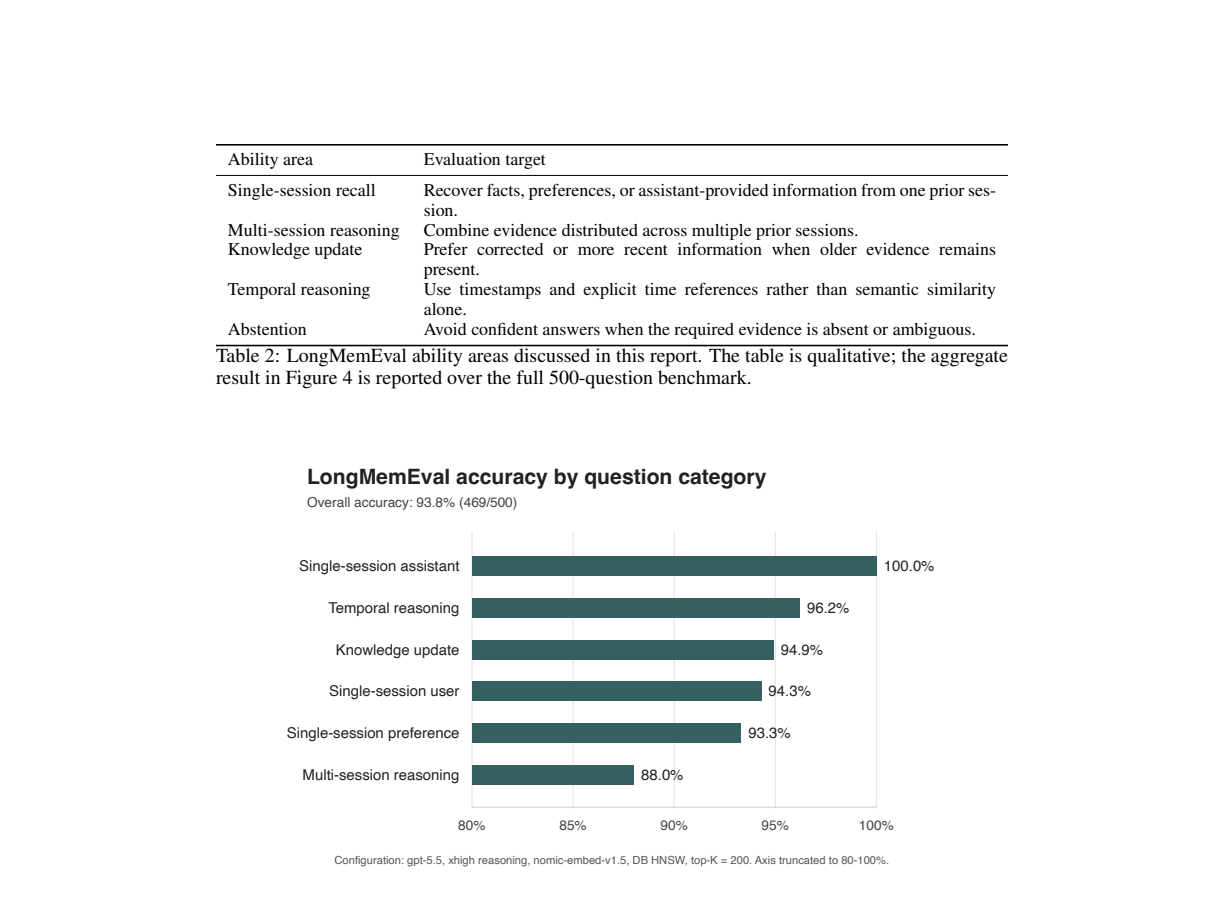
These requirements extend beyond document retrieval: a memory layer must determine which interactions become durable state, how that state is scoped, how it is retrieved under latency constraints, and how it is revised or removed over time. This report studies Oracle Agent Memory as a database-native memory substrate built on Oracle Database. Three themes organize the discussion: memory as a lifecycle spanning ingestion, extraction, consolidation, retrieval, summarization, and revision or removal; a layered architecture that separates an active memory core from a passive memory-store interface with explicit scope control across users, agents, and threads; and evaluation methodology in which downstream task accuracy is complemented by memory-centric measures such as evidence retrieval, recall, latency, and estimated token use. The report summarizes LongMemEval results, reaching 93.8% accuracy, compares Oracle Agent Memory against flat-history baselines, using about 10.7x fewer tokens, and published or reported external baselines where available, and closes with implementation-oriented appendix material covering setup, thread lifecycle, and search semantics.
from the abstract
Pith says
Machine review · deepseek-v4-flash · 2 Aug 2026 · what was read was not recorded · not checked by a person
It can be wrong. Challenge this review or reply to it.
Holds up, with conditions. Worth reading for the architecture and candor, but the headline accuracy and token-savings numbers come from different experiments and are not yet independently verifiable. This line is wrong
5 major objections · 6 minor
How often objections from reviews like this one are right: not yet measured
Not checked: figures, code, what the 28 references say.
The paper says, at Abstract; §7.1–7.3
The review did not quote this passage.
Pith says: Objection 1 of 5 · major
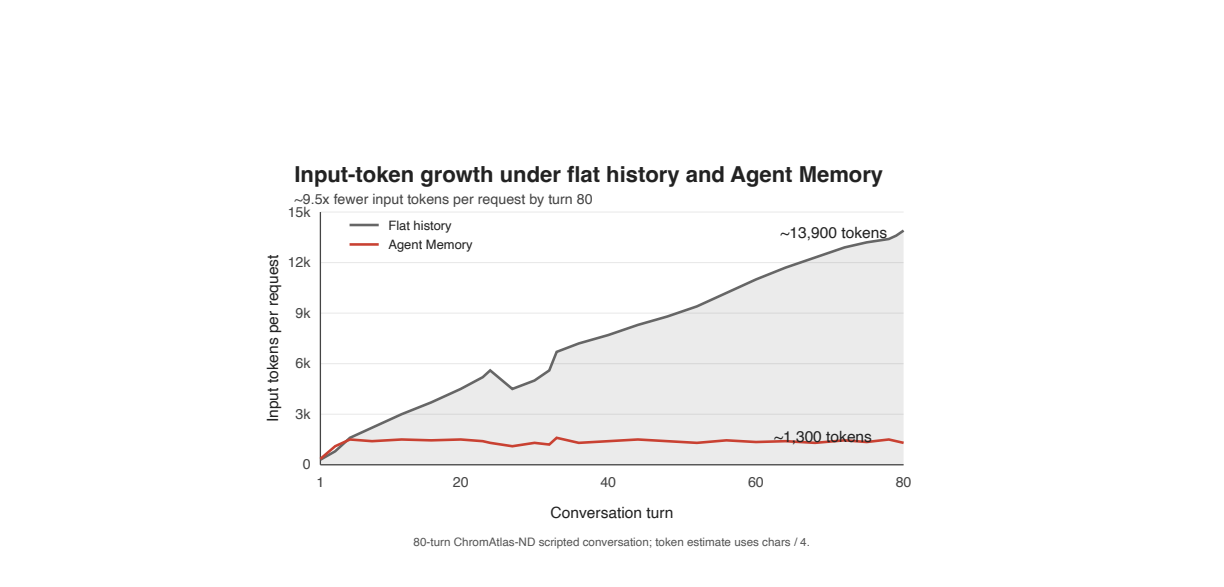
The abstract pairs 93.8% LongMemEval accuracy with ~10.7× fewer tokens, but these numbers are not measurements from a single evaluation. §7.1 reports LongMemEval under gpt-5.5 with xhigh reasoning and top-K=200, while §7.2 reports estimated token growth on an 80-turn ChromAtlas-ND scripted conversation using a chars/4 estimator.
more of objection 1
No per-question input-token count is given for the LongMemEval run. With top-K=200, the retrieved context alone could push per-question input tokens far above the ~1,300 figure reported for the scripted conversation. Please provide a single consistent evaluation in which accuracy and per-question token use are measured on the same benchmark, configuration, and prompt pipeline.
The paper says, at §7; §7.1
The review did not quote this passage.
Pith says: Objection 2 of 5 · major
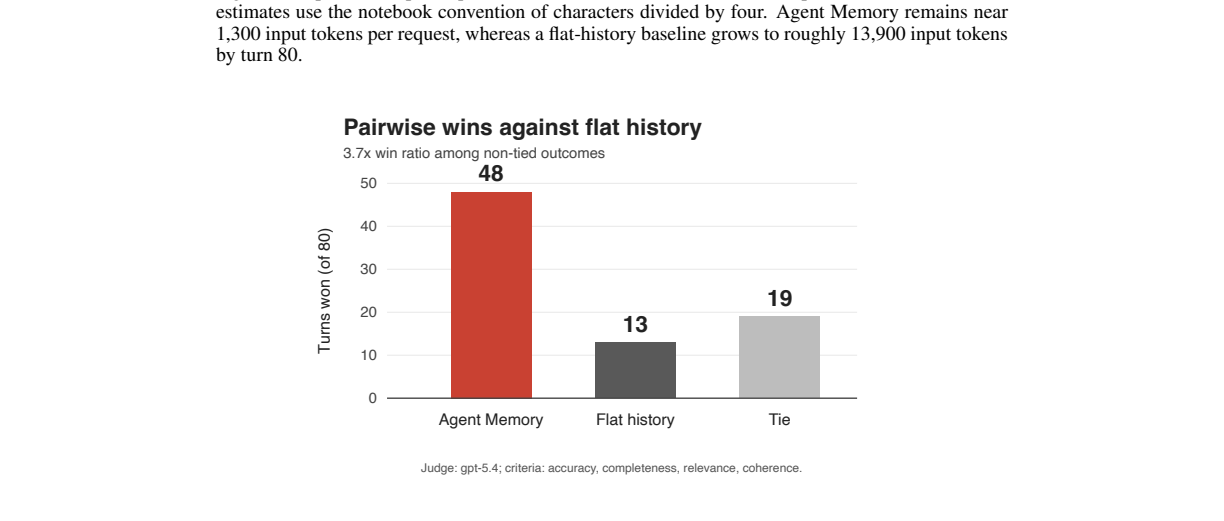
The paper states that 'exact prompts, model snapshots, and run metadata are not fully enumerated' and does not release code, data, or judge outputs. The headline accuracy and pairwise-win results are therefore not independently reproducible. In particular, the flat-history baseline prompt construction and the gpt-5.4 judge are not described at the level needed to rule out prompt-construction or length bias favoring the memory-managed answers.
more of objection 2
Please release the exact prompts, per-item scores, judge outputs, dataset versions, and configuration files, or at minimum include them in an appendix.
The paper says, at §7.2; Figure 5 caption
The review did not quote this passage.
Pith says: Objection 3 of 5 · major
The token-ratio claim is internally inconsistent: the text and abstract report 'roughly 10.7× fewer tokens,' while the Figure 5 caption states '~9.5x fewer input tokens per request by turn 80.' The rounded values ~13,900 and ~1,300 give ~10.7, so the caption appears to reflect a different calculation or segment. Since this number is a central headline claim, the discrepancy must be reconciled and the estimator defined precisely.
The paper says, at §7.4; Figure 7
The review did not quote this passage.
Pith says: Objection 4 of 5 · major
The summarization-threshold sweep reports the 10,000-token trigger as producing the 'lowest reported mean' total token estimate, but no answer-quality or accuracy metric is reported for each threshold, and only five runs per threshold are used. The choice of operating point is therefore selected on the test data without a cost-quality tradeoff curve.
more of objection 4
Please report mean ± variance for each threshold together with an accuracy or retrieval-quality metric, and clarify whether the 10k trigger was selected before or after inspecting the results.
The paper says, at §7.6; Table 3
The review did not quote this passage.
Pith says: Objection 5 of 5 · major
The BEAM 10M result reports a mean answer input token count of 122,720.8, which is orders of magnitude above the ~1,300 tokens claimed for the 80-turn scripted conversation. The paper acknowledges this is an early stress-test measurement, but it materially narrows the general claim of 'order-of-magnitude lower token cost.' The scope of the token-efficiency claim should be stated explicitly so that readers do not generalize the 10.7× figure to all long-horizon settings.
6 minor objections
The paper says, at §7.2 / Figure 5
Pith says: minor objection 1 of 6
Please ensure the caption and body text use the same ratio and the same rounding convention; currently '~9.5x' and '~10.7×' both appear for the same result.
The paper says, at Figure 4
Pith says: minor objection 2 of 6
The axis truncation to 80–100% is acceptable, but adding category-level n counts or confidence intervals would help readers assess the stability of the category percentages, especially the 100.0% single-session assistant score.
show 4 more
The paper says, at §7.3 / Figure 6
Pith says: minor objection 3 of 6
The pairwise judgment reports 48 wins, 13 losses, 19 ties. It would be useful to report the standard deviation across turns or a paired significance test, since 48/80 could be sensitive to a few prompt-format choices.
The paper says, at §7.6 / Table 3
Pith says: minor objection 4 of 6
The table caption and surrounding text use 'Table 3' but the table appears before the reference in the text; please renumber or restructure so the cross-reference is clear.
The paper says, at §3.2
Pith says: minor objection 5 of 6
The sentence 'RAG combines a parametric sequence-to-sequence model with a dense non-parametric memory' is a simplification; RAG is not inherently sequence-to-sequence. Consider a more neutral phrasing.
The paper says, at §7.5
Pith says: minor objection 6 of 6
The 'intermediate operating point' recommendation is sensible but is presented as guidance without supporting measurements. If retained, mark it clearly as a design recommendation rather than an evaluated result.
What would settle it
Obtain the exact LongMemEval prompt template and retrieval-to-prompt mapping used for the 93.8% result. Reproduce the 500-question run with token accounting: compute mean input tokens per question for Agent Memory and for a flat-history baseline using the same model, embedding model, and scoring. If Agent Memory's mean tokens per question is not at least 5x lower than the flat-history baseline on the same 500 questions, the headline claim fails. Also recompute the per-turn token ratio for the ChromAtlas-ND conversation from raw logs to resolve whether it is 9.5x or 10.7x.
from the skeptic's reading
How the review went
4 readings by deepseek-v4-flash · 2 Aug 2026
- Reader holds up, with conditions
- Skeptic partly agrees
- Editor wrote the verdict above
- Referee major revision: 5 major objections, 6 minor
Not run on this paper: the simulated authors' defence.
Pith did not check this review's objections against the paper.
The review in full
The review in brief, machine-written
You should know this about the paper: the two headline numbers don't come from the same experiment. The 93.8% LongMemEval accuracy is from a run with gpt-5.5, top-K=200, on LongMemEval. The 10.7x token saving is from an 80-turn scripted ChromAtlas-ND conversation, estimated with a chars/4 approximation. The abstract pairs them as if one configuration achieves both, but the paper doesn't provide a per-question token count for the LongMemEval run. The stress-test note is right about this.
What's actually new: the database-native memory substrate with explicit user/agent/thread scoping, and a security story that puts authorization in the database layer. That's a legitimate design contribution, especially compared to assembling memory from separate services. The lifecycle taxonomy—working, factual, procedural—is standard but clearly presented. The paper is well-organized and unusually candid: it explicitly says exact prompts, model snapshots, and run metadata are not enumerated, and it labels the token estimates as approximate. The BEAM section is refreshingly explicit about scoring-convention differences.
Soft spots beyond the experiment mismatch: no code, data, or exact prompts are released, so nothing is independently verifiable. The flat-history comparison on the scripted conversation uses a gpt-5.4 judge, and it's not connected to the LongMemEval accuracy run. The summarization-trigger sweep is on an eight-query demo, which is thin. The figure caption says ~9.5x while the text says 10.7x, a minor but real internal inconsistency. None of this is fatal—the architecture is coherent and the limitations are stated—but the cost-quality claim as advertised is not yet supported by any single consistent evaluation.
Who this is for: anyone working on agent memory systems, especially in enterprise settings. The architecture discussion and the evaluation-methodology arguments in Section 8 are worth reading even if you don't trust the numbers.
My recommendation: send it to peer review, but with the expectation that the authors release the evaluation harness, exact prompts, and run metadata, or narrow their claims accordingly. The paper deserves a serious referee because it's a thoughtful systems design with honest reporting, but the current evidence is configuration-specific and incomplete. I wouldn't cite it yet.
The strongest objection
The abstract and reader's summary pair two headline numbers as if they come from one system evaluation: 93.8% LongMemEval accuracy and ~10.7x lower token use. Reading Sections 7.1 and 7.2 carefully, these numbers are not measurements of the same experiment. Section 7.1 reports an accuracy run on LongMemEval using gpt-5.5 with xhigh reasoning, nomic-embed-v1.5, DB HNSW, and top-K=200. Section 7.2 reports token growth on an 80-turn ChromAtlas-ND scripted conversation, using the chars/4 estimator; that is a different dataset, likely a different prompt, and no per-question token count for the LongMemEval run is given. If the LongMemEval prompt injects a large retrieved context (e.g., top-200 chunks), the input tokens per question would be far above the ~1,300 claimed for the scripted conversation, so the order-of-magnitude cost advantage may not hold for the very configuration that produced 93.8%. The paper explicitly says exact prompts, model snapshots, and run metadata are not enumerated, and even the token-ratio caption (9.5x) disagrees with the text (10.7x). The central claim—'competitive long-horizon memory at an order-of-magnitude lower token cost'—is therefore not yet supported by any single consistent evaluation; it stitches together two independent demonstrations. This is a measurement/consistency concern, not a claim that the components are fraudulent.
The reader's verdict of CONDITIONAL is appropriate, and this stress-test identifies a more specific gap: the two headline metrics come from different experimental setups, so the abstract's implied joint claim is not internally consistent. This is more concrete than a general concern about prompt construction, though it is related. The architecture and design appear coherent, and the paper is candid about many limitations, but the evidence as presented does not establish that the high-accuracy configuration also enjoys the 10.7x token advantage. A single experiment measuring both accuracy and token use on LongMemEval, with exact prompts released, would settle this. If the LongMemEval prompts are compact and the system does hold token use low, the central claim would be substantially supported; if not, the claim would be overstated. The same test would also address the reader's broader worry about prompt artifacts by making the comparison transparent. Since the concern is addressable and does not call the core design into question, the verdict stays CONDITIONAL rather than moving to REJECT or ACCEPT.
The referee's report
If the evaluation were fully supported, this would be a useful systems contribution: it connects agent-memory requirements to database capabilities, offers a clear scoping model, and augments downstream accuracy with memory-centric diagnostics such as retrieval recall, latency, and token estimates. The authors are explicit that results are configuration-specific and list limitations candidly, which is a strength. However, the headline cost-quality claim is currently assembled from separate experiments with undisclosed prompts and approximate token estimation, so the significance cannot be fully assessed from the manuscript as written. The architecture and taxonomy are clearly described and likely useful to practitioners, but the empirical basis for the order-of-magnitude token claim needs substantial strengthening.
Pith's reading of the paper (a machine's summary, not the authors')
This paper is trying to establish that long-horizon agent memory is best treated as a database-native systems lifecycle—select what becomes durable, store it under explicit user/agent/thread scope, retrieve it under latency constraints, and revise it over time—rather than as a retrieval layer bolted onto a transcript. It reports a concrete implementation of this idea and claims it reaches 93.8% accuracy on the LongMemEval benchmark (469 of 500 questions), uses roughly 10.7x fewer estimated input tokens per request than a flat-history agent by turn 80, and wins 48 of 80 pairwise-judged turns against that baseline. The intended upshot is that an enterprise agent can keep working context bounded, cut cost and latency, and still answer accurately, while memory governance inherits the database's security model. A sympathetic reader would care because long-horizon agents currently rely on either unbounded transcript growth or ad hoc memory glue, and the paper offers a single substrate that separates active memory policy from a passive, reusable store.
What carries the argument. The load-bearing mechanism is the thread-centric memory lifecycle implemented as a layered stack: an active memory core that synchronizes messages, produces bounded context cards and summaries, and triggers extraction, sitting above a passive memory-store API for insert/search with explicit scope. The underlying schema unifies raw messages, durable memories, actor profiles, and chunked vectorized records under user, agent, and thread identifiers, with exact-match flags controlling retrieval strictness. This design lets the system materialize a compact next-turn prompt while keeping raw evidence searchable and governed in the database.
Core claim. The paper's central claim is that a memory layer with a full lifecycle—ingestion, extraction, consolidation, retrieval, summarization, and revision/removal—can be built squarely on a relational-plus-vector database and still outperform both flat history and published baselines. The authors assert that on LongMemEval their configuration reaches 93.8% overall accuracy, that the 80-turn flat-history comparison favors Agent Memory 48 to 13 with 19 ties, and that keeping prompt context bounded near 1,300 estimated input tokens versus roughly 13,900 for flat history corresponds to about 10.7x fewer estimated input tokens. They frame these numbers as configuration-specific measurements, not univers
The premise it rests on. The load-bearing premise is that the reported numbers measure memory quality and not artifacts of prompt construction or configuration: the report states exact prompts, model snapshots, and run metadata are not fully enumerated, and the token savings are estimated by dividing character counts by four rather than by billing a tokenizer.
If the paper is right (Pith's inferences, not the authors')
Long-horizon agents can keep per-turn prompt size roughly constant instead of growing linearly, which directly reduces latency and estimated token cost as conversations extend.
Scoped retrieval across user, agent, and thread makes multi-tenant or multi-agent memory feasible without moving authorization out of the database.
Bounded, focused context can beat a full verbatim transcript on judged answer quality, suggesting transcript completeness is not the main driver of long-conversation accuracy.
Compaction thresholds are a tunable operating parameter: aggressive summarization saves tokens but erodes fidelity, and the right setting depends on the workload.
Order-sensitive long-context tasks, especially event ordering and summarization at 10M-token scale, remain weak even when retrieval succeeds, pointing where the memory model must grow.
We infer that if the token estimates survive provider-billed measurement, memory substrates of this kind shift the economic case for long-session agents from 'more context tokens' to 'retrieval quality plus prompt organization.'
We infer that benchmark practice should adopt the paper's three-layer split—evidence retrieval, evidence use, final outcome—because a single accuracy number cannot locate failures in extraction, scoping, or generation.
We infer that the architecture's extensibility to graph-aware and order-preserving memory artifacts is the natural next test: BEAM's event-ordering weakness suggests flat semantic retrieval is insufficient for sequence-critical procedures.
Check this review
Pith stored no record of this review's passes and took no fingerprint of it. Reviews made by code from 13 Nov 2026 on carry both.
How often reviews like this one are right
Reviews like this one: written by deepseek-v4-flash, where what was read was not recorded.
How often objections from reviews like this one are right: not yet measured
Reviews by people
This review was written by a machine. No person has reviewed this paper on Pith yet. A scientist listed on Pith can review it for a fee, and their review is published here whatever it concludes.
The paper
Abstract
Agent memory is a systems problem for long-horizon agents. Practical deployments require retention of task state across extended conversations, recovery of user-specific facts and preferences across sessions, and accumulation of procedural knowledge from prior outcomes. These requirements extend beyond document retrieval: a memory layer must determine which interactions become durable state, how that state is scoped, how it is retrieved under latency constraints, and how it is revised or removed over time. This report studies Oracle Agent Memory as a database-native memory substrate built on Oracle Database. Three themes organize the discussion: memory as a lifecycle spanning ingestion, extraction, consolidation, retrieval, summarization, and revision or removal; a layered architecture that separates an active memory core from a passive memory-store interface with explicit scope control across users, agents, and threads; and evaluation methodology in which downstream task accuracy is complemented by memory-centric measures such as evidence retrieval, recall, latency, and estimated token use. The report summarizes LongMemEval results, reaching 93.8% accuracy, compares Oracle Agent Memory against flat-history baselines, using about 10.7x fewer tokens, and published or reported external baselines where available, and closes with implementation-oriented appendix material covering setup, thread lifecycle, and search semantics.
The paper's own sentences, arranged, kept beside the review and separate from it. Each label is drawn from a closed vocabulary; the number beside it is the probability the classifier gave that label. No sentence in this record was written by a model.
abstract compiled · 2026-09-23
The authors' main claim, as the classifier picked it out 0.98
“The report summarizes LongMemEval results, reaching 93.8% accuracy, compares Oracle Agent Memory against flat-history baselines, using about 10.7x fewer tokens, and published or reported external baselines where available, and closes with implementation-oriented appendix material covering setup, thread lifecycle, and search semantics.”
How the main claim is stated: asserted 1.00
What the abstract itself states, as probabilities: claims first 0.04 · states limitation 0.11 · human participants 0.12 · controlled comparison 0.95 · randomized assignment 0.02 · states quantitative result 0.99 · compares with prior results 0.98 · mentions code or data availability 0.09
The abstract, sentence by sentence
This table labels the abstract only (arXiv listing abstract v1). The number is the probability the classifier gave the label.
| Sentence | Role | The authors' own work | States the main conclusion | Strength |
|---|---|---|---|---|
| Agent memory is a systems problem for long-horizon agents. | background 1.00 | 0.10 | 0.07 | asserted 1.00 |
| Practical deployments require retention of task state across extended conversations, recovery of user-specific facts and preferences across sessions, and accumulation of procedural knowledge from prior outcomes. | background 0.99 | 0.07 | 0.04 | asserted 1.00 |
| These requirements extend beyond document retrieval: a memory layer must determine which interactions become durable state, how that state is scoped, how it is retrieved under latency constraints, and how it is revised or removed over time. | background 0.68 | 0.08 | 0.04 | asserted 1.00 |
| This report studies Oracle Agent Memory as a database-native memory substrate built on Oracle Database. | contribution 0.94 | 0.55 | 0.07 | asserted 0.99 |
| Three themes organize the discussion: memory as a lifecycle spanning ingestion, extraction, consolidation, retrieval, summarization, and revision or removal; a layered architecture that separates an active memory core from a passive memory-store interface with explicit scope control across users, agents, and threads; and evaluation methodology in which downstream task accuracy is complemented by memory-centric measures such as evidence retrieval, recall, latency, and estimated token use. | contribution 0.65 | 0.57 | 0.10 | asserted 0.97 |
| The report summarizes LongMemEval results, reaching 93.8% accuracy, compares Oracle Agent Memory against flat-history baselines, using about 10.7x fewer tokens, and published or reported external baselines where available, and closes with implementation-oriented appendix material covering setup, thread lifecycle, and search semantics. | result 0.88 | 0.90 | 0.47 | asserted 1.00 |
What kind of paper the classifier reports this is: method or tool 0.99 · evidence from observation or experiment 0.90
What was examined, and what was not
Sources read
- arXiv listing abstract v1
Not examined
- full text
- figures and tables
- references and citing sentences
- relations to other papers
Levels run
- P abstract
Not run
- S sections
- T body sentences
- C citations
- R cross-paper relations
How the labels were made
Compiled by classifier-1.13.0 via TypeSafe API, question bank abstract-p1-20260923, 2026-09-23: 1 request, 5,067 input tokens.
Every quoted sentence on this record is the authors'. Every label is from Pith's closed vocabulary, with the probability shown beside it. This record as JSON
Figures (7)



Figures are the authors', reproduced from the paper.
References (28)
- [1] Richmond Alake. Oracle AI agent memory: A governed, unified memory core for enterprise AI agents. Oracle Developers Blog, 2026 on Pith
- [2] Anthropic. Prompt caching. Anthropic Documentation, 2026 on Pith
- [3] Iz Beltagy, Matthew E. Peters, and Arman Cohan. Longformer: The long-document trans- former, 2020 on Pith
- [4] Sebastian Borgeaud, Arthur Mensch, Jordan Hoffmann, et al. Improving language models by retrieving from trillions of tokens. InProceedings of the 39th International Conference on Machine Learning, 2022 on Pith
- [5] Prateek Chhikara, Dev Khant, Saket Aryan, Taranjeet Singh, and Deshraj Yadav. Mem0: Building production-ready AI agents with scalable long-term memory, 2025 on Pith
- [6] Kelvin Guu, Kenton Lee, Zora Tung, Panupong Pasupat, and Ming-Wei Chang. REALM: Retrieval-augmented language model pre-training. InProceedings of the 37th International Conference on Machine Learning, 2020. 18 on Pith
- [7] Yuanzhe Hu, Yu Wang, and Julian McAuley. Evaluating memory in LLM agents via incre- mental multi-turn interactions, 2025 on Pith
- [8] Yuyang Hu, Shichun Liu, Yanwei Yue, et al. Memory in the age of AI agents, 2025 on Pith
- [9] Vladimir Karpukhin, Barlas Oguz, Sewon Min, Patrick Lewis, Ledell Wu, Sergey Edunov, Danqi Chen, and Wen-tau Yih. Dense passage retrieval for open-domain question answering. InProceedings of the 2020 Conference on Empirical Methods in Natural Language Process- ing, 2020 on Pith
- [10] LangChain. Langmem. GitHub repository, 2026 on Pith
- [11] Letta. Letta. GitHub repository, 2026 on Pith
- [12] Patrick Lewis, Ethan Perez, Aleksandra Piktus, Fabio Petroni, Vladimir Karpukhin, Naman Goyal, Heinrich Kuttler, Mike Lewis, Wen-tau Yih, Tim Rocktaschel, Sebastian Riedel, and Douwe Kiela. Retrieval-augmented generation for knowledge-intensive NLP tasks. InAd- vances in Neura... on Pith
- [13] Nelson F. Liu, Kevin Lin, John Hewitt, Ashwin Paranjape, Michele Bevilacqua, Fabio Petroni, and Percy Liang. Lost in the middle: How language models use long contexts.Transactions of the Association for Computational Linguistics, 2024 on Pith
- [14] Adyasha Maharana, Dong-Ho Lee, Sergey Tulyakov, Mohit Bansal, Francesco Barbieri, and Yuwei Fang. Evaluating very long-term conversational memory of LLM agents, 2024 on Pith
- [15] OpenAI. Prompt caching. OpenAI API Documentation, 2026 on Pith
- [16] Oracle. Introducing oracle deep data security: Identity-aware data access control for agentic AI in oracle AI database 26ai. Oracle Database Blog, 2026 on Pith
- [17] Oracle. Oracle deep data security: Database-enforced access control for agentic AI, analytics, and enterprise applications. Oracle Technical Brief, 2026 on Pith
- [18] Oracle. Safely unleash AI on enterprise data with deep data security. Oracle Database Security, 2026 on Pith
- [19] Charles Packer, Sarah Wooders, Kevin Lin, Vivian Fang, Shishir G. Patil, Ion Stoica, and Joseph E. Gonzalez. MemGPT: Towards LLMs as operating systems. InICML Workshop on LLM Agents, 2024 on Pith
- [20] Joon Sung Park, Joseph C. O’Brien, Carrie J. Cai, Meredith Ringel Morris, Percy Liang, and Michael S. Bernstein. Generative agents: Interactive simulacra of human behavior, 2023 on Pith
show 8 more
- [21] Preston Rasmussen, Pavlo Paliychuk, Travis Beauvais, Jack Ryan, and Daniel Chalef. Zep: A temporal knowledge graph architecture for agent memory, 2025 on Pith
- [22] Timo Schick, Jane Dwivedi-Yu, Roberto Dessi, Roberta Raileanu, Maria Lomeli, Eric Hambro, Luke Zettlemoyer, Nicola Cancedda, and Thomas Scialom. Toolformer: Language models can teach themselves to use tools, 2023 on Pith
- [23] Noah Shinn, Federico Cassano, Edward Berman, Ashwin Gopinath, Karthik Narasimhan, and Shunyu Yao. Reflexion: Language agents with verbal reinforcement learning, 2023 on Pith
- [24] Mohammad Tavakoli, Alireza Salemi, Carrie Ye, Mohamed Abdalla, Hamed Zamani, and J. Ross Mitchell. Beyond a million tokens: Benchmarking and enhancing long-term memory in LLMs, 2026 on Pith
- [25] Di Wu, Hongwei Wang, Wenhao Yu, Yuwei Zhang, Kai-Wei Chang, and Dong Yu. Long- MemEval: Benchmarking chat assistants on long-term interactive memory. InInternational Conference on Learning Representations, 2025 on Pith
- [26] Wujiang Xu, Zujie Liang, Kai Mei, Hang Gao, Juntao Tan, and Yongfeng Zhang. A-Mem: Agentic memory for LLM agents, 2025. 19 on Pith
- [27] Shunyu Yao, Jeffrey Zhao, Dian Yu, Nan Du, Izhak Shafran, Karthik Narasimhan, and Yuan Cao. ReAct: Synergizing reasoning and acting in language models. InInternational Confer- ence on Learning Representations, 2023 on Pith
- [28] Zeyu Zhang, Xiaohe Bo, Chen Ma, Rui Li, Xu Chen, Quanyu Dai, Jieming Zhu, Zhenhua Dong, and Ji-Rong Wen. A survey on the memory mechanism of large language model based agents, 2024. 20 A Appendix: Setup and Configuration Oracle Agent Memory is exposed as a Python-facing compon... on Pith
Cited by 2 Pith papers
Reviewed papers on Pith that cite this one. The full citation record
- Learning from Research: Toward Lifelong Agent Harness Evolution cs.AI · Sep 2026
- AkasicMEM: Governed Enterprise Memory for Agents cs.DB · Sep 2026
How the literature uses it
What this paper does with the arXiv papers it cites
What it cites · 24 sentences without a confident label
Cites as support 2 papers
-
Memory in agentic systems spans multiple forms, functions, and temporal dynamics, and is not adequately characterized by a simple short-term versus long-term dichotomy [ref] .
A Survey on the Memory Mechanism of Large Language Model based Agents · Introduction · 0.99
-
Memory in agentic systems spans multiple forms, functions, and temporal dynamics, and is not adequately characterized by a simple short-term versus long-term dichotomy [ref] .
Memory in the Age of AI Agents · Introduction · 0.99
Cites as background 9 papers
-
MemoryAgentBench moves further toward online agent behavior by testing incremental multi-turn interactions in which memory must support repeated decision making rather than a single isolated answer [ref] .
Evaluating Memory in LLM Agents via Incremental Multi-Turn Interactions · Memory Benchmarks · 0.84
-
Section 3 described related benchmarks, including LoCoMo and MemoryAgentBench [ref] .
Evaluating Very Long-Term Conversational Memory of LLM Agents · Evaluation and Benchmarking · 0.97
-
Zep represents agent memory through a temporal knowledge graph that supports evolving entities and relationships over time [ref] .
Zep: A Temporal Knowledge Graph Architecture for Agent Memory · Contemporary Agent-Memory Systems · 0.96
Challenges and discussion
Disagree with the review, or know something it missed? Leave a comment, or challenge this review formally: a challenge becomes a permanent entry in this paper's record, and its decision is published here.
Come back by email
A short list of the week's newly reviewed papers. Nothing is sent until you confirm from your inbox, and every email has a link that stops it. No account.
No comments yet.
Sign in to comment