REVIEW 5 major objections 4 minor 87 references
The best SSL training paradigm depends on the method, domain, and label count
Reviewed by Pith at T0; open to challenge. T0 means a machine referee read the full paper against a public rubric. the ladder, T0–T4 →
T0 review · deepseek-v4-flash
2026-08-02 05:54 UTC pith:2CNCMRME
load-bearing objection Broad, useful benchmark, but the PFT–JT comparison is confounded: PFT freezes the backbone for classification/IQA while JT trains it end-to-end, so the headline claims overstate the joint-objective effect. the 5 major comments →
Self-Supervised Visual Representation Learning: Pretrain-Finetuning or Joint Training?
The pith
A machine-rendered reading of the paper's core claim, the machinery that carries it, and where it could break.
Core claim
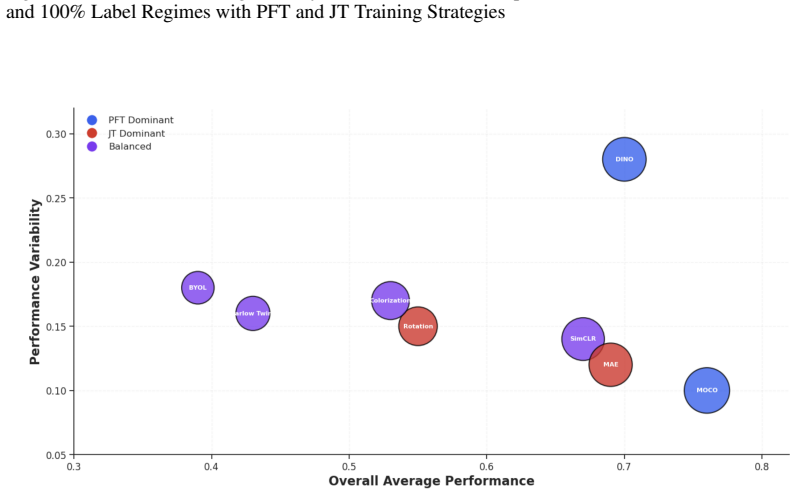
The paper establishes that the relative effectiveness of pretrain-finetune (PFT) and joint training (JT) is governed by the SSL objective, the downstream task, the domain, and the labeled-data fraction. Reconstruction-oriented and auxiliary-task methods (Colorization, Rotation, MAE) generally benefit from JT, sometimes with large gains — for example, Colorization on CIFAR-10 rises from 0.5090 accuracy under PFT to 0.9099 under JT at full labels, and MAE from 0.5920 to 0.8341. Contrastive and redundancy-reduction methods (SimCLR, MoCo, DINO, Barlow Twins) often transfer better under PFT, especially in specialized domains like crisis response, medical imaging, and image quality assessment. JT
What carries the argument
The central comparison is between two training protocols instantiated across eight SSL methods: PFT, which pretrains a backbone (ResNet-18, or ViT for MAE) with a self-supervised loss and then trains only a downstream head on labeled data; and JT, which optimizes L_total = L_SSL + L_sup simultaneously on the shared encoder. The benchmark spans classification (CIFAR-10, CrisisMMD, ISIC, JSRT), detection (COCO, PASCAL VOC), segmentation (ISIC, JSRT, EarthScape), and image quality assessment (KADID-10k, KonIQ-10k, LDCTIQA) at 10%, 20%, 50%, and 100% labeled fractions. The fixed equal weighting of the two losses in JT is a key design choice, as the paper does not tune a loss weight.
Load-bearing premise
The paper assumes that adding the self-supervised and supervised losses with equal, fixed weights is a fair and representative implementation of joint training, and that single-seed runs are sufficient to establish consistent trends.
What would settle it
Re-run a representative subset (e.g., CIFAR-10 with Colorization and SimCLR) over a grid of loss weights (λ from 0.1 to 10) and check whether the JT-vs-PFT ranking flips for any λ; if it does, the equal-weighting choice is load-bearing. Also repeat the main comparisons with multiple random seeds: if the JT advantages (e.g., Colorization 0.9099 vs 0.5090) are not consistent across seeds, the 'consistent trends' claim is weakened.
If this is right
- Practitioners with scarce labels can adopt joint training for reconstruction-based SSL methods to gain both accuracy and a large reduction in training time.
- In specialized domains (medical, crisis, remote sensing) and for contrastive SSL methods, the conventional two-stage pretrain-finetune pipeline remains a safer default.
- JT's computational savings of up to 7–8× make it attractive for rapid iteration and resource-constrained deployment when task performance is competitive.
- The benchmark offers a reference map of which SSL objectives are compatible with joint optimization, helping practitioners avoid known failure cases such as Rotation-on-JSRT segmentation.
Where Pith is reading between the lines
- The equal weighting of L_SSL and L_sup is a strong simplifying choice; tuning the loss weight or scheduling it over training could change which methods prefer JT, so the practical guidance may need re-qualification.
- The paper's single-seed runs leave open whether the 'consistent' trends are statistically robust; multi-seed re-runs would strengthen or qualify the claims.
- A testable hypothesis suggested by the results: SSL objectives that preserve spatial structure (colorization, masked reconstruction) align with supervised gradients and thus benefit from JT, while objectives that enforce invariance (contrastive) compete with them; measuring gradient alignment could predict JT benefit.
- The CLIP extension on CIFAR-10 shows JT underperforming PFT at 10% labels, hinting that the interaction may differ for contrastive-language objectives; this deserves exploration on larger multimodal datasets.
Editorial analysis
A structured set of objections, weighed in public.
Referee Report
Summary. The paper compares two paradigms for combining self-supervised and supervised learning: pretrain-then-finetune (PFT) and joint training (JT). Across eight SSL methods (Colorization, Rotation, SimCLR, BYOL, MoCo, DINO, MAE, Barlow Twins) and eleven datasets spanning natural, medical, crisis, remote-sensing, detection, and IQA tasks, the authors report performance under 10–100% labeled data, plus analyses of robustness, efficiency, interpretability, and cross-domain transfer. The stated conclusion is that JT is often more data- and training-efficient and robust in low-label settings, while PFT tends to be more reliable in specialized domains and for contrastive methods. The paper is primarily an empirical benchmark and presents a large set of tables and figures in support of this conclusion.
Significance. If the comparison were clean, this would be a useful benchmark for practitioners choosing between two-stage SSL and joint training. The breadth of methods, domains, and tasks is a real strength, as is the consistent reporting of training time alongside accuracy. However, the central comparison is confounded by an asymmetric evaluation protocol: for classification, IQA, and most segmentation experiments, PFT uses a frozen backbone and trains only a head, while JT trains the entire encoder. In addition, nearly every quantitative claim rests on a single fixed-random-seed run with no error bars. The inconsistencies between the abstract's sweeping claims and the appendix's own results (e.g., Barlow Twins collapsing under JT on crisis data, DINO degrading sharply on EarthScape) further weaken the conclusions as stated. The paper's breadth makes the topic significant, but the present evidence does not cleanly support the headline claims.
major comments (5)
- [Sec. 4.1, Fig. 1, Table 2] The PFT vs JT comparison is confounded by unequal trainable capacity. In Sec. 4.1 the authors state that for classification and IQA 'the encoder is frozen and only a linear layer is trained' in PFT, and Fig. 1 says 'During fine-tuning, the pretrained backbone is kept frozen.' In JT, by contrast, 'the encoder is shared and optimized jointly through both supervised and self-supervised losses.' Thus any JT advantage could stem from adapting the backbone to the task, not from the joint SSL+supervised objective. A concrete example is Colorization on CIFAR-10 (Table 2): PFT reaches only 0.5090 accuracy while JT reaches 0.9099, yet a conventionally fine-tuned ResNet-18 with only supervised loss typically exceeds 0.90 on CIFAR-10. Without a PFT control that also fine-tunes the backbone (supervised loss only), the paper's central comparison is not cleanly interpretable. This is the load-bearing p
- [Abstract, Sec. 4.2, Tables 4 and 13] The abstract's claim that 'JT consistently improves data and training efficiency while being robust in low-label settings' is contradicted by the paper's own appendix results. On CrisisMMD (Table 4), Barlow Twins JT drops to 0.6258 accuracy / 0.6130 F1 at 100% labels versus 0.7169 / 0.6885 under PFT, and cross-domain DMD F1 falls from 0.6845 to 0.4661. On EarthScape (Table 13), DINO JT at 100% labels drops from 0.6230/0.8487 to 0.5126/0.5552 accuracy/F1, and cross-domain F1 drops from 0.8038 to 0.4964. The body of Sec. 4.2 does acknowledge these instabilities, but the abstract and conclusion overstate consistency. The wording should be aligned with the actual, heavily conditional findings.
- [Tables 2–14, Sec. H.1] Every quantitative result appears to be a single point estimate with a fixed random seed ('a fixed random seed of 1' in Sec. H.1), with no error bars, multiple seeds, or significance tests. Many reported differences are small — for example, Table 7 shows COCO detection mAP differences as tiny as 0.001–0.003 between PFT and JT, and Table 8 shows almost identical cross-domain VOC mAP values. Without repeated runs or variance estimates, claims of 'consistent' improvement or degradation cannot be supported, especially for the training-time and 'comparable performance' statements. At minimum, the authors should report mean±std over at least three seeds for a subset of key experiments, or explicitly caveat all qualitative conclusions.
- [Sec. 4.1, Sec. H.1] The PFT protocol is not defined consistently across tasks. For classification and IQA, PFT is linear probing with a frozen backbone. For object detection, the authors write that they 'fine-tune YOLOv12' after injecting pretrained weights — i.e., the backbone is trained. For segmentation, the encoder is frozen and only the U-Net decoder is optimized (Sec. H.1: 'the SSL encoder is frozen, and only the U-Net decoder is optimized'). This means the comparison across tasks simultaneously changes the definition of PFT, making the headline conclusion 'relative effectiveness depends on task' partly an artifact of protocol inconsistency. The authors should adopt a uniform PFT definition (e.g., supervised fine-tuning of the full model, or both frozen- and fine-tuned variants) across all task families.
- [Sec. 3, Eq. (1)–(2)] The JT objective is defined as L_total = L_SSL + L_sup with equal weighting, and no loss-weight tuning or sensitivity analysis is reported. The relative benefit of JT is likely sensitive to this weighting; a fixed equal weight may favor some SSL methods (e.g., reconstruction losses with small magnitude) and disfavor others. The paper's practical guidance about which methods benefit from JT is therefore conditional on an arbitrary weighting choice. The authors should either justify the equal-weight choice with a sensitivity analysis or explicitly restrict the claims to this protocol.
minor comments (4)
- [Table 8] The MAE PFT 100% row in Table 8 reports the same COCO metrics as the 10% row (0.494 P, 0.375 R, 0.376 mAP, 0.252 mAP50–95), which appears to be a copy/paste error; Table 7 lists MAE PFT 100% as 0.689 P / 0.560 R / 0.608 mAP / 0.445 mAP50–95. Please correct.
- [Fig. 2] The color legend says 'warmer colors indicate lower performance, cooler colors indicate higher performance,' which is the reverse of common intuition and of many other heatmaps in the literature. Consider inverting the colormap or relabeling the legend for clarity.
- [Appendix F.1, F.3] Figures 17 and 18 appear to be duplicates with different captions, both showing SROCC/PLCC under clean and adversarial settings for MoCo and DINO. Please remove or differentiate them.
- [Sec. H.1, Appendix I] The description of hyperparameters is spread over the appendix and is not complete enough for exact reproduction; for example, the loss weighting, augmentation strengths, and early-stopping criteria for EarthScape differ from other datasets and are described only qualitatively. A code release would substantially strengthen the reproducibility of this benchmark.
Circularity Check
No significant circularity: the PFT-vs-JT comparison is an empirical benchmark, and the self-citations are not load-bearing.
full rationale
The paper is an empirical comparison rather than a derivation chain. The only formal object, L_total = L_SSL + L_sup (Sec. 3), is a definition of the JT protocol, not a fitted model whose output is later renamed a prediction. The reported accuracy, F1, Dice, mIoU, SROCC, and wall-clock numbers are measured outcomes on external datasets; no parameter is tuned to a subset of the target result and then presented as a forecast. The self-citations [36] and [49] are used as prior-work background and as one benchmark dataset respectively; neither supplies the PFT-vs-JT comparisons, which are run in this paper against CIFAR-10, COCO, ISIC, JSRT, CrisisMMD, KADID, and other datasets. Appendix I explicitly states 'our work is primarily empirical in nature' and that a deeper theoretical understanding remains open, confirming that no first-principles derivation is claimed. The protocol asymmetry noted by a skeptical reader—PFT freezes the backbone while JT trains the full encoder (Sec. 4.1: 'the encoder is frozen and only a linear layer is trained')—is a possible confound for the comparison's validity, but it is not a circular step: the observed accuracy differences are not constructed to equal the input losses. Similarly, JT's wall-clock speed advantage is a measured consequence of using a single training phase, not an algebraic consequence of the loss equation. No step in the paper reduces to its own inputs, so the circularity score is 0.
Axiom & Free-Parameter Ledger
free parameters (4)
- Fixed random seed =
1
- Label fractions =
10%, 20%, 50%, 100%
- Per-dataset hyperparameters =
various (learning rates, batch sizes, epochs)
- JT loss weighting =
1.0 for both losses
axioms (3)
- domain assumption Frozen-backbone linear probing is a valid measure of representation quality for PFT.
- domain assumption ResNet-18 and the selected datasets are representative of practical SSL use.
- ad hoc to paper Single-run results without error bars are sufficient to establish qualitative trends.
read the original abstract
Self-supervision is a powerful technique for learning visual representations from unlabeled data. Existing techniques primarily adopt a two-stage approach for self-supervised learning (SSL): a pretraining stage on unlabeled data followed by a finetuning stage on labeled data. While this pipeline has demonstrated extreme effectiveness, the interaction between self-supervised and supervised learning objectives remains insufficiently understood. In this work, we systematically investigate whether jointly optimizing the self-supervised and supervised objectives during training provides a better alternative. We compare two training paradigms: (1) the aforementioned pretraining followed by finetuning (PFT) and (2) joint training (JT), where self-supervised and supervised losses are optimized simultaneously in the same network. Across eight representative SSL methods and diverse computer vision tasks on natural, medical, crisis response, and remote sensing data, we evaluate performance under varying percentages of labeled data. Our results reveal that the relative effectiveness of PFT and JT depends strongly on the task at hand, the availability of labeled data, and the complexity of the domain. We find that JT consistently improves data and training efficiency while being robust in low-label settings, while PFT is more reliable in more specialized domains. We further analyze representation quality, robustness, and cross-domain generalization, providing new insights into how self-supervised and supervised objectives interact during optimization. We establish a comprehensive empirical benchmark for hybrid SSL-based semi-supervised learning and offer practical guidance for selecting appropriate training strategies across diverse vision applications.
Figures



Reference graph
Works this paper leans on
-
[1]
GPT-4 technical report.arXiv preprint arXiv:2303.08774, 2023
Josh Achiam, Steven Adler, Sandhini Agarwal, Lama Ahmad, Ilge Akkaya, Florencia Leoni Aleman, Diogo Almeida, Janko Altenschmidt, Sam Altman, Shyamal Anadkat, et al. GPT-4 technical report.arXiv preprint arXiv:2303.08774, 2023
Pith/arXiv arXiv 2023
-
[2]
JGCL: Joint self-supervised and supervised graph contrastive learning
Selahattin Akkas and Ariful Azad. JGCL: Joint self-supervised and supervised graph contrastive learning. InCompanion Proceedings of the Web Conference, 2022
2022
-
[3]
CrisisMMD: Multimodal twitter datasets from natural disasters
Firoj Alam, Ferda Ofli, and Muhammad Imran. CrisisMMD: Multimodal twitter datasets from natural disasters. InProceedings of the international AAAI conference on web and social media, volume 12, 2018
2018
-
[4]
Flamingo: A visual language model for few-shot learning.Advances in neural information processing systems, 35: 23716–23736, 2022
Jean-Baptiste Alayrac, Jeff Donahue, Pauline Luc, Antoine Miech, Iain Barr, Yana Hasson, Karel Lenc, Arthur Mensch, Katherine Millican, Malcolm Reynolds, et al. Flamingo: A visual language model for few-shot learning.Advances in neural information processing systems, 35: 23716–23736, 2022
2022
-
[5]
Hyperspectral target detection using self-supervised background learning.Advances in Space Research, 74(2):628–646, 2024
Muhammad Khizer Ali, Benish Amin, Abdur Rahman Maud, Farrukh Aziz Bhatti, Komal Nain Sukhia, and Khurram Khurshid. Hyperspectral target detection using self-supervised background learning.Advances in Space Research, 74(2):628–646, 2024
2024
-
[6]
Robust and data-efficient generalization of self-supervised machine learning for diagnostic imaging.Nature Biomedical Engineering, 7(6):756–779, 2023
Shekoofeh Azizi, Laura Culp, Jan Freyberg, Basil Mustafa, Sebastien Baur, Simon Kornblith, Ting Chen, Nenad Tomasev, Jovana Mitrovi´c, Patricia Strachan, et al. Robust and data-efficient generalization of self-supervised machine learning for diagnostic imaging.Nature Biomedical Engineering, 7(6):756–779, 2023
2023
-
[7]
BEiT: BERT pre-training of image transformers.arXiv preprint arXiv:2106.08254, 2021
Hangbo Bao, Li Dong, Songhao Piao, and Furu Wei. BEiT: BERT pre-training of image transformers.arXiv preprint arXiv:2106.08254, 2021
Pith/arXiv arXiv 2021
-
[8]
Adrien Bardes, Jean Ponce, and Yann LeCun. VICReg: Variance-invariance-covariance regular- ization for self-supervised learning.arXiv preprint arXiv:2105.04906, 2021
Pith/arXiv arXiv 2021
-
[9]
David Berthelot, Nicholas Carlini, Ekin D Cubuk, Alex Kurakin, Kihyuk Sohn, Han Zhang, and Colin Raffel. Remixmatch: Semi-supervised learning with distribution alignment and augmentation anchoring.arXiv preprint arXiv:1911.09785, 2019
Pith/arXiv arXiv 1911
-
[10]
Mixmatch: A holistic approach to semi-supervised learning.Advances in neural information processing systems, 32, 2019
David Berthelot, Nicholas Carlini, Ian Goodfellow, Nicolas Papernot, Avital Oliver, and Colin A Raffel. Mixmatch: A holistic approach to semi-supervised learning.Advances in neural information processing systems, 32, 2019
2019
-
[11]
Unsupervised learning of visual features by contrasting cluster assignments.Advances in neural information processing systems, 33:9912–9924, 2020
Mathilde Caron, Ishan Misra, Julien Mairal, Priya Goyal, Piotr Bojanowski, and Armand Joulin. Unsupervised learning of visual features by contrasting cluster assignments.Advances in neural information processing systems, 33:9912–9924, 2020
2020
-
[12]
Emerging properties in self-supervised vision transformers
Mathilde Caron, Hugo Touvron, Ishan Misra, Hervé Jégou, Julien Mairal, Piotr Bojanowski, and Armand Joulin. Emerging properties in self-supervised vision transformers. InProceedings of the IEEE/CVF international conference on computer vision, pages 9650–9660, 2021
2021
-
[13]
A simple framework for contrastive learning of visual representations
Ting Chen, Simon Kornblith, Mohammad Norouzi, and Geoffrey Hinton. A simple framework for contrastive learning of visual representations. InInternational conference on machine learning, pages 1597–1607. PmLR, 2020
2020
-
[14]
Big self-supervised models are strong semi-supervised learners.Advances in neural information processing systems, 33:22243–22255, 2020
Ting Chen, Simon Kornblith, Kevin Swersky, Mohammad Norouzi, and Geoffrey E Hinton. Big self-supervised models are strong semi-supervised learners.Advances in neural information processing systems, 33:22243–22255, 2020. 10
2020
-
[15]
Exploring simple siamese representation learning
Xinlei Chen and Kaiming He. Exploring simple siamese representation learning. InProceedings of the IEEE/CVF conference on computer vision and pattern recognition, pages 15750–15758, 2021
2021
-
[16]
Not-so-supervised: a survey of semi-supervised, multi-instance, and transfer learning in medical image analysis.Medical image analysis, 54:280–296, 2019
Veronika Cheplygina, Marleen De Bruijne, and Josien PW Pluim. Not-so-supervised: a survey of semi-supervised, multi-instance, and transfer learning in medical image analysis.Medical image analysis, 54:280–296, 2019
2019
-
[17]
Orienting novel 3D objects using self-supervised learning of rotation transforms
Shivin Devgon, Jeffrey Ichnowski, Ashwin Balakrishna, Harry Zhang, and Ken Goldberg. Orienting novel 3D objects using self-supervised learning of rotation transforms. In2020 IEEE 16th International Conference on Automation Science and Engineering (CASE), pages 1453–1460. IEEE, 2020
2020
-
[18]
BERT: Pre-training of deep bidirectional transformers for language understanding
Jacob Devlin, Ming-Wei Chang, Kenton Lee, and Kristina Toutanova. BERT: Pre-training of deep bidirectional transformers for language understanding. InProceedings of the 2019 Conference of the North American Chapter of the Association for Computational Linguistics: Human Language Technologies, Volume 1 (Long and Short papers), pages 4171–4186, 2019
2019
-
[19]
Unsupervised visual representation learning by context prediction
Carl Doersch, Abhinav Gupta, and Alexei A Efros. Unsupervised visual representation learning by context prediction. InProceedings of the IEEE international conference on computer vision, pages 1422–1430, 2015
2015
-
[20]
Self- supervised colorization towards monochrome-color camera systems using cycle cnn.IEEE Transactions on Image Processing, 30:6609–6622, 2021
Xuan Dong, Chang Liu, Weixin Li, Xiaoyan Hu, Xiaojie Wang, and Yunhong Wang. Self- supervised colorization towards monochrome-color camera systems using cycle cnn.IEEE Transactions on Image Processing, 30:6609–6622, 2021
2021
-
[21]
Alexey Dosovitskiy, Lucas Beyer, Alexander Kolesnikov, Dirk Weissenborn, Xiaohua Zhai, Thomas Unterthiner, Mostafa Dehghani, Matthias Minderer, Georg Heigold, Sylvain Gelly, et al. An image is worth 16x16 words: Transformers for image recognition at scale.arXiv preprint arXiv:2010.11929, 2020
Pith/arXiv arXiv 2010
-
[22]
Everingham, L
M. Everingham, L. Van Gool, C. K. I. Williams, J. Winn, and A. Zisserman. The PASCAL Visual Object Classes Challenge 2012 (VOC2012) Results. http://www.pascal- network.org/challenges/VOC/voc2012/workshop/index.html
2012
-
[23]
The Pascal Visual Object Classes (VOC) Challenge.International Journal of Computer Vision, 88(2):303–338, 2010
Mark Everingham, Luc Van Gool, Christopher KI Williams, John Winn, and Andrew Zisserman. The Pascal Visual Object Classes (VOC) Challenge.International Journal of Computer Vision, 88(2):303–338, 2010
2010
-
[24]
Self-supervised representation learning by rotation feature decoupling
Zeyu Feng, Chang Xu, and Dacheng Tao. Self-supervised representation learning by rotation feature decoupling. InProceedings of the IEEE/CVF Conference on Computer Vision and Pattern Recognition, pages 10364–10374, 2019
2019
-
[25]
Bootstrap your own latent-a new approach to self-supervised learning.Advances in neural information processing systems, 33:21271–21284, 2020
Jean-Bastien Grill, Florian Strub, Florent Altché, Corentin Tallec, Pierre Richemond, Elena Buchatskaya, Carl Doersch, Bernardo Avila Pires, Zhaohan Guo, Mohammad Gheshlaghi Azar, et al. Bootstrap your own latent-a new approach to self-supervised learning.Advances in neural information processing systems, 33:21271–21284, 2020
2020
-
[26]
A survey on self-supervised learning: Algorithms, applications, and future trends.IEEE Transactions on Pattern Analysis and Machine Intelligence, 46(12):9052–9071, 2024
Jie Gui, Tuo Chen, Jing Zhang, Qiong Cao, Zhenan Sun, Hao Luo, and Dacheng Tao. A survey on self-supervised learning: Algorithms, applications, and future trends.IEEE Transactions on Pattern Analysis and Machine Intelligence, 46(12):9052–9071, 2024
2024
-
[27]
CrisisKAN: Knowledge- infused and explainable multimodal attention network for crisis event classification
Shubham Gupta, Nandini Saini, Suman Kundu, and Debasis Das. CrisisKAN: Knowledge- infused and explainable multimodal attention network for crisis event classification. InEuropean Conference on Information Retrieval, pages 18–33. Springer, 2024
2024
-
[28]
David Gutman, Noel CF Codella, Emre Celebi, Brian Helba, Michael Marchetti, Nabin Mishra, and Allan Halpern. Skin lesion analysis toward melanoma detection: A challenge at the international symposium on biomedical imaging (isbi) 2016, hosted by the international skin imaging collaboration (isic).arXiv preprint arXiv:1605.01397, 2016
Pith/arXiv arXiv 2016
-
[29]
Deep residual learning for im- age recognition
Kaiming He, Xiangyu Zhang, Shaoqing Ren, and Jian Sun. Deep residual learning for im- age recognition. InProceedings of the IEEE Conference on Computer Vision and Pattern Recognition, pages 770–778, 2016. 11
2016
-
[30]
Momentum contrast for unsupervised visual representation learning
Kaiming He, Haoqi Fan, Yuxin Wu, Saining Xie, and Ross Girshick. Momentum contrast for unsupervised visual representation learning. InProceedings of the IEEE/CVF conference on computer vision and pattern recognition, pages 9729–9738, 2020
2020
-
[31]
Masked autoencoders are scalable vision learners
Kaiming He, Xinlei Chen, Saining Xie, Yanghao Li, Piotr Dollár, and Ross Girshick. Masked autoencoders are scalable vision learners. InProceedings of the IEEE/CVF conference on computer vision and pattern recognition, pages 16000–16009, 2022
2022
-
[32]
Koniq-10k: An ecologically valid database for deep learning of blind image quality assessment.IEEE Transactions on Image Processing, 29:4041–4056, 2020
Vlad Hosu, Hanhe Lin, Tamas Sziranyi, and Dietmar Saupe. Koniq-10k: An ecologically valid database for deep learning of blind image quality assessment.IEEE Transactions on Image Processing, 29:4041–4056, 2020
2020
-
[33]
Self-supervised learning by image colorization
Jie Hou. Self-supervised learning by image colorization. Master’s thesis, Universitat Politècnica de Catalunya, 2021
2021
-
[34]
Adco: Adversarial contrast for efficient learning of unsupervised representations from self-trained negative adversaries
Qianjiang Hu, Xiao Wang, Wei Hu, and Guo-Jun Qi. Adco: Adversarial contrast for efficient learning of unsupervised representations from self-trained negative adversaries. InProceedings of the IEEE/CVF Conference on Computer Vision and Pattern Recognition, pages 1074–1083, 2021
2021
-
[35]
Self-supervised color- concept association via image colorization.IEEE Transactions on Visualization and Computer Graphics, 29(1):247–256, 2022
Ruizhen Hu, Ziqi Ye, Bin Chen, Oliver van Kaick, and Hui Huang. Self-supervised color- concept association via image colorization.IEEE Transactions on Visualization and Computer Graphics, 29(1):247–256, 2022
2022
-
[36]
Self-supervised, semi-supervised, multi-context learning for the combined classification and segmentation of medical images
Abdullah-Al-Zubaer Imran, Chao Huang, Hui Tang, Wei Fan, Yuan Xiao, Dingjun Hao, Zhen Qian, and Demetri Terzopoulos. Self-supervised, semi-supervised, multi-context learning for the combined classification and segmentation of medical images. InProceedings of the AAAI Conference on Artificial Intelligence, volume 34, pages 13815–13816, 2020
2020
-
[37]
Scaling up visual and vision-language representation learning with noisy text supervision
Chao Jia, Yinfei Yang, Ye Xia, Yi-Ting Chen, Zarana Parekh, Hieu Pham, Quoc Le, Yun-Hsuan Sung, Zhen Li, and Tom Duerig. Scaling up visual and vision-language representation learning with noisy text supervision. InInternational conference on machine learning, pages 4904–4916. PMLR, 2021
2021
-
[38]
Self-supervised visual feature learning with deep neural networks: A survey.IEEE transactions on pattern analysis and machine intelligence, 43(11): 4037–4058, 2020
Longlong Jing and Yingli Tian. Self-supervised visual feature learning with deep neural networks: A survey.IEEE transactions on pattern analysis and machine intelligence, 43(11): 4037–4058, 2020
2020
-
[39]
Longlong Jing, Xiaodong Yang, Jingen Liu, and Yingli Tian. Self-supervised spatiotemporal feature learning via video rotation prediction.arXiv preprint arXiv:1811.11387, 2018
Pith/arXiv arXiv 2018
-
[40]
Learning multiple layers of features from tiny images
Alex Krizhevsky, Geoffrey Hinton, et al. Learning multiple layers of features from tiny images. 2009
2009
-
[41]
Temporal ensembling for semi-supervised learning.arXiv preprint arXiv:1610.02242, 2016
Samuli Laine and Timo Aila. Temporal ensembling for semi-supervised learning.arXiv preprint arXiv:1610.02242, 2016
Pith/arXiv arXiv 2016
-
[42]
Wonkyeong Lee, Fabian Wagner, Andreas Maier, Adam Wang, Jongduk Baek, Scott S. Hsieh, and Jang-Hwan Choi. Low-dose computed tomography perceptual image quality assessment grand challenge dataset (miccai 2023), 2023. URL https://doi.org/10.5281/zenodo. 7833096
doi:10.5281/zenodo 2023
-
[43]
BLIP: Bootstrapping language- image pre-training for unified vision-language understanding and generation
Junnan Li, Dongxu Li, Caiming Xiong, and Steven Hoi. BLIP: Bootstrapping language- image pre-training for unified vision-language understanding and generation. InInternational conference on machine learning, pages 12888–12900. PMLR, 2022
2022
-
[44]
BLIP-2: Bootstrapping language-image pre-training with frozen image encoders and large language models
Junnan Li, Dongxu Li, Silvio Savarese, and Steven Hoi. BLIP-2: Bootstrapping language-image pre-training with frozen image encoders and large language models. InInternational conference on machine learning, pages 19730–19742. PMLR, 2023
2023
-
[45]
KADID-10k: A large-scale artificially distorted IQA database
Hanhe Lin, Vlad Hosu, and Dietmar Saupe. KADID-10k: A large-scale artificially distorted IQA database. In2019 Eleventh International Conference on Quality of Multimedia Experience (QoMEX), pages 1–3. IEEE, 2019. 12
2019
-
[46]
Microsoft coco: Common objects in context
Tsung-Yi Lin, Michael Maire, Serge Belongie, James Hays, Pietro Perona, Deva Ramanan, Piotr Dollár, and C Lawrence Zitnick. Microsoft coco: Common objects in context. InEuropean conference on computer vision, pages 740–755. Springer, 2014
2014
-
[47]
Visual instruction tuning.Advances in neural information processing systems, 36:34892–34916, 2023
Haotian Liu, Chunyuan Li, Qingyang Wu, and Yong Jae Lee. Visual instruction tuning.Advances in neural information processing systems, 36:34892–34916, 2023
2023
-
[48]
Self-supervised learning: Generative or contrastive.IEEE transactions on knowledge and data engineering, 35(1):857–876, 2021
Xiao Liu, Fanjin Zhang, Zhenyu Hou, Li Mian, Zhaoyu Wang, Jing Zhang, and Jie Tang. Self-supervised learning: Generative or contrastive.IEEE transactions on knowledge and data engineering, 35(1):857–876, 2021
2021
-
[49]
Matthew Massey, Nusrat Munia, and Abdullah-Al-Zubaer Imran. Earthscape: A multi- modal dataset for surficial geologic mapping and earth surface analysis.arXiv preprint arXiv:2503.15625, 2025
arXiv 2025
-
[50]
Damage identification in social media posts using multimodal deep learning
Hussein Mouzannar, Yara Rizk, and Mariette Awad. Damage identification in social media posts using multimodal deep learning. InISCRAM. Rochester, NY , USA, 2018
2018
-
[51]
Self-supervision for medical image classification: State-of-the-art performance with ˜100 labeled training samples per class.Bioengineering, 10(8):895, 2023
Maximilian Nielsen, Laura Wenderoth, Thilo Sentker, and René Werner. Self-supervision for medical image classification: State-of-the-art performance with ˜100 labeled training samples per class.Bioengineering, 10(8):895, 2023
2023
-
[52]
Unsupervised learning of visual representations by solving jigsaw puzzles
Mehdi Noroozi and Paolo Favaro. Unsupervised learning of visual representations by solving jigsaw puzzles. InEuropean conference on computer vision, pages 69–84. Springer, 2016
2016
-
[53]
Real- istic evaluation of deep semi-supervised learning algorithms.Advances in neural information processing systems, 31, 2018
Avital Oliver, Augustus Odena, Colin A Raffel, Ekin Dogus Cubuk, and Ian Goodfellow. Real- istic evaluation of deep semi-supervised learning algorithms.Advances in neural information processing systems, 31, 2018
2018
-
[54]
Representation learning with contrastive predictive coding.arXiv preprint arXiv:1807.03748, 2018
Aaron van den Oord, Yazhe Li, and Oriol Vinyals. Representation learning with contrastive predictive coding.arXiv preprint arXiv:1807.03748, 2018
Pith/arXiv arXiv 2018
-
[55]
DINOv2: Learning robust visual features without supervision.arXiv preprint arXiv:2304.07193, 2023
Maxime Oquab, Timothée Darcet, Théo Moutakanni, Huy V o, Marc Szafraniec, Vasil Khalidov, Pierre Fernandez, Daniel Haziza, Francisco Massa, Alaaeldin El-Nouby, et al. DINOv2: Learning robust visual features without supervision.arXiv preprint arXiv:2304.07193, 2023
Pith/arXiv arXiv 2023
-
[56]
Self-supervised learning through colorization for microscopy images
Vaidehi Pandey, Christoph Brune, and Nicola Strisciuglio. Self-supervised learning through colorization for microscopy images. InInternational Conference on Image Analysis and Processing, pages 621–632. Springer, 2022
2022
-
[57]
Context encoders: Feature learning by inpainting
Deepak Pathak, Philipp Krahenbuhl, Jeff Donahue, Trevor Darrell, and Alexei A Efros. Context encoders: Feature learning by inpainting. InProceedings of the IEEE conference on computer vision and pattern recognition, pages 2536–2544, 2016
2016
-
[58]
Zhiliang Peng, Wenhui Wang, Li Dong, Yaru Hao, Shaohan Huang, Shuming Ma, and Furu Wei. Kosmos-2: Grounding multimodal large language models to the world.arXiv preprint arXiv:2306.14824, 2023
Pith/arXiv arXiv 2023
-
[59]
Learning transferable visual models from natural language supervision
Alec Radford, Jong Wook Kim, Chris Hallacy, Aditya Ramesh, Gabriel Goh, Sandhini Agarwal, Girish Sastry, Amanda Askell, Pamela Mishkin, Jack Clark, et al. Learning transferable visual models from natural language supervision. InInternational conference on machine learning, pages 8748–8763. PmLR, 2021
2021
-
[60]
High- resolution image synthesis with latent diffusion models
Robin Rombach, Andreas Blattmann, Dominik Lorenz, Patrick Esser, and Björn Ommer. High- resolution image synthesis with latent diffusion models. InProceedings of the IEEE/CVF conference on computer vision and pattern recognition, pages 10684–10695, 2022
2022
-
[61]
U-net: Convolutional networks for biomedical image segmentation
Olaf Ronneberger, Philipp Fischer, and Thomas Brox. U-net: Convolutional networks for biomedical image segmentation. InInternational Conference on Medical image computing and computer-assisted intervention, pages 234–241. Springer, 2015. 13
2015
-
[62]
Junji Shiraishi, Shigehiko Katsuragawa, Junpei Ikezoe, Tsuneo Matsumoto, Takeshi Kobayashi, Ken-ichi Komatsu, Mitate Matsui, Hiroshi Fujita, Yoshie Kodera, and Kunio Doi. Development of a digital image database for chest radiographs with and without a lung nodule: receiver operating characteristic analysis of radiologists’ detection of pulmonary nodules.A...
2000
-
[63]
Fixmatch: Simplifying semi- supervised learning with consistency and confidence.Advances in neural information processing systems, 33:596–608, 2020
Kihyuk Sohn, David Berthelot, Nicholas Carlini, Zizhao Zhang, Han Zhang, Colin A Raf- fel, Ekin Dogus Cubuk, Alexey Kurakin, and Chun-Liang Li. Fixmatch: Simplifying semi- supervised learning with consistency and confidence.Advances in neural information processing systems, 33:596–608, 2020
2020
-
[64]
Antti Tarvainen and Harri Valpola. Mean teachers are better role models: Weight-averaged con- sistency targets improve semi-supervised deep learning results.Advances in neural information processing systems, 30, 2017
2017
-
[65]
What makes for good views for contrastive learning?Advances in neural information processing systems, 33:6827–6839, 2020
Yonglong Tian, Chen Sun, Ben Poole, Dilip Krishnan, Cordelia Schmid, and Phillip Isola. What makes for good views for contrastive learning?Advances in neural information processing systems, 33:6827–6839, 2020
2020
-
[66]
YOLOv12: Attention-centric real-time object detectors.Advances in neural information processing systems, 38:78433–78457, 2025
Yunjie Tian, Qixiang Ye, and David Doermann. YOLOv12: Attention-centric real-time object detectors.Advances in neural information processing systems, 38:78433–78457, 2025
2025
-
[67]
Real-time self-supervised achromatic face colorization.The Visual Computer, 39(12):6521–6536, 2023
Hitika Tiwari, Venkatesh K Subramanian, and Yong-Sheng Chen. Real-time self-supervised achromatic face colorization.The Visual Computer, 39(12):6521–6536, 2023
2023
-
[68]
Toward a collective agenda on ai for earth science data analysis.IEEE Geoscience and Remote Sensing Magazine, 9(2):88–104, 2021
Devis Tuia, Ribana Roscher, Jan Dirk Wegner, Nathan Jacobs, Xiaoxiang Zhu, and Gustau Camps-Valls. Toward a collective agenda on ai for earth science data analysis.IEEE Geoscience and Remote Sensing Magazine, 9(2):88–104, 2021
2021
-
[69]
A survey on semi-supervised learning.Machine learning, 109(2):373–440, 2020
Jesper E Van Engelen and Holger H Hoos. A survey on semi-supervised learning.Machine learning, 109(2):373–440, 2020
2020
-
[70]
Optimizing area under the roc curve using semi-supervised learning
Shijun Wang, Diana Li, Nicholas Petrick, Berkman Sahiner, Marius George Linguraru, and Ronald M Summers. Optimizing area under the roc curve using semi-supervised learning. Pattern Recognition, 48(1):276–287, 2015
2015
-
[71]
Unsupervised learning of visual representations using videos
Xiaolong Wang and Abhinav Gupta. Unsupervised learning of visual representations using videos. InProceedings of the IEEE international conference on computer vision, pages 2794– 2802, 2015
2015
-
[72]
Unsupervised data aug- mentation for consistency training.Advances in neural information processing systems, 33: 6256–6268, 2020
Qizhe Xie, Zihang Dai, Eduard Hovy, Thang Luong, and Quoc Le. Unsupervised data aug- mentation for consistency training.Advances in neural information processing systems, 33: 6256–6268, 2020
2020
-
[73]
Simmim: A simple framework for masked image modeling
Zhenda Xie, Zheng Zhang, Yue Cao, Yutong Lin, Jianmin Bao, Zhuliang Yao, Qi Dai, and Han Hu. Simmim: A simple framework for masked image modeling. InProceedings of the IEEE/CVF conference on computer vision and pattern recognition, pages 9653–9663, 2022
2022
-
[74]
Image enhanced rotation prediction for self-supervised learning
Shin’ya Yamaguchi, Sekitoshi Kanai, Tetsuya Shioda, and Shoichiro Takeda. Image enhanced rotation prediction for self-supervised learning. In2021 IEEE International Conference on Image Processing (ICIP), pages 489–493. IEEE, 2021
2021
-
[75]
Self-supervised 3d action representation learning with skeleton cloud colorization.IEEE Transactions on Pattern Analysis and Machine Intelligence, 46(1):509–524, 2023
Siyuan Yang, Jun Liu, Shijian Lu, Er Meng Hwa, Yongjian Hu, and Alex C Kot. Self-supervised 3d action representation learning with skeleton cloud colorization.IEEE Transactions on Pattern Analysis and Machine Intelligence, 46(1):509–524, 2023
2023
-
[76]
Barlow twins: Self- supervised learning via redundancy reduction
Jure Zbontar, Li Jing, Ishan Misra, Yann LeCun, and Stephane Deny. Barlow twins: Self- supervised learning via redundancy reduction. InInternational conference on machine learning, pages 12310–12320. PMLR, 2021
2021
-
[77]
S4L: Self-supervised semi-supervised learning
Xiaohua Zhai, Avital Oliver, Alexander Kolesnikov, and Lucas Beyer. S4L: Self-supervised semi-supervised learning. InProceedings of the IEEE/CVF International Conference on Computer Vision (ICCV), pages 1476–1485, 2019. 14
2019
-
[78]
Colorful image colorization
Richard Zhang, Phillip Isola, and Alexei A Efros. Colorful image colorization. InEuropean conference on computer vision, pages 649–666. Springer, 2016
2016
-
[79]
Combining self-supervised and supervised learning with noisy labels
Yongqi Zhang, Hui Zhang, Quanming Yao, and Jun Wan. Combining self-supervised and supervised learning with noisy labels. In2023 IEEE International Conference on Image Processing (ICIP), pages 605–609. IEEE, 2023
2023
-
[80]
iBOT: Image BERT pre-training with online tokenizer.arXiv preprint arXiv:2111.07832, 2021
Jinghao Zhou, Chen Wei, Huiyu Wang, Wei Shen, Cihang Xie, Alan Yuille, and Tao Kong. iBOT: Image BERT pre-training with online tokenizer.arXiv preprint arXiv:2111.07832, 2021. 15 Appendices A Datasets 17 A.1 General Domain Datasets . . . . . . . . . . . . . . . . . . . . . . . . . . . . . . . 17 A.2 Domain-Specific Datasets . . . . . . . . . . . . . . . ....
Pith/arXiv arXiv 2021
discussion (0)
Sign in with ORCID, Apple, or X to comment. Anyone can read and Pith papers without signing in.